Sparse Functional Singular Value Decomposition for Biclustering and Triclustering Longitudinal Data
Pith reviewed 2026-06-28 03:30 UTC · model grok-4.3
The pith
Tri-SfSVD identifies biclusters and triclusters in high-dimensional longitudinal data by adding sparse penalties to functional singular value decomposition.
A machine-rendered reading of the paper's core claim, the machinery that carries it, and where it could break.
Core claim
Tri-SfSVD integrates continuous trajectory estimation with simultaneous subject, feature, and temporal selection inside one penalized functional SVD. Sparse penalties across the three modes uncover localized structures at subject, subject-feature, and subject-feature-time levels directly from observed longitudinal data without ad hoc imputation or restrictive shape-homogeneity assumptions.
What carries the argument
Tri-SfSVD, a sparse functional singular value decomposition that imposes L1 penalties on subject, variable, and temporal subregion modes to induce simultaneous selection while estimating trajectories.
If this is right
- Clustering can proceed on raw irregular observations without a separate imputation step.
- The method recovers subject groups tied to specific feature groups and specific time windows in one pass.
- It extends biclustering to triclustering for multi-channel time series while preserving temporal locality.
- Applications to omics data yield subject-pathway associations linked to clinical characteristics.
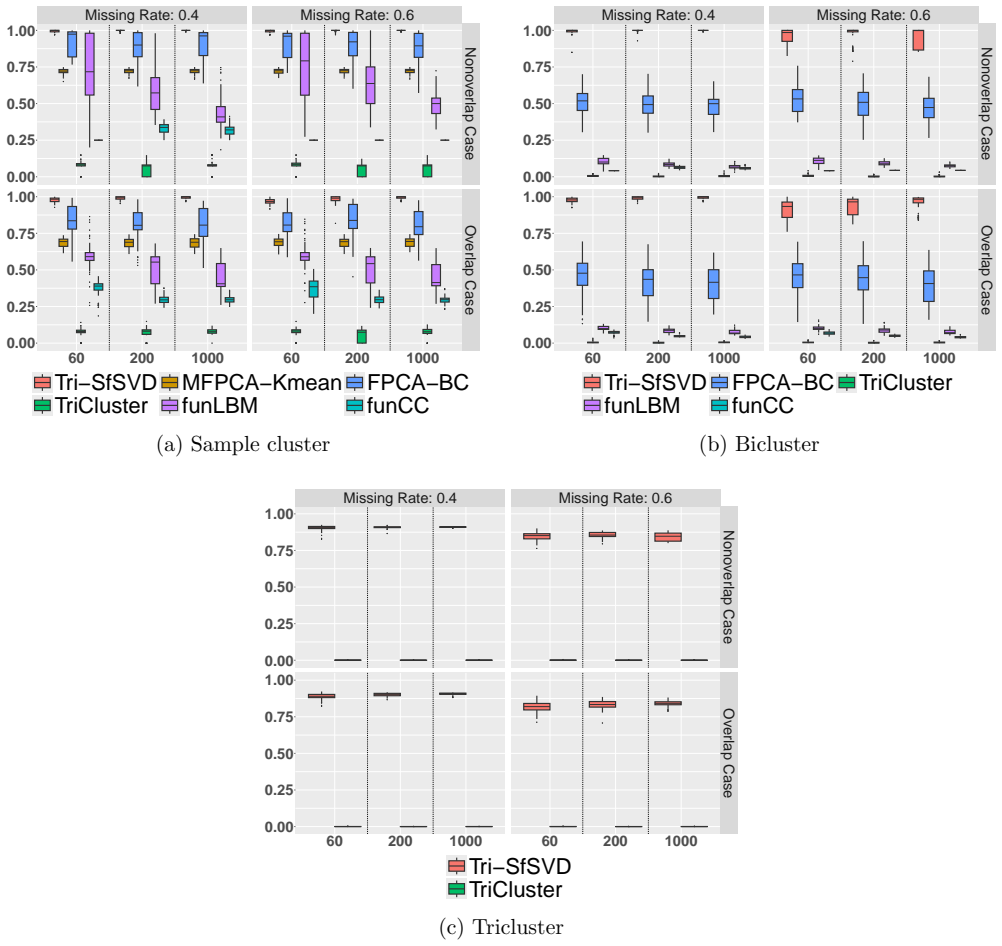
- Simulations indicate improved performance over existing methods when dimensionality and sparsity are high.
Where Pith is reading between the lines
- Joint estimation and selection may prove more stable than sequential pipelines when data are both functional and sparse.
- The framework could be tested on other tensor-like longitudinal datasets such as wearable sensor streams or environmental time series.
- If the penalties scale well, the approach suggests a route to parameter-light clustering for any irregularly sampled functional data.
- Extending the same penalty structure to higher-order tensors might address four-way or five-way longitudinal problems without new machinery.
Load-bearing premise
Sparse penalties on subjects, features, and temporal subregions will successfully identify meaningful localized clusters directly from irregularly observed data without imputation or shape-homogeneity assumptions.
What would settle it
Running Tri-SfSVD on simulated longitudinal data with known ground-truth clusters but irregular sampling and showing cluster recovery no better than standard imputation-plus-biclustering pipelines would falsify the unified-framework advantage.
Figures
read the original abstract
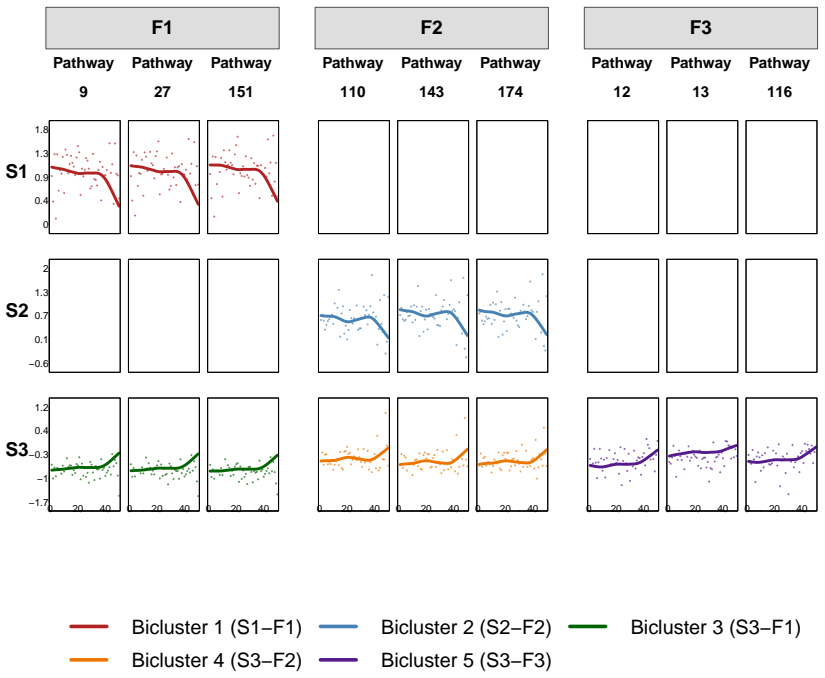
Identifying subtypes of complex conditions, such as Inflammatory Bowel Disease (IBD), often requires capturing latent patterns in longitudinal omics data. However, these data are typically high-dimensional, sparsely sampled, and irregularly observed over time, posing substantial challenges for conventional (bi)clustering and functional data analysis methods. We propose Tri-SfSVD, a unified sparse functional Singular Value Decomposition framework for discovering biclusters and triclusters in longitudinal data. Unlike existing functional biclustering methods that rely on ad hoc imputation or enforce restrictive shape-homogeneity assumptions, Tri-SfSVD integrates continuous trajectory estimation with simultaneous subject, feature, and temporal selection within a single optimization framework. By imposing sparse penalties across subjects, variables, and temporal subregions, the proposed method works directly on observed data to uncover localized structures at the subject, subject-feature, and subject-feature-time levels. Extensive simulations demonstrate that Tri-SfSVD outperforms existing approaches in high-dimensional settings. Applied to IBD multi-omics data, the method identified three biclusters linking sample clusters with distinct IBD-related clinical characteristics to microbial pathway groups associated with specific bacterial taxa, providing interpretable subject-pathway associations for characterizing disease heterogeneity. Applied to multi-channel EEG data, the method identified three triclusters linking sample clusters with distinct alcohol-related phenotypes to localized brain activity patterns, including subgroup differences separated by temporal subregions within the same spatial region.
Editorial analysis
A structured set of objections, weighed in public.
Referee Report
Summary. The manuscript introduces Tri-SfSVD, a sparse functional singular value decomposition framework that performs simultaneous continuous trajectory estimation and sparse selection across subjects, features, and temporal subregions for biclustering and triclustering of irregularly observed longitudinal data. Unlike prior methods, it operates directly on observed data via a single optimization with L1-type penalties on the three modes. Simulations show outperformance over existing approaches; applications to IBD multi-omics data recover three biclusters linking subject clusters with clinical characteristics and microbial pathways, while EEG data yield three triclusters associating subject clusters with alcohol phenotypes and localized temporal brain activity patterns.
Significance. If the optimization and recovery guarantees hold, the unified framework addresses a practical gap in high-dimensional longitudinal analysis by avoiding imputation and restrictive homogeneity assumptions, enabling interpretable subtype discovery in omics and neuroimaging. The direct handling of irregular sampling and the three-mode sparsity are potentially valuable contributions to functional data biclustering.
major comments (2)
- [§3.2, Eq. (7)] §3.2, Eq. (7): the objective couples the functional basis expansion with the three-mode sparse penalties; it is unclear whether the temporal subregion selection is achieved solely by the penalty or requires post-hoc thresholding, which would affect the claim of simultaneous selection within a single optimization.
- [§5.1, Table 2] §5.1, Table 2: the reported ARI and F1 improvements over baselines are shown only for n=200, p=500; no results are given for the higher-dimensional regime (p>2000) that matches the IBD application, weakening the support for the high-dimensional outperformance claim.
minor comments (3)
- [Abstract] Abstract: the acronym Tri-SfSVD is not expanded on first use.
- [§4.3] §4.3: the description of the EEG tricluster temporal subregions lacks a quantitative definition of 'subregion' (e.g., contiguous time intervals or basis support).
- [Figure 3] Figure 3 caption: color scale for the subject-feature loadings is not labeled.
Simulated Author's Rebuttal
We thank the referee for the constructive comments. We address each major point below and indicate the revisions we will make to the manuscript.
read point-by-point responses
-
Referee: [§3.2, Eq. (7)] §3.2, Eq. (7): the objective couples the functional basis expansion with the three-mode sparse penalties; it is unclear whether the temporal subregion selection is achieved solely by the penalty or requires post-hoc thresholding, which would affect the claim of simultaneous selection within a single optimization.
Authors: The temporal subregion selection is achieved solely by the L1 penalty on the temporal coefficients inside the single optimization problem defined by Equation (7). No post-hoc thresholding is applied; the sparsity pattern emerges directly from the penalized objective. We will revise the text in §3.2 to state this explicitly and to emphasize that all three modes are handled simultaneously within the same optimization. revision: yes
-
Referee: [§5.1, Table 2] §5.1, Table 2: the reported ARI and F1 improvements over baselines are shown only for n=200, p=500; no results are given for the higher-dimensional regime (p>2000) that matches the IBD application, weakening the support for the high-dimensional outperformance claim.
Authors: We agree that results for p>2000 would strengthen the high-dimensional claim. The reported simulations use n=200, p=500 to enable fair comparison with slower baseline methods; we will add a supplementary table with results at p=2000 (and higher) in the revised manuscript to directly support the outperformance statement. revision: yes
Circularity Check
No significant circularity detected
full rationale
The paper introduces Tri-SfSVD as a new unified optimization framework that integrates continuous trajectory estimation with L1-type sparse penalties across subjects, features, and temporal subregions. The abstract and described construction present this as an explicit modeling choice that operates directly on irregularly observed data, without reducing any claimed prediction or uniqueness result to a fitted input by definition, a self-citation chain, or an ansatz smuggled from prior work. No load-bearing step is shown to be equivalent to its inputs; the method is offered as an independent algorithmic contribution whose performance is evaluated via simulations and applications rather than tautological re-derivation.
Axiom & Free-Parameter Ledger
Reference graph
Works this paper leans on
-
[1]
Journal of Clinical Medicine , year =
Nomura, K and Ishikawa, D and Okahara, K and others , title =. Journal of Clinical Medicine , year =
-
[2]
de Meij, T. G. J. and de Groot, E. F. J. and others , title =. PLOS ONE , year =. doi:10.1371/journal.pone.0197649 , volume =
-
[3]
Parker, B. J. and Wearsch, P. A. and Veloo, A. C. M. and Rodriguez-Palacios, A. , title =. Frontiers in Immunology , year =
-
[4]
Schaus, S. R. and Pereira, G. V. and others , title =. mBio , year =
-
[5]
Zheng, Jiaying and Sun, Qianru and Zhang, Mengjing and others , title =. Nature Medicine , year =. doi:10.1038/s41591-024-03280-4 , number =
-
[6]
and others , title =
Lou, Y. and others , title =. Journal of Translational Medicine , year =
-
[7]
Thierry Chekouo and Alejandro Murua and Wolfgang Raffelsberger , date-added =. 2015 , bdsk-url-1 =. doi:10.1214/15-AOAS854 , journal =
-
[8]
and Singh, Jagmeet P
Sana, Furrukh and Isselbacher, Eric M. and Singh, Jagmeet P. and Heist, E. Kevin and Pathik, Bhupesh and Armoundas, Antonis A. , journal =. Wearable Devices for Ambulatory Cardiac Monitoring:. 2020 , volume =
2020
-
[9]
Military Medical Research , year =
The applied principles of EEG analysis methods in neuroscience and clinical neurology , author =. Military Medical Research , year =
-
[10]
Applied Sciences , year =
Electroencephalography (EEG) technology applications and available devices , author =. Applied Sciences , year =
-
[11]
Sensors , year =
Surface Electromyography Signal Processing and Classification Techniques , author =. Sensors , year =
-
[12]
The extraction of neural information from the surface
Farina, Dario and Jiang, Ning and Rehbaum, Hubertus and Holobar, Ale. The extraction of neural information from the surface. IEEE Transactions on Neural Systems and Rehabilitation Engineering , year =
-
[13]
Turkish Journal of Medical Sciences , year =
Current developments in surface electromyography , author =. Turkish Journal of Medical Sciences , year =
-
[14]
Nature Communications , year =
Chen, Lianmin and Collij, Valerie and others , title =. Nature Communications , year =
-
[15]
Yu, Shicheng and Zhang, Mengxian and Ye, Zhaofeng and others , title =. Cell Regeneration , year =. doi:10.1186/s13619-022-00143-6 , number =
-
[16]
Synth Syst Biotechnol , keywords =
Liang, Guangcai , doi =. Synth Syst Biotechnol , keywords =. 2021 , bdsk-url-1 =
2021
-
[17]
Zhang, X. L. and Begleiter, H. and Porjesz, B. and Litke, A. , date-added =. Electrophysiological evidence of memory impairment in alcoholic patients , volume =. Biological Psychiatry , month = dec, number =. 1997 , bdsk-url-1 =. doi:10.1016/S0006-3223(96)00552-5 , issn =
-
[18]
Begleiter, Henri , date-added =
-
[19]
Inflammatory Bowel Disease Multi-omics Database , year =
-
[20]
and others , title =
Lloyd-Price, Jason and Arze, Cesar and Ananthakrishnan, Ashwin N. and others , title =. Nature , volume =. 2019 , doi =
2019
-
[21]
Experimental and clinical psychopharmacology , title =
Inna Fishman and Mark S Goldman and Emanuel Donchin , date-added =. Experimental and clinical psychopharmacology , title =. doi:10.1037/a0012873 , year =
-
[22]
Frontiers in behavioral neuroscience , title =
Eduardo L. Frontiers in behavioral neuroscience , title =. doi:10.3389/fnbeh.2017.00168 , year =
-
[23]
Dialogues in clinical neuroscience , title =
Ji Sun Kim and Young Wook Song and Sungkean Kim and Ji-Yoon Lee and So Young Yoo and Joon Hwan Jang and Jung-Seok Choi , date-added =. Dialogues in clinical neuroscience , title =. doi:10.1080/19585969.2024.2432913 , year =
-
[24]
CNS neuroscience and therapeutics , title =
Huiwen Zhang and Jiahui Yao and Cheng Xu and Chengyu Wang , date-added =. CNS neuroscience and therapeutics , title =. doi:10.1111/cns.14138 , year =
-
[25]
Glen Forester and Lauren M. Schaefer and Jeffrey S. Johnson and Theresah Amponsah and Robert D. Dvorak and Stephen A. Wonderlich , date-added =. Neurocognitive reward processes measured via event-related potentials are associated with binge-eating disorder diagnosis and ecologically-assessed behavior , url =. Appetite , keywords =. 2024 , bdsk-url-1 =. do...
-
[26]
Robert D Little and Thisun Jayawardana and Sabrina Koentgen and Fan Zhang and Susan J Connor and Alex Boussioutas and Mark G Ward and Peter R Gibson and Miles P Sparrow , date-added =. eGastroenterology , title =. 2024 , volume =. doi:10.1136/egastro-2023-100006 , bdsk-file-1 =
-
[27]
Kaiqi Yang and Changhao Zhang and Rui Gong and Wei Jiang and Yuchen Ding and Yang Yu and Jinlong Chen and Min Zhu and Jiaxuan Zuo and Xueping Huang and Lumei Wang and Peng Li and Xiujing Sun , date-added =. BMC public health , title =. doi:10.1186/s12889-025-24009-z , year =
-
[28]
April N Naegeli and Bridget L Balkaran and Mingyang Shan and Theresa Marie Hunter and Lulu K Lee and Vipul Jairath , date-added =. Curr Med Res Opin , title =. doi:10.1080/03007995.2022.2043655 , year =
-
[29]
Journal of immunology research , title =
Qingdong Guan , date-added =. Journal of immunology research , title =. doi:10.1155/2019/7247238 , year =
-
[30]
Consistent group selection in high-dimensional linear regression , volume =
Wei, Fengrong and Huang, jian , date-added =. Consistent group selection in high-dimensional linear regression , volume =. Bernoulli , number =. doi:10.3150/10-BEJ252 , year =
-
[32]
The Adaptive Lasso and Its Oracle Properties , url =
Hui Zou , date-added =. The Adaptive Lasso and Its Oracle Properties , url =. Journal of the American Statistical Association , number =. 2006 , bdsk-url-1 =. doi:10.1198/016214506000000735 , eprint =
-
[33]
Soares and Rui Henriques and Sara C
Diogo F. Soares and Rui Henriques and Sara C. Madeira , date-added =. TriHSPAM: Triclustering heterogeneous longitudinal clinical data using sequential patterns , url =. Pattern Recognition , keywords =. 2025 , bdsk-url-1 =. doi:https://doi.org/10.1016/j.patcog.2025.111762 , issn =
-
[34]
Xiaojing Wu and Changxiu Cheng and Raul Zurita-Milla and Changqing Song , date-added =. An overview of clustering methods for geo-referenced time series: from one-way clustering to co- and tri-clustering , url =. International Journal of Geographical Information Science , number =. 2020 , bdsk-url-1 =. doi:10.1080/13658816.2020.1726922 , eprint =
-
[35]
Tri-Clustered Tensor Completion for Social-Aware Image Tag Refinement , volume =
Tang, Jinhui and Shu, Xiangbo and Qi, Guo-Jun and Li, Zechao and Wang, Meng and Yan, Shuicheng and Jain, Ramesh , date-added =. Tri-Clustered Tensor Completion for Social-Aware Image Tag Refinement , volume =. 2017 , bdsk-url-1 =. doi:10.1109/TPAMI.2016.2608882 , journal =
-
[36]
Zhao, Lizhuang and Zaki, Mohammed J. , booktitle =. TRICLUSTER: an effective algorithm for mining coherent clusters in 3D microarray data , url =. 2005 , pages =. doi:10.1145/1066157.1066236 , publisher =
-
[37]
Recovering the underlying trajectory from sparse and irregular longitudinal data , url =
Nie, Yunlong and Yang, Yuping and Wang, Liangliang and Cao, Jiguo , date-added =. Recovering the underlying trajectory from sparse and irregular longitudinal data , url =. Canadian Journal of Statistics , keywords =. 2022 , bdsk-url-1 =. doi:https://doi.org/10.1002/cjs.11677 , eprint =
-
[38]
Alcohol affects the P3 component of an adaptive stop signal task ERP , volume =
Plawecki, Martin H and Windisch, Kyle A and Wetherill, Leah and Kosobud, Ann EK and Dzemidzic, Mario and Kareken, David A and O'Connor, Sean J , date-added =. Alcohol affects the P3 component of an adaptive stop signal task ERP , volume =. Alcohol , pages =. doi:10.1016/j.alcohol.2017.08.012 , year =
-
[39]
P300 abnormality due to chronic alcohol exposure in patients with alcohol dependence , volume =
Karaaslan, M Fatih and G. P300 abnormality due to chronic alcohol exposure in patients with alcohol dependence , volume =. Klinik Psikofarmakoloji B
-
[40]
Langfelder, Peter and Horvath, Steve , date =. BMC Bioinformatics , number =. 2008 , bdsk-file-1 =. doi:10.1186/1471-2105-9-559 , id =
-
[41]
Measuring and Testing Dependence by Correlation of Distances , url =
G. Measuring and Testing Dependence by Correlation of Distances , url =. The Annals of Statistics , number =. 2007 , bdsk-url-1 =
2007
-
[42]
, title =
Liu, Limeng and Wang, Guannan and Safo, Sandra E. , title =. 2025 , howpublished =
2025
-
[43]
, title =
Begleiter, H. , title =. 1995 , note =
1995
-
[44]
Moselhy, H. F. and Georgiou, G. and Kahn, A. , title =. Alcohol and Alcoholism , year =
-
[45]
and Choi, Keewhan and Chorlian, David B
Kamarajan, Chella and Porjesz, Bernice and Jones, Kevin A. and Choi, Keewhan and Chorlian, David B. and Padmanabhapillai, Ajayan and Rangaswamy, Madhavi and Stimus, Arthur T. and Begleiter, Henri , title =. International Journal of Psychophysiology , year =
-
[46]
Biometrika , year =
Chen, Jiahua and Chen, Zehua , title =. Biometrika , year =
-
[47]
Multi-omics of the gut microbial ecosystem in inflammatory bowel diseases , volume =
Jason Lloyd-Price and Cesar Arze and Ashwin N Ananthakrishnan and Melanie Schirmer and Julian Avila-Pacheco and Tiffany W Poon and Elizabeth Andrews and Nadim J Ajami and Kevin S Bonham and Colin J Brislawn and others , date-added =. Multi-omics of the gut microbial ecosystem in inflammatory bowel diseases , volume =. Nature , number =. 2019 , bdsk-file-1 =
2019
-
[48]
Begleiter, Henri , date-added =. EEG Database , year =. doi:https://doi.org/10.24432/C5TS3D , howpublished =
-
[49]
Statistical methods in medical research , title =
Weijie Zhang and Christine Wendt and Russel Bowler and Craig P Hersh and Sandra E Safo , date-added =. Statistical methods in medical research , title =. doi:10.1177/09622802221122427 , year =
-
[50]
Huang and J
Mihee Lee and Haipeng Shen and Jianhua Z. Huang and J. S. Marron , title =. Biometrics , volume =. 2010 , doi =
2010
-
[51]
Journal of Applied Statistics , title =
Thierry Chekouo and Alejandro Murua , date-added =. Journal of Applied Statistics , title =. doi:10.1080/02664763.2014.999647 , year =
-
[52]
Ziyi Li and Changgee Chang and Suprateek Kundu and Qi Long , date-added =. Biostatistics , title =. doi:10.1093/biostatistics/kxy081 , year =
-
[53]
Amela Prelic and Stefan Bleuler and Philip Zimmermann and Anja Wille and Peter Buhlmann and Wilhelm Gruissem and Lars Hennig and Lothar Thiele and Eckart Zitzler , date-added =. BIOINFORMATICS , title =. doi:10.1093/bioinformatics/btl060 , year =
-
[54]
Sara C. Madeira and Arlindo L. Oliveira , date-added =. Biclustering Algorithms for Biological Data Analysis: A Survey , volume =. IEEE TRANSACTIONS ON COMPUTATIONAL BIOLOGY AND BIOINFORMATICS , number =. doi:10.1109/TCBB.2004.2 , year =
-
[55]
Journal of the Royal Statistical Society Series C: Applied Statistics , title =
Charles Bouveyron and Laurent Bozzi and Julien Jacques and Franc ̧ois-Xavier Jollois , date-added =. Journal of the Royal Statistical Society Series C: Applied Statistics , title =. doi:10.1111/rssc.12260 , year =
-
[56]
Martin Sill and Sebastian Kaiser and Axel Benner and Annette Kopp-Schneider , date-added =. BIOINFORMATICS , title =. doi:10.1093/bioinformatics/btr322 , year =
-
[57]
Journal of Multivariate Analysis , title =
Kuangnan Fang and Yuanxing Chen and Shuangge Ma and Qingzhao Zhang , date-added =. Journal of Multivariate Analysis , title =. doi:10.1016/j.jmva.2021.104874 , year =
-
[58]
Yosra Ben Slimen and Sylvain Allio and Julien Jacques , date-added =. Neurocomputing , title =. doi:10.1016/j.neucom.2018.02.055 , year =
-
[59]
Computational Statistics and Data Analysis , title =
Marta Galvani and Agostino Torti and Alessandra Menafoglio and Simone Vantini , date-added =. Computational Statistics and Data Analysis , title =. doi:10.1016/j.csda.2021.107219 , year =
-
[60]
sparsegl: An R Package for Estimating Sparse Group Lasso
Xiaoxuan Liang and Aaron Cohen and Anibal Sol. sparsegl: An R Package for Estimating Sparse Group Lasso. , volume =. Journal of Statistical Software , pages =. doi:10.18637/jss.v110.i06 , year =
-
[61]
On the ``degrees of freedom'' of the lasso , url =
Hui Zou and Trevor Hastie and Robert Tibshirani , date-added =. On the ``degrees of freedom'' of the lasso , url =. 2007 , bdsk-url-1 =. doi:10.1214/009053607000000127 , journal =
-
[62]
Allen, Michael Weylandt , booktitle =
Genevera I. Allen, Michael Weylandt , booktitle =. SPARSE AND FUNCTIONAL PRINCIPAL COMPONENTS ANALYSIS , year =
-
[63]
NeuroImage , year =
Bayesian estimation of ERP components from multicondition and multichannel EEG , author =. NeuroImage , year =
-
[64]
Statistics in Medicine , year =
Nonparametric collective spectral density estimation with an application to clustering the brain signals , author =. Statistics in Medicine , year =
-
[65]
arXiv preprint arXiv:1001.0736 , title =
Jerome Friedman; Trevor Hastie; Robert Tibshirani , date-added =. arXiv preprint arXiv:1001.0736 , title =. 2010 , bdsk-url-1 =
Pith/arXiv arXiv 2010
-
[66]
A Sparse-Group Lasso , volume =
Noah Simon, Jerome Friedman, Trevor Hastie & Robert Tibshirani , date-added =. A Sparse-Group Lasso , volume =. Journal of Computational and Graphical Statistics , number =
-
[67]
A Fast Iterative Shrinkage-Thresholding Algorithm for Linear Inverse Problems , volume =
Amir Beck and Marc Teboulle , date-added =. A Fast Iterative Shrinkage-Thresholding Algorithm for Linear Inverse Problems , volume =. SIAM J. IMAGING SCIENCES , number =
-
[68]
Regularized Multivariate Functional Principal Component Analysis , year =
Zhao,Yue , date-added =. Regularized Multivariate Functional Principal Component Analysis , year =
-
[69]
Green, P. J. and Silverman, B. W. , date-added =. Nonparametric regression and generalized linear models , volume =
-
[70]
Hossein Haghbin and Yue Zhao and Mehdi Maadooliat , date-added =. Regularized multivariate functional principal component analysis for data observed on different domains , volume =. doi:10.3934/fods.2025018 , journal =
-
[71]
Interpretable Functional Principal Component Analysis , volume =
Zhenhua Lin and Liangliang Wang and Jiguo Cao , date-added =. Interpretable Functional Principal Component Analysis , volume =. Biometrics , number =
-
[72]
Yao, F. and M. Shrinkage estimation for functional principal component scores with application to the population kinetics of plasma folate , volume =. Biometrics , number =
-
[73]
Localized Functional Principal Component Analysis , volume =
Kehui Chen and Jing Lei , date-added =. Localized Functional Principal Component Analysis , volume =. Journal of the American Statistical Association , number =
-
[74]
and Weylandt, Michael , booktitle =
Allen, Genevera I. and Weylandt, Michael , booktitle =. Sparse and Functional Principal Components Analysis , year =. doi:10.1109/DSW.2019.8755778 , keywords =
-
[75]
Sparse Principal Component Analysis , url =
Hui Zou, Trevor Hastie and Robert Tibshirani , date-added =. Sparse Principal Component Analysis , url =. Journal of Computational and Graphical Statistics , number =. 2006 , bdsk-url-1 =. doi:10.1198/106186006X113430 , eprint =
-
[76]
Haipeng Shen and Jianhua Z. Huang , date-added =. Sparse principal component analysis via regularized low rank matrix approximation , url =. Journal of Multivariate Analysis , keywords =. 2008 , bdsk-url-1 =. doi:https://doi.org/10.1016/j.jmva.2007.06.007 , issn =
-
[77]
Multivariate Functional Singular Spectrum Analysis: A Nonparametric Approach for Analyzing Multivariate Functional Time Series , year =
Trinka, Jordan and Haghbin, Hossein and Maadooliat, Mehdi , booktitle =. Multivariate Functional Singular Spectrum Analysis: A Nonparametric Approach for Analyzing Multivariate Functional Time Series , year =
-
[78]
Weather History & Data Archive , url =. n.d. , bdsk-url-1 =
-
[79]
Hebrail,Georges and Berard,Alice , howpublished =
-
[80]
Comparing partitions , volume =
Hubert, Lawrence and Arabie, Phipps , journal =. Comparing partitions , volume =
-
[81]
functional singular spectrum analysis , volume =
Haghbin, Hossein and Najibi, Seyed Morteza and Mahmoudvand, Rahim and Trinka, Jordan and Maadooliat, Mehdi , journal =. functional singular spectrum analysis , volume =. doi:10.1002/sta4.330 , year =
discussion (0)
Sign in with ORCID, Apple, or X to comment. Anyone can read and Pith papers without signing in.