Unpaired RGB-Thermal Gaussian-Splatting Using Visual Geometric Transformers
Reviewed by Pith2026-06-28 06:05 UTCgrok-4.3pith:HZESOFSVopen to challenge →
The pith
Unpaired RGB and thermal images support consistent novel view synthesis when poses are estimated independently then aligned for joint Gaussian splatting.
A machine-rendered reading of the paper's core claim, the machinery that carries it, and where it could break.
Core claim
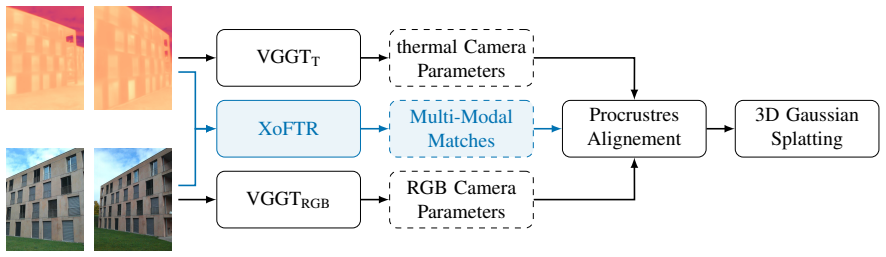
Independent pose estimation with VGGT for RGB and thermal images, followed by Procrustes alignment via cross-modal feature matching, produces a shared coordinate frame that supports training a multi-modal 3D Gaussian Splatting model from unpaired data, yielding competitive thermal synthesis while retaining RGB fidelity.
What carries the argument
VGGT for separate per-modality pose estimation, Procrustes algorithm with cross-modal feature matcher for alignment, and multi-modal 3D Gaussian Splatting trained jointly on unpaired RGB and thermal images.
If this is right
- Modality-specific reconstructions from existing methods lack cross-modal consistency.
- The aligned poses enable direct learning of a joint multi-modal Gaussian splat model without paired calibration.
- The method reports competitive thermal view synthesis quality while preserving RGB reconstruction fidelity across diverse scenes.
- A new benchmarking protocol can measure both single-modality image quality and multi-modal scene coherence.
Where Pith is reading between the lines
- The same pose-alignment step could be tested on other unpaired modality pairs such as RGB and depth if suitable feed-forward pose estimators exist for each.
- If the cross-modal matcher remains reliable under changing thermal conditions, the approach might reduce reliance on specialized stereo rigs for multi-modal capture.
- The benchmarking framework could be extended to quantify how alignment error propagates into final rendered thermal images.
Load-bearing premise
Pose estimates produced independently by VGGT on RGB images and on thermal images can be aligned into one shared coordinate frame using only Procrustes plus a cross-modal feature matcher and without any paired calibration data.
What would settle it
Running the pipeline on a dataset where the aligned poses produce visibly misregistered 3D geometry or where novel thermal views show large errors relative to a paired-calibration baseline would falsify the central claim.
Figures


read the original abstract
Multi-modal novel view synthesis (NVS) combining RGB and thermal imagery enables precise 3D scene reconstruction with visual and thermal information. However, existing methods typically rely on precisely calibrated RGB-thermal image pairs or stereo setups, limiting scalability and practical deployment. To address this, we introduce a framework for unpaired RGB-thermal NVS that leverages VGGT, a 3D feed-forward transformer architecture, to independently estimate camera poses for each modality. The pose sets are then aligned using the Procrustes algorithm with a cross-modal feature matcher, enabling joint registration without paired calibration. Building on this alignment, we further propose a multi-modal 3D Gaussian Splatting approach that learns directly from unpaired RGB and thermal images. Experiments on diverse scenes demonstrate that our method achieves competitive performance in thermal view synthesis while maintaining RGB fidelity. Moreover, we show that existing reconstruction approaches can produce modality-specific reconstructions that lack cross-modal consistency. We thus introduce a benchmarking framework to rigorously evaluate both per-modality image synthesis and the multi-modal coherence of reconstructed scenes.
Editorial analysis
A structured set of objections, weighed in public.
Referee Report
Summary. The paper introduces a framework for unpaired RGB-thermal novel view synthesis (NVS) that uses VGGT to estimate camera poses independently for each modality, aligns the pose sets via the Procrustes algorithm combined with a cross-modal feature matcher, and then applies a multi-modal 3D Gaussian Splatting model trained directly on the unpaired images. It also presents a benchmarking framework to evaluate both per-modality synthesis quality and cross-modal consistency, claiming competitive thermal view synthesis performance while preserving RGB fidelity on diverse scenes.
Significance. If the core alignment step holds, the approach would remove the need for paired calibration or stereo rigs, enabling more scalable multi-modal 3D reconstruction. The introduction of a benchmarking framework that explicitly measures cross-modal coherence is a clear positive contribution that could support future work in this area.
major comments (2)
- [§3 (pose alignment)] The central claim rests on reliable cross-modal pose alignment without paired data. The description of the Procrustes step after the cross-modal matcher (abstract and §3) provides no quantitative alignment-error metrics, no ablation on matcher accuracy, and no comparison against ground-truth paired poses; without these, it is unclear whether the shared coordinate frame required for joint Gaussian Splatting is accurate enough to support the reported synthesis results.
- [§3.1 (VGGT application)] VGGT is applied independently to thermal images, yet the method section does not report any domain-adaptation steps or failure-case analysis for thermal inputs (different radiometry, lower texture). If per-modality pose errors are not rigidly related, the subsequent Procrustes alignment cannot be guaranteed to produce a consistent frame; this assumption is load-bearing for the unpaired claim but lacks direct validation.
minor comments (2)
- [§4] Notation for the multi-modal Gaussian Splatting loss is introduced without an explicit equation; adding the combined RGB-thermal objective (presumably in §4) would improve clarity.
- [§5] The benchmarking framework is described at a high level; a table listing the exact metrics (PSNR, SSIM, cross-modal consistency score, etc.) and their definitions would help readers reproduce the evaluation protocol.
Simulated Author's Rebuttal
We thank the referee for the constructive feedback and for recognizing the potential of the unpaired alignment approach and the cross-modal benchmarking framework. We address each major comment below, proposing targeted revisions to strengthen the manuscript.
read point-by-point responses
-
Referee: [§3 (pose alignment)] The central claim rests on reliable cross-modal pose alignment without paired data. The description of the Procrustes step after the cross-modal matcher (abstract and §3) provides no quantitative alignment-error metrics, no ablation on matcher accuracy, and no comparison against ground-truth paired poses; without these, it is unclear whether the shared coordinate frame required for joint Gaussian Splatting is accurate enough to support the reported synthesis results.
Authors: We acknowledge that the current manuscript lacks explicit quantitative alignment-error metrics and ablations on the cross-modal matcher. Because the core setting is unpaired, ground-truth paired poses are unavailable for the primary datasets by design. We validate alignment indirectly via the downstream multi-modal Gaussian Splatting quality and the new cross-modal consistency benchmark. To directly address the concern, we will add (i) an ablation on matcher accuracy using available paired RGB-thermal subsets and (ii) Procrustes residual statistics on those subsets in the revised §3 and supplementary material. revision: yes
-
Referee: [§3.1 (VGGT application)] VGGT is applied independently to thermal images, yet the method section does not report any domain-adaptation steps or failure-case analysis for thermal inputs (different radiometry, lower texture). If per-modality pose errors are not rigidly related, the subsequent Procrustes alignment cannot be guaranteed to produce a consistent frame; this assumption is load-bearing for the unpaired claim but lacks direct validation.
Authors: We agree that VGGT was pretrained on RGB data and that thermal imagery presents challenges due to lower texture and different radiometry. The manuscript currently relies on VGGT's geometric priors without explicit domain adaptation. We will revise §3.1 to include a discussion of these limitations, report observed failure modes (e.g., low-texture thermal regions), and add a failure-case analysis with qualitative examples in the supplementary material. This will clarify the robustness of the independent pose estimation step. revision: yes
Circularity Check
No circularity detected; method relies on external components without self-referential reduction
full rationale
The paper introduces a framework combining VGGT (external feed-forward transformer), Procrustes alignment, and multi-modal Gaussian Splatting. No derivations, equations, fitted parameters renamed as predictions, or self-citation chains appear in the abstract or described claims. The core steps use standard algorithms and an external model without defining outputs in terms of inputs by construction. The derivation chain is self-contained against external benchmarks.
Axiom & Free-Parameter Ledger
axioms (2)
- domain assumption VGGT can independently estimate accurate camera poses for both RGB and thermal modalities
- domain assumption Procrustes algorithm plus cross-modal feature matching suffices to align independent pose sets without paired data
Reference graph
Works this paper leans on
-
[1]
Thermal-nerf: Neural radiance fields from an infrared camera,
T. Ye et al., “Thermal-nerf: Neural radiance fields from an infrared camera,” in 2024 IEEE/RSJ International Con- ference on Intelligent Robots and Systems (IROS) , 2024, pp. 1046–1053
2024
-
[2]
ThermoN- eRF: A multimodal Neural Radiance Field for joint RGB- thermal novel view synthesis of building facades,
M. Hassan, F. Forest, O. Fink, and M. Mielle, “ThermoN- eRF: A multimodal Neural Radiance Field for joint RGB- thermal novel view synthesis of building facades,” Advanced Engineering Informatics, vol. 65, p. 103 345, May 1, 2025, ISSN : 1474-0346
2025
-
[3]
Thermalgs: Dynamic 3d thermal reconstruction with gaussian splatting,
Y . Liu et al., “Thermalgs: Dynamic 3d thermal reconstruction with gaussian splatting,” Remote Sensing , vol. 17, no. 2, p. 335, 2025
2025
-
[4]
Structure-from-motion revisited,
J. L. Sch ¨onberger and J.-M. Frahm, “Structure-from-motion revisited,” in Conference on Computer Vision and Pattern Recognition (CVPR), 2016
2016
-
[5]
Why thermal images are blurry,
F. Bao, S. Jape, A. Schramka, J. Wang, T. E. McGraw, and Z. Jacob, “Why thermal images are blurry,” Opt. Express , vol. 32, no. 3, pp. 3852–3865, Jan. 2024
2024
-
[6]
Thermalgaussian: Thermal 3d gaussian splat- ting,
R. Lu et al., “Thermalgaussian: Thermal 3d gaussian splat- ting,” in The Thirteenth International Conference on Learn- ing Representations, 2025
2025
-
[7]
Ther- moxels: A voxel-based method to generate simulation-ready 3D thermal models,
E. Chassaing, F. Forest, O. Fink, and M. Mielle, “Ther- moxels: A voxel-based method to generate simulation-ready 3D thermal models,” in Journal of Physics , ser. Conference Series, Apr. 6, 2025. arXiv: 2504.04448 [cs]
-
[8]
Ex- ploring multi-modal neural scene representations with appli- cations on thermal imaging,
M. ¨Ozer, M. Weiherer, M. Hundhausen, and B. Egger, “Ex- ploring multi-modal neural scene representations with appli- cations on thermal imaging,” in Computer Vision – ECCV 2024 Workshops, A. Del Bue, C. Canton, J. Pont-Tuset, and T. Tommasi, Eds., Cham: Springer Nature Switzerland, 2025, pp. 82–98, ISBN : 978-3-031-92805-5
2024
-
[9]
Dust3r: Geometric 3d vision made easy,
S. Wang, V . Leroy, Y . Cabon, B. Chidlovskii, and J. Revaud, “Dust3r: Geometric 3d vision made easy,” in Proceedings of the IEEE/CVF Conference on Computer Vision and Pattern Recognition, 2024, pp. 20 697–20 709
2024
-
[10]
Mast3r-sfm: A fully-integrated solution for unconstrained structure-from-motion,
B. Duisterhof, L. Zust, P. Weinzaepfel, V . Leroy, Y . Cabon, and J. Revaud, “Mast3r-sfm: A fully-integrated solution for unconstrained structure-from-motion,” arXiv preprint arXiv:2409.19152, 2024
-
[11]
arXiv preprint arXiv:2503.11651 , year=
J. Wang, M. Chen, N. Karaev, A. Vedaldi, C. Rupprecht, and D. Novotny, “Vggt: Visual geometry grounded transformer,” arXiv preprint arXiv:2503.11651 , 2025
-
[12]
Nerf: Representing scenes as neural radiance fields for view synthesis,
B. Mildenhall, P. P. Srinivasan, M. Tancik, J. T. Barron, R. Ramamoorthi, and R. Ng, “Nerf: Representing scenes as neural radiance fields for view synthesis,” Communications of the ACM , vol. 65, no. 1, pp. 99–106, 2021
2021
-
[13]
3qfp: Efficient neural implicit surface reconstruction us- ing tri-quadtrees and fourier feature positional encoding,
S. Sun, M. Mielle, A. J. Lilienthal, and M. Magnusson, “3qfp: Efficient neural implicit surface reconstruction us- ing tri-quadtrees and fourier feature positional encoding,” in 2024 IEEE International Conference on Robotics and Automation (ICRA), IEEE, May 2024, pp. 4036–4044
2024
-
[14]
3d gaussian splatting for real-time radiance field rendering.,
B. Kerbl, G. Kopanas, T. Leimk ¨uhler, and G. Drettakis, “3d gaussian splatting for real-time radiance field rendering.,” ACM Trans. Graph., vol. 42, no. 4, pp. 139–1, 2023
2023
-
[15]
S. Sun, M. Mielle, A. J. Lilienthal, and M. Magnus- son, “High-Fidelity SLAM Using Gaussian Splatting with Rendering-Guided Densification and Regularized Optimiza- tion,” in 2024 IEEE International Conference on Intelli- gent Robots and Systems (IROS) , Abu Dhabi, UAE: IEEE, Oct. 14, 2024. arXiv: 2403.12535 [cs]
-
[16]
Exploiting semantic scene reconstruction for estimating building envelope characteristics,
C. Xu, M. Mielle, A. Laborde, A. Waseem, F. Forest, and O. Fink, “Exploiting semantic scene reconstruction for estimating building envelope characteristics,” Building and Environment, vol. 275, p. 112 731, May 2025, ISSN : 0360- 1323
2025
-
[17]
Hypergs: Hyperspectral 3d gaussian splatting,
C. Thirgood, O. Mendez, E. Ling, J. Storey, and S. Hadfield, “Hypergs: Hyperspectral 3d gaussian splatting,” in Proceed- ings of the IEEE/CVF Conference on Computer Vision and Pattern Recognition (CVPR), Jun. 2025, pp. 5970–5979
2025
-
[18]
Xoftr: Cross-modal feature matching transformer,
¨O. Tuzcuo ˘glu, A. K ¨oksal, B. Sofu, S. Kalkan, and A. A. Alatan, “Xoftr: Cross-modal feature matching transformer,” in Proceedings of the IEEE/CVF conference on computer vision and pattern recognition , 2024, pp. 4275–4286
2024
-
[19]
Magsac: Marginalizing sample consensus,
D. Barath, J. Matas, and J. Noskova, “Magsac: Marginalizing sample consensus,” in Proceedings of the IEEE/CVF con- ference on computer vision and pattern recognition , 2019, pp. 10 197–10 205
2019
-
[20]
The trimmed iterative closest point algorithm,
D. Chetverikov, D. Svirko, D. Stepanov, and P. Krsek, “The trimmed iterative closest point algorithm,” in 2002 Inter- national Conference on Pattern Recognition , IEEE, vol. 3, 2002, pp. 545–548
2002
-
[21]
Random sample consensus: A paradigm for model fitting with applications to image analysis and automated cartography,
M. A. Fischler and R. C. Bolles, “Random sample consensus: A paradigm for model fitting with applications to image analysis and automated cartography,”Communications of the ACM, vol. 24, no. 6, pp. 381–395, 1981
1981
-
[22]
Nerfstudio: A modular framework for neural radiance field development,
M. Tancik et al., “Nerfstudio: A modular framework for neural radiance field development,” in ACM SIGGRAPH 2023 conference proceedings, 2023, pp. 1–12
2023
discussion (0)
Sign in with ORCID, Apple, or X to comment. Anyone can read and Pith papers without signing in.