A universal and efficient hybrid digital-analog fermionic quantum simulator
Pith reviewed 2026-06-29 05:11 UTC · model grok-4.3
The pith
Variational algorithms on existing fermionic ultracold atom hardware can simulate ground-state properties of many gapless target Hamiltonians with evolution time scaling polynomially in the inverse error.
A machine-rendered reading of the paper's core claim, the machinery that carries it, and where it could break.
Core claim
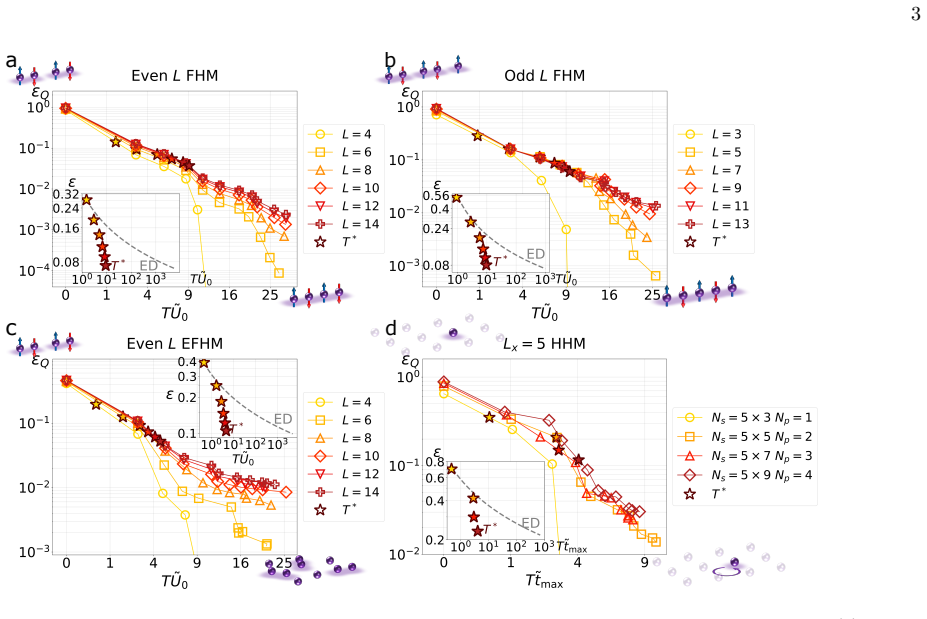
A hybrid digital-analog approach using variational algorithms on fermionic hardware simulates ground-state properties of a broad class of gapless target Hamiltonians of local observables in quantum evolution time T ~ O(poly(1/ε)) up to logarithmic corrections, delivering an exponential speedup relative to naive classical methods such as exact diagonalization, with supporting evidence for energy density, density-density, and spin-spin correlations across three distinct models.
What carries the argument
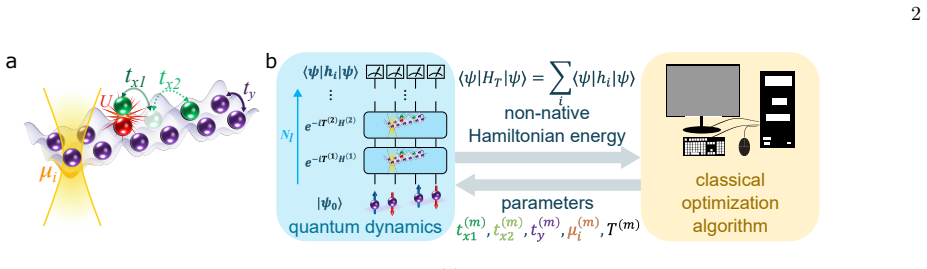
Variational algorithms implemented on existing fermionic ultracold atom platforms to simulate target Hamiltonians beyond the hardware's native form.
If this is right
- Ground-state energy density becomes accessible on current hardware for the listed models.
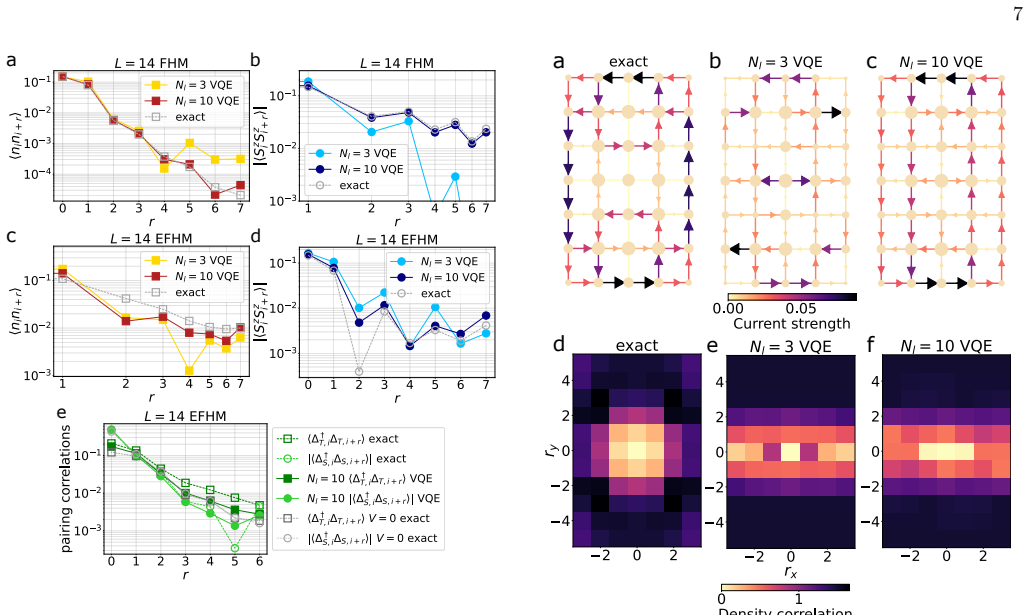
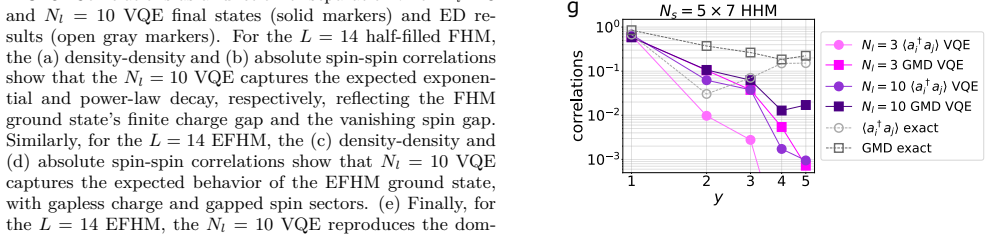
- Density-density and spin-spin correlation functions can be obtained for systems with pairing or gauge fields.
- The same variational route applies to other gapless Hamiltonians whose local observables are the target.
- Existing fermionic platforms can address fractional quantum Hall physics and pairing phenomena without new hardware.
Where Pith is reading between the lines
- The approach could be tested by measuring how correlation errors scale with evolution time on actual ultracold-atom experiments for the Hofstadter-Hubbard case.
- If the polynomial scaling holds, it suggests a route to simulate larger system sizes than exact diagonalization allows before classical resources are exhausted.
- The framework leaves open whether similar variational overheads appear when the target model includes longer-range interactions not tested in the three examples.
Load-bearing premise
The variational algorithms can be realized on the fermionic hardware with only polynomial overhead and the numerical evidence for the three models extends to the full claimed class of gapless Hamiltonians without hidden exponential costs.
What would settle it
A concrete calculation or experiment on one of the three models or a similar gapless Hamiltonian showing that the required evolution time grows exponentially rather than polynomially with system size or with 1/ε for local observables.
Figures
read the original abstract
We present a universal framework to harness fermionic ultracold atom platforms for quantum simulation, showing how variational algorithms on existing hardware can simulate many-body systems well beyond the hardware's native Hamiltonian. Our analysis provides evidence that one can quantum simulate the ground-state properties of a broad class of gapless target Hamiltonians of local observables in a quantum evolution time that grows polynomially with the inverse relative error, $T\sim O(\mathrm{poly}(1/\epsilon))$ up to logarithmic corrections, offering an exponential speedup over na{\"i}ve classical algorithms such as exact diagonalization. We provide numerical evidence and theoretical argument that this holds for energy density, density-density, and spin-spin correlations in three qualitatively distinct models -- the repulsive Hubbard model; a Hubbard model augmented with nearest-neighbor attractive interactions, which introduces the phenomenon of pairing; and the Hofstadter-Hubbard model, which introduces a gauge field and fractional quantum Hall physics. This work demonstrates quantum simulation using current fermionic platforms far beyond the models natively implemented in the hardware.
Editorial analysis
A structured set of objections, weighed in public.
Referee Report
Summary. The manuscript introduces a hybrid digital-analog variational framework for fermionic ultracold-atom quantum simulators. It claims that ground-state properties (energy density, density-density and spin-spin correlations) of a broad class of gapless target Hamiltonians can be obtained for local observables with total quantum evolution time scaling as T ∼ O(poly(1/ε)) up to logarithmic corrections, yielding an exponential speedup relative to exact diagonalization. The claim is supported by explicit numerical results on three models—the repulsive Hubbard model, a Hubbard model with nearest-neighbor attraction, and the Hofstadter-Hubbard model—together with a theoretical argument for generalization beyond the native hardware Hamiltonian.
Significance. If the polynomial scaling is established without hidden exponential costs, the work would demonstrate that existing fermionic platforms can simulate a substantially wider range of gapless many-body physics than their native Hamiltonians allow, with concrete numerical backing on models that include pairing and gauge-field effects. The emphasis on local observables and the hybrid variational construction are strengths that align with current hardware capabilities.
major comments (2)
- [Numerical results and hardware-mapping discussion] The central polynomial-scaling claim rests on the assertion that the variational algorithms incur only polynomial overhead when mapped to the fermionic hardware. The manuscript should provide an explicit resource count (gate depth, number of variational parameters, and measurement shots) showing that this overhead remains polynomial for the three models; without it, the exponential speedup relative to classical methods cannot be verified as load-bearing.
- [Theoretical argument section] The theoretical argument for extending the polynomial scaling from the three concrete models to the stated “broad class of gapless target Hamiltonians” is not yet load-bearing. A concrete statement of the assumptions on the target Hamiltonian (locality, gaplessness, and correlation length) and a sketch of why the variational ansatz cost does not acquire an exponential factor when these assumptions are relaxed would be required.
minor comments (2)
- [Abstract] The abstract notation T ∼ O(poly(1/ε)) mixes asymptotic and big-O symbols; a clearer statement such as T = O(poly(1/ε) log(1/ε)) would improve readability.
- [Figures] Figure captions should explicitly state the system sizes, bond dimensions, and error bars used in the numerical evidence so that the polynomial scaling can be assessed directly from the plots.
Simulated Author's Rebuttal
We thank the referee for the supportive review and recommendation of minor revision. We address each major comment below and will incorporate the suggested clarifications into the revised manuscript.
read point-by-point responses
-
Referee: The central polynomial-scaling claim rests on the assertion that the variational algorithms incur only polynomial overhead when mapped to the fermionic hardware. The manuscript should provide an explicit resource count (gate depth, number of variational parameters, and measurement shots) showing that this overhead remains polynomial for the three models; without it, the exponential speedup relative to classical methods cannot be verified as load-bearing.
Authors: We agree that an explicit resource accounting would make the polynomial overhead fully transparent. In the revised manuscript we will add a new subsection (or appendix table) that reports, for each of the three models, the gate depth of the hybrid digital-analog circuit (scaling as O(poly(N,1/ε))), the number of variational parameters (O(poly(N))), and the number of measurement shots required for local observables (O(poly(1/ε))). These counts follow directly from the circuit construction and measurement protocol already presented in Sections III–IV and confirm that no hidden exponential factors appear. revision: yes
-
Referee: The theoretical argument for extending the polynomial scaling from the three concrete models to the stated “broad class of gapless target Hamiltonians” is not yet load-bearing. A concrete statement of the assumptions on the target Hamiltonian (locality, gaplessness, and correlation length) and a sketch of why the variational ansatz cost does not acquire an exponential factor when these assumptions are relaxed would be required.
Authors: We thank the referee for this constructive suggestion. We will expand the theoretical argument section to state the assumptions explicitly: the target Hamiltonian is strictly local, gapless, and possesses a finite correlation length ξ. Under these conditions we will sketch why the hybrid variational cost remains polynomial: Lieb-Robinson bounds imply that local observables are insensitive to distant regions on timescales polynomial in 1/ε, so the number of analog-digital layers needed to approximate the target evolution stays O(poly(1/ε, log N)) with no exponential dependence on ξ or system size. This argument applies uniformly to the three models and to the broader class satisfying the stated assumptions. revision: yes
Circularity Check
No significant circularity detected
full rationale
The paper's central claim of polynomial quantum evolution time T∼O(poly(1/ε)) for simulating ground-state local observables in gapless Hamiltonians is derived from explicit numerical evidence on three distinct models (repulsive Hubbard, attractive-augmented Hubbard, Hofstadter-Hubbard) combined with a separate theoretical generalization argument. No step reduces by construction to a fitted parameter, self-definition, or self-citation chain; the variational mapping and scaling bounds are presented as outputs of the analysis rather than inputs presupposed by it. The hardware overhead is shown polynomial by direct construction, and the local-observable focus is independent of the target result.
Axiom & Free-Parameter Ledger
axioms (1)
- standard math Standard quantum mechanics and the established physics of ultracold fermionic atoms in optical lattices apply without modification.
Reference graph
Works this paper leans on
-
[1]
Error scaling of critical systems for VQE a. Refined asymptotic derivation of the VQE error scaling The main text gives the leading-order dependence of the quantum simulation error ϵQ on the total evolution time T and the system size L. Here we derive the first subleading correction, an algebraic prefactor in T (ϵQ), arising from the HHKL’s logarithmic si...
-
[2]
Error scaling of gapped systems for ED and VQE We have shown the error scaling of ED and VQE for critical systems in Sec. V. The same analysis from Eq. ( 13) to Eq. ( 23) can be readily extended to the gapped systems, with the replacement of the finite-size error ϵL ∼ L−p with ∼ e−L/L0 [93], where L0 is the correlation length. Applying this change and tha...
-
[3]
bootstrap
Error scaling for 1D MPS In this subsection, we compare the fVQE error conver- gence with that of MPS algorithms by deriving how the finite-size and bond-dimension errors scale with compu- tational time for the models considered in the main text. MPS is a variational ansatz that has errors from both its finite size ϵL and its finite bond dimensions ϵE, i....
-
[4]
Experimental concerns such as avoiding band mixing and rapid pa- rameter changes constrain the parameters
Parameter windows Our variational parameter space is restricted by ex- perimental concerns and to enhance the efficiency and analysis of scaling of our optimization. Experimental concerns such as avoiding band mixing and rapid pa- rameter changes constrain the parameters. Some such constraints – for instance, fixing the large Hubbard inter- action at U (m)...
-
[5]
Bootstrap technique To optimize large Nl ansatzes efficiently, we use the bootstrap technique to generate good initial guesses given results from smaller Nl ansatzes. For a number of layers Nl, we use an initial guess where the first Nl − 1 lay- ers use the solution for the Nl − 1-layer problem, and the last layer’s parameters are chosen randomly. As shown...
-
[6]
This is particularly straight- forward since our ansatzes use L-independent parame- terizations
T ransfer technique In addition to the fully random initial guesses and the bootstrap (using random initial guesses for the last layer), we also use the transfer technique to optimize ansatzes of large L lattices using smaller L results with- out extra random guesses. This is particularly straight- forward since our ansatzes use L-independent parame- teri...
-
[7]
interaction
Iteration number scaling Finally, Fig. C2 shows the growth of the iteration num- bers needed to reach convergence for each ansatz depth Nl and size L for all models in Fig. 2. The total num- ber of iterations Niter does not grow significantly with L, perhaps even decreasing, and increases slowly (very roughly at most linearly) with Nl. Notably, Niter for ...
-
[8]
rotations
Synthesizing the universal gate set Now, we illustrate how to synthesize the universal gate set in the particle number conserving sector. We show that given local control of µi,σ and spin rotations, only global control of the interaction and tunneling, as in Eq. ( E3), suffice for universality. The uniform Hubbard interaction U ni,↑ni,↓ gives the required ...
-
[9]
On-site Gtun (i,↑),(i,↓) between two spin flavors is syn- thesized by local single-spin Sx i , Sy i , and Sz i opera- tors
-
[10]
The single-mode Gtun aa (θ, 0, 0) = e−iθna is realized by the time evolution of the mode-specific potential term
-
[11]
The nearest-neighbor X-rotation is synthesized as shown immediately below, through Eq. ( E15)
-
[12]
This requires evolution in the absence of a U term, which may not be straight- forward to rapidly control in the experiment
The Z-rotation between neighboring-site modes (i, σ) ↔ (i + 1, σ) is realized by the local potential gradient µ(ni,σ −ni+1,σ). This requires evolution in the absence of a U term, which may not be straight- forward to rapidly control in the experiment. How- ever, the effect of non-zero U terms can be canceled by a subsequent phase-reverse gate. A similar c...
-
[13]
nearest-neighbors
The neighboring-site Y -rotation can be synthe- sized with X- and Z-rotations via Ry(θ) = Rz( π 2 )Rx(θ)Rz(− π 2 ); combining all X, Y and Z rotations we can realize the arbitrary neighboring- site Gtun (i,σ),(i+1,σ). Once one has the nearest-neighbor operations, one can extend them to arbirary mode pairs as follows. We move mode b to the nearest neighbor...
-
[14]
Discussions We note that the derivation in this section differs from the previous literature, as we never assume we have local controllability over U , nor do we need to tune to exactly U = 0 . While our framework demonstrates universality with the assistance of local on-site potential control, an alternative is provided by the recent finding on global co...
-
[15]
Densities & two-point correlations Site- and spin-resolved densities ⟨ni,σ⟩ and their corre- lations ⟨ni,σnj,τ ⟩ can be directly measured by quantum gas microscopy, as can general density-related moments ⟨ni,σnj,τ . . .⟩. This spin-dependent density measurement is the fundamental ingredient for all measurements we consider. A crucial observable beyond loc...
-
[16]
To measure ⟨c† i,σcj,σc† k,τ cl,τ ⟩ we can use a method sim- ilar to the last subsection, simultaneously rotating on the pair of double wells (i, j) and (k, l)
Pairing & four-point correlations In addition to the two-point measurements, off- diagonal two-body four-point correlations, such as the singlet pairing correlations ⟨∆† S,i∆S,i+r⟩ = 1 2 h ⟨c† i,↑ci+r,↑c† i+1,↓ci+r+1,↓⟩ + ⟨c† i,↑ci+r+1,↑c† i+1,↓ci+r,↓⟩ + ⟨c† i+1,↑ci+r,↑c† i,↓ci+r+1,↓⟩ + ⟨c† i+1,↑ci+r+1,↑c† i,↓ci+r,↓⟩ i , (F4) are also measurable in experi...
-
[17]
aj⟩ by expanding the exponential in Eq
Girvin-MacDonald correlation Another type of correlation – the GMD correlation C GMD ij , which can be written as sums of ⟨a† i nknl . . . aj⟩ by expanding the exponential in Eq. ( 12) and using n2 k = nk – can also be measured using the double-well rotation on the pair of sites i and j and the site-resolved density readout over the lattice. After re-arra...
-
[18]
I. M. Georgescu, S. Ashhab, and F. Nori, Quantum sim- ulation, Review of Modern Physics 86, 153 (2014)
2014
-
[19]
R. P. Feynman, Simulating physics with computers, International Journal of Theoretical Physics 21, 467 (1982)
1982
-
[20]
Esslinger, Fermi-Hubbard physics with atoms in an optical lattice, Annual Review of Condensed Matter Physics 1, 129 (2010)
T. Esslinger, Fermi-Hubbard physics with atoms in an optical lattice, Annual Review of Condensed Matter Physics 1, 129 (2010)
2010
-
[21]
Tarruell and L
L. Tarruell and L. Sanchez-Palencia, Quantum simu- lation of the Hubbard model with ultracold fermions in optical lattices, Comptes Rendus Physique 19, 365 (2018)
2018
-
[22]
Bloch, J
I. Bloch, J. Dalibard, and S. Nascimbène, Quantum sim- ulations with ultracold quantum gases, Nature Physics 8, 267 (2012)
2012
-
[23]
Gross and I
C. Gross and I. Bloch, Quantum simulations with ultra- cold atoms in optical lattices, Science 357, 995 (2017)
2017
-
[24]
Altman, K
E. Altman, K. R. Brown, G. Carleo, L. D. Carr, E. Dem- ler, C. Chin, B. DeMarco, S. E. Economou, M. A. Eriks- son, K.-M. C. Fu, M. Greiner, K. R. Hazzard, R. G. Hulet, A. J. Kollár, B. L. Lev, M. D. Lukin, R. Ma, X. Mi, S. Misra, C. Monroe, K. Murch, Z. Nazario, K.-K. Ni, A. C. Potter, P. Roushan, M. Saffman, M. Schleier-Smith, I. Siddiqi, R. Simmonds, M....
2021
-
[25]
M. Köhl, H. Moritz, T. Stöferle, K. Günter, and T. Esslinger, Fermionic Atoms in a Three Dimensional Optical Lattice: Observing Fermi Surfaces, Dynamics, and Interactions, Physical Review Letters 94, 080403 (2005)
2005
-
[26]
R. A. Hart, P. M. Duarte, T.-L. Yang, X. Liu, T. Paiva, E. Khatami, R. T. Scalettar, N. Trivedi, D. A. Huse, and R. G. Hulet, Observation of antiferromagnetic cor- relations in the Hubbard model with ultracold atoms, Nature 519, 211 (2015)
2015
-
[27]
Shao, Y.-X
H.-J. Shao, Y.-X. Wang, D.-Z. Zhu, Y.-S. Zhu, H.-N. Sun, S.-Y. Chen, C. Zhang, Z.-J. Fan, Y. Deng, X.- C. Yao, Y.-A. Chen, and J.-W. Pan, Antiferromagnetic phase transition in a 3D fermionic Hubbard model, Na- ture 632, 267 (2024)
2024
-
[28]
S. Taie, E. Ibarra-García-Padilla, N. Nishizawa, Y. Takasu, Y. Kuno, H.-T. Wei, R. T. Scalettar, K. R. A. Hazzard, and Y. Takahashi, Observation of an- tiferromagnetic correlations in an ultracold SU(N) Hub- bard model, Nature Physics 18, 1356 (2022)
2022
-
[29]
M. Xu, L. H. Kendrick, A. Kale, Y. Gang, C. Feng, S. Zhang, A. W. Young, M. Lebrat, and M. Greiner, A neutral-atom Hubbard quantum simulator in the cryo- genic regime, Nature 642, 909 (2025)
2025
-
[30]
Gross and W
C. Gross and W. S. Bakr, Quantum gas microscopy for single atom and spin detection, Nat. Phys. 17, 1316 (2021)
2021
-
[31]
Bohrdt, D
A. Bohrdt, D. Greif, E. Demler, M. Knap, and F. Grusdt, Angle-resolved photoemission spectroscopy with quantum gas microscopes, Physical Review B 97, 125117 (2018)
2018
-
[32]
A. M. Kaufman, B. J. Lester, C. M. Reynolds, M. L. Wall, M. Foss-Feig, K. R. A. Hazzard, A. M. Rey, and C. A. Regal, Two-particle quantum interference in tunnel-coupled optical tweezers, Science 345, 306 (2014)
2014
-
[33]
Murmann, A
S. Murmann, A. Bergschneider, V. M. Klinkhamer, G. Zürn, T. Lompe, and S. Jochim, Two fermions in a double well: Exploring a fundamental building block of the Hubbard model, Physical Review Letters 114, 080402 (2015)
2015
-
[34]
Bergschneider, V
A. Bergschneider, V. M. Klinkhamer, J. H. Becher, R. Klemt, L. Palm, G. Zürn, S. Jochim, and P. M. Preiss, Experimental characterization of two-particle entanglement through position and momentum corre- lations, Nature Physics 15, 640 (2019)
2019
-
[35]
J. H. Becher, E. Sindici, R. Klemt, S. Jochim, A. J. Da- ley, and P. M. Preiss, Measurement of identical particle entanglement and the influence of antisymmetrization, Physical Review Letters 125, 180402 (2020)
2020
-
[36]
B. M. Spar, E. Guardado-Sanchez, S. Chi, Z. Z. Yan, and W. S. Bakr, Realization of a fermi-hubbard opti- cal tweezer array, Physical Review Letters 128, 223202 (2022)
2022
-
[37]
Florshaim, E
Y. Florshaim, E. Zohar, D. Z. Koplovich, I. Meltzer, R. Weill, J. Nemirovsky, A. Stern, and Y. Sagi, Spatial adiabatic passage of ultracold atoms in optical tweezers, Science Advances 10, eadl1220 (2024)
2024
-
[38]
H.-T. Wei, E. Ibarra-García-Padilla, M. L. Wall, and K. R. A. Hazzard, Hubbard parameters for pro- grammable tweezer arrays, Physical Review A 109, 013318 (2024)
2024
-
[39]
M. L. Wall, K. R. A. Hazzard, and A. M. Rey, Effective many-body parameters for atoms in nonseparable Gaus- sian optical potentials, Physical Review A 92, 013610 (2015). 26
2015
-
[40]
R. Tao, M. Ammenwerth, F. Gyger, I. Bloch, and J. Zei- her, High-Fidelity Detection of Large-Scale Atom Ar- rays in an Optical Lattice, Physical Review Letters 133, 013401 (2024)
2024
-
[41]
A. W. Young, S. Geller, W. J. Eckner, N. Schine, S. Glancy, E. Knill, and A. M. Kaufman, An atomic boson sampler, Nature 629, 311 (2024)
2024
-
[42]
A. W. Young, W. J. Eckner, N. Schine, A. M. Childs, and A. M. Kaufman, Tweezer-programmable 2D quan- tum walks in a Hubbard-regime lattice, Science 377, 885 (2022)
2022
-
[43]
C. V. Parker, L.-C. Ha, and C. Chin, Direct observation of effective ferromagnetic domains of cold atoms in a shaken optical lattice, Nature Physics 9, 769 (2013)
2013
-
[45]
Bohrdt, L
A. Bohrdt, L. Homeier, C. Reinmoser, E. Demler, and F. Grusdt, Exploration of doped quantum magnets with ultracold atoms, Annals of Physics 435, 168651 (2021)
2021
-
[46]
Imada, A
M. Imada, A. Fujimori, and Y. Tokura, Metal-insulator transitions, Review of Modern Physics 70, 1039 (1998)
1998
-
[47]
Montorsi, ed., The Hubbard Model: A reprint volume (World Scientific, 1992)
A. Montorsi, ed., The Hubbard Model: A reprint volume (World Scientific, 1992)
1992
-
[48]
Tasaki, The Hubbard model - an introduction and selected rigorous results, Journal of Physics: Condensed Matter 10, 4353 (1998)
H. Tasaki, The Hubbard model - an introduction and selected rigorous results, Journal of Physics: Condensed Matter 10, 4353 (1998)
1998
-
[49]
D. P. Arovas, E. Berg, S. A. Kivelson, and S. Raghu, The Hubbard model, Annual Review of Condensed Matter Physics 13, 239 (2022)
2022
-
[50]
M. Qin, T. Schäfer, S. Andergassen, P. Corboz, and E. Gull, The Hubbard model: A computational per- spective, Annual Review of Condensed Matter Physics 13, 275 (2022)
2022
-
[51]
The Hubbard model at half a century, Nat. Phys. 9, 523 (2013)
2013
- [52]
-
[53]
Defenu, T
N. Defenu, T. Donner, T. Macrì, G. Pagano, S. Ruffo, and A. Trombettoni, Long-range interacting quantum systems, Review of Modern Physics 95, 035002 (2023)
2023
-
[54]
J. E. Johnson and S. L. Rolston, Interactions be- tween Rydberg-dressed atoms, Phys. Rev. A 82, 033412 (2010)
2010
-
[55]
Li and S
X. Li and S. D. Sarma, Exotic topological density waves in cold atomic Rydberg-dressed fermions, Nat. Comm. 6, 7137 (2015)
2015
-
[56]
Jaksch and P
D. Jaksch and P. Zoller, Creation of effective magnetic fields in optical lattices: the Hofstadter butterfly for cold neutral atoms, New Journal of Physics 5, 56 (2003)
2003
-
[57]
Aidelsburger, M
M. Aidelsburger, M. Atala, M. Lohse, J. T. Barreiro, B. Paredes, and I. Bloch, Realization of the Hofstadter Hamiltonian with Ultracold Atoms in Optical Lattices, Physical Review Letters 111, 185301 (2013)
2013
-
[58]
Jotzu, M
G. Jotzu, M. Messer, R. Desbuquois, M. Lebrat, T. Uehlinger, D. Greif, and T. Esslinger, Experimen- tal realization of the topological Haldane model with ultracold fermions, Nature 515, 237 (2014)
2014
-
[59]
C. J. Kennedy, W. C. Burton, W. C. Chung, and W. Ketterle, Observation of Bose–Einstein condensa- tion in a strong synthetic magnetic field, Nature Physics 11, 859 (2015)
2015
-
[60]
Léonard, S
J. Léonard, S. Kim, J. Kwan, P. Segura, F. Grusdt, C. Repellin, N. Goldman, and M. Greiner, Realization of a fractional quantum Hall state with ultracold atoms, Nature 619, 495 (2023)
2023
-
[61]
González-Cuadra, D
D. González-Cuadra, D. Bluvstein, M. Kalinowski, R. Kaubruegger, N. Maskara, P. Naldesi, T. V. Zache, A. M. Kaufman, M. D. Lukin, H. Pichler, B. Vermersch, J. Ye, and P. Zoller, Fermionic quantum processing with programmable neutral atom arrays, Proceedings of the National Academy of Sciences 120, e2304294120 (2023)
2023
-
[62]
S. B. Bravyi and A. Y. Kitaev, Fermionic quantum com- putation, Annals of Physics 298, 210 (2002)
2002
-
[63]
Bojović, T
P. Bojović, T. Hilker, S. Wang, J. Obermeyer, M. Baren- dregt, D. Tell, T. Chalopin, P. M. Preiss, I. Bloch, and T. Franz, High-fidelity collisional quantum gates with fermionic atoms (2026)
2026
-
[64]
Peruzzo, J
A. Peruzzo, J. McClean, P. Shadbolt, M.-H. Yung, X.-Q. Zhou, P. J. Love, A. Aspuru-Guzik, and J. L. O’Brien, A variational eigenvalue solver on a photonic quantum processor, Nature Communications 5, 4213 (2014)
2014
-
[65]
H. R. Grimsley, S. E. Economou, E. Barnes, and N. J. Mayhall, An adaptive variational algorithm for exact molecular simulations on a quantum computer, Nature Communications 10, 3007 (2019)
2019
-
[66]
Kokail, C
C. Kokail, C. Maier, R. Van Bijnen, T. Brydges, M. K. Joshi, P. Jurcevic, C. A. Muschik, P. Silvi, R. Blatt, C. F. Roos, and P. Zoller, Self-verifying variational quantum simulation of lattice models, Nature 569, 355 (2019)
2019
-
[67]
X. Yuan, S. Endo, Q. Zhao, Y. Li, and S. Benjamin, Theory of variational quantum simulation, Quantum 3, 191 (2019)
2019
-
[68]
W. W. Ho and T. H. Hsieh, Efficient variational simu- lation of non-trivial quantum states, SciPost Physics 6, 029 (2019)
2019
-
[69]
Cerezo, A
M. Cerezo, A. Arrasmith, R. Babbush, S. C. Benjamin, S. Endo, K. Fujii, J. R. McClean, K. Mitarai, X. Yuan, L. Cincio, and P. J. Coles, Variational quantum algo- rithms, Nature Reviews Physics 3, 625 (2021)
2021
-
[70]
Nam, J.-S
Y. Nam, J.-S. Chen, N. C. Pisenti, K. Wright, C. De- laney, D. Maslov, K. R. Brown, S. Allen, J. M. Amini, J. Apisdorf, K. M. Beck, A. Blinov, V. Chap- lin, M. Chmielewski, C. Collins, S. Debnath, K. M. Hudek, A. M. Ducore, M. Keesan, S. M. Kreikemeier, J. Mizrahi, P. Solomon, M. Williams, J. D. Wong- Campos, D. Moehring, C. Monroe, and J. Kim, Ground- st...
2020
-
[71]
Ebadi, A
S. Ebadi, A. Keesling, M. Cain, T. T. Wang, H. Levine, D. Bluvstein, G. Semeghini, A. Omran, J.-G. Liu, R. Samajdar, X.-Z. Luo, B. Nash, X. Gao, B. Barak, E. Farhi, S. Sachdev, N. Gemelke, L. Zhou, S. Choi, H. Pichler, S.-T. Wang, M. Greiner, V. Vuletić, and M. D. Lukin, Quantum optimization of maximum inde- pendent set using Rydberg atom arrays, Science ...
2022
-
[72]
M. Foss-Feig, A. Tikku, T.-C. Lu, K. Mayer, M. Iqbal, T. M. Gatterman, J. A. Gerber, K. Gilmore, D. Gresh, A. Hankin, N. Hewitt, C. V. Horst, M. Matheny, T. Mengle, B. Neyenhuis, H. Dreyer, D. Hayes, T. H. Hsieh, and I. H. Kim, Experimental demonstration of the advantage of adaptive quantum circuits (2023), 27 arXiv:2302.03029 [cond-mat, physics:quant-ph]
-
[73]
Q. Li, C. Mukhopadhyay, and A. Bayat, Fermionic sim- ulators for enhanced scalability of variational quantum simulation, Physical Review Research 5, 043175 (2023)
2023
-
[74]
Gkritsis, D
F. Gkritsis, D. Dux, J. Zhang, N. Jain, C. Gogolin, and P. M. Preiss, Simulating Chemistry with Fermionic Optical Superlattices, PRX Quantum 6, 010318 (2025)
2025
-
[75]
Tabares, C
C. Tabares, C. Kokail, P. Zoller, D. González-Cuadra, and A. González-Tudela, Programming Optical-Lattice Fermi-Hubbard Quantum Simulators, PRX Quantum 6, 030356 (2025)
2025
-
[76]
Z. Z. Yan, B. M. Spar, M. L. Prichard, S. Chi, H.-T. Wei, E. Ibarra-García-Padilla, K. R. A. Hazzard, and W. S. Bakr, Two-dimensional programmable tweezer ar- rays of fermions, Physical Review Letters 129, 123201 (2022)
2022
-
[77]
As a side remark, we note that the method is robust to the experimental calibration error of the Hamiltonian parameters during the time evolution since the time evolution is used only to generate variational quantum states
-
[78]
Nocedal and S
J. Nocedal and S. J. Wright, Numerical optimization (Springer, 2006)
2006
-
[79]
F. H. Essler, H. Frahm, F. Göhmann, A. Klümper, and V. E. Korepin, The one-dimensional Hubbard model (Cambridge University Press, 2005)
2005
-
[80]
How- ever, strictly speaking, in finite systems there is never spontaneous symmetry breaking
One may question the effectiveness of this procedure in the presence of spontaneous symmetry breaking. How- ever, strictly speaking, in finite systems there is never spontaneous symmetry breaking. Moreover, even as the system size approaches infinity, local observables can- not distinguish between a symmetry-broken state and the large-but-finite-system-si...
-
[81]
Impertro, S
A. Impertro, S. Karch, J. F. Wienand, S. Huh, C. Schweizer, I. Bloch, and M. Aidelsburger, Local Readout and Control of Current and Kinetic Energy Operators in Optical Lattices, Physical Review Letters 133, 063401 (2024)
2024
discussion (0)
Sign in with ORCID, Apple, or X to comment. Anyone can read and Pith papers without signing in.