Sustainability by Design in Decentralized Autonomous Organizations: An Empirical Review of Governance, Innovation, and Institutional Design
Pith reviewed 2026-06-27 23:42 UTC · model grok-4.3
The pith
DAO-governed standards for agent interoperability embed sustainability by design unlike corporate consortium models.
A machine-rendered reading of the paper's core claim, the machinery that carries it, and where it could break.
Core claim
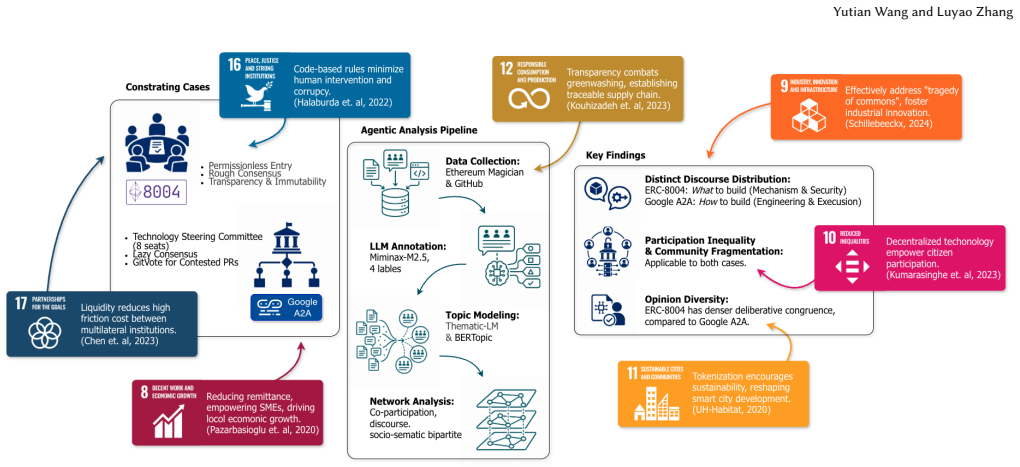
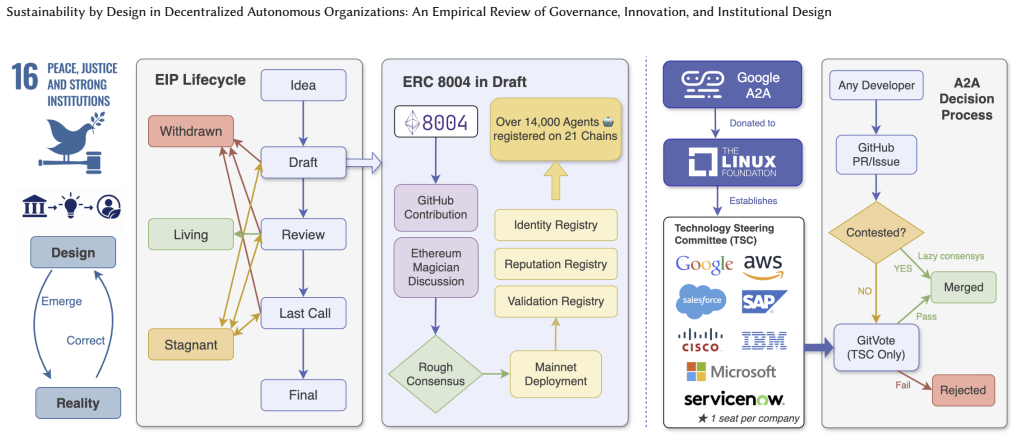
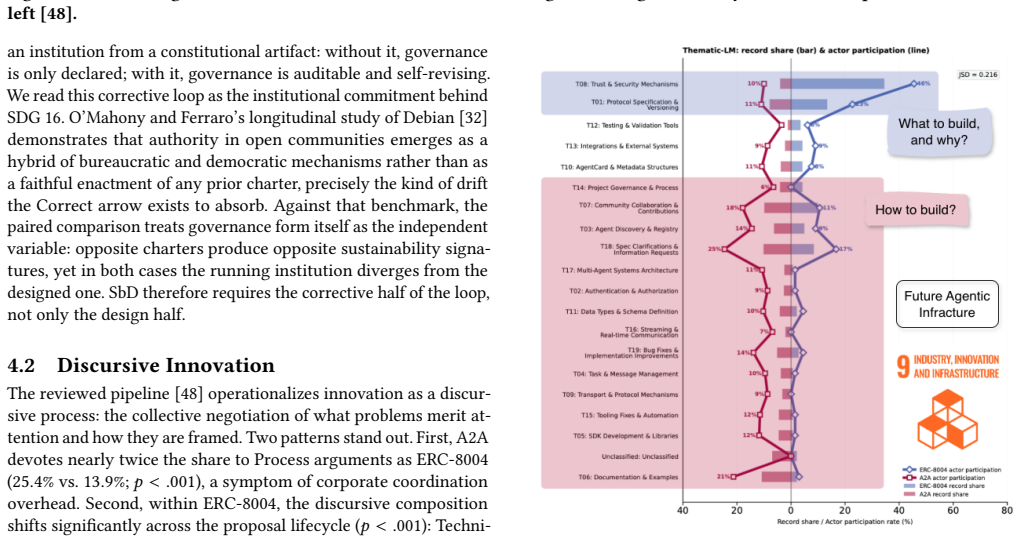
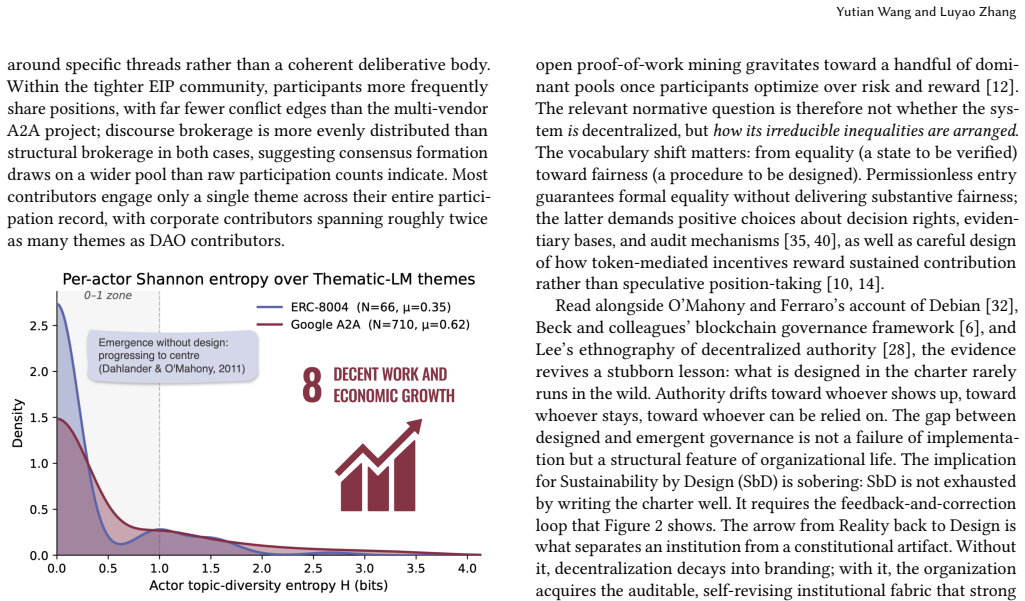
Decentralized Autonomous Organizations represent an emerging innovation ecosystem in which sustainability can be embedded directly into organizational design through blockchain-based transparency, open participation, and token-driven governance; this is examined by comparing the DAO-governed ERC-8004 standard with the corporation-consortium-governed Google A2A standard via an LLM-powered pipeline that combines automated annotation, neural topic modeling, and multi-layer network analysis to reveal differences in socio-technical power structures.
What carries the argument
LLM-powered comparative pipeline that integrates automated annotation, neural topic modeling, and multi-layer network analysis to study socio-technical power structures in governance discourse.
If this is right
- Innovation theories must be updated to account for open, token-driven boundaries rather than closed hierarchical firms.
- Designers of future standards can copy governance features from DAO models to embed sustainability directly.
- Policymakers gain concrete examples of how decentralized versus centralized control affects long-term institutional outcomes.
- Scholars obtain a reusable method for large-scale comparison of governance discourse across organizational forms.
Where Pith is reading between the lines
- The same pipeline could be applied to additional DAO and corporate standards to test whether the observed governance differences hold more broadly.
- If DAO models consistently surface stronger sustainability signals, projects may migrate toward decentralized governance to meet institutional-design goals.
- The work connects to questions of how digital-native organizations redistribute decision-making power compared with legacy firms.
Load-bearing premise
The LLM-powered pipeline accurately captures the socio-technical power structures in the governance discourse of the two standards without introducing significant bias or error.
What would settle it
Re-running the full pipeline on the same documents with independent human annotators or a different model family and obtaining substantially different topic distributions or network layers.
Figures
read the original abstract
Recent innovation theories on economics remain largely grounded in assumptions of hierarchical firms and closed organizational boundaries, offering limited insight into how innovation unfolds within decentralized, digitally native organizations. Decentralized Autonomous Organizations (DAOs) represent an emerging form of innovation ecosystem characterized by blockchain-based transparency, open participation, and token-driven governance, in which sustainability can be embedded directly into organizational design. This study compares two standards, ERC-8004 and Google A2A, who address the same agent interoperability question, while the former is governed by DAO and the latter by corporation consortium. They are examined through an LLM-powered comparative pipeline for large-scale governance discourse analysis, integrating automated annotation, neural topic modeling, and multi-layer network analysis to study socio-technical power structures. The study provides evidence-based insights for scholars, policymakers, and designers seeking to align innovation, technological governance, and sustainability in future organizational forms.
Editorial analysis
A structured set of objections, weighed in public.
Referee Report
Summary. The manuscript claims to provide evidence-based insights into sustainability by design in decentralized autonomous organizations by comparing two agent interoperability standards: ERC-8004 (governed by a DAO) and Google A2A (governed by a corporate consortium). It applies an LLM-powered comparative pipeline integrating automated annotation, neural topic modeling, and multi-layer network analysis to examine socio-technical power structures, governance discourse, and implications for innovation and institutional design beyond traditional hierarchical firms.
Significance. If the pipeline accurately and unbiasedly extracts governance elements, the study could contribute novel comparative evidence on embedding sustainability into DAO designs versus consortium models, extending innovation theories to digitally native, token-driven organizations and informing scholars, policymakers, and designers.
major comments (1)
- [LLM-powered comparative pipeline description] The section describing the LLM-powered comparative pipeline provides no details on the specific model, prompts, temperature, few-shot examples, or human validation steps for the automated annotation, neural topic modeling, or network analysis. This is load-bearing for the central claim, as unvalidated extraction of elements such as token-weighted voting, proposal thresholds, or consortium veto rights could introduce systematic bias and undermine the evidence-based insights on power structures and sustainability.
minor comments (1)
- [Abstract] The abstract outlines the method and intended contributions but supplies no specific findings, error analysis, data details, or validation metrics, limiting the reader's ability to evaluate the strength of the reported insights.
Simulated Author's Rebuttal
We thank the referee for highlighting the importance of methodological transparency in our LLM-powered pipeline. We address the single major comment below and commit to a full revision of the relevant section.
read point-by-point responses
-
Referee: The section describing the LLM-powered comparative pipeline provides no details on the specific model, prompts, temperature, few-shot examples, or human validation steps for the automated annotation, neural topic modeling, or network analysis. This is load-bearing for the central claim, as unvalidated extraction of elements such as token-weighted voting, proposal thresholds, or consortium veto rights could introduce systematic bias and undermine the evidence-based insights on power structures and sustainability.
Authors: We agree that the current manuscript provides only a high-level description of the pipeline and lacks the requested implementation details. This omission limits reproducibility and leaves open the possibility of unexamined bias in the automated extraction of governance elements. In the revised version we will expand the methods section to specify the exact LLM (including version), complete prompt templates, temperature and sampling parameters, any few-shot examples employed, and the full human validation protocol together with inter-annotator agreement statistics. These additions will directly support the validity of the comparative findings on power structures and sustainability. revision: yes
Circularity Check
No circularity; empirical analysis with no derivations or self-referential fits
full rationale
The paper presents an empirical comparative study of two standards (ERC-8004 DAO vs. Google A2A consortium) via an LLM pipeline for annotation, topic modeling, and network analysis. No equations, predictions, or first-principles derivations are claimed. No self-citations, fitted parameters renamed as predictions, or ansatzes appear in the provided text. The analysis is framed as evidence-based review of governance discourse, with no load-bearing steps that reduce to the paper's own inputs by construction. This is a standard non-circular empirical paper.
Axiom & Free-Parameter Ledger
Reference graph
Works this paper leans on
-
[1]
A2A Authors. 2025. Agent2Agent (A2A) Protocol. https://github.com/a2aproject/ A2A
2025
-
[2]
A2A Authors. 2025. GOVERNANCE.md. https://github.com/a2aproject/A2A/ blob/main/GOVERNANCE.md
2025
-
[3]
a2aproject. 2025. .gitvote.yml. GitHub. https://github.com/a2aproject/A2A/ blob/main/.gitvote.yml
2025
-
[4]
Philippe Aghion and Peter Howitt. 1992. A Model of Growth Through Creative Destruction.Econometrica60, 2 (1992), 323–351
1992
- [5]
-
[6]
Roman Beck, Christoph Müller-Bloch, and John L. King. 2018. Governance in the Blockchain Economy: A Framework and Research Agenda.Journal of the Association for Information Systems19, 10 (2018), 1020–1034
2018
-
[7]
Bharathi S., Himadri Sikhar Pramanik, Vijayakumar Bharathi Venkatesan, and Rui Pereira
V. Bharathi S., Himadri Sikhar Pramanik, Vijayakumar Bharathi Venkatesan, and Rui Pereira. 2024. From Ocean to Table: Examining the Potential of Blockchain for Responsible Sourcing and Sustainable Seafood Supply Chains.Production Planning & Control(2024)
2024
-
[8]
Carmelo Cennamo, Peter Gianiodis, Tobias Kretschmer, David McIntyre, Pinar Ozcan, and Marshall Van Alstyne. 2025. Platform Regulation: Beyond Power and Size.Academy of Management Perspectives(2025). doi:10.5465/amp.2025.0261
-
[9]
Roberto Cerchione, Piera Centobelli, Eugenio Riccio, Stefano Abbate, and Euge- nio Oropallo. 2022. Blockchain and Sustainable Development Goals: A Systematic Review.Sustainability(2022)
2022
-
[10]
Kun Chen, Yifan Fan, Yulin Fang, and Xin Luo. 2025. Beyond Money: Incentive Effects of Tokenized Ownership on User Contribution in DAOs.Journal of Operations Management71, 7 (2025), 988–1016
2025
-
[11]
Wei Chen et al. 2023. Harnessing Web3 and Blockchain to Finance Global Public Goods.Nature Climate Change (policy perspective)(2023)
2023
-
[12]
Lin William Cong, Zhiguo He, and Jiasun Li. 2021. Decentralized Mining in Centralized Pools.The Review of Financial Studies34, 3 (2021), 1191–1235
2021
-
[13]
Linus Dahlander and Siobhán O’Mahony. 2011. Progressing to the Center: Coordinating Project Work.Organization Science22, 4 (2011), 961–979
2011
-
[14]
Eleunthia Wong Ellinger, Robert Wayne Gregory, Tobias Mini, Thomas Widjaja, and Ola Henfridsson. 2024. Skin in the game: The transformational potential of decentralized autonomous organizations.MIS quarterly48, 1 (2024), 245–272
2024
-
[15]
ERC-8004 Authors. 2026. erc-8004.md. GitHub. https://github.com/ethereum/ ERCs/blob/master/ERCS/erc-8004.md
2026
-
[16]
Ethereum Foundation. 2015. EIP-1: EIP Purpose and Guidelines. https://eips. ethereum.org/EIPS/eip-1
2015
-
[17]
Ethereum Magicians. 2025. ERC-8004: Trustless Agents. Ethereum Magi- cians Forum, topic 25098. https://ethereum-magicians.org/t/erc-8004-trustless- agents/25098
2025
-
[18]
Etherscan. 2026. ERC-8004 Identity Registry Contract (0x8004A169. . . ). Ethereum Mainnet. https://etherscan.io/address/ 0x8004A169FB4a3325136EB29fA0ceB6D2e539a432 Deployed Jan. 29, 2026
2026
-
[19]
Rainer Feichtinger, Robin Fritsch, Yann Vonlanthen, and Roger Wattenhofer. 2023. The hidden shortcomings of (d) aos–an empirical study of on-chain governance. InInternational Conference on Financial Cryptography and Data Security. Springer, 165–185
2023
-
[20]
Google Cloud. 2025. Google Cloud Donates A2A to Linux Founda- tion. https://developers.googleblog.com/en/google-cloud-donates-a2a-to-linux- foundation/
2025
-
[21]
Maarten Grootendorst. 2022. BERTopic: Neural Topic Modeling with a Class- Based TF-IDF Procedure. arXiv:2203.05794
work page internal anchor Pith review Pith/arXiv arXiv 2022
-
[22]
Hanna Halaburda, Natalia Levina, and Semi Min. 2024. Digitization of Transac- tion Terms within TCE: Strong Smart Contract as a New Mode of Transaction Governance.MIS Quarterly48, 2 (2024), 825–846. doi:10.25300/MISQ/2023/17818
-
[23]
Hannigan, Richard F
Timothy R. Hannigan, Richard F. J. Haans, Keyvan Vakili, Hovig Tchalian, Vern L. Glaser, Milo Shaoqing Wang, Sarah Kaplan, and P. Devereaux Jennings. 2019. Topic Modeling in Management Research: Rendering New Theory from Textual Data.Academy of Management Annals13, 2 (2019), 586–632
2019
-
[24]
Harvey, Ashwin Ramachandran, and Joey Santoro
Campbell R. Harvey, Ashwin Ramachandran, and Joey Santoro. 2021.DeFi and the Future of Finance. Wiley, Hoboken, NJ
2021
-
[25]
Xiang Hui and Catherine E. Tucker. 2025. Decentralization, Blockchain, Artificial Intelligence (AI): Calenges and Opportunities.Journal of Product Innovation Management42, 5 (2025), 947–957
2025
-
[26]
Mahtab Kouhizadeh, Sara Saberi, and Joseph Sarkis. 2021. Blockchain Technology and the Sustainable Supply Chain: Theoretically Exploring Adoption Barriers. International Journal of Production Economics231 (2021), 107831
2021
-
[27]
Nilushi Kumarasinghe, Tom Bouman, Ilan Kelman, and Scott Bremer. 2023. Lessons Learned on Leveraging Digital Transformations to Meet the SDGs. Science-Policy Brief for the STI Forum 2023. United Nations Department of Economic and Social Affairs (UN DESA), Future Earth and Sustainability in the Digital Age. https://sdgs.un.org/sites/default/files/2023-05/B...
2023
-
[28]
Michael Y. Lee. 2024. Enacting Decentralized Authority: The Practices and Limits of Moving Beyond Hierarchy.Administrative Science Quarterly69, 3 (2024), 791–833
2024
-
[29]
Philip Leifeld. 2013. Reconceptualizing Major Policy Change in the Advocacy Coalition Framework: A Discourse Network Analysis of German Pension Politics. Policy Studies Journal41, 1 (2013), 169–198
2013
-
[30]
MiniMax. 2026. MiniMax M2.5: Built for Real-World Productivity. MiniMax. https://www.minimax.io/news/minimax-m25 Accessed: Apr. 11, 2026
2026
-
[31]
2002.The Gifts of Athena: Historical Origins of the Knowledge Economy
Joel Mokyr. 2002.The Gifts of Athena: Historical Origins of the Knowledge Economy. Princeton University Press, Princeton, NJ
2002
-
[32]
Siobhán O’Mahony and Fabrizio Ferraro. 2007. The Emergence of Governance in an Open Source Community.Academy of Management Journal50, 5 (2007), 1079–1106
2007
-
[33]
2020.Digital Financial Services
Ceyla Pazarbasioglu, Alfonso Garcia Mora, Mahesh Uttamchandani, Harish Natarajan, Erik Feyen, and Mathew Saal. 2020.Digital Financial Services. Report. World Bank Group. https://www.worldbank.org/en/topic/financialinclusion/ publication/digital-financial-services Accessed: May 27, 2026
2020
-
[34]
Tingrui Qiao, Caroline Walker, Chris Cunningham, and Yun Sing Koh. 2025. Thematic-LM: A LLM-Based Multi-Agent System for Large-Scale Thematic Anal- ysis. InWWW ’25: Proceedings of the ACM on Web Conference 2025. 649–658
2025
-
[35]
Eisenhardt
Philipp Reineke, Riitta Katila, and Kathleen M. Eisenhardt. 2025. Decentralization in Organizations: A Revolution or a Mirage?Academy of Management Annals 19, 1 (2025), 298–342
2025
-
[36]
Camille Roth and Jean-Philippe Cointet. 2010. Social and Semantic Coevolution in Knowledge Networks.Social Networks32, 1 (2010), 16–29
2010
-
[37]
David Rozas, Antonio Tenorio-Fornés, Silvia Díaz-Molina, and Samer Hassan
-
[38]
When Ostrom Meets Blockchain: Exploring the Potentials of Blockchain for Commons Governance.SAGE Open11, 1 (2021)
2021
-
[39]
Simon J. D. Schillebeeckx. 2024. Blockchain Technologies and Environmental Sustainability.Singapore Management University Institutional Knowledge (InK), Research on Decentralized Systems(2024)
2024
-
[40]
Herbert A. Simon. 1947.Administrative Behavior: A Study of Decision-Making Processes in Administrative Organization. Macmillan, New York
1947
-
[41]
Ali Sunyaev, Michel Avital, and Mary C. Lacity. 2026. From Ideology to Design: Toward Purposeful Decentralization of Information Systems Governance.Journal of the Association for Information Systems27, 1 (2026)
2026
-
[42]
2015.The International Law of the Sea
Yoshifumi Tanaka. 2015.The International Law of the Sea. Cambridge University Press, Cambridge
2015
-
[43]
The Royal Swedish Academy of Sciences. 2025. Prize in Economic Sciences 2025 — Press Release. NobelPrize.org. https://www.nobelprize.org/prizes/economic- sciences/2025/press-release/ Accessed: May 27, 2026
2025
-
[44]
Jane Thomason. 2026. Ethics: Essential Infrastructure for Governance of Web3 and the Metaverse in the Age of AI.Frontiers in Blockchain(2026)
2026
-
[45]
2020.Blockchain for Urban Development
UN-Habitat. 2020.Blockchain for Urban Development. White Paper. United Nations Human Settlements Programme
2020
-
[46]
2021.CryptoFund and Open Source Tech for Social Good
UNICEF Office of Innovation. 2021.CryptoFund and Open Source Tech for Social Good. Report. United Nations Children’s Fund
2021
-
[47]
2021.Digital Identity and Blockchain: The Future of E-Governance
United Nations Development Programme. 2021.Digital Identity and Blockchain: The Future of E-Governance. Report. UNDP
2021
-
[48]
2022.Digital Economy and Sustain- ability: Web3 for Climate and Environment
United Nations Environment Programme. 2022.Digital Economy and Sustain- ability: Web3 for Climate and Environment. Report. UNEP
2022
-
[49]
Yutian Wang and Luyao Zhang. 2026. Agentic Analysis for Agentic Infrastructure: An LLM-Powered Pipeline for Comparative Governance of DAO and Corporate AI Protocols. Working Paper
2026
-
[50]
World Economic Forum and Accenture. 2026. Organizational Transforma- tion in the Age of AI. https://www.weforum.org/publications/organizational- transformation-in-the-age-of-ai/
2026
-
[51]
Robert K. Yin. 2018.Case Study Research and Applications: Design and Methods (6th ed.). SAGE
2018
discussion (0)
Sign in with ORCID, Apple, or X to comment. Anyone can read and Pith papers without signing in.