REVIEW 2 major objections 3 minor 13 references
QueryAgent-R1: Bridging Query Generation and Product Retrieval for E-Commerce Query Recommendation
T0 review · 2 major / 3 minor · reviewed 2026-06-28 · grok-4.3
Pith's one-line read QueryAgent-R1 grounds query generation in real inventory retrieval and applies consistency rewards during reinforcement learning to align query clicks with product conversions.
desk verdict QueryAgent-R1 shows real online A/B lifts on a production e-commerce platform by grounding query generation in retrieval and adding a consistency reward, but the abstract leaves the exact reward construction and baseline details unclear enough that circularity remains a live question. read the letter →
The pith
A machine-rendered reading of the paper's core claim, the machinery that carries it, and where it could break.
The reading
What carries the argument
Chain-of-retrieval optimization, which grounds query generation in real inventory retrieval so the agent can validate and refine queries based on the products actually returned.
What would settle it
An online A/B test on the production platform in which guided CVR shows no statistically significant rise or declines while query CTR increases.
Extended reading notes
Core claim
QueryAgent-R1 is a memory-augmented agentic framework that improves end-to-end alignment via chain-of-retrieval optimization. It grounds query generation in real inventory retrieval, allowing the agent to validate and refine queries based on retrieved products, and employs a consistency reward in the agentic reinforcement learning process to jointly optimize query relevance and downstream engagement. On two constructed datasets the method outperforms strong baselines, and in large-scale online A/B tests it raises query CTR by 2.9 percent and guided CVR by 3.1 percent.
Load-bearing premise
That the consistency reward during reinforcement learning produces refinements that genuinely improve downstream product conversions rather than merely rewarding the same metrics used for evaluation.
Editorial extensions
If this is right
- Queries achieve higher click-through rates while also guiding higher product conversion rates.
- The method delivers consistent gains on offline datasets built from both industrial logs and public sources.
- Online production traffic shows simultaneous lifts in query CTR and guided CVR.
- The memory abstraction module supports scalable user profiling without repeated full-history processing.
Reading between the lines
- The same retrieval-grounding pattern could be tested in non-e-commerce search or recommendation settings where relevance and engagement objectives diverge.
- Removing the consistency reward component in an ablation would isolate whether the joint optimization or the retrieval step drives most of the measured lift.
- The memory module could be extended to handle cross-session user histories longer than those used in the reported experiments.
Editorial analysis
A structured set of objections, weighed in public.
Referee Report
Summary. The paper proposes QueryAgent-R1, a memory-augmented agentic RL framework for e-commerce query recommendation. It grounds query generation via chain-of-retrieval in real inventory to enable validation and refinement, introduces a consistency reward to jointly optimize query relevance and downstream engagement metrics, and includes a memory abstraction module for user profiling. Offline evaluation uses two constructed datasets (proprietary industrial and public) where the method outperforms baselines; online A/B tests on a large-scale production platform report 2.9% Query CTR and 3.1% guided CVR lifts.
Significance. If the results hold after addressing reward formulation details, the work offers a concrete agentic approach to closing the CTR-CVR gap in query recommendation, with the online A/B tests on a production platform and the construction of evaluation datasets providing direct evidence of practical utility and enabling future comparisons.
major comments (2)
- [§3 (Agentic RL and consistency reward)] §3 (Agentic RL and consistency reward): the consistency reward is described as jointly optimizing the same relevance and engagement metrics (CTR/CVR) that are used for both offline dataset evaluation and the online A/B test results. The manuscript must provide the exact mathematical definition of this reward (including any retrieval-success indicators) and show via ablation or alternative reward that observed lifts are not explained by direct optimization of the evaluation metrics themselves.
- [§4 (Offline evaluation and dataset construction)] §4 (Offline evaluation and dataset construction): the two constructed datasets lack reported details on query-product pair sampling, negative sampling strategy, and how ground-truth CTR/CVR labels are obtained. Without these, it is impossible to assess whether baseline comparisons are fair or whether the chain-of-retrieval component contributes beyond metric alignment.
minor comments (3)
- [Tables 1-2] Table 1 and Table 2: report standard errors or confidence intervals alongside the percentage improvements; absolute metric values (not only relative lifts) should also be shown.
- [Figure 3] Figure 3 (online A/B test): clarify the exact definition of 'guided CVR' and the duration/statistical power of the test.
- [§2.3] Notation: the memory abstraction module is introduced without a formal equation or pseudocode; add a concise definition in §2.3.
Simulated Author's Rebuttal
We thank the referee for the constructive feedback on our manuscript. We address each major comment below and will incorporate clarifications and additional details in the revised version.
read point-by-point responses
-
Referee: [§3 (Agentic RL and consistency reward)] §3 (Agentic RL and consistency reward): the consistency reward is described as jointly optimizing the same relevance and engagement metrics (CTR/CVR) that are used for both offline dataset evaluation and the online A/B test results. The manuscript must provide the exact mathematical definition of this reward (including any retrieval-success indicators) and show via ablation or alternative reward that observed lifts are not explained by direct optimization of the evaluation metrics themselves.
Authors: We agree that the exact mathematical definition of the consistency reward and supporting ablations are necessary to clarify its contribution. The current manuscript describes the reward at a high level; in the revision we will add the precise formulation (including retrieval-success indicators) in §3 and include an ablation comparing the full consistency reward against a direct metric-optimization baseline to demonstrate that gains arise from the agentic chain-of-retrieval and memory components rather than metric alignment alone. revision: yes
-
Referee: [§4 (Offline evaluation and dataset construction)] §4 (Offline evaluation and dataset construction): the two constructed datasets lack reported details on query-product pair sampling, negative sampling strategy, and how ground-truth CTR/CVR labels are obtained. Without these, it is impossible to assess whether baseline comparisons are fair or whether the chain-of-retrieval component contributes beyond metric alignment.
Authors: We acknowledge the need for greater transparency on dataset construction. In the revised §4 we will provide explicit details on query-product pair sampling, the negative sampling strategy, and the procedure for deriving ground-truth CTR/CVR labels from industrial logs and public data. These additions will enable readers to evaluate baseline fairness and isolate the contribution of the chain-of-retrieval optimization. revision: yes
Circularity Check
Consistency reward directly optimizes the CTR/CVR metrics used for evaluation
-
fitted input called prediction
[Abstract]
"We also design a consistency reward in the agentic reinforcement learning (RL) process to jointly optimize query relevance and downstream engagement."
The reward is defined to optimize precisely the two quantities (query relevance, downstream engagement) whose improvements are later reported as 2.9% CTR and 3.1% CVR gains. The performance numbers are therefore produced by construction through RL on those signals, not by an independent prediction from the agentic grounding.
full rationale
The paper's central contribution is an agentic RL framework whose consistency reward is explicitly constructed to jointly optimize query relevance and downstream engagement. These are the exact quantities measured as Query CTR and guided CVR in both offline datasets and the online A/B test. Because the reward is defined from the same signals that appear in the reported lifts, the observed improvements reduce to direct optimization of the evaluation metrics rather than an independent verification of the chain-of-retrieval mechanism. No equations or self-citations are needed to exhibit the reduction; the abstract itself states the alignment between reward and reported metrics.
Assumptions & free parameters
Cite this review
Pith. "Pith review of QueryAgent-R1: Bridging Query Generation and Product Retrieval for E-Commerce Query Recommendation." pith.science (2026). https://pith.science/paper/QF5ONKEF
@misc{pith2026260605671,
  author       = {Pith},
  title        = {Pith review of: QueryAgent-R1: Bridging Query Generation and Product Retrieval for E-Commerce Query Recommendation},
  year         = {2026},
  howpublished = {\url{https://pith.science/paper/QF5ONKEF}},
  note         = {Machine review of arXiv:2606.05671}
}
read the original abstract
Query recommendation in e-commerce search aims to proactively suggest queries that match users' potential interests. However, existing methods mainly optimize query-level relevance, while neglecting whether the retrieved products align with users' downstream preferences. This mismatch often leads to high query click through rates (CTR) but low product conversion rates (CVR). To bridge this gap, we propose QueryAgent-R1, a memory-augmented agentic framework that improves end-to-end alignment via chain-of-retrieval optimization. Our QueryAgent-R1 grounds query generation in real inventory retrieval, allowing the agent to validate and refine queries based on retrieved products. We also design a consistency reward in the agentic reinforcement learning (RL) process to jointly optimize query relevance and downstream engagement. In addition, we construct a memory abstraction module for efficient user profiling. To support offline evaluation, we construct two datasets based on both proprietary industrial data and public datasets, on which QueryAgent-R1 consistently outperforms strong baselines. Moreover, on a large scale production platform, QueryAgent-R1 improves Query CTR by 2.9% and guided CVR by 3.1% in online A/B tests.
Figures


Figures from the paper (3 more)


Reference graph
Works this paper leans on
-
[1]
Performance of recommender algorithms on top-n recommendation tasks. InProceedings of the F ourth ACM Conference on Recommender Systems, RecSys ’10, page 39–46, New York, NY , USA. Asso- ciation for Computing Machinery. Kaustubh D. Dhole, Ramraj Chandradevan, and Eugene Agichtein. 2024. Generative query reformulation using ensemble prompting, document fus...
-
[2]
arXiv preprint arXiv:2512.22386
Oxygenrec: An instruction-following gen- erative framework for e-commerce recommendation. arXiv preprint arXiv:2512.22386. Yupeng Hou, Jiacheng Li, Zhankui He, An Yan, Xiusi Chen, and Julian McAuley. 2024. Bridging language and items for retrieval and recommendation.arXiv preprint arXiv:2403.03952. Po-Sen Huang, Xiaodong He, Jianfeng Gao, Li Deng, Alex Ac...
-
[3]
DeepSeekMath: Pushing the Limits of Mathematical Reasoning in Open Language Models
Shopping queries dataset: A large-scale ESCI benchmark for improving product search. Stephen Robertson and Hugo Zaragoza. 2009. The probabilistic relevance framework: Bm25 and be- yond.F ound. Trends Inf. Retr ., 3(4):333–389. Zhihong Shao, Peiyi Wang, Qihao Zhu, Runxin Xu, Junxiao Song, Xiao Bi, Haowei Zhang, Mingchuan Zhang, Y . K. Li, Y . Wu, and Daya ...
work page Pith review arXiv 2009
-
[4]
Under this configuration, the single-node serving through- put is approximately 10 queries per second (QPS)
hosted on a single NVIDIA L20 GPU. Under this configuration, the single-node serving through- put is approximately 10 queries per second (QPS). Due to these computational throughput constraints, we route a controlled 1% subset of live production traffic to the agent pipeline. D.1 Near-Line Latency Masking The end-to-end inference latency of the agent is a...
-
[5]
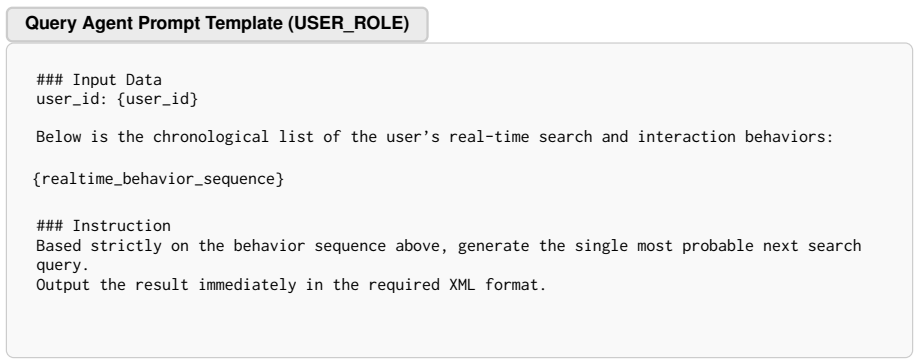
Context Awareness: Derive the next query strictly based on the progression of the provided behavior logs
-
[6]
- Execution: Call the memory tool using the user’s ID found in the context
User Memory Retrieval (MANDATORY): - Requirement: Before predicting any query, you MUST first retrieve the user’s long-term profile and preferences to understand their intent. - Execution: Call the memory tool using the user’s ID found in the context. - Syntax: To call the memory tool: <tool_call> user_id </tool_call>. - Integration: Use the retrieved pro...
-
[7]
If info is missing or context is complex, you MUST call Tool(search)
Tool Usage & Refinement: - Execution: Verify if you have enough product info context. If info is missing or context is complex, you MUST call Tool(search). - Syntax: To call a tool: <tool_call> query + user_id </tool_call>. - Result Validation: If search results are available, evaluate whether they cover the products user clicked subsequently. - Query Adj...
-
[8]
Conciseness: The generated query must be under 10 words
Show all 13 references
-
[9]
Natural Language: The query should sound like a natural user search input (keywords + modifiers), not a full sentence
-
[10]
### Output Format Rules
No Explanations: Do not output any extra text outside the defined XML tags. ### Output Format Rules
-
[11]
Strict XML: Output must be wrapped in <next_query> tags
-
[12]
No Markdown: Do not use markdown code blocks (e.g.,```xml)
-
[13]
type": "function
Structure: ~~~[Reasoning steps and tool check] ~~~<next_query> ~~~[predicted query string] ~~~</next_query> # Tools You may call one or more functions to assist with the user query. You are provided with function signatures within <tools></tools> XML tags: <tools> {"type": "fu...
Reviewed June 28, 2026 · model on record in the stance chip above.
Discussion (0). Continue with ORCID to comment.