REVIEW 2 major objections 2 minor 65 references
Pion transitions in the Born-Oppenheimer Effective Field Theory: a long distance approach
T0 review · 2 major / 2 minor · reviewed 2026-06-28 · grok-4.3
Pith's one-line read Pion transitions in heavy quarkonium and hybrid states are determined by matching a pion-QCD string interaction Lagrangian to the Born-Oppenheimer effective field theory, expressing the low-energy functions in three universal parameters.
desk verdict The paper matches a pion-QCD string Lagrangian to static BOEFT amplitudes to express long-distance low-energy functions via three parameters, but all transition rates rest on an unchecked long-distance dominance assumption. read the letter →
The pith
A machine-rendered reading of the paper's core claim, the machinery that carries it, and where it could break.
The reading
What carries the argument
The interaction Lagrangian for pions and the QCD string, matched to Born-Oppenheimer effective field theory amplitudes in the static limit, which fixes the long-distance behavior of the unknown low-energy functions.
What would settle it
A measured transition rate between a specific hybrid state and a quarkonium state that cannot be reproduced by any choice of the three universal parameters within their phenomenologically estimated ranges.
Extended reading notes
Core claim
By proposing an interaction Lagrangian for pions and the QCD string and matching its amplitudes to the Born-Oppenheimer effective field theory in the static limit, the low energy functions for pion transitions are obtained in terms of three universal parameters, along with the light quark mass dependence of the string tension. Assuming long-distance dominance, the method is used to calculate several quarkonium-to-quarkonium and hybrid-to-quarkonium transitions.
Load-bearing premise
The low energy functions are long-distance dominated.
Signed reviews
Editorial analysis
A structured set of objections, weighed in public.
Referee Report
Summary. The paper introduces an interaction Lagrangian coupling pions to the QCD string in order to determine the long-distance behavior of unknown low-energy functions appearing in Born-Oppenheimer EFT descriptions of pion transitions between heavy quarkonium and hybrid states. Matching the resulting amplitudes to BOEFT in the static limit expresses these functions in terms of three universal parameters; the light-quark-mass dependence of the string tension is obtained as a byproduct. Under the additional assumption that the low-energy functions are long-distance dominated, the authors compute several quarkonium-to-quarkonium and hybrid-to-quarkonium transition rates and perform a phenomenological fit of the three parameters to data.
Significance. If the matching is correct and the long-distance-dominance assumption holds with quantifiable accuracy, the framework supplies a concrete parametrization that extends beyond the multipole expansion for states whose size exceeds the hadronic scale, while relating the string tension's quark-mass dependence to the same parameters. The explicit construction of the pion-string Lagrangian and the static-limit matching constitute a technical advance that could be tested against lattice matrix elements. The phenomenological estimates, however, are necessarily data-driven rather than first-principles predictions.
major comments (2)
- [Abstract and transition-rate section] The long-distance-dominance assumption invoked after the matching (abstract and the section on transition calculations) is load-bearing for every numerical rate quoted. No cross-check against short-distance multipole results at intermediate distances or against lattice evaluations of the same matrix elements is supplied to bound the size of the neglected contributions. Without such a test the computed transition rates do not follow from the matching alone.
- [Phenomenological analysis section] The three universal parameters are determined by fitting to existing data (phenomenological analysis section). Consequently the quoted transition rates reduce, by construction, to quantities whose numerical values are fixed by the fit rather than by independent first-principles input from the matching procedure.
minor comments (2)
- [Matching section] The manuscript should state explicitly in which section the matching equations are written and which BOEFT amplitudes are used on the right-hand side.
- [Notation throughout] Notation for the low-energy functions should be introduced once and used consistently; currently the same symbols appear to be redefined between the Lagrangian and the transition-rate formulae.
Simulated Author's Rebuttal
We thank the referee for the careful reading of the manuscript and the constructive comments. We address each major comment below and indicate the revisions we will make to improve clarity.
read point-by-point responses
-
Referee: [Abstract and transition-rate section] The long-distance-dominance assumption invoked after the matching (abstract and the section on transition calculations) is load-bearing for every numerical rate quoted. No cross-check against short-distance multipole results at intermediate distances or against lattice evaluations of the same matrix elements is supplied to bound the size of the neglected contributions. Without such a test the computed transition rates do not follow from the matching alone.
Authors: We agree that the long-distance-dominance assumption is essential for obtaining numerical values of the transition rates and that the matching procedure alone does not determine these rates. No cross-checks against lattice matrix elements or intermediate-distance multipole results are provided because such data are not available in the literature for the relevant transitions. We will revise the abstract and the transition-rate section to state explicitly that the quoted rates rely on this assumption and to distinguish what follows from the matching versus the assumption. This is a partial revision. revision: partial
-
Referee: [Phenomenological analysis section] The three universal parameters are determined by fitting to existing data (phenomenological analysis section). Consequently the quoted transition rates reduce, by construction, to quantities whose numerical values are fixed by the fit rather than by independent first-principles input from the matching procedure.
Authors: We acknowledge that the three parameters are obtained from a fit to data and that the numerical transition rates are therefore fixed by this fit. The matching determines the functional form in terms of the parameters and yields the light-quark-mass dependence of the string tension as a byproduct, but the specific values remain phenomenological. We will revise the phenomenological analysis section to clarify this distinction and to note that the rates are not independent first-principles predictions from the matching. revision: yes
Circularity Check
No significant circularity; matching and phenomenological fitting are independent of target transitions
full rationale
The paper proposes a pion-QCD-string Lagrangian, matches its amplitudes to BOEFT static-limit amplitudes to express low-energy functions via three universal parameters, then invokes a long-distance-domination assumption to compute transitions while estimating the parameters from data for phenomenological use. This chain does not reduce any claimed result to its inputs by construction: the matching step is a standard EFT procedure independent of the fitted values, the assumption is stated explicitly rather than smuggled, and no self-citation or uniqueness theorem is invoked as load-bearing. The approach is self-contained against external benchmarks such as multipole expansion at short distances.
Assumptions & free parameters
free parameters (1)
- three universal parameters
assumptions (2)
- domain assumption The low energy functions are long-distance dominated
- standard math Standard assumptions of effective field theory and the Born-Oppenheimer approximation in the static limit
invented entities (1)
-
Interaction Lagrangian for pions and the QCD string
Cite this review
Pith. "Pith review of Pion transitions in the Born-Oppenheimer Effective Field Theory: a long distance approach." pith.science (2026). https://pith.science/paper/Q2RD5MJO
@misc{pith2026260605791,
  author       = {Pith},
  title        = {Pith review of: Pion transitions in the Born-Oppenheimer Effective Field Theory: a long distance approach},
  year         = {2026},
  howpublished = {\url{https://pith.science/paper/Q2RD5MJO}},
  note         = {Machine review of arXiv:2606.05791}
}
read the original abstract
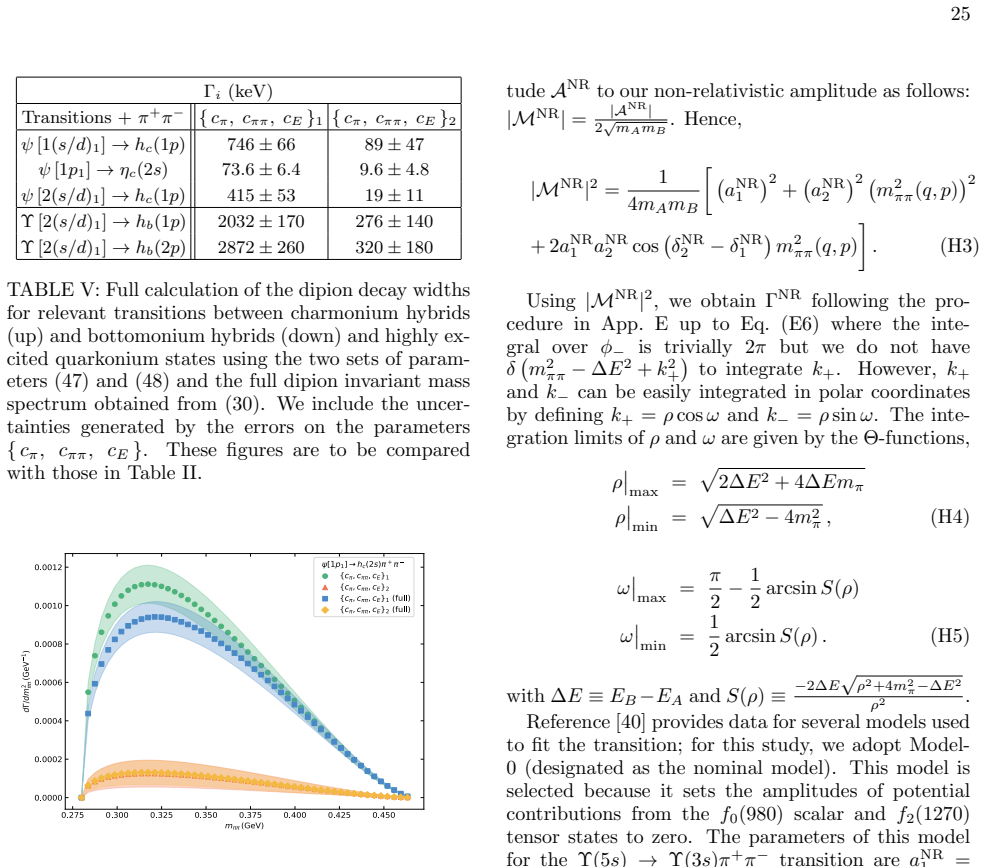
We address pion transitions involving heavy quarkonium and heavy exotic states in the Born-Oppenheimer effective field theory. Many of these states have a size similar or larger than the typical hadronic scale, and hence the usual QCD multipole expansion breaks down. Unknown low energy functions must be introduced, which at short distances must reproduce the known results of the multipole expansion. In order to determine the long distance behavior of these functions, we propose an interaction Lagrangian for pions and the QCD string. By matching the amplitudes obtained with this Lagrangian to the ones of the Born-Oppenheimer effective field theory in the static limit, we obtain the low energy functions in terms of three universal parameters. As a by product, we also obtain the light quark mass dependence of the string tension. Assuming that the low energy functions are long-distance dominated, we calculate several quarkonium-to-quarkonium and hybrid-to-quarkonium transitions. We estimate the universal constants and provide a phenomenological analysis of the most relevant transitions.
Figures


Figures from the paper (9 more)


Reference graph
Works this paper leans on
-
[1]
30R m 2 ππ cπm2 π +c ππ m2 ππ + 20c E h 4 R+R 0 ×m 2 πm2 ππ − R−2R 0 m4 ππ + 2 R−R 0 (2m2 π +m 2 ππ)∆E2 i# +c 2 E
is the wave function field for the spin 0 (spin 1) heavy quarkonium hybrid. The trace must be understood to act independently on both spin- symmetry multiplets of quarkonium and on the chiral operators. At short distance,g 4(r)∼r[18]. The unknown long distance behavior will be obtained in Sec. IV. A. Pion scattering off static quarkonium We compute⟨π(q);S...
-
[2]
We have also assumed that the Υ(10860) corresponds to the Υ(5s) state
The low energy constants In order to obtain the low energy constants, we have chosen the following three transitions: Υ(3s)→ Υ(2s)π+π−, Υ(4s)→Υ(2s)π +π− and Υ(10860)→ Υ(3s)π+π−. We have also assumed that the Υ(10860) corresponds to the Υ(5s) state. The two first tran- sitions are not expected to have sizable contribu- tions from resonances, and hence the ...
-
[3]
Uncertanties The uncertainties on the parameters{c π, c ππ , c E } were estimated using a Monte Carlo procedure that propagates the experimental errors of the decay widths used. For each decay width, pseudo–experimental values were generated assuming Gaussian distributions centered at the measured val- ues with widths given by the corresponding experi- me...
-
[4]
Dipion invariant mass spectrum With (40), (47), and (48) we obtain predictions for the dipion invariant mass spectrum as well as the dipion decay width for some relevant dipion transi- tions between excited quarkonium states. The allowed transitions by the angular integrals are those between states with initial (final) orbital angular momentuml (l′) that ...
-
[5]
Between excited quarkonium states With this notation, (32) reads M( ⃗P nlm→ ⃗P ′n′l′m′ π(q)π(p)) = Z d3rψ ∗ n′l′m′(r) ×ψ nlm(r) − 8 f2π " λ 2 m2 ππ + −λ−η+ λ′ 2B0 m2 π + η 2 E+ 2 − 1 2 k+ 2 +k − 2 − η 4 h k+ 2 cos2 θ+ −k − 2 ×(cosθ + cosθ − + cos (ϕ+ −ϕ −) sinθ+ sinθ −)2 i# × sin k+ cosθ + r 2 k+ cosθ + ,(C1) withE + ≡k 0 +. For simplification purposes we...
-
[6]
Between hybrids and excited quarkonium states To compute ⃗ψnJM lm(r)׈r k ∝(⃗ χµ ׈r)k we write ˆr=P ν=0,±1(−1)νrν ⃗ χ−ν obtaining ⃗ χµ×ˆr k =i √ 2 X ν (−1)νrνC(111, µ−ν)χ µ−ν,k (C5) where rν=±1 =∓ 1√ 2 sinθ +e±iϕ+, rν=0 = cosθ + and χ±1 =∓ 1√ 2 1 ±i 0 ,χ 0 = 0 0 1 .(C6) Usingk ± notation (42) reads M( ⃗P nJ M l→ ⃗P ′n′l′m′ π(q)π(p)) (...
-
[7]
−6rk −24 +r 2k2 cos rk 2 + 36 −8 +r 2k2 sin rk 2 # (D4) A1111 =A 1−11−1 (D5) = 3 2r2k3
Between excited quarkonium states The angular integralsA κ l′m′lm(r, k) (34) for the allowed dipion transitions between highly excited quarkonium states depending on the form factors in (C2) are the following. Whereκ= 0,±1,±2 and the trivial case with form factorF 00 = 1 is labeled with- outκ,A l′m′lm(r, k). A0000 = Si( kr 2 ) k (D1) A0 0000 = −2rkcos rk ...
2000
-
[8]
4πsin rk 2 + (π2 −r 2k2) × Si 1 2(π−rk) −Si 1 2(π+rk) # (D24) A10 22111 =A −10 2−21−11 = r 5 6 A−1−1 11112 =− r 5 6 A11 1−11−12 =− 3 8π r5k5 r 5 2
Between hybrids and excited quarkonium states The angular integralsA κµ l′m′JM l(r, k) (43) for the al- lowed dipion transitions between hybrids and highly excited quarkonium states depending on the form fac- tors in (C8) are the following. Whereκ= 0,±1 and µ= 0,±1. A01 00111 =−A 0−1 001−11 =− 1√ 2 A01 10110 =− 1√ 2 A0−1 101−10 =− 1 2r3k3 r 3 2 4 sin rk 2...
Show all 65 references
-
[9]
We have restricted ourselves toS-wave states by limiting the sum to zero orbital angular momentum (l= 0, m= 0). Then, we have from (1), Lint|S−wave = Z d3R X nm Tr h J † m(R, t) (I2) × gnm 0 ∂0U †∂0U+g nm 1 ∂iU †∂iU +g nm 3 U †M+M †U Jn(R, t) i , whereU=U(R, t) and gnm k = Z d...
-
[10]
Unconventional States of Confined Quarks and Gluons,
R. L. Jaffe and K. Johnson, “Unconventional States of Confined Quarks and Gluons,” Phys. Lett. B, vol. 60, pp. 201–204, 1976
1976
-
[11]
Heavy-Quark QCD Exotica,
R. F. Lebed, R. E. Mitchell, and E. S. Swan- son, “Heavy-Quark QCD Exotica,” Prog. Part. Nucl. Phys., vol. 93, pp. 143–194, 2017
2017
-
[12]
TheXY Zstates: experimental and theoretical sta- tus and perspectives,
N. Brambilla, S. Eidelman, C. Hanhart, A. Nefediev, C.-P. Shen, C. E. Thomas, A. Vairo, and C.-Z. Yuan, “TheXY Zstates: experimental and theoretical sta- tus and perspectives,” Phys. Rept., vol. 873, pp. 1– 154, 2020
2020
-
[13]
An updated review of the new hadron states,
H.-X. Chen, W. Chen, X. Liu, Y.-R. Liu, and S.-L. 27 Transitions +π +π− c1 (GeV−1) c2 (GeV−1) cπ cππ cE Ref. Υ(4s)→Υ(2s) (1.2±0.6)×10 −1 (−1.0±0.6)×10 −1 0.0776 −0.1843 0.1455 [48] Υ(5s)→Υ(2s) (21.1±0.6)×10 −4 (−12.6±0.5)×10 −4 0.0061 −0.0065 0.0034 [49] Υ(5s)→Υ(3s) (−17.8±3.1...
2023
-
[14]
Observation of a Charged Char- moniumlike Structure ine +e− →π +π−J/ψat √s =4.26 GeV,
M. Ablikim et al., “Observation of a Charged Char- moniumlike Structure ine +e− →π +π−J/ψat √s =4.26 GeV,” Phys. Rev. Lett., vol. 110, p. 252001, 2013
2013
-
[15]
Study ofe +e− →π +π−J/ψand Observation of a Charged Charmoniumlike State at Belle,
Z. Q. Liu et al., “Study ofe +e− →π +π−J/ψand Observation of a Charged Charmoniumlike State at Belle,” Phys. Rev. Lett., vol. 110, p. 252002, 2013. [Erratum: Phys.Rev.Lett. 111, 019901 (2013)]
2013
-
[16]
Observation ofJ/ψpResonances Con- sistent with Pentaquark States in Λ0 b →J/ψK −pDe- cays,
R. Aaij et al., “Observation ofJ/ψpResonances Con- sistent with Pentaquark States in Λ0 b →J/ψK −pDe- cays,” Phys. Rev. Lett., vol. 115, p. 072001, 2015
2015
-
[17]
Observation of a nar- row charmonium-like state in exclusiveB ± → K ±π+π−J/ψdecays,
S. K. Choi et al., “Observation of a nar- row charmonium-like state in exclusiveB ± → K ±π+π−J/ψdecays,” Phys. Rev. Lett., vol. 91, p. 262001, 2003
2003
-
[18]
Observation of the narrow state X(3872)→J/ψπ +π− in ¯ppcollisions at √s= 1.96 TeV,
D. Acosta et al., “Observation of the narrow state X(3872)→J/ψπ +π− in ¯ppcollisions at √s= 1.96 TeV,” Phys. Rev. Lett., vol. 93, p. 072001, 2004
2004
-
[19]
Born- Oppenheimer Approximation for the XYZ Mesons,
E. Braaten, C. Langmack, and D. H. Smith, “Born- Oppenheimer Approximation for the XYZ Mesons,” Phys. Rev. D, vol. 90, no. 1, p. 014044, 2014
2014
-
[20]
Quarkonium Hybrids with Nonrelativis- tic Effective Field Theories,
M. Berwein, N. Brambilla, J. Tarr´ us Castell` a, and A. Vairo, “Quarkonium Hybrids with Nonrelativis- tic Effective Field Theories,” Phys. Rev. D, vol. 92, no. 11, p. 114019, 2015
2015
-
[21]
Heavy Quarkonium Hybrids: Spectrum, Decay and Mixing,
R. Oncala and J. Soto, “Heavy Quarkonium Hybrids: Spectrum, Decay and Mixing,” Phys. Rev. D, vol. 96, no. 1, p. 014004, 2017
2017
-
[22]
Heavy Quarkonium Hybrids,
J. Soto, “Heavy Quarkonium Hybrids,” Nucl. Part. Phys. Proc., vol. 294-296, pp. 87–94, 2018
2018
-
[23]
Spin struc- ture of heavy-quark hybrids,
N. Brambilla, W. K. Lai, J. Segovia, J. Tarr´ us Castell` a, and A. Vairo, “Spin struc- ture of heavy-quark hybrids,” Phys. Rev. D, vol. 99, no. 1, p. 014017, 2019. [Erratum: Phys.Rev.D 101, 099902 (2020)]
2019
-
[24]
Nonrelativistic effec- tive field theory for heavy exotic hadrons,
J. Soto and J. Tarr´ us Castell` a, “Nonrelativistic effec- tive field theory for heavy exotic hadrons,”Phys. Rev. D, vol. 102, no. 1, p. 014012, 2020
2020
-
[25]
Ab initio study of hybrid anti-b g b mesons,
K. J. Juge, J. Kuti, and C. J. Morningstar, “Ab initio study of hybrid anti-b g b mesons,” Phys. Rev. Lett., vol. 82, pp. 4400–4403, 1999
1999
-
[26]
Selec- tion Rules for Hadronic Transitions of XYZ Mesons,
E. Braaten, C. Langmack, and D. H. Smith, “Selec- tion Rules for Hadronic Transitions of XYZ Mesons,” Phys. Rev. Lett., vol. 112, p. 222001, 2014
2014
-
[27]
Exotic to standard bottomonium transitions,
J. Tarr´ us Castell` a and E. Passemar, “Exotic to standard bottomonium transitions,” Phys. Rev. D, vol. 104, no. 3, p. 034019, 2021
2021
-
[28]
Heavy hybrid decays to quarkonia,
N. Brambilla, W. K. Lai, A. Mohapatra, and A. Vairo, “Heavy hybrid decays to quarkonia,” Phys. Rev. D, vol. 107, no. 5, p. 054034, 2023
2023
-
[29]
Novel imple- mentation of the multipole expansion to quarkonium hadronic transitions,
A. Pineda and J. Tarr´ us Castell` a, “Novel imple- mentation of the multipole expansion to quarkonium hadronic transitions,” Phys. Rev. D, vol. 100, no. 5, p. 054021, 2019
2019
-
[30]
Spin struc- ture of heavy-quark hybrids,
N. Brambilla, W. K. Lai, J. Segovia, J. Tarr´ us Castell` a, and A. Vairo, “Spin struc- ture of heavy-quark hybrids,” Phys. Rev. D, vol. 99, p. 014017, 2019. Erratum: Phys. Rev. D 101, 099902 (2020)
2019
-
[31]
Hyperfine splittings of heavy quarkonium hybrids,
J. Soto and S. T. Valls, “Hyperfine splittings of heavy quarkonium hybrids,” Phys. Rev. D, vol. 108, no. 1, p. 014025, 2023
2023
-
[32]
Hadronic Transitions Between Quark - anti-Quark Bound States,
K. Gottfried, “Hadronic Transitions Between Quark - anti-Quark Bound States,” Phys. Rev. Lett., vol. 40, p. 598, 1978
1978
-
[33]
On Dynamics of Heavy Quarks in Nonperturbative QCD Vacuum,
M. B. Voloshin, “On Dynamics of Heavy Quarks in Nonperturbative QCD Vacuum,” Nucl. Phys. B, vol. 154, pp. 365–380, 1979
1979
-
[34]
String excitation energies in SU(N) gauge theories beyond the free-string ap- proximation,
M. Luscher and P. Weisz, “String excitation energies in SU(N) gauge theories beyond the free-string ap- proximation,” JHEP, vol. 07, p. 014, 2004
2004
-
[35]
Born-Oppenheimer approximation in an effective field theory language,
N. Brambilla, G. Krein, J. Tarr´ us Castell` a, and A. Vairo, “Born-Oppenheimer approximation in an effective field theory language,” Phys. Rev. D, vol. 97, no. 1, p. 016016, 2018
2018
-
[36]
Hybrids, tetraquarks, pentaquarks, doubly heavy baryons, and quarkonia in Born-Oppenheimer effective theory,
M. Berwein, N. Brambilla, A. Mohapatra, and A. Vairo, “Hybrids, tetraquarks, pentaquarks, doubly heavy baryons, and quarkonia in Born-Oppenheimer effective theory,” Phys. Rev. D, vol. 110, no. 9, p. 094040, 2024. 28
2024
-
[37]
Quark confinement and the bosonic string,
M. Luscher and P. Weisz, “Quark confinement and the bosonic string,” JHEP, vol. 07, p. 049, 2002
2002
-
[38]
The Effective The- ory of Long Strings,
O. Aharony and Z. Komargodski, “The Effective The- ory of Long Strings,” JHEP, vol. 05, p. 118, 2013
2013
-
[39]
The Lorentz-invariant boundary action of the confining string and its universal contribution to the inter-quark potential,
M. Billo, M. Caselle, F. Gliozzi, M. Meineri, and R. Pellegrini, “The Lorentz-invariant boundary action of the confining string and its universal contribution to the inter-quark potential,” JHEP, vol. 05, p. 130, 2012
2012
-
[40]
Spectrum of the open QCD flux tube and its effective string description I: 3d static poten- tial in SU(N = 2, 3),
B. B. Brandt, “Spectrum of the open QCD flux tube and its effective string description I: 3d static poten- tial in SU(N = 2, 3),” JHEP, vol. 07, p. 008, 2017
2017
-
[41]
Nonlin- ear realizations of space-time symmetries. Scalar and tensor gravity,
C. J. Isham, A. Salam, and J. A. Strathdee, “Nonlin- ear realizations of space-time symmetries. Scalar and tensor gravity,” Annals Phys., vol. 62, pp. 98–119, 1971
1971
-
[42]
Phenomenological Lagrangians,
D. V. Volkov, “Phenomenological Lagrangians,” Fiz. Elem. Chast. Atom. Yadra, vol. 4, pp. 3–41, 1973
1973
-
[43]
Effective String Theory Revisited,
S. Dubovsky, R. Flauger, and V. Gorbenko, “Effective String Theory Revisited,” JHEP, vol. 09, p. 044, 2012
2012
-
[44]
Chiral Perturbation Theory to One Loop,
J. Gasser and H. Leutwyler, “Chiral Perturbation Theory to One Loop,” Annals Phys., vol. 158, p. 142, 1984
1984
-
[45]
Excited and exotic charmonium spectroscopy from lattice QCD,
L. Liu, G. Moir, M. Peardon, S. M. Ryan, C. E. Thomas, P. Vilaseca, J. J. Dudek, R. G. Edwards, B. Joo, and D. G. Richards, “Excited and exotic charmonium spectroscopy from lattice QCD,” JHEP, vol. 07, p. 126, 2012
2012
-
[46]
Excited and exotic charmonium,D s andDmeson spectra for two light quark masses from lattice QCD,
G. K. C. Cheung, C. O’Hara, G. Moir, M. Peardon, S. M. Ryan, C. E. Thomas, and D. Tims, “Excited and exotic charmonium,D s andDmeson spectra for two light quark masses from lattice QCD,” JHEP, vol. 12, p. 089, 2016
2016
-
[47]
The quark-mass dependence of the po- tential energy between static colour sources in the QCD vacuum with light and strange quarks,
J. Bulava, F. Knechtli, V. Koch, C. Morningstar, and M. Peardon, “The quark-mass dependence of the po- tential energy between static colour sources in the QCD vacuum with light and strange quarks,” Phys. Lett. B, vol. 854, p. 138754, 2024
2024
-
[48]
Review of particle physics,
S. Navas et al., “Review of particle physics,” Phys. Rev. D, vol. 110, no. 3, p. 030001, 2024
2024
-
[49]
Amplitude analysis ofe +e− → Υ(nS)π +π− at √s= 10.865˜GeV,
A. Garmash et al., “Amplitude analysis ofe +e− → Υ(nS)π +π− at √s= 10.865˜GeV,” Phys. Rev. D, vol. 91, no. 7, p. 072003, 2015
2015
-
[50]
Fine struc- ture of the QCD string spectrum,
K. J. Juge, J. Kuti, and C. Morningstar, “Fine struc- ture of the QCD string spectrum,” Phys. Rev. Lett., vol. 90, p. 161601, 2003
2003
-
[51]
Effective field theory for double heavy baryons at strong coupling,
J. Soto and J. Tarr´ us Castell` a, “Effective field theory for double heavy baryons at strong coupling,” Phys. Rev. D, vol. 102, no. 1, p. 014013, 2020. [Erratum: Phys.Rev.D 104, 059901 (2021)]
2020
-
[52]
Hybrid to Quarkonia transi- tions,
R. Oncala and J. Soto, “Hybrid to Quarkonia transi- tions,” 11 2025
2025
-
[53]
Effective QCD string and doubly heavy baryons,
J. Soto and J. Tarr´ us Castell` a, “Effective QCD string and doubly heavy baryons,” Phys. Rev. D, vol. 104, p. 074027, 2021
2021
-
[54]
Amplitude analysis ofe +e− →Υ(nS)π +π− transitions at √s= 10.865 GeV,
A. Bondar, A. Garmash, and A. Kuzmin, “Amplitude analysis ofe +e− →Υ(nS)π +π− transitions at √s= 10.865 GeV,” BELLE-NOTE-1292, p. 033, 2013
2013
-
[55]
Unified de- scription of BaBar and Belle data on the bottomo- nia decays Υ(mS)→Υ(nS)π +π−,
Y. S. Surovtsev, P. Bydzovsky, T. Gutsche, R. Kamin- ski, V. E. Lyubovitskij, and M. Nagy, “Unified de- scription of BaBar and Belle data on the bottomo- nia decays Υ(mS)→Υ(nS)π +π−,” Phys. Rev. D, vol. 92, no. 3, p. 036002, 2015
2015
-
[56]
Study of di-pion tran- sitions among Upsilon(3S), Upsilon(2S), and Up- silon(1S) states,
D. Cronin-Hennessy et al., “Study of di-pion tran- sitions among Upsilon(3S), Upsilon(2S), and Up- silon(1S) states,” Phys. Rev. D, vol. 76, p. 072001, 2007
2007
-
[57]
Effects ofZ b states and bottom meson loops on Υ(4S)→Υ(1S,2S)π +π− transitions,
Y.-H. Chen, M. Cleven, J. T. Daub, F.-K. Guo, C. Hanhart, B. Kubis, U.-G. Meißner, and B.-S. Zou, “Effects ofZ b states and bottom meson loops on Υ(4S)→Υ(1S,2S)π +π− transitions,” Phys. Rev. D, vol. 95, no. 3, p. 034022, 2017
2017
-
[58]
Insights into Zb(10610) andZ b(10650) from dipion transitions from Υ(10860),
V. Baru, E. Epelbaum, A. A. Filin, C. Hanhart, R. V. Mizuk, A. V. Nefediev, and S. Ropertz, “Insights into Zb(10610) andZ b(10650) from dipion transitions from Υ(10860),” Phys. Rev. D, vol. 103, no. 3, p. 034016, 2021
2021
-
[59]
Decoding the structure near theπ+π- mass threshold inψ(3686)→J/ψπ+π- decays,
Y.-H. Chen, X.-K. Dong, F.-K. Guo, C. Hanhart, and B. Kubis, “Decoding the structure near theπ+π- mass threshold inψ(3686)→J/ψπ+π- decays,” Phys. Rev. D, vol. 113, no. 5, p. 054018, 2026
2026
-
[60]
Effective string theory and the long-range relativistic corrections to the quark-antiquark poten- tial,
N. Brambilla, M. Groher, H. E. Martinez, and A. Vairo, “Effective string theory and the long-range relativistic corrections to the quark-antiquark poten- tial,” Phys. Rev. D, vol. 90, no. 11, p. 114032, 2014
2014
-
[61]
Observation of anomalous Up- silon(1S) pi+ pi- and Upsilon(2S) pi+ pi- production near the Upsilon(5S) resonance,
K. F. Chen et al., “Observation of anomalous Up- silon(1S) pi+ pi- and Upsilon(2S) pi+ pi- production near the Upsilon(5S) resonance,” Phys. Rev. Lett., vol. 100, p. 112001, 2008
2008
-
[62]
Observation of two charged bot- tomoniumlike resonances in Υ(5s) decays,
A. Bondar et al., “Observation of two charged bot- tomoniumlike resonances in Υ(5s) decays,” Phys. Rev. Lett., vol. 108, p. 122001, Mar 2012
2012
-
[63]
Charmonium,
M. B. Voloshin, “Charmonium,” Prog. Part. Nucl. Phys., vol. 61, pp. 455–511, 2008
2008
-
[64]
Two-pion transitions in quarkonium revisited,
M. B. Voloshin, “Two-pion transitions in quarkonium revisited,” Phys. Rev. D, vol. 74, p. 054022, 2006
2006
-
[65]
Phenomenol- ogy of heavy meson chiral Lagrangians,
R. Casalbuoni, A. Deandrea, N. Di Bartolomeo, R. Gatto, F. Feruglio, and G. Nardulli, “Phenomenol- ogy of heavy meson chiral Lagrangians,” Phys. Rept., vol. 281, pp. 145–238, 1997
1997
Reviewed June 28, 2026 · model on record in the stance chip above.
Discussion (0). Continue with ORCID to comment.