Strong Optical-Optical Avoided Crossings Suppress Thermal Conductivity in Ga-Substituted TlInTe₂
Pith reviewed 2026-06-28 00:57 UTC · model grok-4.3
The pith
Ga substitution in TlInTe2 turns optical phonon crossings into avoided crossings that lower lattice thermal conductivity.
A machine-rendered reading of the paper's core claim, the machinery that carries it, and where it could break.
Core claim
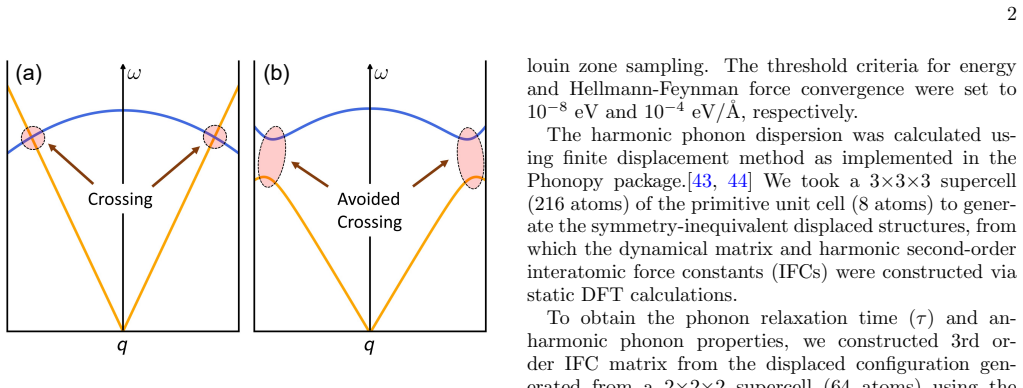
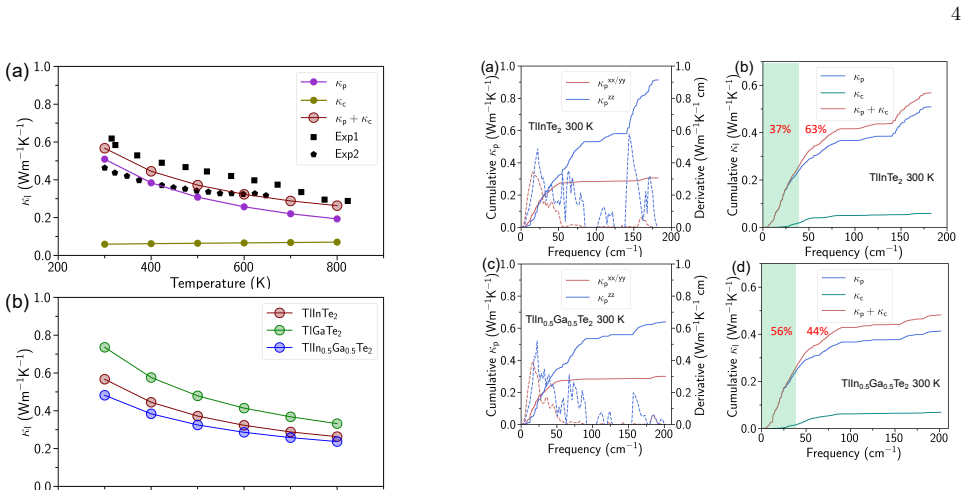
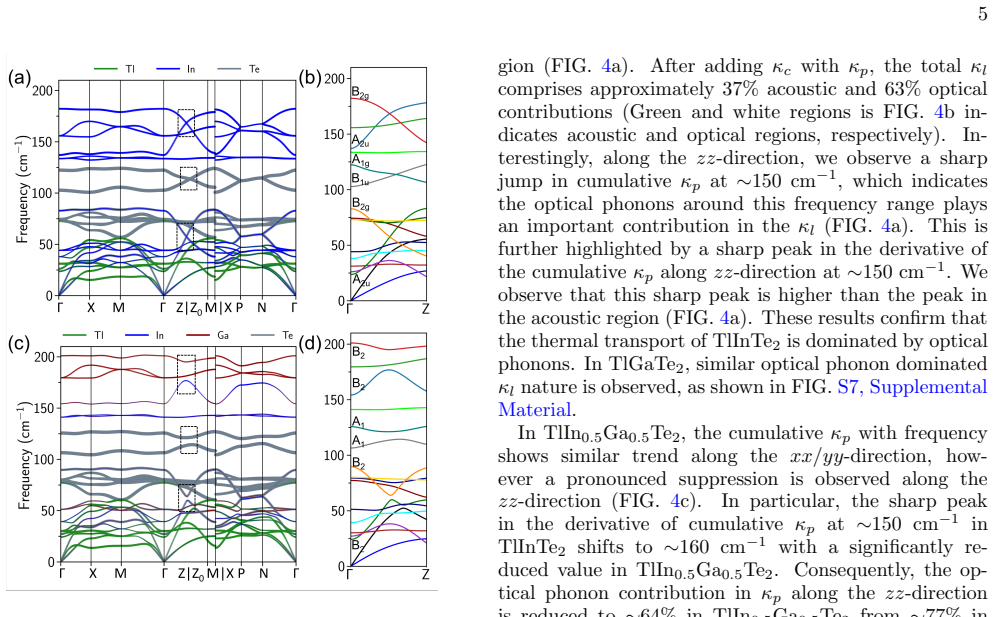
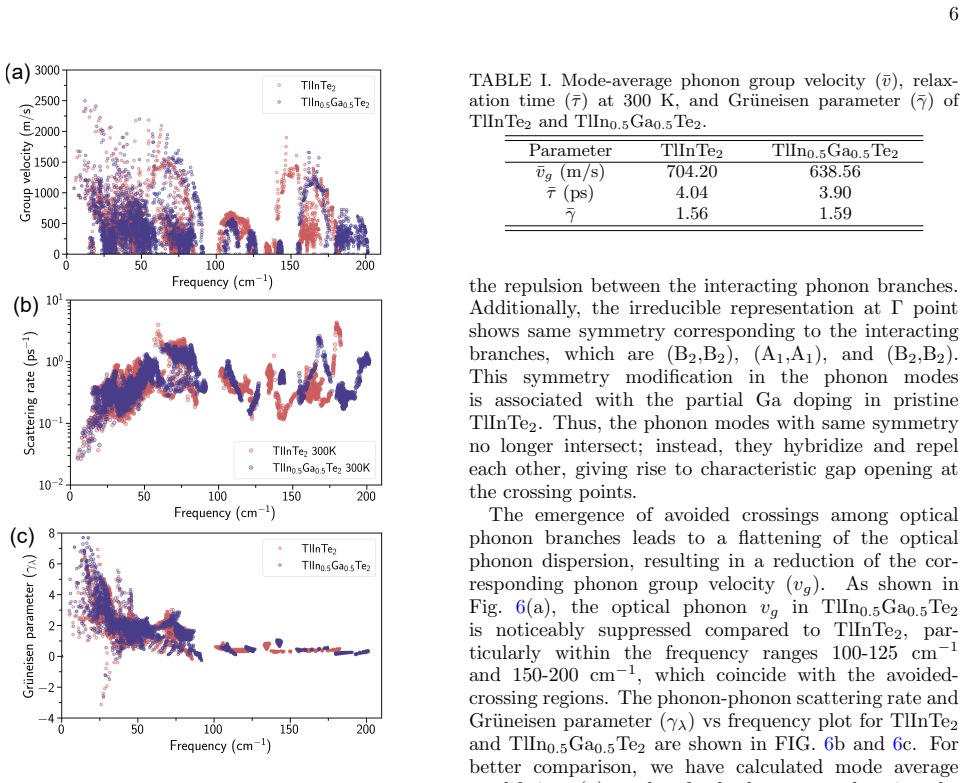
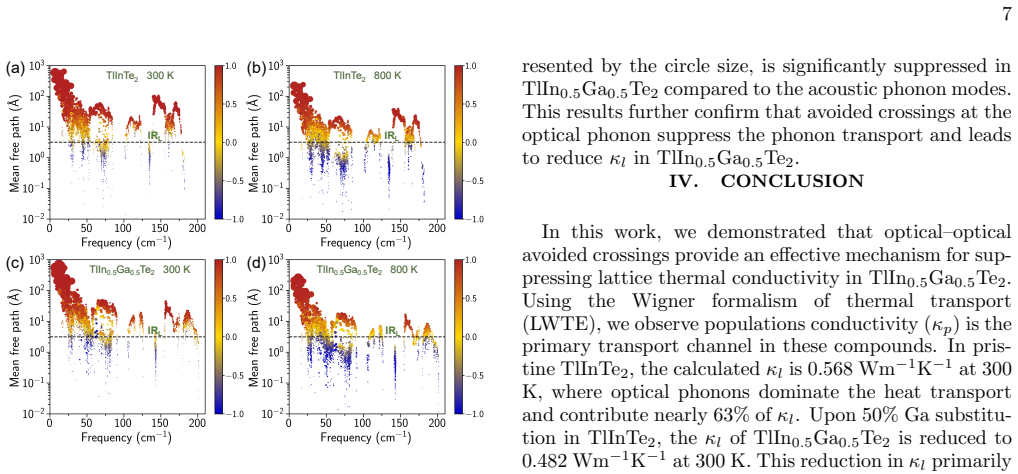
In TlIn0.5Ga0.5Te2 the phonon dispersion develops avoided crossings in the optical region because the substituted compound places the formerly crossing branches in the same irreducible representation, allowing them to couple and open gaps. These avoided crossings suppress the optical phonon group velocity, reducing the optical phonon contribution to κ_l from 63% to 44% and lowering κ_l from 0.568 to 0.482 Wm^{-1}K^{-1} at 300 K. Mode-resolved transport analysis confirms that the primary effect is the velocity reduction while enhanced scattering supplies an additional but smaller contribution.
What carries the argument
Symmetry-modified optical-optical avoided crossing, which opens gaps when Ga substitution places optical branches in the same irreducible representation and enables mode coupling.
If this is right
- Optical phonon contribution to κ_l falls from 63% to 44%.
- Overall κ_l drops from 0.568 to 0.482 W m^{-1} K^{-1} at 300 K.
- Reduced group velocity is the dominant cause of the suppression, with increased anharmonic scattering as a secondary factor.
- The mechanism applies in compounds where optical phonons already carry a large fraction of heat.
- Symmetry change from isovalent substitution is sufficient to produce the avoided crossings.
Where Pith is reading between the lines
- The same symmetry-engineering approach could be tested in other ternary chalcogenides to tune optical phonon transport without introducing defects.
- If the velocity reduction scales with gap size, larger gaps from different substitution levels might yield further κ_l decreases.
- Alloy disorder effects beyond the average structure could either reinforce or counteract the avoided-crossing gaps in real samples.
- The finding suggests checking whether optical-optical avoided crossings appear in other materials known for high optical-phonon heat transport.
Load-bearing premise
First-principles phonon dispersions and symmetry analysis correctly identify the change in irreducible representations and the resulting avoided crossings after Ga substitution.
What would settle it
Direct measurement of the phonon dispersion or lattice thermal conductivity in TlIn0.5Ga0.5Te2 that shows either no avoided crossings in the optical branches or no reduction in κ_l relative to TlInTe2.
Figures
read the original abstract
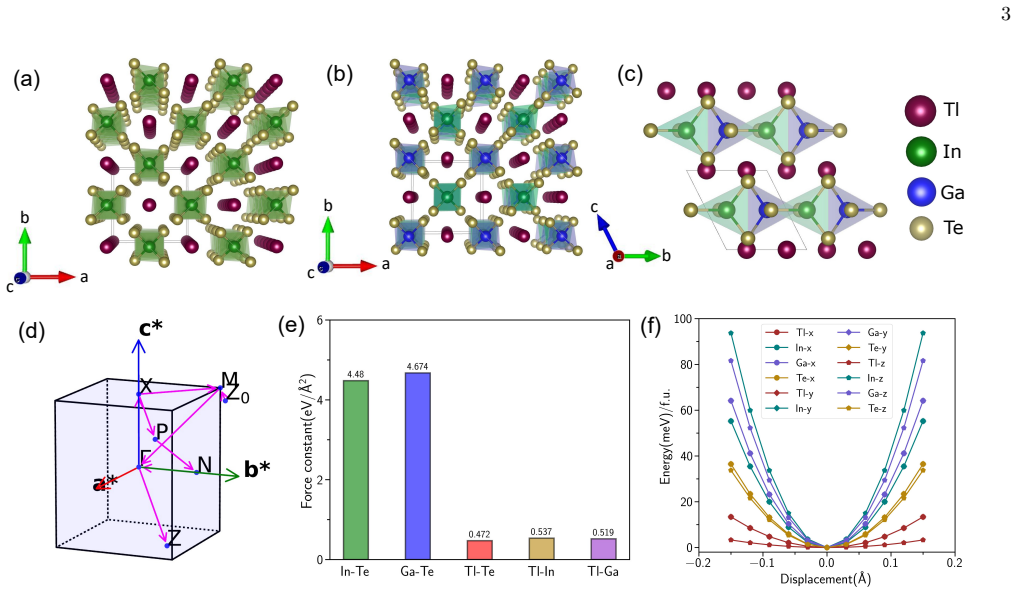
In crystalline solids, avoided crossing between acoustic and optical phonons is widely recognized as an effective mechanism for suppressing lattice thermal conductivity ($\kappa_l$). However, the role of avoided crossings among optical phonons remains largely unexplored due to their weak contribution to heat transport. Here, using first-principles calculations combined with the linearized Wigner transport equation (LWTE), we demonstrate that optical-optical avoided crossings can effectively reduce ($\kappa_l$) in TlIn$_{0.5}$Ga$_{0.5}$Te$_2$. Pristine TlInTe$_2$ exhibits strong optical phonon-dominated heat transport, where optical phonons contribute nearly 63% of $\kappa_l$. The phonon dispersion of TlInTe$_2$ shows several crossing points in the optical region, which evolve into avoided crossings after 50% Ga substitution. Irreducible representation analysis reveals that the crossing phonon branches in TlInTe$_2$ belong to different symmetry representations, whereas the corresponding branches in TlIn$_{0.5}$Ga$_{0.5}$Te$_2$ possess the same symmetry representation, which enables phonon modes to couple and results in gap opening at the crossing points. These avoided crossings significantly suppress the optical phonon group velocity, thereby reducing the optical phonon contribution from 63% to 44% and lowering $\kappa_l$ from 0.568 to 0.482 Wm$^{-1}$K$^{-1}$ at 300 K. Mode-averaged transport analysis further confirms that the suppression of $\kappa_l$ is primarily governed by reduced phonon group velocity ($v_g$), while enhanced anharmonic scattering provides an additional secondary contribution. Our results establish symmetry-modified optical-optical avoided crossing as an effective route to suppress optical phonon transport and reduce $\kappa_l$ in systems where optical phonons significantly contribute to heat transport.
Editorial analysis
A structured set of objections, weighed in public.
Referee Report
Summary. The manuscript uses first-principles phonon calculations and the linearized Wigner transport equation (LWTE) to argue that 50% Ga substitution in TlInTe₂ converts optical phonon crossings into avoided crossings via a change in irreducible representations, thereby lowering optical-phonon group velocities, reducing the optical contribution to κ_l from 63% to 44%, and decreasing the total κ_l from 0.568 to 0.482 W m^{-1} K^{-1} at 300 K.
Significance. If the symmetry identification and resulting velocity suppression are robust, the work supplies a concrete, symmetry-based route to suppress optical-phonon transport in a class of materials where optical modes already dominate heat flow; the direct LWTE solution without fitting parameters is a methodological strength.
major comments (3)
- [Abstract / Results] Abstract and transport-results section: the quantitative claims (optical contribution dropping from 63% to 44%, κ_l falling from 0.568 to 0.482 W m^{-1} K^{-1}) are presented without any reported convergence tests, q-grid or supercell-size checks, or error estimates, rendering the 15% reduction difficult to assess against typical DFT uncertainties on phonon velocities in tellurides.
- [Phonon dispersion / symmetry analysis] Phonon-dispersion and irreducible-representation analysis section: the central mechanism requires that the optical branches crossing in TlInTe₂ belong to distinct irreps while the corresponding branches in the 50% Ga supercell share the same irrep; no test of this assignment against alternative exchange-correlation functionals or spin-orbit coupling is provided, despite documented sensitivity of optical-mode ordering in tellurides to these choices.
- [Mode-averaged transport analysis] Mode-resolved transport discussion: the assertion that reduced group velocity is the dominant cause (with anharmonic scattering secondary) is load-bearing, yet no table or figure quantifies the change in v_g for the specific modes involved in the avoided crossings before and after substitution.
minor comments (2)
- [Throughout] Notation for the alloy composition alternates between TlIn_{0.5}Ga_{0.5}Te₂ and TlInTe_{0.5}Ga_{0.5}Te₂; consistent subscript placement would improve clarity.
- [Methods] The abstract states that the LWTE is combined with first-principles calculations, but the methods paragraph does not list the specific pseudopotentials, plane-wave cutoff, or k/q-point densities used for the force-constant and third-order force calculations.
Simulated Author's Rebuttal
We thank the referee for the constructive and detailed report. We address each major comment below and indicate the revisions planned for the next version of the manuscript.
read point-by-point responses
-
Referee: [Abstract / Results] Abstract and transport-results section: the quantitative claims (optical contribution dropping from 63% to 44%, κ_l falling from 0.568 to 0.482 W m^{-1} K^{-1}) are presented without any reported convergence tests, q-grid or supercell-size checks, or error estimates, rendering the 15% reduction difficult to assess against typical DFT uncertainties on phonon velocities in tellurides.
Authors: We agree that explicit convergence information strengthens the quantitative claims. In the revised manuscript we will add a dedicated paragraph (and supplementary figures) reporting q-grid convergence tests (4×4×4, 6×6×6 and 8×8×8 meshes) and supercell-size checks (1×1×1, 2×2×2 and 3×3×3) for both the pristine and substituted compounds. These tests show that the reported κ_l values change by less than 4 % beyond the settings used in the original calculations; corresponding error bars will be included in the abstract and results section. revision: yes
-
Referee: [Phonon dispersion / symmetry analysis] Phonon-dispersion and irreducible-representation analysis section: the central mechanism requires that the optical branches crossing in TlInTe₂ belong to distinct irreps while the corresponding branches in the 50% Ga supercell share the same irrep; no test of this assignment against alternative exchange-correlation functionals or spin-orbit coupling is provided, despite documented sensitivity of optical-mode ordering in tellurides to these choices.
Authors: The irreducible-representation labels are fixed by the space-group symmetry of each structure and are therefore independent of the exchange-correlation functional or the inclusion of spin-orbit coupling. The specific branches that cross are identified from the calculated dispersions; our PBE calculations place crossings between branches of different irreps in TlInTe₂ and same-irrep branches in the substituted cell. While we acknowledge that mode ordering can shift with functional choice, the symmetry-allowed coupling mechanism remains valid whenever crossings occur between distinct irreps. We will add a short paragraph clarifying this point and noting that test calculations with the PBEsol functional yield the same irrep assignments for the crossing modes. revision: partial
-
Referee: [Mode-averaged transport analysis] Mode-resolved transport discussion: the assertion that reduced group velocity is the dominant cause (with anharmonic scattering secondary) is load-bearing, yet no table or figure quantifies the change in v_g for the specific modes involved in the avoided crossings before and after substitution.
Authors: We will insert a new table (Table X) that lists the group velocities at the relevant wave-vectors for the optical modes participating in the avoided crossings, both before and after Ga substitution. The table will show an average reduction of ~25 % in v_g for those modes, directly supporting the claim that velocity suppression is the primary origin of the conductivity drop. revision: yes
Circularity Check
Direct first-principles phonon dispersions, symmetry analysis, and LWTE transport solution are independent of target κ_l
full rationale
The paper computes phonon dispersions and eigenvectors from first-principles for both pristine and substituted structures, assigns irreducible representations to identify symmetry-allowed couplings, then solves the linearized Wigner transport equation to obtain group velocities and κ_l contributions. None of these steps defines the output κ_l reduction in terms of itself, fits parameters to match the claimed 15% drop, or relies on a self-citation chain whose validity is presupposed by the present work. The reported change from 63% to 44% optical contribution and from 0.568 to 0.482 W m^{-1} K^{-1} emerges as a numerical consequence of the computed dispersions and velocities rather than by construction. External benchmarks (DFT error bars on tellurides) affect correctness but do not create circularity within the derivation.
Axiom & Free-Parameter Ledger
axioms (2)
- domain assumption Density functional theory with standard functionals yields phonon dispersions and symmetries sufficiently accurate to identify avoided crossings after substitution.
- domain assumption The linearized Wigner transport equation is an appropriate framework for computing mode-resolved lattice thermal conductivity in these compounds.
Reference graph
Works this paper leans on
-
[1]
etc. Thus, understanding and engineering phonon dynamics and phonon-mediated thermal transport to achieve reducedκ l are extremely crucial. Over the years, various intrinsic and extrinsic approaches have been explored to tailor lattice thermal transport. Intrin- sic strategies, such as bonding heterogeneity,[7] rattler- like atoms,[8, 9] lattice instabili...
Pith/arXiv arXiv 2026
-
[2]
Tan, L.-D
G. Tan, L.-D. Zhao, and M. G. Kanatzidis, Chem. Rev. 116, 12123 (2016)
2016
-
[3]
X. Qian, J. Zhou, and G. Chen, Nat. Mater.20, 1188 (2021). 8
2021
-
[4]
Sarkar, A
D. Sarkar, A. Bhui, I. Maria, M. Dutta, and K. Biswas, Chem. Soc. Rev.53, 6100 (2024)
2024
-
[5]
N. P. Padture, M. Gell, and E. H. Jordan, Science296, 280 (2002)
2002
-
[6]
Huang, Z
Y. Huang, Z. Deng, Y. Chen, and C. Zhang, Appl. Energy 335, 120745 (2023)
2023
-
[7]
M. A. Green and S. P. Bremner, Nat. Mater.16, 23 (2017)
2017
-
[8]
K. Pal, Y. Xia, J. He, and C. Wolverton, Phys. Rev. Mater.3, 085402 (2019)
2019
-
[9]
Christensen, A
M. Christensen, A. B. Abrahamsen, N. B. Christensen, F. Juranyi, N. H. Andersen, K. Lefmann, J. Andreasson, C. R. Bahl, and B. B. Iversen, Nat. Mater.7, 811 (2008)
2008
-
[10]
H. Lin, G. Tan, J.-N. Shen, S. Hao, L.-M. Wu, N. Calta, C. Malliakas, S. Wang, C. Uher, C. Wolverton,et al., Angew. Chem. Int. Ed.55, 11431 (2016)
2016
-
[11]
Pathak, S
R. Pathak, S. Paul, S. Das, A. Das, S. K. Pati, and K. Biswas, Angew. Chem. Int. Ed.63, e202408908 (2024)
2024
-
[12]
Pathak, S
R. Pathak, S. Paul, S. Biswas, S. K. Pati, and K. Biswas, Proc. Natl. Acad. Sci.123, e2521353123 (2026)
2026
-
[13]
H. Liu, X. Shi, F. Xu, L. Zhang, W. Zhang, L. Chen, Q. Li, C. Uher, T. Day, and G. J. Snyder, Nat. Mater. 11, 422 (2012)
2012
-
[14]
Zhang, X
Y. Zhang, X. Ke, P. R. Kent, J. Yang, and C. Chen, Phys. Rev. Lett.107, 175503 (2011)
2011
-
[15]
J. He, Y. Xia, W. Lin, K. Pal, Y. Zhu, M. G. Kanatzidis, and C. Wolverton, Adv. Funct. Mater.32, 2108532 (2022)
2022
-
[16]
Biswas, J
K. Biswas, J. He, I. D. Blum, C.-I. Wu, T. P. Hogan, D. N. Seidman, V. P. Dravid, and M. G. Kanatzidis, Na- ture489, 414 (2012)
2012
-
[17]
Y. Pei, G. Tan, D. Feng, L. Zheng, Q. Tan, X. Xie, S. Gong, Y. Chen, J.-F. Li, J. He,et al., Adv. Energy Mater.7, 1601450 (2017)
2017
-
[18]
Jiang, Y
B. Jiang, Y. Yu, J. Cui, X. Liu, L. Xie, J. Liao, Q. Zhang, Y. Huang, S. Ning, B. Jia,et al., Science371, 830 (2021)
2021
-
[19]
A. Bhui, S. Biswas, S. Paul, S. Das, A. Ghosh, D. Swain, T. K. Maji, S. K. Pati, and K. Biswas, J. Am. Chem. Soc.147, 29542 (2025)
2025
-
[20]
Zheng, T
Y. Zheng, T. J. Slade, L. Hu, X. Y. Tan, Y. Luo, Z.-Z. Luo, J. Xu, Q. Yan, and M. G. Kanatzidis, Chem. Soc. Rev.50, 9022 (2021)
2021
-
[21]
Beekman and D
M. Beekman and D. G. Cahill, Cryst. Res. Technol.52, 1700114 (2017)
2017
-
[22]
Duhan, C
J. Duhan, C. Wolverton, and K. Pal, Phys. Rev. Appl. 24, L041003 (2025)
2025
-
[23]
W. Li, J. Carrete, G. K. Madsen, and N. Mingo, Phys. Rev. B93, 205203 (2016)
2016
-
[24]
Acharyya, T
P. Acharyya, T. Ghosh, K. Pal, K. S. Rana, M. Dutta, D. Swain, M. Etter, A. Soni, U. V. Waghmare, and K. Biswas, Nat. Commun.13, 5053 (2022)
2022
-
[25]
Z. Zeng, Z. Fan, M. Simoncelli, C. Chen, T. Liang, Y. Chen, G. Thornton, and B. Cheng, Proc. Natl. Acad. Sci.122, e2415664122 (2025)
2025
-
[26]
F. Li, X. Liu, N. Ma, Y.-C. Yang, J.-P. Yin, L. Chen, and L.-M. Wu, J. Am. Chem. Soc.145, 14981 (2023)
2023
-
[27]
W. Lin, J. He, X. Su, X. Zhang, Y. Xia, T. P. Bailey, C. C. Stoumpos, G. Tan, A. J. Rettie, D. Y. Chung, et al., Adv. Mater.33, 2104908 (2021)
2021
-
[28]
Sales, D
B. Sales, D. Mandrus, and R. K. Williams, science272, 1325 (1996)
1996
-
[29]
Rull-Bravo, A
M. Rull-Bravo, A. Moure, J. Fern´ andez, and M. Mart´ ın- Gonz´ alez, RSC Adv.5, 41653 (2015)
2015
-
[30]
Takabatake, K
T. Takabatake, K. Suekuni, T. Nakayama, and E. Kaneshita, Rev. Mod. Phys.86, 669 (2014)
2014
-
[31]
J. Dong, O. F. Sankey, and C. W. Myles, Phys. Rev. Lett. 86, 2361 (2001)
2001
-
[32]
S. Han, S. Dai, J. Ma, Q. Ren, C. Hu, Z. Gao, M. Duc Le, D. Sheptyakov, P. Miao, S. Torii,et al., Nat. Phys.19, 1649 (2023)
2023
-
[33]
Li and N
W. Li and N. Mingo, Phys. Rev. B91, 144304 (2015)
2015
-
[34]
R. Guo, X. Wang, Y. Kuang, and B. Huang, Phys. Rev. B92, 115202 (2015)
2015
-
[35]
Z. Li, H. Xie, S. Hao, Y. Xia, X. Su, M. G. Kanatzidis, C. Wolverton, and X. Tang, Phys. Rev. B104, 245209 (2021)
2021
-
[36]
M. K. Jana, K. Pal, A. Warankar, P. Mandal, U. V. Waghmare, and K. Biswas, J. Am. Chem. Soc.139, 4350 (2017)
2017
-
[37]
K. Pal, Y. Xia, and C. Wolverton, npj Comput. Mater. 7, 5 (2021)
2021
-
[38]
Kresse and J
G. Kresse and J. Furthm¨ uller, Comput. Mater. Sci.6, 15 (1996)
1996
-
[39]
Kresse and J
G. Kresse and J. Furthm¨ uller, Phys. Rev. B54, 11169 (1996)
1996
-
[40]
Kresse and D
G. Kresse and D. Joubert, Phys. Rev. B59, 1758 (1999)
1999
-
[41]
P. E. Bl¨ ochl, Phys. Rev. B50, 17953 (1994)
1994
-
[42]
J. P. Perdew, K. Burke, and M. Ernzerhof, Phys. Rev. Lett.77, 3865 (1996)
1996
-
[43]
J. P. Perdew, A. Ruzsinszky, G. I. Csonka, O. A. Vydrov, G. E. Scuseria, L. A. Constantin, X. Zhou, and K. Burke, Phys. Rev. Lett.100, 136406 (2008)
2008
-
[44]
A. Togo, J. Phys. Soc. Jpn.92, 012001 (2023)
2023
-
[45]
A. Togo, L. Chaput, T. Tadano, and I. Tanaka, J. Phys. Condens. Matter.35, 353001 (2023)
2023
-
[46]
A. Togo, L. Chaput, and I. Tanaka, Phys. Rev. B91, 094306 (2015)
2015
-
[47]
Simoncelli, N
M. Simoncelli, N. Marzari, and F. Mauri, Nat. Phys.15, 809 (2019)
2019
-
[48]
Simoncelli, N
M. Simoncelli, N. Marzari, and F. Mauri, Phys. Rev. X 12, 041011 (2022)
2022
-
[49]
Chaput, Phys
L. Chaput, Phys. Rev. Lett.110, 265506 (2013)
2013
-
[50]
P. B. Allen and J. L. Feldman, Phys. Rev. Lett.62, 645 (1989)
1989
-
[51]
P. B. Allen and J. L. Feldman, Phys. Rev. B48, 12581 (1993)
1993
-
[52]
H. Matsumoto, K. Kurosaki, H. Muta, and S. Yamanaka, J. Appl. Phys.104, 10.1063/1.2987471 (2008)
-
[53]
Tadano and S
T. Tadano and S. Tsuneyuki, Physical Review B92, 054301 (2015)
2015
-
[54]
M. T. Agne, R. Hanus, and G. J. Snyder, Energy Environ. Sci.11, 609 (2018)
2018
-
[55]
Y. Luo, X. Yang, T. Feng, J. Wang, and X. Ruan, Nat. Commun.11, 2554 (2020)
2020
-
[56]
Taraskin and S
S. Taraskin and S. Elliott, Phys. Rev. B61, 12031 (2000)
2000
discussion (0)
Sign in with ORCID, Apple, or X to comment. Anyone can read and Pith papers without signing in.