Inverse Design of Realizable Metasurface based Absorbers using Improved Conditioning and Diversity Enhanced Progressively Growing GANs
Pith reviewed 2026-06-28 00:08 UTC · model grok-4.3
The pith
A GAN with spectral conditioning and diversity regularization generates accurate and realizable metasurface absorber designs.
A machine-rendered reading of the paper's core claim, the machinery that carries it, and where it could break.
Core claim
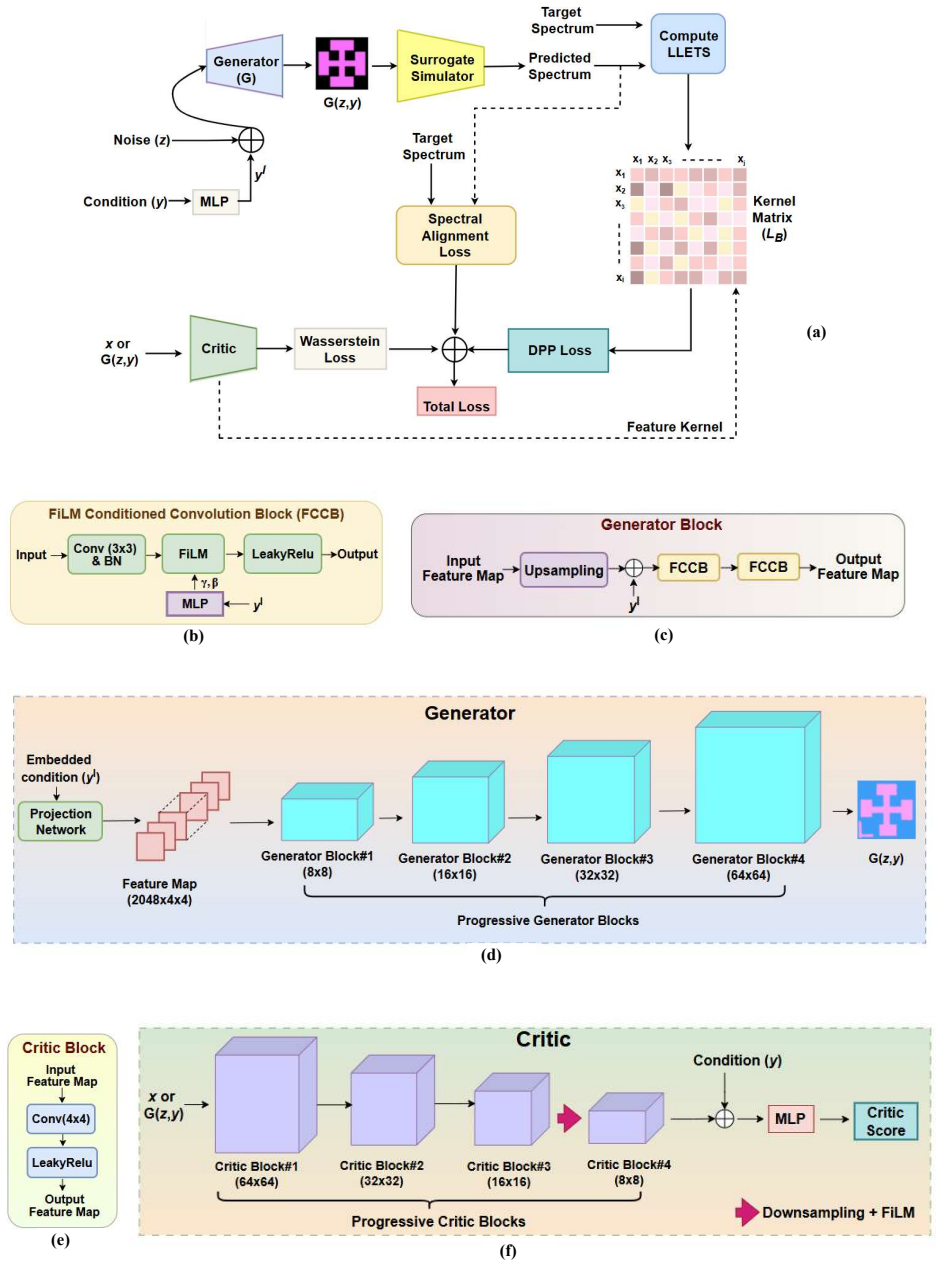
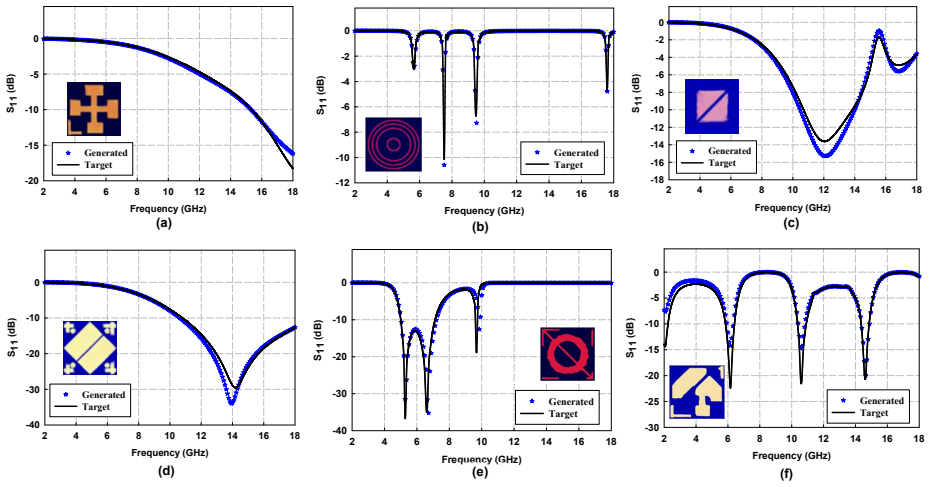
The paper claims that the proposed framework, which integrates feature-wise linear modulation conditioning into a progressively growing Wasserstein GAN with gradient penalty, along with a surrogate-assisted spectral alignment loss and determinantal point process diversity regularization, generates metasurface absorber designs that are highly accurate, diverse, electromagnetically consistent, and fabrication realizable, as shown by average mean squared error of 0.0052, diversity score of 0.8730, band alignment accuracy of 0.8533, and 89.57 percent valid designs validated by EM simulations.
What carries the argument
Progressively growing WGAN-GP with FiLM conditioning, surrogate spectral alignment loss, and DPP-based diversity regularization that enforces physical consistency and variety during generation.
If this is right
- The designs match target spectra with high accuracy as measured by low mean squared error.
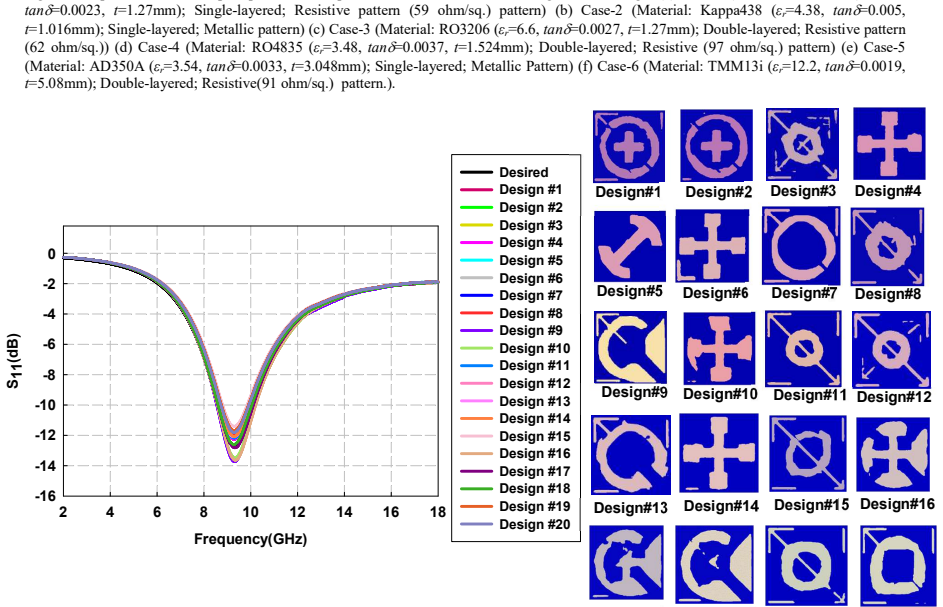
- Multiple diverse geometries are produced for identical spectral targets.
- The generated structures are electromagnetically consistent and fabrication realizable.
- Band alignment accuracy reaches 0.8533 for the absorber responses in 2-18 GHz.
- Valid electromagnetic design generation rate is 89.57 percent.
Where Pith is reading between the lines
- This method could shorten design times for metasurfaces by avoiding repeated full-wave optimizations.
- Similar conditioning and loss strategies might apply to inverse design of other wave-manipulating structures.
- Selecting from the diverse outputs based on additional criteria like material cost could enhance practicality.
- Extending the frequency range or adding more fabrication constraints in training would test broader applicability.
Load-bearing premise
The surrogate model used in the spectral alignment loss correctly approximates the electromagnetic behavior of the generated metasurfaces.
What would settle it
Full-wave simulations revealing that many generated designs have reflection spectra far from the targets or geometries that cannot be fabricated would disprove the framework's effectiveness.
Figures
read the original abstract
Metasurfaces enable precise manipulation of electromagnetic waves for applications such as beam steering, sensing, and stealth technology. However, inverse design of metasurfaces with targeted EM responses remains challenging due to the computational expense of iterative full wave simulation driven optimization and the limited conditioning fidelity and diversity of existing generative approaches. To address these challenges, this paper presents a generative inverse design framework for controllable and physically consistent metasurface synthesis under continuous spectral constraints. The proposed approach employs a progressively growing Wasserstein generative adversarial network with gradient penalty integrated with feature wise linear modulation based conditioning for stable propagation of continuous spectral and fabrication constraints. EM consistency is embedded directly into the generative learning process through a surrogate assisted spectral alignment loss, enabling physics constrained generation during training. Further, a determinantal point process based diversity regularization strategy is incorporated to generate geometrically diverse yet spectrally consistent realizations for the same target response. The effectiveness of the proposed framework is demonstrated through the generation of practically realizable metasurface absorbers exhibiting diverse reflection characteristics in the frequency range of 2 to 18 GHz. EM simulations validate that the generated designs meet the target specifications with high accuracy. The final proposed framework achieved an average mean squared error of 0.0052, diversity score of 0.8730, band alignment accuracy of 0.8533, and a valid EM design generation percentage of 89.57, clearly demonstrating its capability to generate highly accurate, diverse, electromagnetically consistent and fabrication realizable metasurface configurations.
Editorial analysis
A structured set of objections, weighed in public.
Referee Report
Summary. The paper proposes a progressively growing Wasserstein GAN with gradient penalty, FiLM-based conditioning for continuous spectral and fabrication constraints, a surrogate-assisted spectral alignment loss to embed EM consistency during training, and DPP-based diversity regularization. It claims generation of realizable metasurface absorbers (2-18 GHz) with average MSE 0.0052, diversity score 0.8730, band alignment accuracy 0.8533, and 89.57% valid designs, with EM simulations validating that generated designs meet target specifications.
Significance. If the surrogate generalizes accurately to generated geometries, the framework could advance inverse metasurface design by enabling physics-constrained generation without full-wave simulation in the training loop while promoting diversity. The integration of progressive growing, conditioning, surrogate loss, and diversity regularization addresses multiple known challenges in the area.
major comments (3)
- [Abstract] Abstract: The reported aggregate metrics (MSE of 0.0052, 89.57% valid EM designs) supply no details on the number of designs evaluated, the exact validation protocol (including how many full-wave simulations were run post-generation), error bars, baseline comparisons, or post-hoc selection criteria, rendering the central performance claims difficult to evaluate.
- [Abstract] Abstract (surrogate-assisted spectral alignment loss): The claim that the surrogate loss produces electromagnetically consistent designs (MSE 0.0052, 89.57% valid) without full-wave simulation during training rests on the unverified assumption that the surrogate generalizes to novel geometries produced by the GAN. No quantitative surrogate-vs-full-wave spectral comparison on held-out generated samples, no information on whether the surrogate was trained on the same distribution as the generated designs, and no ablation removing the surrogate loss are provided.
- [Abstract] Abstract / framework description: No ablation studies are reported to quantify the individual contributions of the surrogate loss versus the diversity regularization (or the progressive growing and FiLM conditioning) to the final metrics, leaving the load-bearing role of each component untested.
Simulated Author's Rebuttal
We thank the referee for their constructive comments on our manuscript. We address each major comment point-by-point below, indicating where revisions will be made to improve clarity and completeness.
read point-by-point responses
-
Referee: [Abstract] Abstract: The reported aggregate metrics (MSE of 0.0052, 89.57% valid EM designs) supply no details on the number of designs evaluated, the exact validation protocol (including how many full-wave simulations were run post-generation), error bars, baseline comparisons, or post-hoc selection criteria, rendering the central performance claims difficult to evaluate.
Authors: We agree that the abstract would benefit from greater specificity on the evaluation setup. In the revised manuscript we will expand the abstract to report the number of designs evaluated, the validation protocol including the number of post-generation full-wave simulations performed, error bars from repeated runs, baseline comparisons, and confirmation that no post-hoc selection was applied beyond the validity criteria defined in the methods. revision: yes
-
Referee: [Abstract] Abstract (surrogate-assisted spectral alignment loss): The claim that the surrogate loss produces electromagnetically consistent designs (MSE 0.0052, 89.57% valid) without full-wave simulation during training rests on the unverified assumption that the surrogate generalizes to novel geometries produced by the GAN. No quantitative surrogate-vs-full-wave spectral comparison on held-out generated samples, no information on whether the surrogate was trained on the same distribution as the generated designs, and no ablation removing the surrogate loss are provided.
Authors: The surrogate was trained on geometries drawn from the same parameter ranges used for GAN training and generation. We will revise the manuscript to include a quantitative surrogate-versus-full-wave comparison on held-out generated samples and an ablation that removes the surrogate-assisted loss, thereby directly addressing the generalization concern. revision: yes
-
Referee: [Abstract] Abstract / framework description: No ablation studies are reported to quantify the individual contributions of the surrogate loss versus the diversity regularization (or the progressive growing and FiLM conditioning) to the final metrics, leaving the load-bearing role of each component untested.
Authors: We acknowledge that explicit ablation studies would strengthen the claims. The revised manuscript will add ablation experiments that isolate the surrogate loss, DPP diversity regularization, progressive growing, and FiLM conditioning to quantify their individual effects on the reported metrics. revision: yes
Circularity Check
No circularity: framework uses independent surrogate training and external EM validation
full rationale
The paper trains a progressively growing WGAN with a surrogate-assisted spectral alignment loss to enforce EM consistency during generation, then reports final performance metrics (MSE 0.0052, 89.57% valid) after explicit full-wave EM simulations on the generated designs. No equation or step reduces a claimed prediction to a fitted parameter by construction, nor does any load-bearing claim rest solely on self-citation of an unverified uniqueness result. The surrogate is presented as a separate model whose outputs are cross-checked by independent EM simulation; the diversity regularization and conditioning are standard architectural choices whose effectiveness is measured against held-out targets. This keeps the central claims externally falsifiable and self-contained against the reported validation protocol.
Axiom & Free-Parameter Ledger
free parameters (2)
- GAN training hyperparameters and loss weights
- Surrogate model architecture and training data
axioms (1)
- domain assumption The surrogate model provides sufficiently accurate electromagnetic response predictions to guide generation
Reference graph
Works this paper leans on
-
[1]
An overview of the theory and applications of metasurfaces: The two-dimensional equivalents of metamaterials,
C. L. Holloway, E. F. Kuester, J. A. Gordon, J. O'Hara, J. Booth, and D. R. Smith, “An overview of the theory and applications of metasurfaces: The two-dimensional equivalents of metamaterials,” IEEE Antennas Propag. Mag., vol. 54, no. 2, pp. 10–35, Apr. 2012
2012
-
[2]
A review of metasurfaces: physics and applications,
H.-T. Chen, A. J. Taylor, and N. Yu, “A review of metasurfaces: physics and applications,” Rep. Prog. Phys., vol. 79, no. 7, p. 076401, 2016
2016
-
[3]
Negative refraction makes a perfect lens,
J. B. Pendry, “Negative refraction makes a perfect lens,” Phys. Rev. Lett., vol. 85, no. 18, pp. 3966–3969, Oct. 2000
2000
-
[4]
Composite medium with simultaneously negative permeability and permittivity,
D. R. Smith, W. J. Padilla, D. C. Vier, S. C. Nemat-Nasser, and S. Schultz, “Composite medium with simultaneously negative permeability and permittivity,” Phys. Rev. Lett., vol. 84, no. 18, pp. 4184–4187, May 2000
2000
-
[5]
Metasurfaces: From microwaves to visible,
S. B. Glybovski, S. A. Tretyakov, P. A. Belov, Y. S. Kivshar, and C. R. Simovski, “Metasurfaces: From microwaves to visible,” Physics Reports, vol. 634, pp. 1–72, 2016
2016
-
[6]
Kats, Francesco Aieta, Jean-Philippe Tetienne, Fed- erico Capasso, and Zeno Gaburro
N. Yu, P. Genevet, M. A. Kats, F. Aieta, J.-P. Tetienne, F. Capasso, and Z. Gaburro, “Light propagation with phase discontinuities: Generalized laws of reflection and refraction,” Science, vol. 334, no. 6054, pp. 333–337, Oct. 2011, doi: 10.1126/science.1210713
-
[7]
Planar photonics with metasurfaces,
A. V. Kildishev, A. Boltasseva, and V. M. Shalaev, “Planar photonics with metasurfaces,” Science, vol. 339, no. 6125, p. 1232009, Mar. 2013, doi: 10.1126/science.1232009
-
[8]
Flat optics with designer metasurfaces,
N. Yu and F. Capasso, “Flat optics with designer metasurfaces,” Nature Materials, vol. 13, no. 2, pp. 139–150, Feb. 2014, doi: 10.1038/nmat3839
-
[9]
Metasurface holograms for visible light,
X. Ni, A. V. Kildishev, and V. M. Shalaev, “Metasurface holograms for visible light,” Nature Communications, vol. 4, p. 2807, Dec. 2013, doi: 10.1038/ncomms3807
-
[10]
Devlin, Jaewon Oh, Alexander Y
M. Khorasaninejad, W. T. Chen, R. C. Devlin, J. Oh, A. Y. Zhu, and F. Capasso, “Metalenses at visible wavelengths: Diffraction- limited focusing and subwavelength resolution imaging,” Science, vol. 352, no. 6290, pp. 1190–1194, Jun. 2016, doi: 10.1126/science.aaf6644
-
[11]
Metalenses: Versatile multifunctional photonic components,
M. Khorasaninejad and F. Capasso, “Metalenses: Versatile multifunctional photonic components,” Science, vol. 358, no. 6367, p. eaam8100, Nov. 2017, doi: 10.1126/science.aam8100
-
[12]
Metamaterial Huygens’ surfaces: Tailoring wave fronts with reflectionless sheets,
C. Pfeiffer and A. Grbic, “Metamaterial Huygens’ surfaces: Tailoring wave fronts with reflectionless sheets,” Physical Review Letters, vol. 110, no. 19, p. 197401, May 2013, doi: 10.1103/PhysRevLett.110.197401
-
[13]
F. Ding, A. Pors, and S. I. Bozhevolnyi, “Gradient metasurfaces: A review of fundamentals and applications,” Reports on Progress in Physics, vol. 81, no. 2, p. 026401, Feb. 2018, doi: 10.1088/1361- 6633/aa8732
-
[14]
S. Jahani and Z. Jacob, “All-dielectric metamaterials,” Nature Nanotechnology, vol. 11, no. 1, pp. 23–36, Jan. 2016, doi: 10.1038/nnano.2015.304
-
[15]
Inverse designed plasmonic metasurface with parts per billion optical hydrogen detection,
F. A. A. Nugroho, G. W. Castellanos, P. Bai, I. Darmadi, J. Fritzsche, J. Gómez Rivas, and A. Baldi, “Inverse designed plasmonic metasurface with parts per billion optical hydrogen detection,” Nature Materials, vol. 18, no. 5, pp. 489–495, May 2019, doi: 10.1038/s41563-019-0296-9
-
[16]
Metasurfaces for stealth applications: A comprehensive review,
V. Joy, A. Dileep, P. V. Abhilash, R. U. Nair, H. Singh, “Metasurfaces for stealth applications: A comprehensive review,” Journal of Electronics Materials, vol. 50, no. 6, pp. 3129–3148, Jun. 2021
2021
-
[17]
Broadband multifunctional efficient meta-gratings based on dielectric waveguide phase shifters,
M. Khorasaninejad and F. Capasso, “Broadband multifunctional efficient meta-gratings based on dielectric waveguide phase shifters,” Nano Letters, vol. 15, no. 10, pp. 6709–6715, Oct. 2015
2015
-
[18]
Structured transparent low emissivity coatings with high microwave transmission,
O. Bouvard, M. Lanini, and L. Burnier, “Structured transparent low emissivity coatings with high microwave transmission,” Applied Physics A, vol. 123, no. 1, Art. no. 66, 2017
2017
-
[19]
Empowering metasurfaces with inverse design: Principles and applications,
Z. Li, R. Pestourie, Z. Lin, S. G. Johnson, and F. Capasso, “Empowering metasurfaces with inverse design: Principles and applications,” ACS Photonics, vol. 9, no. 7, pp. 2178–2192, Jul. 2022, doi: 10.1021/acsphotonics.1c01850
-
[20]
Global optimization of metasurface designs using statistical learning methods,
M. M. R. Elsawy, S. Lanteri, R. Duvigneau, G. Brière, M. S. Mohamed & P. Genevet, “Global optimization of metasurface designs using statistical learning methods,” Scientific Reports, vol. 9, p. 17918, 2019, doi: 10.1038/s41598-019-53878-9
-
[21]
Large-scale photonic inverse design: Computational challenges and breakthroughs,
C. Kang, C. Park, M. Lee, J. Kang, M. S. Jang, and H. Chung, “Large-scale photonic inverse design: Computational challenges and breakthroughs,” Nanophotonics, vol. 13, no. 20, pp. 3765– 3792, Jun. 2024, doi: 10.1515/nanoph-2024-0127
-
[22]
Deep learning enabled inverse design in nanophotonics,
S. So, T. Badloe, J. Noh, J. Bravo-Abad, and J. Rho, “Deep learning enabled inverse design in nanophotonics,” Nanophotonics, vol. 9, no. 5, pp. 1041–1057, 2020
2020
-
[23]
Training deep neural networks for the inverse design of nanophotonic structures,
D. Liu, Y. Tan, E. Khoram, and Z. Yu, “Training deep neural networks for the inverse design of nanophotonic structures,” ACS Photonics, vol. 5, no. 4, pp. 1365–1369, 2018
2018
-
[24]
Generative model for the inverse design of metasurfaces,
Z. Liu, D. Zhu, K. Lee, A. S. Kim, and J. R. W. Mark, “Generative model for the inverse design of metasurfaces,” ACS Nano, vol. 12, no. 7, pp. 7073–7083, 2018
2018
-
[25]
Prediction of multi-layer metasurface design using conditional deep convolutional generative adversarial networks,
A. Nezaratizadeh, S. M. Hashemi, and M. Bod., “Prediction of multi-layer metasurface design using conditional deep convolutional generative adversarial networks,” International Journal for Light and Electron Optics, vol. 313, p. 172005, 2024
2024
-
[26]
Single-layer metasurface design with symmetrical free-form patterns using generative adversarial networks,
G. Dai, H. Li, X. Zhang, and Y. Liu, “Single-layer metasurface design with symmetrical free-form patterns using generative adversarial networks,” Applied Soft Computing, vol. 127, Art. no. 109353, 2022
2022
-
[27]
A cyclical deep learning based framework for simultaneous inverse and forward design of nanophotonic metasurfaces,
A. Mall, A. Patil, A. Sethi & A. Kumar, “A cyclical deep learning based framework for simultaneous inverse and forward design of nanophotonic metasurfaces,” Scientific Reports, Article number: 19427, 2020
2020
-
[28]
Fast design of plasmonic metasurfaces enabled by deep learning,
A. Mall, A. Patil, D. Tamboli, A. Sethi and A. Kumar, “Fast design of plasmonic metasurfaces enabled by deep learning,” Journal of Physics D: Applied Physics, vol. 53, no. 49, October 2020
2020
-
[29]
A generative machine learning-based approach for inverse design of multilayer metasurfaces,
P. Naseri and S. V. Hum, “A generative machine learning-based approach for inverse design of multilayer metasurfaces,” IEEE Transactions on Antennas and Propagation, vol. 69, no. 9, pp. 5725 5739, Sep. 2021
2021
-
[30]
Design of Metamaterials for Absorbers Based on Variational Autoencoder,
Q. Li, J. Wang, T. Lei, T. Xiang, C. Qin and M. Yang, “Design of Metamaterials for Absorbers Based on Variational Autoencoder,” IEEE Access, vol. 12, pp. 92328-92336, 2024
2024
-
[31]
VAE enhanced tandem neural network for reverse design of metasurface structural-colors with high efficiency and accuracy,
W. Lin, J. Zhang, Z. Zou, Y. Lin, Y. Peng, W. Yang, Y. Zhang, T. Guo, C. Wu, and X. Zhou, “VAE enhanced tandem neural network for reverse design of metasurface structural-colors with high efficiency and accuracy,” Optics Communications, vol. 601, p. 132760, 2026
2026
-
[32]
Optimizing metamaterial inverse design with 3D conditional diffusion model and data augmentation,
X. Zheng, J. Shiomi and T. Yamada, “Optimizing metamaterial inverse design with 3D conditional diffusion model and data augmentation,” Advanced Materials Tech., vol. 10, 10p., 2025
2025
-
[33]
PaDGAN: A generative adversarial network for performance augmented diverse designs,
W. Chen and F. Ahmed, “PaDGAN: A generative adversarial network for performance augmented diverse designs,” arXiv preprint arXiv:2002.11304, 2020
arXiv 2002
-
[34]
Continuous conditional generative adversarial networks: Novel empirical losses and label input mechanisms,
X. Ding, Y. Wang, Z. Xu, W. J. Welch, and Z. J. Wang, “Continuous conditional generative adversarial networks: Novel empirical losses and label input mechanisms,” IEEE Trans.Pattern Analysis and Machine Intelligence, vol. 45, no. 7, pp. 8143-8158, Jul. 2023
2023
-
[35]
PcDGAN: A Continuous Conditional Diverse Generative Adversarial Network for Inverse Design,
A. H. Nobari, W. Chen, and F. Ahmed, “PcDGAN: A Continuous Conditional Diverse Generative Adversarial Network for Inverse Design,” in Proc. 27th ACM SIGKDD Conf. Knowl. Discovery Data Mining (KDD '21), Virtual Event, Singapore, Aug. 2021, pp. 1–12. doi: 10.1145/3447548.3467414
-
[36]
Improved training of Wasserstein GANs,
I. Gulrajani, F. Ahmed, M. Arjovsky, V. Dumoulin, and A. C. Courville, “Improved training of Wasserstein GANs,” in Adv. Neural Inf. Process. Syst. (NIPS), vol. 30, pp. 5767–5777, 2017
2017
-
[37]
Kulesza and B
A. Kulesza and B. Taskar, Determinantal Point Processes for Machine Learning. Hanover, MA, USA: Now Publishers Inc., Nov. 2012, pp. 1–178, ISBN: 978-1-60198-628-3
2012
-
[38]
Kernel methods in machine learning,
T. Hofmann, B. Schölkopf, and A. J. Smola, “Kernel methods in machine learning,” The Annals of Statistics, vol. 36, no. 3, pp. 1171–1220, 2008
2008
-
[39]
R. M. Corless, G. H. Gonnet, D. E. G. Hare, D. J. Jeffrey, and D. E. Knuth, “On the Lambert W function,” Advances in Computational Mathematics, vol. 5, no. 1, pp. 329–359, 1996, doi: 10.1007/BF02124750
-
[40]
FiLM: Visual reasoning with a general conditioning layer,
E. Perez, F. Strub, H. de Vries, V. Dumoulin, and A. Courville, “FiLM: Visual reasoning with a general conditioning layer,” in Proceedings of the Thirty-Second AAAI Conference on Artificial Intelligence, Article No.: 483, pp. 3942 - 3951, 2018
2018
-
[41]
CST Studio Suite®, CST AG, Germany, www.cst.com
-
[42]
C. M. Bishop, Pattern Recognition and Machine Learning. New York, NY, USA: Springer, 2006
2006
-
[43]
Boundary IoU: Improving object-centric image segmentation evaluation,
B. Cheng, R. Girshick, P. Dollár, A. C. Berg, and A. Kirillov, “Boundary IoU: Improving object-centric image segmentation evaluation,” in Proc. IEEE/CVF Conf. Comput. Vis. Pattern Recognit. (CVPR), Nashville, TN, USA, 2021, pp. 15334–15342
2021
discussion (0)
Sign in with ORCID, Apple, or X to comment. Anyone can read and Pith papers without signing in.