REVIEW 2 major objections 3 minor 2 cited by
Towards stable and accurate electron dynamics via neural network based time-dependent variational Monte Carlo
T0 review · 2 major / 3 minor · reviewed 2026-06-27 · grok-4.3
Pith's one-line read Neural network variational Monte Carlo enables stable and accurate real-time electron dynamics.
desk verdict Stable neural TD-VMC on small systems via manifold constraint, with clean benchmarks but limited scope so far. read the letter →
The pith
A machine-rendered reading of the paper's core claim, the machinery that carries it, and where it could break.
The reading
What carries the argument
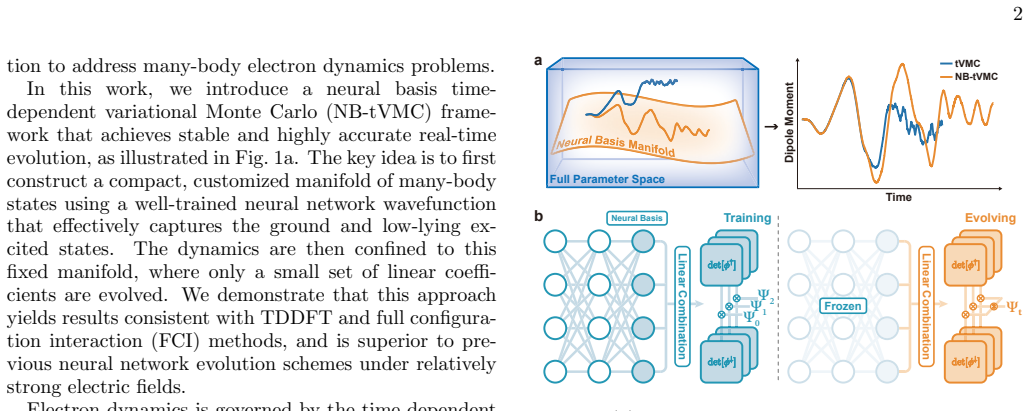
The neural basis time-dependent variational Monte Carlo framework, which uses neural network ansatzes to define a manifold that constrains the time evolution of the wavefunction.
What would settle it
If high-precision reference calculations for the hydrogen atom's laser-driven dipole response show large deviations from the neural network results over long simulation times, the claim of benchmark accuracy would be falsified.
Extended reading notes
Core claim
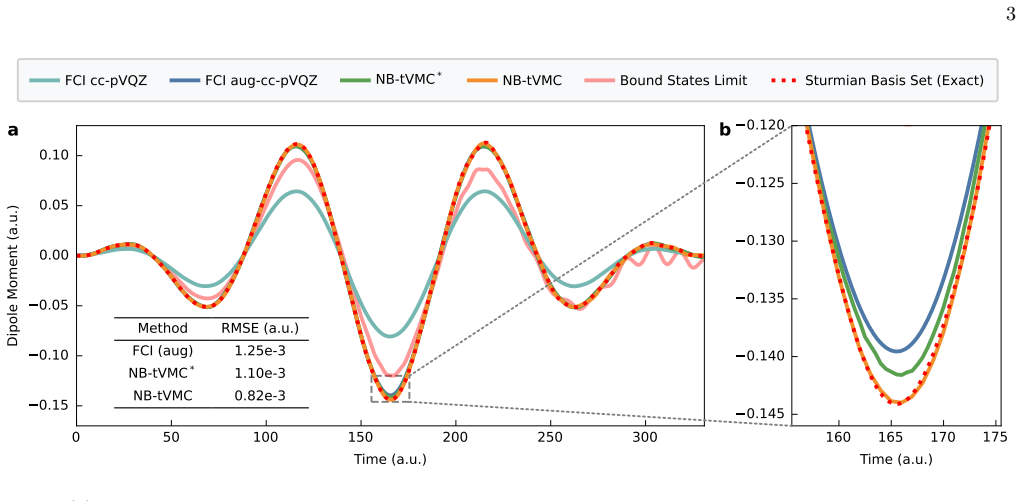
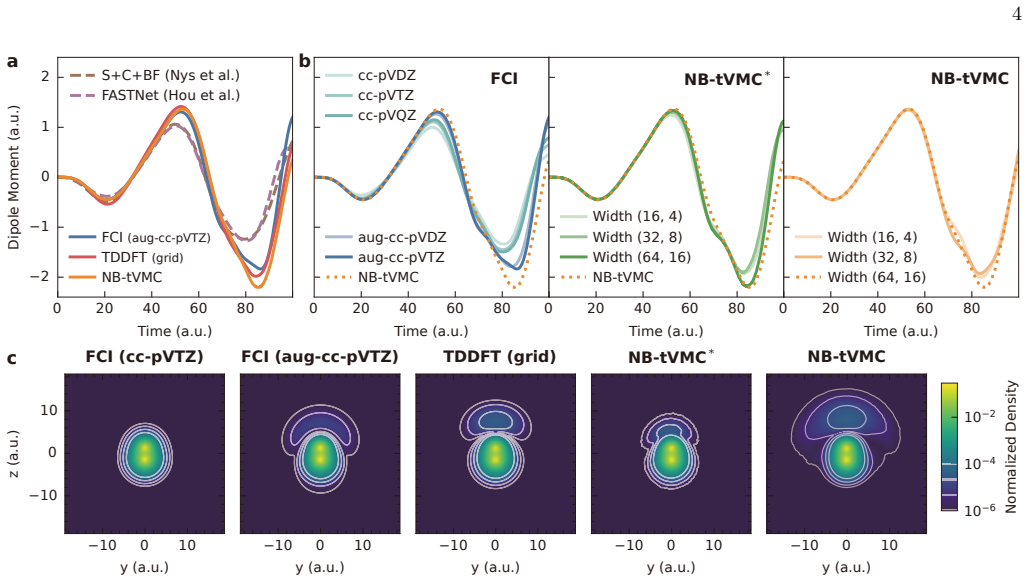
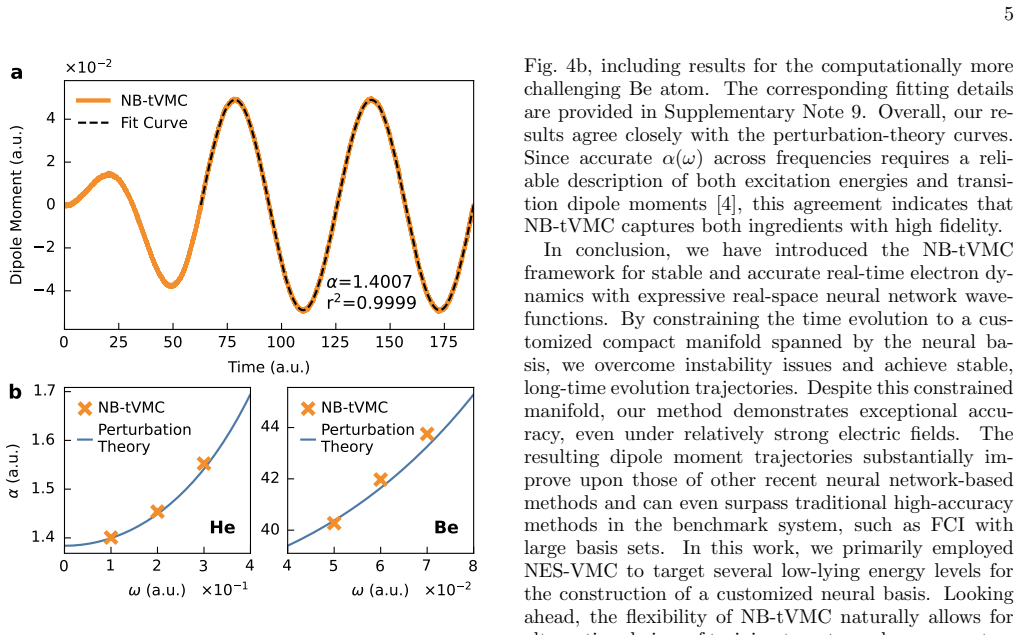
By constraining the time evolution to a compact, customized manifold spanned by the neural basis, the neural basis time-dependent variational Monte Carlo framework bypasses instability issues and achieves long-term stable evolution with benchmark-quality accuracy in simulating the laser-driven dipole responses of the hydrogen atom and a stretched hydrogen molecule, and accurately extracts the dynamic polarizabilities of helium and beryllium atoms.
Load-bearing premise
Limiting the wavefunction evolution to the neural basis manifold is enough to capture the essential physics of the driven electron dynamics without introducing significant errors.
Editorial extensions
If this is right
- Long-term stable simulations of real-time electron dynamics become feasible.
- Benchmark accuracy is reached for laser-driven responses in small atoms and molecules.
- Dynamic polarizabilities can be extracted accurately from the simulations.
- The approach provides a route for first-principles simulations of complex time-dependent electronic phenomena.
Reading between the lines
- Scaling this method to larger molecular systems could enable simulations previously inaccessible due to instability.
- Integration with other neural network techniques might improve handling of excited states or correlations.
- Testing on more complex laser-driven processes would reveal the limits of the manifold approximation.
Editorial analysis
A structured set of objections, weighed in public.
Referee Report
Summary. The manuscript introduces the neural basis time-dependent variational Monte Carlo (NB-TDVMC) framework. By restricting real-time evolution to a compact manifold spanned by a neural-network ansatz, the method is claimed to eliminate the instability that has previously limited TDVMC while delivering benchmark-quality accuracy for laser-driven dipole responses of H and stretched H2 and for dynamic polarizabilities of He and Be.
Significance. If the reported stability and accuracy hold under the conditions shown, the work provides a concrete route to extend the high accuracy already achieved by neural-network VMC in stationary-state calculations to real-time electron dynamics. The explicit demonstration that a neural-basis manifold can preserve both norm and observables over long propagation times is a substantive technical advance for first-principles non-equilibrium simulations.
major comments (2)
- [§4.2, Fig. 4] §4.2, Fig. 4: the long-time dipole trace for stretched H2 is shown to remain stable, yet the paper does not report the accumulated phase error or the deviation from the exact time-dependent dipole moment beyond t = 20 a.u.; without these metrics it is difficult to judge whether the manifold constraint preserves the essential physics or merely damps high-frequency components.
- [§5.1, Table 3] §5.1, Table 3: the dynamic polarizabilities extracted for Be at ħω = 0.1–0.5 a.u. are stated to agree with reference values to < 2 %, but the table supplies neither statistical uncertainties from the Monte Carlo sampling nor the number of independent trajectories; the accuracy claim therefore cannot be assessed for statistical significance.
minor comments (3)
- [Eq. (3)] The definition of the neural-basis manifold (Eq. 3) uses a time-dependent parameterization whose explicit form is only given in the supplementary material; moving the key expression into the main text would improve readability.
- [Fig. 2] Figure 2 caption states “exact” results for the H atom, but the text does not specify whether these are obtained from the exact TDSE solution or from a high-level reference method; the distinction should be stated explicitly.
- The manuscript cites several earlier TDVMC works but does not compare wall-time or scaling with the present neural-basis implementation; a brief scaling plot or table would strengthen the practical-advantage claim.
Simulated Author's Rebuttal
We thank the referee for the constructive comments and positive assessment of the NB-TDVMC framework. We address each major comment below.
read point-by-point responses
-
Referee: [§4.2, Fig. 4] §4.2, Fig. 4: the long-time dipole trace for stretched H2 is shown to remain stable, yet the paper does not report the accumulated phase error or the deviation from the exact time-dependent dipole moment beyond t = 20 a.u.; without these metrics it is difficult to judge whether the manifold constraint preserves the essential physics or merely damps high-frequency components.
Authors: We agree that quantitative metrics of fidelity beyond visual stability would strengthen the presentation. In the revised manuscript we will add a supplementary panel (or table) showing the absolute deviation |d(t) - d_exact(t)| for the stretched H2 case together with an estimate of accumulated phase error, computed from the available exact reference data up to the longest propagation times we have. This will clarify that the manifold constraint maintains the essential oscillatory physics rather than damping high-frequency content. revision: yes
-
Referee: [§5.1, Table 3] §5.1, Table 3: the dynamic polarizabilities extracted for Be at ħω = 0.1–0.5 a.u. are stated to agree with reference values to < 2 %, but the table supplies neither statistical uncertainties from the Monte Carlo sampling nor the number of independent trajectories; the accuracy claim therefore cannot be assessed for statistical significance.
Authors: We acknowledge that Table 3 currently lacks the requested statistical information. In the revision we will expand the table to include Monte Carlo standard errors (obtained from the block-averaging procedure already used in the calculations) and will state the number of independent trajectories averaged for each frequency point. This will permit direct assessment of the statistical significance of the reported <2 % agreement. revision: yes
Circularity Check
No significant circularity identified
full rationale
The paper presents a new neural-basis time-dependent variational Monte Carlo framework whose stability and accuracy claims rest on explicit numerical benchmarks against exact or high-level references for the hydrogen atom, stretched H2, He, and Be. The core construction—constraining evolution to a neural-basis manifold—is introduced as an independent methodological choice rather than derived from or fitted to the target observables. No load-bearing equations, parameters, or self-citations reduce the reported results to tautological inputs by construction; the derivation chain remains self-contained against external benchmarks.
Assumptions & free parameters
Cite this review
Pith. "Pith review of Towards stable and accurate electron dynamics via neural network based time-dependent variational Monte Carlo." pith.science (2026). https://pith.science/paper/UVEQRM2X
@misc{pith2026260605850,
  author       = {Pith},
  title        = {Pith review of: Towards stable and accurate electron dynamics via neural network based time-dependent variational Monte Carlo},
  year         = {2026},
  howpublished = {\url{https://pith.science/paper/UVEQRM2X}},
  note         = {Machine review of arXiv:2606.05850}
}
read the original abstract
Real-time dynamics of interacting electrons lies at the interface between quantum mechanics and non-equilibrium physics, governing the microscopic origin of ultrafast phenomena of molecules and nano-materials. Though neural network variational Monte Carlo has achieved unprecedented accuracy for stationary state calculations, its extension to real-time evolution remains challenging. In this work, we introduce the neural basis time-dependent variational Monte Carlo framework, which achieves stable and highly accurate simulations of electron dynamics. By constraining the time evolution to a compact, customized manifold spanned by the neural basis, we effectively bypass instability issues and achieve long-term stable evolution. Moreover, we demonstrate that this framework yields benchmark-quality accuracy in simulating the laser-driven dipole responses of the hydrogen atom and a stretched hydrogen molecule, and accurately extracts the dynamic polarizabilities of helium and beryllium atoms. Our work reveals the vast potential of neural network wavefunctions for accurately describing real-time electron dynamics and establishes a promising new route for first-principles simulations of complex, time-dependent electronic phenomena.
Figures
Figures from the paper (1 more)
Forward citations
Cited by 2 Pith papers
-
Neural Wavefunctions in Quantum Field Theory I: Asymptotic Freedom
Neural network wavefunctions enable variational calculations that reproduce asymptotic freedom, dynamical mass generation, and step-scaling in the 2D nonlinear sigma model.
-
Neural Wavefunctions in Quantum Field Theory I: Asymptotic Freedom
Neural-network wavefunctions enable variational Monte Carlo calculations that reproduce asymptotic freedom, dynamical mass generation, and the step-scaling function in the 2D nonlinear sigma-model.
Reference graph
Works this paper leans on
-
[1]
Geometry of variational methods: dynamics of closed quantum systems.SciPost Physics, 9(4):048, 2020
Lucas Hackl, Tommaso Guaita, Tao Shi, Jutho Haegeman, Eugene Demler, and J Ignacio Cirac. Geometry of variational methods: dynamics of closed quantum systems.SciPost Physics, 9(4):048, 2020
2020
-
[2]
On the equivalence of time-dependent variational principles
J Broeckhove, L Lathouwers, E Kesteloot, and P Van Leuven. On the equivalence of time-dependent variational principles. Chemical physics letters, 149(5-6):547–550, 1988
1988
-
[3]
Theory of variational quantum simulation.Quantum, 3:191, 2019
Xiao Yuan, Suguru Endo, Qi Zhao, Ying Li, and Simon C Benjamin. Theory of variational quantum simulation.Quantum, 3:191, 2019
2019
-
[4]
B. J. Orr and J. F. Ward. Perturbation theory of the non-linear optical polarization of an isolated system.Molecular Physics, 20(3):513–526, 1971
1971
-
[5]
Alexander Dalgarno and J. T. Lewis. The exact calculation of long-range forces between atoms by perturbation theory.Pro- ceedings of the Royal Society of London. Series A. Mathematical and Physical Sciences, 233(1192):70–74, 1955
1955
-
[6]
L. D. Landau and E. M. Lifshitz.Quantum Mechanics: Non-Relativistic Theory. Pergamon Press, 3 edition, 1977. 8
1977
-
[7]
Yong-ChangHanandLarsBojerMadsen.Comparisonbetweenlengthandvelocitygaugesinquantumsimulationsofhigh-order harmonic generation.Physical Review A—Atomic, Molecular, and Optical Physics, 81(6):063430, 2010
2010
-
[8]
A time- dependenthartree–fockapproachforstudyingtheelectronicopticalresponseofmoleculesinintensefields.PhysicalChemistry Chemical Physics, 7(2):233–239, 2005
Xiaosong Li, Stanley M Smith, Alexei N Markevitch, Dmitri A Romanov, Robert J Levis, and H Bernhard Schlegel. A time- dependenthartree–fockapproachforstudyingtheelectronicopticalresponseofmoleculesinintensefields.PhysicalChemistry Chemical Physics, 7(2):233–239, 2005
2005
Show all 13 references
-
[9]
Molecular response properties from explicitly time-dependent config- uration interaction methods.The Journal of chemical physics, 127(3), 2007
Pascal Krause, Tillmann Klamroth, and Peter Saalfrank. Molecular response properties from explicitly time-dependent config- uration interaction methods.The Journal of chemical physics, 127(3), 2007
2007
-
[10]
Pyscf: the python-based simulations of chemistry framework.Wiley Interdisci- plinary Reviews: Computational Molecular Science, 8(1):e1340, 2018
Qiming Sun, Timothy C Berkelbach, Nick S Blunt, George H Booth, Sheng Guo, Zhendong Li, Junzi Liu, James D McClain, Elvira R Sayfutyarova, Sandeep Sharma, et al. Pyscf: the python-based simulations of chemistry framework.Wiley Interdisci- plinary Reviews: Computational Molecul...
2018
-
[11]
Recent developments in the pyscf program package.The Journal of chemical physics, 153(2), 2020
Qiming Sun, Xing Zhang, Samragni Banerjee, Peng Bao, Marc Barbry, Nick S Blunt, Nikolay A Bogdanov, George H Booth, Jia Chen, Zhi-Hao Cui, et al. Recent developments in the pyscf program package.The Journal of chemical physics, 153(2), 2020
2020
-
[12]
Rozzi, Xavier Andrade, Florian Lorenzen, M
Alberto Castro, Heiko Appel, Micael Oliveira, Carlo A. Rozzi, Xavier Andrade, Florian Lorenzen, M. A. L. Marques, E. K. U. Gross, and Angel Rubio.octopus: a tool for the application of time-dependent density functional theory.physica status solidi (b), 243(11):2465–2488, 2006
2006
-
[13]
Xavier Andrade, David Strubbe, Umberto De Giovannini, Ask Hjorth Larsen, Micael J. T. Oliveira, Joseba Alberdi-Rodriguez, Alejandro Varas, Iris Theophilou, Nicole Helbig, Matthieu J. Verstraete, Lorenzo Stella, Fernando Nogueira, Alán Aspuru- Guzik, Alberto Castro, Miguel A. L...
2015
Reviewed June 27, 2026 · model on record in the stance chip above.
Discussion (0). Sign in to comment.