EEGDancer: Dynamic Emotion Latent Space Masked Modeling with Reinforcement Learning for EEG Continuous Emotion Prediction
Pith reviewed 2026-06-27 23:52 UTC · model grok-4.3
The pith
A framework combining vector-quantized latent spaces, masked modeling, and sequence-level reinforcement learning improves continuous emotion prediction from EEG signals over point-wise regression.
A machine-rendered reading of the paper's core claim, the machinery that carries it, and where it could break.
Core claim
EEGDancer integrates a causal spatiotemporal VQ-VAE to learn discrete-continuous emotional latent representations from EEG, a Transformer masked modeling stage to capture long-range dependencies, and Soft Actor-Critic optimization of full prediction trajectories instead of frame-wise regression, yielding higher accuracy on the SEED, SEED-IV, and Long-Term Naturalistic Emotion datasets.
What carries the argument
The causal spatiotemporal VQ-VAE that constructs a discrete-continuous emotional latent space, combined with Soft Actor-Critic trajectory optimization that replaces point-wise regression.
If this is right
- The learned emotional prototypes enable modeling of coherent long-range dynamics instead of isolated frame predictions.
- Sequence-level optimization reduces the impact of local noise in EEG signals during continuous tracking.
- Ablation results isolate the contribution of the latent space construction and the reinforcement learning component.
- The unified architecture handles both discrete prototypes and continuous evolution within one model.
Where Pith is reading between the lines
- The discrete latent prototypes could support more stable tracking when EEG recordings contain artifacts or missing segments.
- Similar latent-space-plus-trajectory methods might transfer to other continuous biosignal tasks such as fatigue or attention monitoring.
- If the prototypes align with established emotion dimensions, they could offer a route to more interpretable outputs than black-box regression.
Load-bearing premise
Formulating continuous emotion prediction as a sequential decision-making problem and optimizing via Soft Actor-Critic at the sequence level will yield better results than point-wise regression on raw EEG features.
What would settle it
A controlled comparison on the same three datasets in which a standard point-wise regression model without the VQ-VAE latent space or SAC trajectory optimization matches or exceeds EEGDancer accuracy.
Figures
read the original abstract
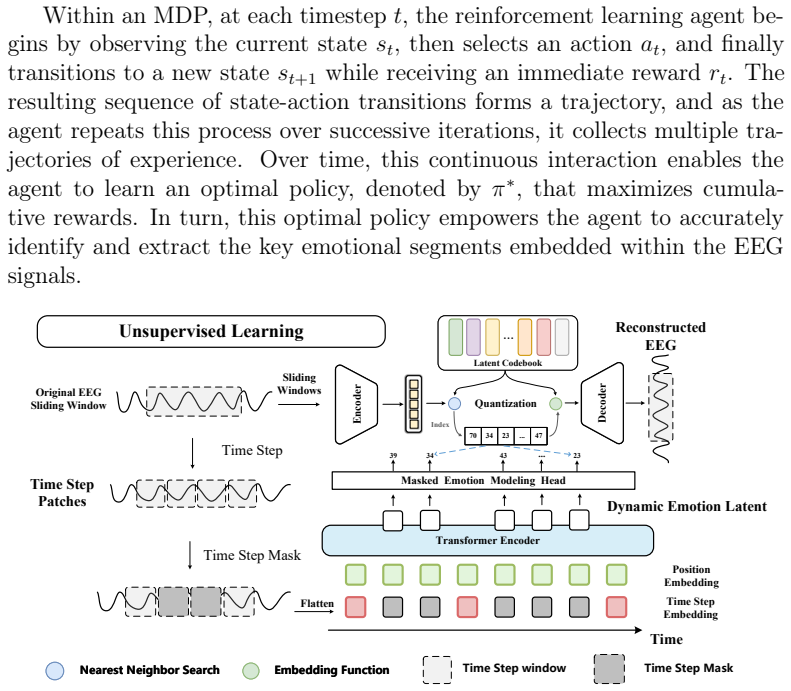
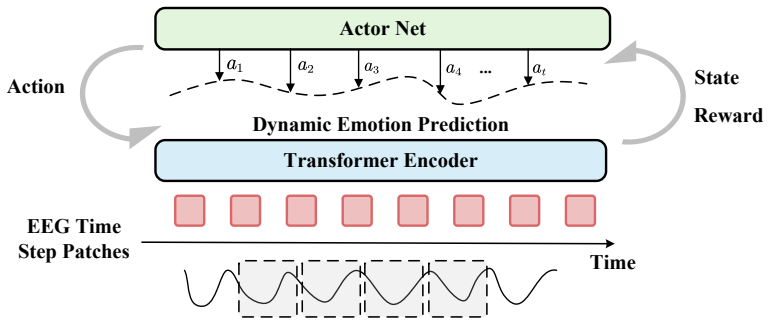
Continuous electroencephalography (EEG) emotion prediction aims to model the temporal evolution of human emotional states from EEG signals. Unlike conventional discrete emotion recognition, continuous prediction requires capturing long-range temporal dependencies and coherent emotional dynamics. However, existing methods mainly rely on point-wise regression and directly model noisy high-dimensional EEG features, limiting their ability to characterize continuous emotional evolution.To address these challenges, we propose EEGDancer, a dynamic emotional latent space learning framework for continuous EEG emotion prediction. The framework integrates vector-quantized representation learning, masked temporal modeling, and reinforcement learning-based trajectory optimization into a unified architecture.Specifically, a causal spatiotemporal Vector-Quantization Variational Autoencoder (VQ-VAE) is designed to learn structured emotional prototypes and construct a discrete-continuous emotional latent space from EEG signals. Based on the learned latent representations, a Transformer-based masked dynamic modeling strategy captures long-range emotional dependencies and temporal evolution patterns. Furthermore, continuous emotion prediction is formulated as a sequential decision-making problem, and a Soft Actor-Critic (SAC) framework is introduced to optimize emotional prediction trajectories at the sequence level instead of frame-wise local fitting.Extensive experiments on the SEED, SEED-IV, and Long-Term Naturalistic Emotion datasets demonstrate that EEGDancer consistently outperforms existing machine learning and deep learning methods. Ablation studies further verify the effectiveness of the proposed latent space and reinforcement learning-based trajectory optimization for modeling continuous EEG emotional dynamics.
Editorial analysis
A structured set of objections, weighed in public.
Referee Report
Summary. The paper proposes EEGDancer, a unified framework for continuous EEG emotion prediction that combines a causal spatiotemporal VQ-VAE to learn structured emotional prototypes in a discrete-continuous latent space, Transformer-based masked dynamic modeling to capture long-range temporal dependencies, and a Soft Actor-Critic (SAC) reinforcement learning formulation that treats prediction as sequence-level trajectory optimization rather than frame-wise regression. It reports consistent outperformance over existing machine learning and deep learning baselines on the SEED, SEED-IV, and Long-Term Naturalistic Emotion datasets, supported by ablation studies on the latent space and RL components.
Significance. If the empirical claims hold with rigorous validation, the work could advance continuous emotion modeling by explicitly addressing temporal coherence through RL-based sequence optimization and structured latent representations, offering a potential alternative to point-wise regression approaches in affective EEG analysis.
major comments (2)
- [Abstract] Abstract: The central claim that EEGDancer 'consistently outperforms existing machine learning and deep learning methods' on three named datasets is stated without any quantitative metrics, baselines, error bars, or statistical tests. This absence prevents assessment of whether the data support the outperformance assertion that is load-bearing for the paper's contribution.
- [Abstract] The motivation for reformulating continuous prediction as a sequential decision-making problem optimized via SAC (to address 'frame-wise local fitting') is presented as a key innovation, yet the manuscript provides no direct comparison of sequence-level vs. point-wise performance or ablation isolating the RL component's contribution to the reported gains.
Simulated Author's Rebuttal
We thank the referee for the constructive feedback on the abstract and the need for clearer empirical support. We address each major comment below and will revise the manuscript to strengthen the presentation of results while preserving the core contributions.
read point-by-point responses
-
Referee: [Abstract] Abstract: The central claim that EEGDancer 'consistently outperforms existing machine learning and deep learning methods' on three named datasets is stated without any quantitative metrics, baselines, error bars, or statistical tests. This absence prevents assessment of whether the data support the outperformance assertion that is load-bearing for the paper's contribution.
Authors: We agree that the abstract, as a concise summary, omits specific numbers. The full manuscript reports detailed quantitative results with metrics, baselines, standard deviations, and statistical significance tests in Tables 1–3 and the associated experimental sections. To improve accessibility, we will revise the abstract to include key performance metrics (e.g., CCC and RMSE values) and error bars from the main experiments on SEED, SEED-IV, and Long-Term Naturalistic Emotion datasets. revision: yes
-
Referee: [Abstract] The motivation for reformulating continuous prediction as a sequential decision-making problem optimized via SAC (to address 'frame-wise local fitting') is presented as a key innovation, yet the manuscript provides no direct comparison of sequence-level vs. point-wise performance or ablation isolating the RL component's contribution to the reported gains.
Authors: The manuscript already includes ablation studies (Section 4.3) that isolate the RL component by comparing the full model against variants without the SAC trajectory optimization, demonstrating its contribution to temporal coherence. The sequence-level formulation is evaluated through end-to-end performance gains over point-wise regression baselines. However, we acknowledge the value of an explicit head-to-head comparison and will add a targeted ablation table directly contrasting sequence-level SAC optimization versus frame-wise regression to further isolate this aspect. revision: partial
Circularity Check
No significant circularity detected
full rationale
The paper's central claims consist of empirical outperformance on three named external datasets (SEED, SEED-IV, Long-Term Naturalistic Emotion) via a composite architecture (causal VQ-VAE + Transformer masked modeling + SAC trajectory optimization). No derivation step is shown that reduces a reported prediction or first-principles result to its own fitted inputs by construction, nor does any load-bearing premise rest solely on a self-citation whose content is unverified. The RL formulation is presented as an explicit modeling choice motivated by the goal of sequence-level optimization, not as a mathematical necessity derived from prior self-work. The reported results are therefore falsifiable against the stated benchmarks and do not collapse into tautology.
Axiom & Free-Parameter Ledger
Reference graph
Works this paper leans on
-
[1]
Marttinen, Eeg based emotion recognition: A tutorial and review, ACM Computing Surveys 55 (4) (2022) 1–57
X.Li, Y.Zhang, P.Tiwari, D.Song, B.Hu, M.Yang, Z.Zhao, N.Kumar, P. Marttinen, Eeg based emotion recognition: A tutorial and review, ACM Computing Surveys 55 (4) (2022) 1–57
2022
-
[2]
S. M. Alarcao, M. J. Fonseca, Emotions recognition using eeg signals: A survey, IEEE transactions on affective computing 10 (3) (2017) 374–393
2017
-
[3]
E. H. Houssein, A. Hammad, A. A. Ali, Human emotion recognition from eeg-based brain–computer interface using machine learning: a com- prehensive review, Neural Computing and Applications 34 (15) (2022) 12527–12557. 40
2022
-
[4]
Y. Peng, F. Jin, W. Kong, F. Nie, B.-L. Lu, A. Cichocki, Ogssl: A semi-supervised classification model coupled with optimal graph learn- ing for eeg emotion recognition, IEEE Transactions on Neural Systems and Rehabilitation Engineering 30 (2022) 1288–1297
2022
-
[5]
Pancholi, A
S. Pancholi, A. Giri, A. Jain, L. Kumar, S. Roy, Source aware deep learning framework for hand kinematic reconstruction using eeg signal, IEEE Transactions on Cybernetics 53 (7) (2022) 4094–4106
2022
-
[6]
Assemlali, S
H. Assemlali, S. Bouhsissin, N. Sael, Deep learning-driven cnn model for detection and classification of dynamic obstacles, Green Energy and Intelligent Transportation (2025) 100334
2025
-
[7]
L. G. Atlas, D. Arockiam, A. Muthusamy, B. Balusamy, S. Selvarajan, T. Al-Shehari, N. A. Alsadhan, A modernized approach to sentiment analysis of product reviews using bigru and rnn based lstm deep learning models, Scientific Reports 15 (1) (2025) 16642
2025
-
[8]
D. Yu, Y. Tang, C. Zhang, W. Wang, G. Yang, X. Zheng, Y. Zhao, Ia 2 gnn: Imbalance-aware adaptive graph construction for multi-modal image fusion, IEEE Transactions on Multimedia (2026)
2026
-
[9]
Wang, Y.-C
F. Wang, Y.-C. Tian, X. Zhou, Cross-dataset eeg emotion recognition basedonpre-trainedvisiontransformerconsideringemotionalsensitivity diversity, Expert Systems with Applications 279 (2025) 127348
2025
-
[10]
L. Shu, J. Xie, M. Yang, Z. Li, Z. Li, D. Liao, X. Xu, X. Yang, A review of emotion recognition using physiological signals, Sensors 18 (7) (2018) 2074
2018
-
[11]
Y. Ji, F. Li, B. Fu, Y. Li, Y. Zhou, Y. Niu, L. Zhang, Y. Chen, G. Shi, Spatial-temporal network for fine-grained-level emotion eeg recognition, Journal of Neural Engineering 19 (3) (2022) 036017
2022
-
[12]
G. Luo, C. Zheng, L. Zhu, T. Fan, F. Tian, D. Wang, K. Qian, J. Liu, S. Sun, B. Hu, Multi-scale cross-domain and class-wise kernel discrimi- native alignment for eeg-based emotion recognition, Pattern Recognition (2026) 113626. 41
2026
-
[13]
P. Liu, C. P. Chen, Y. He, T. Zhang, Cria: A cross-view interaction and instance-adapted pre-training framework for generalizable eeg represen- tations, Pattern Recognition (2026) 113272
2026
-
[14]
X. Zhou, Z. Liang, W. Ye, J. Xue, H. Liu, M. Zhang, Z. Zhang, Emotvr: a hybrid model to estimate continuous-time and continuous-level emo- tion from electroencephalography, in: ICASSP 2024-2024 IEEE Interna- tionalConferenceonAcoustics, SpeechandSignalProcessing(ICASSP), IEEE, 2024, pp. 2021–2025
2024
-
[15]
X. Ju, M. Li, W. Tian, D. Hu, Eeg-based emotion recognition using a temporal-difference minimizing neural network, Cognitive Neurodynam- ics 18 (2) (2024) 405–416
2024
-
[16]
Z. Zhou, L. Zhang, Q. Liu, G. Huang, Z. Yu, Z. Liang, Emotion agent: Unsupervised deep reinforcement learning with distribution-prototype reward for continuous emotional eeg analysis, Neurocomputing (2025) 130951
2025
-
[17]
Zhang, C
Y. Zhang, C. Xie, H. Liu, Y. Shi, G. Liu, D. Zhang, Mind-eeg: Multi- granularity integration network with discrete codebook for eeg-based emotion recognition, IEEE Transactions on Affective Computing (2025)
2025
-
[18]
J. Ma, F. Wu, Q. Lin, Y. Xing, C. Liu, Z. Jia, M. Feng, Codebrain: Bridging decoupled tokenizer and multi-scale architecture for eeg foun- dation model, in: The Fourteenth International Conference on Learning Representations, 2025
2025
-
[19]
H. Bao, L. Dong, S. Piao, F. Wei, Beit: Bert pre-training of image transformers, arXiv preprint arXiv:2106.08254 (2021)
work page internal anchor Pith review Pith/arXiv arXiv 2021
-
[20]
Z. Ren, Y. Wei, X. Guo, Y. Zhao, B. Kang, J. Feng, X. Jin, Videoworld: Exploring knowledge learning from unlabeled videos, in: Proceedings of the Computer Vision and Pattern Recognition Conference, 2025, pp. 29029–29039
2025
-
[21]
Haarnoja, A
T. Haarnoja, A. Zhou, P. Abbeel, S. Levine, Soft actor-critic: Off-policy maximum entropy deep reinforcement learning with a stochastic actor, in: International conference on machine learning, Pmlr, 2018, pp. 1861– 1870. 42
2018
-
[22]
B. Zoph, Q. V. Le, Neural architecture search with reinforcement learn- ing (2017).arXiv:1611.01578
work page internal anchor Pith review Pith/arXiv arXiv 2017
-
[23]
D. Guo, D. Yang, H. Zhang, J. Song, P. Wang, Q. Zhu, R. Xu, R. Zhang, S. Ma, X. Bi, et al., Deepseek-r1 incentivizes reasoning in llms through reinforcement learning, Nature 645 (8081) (2025) 633–638
2025
-
[24]
J. He, J. Chen, X. He, J. Gao, L. Li, L. Deng, M. Ostendorf, Deep reinforcement learning with a natural language action space (2016). arXiv:1511.04636
work page internal anchor Pith review Pith/arXiv arXiv 2016
-
[25]
Yarats, I
D. Yarats, I. Kostrikov, R. Fergus, Image augmentation is all you need: Regularizing deep reinforcement learning from pixels, in: International conference on learning representations, 2021
2021
-
[26]
Zhang, Y
Y. Zhang, Y. Pan, Y. Zhang, M. Zhang, L. Li, L. Zhang, G. Huang, L. Su, Z. Liang, Z. Zhang, Unsupervised time-aware sampling network with deep reinforcement learning for eeg-based emotion recognition, IEEE Transactions on Affective Computing (2023)
2023
-
[27]
Y. Yang, Z. Gao, Y. Li, H. Wang, A cnn identified by reinforcement learning-based optimization framework for eeg-based state evaluation, Journal of Neural Engineering 18 (4) (2021) 046059
2021
-
[28]
H. W. Aung, J. J. Li, Y. An, S. W. Su, A real-time framework for eeg signal decoding with graph neural networks and reinforcement learning, IEEE Transactions on Neural Networks and Learning Systems (2025)
2025
-
[29]
X. Liu, X. Ding, J. Liu, W. Nie, Q. Yuan, Automatic focal eeg identifica- tion based on deep reinforcement learning, Biomedical Signal Processing and Control 83 (2023) 104693
2023
-
[30]
D. Xu, M. Agarwal, E. Gupta, F. Fekri, R. Sivakumar, Accelerating reinforcement learning using eeg-based implicit human feedback, Neu- rocomputing 460 (2021) 139–153
2021
-
[31]
Luo, Y.-c
T.-j. Luo, Y.-c. Fan, J.-t. Lv, C.-l. Zhou, Deep reinforcement learn- ing from error-related potentials via an eeg-based brain-computer in- terface, in: 2018 IEEE international conference on bioinformatics and biomedicine (BIBM), IEEE, 2018, pp. 697–701. 43
2018
-
[32]
D. Li, L. Xie, Z. Wang, H. Yang, Brain emotion perception inspired eeg emotion recognition with deep reinforcement learning, IEEE Transac- tions on Neural Networks and Learning Systems (2023)
2023
-
[33]
M. Elad, M. Aharon, Image denoising via sparse and redundant repre- sentations over learned dictionaries, IEEE Transactions on Image pro- cessing 15 (12) (2006) 3736–3745
2006
-
[34]
J. Yang, J. Wright, T. S. Huang, Y. Ma, Image super-resolution via sparse representation, IEEE transactions on image processing 19 (11) (2010) 2861–2873
2010
-
[35]
Gray, Vector quantization, IEEE Assp Magazine 1 (2) (1984) 4–29
R. Gray, Vector quantization, IEEE Assp Magazine 1 (2) (1984) 4–29
1984
-
[36]
Makhoul, S
J. Makhoul, S. Roucos, H. Gish, Vector quantization in speech coding, Proceedings of the IEEE 73 (11) (1985) 1551–1588
1985
- [37]
-
[38]
Aczel, L
T. Aczel, L. A. Lanzendörfer, F. Gao, R. Wattenhofer, Neural audio compression without residual vector quantization, in: AAAI 2026 Work- shop on Machine Learning for Wireless Communication and Networks (ML4Wireless)
2026
-
[39]
Y. Zhao, H. Jiang, Z. Xu, C. Yang, E. Adeli, P. Krähenbühl, Spherical leech quantization for visual tokenization and generation, in: Proceed- ings of the IEEE/CVF Conference on Computer Vision and Pattern Recognition, 2026, pp. 12913–12923
2026
-
[40]
Zheng, B.-L
W.-L. Zheng, B.-L. Lu, Investigating critical frequency bands and chan- nels for eeg-based emotion recognition with deep neural networks, IEEE Transactions on autonomous mental development 7 (3) (2015) 162–175
2015
-
[41]
Zheng, W
W.-L. Zheng, W. Liu, Y. Lu, B.-L. Lu, A. Cichocki, Emotionmeter: A multimodal framework for recognizing human emotions, IEEE transac- tions on cybernetics 49 (3) (2018) 1110–1122. 44
2018
-
[42]
W. Hu, Z. Zhang, L. Zhang, G. Huang, L. Li, Z. Liang, Microstate de- tection in naturalistic electroencephalography data: A systematic com- parison of topographical clustering strategies on an emotional database, Frontiers in Neuroscience 16 (2022) 812624
2022
-
[43]
W. Hu, Z. Zhang, H. Zhao, L. Zhang, L. Li, G. Huang, Z. Liang, Eeg mi- crostate correlates of emotion dynamics and stimulation content during video watching, Cerebral Cortex 33 (3) (2023) 523–542
2023
-
[44]
Q. Liu, W. Ye, L. Zhang, Z. Liang, Eeg-scmm: Soft contrastive masked modeling for cross-corpus eeg-based emotion recognition, in: Proceed- ings of the 33rd ACM International Conference on Multimedia, 2025, pp. 5834–5842
2025
-
[45]
Drucker, C
H. Drucker, C. J. Burges, L. Kaufman, A. Smola, V. Vapnik, Support vector regression machines, Advances in neural information processing systems 9 (1996)
1996
-
[46]
Cover, P
T. Cover, P. Hart, Nearest neighbor pattern classification, IEEE trans- actions on information theory 13 (1) (1967) 21–27
1967
-
[47]
J. A. Robinson, A machine-oriented logic based on the resolution prin- ciple, Journal of the ACM (JACM) 12 (1) (1965) 23–41
1965
-
[48]
Breiman, Random forests, Machine learning 45 (1) (2001) 5–32
L. Breiman, Random forests, Machine learning 45 (1) (2001) 5–32
2001
-
[49]
D. V. Lindley, A. F. Smith, Bayes estimates for the linear model, Journal of the Royal Statistical Society Series B: Statistical Methodology 34 (1) (1972) 1–18
1972
-
[50]
J. H. Friedman, Greedy function approximation: a gradient boosting machine, Annals of statistics (2001) 1189–1232
2001
-
[51]
Tibshirani, Regression shrinkage and selection via the lasso, Journal of the Royal Statistical Society Series B: Statistical Methodology 58 (1) (1996) 267–288
R. Tibshirani, Regression shrinkage and selection via the lasso, Journal of the Royal Statistical Society Series B: Statistical Methodology 58 (1) (1996) 267–288
1996
-
[52]
A. E. Hoerl, R. W. Kennard, Ridge regression: Biased estimation for nonorthogonal problems, Technometrics 12 (1) (1970) 55–67
1970
-
[53]
D. E. Rumelhart, G. E. Hinton, R. J. Williams, Learning representations by back-propagating errors, nature 323 (6088) (1986) 533–536. 45
1986
-
[54]
P. J. Huber, Robust estimation of a location parameter, in: Break- throughs in statistics: Methodology and distribution, Springer, 1992, pp. 492–518
1992
-
[55]
V. J. Lawhern, A. J. Solon, N. R. Waytowich, S. M. Gordon, C. P. Hung, B. J. Lance, Eegnet: a compact convolutional neural network for eeg- based brain–computer interfaces, Journal of neural engineering 15 (5) (2018) 056013
2018
-
[56]
Li, Y.-M
H. Li, Y.-M. Jin, W.-L. Zheng, B.-L. Lu, Cross-subject emotion recog- nition using deep adaptation networks, in: International conference on neural information processing, Springer, 2018, pp. 403–413
2018
-
[57]
Ganin, E
Y. Ganin, E. Ustinova, H. Ajakan, P. Germain, H. Larochelle, F. Lavi- olette, M. March, V. Lempitsky, Domain-adversarial training of neural networks, Journal of machine learning research 17 (59) (2016) 1–35
2016
-
[58]
Y. Li, W. Zheng, Z. Cui, T. Zhang, Y. Zong, A novel neural network model based on cerebral hemispheric asymmetry for eeg emotion recog- nition., in: IJCAI, 2018, pp. 1561–1567
2018
-
[59]
H. Chen, M. Jin, Z. Li, C. Fan, J. Li, H. He, Ms-mda: Multisource marginal distribution adaptation for cross-subject and cross-session eeg emotion recognition, Frontiers in Neuroscience 15 (2021) 778488
2021
-
[60]
B. Sun, J. Feng, K. Saenko, Return of frustratingly easy domain adap- tation, in: Proceedings of the AAAI conference on artificial intelligence, Vol. 30, 2016
2016
-
[61]
Zhong, D
P. Zhong, D. Wang, C. Miao, Eeg-based emotion recognition using reg- ularized graph neural networks, IEEE Transactions on Affective Com- puting 13 (3) (2020) 1290–1301
2020
-
[62]
Proximal Policy Optimization Algorithms
J. Schulman, F. Wolski, P. Dhariwal, A. Radford, O. Klimov, Proximal policy optimization algorithms, arXiv preprint arXiv:1707.06347 (2017)
work page internal anchor Pith review Pith/arXiv arXiv 2017
-
[63]
Fujimoto, H
S. Fujimoto, H. Hoof, D. Meger, Addressing function approximation error in actor-critic methods, in: International conference on machine learning, PMLR, 2018, pp. 1587–1596. 46
2018
-
[64]
Silver, G
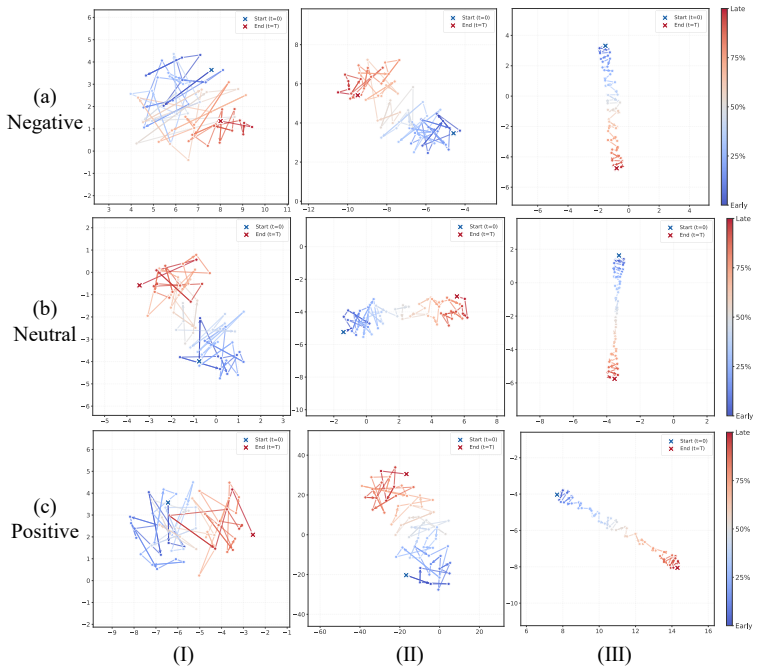
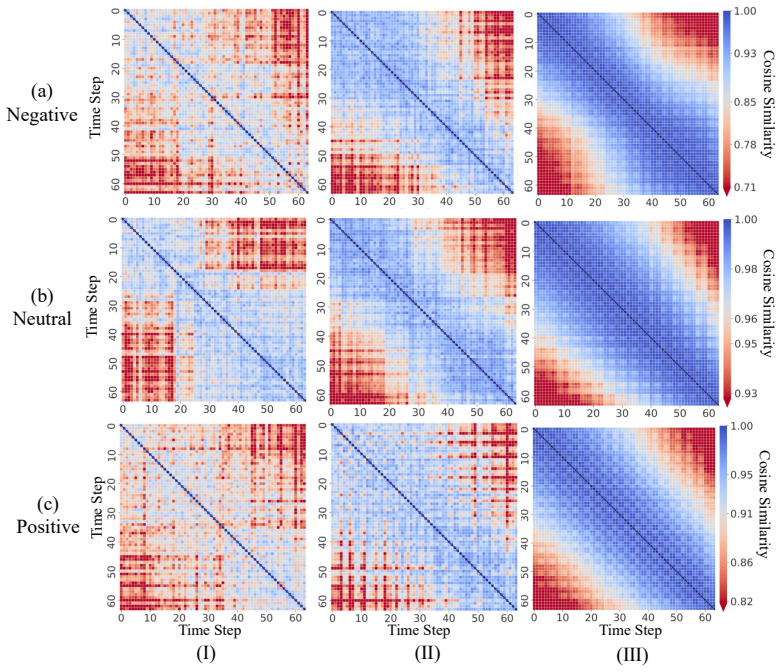
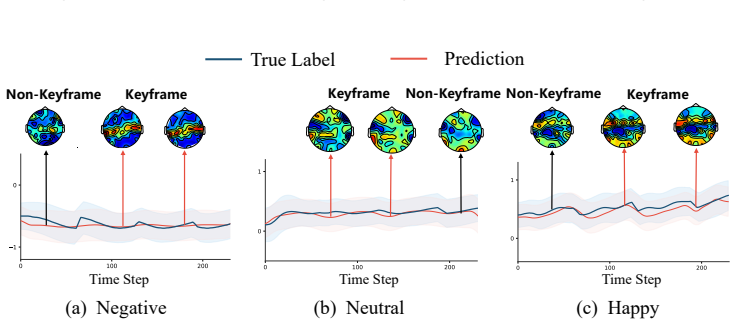
D. Silver, G. Lever, N. Heess, T. Degris, D. Wierstra, M. Riedmiller, Deterministic policy gradient algorithms, in: International conference on machine learning, Pmlr, 2014, pp. 387–395. 47 (b) Neutral (a) Negative (c) Positive (Ⅰ) (Ⅱ) (Ⅲ) Figure 5: Comparative visualization of changes in diverse emotions within the dynamic emotional latent space througho...
2014
discussion (0)
Sign in with ORCID, Apple, or X to comment. Anyone can read and Pith papers without signing in.