Towards World Models in Biomedical Research
Pith reviewed 2026-06-28 01:36 UTC · model grok-4.3
The pith
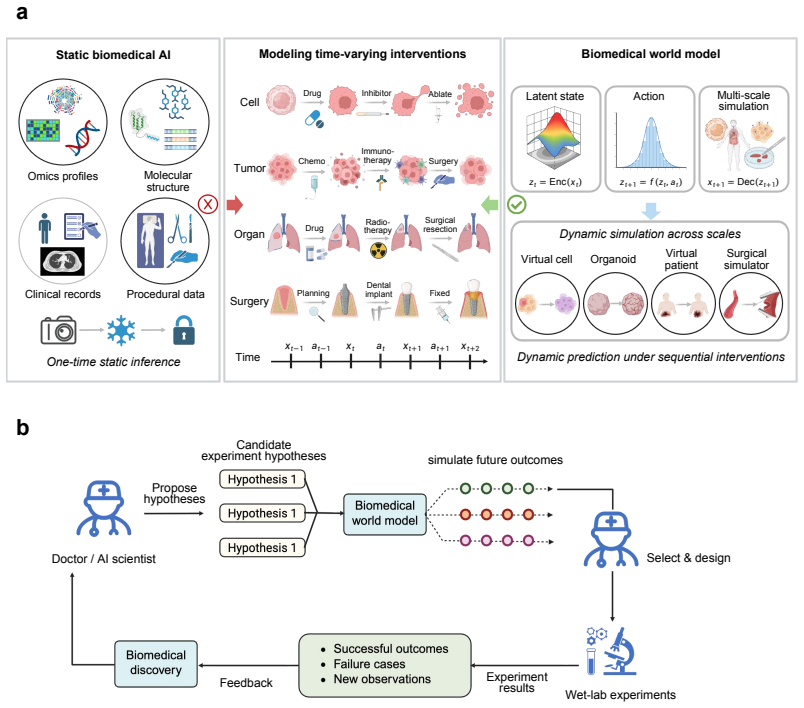
Biomedical world models learn latent multi-scale states and intervention-conditioned dynamics to simulate future biological trajectories.
A machine-rendered reading of the paper's core claim, the machinery that carries it, and where it could break.
Core claim
Biomedical world models learn latent representations of molecular, cellular, tissue and clinical states, together with intervention-conditioned dynamics that allow future trajectories to be simulated before actions are taken. They could function as data engines, environment simulators and scientific planning substrates across applications including virtual cells, organoids, virtual patients and surgical simulation.
What carries the argument
Biomedical world models that combine latent state representations across scales with dynamics conditioned on interventions to enable forward simulation.
If this is right
- The models can serve as virtual cells, organoids, virtual patients and surgical simulators.
- They support simulation-guided, closed-loop and experimentally actionable biomedical discovery.
- Implementation requires new data infrastructure, evaluation benchmarks, safety constraints and governance frameworks.
Where Pith is reading between the lines
- If successful, these models could reduce reliance on preliminary wet-lab experiments by first validating ideas in simulation.
- They might connect to existing foundation models by adding dynamic simulation layers on top of static representations.
- Governance needs could include rules for when simulated predictions are allowed to influence clinical decisions.
Load-bearing premise
Sufficiently rich multi-scale biological data and current or near-future machine learning methods can support learning accurate latent representations and intervention-conditioned dynamics for complex living systems.
What would settle it
A controlled test in which the model generates an intervention-conditioned trajectory that is then measured in a real biological system and shown to diverge substantially from the prediction.
Figures
read the original abstract
A central goal of biomedicine is to understand, predict and ultimately control the dynamic mechanisms by which biological systems respond to perturbations, disease progression and therapeutic intervention. Although foundation models and large language models have accelerated biomedical data interpretation, most current systems remain focused on static pattern recognition rather than prospective simulation of biological futures. Here we propose biomedical world models as a paradigm for AI-driven discovery. These models learn latent representations of molecular, cellular, tissue and clinical states, together with intervention-conditioned dynamics that allow future trajectories to be simulated before actions are taken. We discuss how biomedical world models could function as data engines, environment simulators and scientific planning substrates across applications including virtual cells, organoids, virtual patients and surgical simulation. We outline the data infrastructure, evaluation benchmarks, safety constraints and governance frameworks required. Biomedical world models may provide a foundation for simulation-guided, closed-loop and experimentally actionable biomedical discovery.
Editorial analysis
A structured set of objections, weighed in public.
Referee Report
Summary. The manuscript proposes biomedical world models as a new paradigm for AI-driven biomedical discovery. These models would learn latent representations of molecular, cellular, tissue, and clinical states together with intervention-conditioned dynamics, enabling simulation of future trajectories under perturbations, disease progression, and therapeutic actions. The paper positions the models as data engines, environment simulators, and planning substrates for applications including virtual cells, organoids, virtual patients, and surgical simulation, while outlining required data infrastructure, evaluation benchmarks, safety constraints, and governance frameworks.
Significance. If realized, the proposed paradigm could shift biomedical AI from static pattern recognition toward prospective, simulation-guided discovery and closed-loop experimentation. The conceptual framing is internally coherent as a high-level synthesis of existing ideas in foundation models and dynamical systems, but the manuscript contains no empirical results, architectures, or quantitative assessments, so its significance rests entirely on the future technical feasibility of the outlined vision.
major comments (2)
- [Abstract] The central claim that biomedical world models can learn accurate intervention-conditioned dynamics for complex multi-scale living systems is presented without any discussion of concrete learning algorithms, loss functions, or data requirements (invoked throughout the abstract and application sections). This assumption is load-bearing for the proposal's utility and cannot be evaluated from the provided text.
- No pilot study, toy example, or reference implementation is supplied to illustrate how latent representations and dynamics would be jointly learned from heterogeneous biomedical data sources, leaving the feasibility of the data-engine and simulator roles unaddressed.
minor comments (2)
- The manuscript would benefit from explicit citations to prior work on world models in reinforcement learning and dynamical systems modeling in biology to better situate the proposal.
- Terminology such as 'virtual cells' and 'virtual patients' is used without precise definitions or distinctions from existing digital-twin concepts in the literature.
Simulated Author's Rebuttal
We thank the referee for the thoughtful review and for recognizing the conceptual coherence of the proposed paradigm. Below we respond point-by-point to the major comments, maintaining the manuscript's scope as a high-level position paper that synthesizes existing ideas without new empirical contributions.
read point-by-point responses
-
Referee: [Abstract] The central claim that biomedical world models can learn accurate intervention-conditioned dynamics for complex multi-scale living systems is presented without any discussion of concrete learning algorithms, loss functions, or data requirements (invoked throughout the abstract and application sections). This assumption is load-bearing for the proposal's utility and cannot be evaluated from the provided text.
Authors: We agree that the manuscript contains no concrete learning algorithms, loss functions, or detailed data requirements. This is by design: the paper is a conceptual proposal that defines the biomedical world model paradigm, its potential roles as data engines and simulators, and the broader infrastructure needed, rather than a technical implementation paper. The central claim is framed as a research direction whose feasibility remains to be established, consistent with the referee's own observation that significance rests on future technical work. We will add a short clarifying paragraph in the introduction and discussion sections to explicitly state the manuscript's scope and to reference relevant prior work on world models and dynamical systems that could inform future algorithm development. revision: partial
-
Referee: [—] No pilot study, toy example, or reference implementation is supplied to illustrate how latent representations and dynamics would be jointly learned from heterogeneous biomedical data sources, leaving the feasibility of the data-engine and simulator roles unaddressed.
Authors: The absence of a pilot study or toy example is correct and intentional. The manuscript does not attempt to demonstrate technical feasibility through implementation; its contribution is the high-level framing of the paradigm, applications across virtual cells to surgical simulation, and the required data, evaluation, and governance considerations. Providing a reference implementation would exceed the stated purpose of the work. Feasibility questions are acknowledged as open and are positioned as targets for subsequent research. No revision is planned on this point, as adding an empirical component would change the paper's nature from a position piece to an empirical study. revision: no
Circularity Check
No significant circularity
full rationale
The manuscript is a conceptual proposal paper that defines a paradigm (biomedical world models) and outlines required infrastructure, benchmarks, and governance without presenting new empirical results, derivations, architectures, or proofs of concept. There are no equations, fitted parameters, or self-citations that reduce any claim to a quantity defined by its own inputs. The central claim is the coherence and potential utility of the proposed framing itself rather than any assertion that current methods already achieve accurate multi-scale intervention-conditioned dynamics. No internal inconsistency or hidden assumption in a derivation is present.
Axiom & Free-Parameter Ledger
axioms (1)
- domain assumption Biological systems can be usefully represented by latent states whose evolution under interventions is learnable from data.
Reference graph
Works this paper leans on
-
[1]
Accurate structure prediction of biomolecular interactions with alphafold 3.Nature, 630(8016):493–500, 2024
Josh Abramson, Jonas Adler, Jack Dunger, Richard Evans, Tim Green, Alexander Pritzel, Olaf Ronneberger, Lindsay Willmore, Andrew J Ballard, Joshua Bambrick, et al. Accurate structure prediction of biomolecular interactions with alphafold 3.Nature, 630(8016):493–500, 2024
2024
-
[2]
Josh Achiam, Steven Adler, Sandhini Agarwal, Lama Ahmad, Ilge Akkaya, Florencia Leoni Aleman, Diogo Almeida, Janko Altenschmidt, Sam Altman, Shyamal Anadkat, et al. Gpt-4 technical report.arXiv preprint arXiv:2303.08774, 2023
work page internal anchor Pith review Pith/arXiv arXiv 2023
-
[3]
Physics- informed machine learning in biomedical science and engineering.Annual Review of Biomedical Engineering, 28(1):309–336, 2026
Nazanin Ahmadi, Qianying Cao, Jay D Humphrey, and George Em Karniadakis. Physics- informed machine learning in biomedical science and engineering.Annual Review of Biomedical Engineering, 28(1):309–336, 2026
2026
-
[4]
Bridging ai and biology: Foundation models meet human physiology and disease.Med, 7(1), 2026
Orr Ashenberg and Ramnik J Xavier. Bridging ai and biology: Foundation models meet human physiology and disease.Med, 7(1), 2026
2026
-
[5]
Multivi: deep generative model for the integration of multimodal data.Nature methods, 20(8):1222–1231, 2023
Tal Ashuach, Mariano I Gabitto, Rohan V Koodli, Giuseppe-Antonio Saldi, Michael I Jordan, and Nir Yosef. Multivi: deep generative model for the integration of multimodal data.Nature methods, 20(8):1222–1231, 2023
2023
-
[6]
V-JEPA 2: Self-Supervised Video Models Enable Understanding, Prediction and Planning
Mido Assran, Adrien Bardes, David Fan, Quentin Garrido, Russell Howes, Matthew Muckley, Ammar Rizvi, Claire Roberts, Koustuv Sinha, Artem Zholus, et al. V-jepa 2: Self-supervised video models enable understanding, prediction and planning.arXiv preprint arXiv:2506.09985, 2025
work page internal anchor Pith review Pith/arXiv arXiv 2025
-
[7]
Artificial intelligence virtual organoids (aivos).Bioactive Materials, 59:45–68, 2026
Long Bai and Jiacan Su. Artificial intelligence virtual organoids (aivos).Bioactive Materials, 59:45–68, 2026
2026
-
[8]
Navigation world models
Amir Bar, Gaoyue Zhou, Danny Tran, Trevor Darrell, and Yann LeCun. Navigation world models. InProceedings of the Computer Vision and Pattern Recognition Conference, pages 15791–15801, 2025
2025
-
[9]
The role of dynamic conformational ensembles in biomolecular recognition.Nature chemical biology, 5(11):789–796, 2009
David D Boehr, Ruth Nussinov, and Peter E Wright. The role of dynamic conformational ensembles in biomolecular recognition.Nature chemical biology, 5(11):789–796, 2009
2009
-
[10]
Autonomous chemical research with large language models.Nature, 624(7992):570–578, 2023
Daniil A Boiko, Robert MacKnight, Ben Kline, and Gabe Gomes. Autonomous chemical research with large language models.Nature, 624(7992):570–578, 2023. 13
2023
-
[11]
Genie: Generative interactive environments
Jake Bruce, Michael D Dennis, Ashley Edwards, Jack Parker-Holder, Yuge Shi, Edward Hughes, Matthew Lai, Aditi Mavalankar, Richie Steigerwald, Chris Apps, et al. Genie: Generative interactive environments. InForty-first International Conference on Machine Learning, 2024
2024
-
[12]
How to build the virtual cell with artificial intelligence: Priorities and opportunities.Cell, 187(25):7045–7063, 2024
Charlotte Bunne, Yusuf Roohani, Yanay Rosen, Ankit Gupta, Xikun Zhang, Marcel Roed, Theo Alexandrov, Mohammed AlQuraishi, Patricia Brennan, Daniel B Burkhardt, et al. How to build the virtual cell with artificial intelligence: Priorities and opportunities.Cell, 187(25):7045–7063, 2024
2024
-
[13]
Zhen Chen, Qing Xu, Jinlin Wu, Biao Yang, Yuhao Zhai, Geng Guo, Jing Zhang, Yinlu Ding, Nassir Navab, and Jiebo Luo. How far are surgeons from surgical world models? a pilot study on zero-shot surgical video generation with expert assessment.arXiv preprint arXiv:2511.01775, 2025
-
[14]
Hongrong Cheng, Miao Zhang, and Javen Qinfeng Shi. A survey on deep neural network pruning: Taxonomy, comparison, analysis, and recommendations.IEEE Transactions on Pattern Analysis and Machine Intelligence, 46(12):10558–10578, 2024
2024
-
[15]
Towards building a world model to simulate perturbation-induced cellular dynamics by alphacell.bioRxiv, pages 2026–03, 2026
Guohui Chuai, Xiaohan Chen, Xingbo Yang, Cheng Zhang, Kairu Qu, Yiheng Wang, Wannian Li, Jingya Yang, Duanmiao Si, Feiyang Xing, et al. Towards building a world model to simulate perturbation-induced cellular dynamics by alphacell.bioRxiv, pages 2026–03, 2026
2026
-
[16]
Whatever next? predictive brains, situated agents, and the future of cognitive science.Behavioral and brain sciences, 36(3):181–204, 2013
Andy Clark. Whatever next? predictive brains, situated agents, and the future of cognitive science.Behavioral and brain sciences, 36(3):181–204, 2013
2013
-
[17]
Modeling development and disease with organoids.Cell, 165(7):1586–1597, 2016
Hans Clevers. Modeling development and disease with organoids.Cell, 165(7):1586–1597, 2016
2016
-
[18]
The drug–target residence time model: a 10-year retrospective.Nature Reviews Drug Discovery, 15(2):87–95, 2016
Robert A Copeland. The drug–target residence time model: a 10-year retrospective.Nature Reviews Drug Discovery, 15(2):87–95, 2016
2016
-
[19]
CUP Archive, 1967
Kenneth James Williams Craik.The nature of explanation, volume 445. CUP Archive, 1967
1967
-
[20]
Towards multimodal foundation models in molecular cell biology.Nature, 640(8059):623–633, 2025
Haotian Cui, Alejandro Tejada-Lapuerta, Maria Brbi´c, Julio Saez-Rodriguez, Simona Cristea, Hani Goodarzi, Mohammad Lotfollahi, Fabian J Theis, and Bo Wang. Towards multimodal foundation models in molecular cell biology.Nature, 640(8059):623–633, 2025
2025
-
[21]
scgpt: toward building a foundation model for single-cell multi-omics using generative ai
Haotian Cui, Chloe Wang, Hassaan Maan, Kuan Pang, Fengning Luo, Nan Duan, and Bo Wang. scgpt: toward building a foundation model for single-cell multi-omics using generative ai. Nature methods, 21(8):1470–1480, 2024
2024
-
[22]
Tianxingjian Ding, Yuanhao Zou, Chen Chen, Mubarak Shah, and Yu Tian. Clarity: Medical world model for guiding treatment decisions by modeling context-aware disease trajectories in latent space.arXiv preprint arXiv:2512.08029, 2025
-
[23]
Learning universal policies via text-guided video generation.Advances in neural information processing systems, 36:9156–9172, 2023
Yilun Du, Sherry Yang, Bo Dai, Hanjun Dai, Ofir Nachum, Josh Tenenbaum, Dale Schuurmans, and Pieter Abbeel. Learning universal policies via text-guided video generation.Advances in neural information processing systems, 36:9156–9172, 2023
2023
-
[24]
The free-energy principle: a unified brain theory?Nature reviews neuroscience, 11(2):127–138, 2010
Karl Friston. The free-energy principle: a unified brain theory?Nature reviews neuroscience, 11(2):127–138, 2010
2010
-
[25]
Empow- ering biomedical discovery with ai agents.Cell, 187(22):6125–6151, 2024
Shanghua Gao, Ada Fang, Yepeng Huang, Valentina Giunchiglia, Ayush Noori, Jonathan Richard Schwarz, Yasha Ektefaie, Jovana Kondic, and Marinka Zitnik. Empow- ering biomedical discovery with ai agents.Cell, 187(22):6125–6151, 2024
2024
-
[26]
Joint probabilistic modeling of single-cell multi-omic data with totalvi.Nature methods, 18(3):272–282, 2021
Adam Gayoso, Zoë Steier, Romain Lopez, Jeffrey Regier, Kristopher L Nazor, Aaron Streets, and Nir Yosef. Joint probabilistic modeling of single-cell multi-omic data with totalvi.Nature methods, 18(3):272–282, 2021
2021
-
[27]
Yu Gu, Kai Zhang, Yuting Ning, Boyuan Zheng, Boyu Gou, Tianci Xue, Cheng Chang, Sanjari Srivastava, Yanan Xie, Peng Qi, et al. Is your llm secretly a world model of the internet? model-based planning for web agents.arXiv preprint arXiv:2411.06559, 2024
-
[28]
Computer-using world model.arXiv preprint arXiv:2602.17365, 2026
Yiming Guan, Rui Yu, John Zhang, Lu Wang, Chaoyun Zhang, Liqun Li, Bo Qiao, Si Qin, He Huang, Fangkai Yang, et al. Computer-using world model.arXiv preprint arXiv:2602.17365, 2026
-
[29]
Protein allostery and conformational dynamics.Chemical reviews, 116(11):6503–6515, 2016
Jingjing Guo and Huan-Xiang Zhou. Protein allostery and conformational dynamics.Chemical reviews, 116(11):6503–6515, 2016. 14
2016
-
[30]
David Ha and Jürgen Schmidhuber. World models.arXiv preprint arXiv:1803.10122, 2(3):440, 2018
work page internal anchor Pith review Pith/arXiv arXiv 2018
-
[31]
Learning latent dynamics for planning from pixels
Danijar Hafner, Timothy Lillicrap, Ian Fischer, Ruben Villegas, David Ha, Honglak Lee, and James Davidson. Learning latent dynamics for planning from pixels. InInternational conference on machine learning, pages 2555–2565. PMLR, 2019
2019
-
[32]
Training Agents Inside of Scalable World Models
Danijar Hafner, Wilson Yan, and Timothy Lillicrap. Training agents inside of scalable world models.arXiv preprint arXiv:2509.24527, 2025
work page internal anchor Pith review Pith/arXiv arXiv 2025
-
[33]
Td-mpc2: Scalable, robust world models for continuous control
Nick Hansen, Hao Su, and Xiaolong Wang. Td-mpc2: Scalable, robust world models for continuous control. InInternational Conference on Learning Representations, volume 2024, pages 47376–47405, 2024
2024
-
[34]
Yufan He, Pengfei Guo, Mengya Xu, Zhaoshuo Li, Andriy Myronenko, Dillan Imans, Bingjie Liu, Dongren Yang, Mingxue Gu, Yongnan Ji, et al. Surgworld: Learning surgical robot policies from videos via world modeling.arXiv preprint arXiv:2512.23162, 2025
-
[35]
Distilling the Knowledge in a Neural Network
Geoffrey Hinton, Oriol Vinyals, and Jeff Dean. Distilling the knowledge in a neural network. arXiv preprint arXiv:1503.02531, 2015
work page internal anchor Pith review Pith/arXiv arXiv 2015
-
[36]
GAIA-1: A Generative World Model for Autonomous Driving
Anthony Hu, Lloyd Russell, Hudson Yeo, Zak Murez, George Fedoseev, Alex Kendall, Jamie Shotton, and Gianluca Corrado. Gaia-1: A generative world model for autonomous driving. arXiv preprint arXiv:2309.17080, 2023
work page internal anchor Pith review Pith/arXiv arXiv 2023
-
[37]
Lora: Low-rank adaptation of large language models.Iclr, 1(2):3, 2022
Edward J Hu, Yelong Shen, Phillip Wallis, Zeyuan Allen-Zhu, Yuanzhi Li, Shean Wang, Liang Wang, Weizhu Chen, et al. Lora: Low-rank adaptation of large language models.Iclr, 1(2):3, 2022
2022
-
[38]
Med-cdiff: Conditional medical image generation with diffusion models
Alex Ling Yu Hung, Kai Zhao, Haoxin Zheng, Ran Yan, Steven S Raman, Demetri Terzopoulos, and Kyunghyun Sung. Med-cdiff: Conditional medical image generation with diffusion models. Bioengineering, 10(11):1258, 2023
2023
-
[39]
Highly accurate protein structure prediction with alphafold.nature, 596(7873):583–589, 2021
John Jumper, Richard Evans, Alexander Pritzel, Tim Green, Michael Figurnov, Olaf Ron- neberger, Kathryn Tunyasuvunakool, Russ Bates, Augustin Žídek, Anna Potapenko, et al. Highly accurate protein structure prediction with alphafold.nature, 596(7873):583–589, 2021
2021
-
[40]
Auto-Encoding Variational Bayes
Diederik P Kingma and Max Welling. Auto-encoding variational bayes.arXiv preprint arXiv:1312.6114, 2013
work page internal anchor Pith review Pith/arXiv arXiv 2013
-
[41]
Surgical vision world model
Saurabh Koju, Saurav Bastola, Prashant Shrestha, Sanskar Amgain, Yash Raj Shrestha, Rudra PK Poudel, and Binod Bhattarai. Surgical vision world model. InMICCAI Work- shop on Data Engineering in Medical Imaging, pages 1–10. Springer, 2025
2025
-
[42]
Digital twins in medicine.Nature computational science, 4(3):184–191, 2024
Reinhard Laubenbacher, Borna Mehrad, Ilya Shmulevich, and Natalia Trayanova. Digital twins in medicine.Nature computational science, 4(3):184–191, 2024
2024
-
[43]
A path towards autonomous machine intelligence version 0.9
Yann LeCun et al. A path towards autonomous machine intelligence version 0.9. 2, 2022-06-27. Open Review, 62(1):1–62, 2022
2022
-
[44]
A review of applications in federated learning
Li Li, Yuxi Fan, Mike Tse, and Kuo-Yi Lin. A review of applications in federated learning. Computers & Industrial Engineering, 149:106854, 2020
2020
-
[45]
Sora: A Review on Background, Technology, Limitations, and Opportunities of Large Vision Models
Yixin Liu, Kai Zhang, Yuan Li, Zhiling Yan, Chujie Gao, Ruoxi Chen, Zhengqing Yuan, Yue Huang, Hanchi Sun, Jianfeng Gao, et al. Sora: A review on background, technology, limitations, and opportunities of large vision models.arXiv preprint arXiv:2402.17177, 2024
work page internal anchor Pith review Pith/arXiv arXiv 2024
-
[46]
Lu Lu, Pengzhan Jin, and George Em Karniadakis. Deeponet: Learning nonlinear operators for identifying differential equations based on the universal approximation theorem of operators. arXiv preprint arXiv:1910.03193, 2019
work page internal anchor Pith review Pith/arXiv arXiv 1910
-
[47]
A clinical environment simulator for dynamic ai evaluation.Nature medicine, pages 1–8, 2026
Luyang Luo, Sung Eun Kim, Xiaoman Zhang, Julius M Kernbach, Roshan Kenia, Julian N Acosta, Larry A Nathanson, Adrian D Haimovich, Adam Rodman, Ethan Goh, et al. A clinical environment simulator for dynamic ai evaluation.Nature medicine, pages 1–8, 2026
2026
-
[48]
LeWorldModel: Stable End-to-End Joint-Embedding Predictive Architecture from Pixels
Lucas Maes, Quentin Le Lidec, Damien Scieur, Yann LeCun, and Randall Balestriero. Leworld- model: Stable end-to-end joint-embedding predictive architecture from pixels.arXiv preprint arXiv:2603.19312, 2026
work page internal anchor Pith review Pith/arXiv arXiv 2026
-
[49]
Surgical 15 data science for next-generation interventions.Nature Biomedical Engineering, 1(9):691–696, 2017
Lena Maier-Hein, Swaroop S Vedula, Stefanie Speidel, Nassir Navab, Ron Kikinis, Adrian Park, Matthias Eisenmann, Hubertus Feussner, Germain Forestier, Stamatia Giannarou, et al. Surgical 15 data science for next-generation interventions.Nature Biomedical Engineering, 1(9):691–696, 2017
2017
-
[50]
Transformers are sample-efficient world models.arXiv preprint arXiv:2209.00588, 2022
Vincent Micheli, Eloi Alonso, and François Fleuret. Transformers are sample-efficient world models.arXiv preprint arXiv:2209.00588, 2022
-
[51]
Nerf: Representing scenes as neural radiance fields for view synthesis
Ben Mildenhall, Pratul P Srinivasan, Matthew Tancik, Jonathan T Barron, Ravi Ramamoor- thi, and Ren Ng. Nerf: Representing scenes as neural radiance fields for view synthesis. Communications of the ACM, 65(1):99–106, 2021
2021
-
[52]
Foundation models for generalist medical artificial intelligence.Nature, 616(7956):259–265, 2023
Michael Moor, Oishi Banerjee, Zahra Shakeri Hossein Abad, Harlan M Krumholz, Jure Leskovec, Eric J Topol, and Pranav Rajpurkar. Foundation models for generalist medical artificial intelligence.Nature, 616(7956):259–265, 2023
2023
-
[53]
A machine learning model to predict hepatocellular carcinoma response to transcatheter arterial chemoembolization
Ali Morshid, Khaled M Elsayes, Ahmed M Khalaf, Mohab M Elmohr, Justin Yu, Ahmed O Kaseb, Manal Hassan, Armeen Mahvash, Zhihui Wang, John D Hazle, et al. A machine learning model to predict hepatocellular carcinoma response to transcatheter arterial chemoembolization. Radiology: Artificial Intelligence, 1(5):e180021, 2019
2019
-
[54]
The ensemble nature of allostery.Nature, 508(7496):331–339, 2014
Hesam N Motlagh, James O Wrabl, Jing Li, and Vincent J Hilser. The ensemble nature of allostery.Nature, 508(7496):331–339, 2014
2014
-
[55]
Cell-based computational models of organoids: A systematic review.Cells, 15(2):177, 2026
Monica Neagu, Andreea Robu, Stelian Arjoca, and Adrian Neagu. Cell-based computational models of organoids: A systematic review.Cells, 15(2):177, 2026
2026
-
[56]
Scalable diffusion models with transformers
William Peebles and Saining Xie. Scalable diffusion models with transformers. InProceedings of the IEEE/CVF international conference on computer vision, pages 4195–4205, 2023
2023
-
[57]
Movie Gen: A Cast of Media Foundation Models
Adam Polyak, Amit Zohar, Andrew Brown, Andros Tjandra, Animesh Sinha, Ann Lee, Apoorv Vyas, Bowen Shi, Chih-Yao Ma, Ching-Yao Chuang, et al. Movie gen: A cast of media foundation models.arXiv preprint arXiv:2410.13720, 2024
work page internal anchor Pith review Pith/arXiv arXiv 2024
-
[58]
Use of linear programming methods for synthesizing sampled-data automatic systems.Automn
AI Propoi. Use of linear programming methods for synthesizing sampled-data automatic systems.Automn. Remote Control, 24(7):837–844, 1963
1963
-
[59]
Language models are unsupervised multitask learners.OpenAI blog, 1(8):9, 2019
Alec Radford, Jeffrey Wu, Rewon Child, David Luan, Dario Amodei, Ilya Sutskever, et al. Language models are unsupervised multitask learners.OpenAI blog, 1(8):9, 2019
2019
-
[60]
Ai in health and medicine
Pranav Rajpurkar, Emma Chen, Oishi Banerjee, and Eric J Topol. Ai in health and medicine. Nature medicine, 28(1):31–38, 2022
2022
-
[61]
Predictive coding in the visual cortex: a functional interpretation of some extra-classical receptive-field effects.Nature neuroscience, 2(1):79–87, 1999
Rajesh PN Rao and Dana H Ballard. Predictive coding in the visual cortex: a functional interpretation of some extra-classical receptive-field effects.Nature neuroscience, 2(1):79–87, 1999
1999
-
[62]
Self-driving laboratories to au- tonomously navigate the protein fitness landscape.Nature chemical engineering, 1(1):97–107, 2024
Jacob T Rapp, Bennett J Bremer, and Philip A Romero. Self-driving laboratories to au- tonomously navigate the protein fitness landscape.Nature chemical engineering, 1(1):97–107, 2024
2024
-
[63]
Industrial applications of model based predictive control.Automatica, 29(5):1251–1274, 1993
Jacques Richalet. Industrial applications of model based predictive control.Automatica, 29(5):1251–1274, 1993
1993
-
[64]
High- resolution image synthesis with latent diffusion models
Robin Rombach, Andreas Blattmann, Dominik Lorenz, Patrick Esser, and Björn Ommer. High- resolution image synthesis with latent diffusion models. InProceedings of the IEEE/CVF conference on computer vision and pattern recognition, pages 10684–10695, 2022
2022
-
[65]
Biodiscoveryagent: An ai agent for designing genetic perturbation experiments
Yusuf Roohani, Andrew Lee, Qian Huang, Jian V ora, Zachary Steinhart, Kexin Huang, Alexan- der Marson, Percy Liang, and Jure Leskovec. Biodiscoveryagent: An ai agent for designing genetic perturbation experiments. InInternational Conference on Learning Representations, volume 2025, pages 26417–26466, 2025
2025
-
[66]
Medical digital twins: enabling precision medicine and medical artificial intelligence.The Lancet Digital Health, 7(7), 2025
Christoph Sadée, Stefano Testa, Thomas Barba, Katherine Hartmann, Maximilian Schuessler, Alexander Thieme, George M Church, Ifeoma Okoye, Tina Hernandez-Boussard, Leroy Hood, et al. Medical digital twins: enabling precision medicine and medical artificial intelligence.The Lancet Digital Health, 7(7), 2025
2025
-
[67]
Learning the natural his- tory of human disease with generative transformers.Nature, 647(8088):248–256, 2025
Artem Shmatko, Alexander Wolfgang Jung, Kumar Gaurav, Søren Brunak, Laust Hvas Mortensen, Ewan Birney, Tom Fitzgerald, and Moritz Gerstung. Learning the natural his- tory of human disease with generative transformers.Nature, 647(8088):248–256, 2025. 16
2025
-
[68]
Oriane Siméoni, Huy V V o, Maximilian Seitzer, Federico Baldassarre, Maxime Oquab, Cijo Jose, Vasil Khalidov, Marc Szafraniec, Seungeun Yi, Michaël Ramamonjisoa, et al. Dinov3. arXiv preprint arXiv:2508.10104, 2025
work page internal anchor Pith review Pith/arXiv arXiv 2025
-
[69]
Learning from reward-free offline data: A case for planning with latent dynamics models.Advances in Neural Information Processing Systems, 38:43905–43941, 2026
Uladzislau Sobal, Wancong Zhang, Kyunghyun Cho, Randall Balestriero, Tim GJ Rudner, and Yann LeCun. Learning from reward-free offline data: A case for planning with latent dynamics models.Advances in Neural Information Processing Systems, 38:43905–43941, 2026
2026
-
[70]
Simultaneous epitope and transcriptome measurement in single cells.Nature methods, 14(9):865–868, 2017
Marlon Stoeckius, Christoph Hafemeister, William Stephenson, Brian Houck-Loomis, Pratip K Chattopadhyay, Harold Swerdlow, Rahul Satija, and Peter Smibert. Simultaneous epitope and transcriptome measurement in single cells.Nature methods, 14(9):865–868, 2017
2017
-
[71]
Uk biobank: an open access resource for identifying the causes of a wide range of complex diseases of middle and old age.PLoS medicine, 12(3):e1001779, 2015
Cathie Sudlow, John Gallacher, Naomi Allen, Valerie Beral, Paul Burton, John Danesh, Paul Downey, Paul Elliott, Jane Green, Martin Landray, et al. Uk biobank: an open access resource for identifying the causes of a wide range of complex diseases of middle and old age.PLoS medicine, 12(3):e1001779, 2015
2015
-
[72]
MIT press Cambridge, 1998
Richard S Sutton, Andrew G Barto, et al.Reinforcement learning: An introduction, volume 1. MIT press Cambridge, 1998
1998
-
[73]
The virtual lab of ai agents designs new sars-cov-2 nanobodies.Nature, 646(8085):716–723, 2025
Kyle Swanson, Wesley Wu, Nash L Bulaong, John E Pak, and James Zou. The virtual lab of ai agents designs new sars-cov-2 nanobodies.Nature, 646(8085):716–723, 2025
2025
-
[74]
An autonomous laboratory for the accelerated synthesis of inorganic materials.Nature, 624(7990):86, 2023
Nathan J Szymanski, Bernardus Rendy, Yuxing Fei, Rishi E Kumar, Tanjin He, David Milsted, Matthew J McDermott, Max Gallant, Ekin Dogus Cubuk, Amil Merchant, et al. An autonomous laboratory for the accelerated synthesis of inorganic materials.Nature, 624(7990):86, 2023
2023
-
[75]
Hao Tang, Darren Key, and Kevin Ellis. Worldcoder, a model-based llm agent: Building world models by writing code and interacting with the environment.Advances in Neural Information Processing Systems, 37:70148–70212, 2024
2024
-
[76]
Large language models in medicine.Nature medicine, 29(8):1930–1940, 2023
Arun James Thirunavukarasu, Darren Shu Jeng Ting, Kabilan Elangovan, Laura Gutierrez, Ting Fang Tan, and Daniel Shu Wei Ting. Large language models in medicine.Nature medicine, 29(8):1930–1940, 2023
1930
-
[77]
Neural discrete representation learning.Advances in neural information processing systems, 30, 2017
Aaron Van Den Oord, Oriol Vinyals, et al. Neural discrete representation learning.Advances in neural information processing systems, 30, 2017
2017
-
[78]
Optimized glycemic control of type 2 diabetes with reinforcement learning: a proof-of-concept trial.Nature Medicine, 29(10):2633– 2642, 2023
Guangyu Wang, Xiaohong Liu, Zhen Ying, Guoxing Yang, Zhiwei Chen, Zhiwen Liu, Min Zhang, Hongmei Yan, Yuxing Lu, Yuanxu Gao, et al. Optimized glycemic control of type 2 diabetes with reinforcement learning: a proof-of-concept trial.Nature Medicine, 29(10):2633– 2642, 2023
2023
-
[79]
Foundation model for endoscopy video analysis via large-scale self-supervised pre-train
Zhao Wang, Chang Liu, Shaoting Zhang, and Qi Dou. Foundation model for endoscopy video analysis via large-scale self-supervised pre-train. InInternational conference on medical image computing and computer-assisted intervention, pages 101–111. Springer, 2023
2023
-
[80]
De novo design of protein structure and function with rfdiffusion.Nature, 620(7976):1089–1100, 2023
Joseph L Watson, David Juergens, Nathaniel R Bennett, Brian L Trippe, Jason Yim, Helen E Eisenach, Woody Ahern, Andrew J Borst, Robert J Ragotte, Lukas F Milles, et al. De novo design of protein structure and function with rfdiffusion.Nature, 620(7976):1089–1100, 2023
2023
discussion (0)
Sign in with ORCID, Apple, or X to comment. Anyone can read and Pith papers without signing in.