Simulations of interaction between outflow and surrounding broken power-law circumnuclear medium: implications for different radio light curves of TDEs
Pith reviewed 2026-06-28 00:33 UTC · model grok-4.3
The pith
Outflow-CNM interaction with broken power-law density explains diverse TDE radio light curves
A machine-rendered reading of the paper's core claim, the machinery that carries it, and where it could break.
Core claim
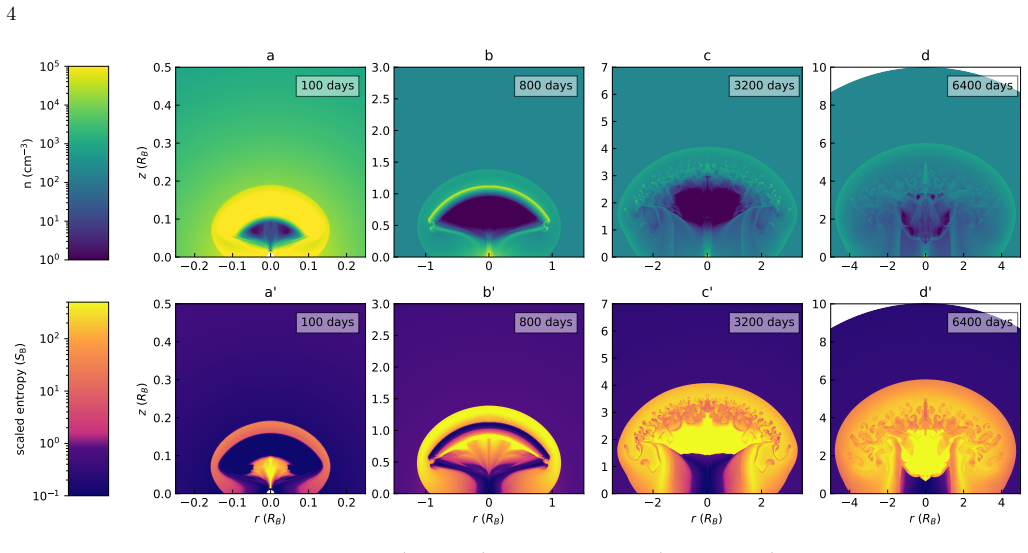
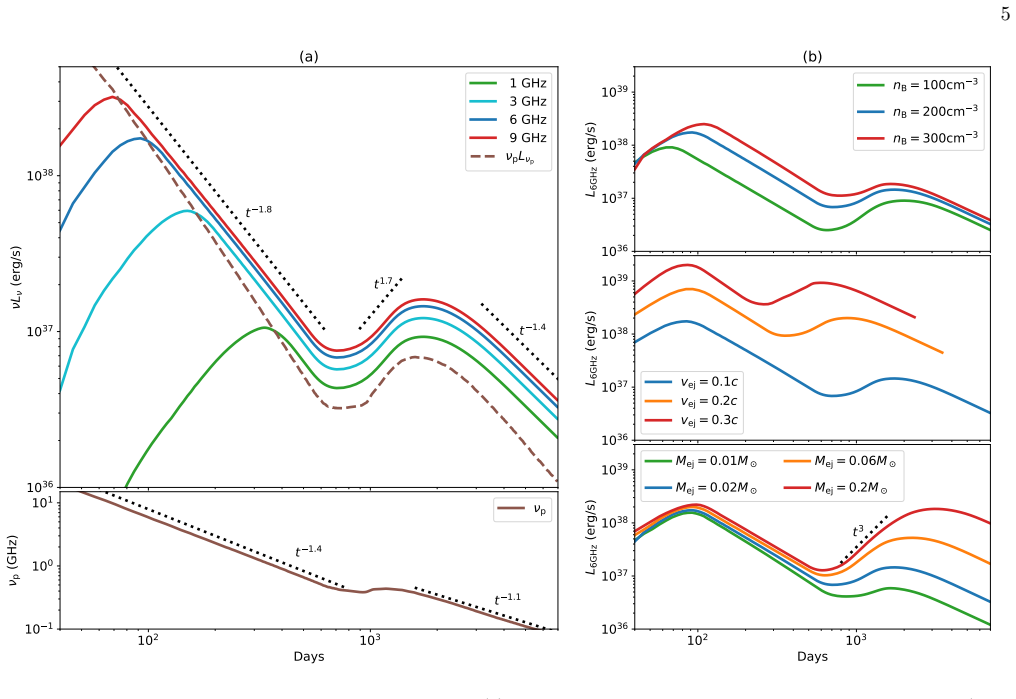
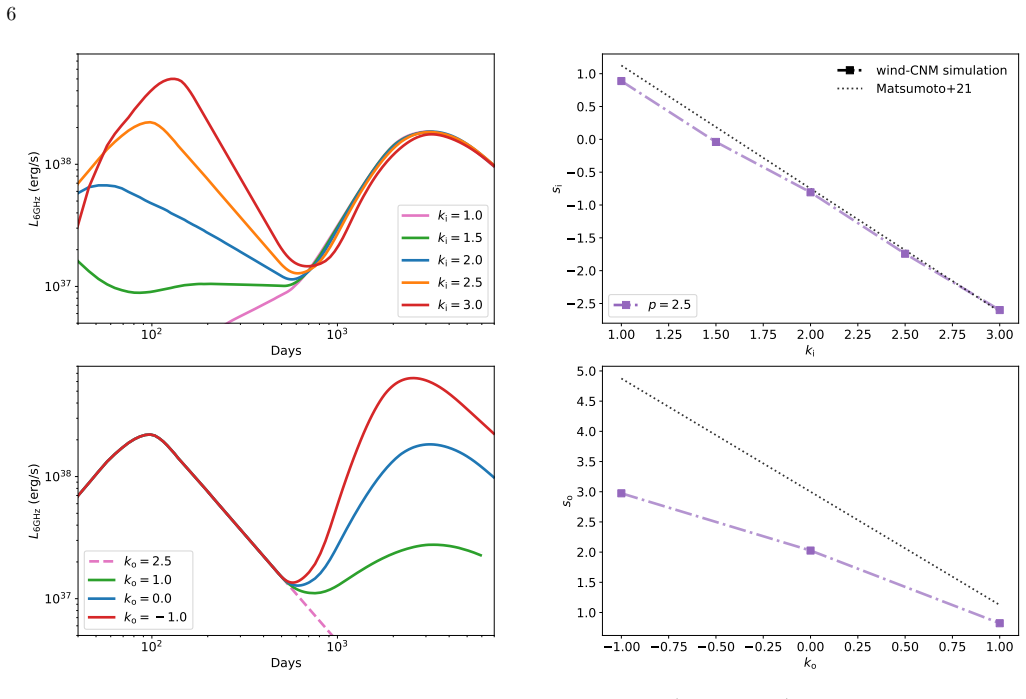
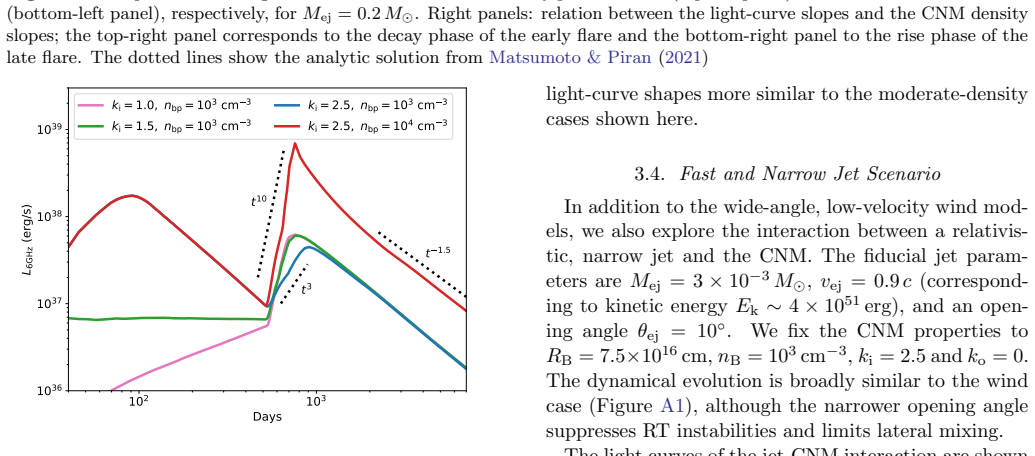
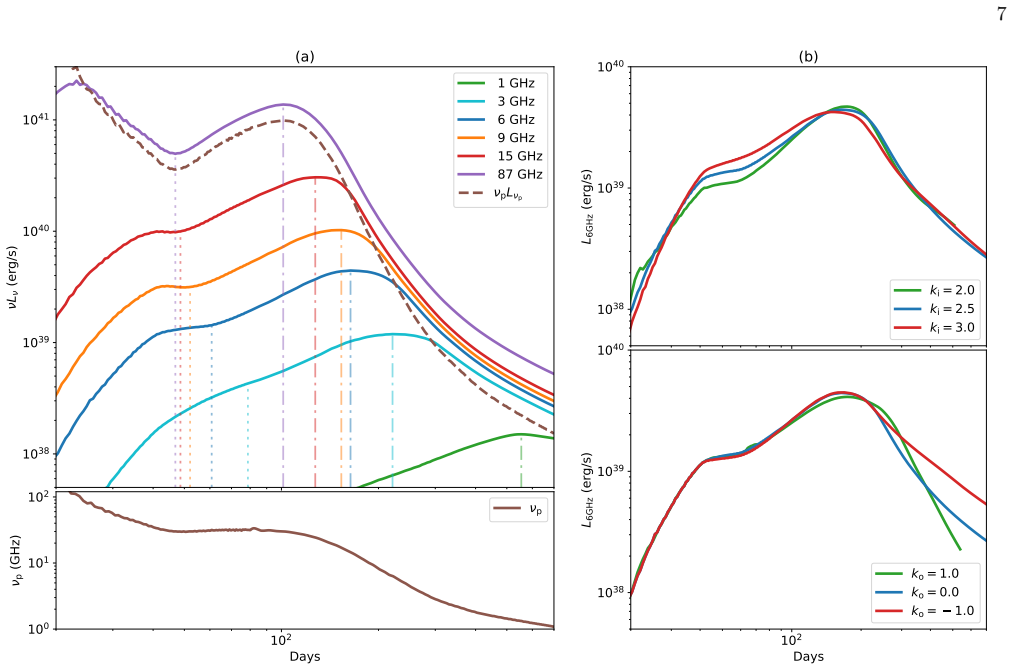
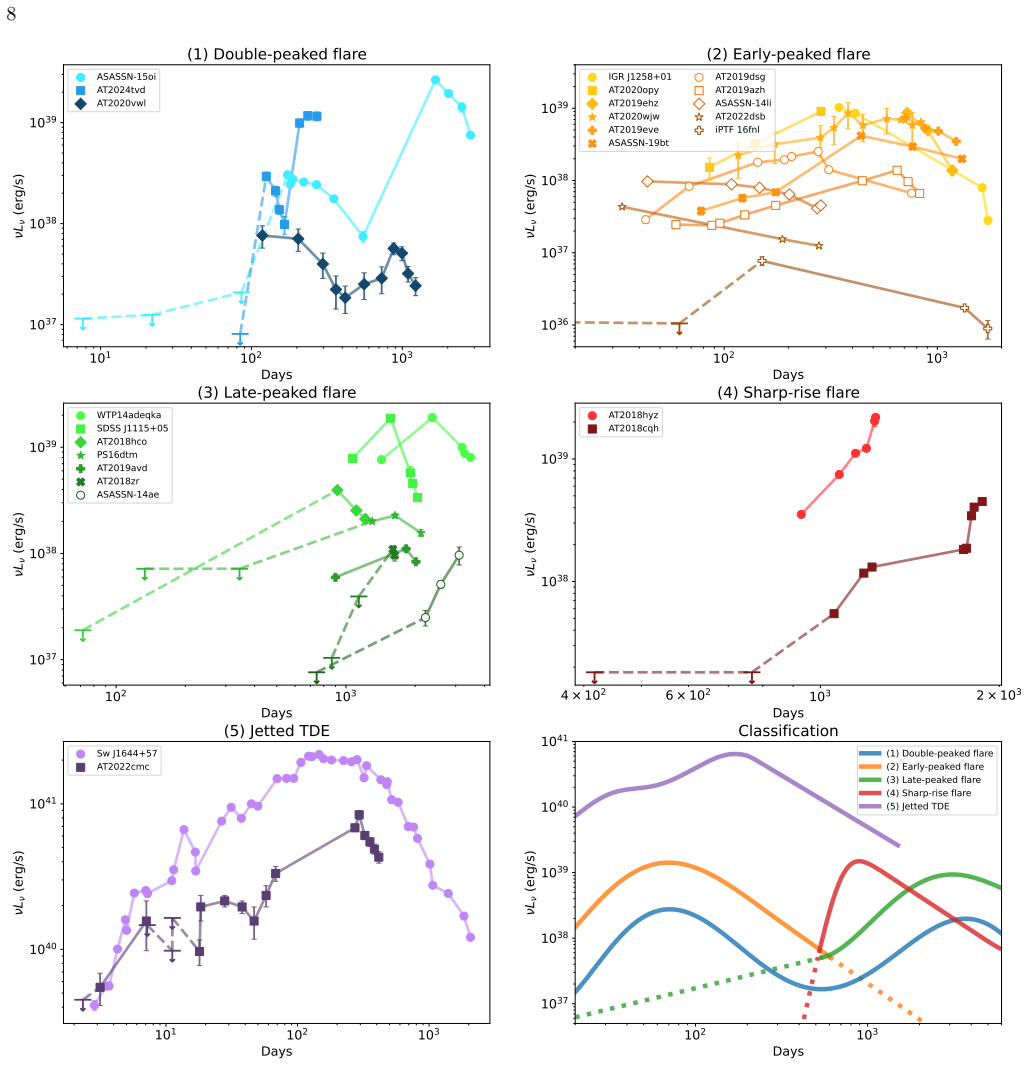
The outflow-CNM interaction inside the Bondi radius produces an early radio flare (≲2 yr) once the emitting region becomes optically thin. A second radio rebrightening can appear a few years later if the outflow decelerates beyond the Bondi radius. Different CNM densities produce single early-peaked, single late-peaked, or sharp late-rise light curves. The relativistic jet case reproduces jetted TDE light curves without complex jet structure.
What carries the argument
Broken power-law CNM density profile with transition near the Bondi radius, which sets the timing of outflow deceleration and the resulting radio emission.
If this is right
- The interaction inside the Bondi radius leads to an early radio flare within roughly two years when the region becomes optically thin.
- Very dense inner CNM causes rapid deceleration and suppresses late rebrightening, yielding a single early-peaked flare.
- Rarefied outer CNM or very dense CNM at large radii can suppress or trigger late features, producing single late-peaked or sharp late-rise curves.
- A relativistic jet with the same CNM profile reproduces the characteristic light curves of jetted TDEs without requiring complex jet structure.
Where Pith is reading between the lines
- Radio light curve shapes could serve as a diagnostic for the density transition scale near the Bondi radius in galactic nuclei.
- The same CNM structure might influence X-ray or optical variability in TDEs through changes in outflow dynamics.
- Adding magnetic fields or non-spherical outflows in follow-up simulations could test whether the predicted light curve categories remain distinct.
Load-bearing premise
The circumnuclear medium follows a broken power-law density profile with a transition near the Bondi radius.
What would settle it
A TDE radio light curve whose shape cannot be matched by any combination of inner and outer CNM densities in the broken power-law model would challenge the explanation for the observed diversity.
Figures
read the original abstract
The complex radio light curves of tidal disruption events (TDEs) challenge our understanding of the properties of both the outflows and the circumnuclear medium (CNM) surrounding supermassive black holes. In this work, we explore outflow-CNM interactions across a broad parameter space using three-dimensional hydrodynamic simulations, adopting a broken power-law CNM density profile with a transition near the Bondi radius. The outflow-CNM interaction inside Bondi radius produces an early radio flare (\(\lesssim 2\) yr) once the emitting region becomes optically thin. A second radio rebrightening can appear a few years later if the outflow decelerates beyond Bondi radius. We also find that either a very dense inner CNM, which causes rapid deceleration, or a rarefied outer CNM suppresses the late rebrightening that will produces a single early-peaked flare. In contrast, a rarefied CNM inside the Bondi radius suppresses the early flare and yields a single late-peaked event. For the case of very dense CNM at large radii, the interaction will trigger a sharp late-time rise as observed in some TDEs. We further explore the interaction of a relativistic jet with a broken power-law CNM, which can reproduce the characteristic light curves as observed in jetted TDEs without invoking complex jet structure.
Editorial analysis
A structured set of objections, weighed in public.
Referee Report
Summary. The paper reports 3D hydrodynamic simulations of outflow-CNM interactions using a broken power-law density profile with a transition near the Bondi radius. It claims that the interaction inside the Bondi radius produces an early radio flare (≲2 yr) once optically thin, with possible late rebrightening if deceleration occurs beyond the Bondi radius; varying inner/outer CNM densities yields single early-peaked, single late-peaked, or sharp late-rise light curves, and a relativistic jet case reproduces jetted TDE light curves without complex jet structure.
Significance. If the results hold, the work supplies a hydrodynamic mechanism linking CNM structure to the observed diversity of TDE radio light curves, including early flares and late rebrightenings, while showing that a relativistic jet in this medium can match jetted TDE observations without additional jet complexity. The use of 3D hydrodynamic simulations across a broad parameter space is a clear strength for forward modeling of these interactions.
major comments (1)
- [Abstract] Abstract: the reported diversity of light-curve morphologies (single early-peaked, single late-peaked, sharp late-rise) and the reproduction of jetted TDE curves are generated exclusively by varying parameters inside the adopted broken power-law CNM profile with a transition near the Bondi radius. No alternative functional forms (e.g., single power-law or different transition radii) are tested, so it remains unclear whether these behaviors are generic to outflow-CNM interactions or specific to this density prescription; this assumption is load-bearing for the claimed implications.
Simulated Author's Rebuttal
We thank the referee for their constructive report and recommendation for major revision. We address the single major comment below regarding the specificity of the adopted CNM density profile.
read point-by-point responses
-
Referee: the reported diversity of light-curve morphologies (single early-peaked, single late-peaked, sharp late-rise) and the reproduction of jetted TDE curves are generated exclusively by varying parameters inside the adopted broken power-law CNM profile with a transition near the Bondi radius. No alternative functional forms (e.g., single power-law or different transition radii) are tested, so it remains unclear whether these behaviors are generic to outflow-CNM interactions or specific to this density prescription; this assumption is load-bearing for the claimed implications.
Authors: We agree that no alternative functional forms (single power-law or shifted transition radii) were simulated. The broken power-law with a break near the Bondi radius was adopted because it is physically motivated by the expected transition between the SMBH-dominated inner region and the larger-scale galactic potential; this break enables the distinct early-flare and late-rebrightening regimes that match observed TDE diversity. Within this framework, varying only the inner/outer normalizations already spans the reported morphologies and reproduces jetted-TDE curves. We will add an explicit paragraph in the revised introduction and discussion sections acknowledging that the results are specific to this motivated profile, noting that single power-laws would lack the break needed for both early and late features, and stating that testing other forms is left for future work. This is a partial revision consisting of added text only. revision: partial
Circularity Check
No circularity: forward hydrodynamic modeling with explicit input assumptions
full rationale
The paper performs 3D hydrodynamic simulations of outflow-CNM interactions using an explicitly adopted broken power-law density profile with a Bondi-radius transition as an input assumption (abstract and setup description). Light-curve morphologies (early flare, late rebrightening, single-peaked or sharp-rise shapes) are direct outputs of varying parameters within this fixed functional form and the relativistic jet case. No equations reduce a claimed prediction to a fitted quantity by construction, no self-citation chain justifies a load-bearing premise, and no ansatz or uniqueness result is smuggled in. The work is self-contained forward modeling whose results follow from the chosen inputs rather than re-deriving them.
Axiom & Free-Parameter Ledger
free parameters (3)
- inner and outer CNM density slopes
- transition radius near Bondi radius
- outflow velocity and density
axioms (2)
- standard math Standard Euler equations of hydrodynamics govern the outflow-CNM interaction.
- domain assumption Radio emission arises once the emitting region becomes optically thin.
Reference graph
Works this paper leans on
-
[1]
Simulations of the Collision between a Debris Stream and an Outer Dusty Torus: A Possible Channel for Forming a Fast-rise and Long-delay Radio Outburst in Tidal Disruption Events. , keywords =. doi:10.3847/1538-4357/ad8ba5 , archivePrefix =. 2410.20127 , primaryClass =
-
[2]
Jets in Gamma-Ray Bursts. , keywords =. doi:10.1086/312109 , archivePrefix =. astro-ph/9903339 , primaryClass =
work page internal anchor Pith review Pith/arXiv arXiv doi:10.1086/312109
-
[3]
The Athena++ Adaptive Mesh Refinement Framework: Design and Magnetohydrodynamic Solvers. , keywords =. doi:10.3847/1538-4365/ab929b , archivePrefix =. 2005.06651 , primaryClass =
-
[4]
, year = 1981, month = may, volume =
Nonthermal radiation from supernova remnants in the adiabatic stage of evolution. , year = 1981, month = may, volume =. doi:10.1086/158868 , adsurl =
-
[5]
Misaligned precessing jets are choked by the accretion disc wind. , keywords =. doi:10.1093/mnras/stae1770 , archivePrefix =. 2310.15336 , primaryClass =
-
[6]
Ubiquitous Late Radio Emission from Tidal Disruption Events. , keywords =. doi:10.3847/1538-4357/ad5541 , archivePrefix =. 2308.13595 , primaryClass =
-
[7]
Transient Name Server Classification Report , keywords =
ZTF Transient Classification Report for 2021-01-15. Transient Name Server Classification Report , keywords =
2021
-
[8]
Propagation of a Precessing Jet in the Envelope of Tidal Disruption Events. , keywords =. doi:10.3847/1538-4357/ae1eed , archivePrefix =. 2508.11578 , primaryClass =
-
[9]
Transient Name Server Discovery Report , keywords =
GaiaAlerts Transient Discovery Report for 2020-10-12. Transient Name Server Discovery Report , keywords =
2020
-
[10]
Tidal Disruption Event Demographics with the Zwicky Transient Facility: Volumetric Rates, Luminosity Function, and Implications for the Local Black Hole Mass Function. , keywords =. doi:10.3847/2041-8213/acf216 , archivePrefix =. 2303.06523 , primaryClass =
-
[11]
AT2019azh: an unusually long-lived, radio-bright thermal tidal disruption event. , keywords =. doi:10.1093/mnras/stac333 , archivePrefix =. 2201.03744 , primaryClass =
-
[12]
Monthly Notices of the Royal Astronomical Society , author =
A radio-emitting outflow produced by the tidal disruption event AT2020vwl. , keywords =. doi:10.1093/mnras/stad1258 , archivePrefix =. 2304.12661 , primaryClass =
-
[13]
A Second Radio Flare from the Tidal Disruption Event AT2020vwl: A Delayed Outflow Ejection?. , keywords =. doi:10.3847/1538-4357/adb0b1 , archivePrefix =. 2410.18665 , primaryClass =
-
[14]
A radio flare associated with the nuclear transient eRASSt J234403-352640: an outflow launched by a potential tidal disruption event. , keywords =. doi:10.1093/mnras/stae362 , archivePrefix =. 2401.17286 , primaryClass =
-
[15]
Tidal disruption of stars by black holes of 10 ^ 6 - 10 ^ 8 solar masses in nearby galaxies. , keywords =. doi:10.1038/333523a0 , adsurl =
-
[16]
The Tidal Disruption of a Star by a Massive Black Hole. , keywords =. doi:10.1086/185567 , adsurl =
-
[17]
Radio Properties of Tidal Disruption Events. , keywords =. doi:10.1007/s11214-020-00702-w , archivePrefix =. 2006.01159 , primaryClass =
-
[18]
Swift J2058.4+0516: Discovery of a Possible Second Relativistic Tidal Disruption Flare?
Swift J2058.4+0516: Discovery of a Possible Second Relativistic Tidal Disruption Flare?. , keywords =. doi:10.1088/0004-637X/753/1/77 , archivePrefix =. 1107.5307 , primaryClass =
work page internal anchor Pith review Pith/arXiv arXiv doi:10.1088/0004-637x/753/1/77
-
[19]
Swift J1112.2-8238: A Candidate Relativistic Tidal Disruption Flare
Swift J1112.2-8238: a candidate relativistic tidal disruption flare. , keywords =. doi:10.1093/mnras/stv1520 , archivePrefix =. 1507.03582 , primaryClass =
work page internal anchor Pith review Pith/arXiv arXiv doi:10.1093/mnras/stv1520
-
[20]
A very luminous jet from the disruption of a star by a massive black hole. , keywords =. doi:10.1038/s41586-022-05465-8 , archivePrefix =. 2211.16530 , primaryClass =
-
[21]
Discovery of an outflow from radio observations of the tidal disruption event ASASSN-14li
Discovery of an Outflow from Radio Observations of the Tidal Disruption Event ASASSN-14li. , keywords =. doi:10.3847/2041-8205/819/2/L25 , archivePrefix =. 1510.01226 , primaryClass =
work page internal anchor Pith review Pith/arXiv arXiv doi:10.3847/2041-8205/819/2/l25 2041
-
[22]
ASASSN-14li: A Model Tidal Disruption Event
ASASSN-14li: A Model Tidal Disruption Event. , keywords =. doi:10.3847/0004-637X/827/2/127 , archivePrefix =. 1602.02824 , primaryClass =
work page internal anchor Pith review Pith/arXiv arXiv doi:10.3847/0004-637x/827/2/127
-
[23]
Discovery of a Time Lag between the Soft X-Ray and Radio Emission of the Tidal Disruption Flare ASASSN-14li: Evidence for Linear Disk-Jet Coupling. , keywords =. doi:10.3847/1538-4357/aab361 , archivePrefix =. 1709.02882 , primaryClass =
work page internal anchor Pith review Pith/arXiv arXiv doi:10.3847/1538-4357/aab361
-
[24]
Self-intersection of the fallback stream in tidal disruption events. , keywords =. doi:10.1093/mnras/stz3405 , archivePrefix =. 1904.12018 , primaryClass =
-
[25]
A tidal disruption event coincident with a high-energy neutrino. Nature Astronomy , keywords =. doi:10.1038/s41550-020-01295-8 , archivePrefix =. 2005.05340 , primaryClass =
-
[26]
Radio Monitoring of the Tidal Disruption Event Swift J164449.3+573451. IV. Continued Fading and Non-relativistic Expansion. , keywords =. doi:10.3847/1538-4357/abd323 , archivePrefix =. 2011.00074 , primaryClass =
-
[27]
Radio Observations of an Ordinary Outflow from the Tidal Disruption Event AT2019dsg. , keywords =. doi:10.3847/1538-4357/ac110a , archivePrefix =. 2103.06299 , primaryClass =
-
[28]
A Unified Theory of Jetted Tidal Disruption Events: From Promptly Escaping Relativistic to Delayed Transrelativistic Jets. , keywords =. doi:10.3847/2041-8213/ad0037 , archivePrefix =. 2308.05161 , primaryClass =
-
[29]
AT2022cmc: A Tidal Disruption Event with a Two-component Jet in a Bondi-profile Circumnuclear Medium. , keywords =. doi:10.3847/1538-4357/ad20f3 , adsurl =
-
[30]
Radio Emission from the unbound Debris of Tidal Disruption Events
Radio emission from the unbound debris of tidal disruption events. , keywords =. doi:10.1093/mnras/stz1567 , archivePrefix =. 1903.02575 , primaryClass =
work page internal anchor Pith review Pith/arXiv arXiv doi:10.1093/mnras/stz1567 1903
-
[31]
Radio emission of tidal disruption events from wind-cloud interaction. , keywords =. doi:10.1093/mnras/stad804 , archivePrefix =. 2303.10817 , primaryClass =
-
[32]
Radio emission from outflow-cloud interaction and its constraint on tidal disruption event outflow. , keywords =. doi:10.1093/mnras/stab3742 , archivePrefix =. 2108.11296 , primaryClass =
-
[33]
Radio emission from simulated tidal disruption events. , keywords =. doi:10.1093/mnras/stac1886 , adsurl =
-
[34]
Delayed radio flares from a tidal disruption event. Nature Astronomy , keywords =. doi:10.1038/s41550-021-01300-8 , archivePrefix =. 2102.11290 , primaryClass =
-
[35]
Are Delayed Radio Flares Common in Tidal Disruption Events? The Case of the TDE iPTF 16fnl. , keywords =. doi:10.3847/2041-8213/ac25fe , archivePrefix =. 2109.10921 , primaryClass =
-
[36]
A Mildly Relativistic Outflow Launched Two Years after Disruption in Tidal Disruption Event AT2018hyz. , keywords =. doi:10.3847/1538-4357/ac88d0 , archivePrefix =. 2206.14297 , primaryClass =
-
[37]
Radio observations of the tidal disruption event AT2020opy: a luminous non-relativistic outflow encountering a dense circumnuclear medium. , keywords =. doi:10.1093/mnras/stac3127 , archivePrefix =. 2208.13967 , primaryClass =
-
[38]
A Late-time Radio Flare Following a Possible Transition in Accretion State in the Tidal Disruption Event AT 2019azh. , keywords =. doi:10.3847/1538-4357/ac74bc , archivePrefix =. 2202.00026 , primaryClass =
-
[39]
Generalized equipartition method from an arbitrary viewing angle. , keywords =. doi:10.1093/mnras/stad1269 , archivePrefix =. 2211.10051 , primaryClass =
-
[40]
An off-axis relativistic jet seen in the long lasting delayed radio flare of the TDE AT 2018hyz. , keywords =. doi:10.1093/mnras/stad3717 , archivePrefix =. 2308.01965 , primaryClass =
-
[41]
Two-component off-axis jet model for radio flares of tidal disruption events. , keywords =. doi:10.1103/PhysRevD.110.L061307 , archivePrefix =. 2404.13326 , primaryClass =
-
[42]
doi:10.1017/9781139226530 , adsurl =
The Physics of Gamma-Ray Bursts. doi:10.1017/9781139226530 , adsurl =
-
[43]
Interaction of an Outflow with Surrounding Gaseous Clouds as the Origin of Late-time Radio Flares in Tidal Disruption Events. , keywords =. doi:10.3847/1538-4357/ad9b98 , archivePrefix =. 2406.08012 , primaryClass =
-
[44]
Late-time Radio Flares in Tidal Disruption Events. , keywords =. doi:10.3847/1538-4357/ad58ba , archivePrefix =. 2404.15966 , primaryClass =
-
[45]
The Host Galaxies of Tidal Disruption Events. , keywords =. doi:10.1007/s11214-020-00657-y , archivePrefix =. 2003.02863 , primaryClass =
-
[46]
IGR J12580+0134: The First Tidal Disruption Event with an Off-beam Relativistic Jet
IGR J12580+0134: The First Tidal Disruption Event with an Off-beam Relativistic Jet. , keywords =. doi:10.3847/0004-637X/816/1/20 , archivePrefix =. 1511.01206 , primaryClass =
work page internal anchor Pith review Pith/arXiv arXiv doi:10.3847/0004-637x/816/1/20
-
[47]
, year = 1952, month = jan, volume =
Bondi, H. , title =. Monthly Notices of the Royal Astronomical Society , volume =. 1952 , month =. doi:10.1093/mnras/112.2.195 , url =
-
[48]
The role of feedback in accretion on Low Luminosity AGN: Sgr A* case study
The role of feedback in accretion on low-luminosity AGN: Sgr A* case study. , keywords =. doi:10.1093/mnras/stv584 , archivePrefix =. 1503.02745 , primaryClass =
work page internal anchor Pith review Pith/arXiv arXiv doi:10.1093/mnras/stv584
-
[49]
Investigating the Circumnuclear Medium of Tidal Disruption Events with Radio Observations. arXiv e-prints , keywords =. doi:10.48550/arXiv.2603.06056 , archivePrefix =. 2603.06056 , primaryClass =
-
[50]
Multizone Modeling of Black Hole Accretion and Feedback in 3D GRMHD: Bridging Vast Spatial and Temporal Scales. , keywords =. doi:10.3847/1538-4357/ad9561 , archivePrefix =. 2405.13887 , primaryClass =
-
[51]
Hydrodynamic Simulations of the Inner Accretion Flow of Sagittarius A* Fueled By Stellar Winds
Hydrodynamic simulations of the inner accretion flow of Sagittarius A* fuelled by stellar winds. , keywords =. doi:10.1093/mnras/sty1146 , archivePrefix =. 1805.00474 , primaryClass =
work page internal anchor Pith review Pith/arXiv arXiv doi:10.1093/mnras/sty1146
-
[52]
Chandra X-ray Spectroscopic Imaging of Sgr A* and the Central Parsec of the Galaxy
Chandra X-Ray Spectroscopic Imaging of Sagittarius A* and the Central Parsec of the Galaxy. , keywords =. doi:10.1086/375145 , archivePrefix =. astro-ph/0102151 , primaryClass =
work page internal anchor Pith review Pith/arXiv arXiv doi:10.1086/375145
-
[53]
A Dynamical Model for Hot Gas in the Galactic Center
A Dynamical Model for Hot Gas in the Galactic Center. , keywords =. doi:10.1086/422973 , archivePrefix =. astro-ph/0310446 , primaryClass =
work page internal anchor Pith review Pith/arXiv arXiv doi:10.1086/422973
-
[54]
Radio constraint on outflows from tidal disruption events. , keywords =. doi:10.1093/mnras/stab2418 , archivePrefix =. 2107.06289 , primaryClass =
-
[55]
Radiative processes in astrophysics
-
[56]
The influence of circumnuclear environment on the radio emission from TDE jets
The influence of circumnuclear environment on the radio emission from TDE jets. , keywords =. doi:10.1093/mnras/stw2439 , archivePrefix =. 1605.08437 , primaryClass =
work page internal anchor Pith review Pith/arXiv arXiv doi:10.1093/mnras/stw2439
-
[57]
Detection of a Drag Force in G2's Orbit: Measuring the Density of the Accretion Flow onto Sgr A* at 1000 Schwarzschild Radii. , keywords =. doi:10.3847/1538-4357/aaf4f8 , adsurl =
-
[58]
Constraining the accretion flow density profile near Sgr A* using the S2 star's trajectory from 2000 to 2018. , keywords =. doi:10.1051/0004-6361/202037724 , adsurl =
-
[59]
Hyperaccretion during tidal disruption events: weakly bound debris envelopes and jets
Hyperaccretion during Tidal Disruption Events: Weakly Bound Debris Envelopes and Jets. , keywords =. doi:10.1088/0004-637X/781/2/82 , archivePrefix =. 1312.5314 , primaryClass =
work page internal anchor Pith review Pith/arXiv arXiv doi:10.1088/0004-637x/781/2/82
-
[60]
Optical-Ultraviolet Tidal Disruption Events. , keywords =. doi:10.1007/s11214-020-00753-z , archivePrefix =. 2008.05461 , primaryClass =
-
[61]
Optical flares from the tidal disruption of stars by massive black holes. , keywords =. doi:10.1111/j.1365-2966.2009.15599.x , archivePrefix =. 0905.3735 , primaryClass =
-
[62]
Spectroscopic signatures of the tidal disruption of stars by massive black holes. , keywords =. doi:10.1111/j.1365-2966.2011.18686.x , archivePrefix =. 1008.4131 , primaryClass =
-
[63]
Multiband light curves of tidal disruption events. , keywords =. doi:10.1111/j.1365-2966.2010.17448.x , archivePrefix =. 1008.4589 , primaryClass =
-
[64]
Flares from the Tidal Disruption of Stars by Massive Black Holes. , keywords =. doi:10.1086/306909 , adsurl =
-
[65]
The X-ray through Optical Fluxes and Line Strengths of Tidal Disruption Events
The X-Ray through Optical Fluxes and Line Strengths of Tidal Disruption Events. , keywords =. doi:10.3847/0004-637X/827/1/3 , archivePrefix =. 1510.08454 , primaryClass =
work page internal anchor Pith review Pith/arXiv arXiv doi:10.3847/0004-637x/827/1/3
-
[66]
Rates of Stellar Tidal Disruption as Probes of the Supermassive Black Hole Mass Function
Rates of stellar tidal disruption as probes of the supermassive black hole mass function. , keywords =. doi:10.1093/mnras/stv2281 , archivePrefix =. 1410.7772 , primaryClass =
work page internal anchor Pith review Pith/arXiv arXiv doi:10.1093/mnras/stv2281
-
[67]
New Physical Insights about Tidal Disruption Events from a Comprehensive Observational Inventory at X-Ray Wavelengths. , keywords =. doi:10.3847/1538-4357/aa633b , archivePrefix =. 1611.02291 , primaryClass =
work page internal anchor Pith review Pith/arXiv arXiv doi:10.3847/1538-4357/aa633b
-
[68]
A unified model for tidal disruption events
A Unified Model for Tidal Disruption Events. , keywords =. doi:10.3847/2041-8213/aab429 , archivePrefix =. 1803.03265 , primaryClass =
work page internal anchor Pith review Pith/arXiv arXiv doi:10.3847/2041-8213/aab429 2041
-
[69]
GRRMHD simulations of tidal disruption event accretion discs around supermassive black holes: jet formation, spectra, and detectability. , keywords =. doi:10.1093/mnras/sty3134 , archivePrefix =. 1811.06971 , primaryClass =
work page internal anchor Pith review Pith/arXiv arXiv doi:10.1093/mnras/sty3134
-
[70]
X-Ray Properties of TDEs. , keywords =. doi:10.1007/s11214-020-00708-4 , adsurl =
-
[71]
Hydrodynamical Simulations to Determine the Feeding Rate of Black Holes by the Tidal Disruption of Stars: The Importance of the Impact Parameter and Stellar Structure. , keywords =. doi:10.1088/0004-637X/767/1/25 , archivePrefix =. 1206.2350 , primaryClass =
work page internal anchor Pith review Pith/arXiv arXiv doi:10.1088/0004-637x/767/1/25
-
[72]
The WISE Detection of an Infrared Echo in Tidal Disruption Event ASASSN-14li
The WISE Detection of an Infrared Echo in Tidal Disruption Event ASASSN-14li. , keywords =. doi:10.3847/2041-8205/828/1/L14 , archivePrefix =. 1605.04640 , primaryClass =
work page internal anchor Pith review Pith/arXiv arXiv doi:10.3847/2041-8205/828/1/l14 2041
-
[73]
"Circularization" vs. Accretion -- What Powers Tidal Disruption Events?
‧Disk Formation Versus Disk Accretion What Powers Tidal Disruption Events?. , keywords =. doi:10.1088/0004-637X/806/2/164 , archivePrefix =. 1502.05792 , primaryClass =
work page internal anchor Pith review Pith/arXiv arXiv doi:10.1088/0004-637x/806/2/164
-
[74]
The Astrophysical Journal , author =
Elliptical Accretion Disk as a Model for Tidal Disruption Events. , keywords =. doi:10.3847/1538-4357/abd2b6 , archivePrefix =. 2012.05552 , primaryClass =
-
[75]
Stream-disk shocks as the origins of peak light in tidal disruption events. , keywords =. doi:10.1038/s41586-023-06875-y , archivePrefix =. 2206.10641 , primaryClass =
-
[76]
An Explanation for the Overrepresentation of Tidal Disruption Events in Post-starburst Galaxies. , keywords =. doi:10.3847/1538-4357/ad0bfb , archivePrefix =. 2311.07040 , primaryClass =
-
[77]
Mid-infrared Outbursts in Nearby Galaxies (MIRONG). I. Sample Selection and Characterization. , keywords =. doi:10.3847/1538-4365/abd1dc , archivePrefix =. 2012.06806 , primaryClass =
-
[78]
A New Population of Mid-infrared-selected Tidal Disruption Events: Implications for Tidal Disruption Event Rates and Host Galaxy Properties. , keywords =. doi:10.3847/1538-4357/ad18bb , archivePrefix =. 2401.01403 , primaryClass =
-
[79]
A relativistic jetted outburst from a massive black hole fed by a tidally disrupted star
A Possible Relativistic Jetted Outburst from a Massive Black Hole Fed by a Tidally Disrupted Star. Science , keywords =. doi:10.1126/science.1207150 , archivePrefix =. 1104.3257 , primaryClass =
work page internal anchor Pith review Pith/arXiv arXiv doi:10.1126/science.1207150
-
[80]
The Birth of a Relativistic Outflow in the Unusual {\gamma}-ray Transient Swift J164449.3+573451
Birth of a relativistic outflow in the unusual -ray transient Swift J164449.3+573451. , keywords =. doi:10.1038/nature10366 , archivePrefix =. 1106.3568 , primaryClass =
work page internal anchor Pith review Pith/arXiv arXiv doi:10.1038/nature10366
discussion (0)
Sign in with ORCID, Apple, or X to comment. Anyone can read and Pith papers without signing in.