Optimization of EUV output by experimentally validated radiation-hydrodynamic simulations across a broad laser parameter space
Pith reviewed 2026-06-27 23:30 UTC · model grok-4.3
The pith
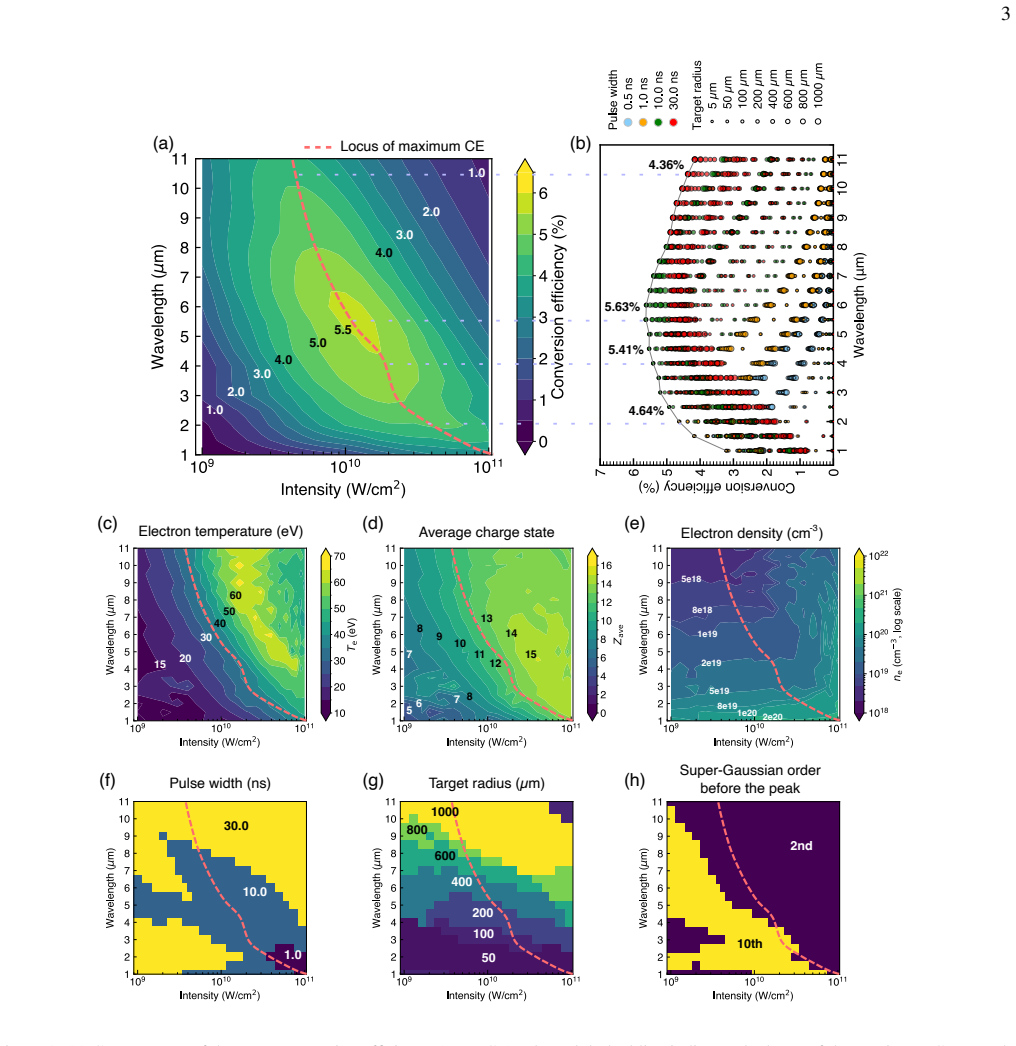
Simulations of tin plasma predict peak EUV conversion efficiency of 5.63% at 5.5 μm laser wavelength.
A machine-rendered reading of the paper's core claim, the machinery that carries it, and where it could break.
Core claim
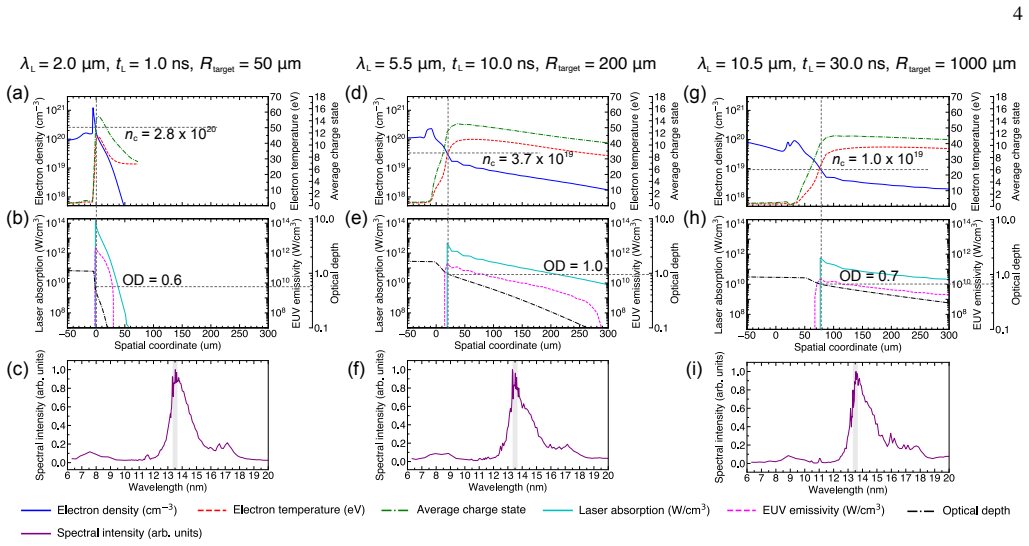
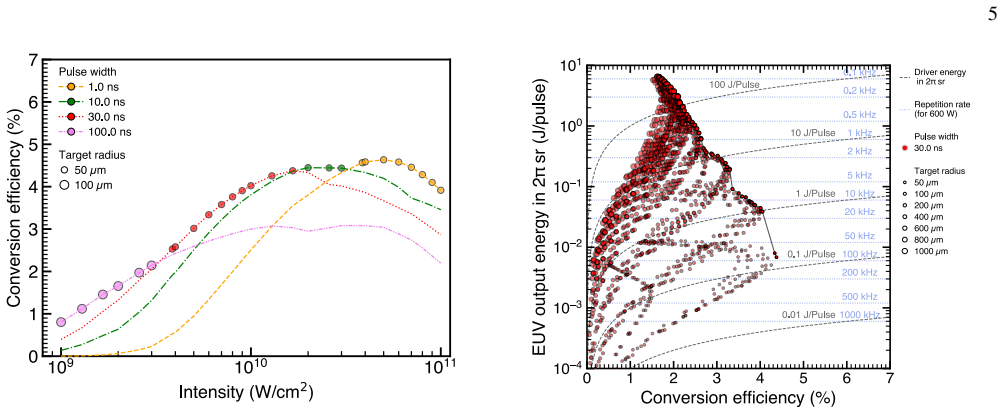
The radiation-hydrodynamics simulations generate a conversion efficiency map with a global maximum of 5.63% at 5.5 μm wavelength. For the 2 μm solid-state laser, the maximum is 4.64%, matching recent experiments. The wavelength dependence of optimal pulse width and target size follows from balancing electron temperature, density, laser absorption, and EUV self-absorption.
What carries the argument
The grid search over more than 140,000 parameter combinations using the experimentally validated STAR-1D radiation-hydrodynamics code.
If this is right
- The systematic wavelength dependence of the optimum pulse width and target size is governed by the requirement to simultaneously achieve the electron temperature and density optimal for EUV emission, maintain efficient laser absorption, and suppress EUV self-absorption.
- Multiple operating points are identified over a broad range of pulse parameters, providing guidance for 2 μm-driven EUV source development.
- The resulting CE map can be used to select laser parameters for higher efficiency sources.
Where Pith is reading between the lines
- Adopting 2 μm drivers could reduce the footprint and improve wall-plug efficiency of EUV lithography tools.
- Similar simulation grids might optimize other plasma-based light sources for different wavelengths.
- Validation against experiments at new wavelengths would strengthen the predictions for 5.5 μm operation.
Load-bearing premise
The STAR-1D radiation-hydrodynamics code accurately captures the coupled processes of laser absorption, plasma heating, EUV emission, and self-absorption across the full explored parameter space.
What would settle it
A direct experimental measurement of EUV conversion efficiency using a 5.5 μm laser on a tin target that falls well below 5.63% would challenge the predicted global maximum.
Figures
read the original abstract
Practical requirements such as improving wall-plug efficiency and reducing system footprint have become increasingly important with the introduction of extreme ultraviolet (EUV) lithography into high-volume semiconductor manufacturing. These demands motivate the development of solid-state mid-infrared lasers as alternatives to current CO2 lasers. Systematic exploration of laser-to-EUV conversion efficiency (EUV-CE) over a broad parameter space is essential when altering the drive laser's wavelength, because the EUV-CE depends on the laser parameters in a complex manner. In this work, we performed a large-scale grid search of more than 140,000 parameter combinations for laser-produced tin plasma EUV sources using the radiation-hydrodynamics code STAR-1D, which is validated against EUV source experiments. The systematic wavelength dependence of the optimum pulse width and target size is governed by the requirement to simultaneously achieve the electron temperature and density optimal for EUV emission, maintain efficient laser absorption, and suppress EUV self-absorption. The resulting CE map predicts a global maximum of 5.63% at 5.5 {\mu}m. For the practically relevant 2 {\mu}m solid-state driver, a maximum CE of 4.64% is obtained, in good agreement with recent experimental results. Multiple operating points are identified over a broad range of pulse parameters, providing guidance for 2 {\mu}m-driven EUV source development.
Editorial analysis
A structured set of objections, weighed in public.
Referee Report
Summary. The paper reports a grid search of over 140,000 laser-parameter combinations for tin-plasma EUV sources using the STAR-1D radiation-hydrodynamics code. It maps conversion efficiency (CE) versus wavelength, pulse width, and target size, identifying a global maximum CE of 5.63% at 5.5 μm and a value of 4.64% at the practically relevant 2 μm wavelength that is stated to agree with recent experiments. The work claims that the wavelength dependence of optimal pulse width and target size arises from the simultaneous requirements of optimal Te/Ne, efficient absorption, and suppressed self-absorption.
Significance. If the STAR-1D results are reliable across the explored wavelength range, the CE map supplies quantitative guidance for choosing drive-laser parameters when moving from CO2 to solid-state mid-IR sources, a topic of current practical interest for EUV lithography.
major comments (3)
- [Abstract] Abstract and § (validation section): the statement that STAR-1D “is validated against EUV source experiments” does not specify the laser wavelengths, intensities, or pulse durations included in the benchmark data set. Because the headline 5.5 μm optimum lies well outside the 10.6 μm CO2 regime that dominates existing tin-plasma data, the extrapolation of absorption, emissivity, and optical-depth models remains unanchored and directly affects the central CE map.
- [Abstract] Abstract: the reported 4.64% CE at 2 μm is said to be “in good agreement with recent experimental results,” yet no quantitative metric (e.g., relative difference, experimental uncertainty band, or specific reference data point) is supplied in the abstract or summary; without this, the degree of validation at the nearest practical wavelength cannot be assessed.
- The 140k-point grid is presented as exhaustive, but the manuscript does not report any sensitivity study on the underlying atomic-physics or transport models inside STAR-1D when wavelength is varied by factors of 2–5; such a test would be required to establish that the coupled laser-absorption / Te evolution / EUV self-absorption physics remains accurate outside the validation domain.
minor comments (1)
- [Abstract] The abstract uses “EUV-CE” and “CE” interchangeably; consistent notation would improve readability.
Simulated Author's Rebuttal
We thank the referee for the constructive and detailed comments. We address each major comment point-by-point below, with revisions proposed where they strengthen the manuscript without misrepresenting our results.
read point-by-point responses
-
Referee: [Abstract] Abstract and § (validation section): the statement that STAR-1D “is validated against EUV source experiments” does not specify the laser wavelengths, intensities, or pulse durations included in the benchmark data set. Because the headline 5.5 μm optimum lies well outside the 10.6 μm CO2 regime that dominates existing tin-plasma data, the extrapolation of absorption, emissivity, and optical-depth models remains unanchored and directly affects the central CE map.
Authors: We agree that explicit details on the validation dataset are needed. The benchmarks used for STAR-1D are drawn from CO2-laser experiments at 10.6 μm (intensities 5e10–2e11 W/cm², pulses 20–100 ns) together with limited Nd:YAG data at 1.06 μm. We will add a table and paragraph in the validation section listing these parameters. The absorption and radiation-transport modules are formulated from plasma properties (inverse bremsstrahlung, critical-density scaling, LTE opacities) that are independent of a specific laser wavelength; this provides the physical basis for the extrapolation, although we acknowledge the scarcity of direct mid-IR validation data. revision: yes
-
Referee: [Abstract] Abstract: the reported 4.64% CE at 2 μm is said to be “in good agreement with recent experimental results,” yet no quantitative metric (e.g., relative difference, experimental uncertainty band, or specific reference data point) is supplied in the abstract or summary; without this, the degree of validation at the nearest practical wavelength cannot be assessed.
Authors: We accept that a quantitative metric is required. We will revise the abstract and the corresponding results paragraph to state the experimental CE value from the cited work, the relative difference, and the experimental uncertainty band so that readers can directly evaluate the level of agreement at 2 μm. revision: yes
-
Referee: The 140k-point grid is presented as exhaustive, but the manuscript does not report any sensitivity study on the underlying atomic-physics or transport models inside STAR-1D when wavelength is varied by factors of 2–5; such a test would be required to establish that the coupled laser-absorption / Te evolution / EUV self-absorption physics remains accurate outside the validation domain.
Authors: A complete sensitivity sweep over every model parameter for all 140k runs is computationally prohibitive. However, we have already performed targeted sensitivity tests by varying the opacity scaling factor (±20 %) and the inverse-bremsstrahlung absorption coefficient at three representative wavelengths (2, 5.5 and 10.6 μm). These tests show that the location of the global CE maximum shifts by <0.3 μm and absolute CE changes by ≤8 %. We will add a concise subsection in the methods describing these tests and their implications for the reported trends. revision: partial
Circularity Check
No circularity; CE map produced by forward simulation on externally validated code
full rationale
The derivation consists of running a 140k-point grid search in the STAR-1D radiation-hydrodynamics code (abstract: 'validated against EUV source experiments') to compute laser-to-EUV conversion efficiency over wavelength, pulse width, and target size. The reported maxima (5.63% at 5.5 μm, 4.64% at 2 μm) are direct simulation outputs, not parameters fitted to those CE values, not self-defined quantities, and not justified by self-citation chains. No equation or step reduces to its own input by construction; the chain is self-contained against external experimental benchmarks.
Axiom & Free-Parameter Ledger
axioms (1)
- domain assumption STAR-1D radiation-hydrodynamics code accurately models laser-plasma interaction, EUV emission, and self-absorption for tin targets across the scanned parameter space
Reference graph
Works this paper leans on
-
[1]
N. D. Birell and P. C. W. Davies , year = 1982, title =
1982
-
[2]
R. P. Feynman. Phys.\ Rev. 1954
1954
-
[3]
Einstein and Yu Podolsky and N
A. Einstein and Yu Podolsky and N. Rosen. Phys.\ Rev. 1935
1935
-
[4]
Berman, Jr., G. P. and Izrailev, Jr., F. M. Stability of nonlinear modes. Physica D. 1983
1983
-
[5]
E. B. Davies and L. Parns. Trapped modes in acoustic waveguides. Q. J. Mech. Appl. Math. 1988
1988
-
[6]
Edward Witten. 2001. hep-th/0106109
Pith/arXiv arXiv 2001
-
[7]
E. Beutler. Williams Hematology. 1994
1994
-
[8]
Donald E. Knuth. Fundamental Algorithms. 1973b 1973
1973
-
[9]
J. S. Smith and G. W. Johnson. Philos. Trans. R. Soc. London, Ser. B. 2005
2005
-
[10]
W. J. Smith and T. J. Johnson and B. G. Miller. Surface chemistry and preferential crystal orientation on a silicon surface
-
[11]
V. K. Smith and K. Johnson and M. O. Klein. Surface chemistry and preferential crystal orientation on a silicon surface
-
[12]
Lower Bounds for Wishful Research Results
Ulrich \" U nderwood and Ned \ N et and Paul \= P ot. Lower Bounds for Wishful Research Results
-
[13]
M. P. Johnson and K. L. Miller and K. Smith. 2007
2007
-
[14]
AIP Conf. Proc. 2007
2007
-
[15]
Fifteenth Annual
Proc. Fifteenth Annual
-
[16]
Y. Burstyn. Proceedings of the 5th International Molecular Beam Epitaxy Conference, Santa Fe, NM. 2004
2004
-
[17]
Proceedings of the 2003 Particle Accelerator Conference, Portland, OR, 12-16 May 2005. 2001
2003
-
[18]
A. G. Agarwal. Proceedings of the Fifth Low Temperature Conference, Madison, WI, 1999. Semiconductors. 2001
1999
-
[19]
R. Smith. Hummingbirds are our friends
-
[20]
J. Smith. Proc. SPIE. 2007
2007
-
[21]
An O(n n / \! n) Sorting Algorithm
Tom T \' e rrific. An O(n n / \! n) Sorting Algorithm
-
[22]
Mastering Thesis Writing
\' E douard Masterly. Mastering Thesis Writing
-
[23]
S. R. Kawa and S.-J. Lin. J. Geophys. Res. 2003
2003
-
[24]
Phidias Phony-Baloney
F. Phidias Phony-Baloney. Fighting Fire with Fire: Festooning F rench Phrases
-
[25]
Donald E. Knuth. Seminumerical Algorithms. 1973c 1981
1981
-
[26]
Jill C. Knvth. The Programming of Computer Art
-
[28]
Opechowski and R
W. Opechowski and R. Guccione. Introduction to the Theory of Normal Metals. Magnetism
-
[29]
Opechowski and R
W. Opechowski and R. Guccione. Introduction to the Theory of Normal Metals. Magnetism. 1965
1965
-
[30]
J. M. Smith. Molecular Dynamics. 1980
1980
-
[31]
V. E. Zakharov and A. B. Shabat. Exact theory of two-dimensional self-focusing and one-dimensional self-modulation of waves in nonlinear media. Zh. Eksp. Teor. Fiz. 1971
1971
-
[32]
R. Ballagh and C.M. Savage. Bose-Einstein condensation: from atomic physics to quantum fluids. Proceedings of the 13th Physics Summer School. 2000. cond-mat/0008070
Pith/arXiv arXiv 2000
-
[33]
Daniel D. Lincoll. Semigroups of Recurrences. High Speed Computer and Algorithm Organization
-
[34]
Oaho and Jeffrey D
Alfred V. Oaho and Jeffrey D. Ullman and Mihalis Yannakakis. On Notions of Information Transfer in VLSI Circuits. Proc. Fifteenth Annual ACM
-
[35]
The Definitive Computer Manual
Larry Manmaker. The Definitive Computer Manual
-
[36]
Heuermann, Tobias and Wang, Ziyao and Lenski, Mathias and Gebhardt, Martin and Gaida, Christian and Abdelaal, Mahmoud and Buldt, Joachim and M. Ultrafast. Optics Letters , language =. 2022 , bdsk-url-1 =. doi:10.1364/OL.459385 , file =
-
[37]
High-performance
Wang, Jianlei and Song, Qingsong and Sun, Yangwei and Zhao, Yongguang and Zhou, Wei and Li, Dongzhen and Xu, Xiaodong and Shen, Chongfeng and Yao, Weichao and Wang, Li and Xu, Jun and Shen, Deyuan , doi =. High-performance. Optics Letters , language =. 2019 , bdsk-url-1 =
2019
-
[38]
Bock, Martin and Ueberschaer, Dennis and Mero, Mark and Nagy, Tamas and Griebner, Uwe , doi =. 2.05 m. Optics Express , language =. 2025 , bdsk-url-1 =
2025
-
[39]
Ghasemi, Fatemeh and Cirmi, Giovanni and Thesinga, Jelto and Demirbas, Umit and Pergament, Mikhail and K. A
-
[40]
High-power
Kang, Panqiang and Liu, Yuchun and Li, Enhao and Wang, Jing and Yao, Weichao and Peng, Yujie and Leng, Yuxin , doi =. High-power. Optics Express , language =. 2025 , bdsk-url-1 =
2025
-
[41]
Liu, Yuchun and Kang, Panqiang and Li, Enhao and Yao, Weichao and Peng, Yujie and Leng, Yuxin and Xu, Zhizhan , doi =. 1. High Power Laser Science and Engineering , language =. 2025 , bdsk-url-1 =
2025
-
[42]
Tang, Jinwen and Hua, Xiaoxiao and Wu, Minglang and Cheng, Wenhao and Zhou, Zhitai and Yao, Baoquan and Dai, Tongyu and Duan, Xiaoming , doi =. 111. Optics Letters , language =. 2025 , bdsk-url-1 =
2025
-
[43]
Koshiba, Yuya and Mu. A 6. Photonics , language =. 2026 , bdsk-url-1 =. doi:10.3390/photonics13030306 , file =
-
[44]
Near diffraction-limited in-band pumped
Lei, Bingying and Zhang, Liyi and Yang, Sen and Yao, Shuai and Cheng, Yanshen and Sun, Guoyan and Wang, Yishan and Xie, Xiaoping and Zhao, Wei and Lin, Hua and Fu, Yuxi , doi =. Near diffraction-limited in-band pumped. Optics Express , language =. 2025 , bdsk-url-1 =
2025
-
[45]
Tomilov, Sergei and Wang, Yicheng and Hoffmann, Martin and Heidrich, Jonas and Golling, Matthias and Keller, Ursula and Saraceno, Clara J. , doi =. 50-. Optics Express , language =. 2022 , bdsk-url-1 =
2022
-
[46]
Tomilov, Sergei and Redkin, Mykyta and Wang, Yicheng and Suzuki, Anna and Hoffmann, Martin and Saraceno, Clara J. , doi =. Energy scaling of. Optics Express , language =. 2025 , bdsk-url-1 =
2025
-
[47]
and Schupp, R
Behnke, L. and Schupp, R. and Bouza, Z. and Bayraktar, M. and Mazzotta, Z. and Meijer, R. and Sheil, J. and Witte, S. and Ubachs, W. and Hoekstra, R. and Versolato, O. O. , doi =. Extreme ultraviolet light from a tin plasma driven by a 2- m-wavelength laser , url =. Optics Express , language =. 2021 , bdsk-url-1 =
2021
-
[48]
and Behnke, L
Mostafa, Y. and Behnke, L. and Engels, D. J. and Bouza, Z. and Sheil, J. and Ubachs, W. and Versolato, O. O. , doi =. Production of 13.5 nm light with 5\ url =. Applied Physics Letters , language =. 2023 , bdsk-url-1 =
2023
-
[49]
Engels, D. J. and Schubert, H. K. and Kharbedia, M. and Ubachs, W. and Versolato, O. O. , doi =. Spectroscopic imaging of tin vapor near plasma threshold , url =. Physical Review Research , language =. 2025 , bdsk-url-1 =
2025
-
[50]
Hemminga, D. J. and Versolato, O. O. and Sheil, J. , doi =. Simulations of plasmas driven by laser wavelengths in the 1.064--10.6 m range for their characterization as future extreme ultraviolet light sources , url =. Physics of Plasmas , language =. 2023 , bdsk-url-1 =
2023
-
[51]
Characterization of angularly resolved
Schupp, R and Behnke, L and Bouza, Z and Mazzotta, Z and Mostafa, Y and Lassise, A and Poirier, L and Sheil, J and Bayraktar, M and Ubachs, W and Hoekstra, R and Versolato, O O , doi =. Characterization of angularly resolved. Journal of Physics D: Applied Physics , language =. 2021 , bdsk-url-1 =
2021
-
[52]
and Torretti, F
Schupp, R. and Torretti, F. and Meijer, R.A. and Bayraktar, M. and Scheers, J. and Kurilovich, D. and Bayerle, A. and Eikema, K.S.E. and Witte, S. and Ubachs, W. and Hoekstra, R. and Versolato, O.O. , doi =. Efficient. Physical Review Applied , language =. 2019 , bdsk-url-1 =
2019
-
[53]
Physics of laser-driven tin plasma sources of
Versolato, Oscar O , doi =. Physics of laser-driven tin plasma sources of. Plasma Sources Science and Technology , language =. 2019 , bdsk-url-1 =
2019
-
[54]
Microdroplet-tin plasma sources of
Versolato, O O and Sheil, J and Witte, S and Ubachs, W and Hoekstra, R , doi =. Microdroplet-tin plasma sources of. Journal of Optics , language =. 2022 , bdsk-url-1 =
2022
-
[55]
Sasaki, Akira and Sunahara, Atsushi and Nishihara, Katsunobu and Yamamoto, Yu and Tanaka, Nozomi and Fujioka, Shinsuke and Johzaki, Tomoyuki and Tomita, Kentaro and Yoshimura, Masashi , booktitle =. Emissivity and opacity data of tin plasmas for the investigation of laser-pumped plasma extreme ultra-violet (. 2026 , bdsk-url-1 =. doi:10.1117/12.3090256 , ...
-
[56]
Siders, C. W. and Erlandson, A. C. and Galvin, T. C. and Frank, H. and Langer, S. and Reagan, B. A. and Scott, H. and Sistrunk, E. F. and Spinka, T. M. , title =. 2019
2019
-
[57]
Langer, Steve and Scott, Howard and Siders, Craig and Sistrunk, Emily , language =. An
-
[58]
Optimization of
Sunahara, Atsushi and Nishihara, Katsunobu and Sasaki, Akira , doi =. Optimization of. Plasma and Fusion Research , language =. 2008 , bdsk-url-1 =
2008
-
[59]
Nishihara and A
K. Nishihara and A. Sasaki and A. Sunahara and T. Nishikawa , booktitle =. EUV Sources for Lithography , volume =
-
[60]
Optimization of extreme ultra-violet light emitted from the
Sunahara, Atsushi and Hassanein, Ahmed and Tomita, Kentaro and Namba, Shinichi and Higashiguchi, Takeshi , doi =. Optimization of extreme ultra-violet light emitted from the. Optics Express , language =. 2023 , bdsk-url-1 =
2023
-
[61]
Properties of ion debris emitted from laser-produced mass-limited tin plasmas for extreme ultraviolet light source applications , url =
Fujioka, Shinsuke and Nishimura, Hiroaki and Nishihara, Katsunobu and Murakami, Masakatsu and Kang, Youngces-G and Gu, Qincui and Nagai, Keiji and Norimatsu, Takayoshi and Miyanaga, Noriaki and Izawa, Yasukazu and Mima, Kunioki and Shimada, Yoshinori and Sunahara, Atsushi and Furukawa, Hiroyuki , doi =. Properties of ion debris emitted from laser-produced...
2005
-
[62]
Fujioka, Shinsuke and Nishimura, Hiroaki and Nishihara, Katsunobu and Sasaki, Akira and Sunahara, Atsushi and Okuno, Tomoharu and Ueda, Nobuyoshi and Ando, Tsuyoshi and Tao, Yezheng and Shimada, Yoshinori and Hashimoto, Kazuhisa and Yamaura, Michiteru and Shigemori, Keisuke and Nakai, Mitsuo and Nagai, Keiji and Norimatsu, Takayoshi and Nishikawa, Takeshi...
-
[63]
Pure-tin microdroplets irradiated with double laser pulses for efficient and minimum-mass extreme-ultraviolet light source production , url =
Fujioka, Shinsuke and Shimomura, Masashi and Shimada, Yoshinori and Maeda, Shinsuke and Sakaguchi, Hirokazu and Nakai, Yuki and Aota, Tatsuya and Nishimura, Hiroaki and Ozaki, Norimasa and Sunahara, Atsushi and Nishihara, Katsunobu and Miyanaga, Noriaki and Izawa, Yasukazu and Mima, Kunioki , doi =. Pure-tin microdroplets irradiated with double laser puls...
2008
-
[64]
and Kang, Y.-G
Murakami, M. and Kang, Y.-G. and Nishihara, K. and Fujioka, S. and Nishimura, H. , doi =. Ion energy spectrum of expanding laser-plasma with limited mass , url =. Physics of Plasmas , language =. 2005 , bdsk-url-1 =
2005
-
[65]
and Fujioka, S
Murakami, M. and Fujioka, S. and Nishimura, H. and Ando, T. and Ueda, N. and Shimada, Y. and Yamaura, M. , doi =. Conversion efficiency of extreme ultraviolet radiation in laser-produced plasmas , url =. Physics of Plasmas , language =. 2006 , bdsk-url-1 =
2006
-
[66]
and Fujioka, S
Namba, S. and Fujioka, S. and Nishimura, H. and Yasuda, Y. and Nagai, K. and Miyanaga, N. and Izawa, Y. and Mima, K. and Takiyama, K. , doi =. Spectroscopic study of debris mitigation with minimum-mass. Applied Physics Letters , language =. 2006 , bdsk-url-1 =
2006
-
[67]
Theoretical
Nishihara, K , file =. Theoretical
-
[68]
Plasma physics and radiation hydrodynamics in developing an extreme ultraviolet light source for lithography , url =
Nishihara, Katsunobu and Sunahara, Atsushi and Sasaki, Akira and Nunami, Masanori and Tanuma, Hajime and Fujioka, Shinsuke and Shimada, Yoshinori and Fujima, Kazumi and Furukawa, Hiroyuki and Kato, Takako and Koike, Fumihiro and More, Richard and Murakami, Masakatsu and Nishikawa, Takeshi and Zhakhovskii, Vasilii and Gamata, Kouhei and Takata, Akira and U...
2008
-
[69]
Absolute evaluation of out-of-band radiation from laser-produced tin plasmas for extreme ultraviolet lithography , url =
Sakaguchi, Hirokazu and Fujioka, Shinsuke and Namba, Shinichi and Tanuma, Hajime and Ohashi, Hayato and Suda, Shintaro and Shimomura, Masashi and Nakai, Yuki and Kimura, Yasuko and Yasuda, Yuzuri and Nishimura, Hiroaki and Norimatsu, Takayoshi and Sunahara, Atsushi and Nishihara, Katsunobu and Miyanaga, Noriaki and Izawa, Yasukazu and Mima, Kunioki , doi ...
2008
-
[70]
Effect of the satellite lines and opacity on the extreme ultraviolet emission from high-density
Sasaki, Akira and Nishihara, Katsunobu and Murakami, Masakatsu and Koike, Fumihiro and Kagawa, Takashi and Nishikawa, Takashi and Fujima, Kazumi and Kawamura, Tohru and Furukawa, Hiroyuki , doi =. Effect of the satellite lines and opacity on the extreme ultraviolet emission from high-density. Applied Physics Letters , language =. 2004 , bdsk-url-1 =
2004
-
[71]
Sasaki, A. and Nishihara, K. and Koike, F. and Kagawa, T. and Nishikawa, T. and Fujima, K. and Kawamura, T. and Furukawa, H. , copyright =. Simulation of the. IEEE Journal of Selected Topics in Quantum Electronics , language =. 2004 , bdsk-url-1 =. doi:10.1109/JSTQE.2004.838081 , file =
-
[72]
Sasaki, Akira and Sunahara, Atsushi and Nishihara, Katsunobu and Nishikawa, Takeshi and Fujima, Kazumi and Kagawa, Takashi and Koike, Fumihiro and Tanuma, Hajime , copyright =. Atomic modeling of the plasma. High Energy Density Physics , language =. 2007 , bdsk-url-1 =. doi:10.1016/j.hedp.2007.02.031 , file =
-
[73]
Detailed atomic modeling of
Sasaki, A and Sunahara, A and Nishihawra, K and Nishikawa, T and Koike, F and Tanuma, H , doi =. Detailed atomic modeling of. Journal of Physics: Conference Series , language =. 2008 , bdsk-url-1 =
2008
-
[74]
Modeling of radiative properties of
Sasaki, Akira and Sunahara, Atsushi and Furukawa, Hiroyuki and Nishihara, Katsunobu and Fujioka, Shinsuke and Nishikawa, Takeshi and Koike, Fumihiro and Ohashi, Hayato and Tanuma, Hajime , doi =. Modeling of radiative properties of. Journal of Applied Physics , language =. 2010 , bdsk-url-1 =
2010
-
[75]
Sasaki, A. , doi =. Effect of multiply excited states to the. Applied Physics Letters , language =. 2024 , bdsk-url-1 =
2024
-
[76]
and Nishimura, H
Shimada, Y. and Nishimura, H. and Nakai, M. and Hashimoto, K. and Yamaura, M. and Tao, Y. and Shigemori, K. and Okuno, T. and Nishihara, K. and Kawamura, T. and Sunahara, A. and Nishikawa, T. and Sasaki, A. and Nagai, K. and Norimatsu, T. and Fujioka, S. and Uchida, S. and Miyanaga, N. and Izawa, Y. and Yamanaka, C. , doi =. Characterization of extreme ul...
2005
-
[77]
Shimomura, Masashi and Fujioka, Shinsuke and Ando, Tsuyoshi and Sakaguchi, Hirokazu and Nakai, Yuki and Yasuda, Yuzuri and Nishimura, Hiroaki and Nagai, Keiji and Norimatsu, Takayoshi and Nishihara, Katsunobu and Miyanaga, Noriaki and Izawa, Yasukazu and Mima, Kunioki , doi =. Neutral. Applied Physics Express , language =. 2008 , bdsk-url-1 =
2008
-
[78]
and Nishimura, H
Tao, Y. and Nishimura, H. and Fujioka, S. and Sunahara, A. and Nakai, M. and Okuno, T. and Ueda, N. and Nishihara, K. and Miyanaga, N. and Izawa, Y. , doi =. Characterization of density profile of laser-produced. Applied Physics Letters , language =. 2005 , bdsk-url-1 =
2005
-
[79]
Features of
Nishihara, Katsunobu and Nishimura, Hiroaki , doi =. Features of. The Review of Laser Engineering , language =. 2004 , bdsk-url-1 =
2004
-
[80]
Zhu, Qiushi and Schafgans, Alexander A. and Stewart, Jayson and Rich, Spencer and Purvis, Michael and Wang, Haining and Hummler, Klaus and LaForge, Andrew and Mayer, Peter and Urone, Dustin and Biabani, Omar and Dorobantu, Andrei and Ma, Yue and Rollinger, Bob , booktitle =. Evolution of. 2025 , bdsk-url-1 =. doi:10.1117/12.3052048 , pages =
-
[81]
Simulation of efficient extreme ultraviolet light generation from a 4- m-wavelength laser irradiating pre-formed targets , volume =. Physics of Plasmas , author =. 2025 , pages =. doi:10.1063/5.0293418 , abstract =
discussion (0)
Sign in with ORCID, Apple, or X to comment. Anyone can read and Pith papers without signing in.