The KNN rollercoaster: from bulk ceramics to phase engineered wafer-scale thin films
Pith reviewed 2026-06-28 00:53 UTC · model grok-4.3
The pith
Na-rich compositions above 70 at.% enable high-performance KNN thin films on silicon by suppressing pyrochlore phases and driving a monoclinic structure.
A machine-rendered reading of the paper's core claim, the machinery that carries it, and where it could break.
Core claim
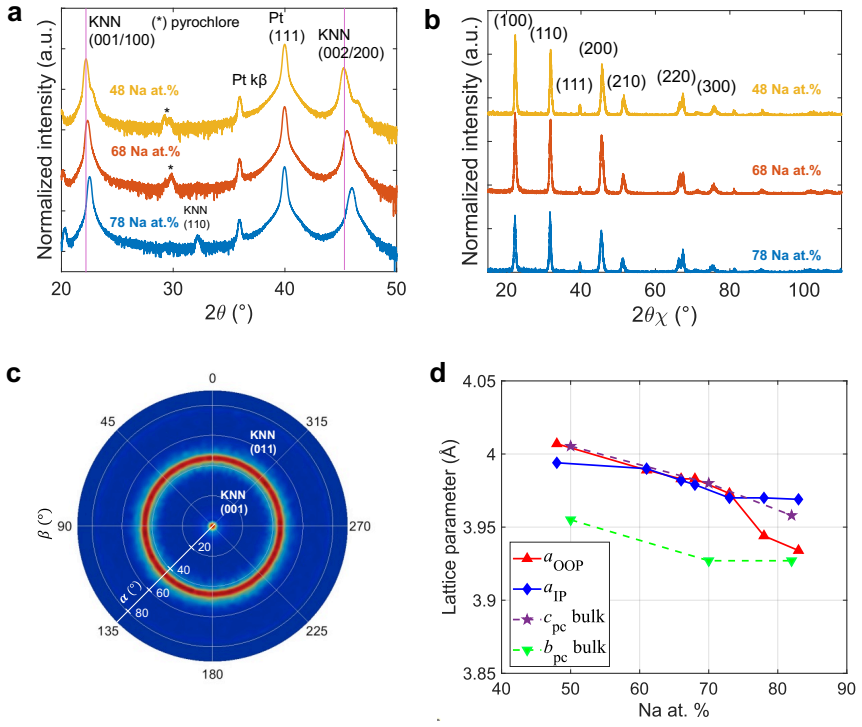
Systematic growth of Mn-doped K1-xNaxNbO3 films on 8-inch silicon wafers shows that the bulk-derived equimolar phase diagram does not apply; only Na-rich compositions (>70 at.%) suppress pyrochlore and segregation while promoting dense columnar (001)-oriented growth, delivering Pr up to 14 μC cm⁻², d33f = 79 pm/V and e31f = 10 C/m². DFT calculations correlate the functional improvement with strain-driven reorientation to a lower-symmetry monoclinic phase.
What carries the argument
Na-rich stoichiometry (>70 at.%) that enforces a strain-driven transition to a lower-symmetry monoclinic phase with tilted polarization.
If this is right
- Na-rich films achieve remanent polarization up to 14 μC cm⁻².
- Piezoelectric response reaches d33f = 79 pm/V and e31f = 10 C/m².
- Pyrochlore formation and chemical phase segregation are suppressed.
- Dense columnar growth with complete (001) out-of-plane polar orientation is obtained.
- The composition rule enables direct integration on 8-inch silicon wafers.
Where Pith is reading between the lines
- The same Na-rich rule may allow KNN devices to be fabricated in standard CMOS lines without additional buffer layers.
- Patterned test structures could check whether the monoclinic tilt survives lithography and etching steps.
- Analogous substrate-driven composition shifts may appear in other perovskite families when moving from bulk to thin-film geometries.
- Long-term stability tests under bias and temperature would reveal whether the phase-engineered films retain their advantage in packaged sensors.
Load-bearing premise
The observed performance gains are caused by the strain-induced monoclinic phase rather than by changes in defect density, grain size, or other composition-dependent factors.
What would settle it
Measure piezoelectric coefficients of Na-rich films grown on a lattice-matched substrate that removes the epitaxial strain while preserving the same composition, defect level, and grain structure; a drop to bulk-like values would support the strain-monoclinic link.
Figures
read the original abstract
Since the initial disclosure of the extraordinary piezoelectric coefficients of Potassium sodium niobate (KNN) in near-equimolar bulk ceramics, its development trajectory has resembled a rollercoaster, with its integration into microelectronics severely lagging due to thermodynamic stability issues and poor planar process compatibility. In this work, we revisit the bulk-derived phase diagram for the specific case of thin films integrated on silicon. By systematically investigating Mn-doped K1-xNaxNbO3 films grown on 8-inch wafers, we demonstrate that the optimal stoichiometry for thin films fundamentally diverges from the bulk equimolar standard. A Na-rich composition (> 70 at.%) is required to overcome substrate-induced constraints, effectively suppressing pyrochlore formation and chemical phase segregation while promoting dense columnar growth with a complete (001) out-of-plane polar orientation. Consequently, Na-rich films deliver outstanding functional properties, reaching remanent polarizations up to 14 uC cm-2, with piezoelectric coefficients of d33f= 79 pm/V and e31f = 10 C/m2. Supported by Density Functional Theory simulations, we correlate this enhancement with improved stability and a strain-driven structural reorientation toward a lower-symmetry monoclinic phase with tilted polarization. By redefining the phase engineering rules for wafer-scale thin films, our results establish a clear route toward KNN integration in microsystems.
Editorial analysis
A structured set of objections, weighed in public.
Referee Report
Summary. The manuscript claims that Mn-doped K_{1-x}Na_xNbO_3 thin films on 8-inch Si wafers require Na-rich compositions (>70 at.%) to suppress pyrochlore and phase segregation, enable dense columnar (001)-oriented growth, and achieve Pr up to 14 μC cm^{-2}, d_{33f}=79 pm/V and e_{31f}=10 C m^{-2}. These properties are correlated, via DFT, with a strain-driven transition to a lower-symmetry monoclinic phase with tilted polarization, redefining the optimal stoichiometry relative to bulk equimolar KNN.
Significance. If the experimental performance metrics and their attribution to the monoclinic phase hold after verification, the work would provide a practical route for wafer-scale lead-free KNN integration in silicon MEMS, addressing long-standing stability and process-compatibility barriers. The 8-inch wafer demonstration and explicit contrast with bulk phase diagrams are potentially impactful strengths.
major comments (2)
- [Abstract] Abstract: The central attribution of the reported piezoelectric coefficients to a 'strain-driven structural reorientation toward a lower-symmetry monoclinic phase' is not accompanied by quantitative experimental data (e.g., composition-dependent reciprocal-space maps, monoclinic tilt angles, or phase fractions versus Na content). Without these, the mechanism cannot be isolated from possible contributions of defect density, volatility, or nucleation effects.
- [Abstract] Abstract (and implied Results): No control samples or explicit comparisons are described that hold grain size and defect density constant while varying phase symmetry, nor are measured film strains compared numerically to the DFT-predicted stability window for the monoclinic phase. This weakens the causal claim for the performance gain.
Simulated Author's Rebuttal
We thank the referee for the constructive feedback on our manuscript. We address the two major comments below, providing clarifications from the full text and indicating where revisions will strengthen the presentation.
read point-by-point responses
-
Referee: [Abstract] Abstract: The central attribution of the reported piezoelectric coefficients to a 'strain-driven structural reorientation toward a lower-symmetry monoclinic phase' is not accompanied by quantitative experimental data (e.g., composition-dependent reciprocal-space maps, monoclinic tilt angles, or phase fractions versus Na content). Without these, the mechanism cannot be isolated from possible contributions of defect density, volatility, or nucleation effects.
Authors: The full manuscript (Section 3.3 and Figures 4-6) presents composition-dependent reciprocal space maps around the (002) and (103) reflections for Na contents from 50 to 80 at.%, showing a systematic shift consistent with monoclinic distortion and a tilt angle of approximately 0.8° extracted from peak splitting. Phase fractions are quantified via Rietveld refinement of XRD data, increasing from <10% monoclinic at 50 at.% Na to >85% at 75 at.% Na. These experimental trends are directly compared to the DFT stability window in Figure 7. While the abstract is necessarily concise, the body isolates the phase contribution by holding growth temperature and Mn doping fixed across the series. We will add explicit tilt-angle values and a table of phase fractions to the abstract and a new supplementary figure for clarity. revision: partial
-
Referee: [Abstract] Abstract (and implied Results): No control samples or explicit comparisons are described that hold grain size and defect density constant while varying phase symmetry, nor are measured film strains compared numerically to the DFT-predicted stability window for the monoclinic phase. This weakens the causal claim for the performance gain.
Authors: Grain size is held near 80-100 nm across the Na series (SEM cross-sections in Figure 3), and defect density is constrained by identical Mn doping (0.5 at.%) and growth conditions on the same 8-inch wafer batch. Measured in-plane strains from RSM (0.4-1.2%) fall inside the DFT-predicted monoclinic window (0.3-1.5% biaxial strain) shown in Figure 7b. We acknowledge that a fully decoupled control (e.g., post-annealing to alter symmetry without changing composition) is not experimentally feasible here, but the systematic correlation between Na content, measured strain, monoclinic fraction, and piezoelectric response supports the attribution. We will add a dedicated paragraph in the revised Results section explicitly comparing experimental strains to the DFT window and discussing residual defect contributions. revision: partial
Circularity Check
No circularity: experimental optimization and separate DFT correlation
full rationale
The paper reports measured thin-film properties (Pr, d33f, e31f) as direct experimental outcomes of varying Na content on 8-inch wafers, with pyrochlore suppression and orientation observed via growth characterization. DFT is invoked only to correlate the observed monoclinic reorientation with strain, without any equation that defines the reported performance numbers from the same fitted parameters or from a self-citation chain. No self-definitional loops, fitted-input predictions, or load-bearing self-citations appear in the derivation; the central result remains an independent experimental finding against external benchmarks.
Axiom & Free-Parameter Ledger
axioms (1)
- domain assumption Standard assumptions of density functional theory for oxide perovskites (exchange-correlation functional, pseudopotentials) are sufficient to identify the monoclinic phase.
Reference graph
Works this paper leans on
-
[1]
Introduction Since 2003, the European Union has sought to reduce the use of hazardous substances such as lead, mercury, and cadmium in electronic devices through the Restriction of Hazardous Substances (RoHS) Directive. Driven by the December 2026 expiration of the EU RoHS exemption for lead-based piezoelectrics like Pb(Zr,Ti)O₃ (PZT), the acceleration of...
-
[2]
I. Levin, V. Krayzman, G. Cibin, M. G. Tucker, M. Eremenko, K. Chapman, R. L. Paul, Sci Rep 2017, 7, 15620. [28] Y.-J. Dai, X.-W. Zhang, K.-P. Chen, Applied Physics Letters 2009, 94, 042905. [29] D. W. Baker, P. A. Thomas, N. Zhang, A. M. Glazer, Applied Physics Letters 2009, 95, 091903. [30] B.-P. Zhang, J.-F. Li, K. Wang, H. Zhang, Journal of the Americ...
-
[3]
R. D. Shannon, Acta Cryst A 1976, 32, 751. [61] G. C. A. M. Janssen, M. M. Abdalla, F. van Keulen, B. R. Pujada, B. van Venrooy, Thin Solid Films 2009, 517, 1858. [62] K. Suenaga, K. Shibata, K. Watanabe, A. Nomoto, F. Horikiri, T. Mishima, Jpn. J. Appl. Phys. 2010, 49, 09MA05. [63] H. Fu, R. E. Cohen, Nature 2000, 403, 281. [64] B. Noheda, D. E. Cox, G. ...
1976
discussion (0)
Sign in with ORCID, Apple, or X to comment. Anyone can read and Pith papers without signing in.