Forecasting of volatility and risk premia in electricity markets
Pith reviewed 2026-06-27 23:02 UTC · model grok-4.3
The pith
Incorporating longer time horizons and renewable generation data improves one-week forecasts of electricity market covariation and risk premia.
A machine-rendered reading of the paper's core claim, the machinery that carries it, and where it could break.
Core claim
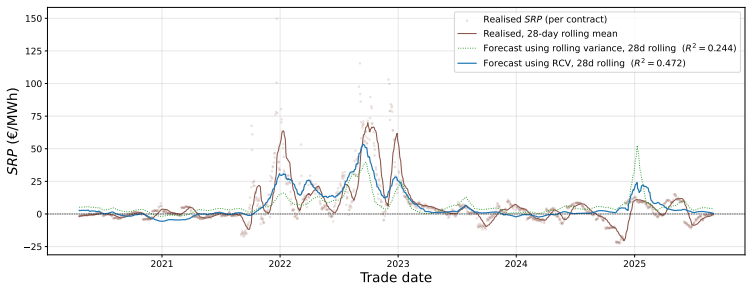
We study forecasting of the realized covariation in electricity markets using a parsimonious matrix-HAR type model. We find that the inclusion of longer time horizons and renewable generation information adds important predictive power to one-week ahead forecasts of the weekly realized covariation. Our variance forecasts provide substantially improved forecasts of spread risk premia compared to standard methods relying on backward looking volatility.
What carries the argument
The matrix-HAR model, a time-series specification that uses multiple lag horizons on the matrix-valued realized covariation to capture dynamics of the latent infinite-dimensional covariance operator.
If this is right
- Longer time horizons in the model improve one-week ahead covariation forecasts.
- Adding renewable generation information enhances predictive accuracy.
- Improved variance forecasts lead to better predictions of spread risk premia in electricity forward markets.
Where Pith is reading between the lines
- This framework could apply to forecasting in other volatile commodity markets influenced by weather or renewables.
- Testing the model on intraday data or different forecast horizons might reveal further improvements or limitations.
Load-bearing premise
The chosen matrix-HAR specification adequately captures the dynamics of the latent covariance operator in electricity markets.
What would settle it
A test showing that one-week ahead forecasts without renewable data or longer horizons match or exceed the full model's accuracy on an extended dataset would challenge the claim of added predictive power.
Figures
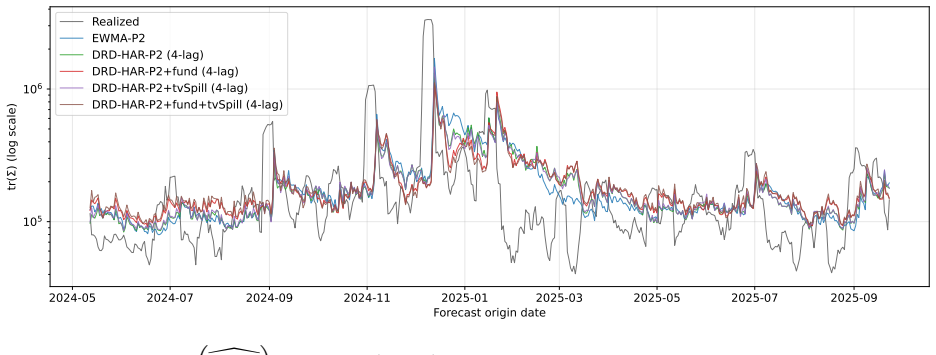
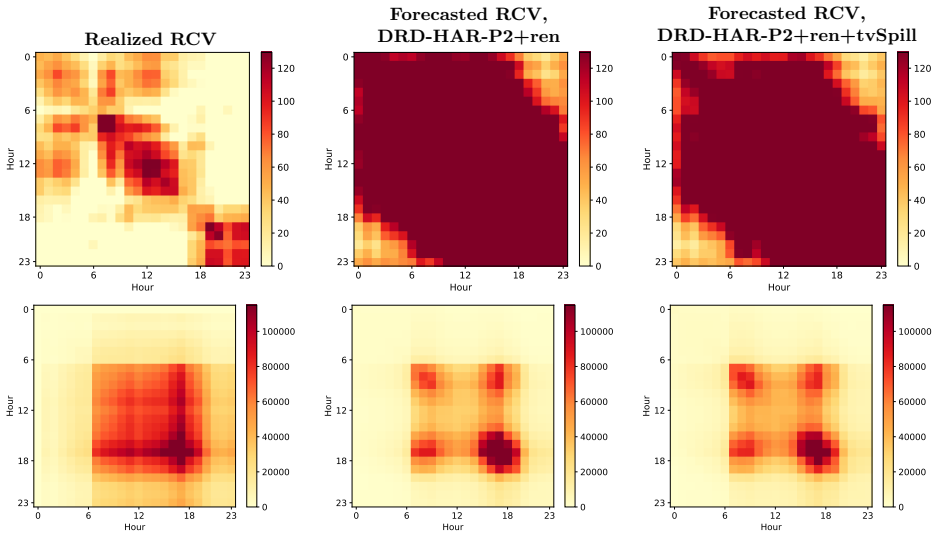
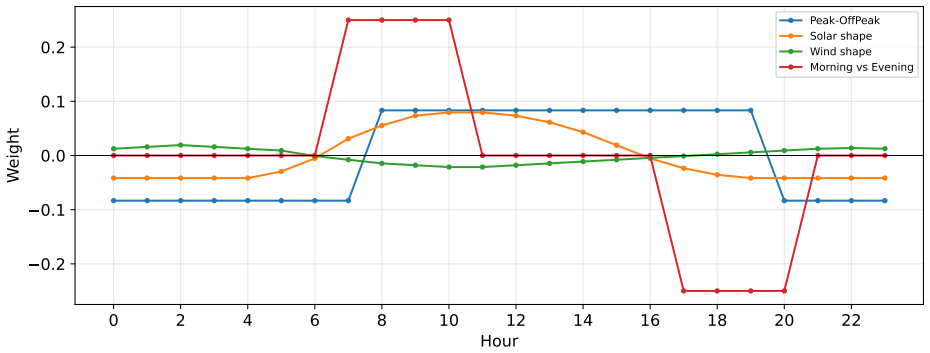
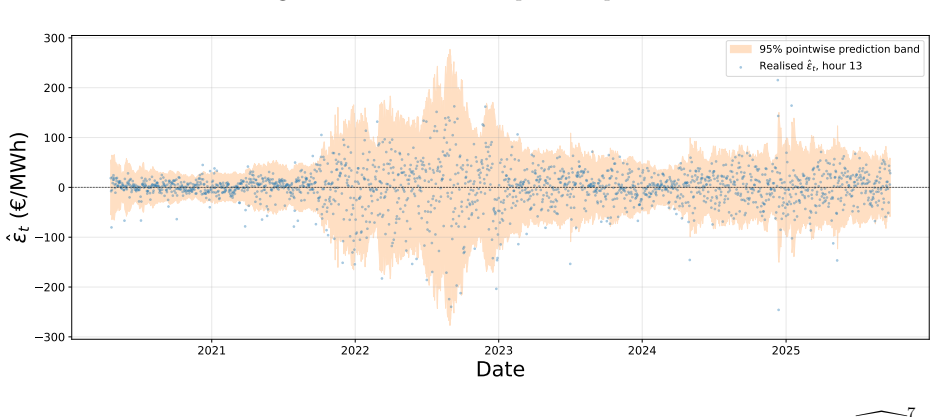
read the original abstract
We study forecasting of the realized covariation in electricity markets. The realized covariation in this context is a matrix-valued representation of the latent infinite-dimensional covariance operator and a parsimonious matrix-HAR type model is constructed to facilitate estimation. We test the model on one-week ahead forecasts of the weekly realized covariation and find that the inclusion of longer time horizons and renewable generation information adds important predictive power. We also investigate the prediction of risk premia in electricity forward markets and find that our variance forecasts provide substantially improved forecasts of spread risk premia compared to standard methods relying on backward looking volatility.
Editorial analysis
A structured set of objections, weighed in public.
Referee Report
Summary. The manuscript develops a parsimonious matrix-HAR model for the realized covariation operator (a matrix-valued representation of the latent infinite-dimensional covariance operator) in electricity markets. It reports that one-week-ahead forecasts of weekly realized covariation benefit from the inclusion of longer time horizons and renewable generation information, and that the resulting variance forecasts substantially improve predictions of spread risk premia relative to standard backward-looking volatility methods.
Significance. If the out-of-sample improvements are confirmed with appropriate statistical controls, the work would offer a practical advance in electricity-market volatility modeling by incorporating renewable-generation covariates and a matrix structure for covariation. The approach could aid risk management in forward markets where spread premia are economically relevant.
major comments (2)
- [Abstract] Abstract: the central empirical claims of 'important predictive power' and 'substantially improved forecasts' are stated without any quantitative error metrics, confidence intervals, or out-of-sample design details, preventing verification of the magnitude or statistical significance of the reported gains.
- [Abstract] Abstract: it is not stated whether the reported 'predictions' are generated from a strictly out-of-sample exercise or include in-sample parameter fitting, which directly affects the validity of the forecasting evaluation and the claim of incremental predictive power from longer horizons and renewables.
minor comments (1)
- The weakest modeling assumption—that the chosen matrix-HAR specification adequately captures the dynamics of the latent covariance operator—would benefit from explicit discussion or sensitivity checks in the methods section.
Simulated Author's Rebuttal
We thank the referee for the detailed comments. The two major points both concern the abstract, and we agree that greater specificity is warranted. We will revise the abstract to incorporate quantitative metrics, confidence intervals where applicable, and explicit confirmation of the out-of-sample design. The body of the paper already contains these elements; the revision will make the abstract self-contained.
read point-by-point responses
-
Referee: [Abstract] Abstract: the central empirical claims of 'important predictive power' and 'substantially improved forecasts' are stated without any quantitative error metrics, confidence intervals, or out-of-sample design details, preventing verification of the magnitude or statistical significance of the reported gains.
Authors: We accept this observation. The revised abstract will report the key out-of-sample metrics (e.g., relative MSE reductions for the matrix-HAR specifications versus benchmarks) together with the evaluation window and any statistical tests employed. These quantities are already computed and presented in Sections 4 and 5 of the manuscript; their inclusion in the abstract will address the concern directly. revision: yes
-
Referee: [Abstract] Abstract: it is not stated whether the reported 'predictions' are generated from a strictly out-of-sample exercise or include in-sample parameter fitting, which directly affects the validity of the forecasting evaluation and the claim of incremental predictive power from longer horizons and renewables.
Authors: The forecasts are produced in a strictly out-of-sample rolling-window scheme in which parameters are re-estimated only on data available at each forecast origin. We will add an explicit sentence to the abstract stating this design. No in-sample fitting is used for the reported predictive comparisons. revision: yes
Circularity Check
No significant circularity identified
full rationale
The paper constructs a parsimonious matrix-HAR model for the realized covariation operator and evaluates its one-week-ahead forecasting performance, reporting incremental value from longer horizons and renewable data plus improved risk-premia forecasts. This is a standard empirical time-series exercise: parameters are estimated on historical observations and forecasts are generated forward. No equation or claim reduces by construction to its own inputs, no self-definitional loop exists, and the central results rest on out-of-sample evaluation rather than renaming or fitting the target quantity itself. The derivation chain is therefore self-contained against external benchmarks.
Axiom & Free-Parameter Ledger
free parameters (2)
- matrix-HAR lag coefficients
- renewable-generation regression weights
axioms (1)
- domain assumption Realized covariation matrix is a faithful finite-dimensional proxy for the latent infinite-dimensional covariance operator
Reference graph
Works this paper leans on
-
[1]
Representation and approximation of ambit fields in Hilbert space , volume =
Benth, Fred Espen and Eyjolfsson, Heidar , address =. Representation and approximation of ambit fields in Hilbert space , volume =. Stochastics (Abingdon, Eng. : 2005) , language =. 2017 , doi =
2005
-
[2]
Benth, Fred Espen and Schroers, Dennis and Veraart, Almut E. D. , address =. A feasible central limit theorem for realised covariation of. The Annals of Applied Probability , language =. 2024 , doi =
2024
-
[3]
, address =
Janczura, Joanna and Trück, Stefan and Weron, Rafał and Wolff, Rodney C. , address =. Identifying spikes and seasonal components in electricity spot price data: A guide to robust modeling , volume =. Energy Economics , language =. 2013 , doi =
2013
-
[4]
A weak law of large numbers for realised covariation in a Hilbert space setting , journal =. 2022 , issn =. doi:https://doi.org/10.1016/j.spa.2021.12.011 , author =
-
[5]
An introduction to stochastic partial differential equations
Walsh, John B. An introduction to stochastic partial differential equations. \'E cole d' \'E t \'e de Probabilit \'e s de Saint Flour XIV - 1984. 1986. doi:10.1007/BFb0074920
-
[6]
Andersen and Tim Bollerslev and Francis X
Torben G. Andersen and Tim Bollerslev and Francis X. Diebold and Paul Labys , journal =. Modeling and Forecasting Realized Volatility , volume =. 2003 , doi =
2003
-
[7]
The distribution of realized stock return volatility , journal =. 2001 , issn =. doi:https://doi.org/10.1016/S0304-405X(01)00055-1 , url =
-
[8]
Andersen and Tim Bollerslev , journal =
Torben G. Andersen and Tim Bollerslev , journal =. Answering the Skeptics: Yes, Standard Volatility Models do Provide Accurate Forecasts , urldate =. 1998 , doi =
1998
-
[9]
Barndorff-Nielsen and Neil Shephard , journal =
Ole E. Barndorff-Nielsen and Neil Shephard , journal =. Econometric Analysis of Realized Volatility and Its Use in Estimating Stochastic Volatility Models , urldate =. 2002 , doi =
2002
-
[10]
Barndorff-Nielsen, Ole E. and Shephard, Neil , title =. Econometrica , volume =. doi:https://doi.org/10.1111/j.1468-0262.2004.00515.x , url =. https://onlinelibrary.wiley.com/doi/pdf/10.1111/j.1468-0262.2004.00515.x , year =
-
[11]
Journal of Financial Econometrics , volume =
Christensen, Kim and Podolskij, Mark , title =. Journal of Financial Econometrics , volume =. 2012 , month =. doi:10.1093/jjfinec/nbr019 , url =
-
[12]
Pre-averaging estimators of the ex-post covariance matrix in noisy diffusion models with non-synchronous data , journal =. 2010 , issn =. doi:https://doi.org/10.1016/j.jeconom.2010.05.001 , url =
-
[13]
Realised quantile-based estimation of the integrated variance , journal =. 2010 , issn =. doi:https://doi.org/10.1016/j.jeconom.2010.04.008 , url =
-
[14]
Expected stock returns and volatility , journal =. 1987 , issn =. doi:https://doi.org/10.1016/0304-405X(87)90026-2 , url =
-
[15]
and Hansen, Peter Reinhard and Lunde, Asger and Shephard, Neil , title =
Barndorff-Nielsen, Ole E. and Hansen, Peter Reinhard and Lunde, Asger and Shephard, Neil , title =. Econometrica , volume =. doi:https://doi.org/10.3982/ECTA6495 , url =. https://onlinelibrary.wiley.com/doi/pdf/10.3982/ECTA6495 , year =
-
[16]
The Review of Financial Studies , volume =
Christoffersen, Peter and Jacobs, Kris and Mimouni, Karim , title =. The Review of Financial Studies , volume =. 2010 , month =. doi:10.1093/rfs/hhq032 , url =
-
[17]
Stochastic modelling of electricity and related markets , volume =
Benth, Fred Espen and. Stochastic modelling of electricity and related markets , volume =. 2008 , doi =
2008
-
[18]
Electricity price forecasting: A review of the state-of-the-art with a look into the future , journal =. 2014 , issn =. doi:https://doi.org/10.1016/j.ijforecast.2014.08.008 , url =
-
[19]
Kloster, Thomas K. , journal =. An ambit field framework for the full panel of day-ahead electricity prices , year =. 2509.17236 , archivePrefix=
-
[20]
The Annals of Applied Statistics , number =
Dominik Liebl , title =. The Annals of Applied Statistics , number =. 2013 , doi =
2013
-
[21]
Ying Chen and J. S. Marron and Jiejie Zhang , title =. The Annals of Applied Statistics , number =. 2019 , doi =
2019
-
[22]
Journal of Business & Economic Statistics , volume=
Ying Chen and Bo Li , title =. Journal of Business & Economic Statistics , volume =. 2017 , publisher =. doi:10.1080/07350015.2015.1092976 , URL =
-
[23]
A space-time random field model for electricity forward prices , journal =. 2018 , note =. doi:https://doi.org/10.1016/j.jbankfin.2017.03.018 , url =
-
[24]
Measure-valued processes for energy markets , year =
Cuchiero, Christa and Di Persio, Luca and Guida, Francesco and Svaluto-Ferro, Sara , address =. Measure-valued processes for energy markets , year =. Mathematical Finance , language =
-
[25]
and Benth, Fred Espen and Veraart, Almut E
Barndorff-Nielsen, Ole E. and Benth, Fred Espen and Veraart, Almut E. D. , address =. Modelling Electricity Futures by Ambit Fields , volume =. Advances in Applied Probability , language =. 2014 , doi =
2014
-
[26]
Asymmetric volatility in. Energy Economics , volume =. 2016 , issn =. doi:https://doi.org/10.1016/j.eneco.2016.04.002 , url =
-
[27]
Energy Economics , year=2017, volume=
Bennedsen, Mikkel , title=. Energy Economics , year=2017, volume=
2017
-
[28]
Tests of common stochastic trends , volume =
Nyblom, Jukka and Harvey, Andrew , address =. Tests of common stochastic trends , volume =. Econometric Theory , language =. 2000 , doi =
2000
-
[29]
and Roberts, Michael R
Knittel, Christopher R. and Roberts, Michael R. , address =. An empirical examination of restructured electricity prices , volume =. Energy Economics , language =. 2005 , doi =
2005
-
[30]
The Journal of Finance , language =
Measuring and Testing the Impact of News on Volatility , volume =. The Journal of Finance , language =. 1993 , author =
1993
-
[31]
Energy Economics , language =
An empirical comparison of alternate regime-switching models for electricity spot prices , volume =. Energy Economics , language =. 2010 , author =
2010
-
[32]
Journal of Financial Econometrics , language =
A Simple Approximate Long-Memory Model of Realized Volatility , volume =. Journal of Financial Econometrics , language =. 2009 , author =
2009
-
[33]
Journal of Business & Economic Statistics , language =
Discrete-Time Volatility Forecasting With Persistent Leverage Effect and the Link With Continuous-Time Volatility Modeling , volume =. Journal of Business & Economic Statistics , language =. 2012 , author =
2012
-
[34]
Journal of Financial Econometrics , language =
A Machine Learning Approach to Volatility Forecasting , volume =. Journal of Financial Econometrics , language =. 2023 , author =
2023
-
[35]
Journal of Econometrics , language =
Exploiting the errors: A simple approach for improved volatility forecasting , volume =. Journal of Econometrics , language =. 2016 , author =
2016
-
[36]
Nelson , journal =
Daniel B. Nelson , journal =. Conditional Heteroskedasticity in Asset Returns: A New Approach , urldate =. 1991 , doi =
1991
-
[37]
Journal of Business & Economic Statistics , volume =
Drew Creal and Siem Jan Koopman and André Lucas , title =. Journal of Business & Economic Statistics , volume =. 2011 , publisher =. doi:10.1198/jbes.2011.10070 , URL =
-
[38]
Nonstationarities in Financial Time Series, the Long-Range Dependence, and the IGARCH Effects , urldate =
Thomas Mikosch and Cătălin Stărică , journal =. Nonstationarities in Financial Time Series, the Long-Range Dependence, and the IGARCH Effects , urldate =. 2004 , doi =
2004
-
[39]
Hourly electricity prices in day-ahead markets , journal =. 2007 , issn =. doi:https://doi.org/10.1016/j.eneco.2006.08.005 , url =
-
[40]
Electronic Journal of Probability , publisher =
Martin Hairer and Jonathan Mattingly , title =. Electronic Journal of Probability , publisher =. 2011 , doi =
2011
-
[41]
Stochastic Analysis and Applications , issue =
Da Prato, Giuseppe and Gatarek, Dariusz and Zabczyk, Jerzy , title =. Stochastic Analysis and Applications , issue =. 1992 , doi =
1992
-
[42]
Stochastic Equations in Infinite Dimensions , publisher=
Da Prato, Giuseppe and Zabczyk, Jerzy , year=. Stochastic Equations in Infinite Dimensions , publisher=
-
[43]
Journal of Applied Econometrics , volume =
Creal, Drew and Koopman, Siem Jan and Lucas, André , title =. Journal of Applied Econometrics , volume =. doi:https://doi.org/10.1002/jae.1279 , year =
-
[44]
and Benth, Fred Espen , journal =
Kloster, Thomas K. and Benth, Fred Espen , journal =. The fine structure of electricity price volatility , year =. 2605.13320 , archivePrefix=
-
[45]
Forecasting realized covariances using
Matias Quiroz and Laleh Tafakori and Hans Manner , year=. Forecasting realized covariances using. 2412.10791 , archivePrefix=
-
[46]
Archakov, Ilya and Hansen, Peter Reinhard , title =. Econometrica , volume =. doi:https://doi.org/10.3982/ECTA16910 , url =. https://onlinelibrary.wiley.com/doi/pdf/10.3982/ECTA16910 , year =
-
[47]
Volatility forecast comparison using imperfect volatility proxies , journal =. 2011 , note =. doi:https://doi.org/10.1016/j.jeconom.2010.03.034 , url =
-
[48]
and Lunde, Asger and Nason, James M
Hansen, Peter R. and Lunde, Asger and Nason, James M. , title =. Econometrica , volume =. doi:https://doi.org/10.3982/ECTA5771 , url =. https://onlinelibrary.wiley.com/doi/pdf/10.3982/ECTA5771 , year =
-
[49]
On loss functions and ranking forecasting performances of multivariate volatility models , journal =. 2013 , issn =. doi:https://doi.org/10.1016/j.jeconom.2012.08.004 , url =
-
[50]
Journal of Applied Econometrics (Chichester, England) , language =
A forecast comparison of volatility models: does anything beat a. Journal of Applied Econometrics (Chichester, England) , language =. 2005 , author =
2005
-
[51]
Lemmon , journal =
Hendrik Bessembinder and Michael L. Lemmon , journal =. Equilibrium Pricing and Optimal Hedging in Electricity Forward Markets , urldate =
-
[52]
Price formation in electricity forward markets and the relevance of systematic forecast errors , journal =. 2009 , issn =. doi:https://doi.org/10.1016/j.eneco.2008.12.001 , url =
discussion (0)
Sign in with ORCID, Apple, or X to comment. Anyone can read and Pith papers without signing in.