Resolving room temperature microscale fracture and plasticity of iron oxides along the cascade of iron ore reduction via nanoindentation and microcantilever bending
Pith reviewed 2026-06-28 00:50 UTC · model grok-4.3
The pith
Hematite shows the highest hardness and fracture toughness among iron oxides, decreasing to magnetite and wustite with orientation-dependent crack behavior on single crystals.
A machine-rendered reading of the paper's core claim, the machinery that carries it, and where it could break.
Core claim
The central claim is that iron oxide phases exhibit systematically different room-temperature mechanical responses during reduction: hematite is the hardest and stiffest phase, followed by magnetite and then wustite, with fracture toughness higher in hematite on low-index planes due to crack deviation while the later phases cleave cleanly; the magnetite-gangue interface is weaker than the oxide itself, and these single-crystal measurements supply quantitative inputs for attrition models.
What carries the argument
Nanoindentation for hardness and modulus combined with notched microcantilever bending for fracture toughness on low- and high-index crystallographic planes.
If this is right
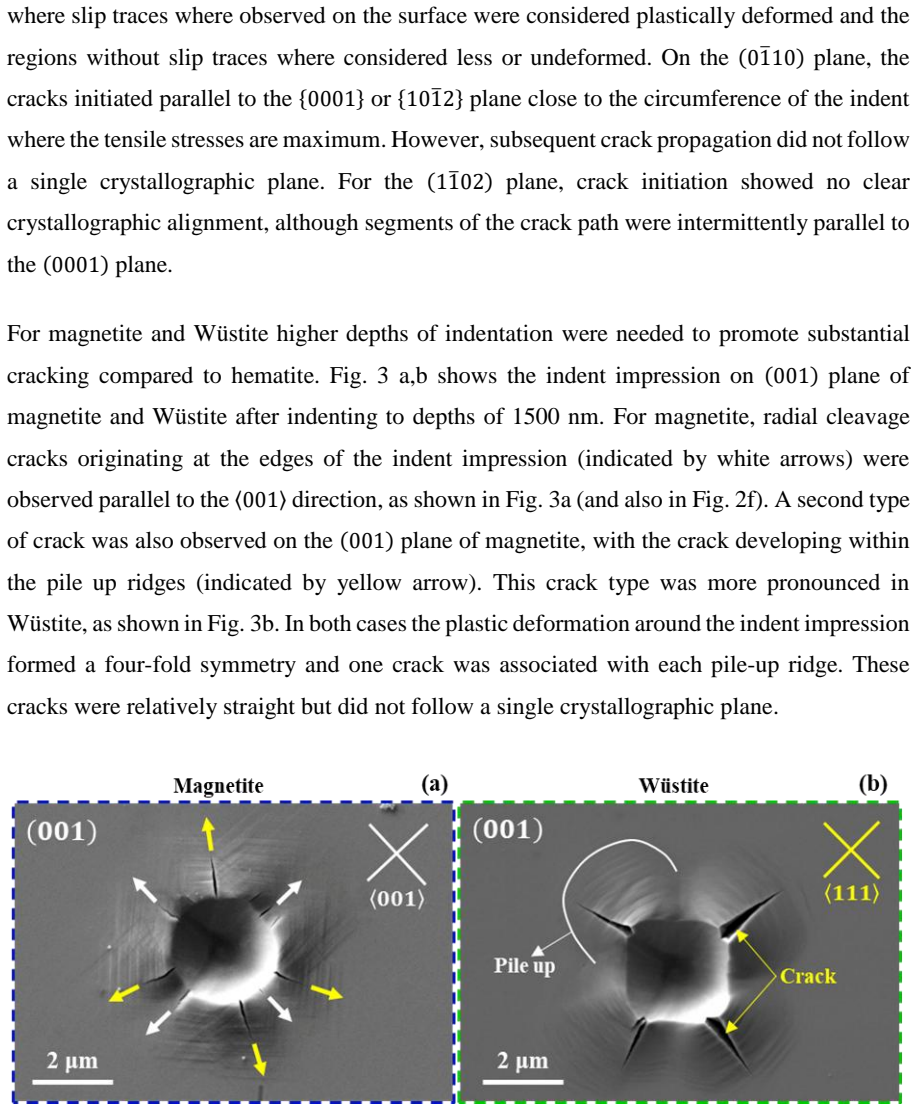
- Hardness and modulus decrease from hematite through magnetite to wustite, reflecting progressive changes in slip activity.
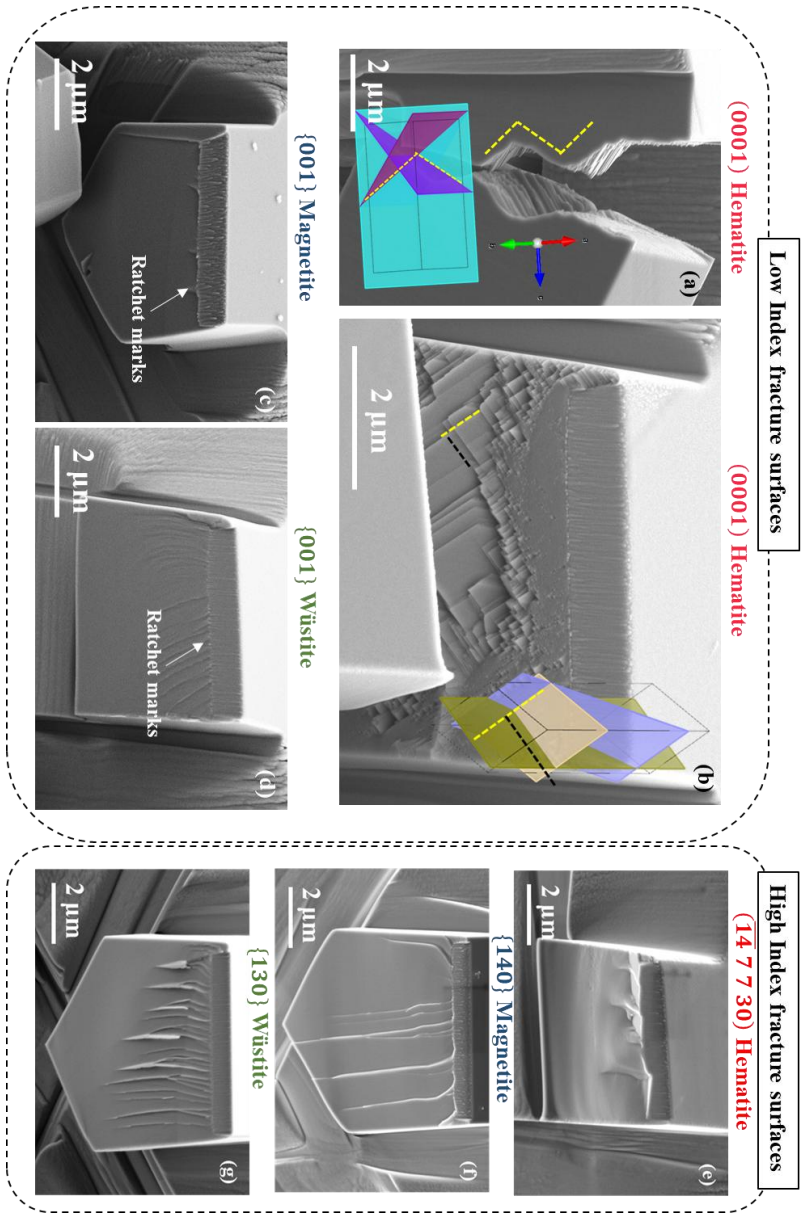
- Hematite exhibits elevated fracture toughness on low-index planes via crack deviation and faceting, unlike cleavage fracture in magnetite and wustite.
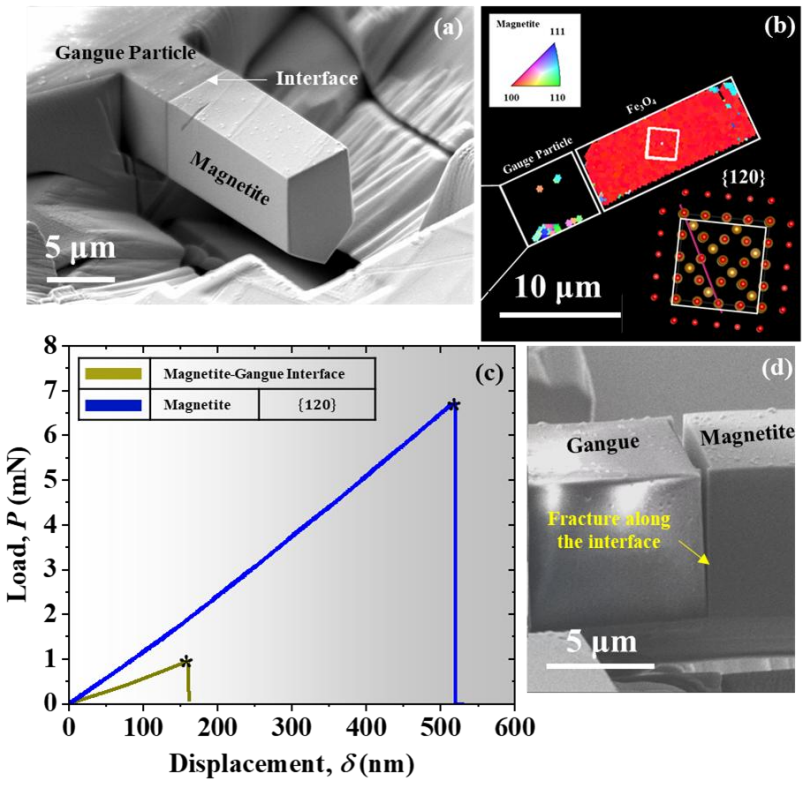
- Magnetite-gangue interfaces display reduced fracture toughness relative to the oxide phase itself.
- The measured property set supplies direct inputs for material models of fracture during hydrogen-based direct reduction.
- Distinct plasticity and cracking responses appear consistently between the two test methods across all three phases.
Where Pith is reading between the lines
- Texture or preferred orientation in real polycrystalline ores could modulate overall attrition rates based on the plane-specific toughness differences observed.
- The room-temperature data set may require supplementary tests at process-relevant elevated temperatures to confirm applicability in operating reduction reactors.
- Interface weakening effects could inform ore beneficiation strategies aimed at limiting gangue-related fracture sites.
- These microscale measurements could be scaled into discrete-element or continuum simulations of particle breakage in direct-reduction furnaces.
Load-bearing premise
Single-crystal measurements on specific low- and high-index planes plus one interface result are representative of polycrystalline multi-phase behavior in actual iron ore particles.
What would settle it
Fracture toughness measurements performed on polycrystalline iron oxide aggregates or actual reduced ore particles that fall outside the range reported for the corresponding single-crystal orientations and phases.
Figures
read the original abstract
Understanding the fundamental mechanical behaviour of iron oxide phases is essential for controlling attrition and fracture during iron ore reduction process, particularly in hydrogen-based direct reduction systems. This study investigates the room temperature plasticity and fracture behaviour of single-crystal hematite, magnetite, and Wustite using nanoindentation and micro-cantilever fracture testing. Hematite exhibited the highest hardness, H and elastic modulus, E (H=18.5 GPa, E=281 GPa), followed by magnetite (H=8.7 GPa, E=165 GPa) and Wustite (H=7.5 GPa, E=145 GPa), reflecting differences in slip activity along the iron oxide reduction sequence. Furthermore, fracture toughness was measured using notched microcantilevers for all three iron oxide phases, aligned along low index and high index crystallographic planes, respectively. For the low index-oriented case hematite showed increased fracture toughness owing to crack deviation and faceting while magnetite and Wustite exhibited single plane cleavage fracture. Distinct changes in the deformation behavior in terms of plasticity and cracking of the three iron oxides were evident from both methods. Further investigation of a magnetite-gangue interface, particularly relevant to low-concentration ores, revealed significantly reduced fracture toughness compared to the magnetite phase. Overall, these results provide a comprehensive set of mechanical properties of iron oxides with potential application in material models for predicting fracture and attrition during hydrogen-based direct reduction.
Editorial analysis
A structured set of objections, weighed in public.
Referee Report
Summary. The manuscript reports room-temperature nanoindentation and microcantilever bending experiments on single-crystal hematite, magnetite, and wustite, giving hardness and modulus values (hematite H=18.5 GPa, E=281 GPa; magnetite H=8.7 GPa, E=165 GPa; wustite H=7.5 GPa, E=145 GPa) and qualitative fracture observations on low- and high-index planes plus one magnetite-gangue interface. It claims these differences reflect slip activity along the reduction sequence and supply data for attrition models in hydrogen-based direct reduction.
Significance. If the measurements prove statistically robust and the single-crystal data can be shown to inform polycrystalline behavior, the work supplies quantitative mechanical properties for the three principal iron-oxide phases that are currently scarce in the literature and directly relevant to modeling fracture during iron-ore reduction.
major comments (3)
- [Abstract] Abstract: hardness and modulus values are stated to three significant figures with no error bars, standard deviations, or number of valid measurements (indents or cantilevers), so the claimed systematic ordering cannot be evaluated for statistical significance.
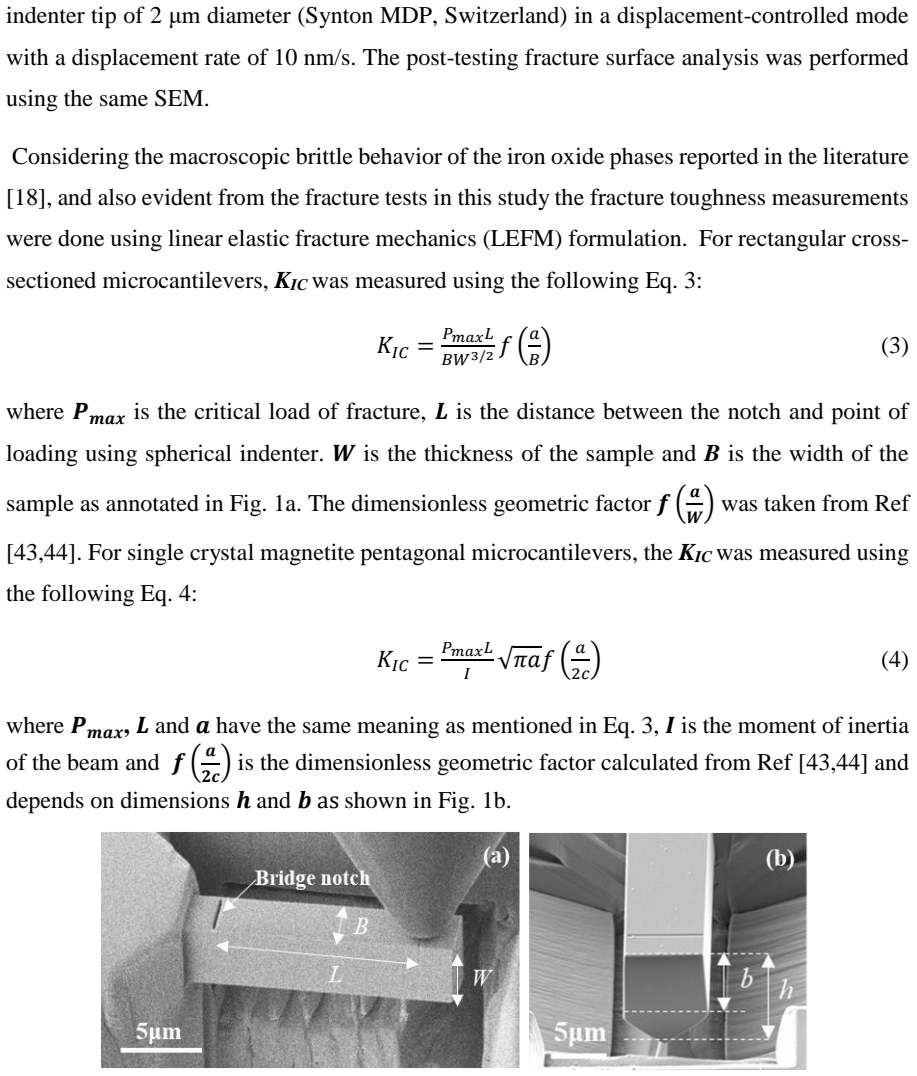
- [Abstract and §4] Abstract and §4 (fracture results): fracture toughness is described as having been measured on low- and high-index planes, yet no numerical K_IC values, calculation method (e.g., LEFM, compliance, or J-integral), or raw load-displacement/SEM data are supplied, rendering the claim of higher toughness for low-index hematite unverifiable.
- [Abstract and Discussion] Abstract and Discussion: the premise that the reported single-crystal, orientation-specific results (plus one interface) are representative inputs for material models of polycrystalline, multi-phase attrition in actual ore particles is stated but unsupported by texture measurements, effective-medium calculations, or any polycrystalline validation experiments.
minor comments (2)
- [Methods/Results] The manuscript should include at least one representative load-displacement curve and post-test SEM image per phase and orientation to allow readers to assess pop-in behavior and crack paths.
- [Methods] Notation for elastic modulus (E) and hardness (H) should be defined consistently when first introduced and cross-referenced to the Oliver-Pharr or other analysis method used.
Simulated Author's Rebuttal
We thank the referee for the constructive feedback. We address each major comment below and will revise the manuscript to improve clarity, statistical reporting, and the framing of our single-crystal results.
read point-by-point responses
-
Referee: [Abstract] Abstract: hardness and modulus values are stated to three significant figures with no error bars, standard deviations, or number of valid measurements (indents or cantilevers), so the claimed systematic ordering cannot be evaluated for statistical significance.
Authors: We agree that the absence of error bars and sample sizes in the abstract prevents proper assessment of the reported ordering. The values are means from multiple nanoindentation tests performed on each single-crystal phase. In the revised manuscript we will report standard deviations together with the number of valid indents for each phase (both in the abstract and in §3) so that the statistical robustness of the H and E trends can be evaluated directly. revision: yes
-
Referee: [Abstract and §4] Abstract and §4 (fracture results): fracture toughness is described as having been measured on low- and high-index planes, yet no numerical K_IC values, calculation method (e.g., LEFM, compliance, or J-integral), or raw load-displacement/SEM data are supplied, rendering the claim of higher toughness for low-index hematite unverifiable.
Authors: The abstract and §4 currently emphasize qualitative observations of crack paths and faceting rather than quantitative K_IC values. We will revise both sections to state explicitly which tests yielded numerical fracture toughness, report the K_IC values obtained, specify the analysis method (LEFM for the notched microcantilevers), and include representative load-displacement curves and post-test SEM images (or direct them to supplementary material). Where only qualitative evidence of toughness differences exists, we will remove or qualify the claim of “higher toughness.” revision: yes
-
Referee: [Abstract and Discussion] Abstract and Discussion: the premise that the reported single-crystal, orientation-specific results (plus one interface) are representative inputs for material models of polycrystalline, multi-phase attrition in actual ore particles is stated but unsupported by texture measurements, effective-medium calculations, or any polycrystalline validation experiments.
Authors: We accept that the current wording overstates the direct applicability of the single-crystal data to polycrystalline ore particles. In the revised abstract and discussion we will clarify that the measurements supply orientation-specific mechanical properties that can serve as inputs for multi-scale models, while explicitly noting the absence of texture data, effective-medium homogenization, or polycrystalline validation experiments in the present study. We will add a short paragraph discussing these limitations and the need for future work to bridge single-crystal and polycrystalline scales. revision: partial
Circularity Check
Purely experimental measurements; no derivations or self-referential steps
full rationale
The paper consists entirely of direct experimental results from nanoindentation (hardness and modulus values) and microcantilever fracture tests on single-crystal specimens. No equations, parameter fitting, theoretical derivations, or predictions appear in the reported work. The abstract and described content present measured quantities without any reduction of outputs to inputs by construction, and no self-citations are invoked as load-bearing justifications. The representativeness concern raised by the skeptic is a question of external validity, not circularity within the paper's own chain.
Axiom & Free-Parameter Ledger
Reference graph
Works this paper leans on
-
[1]
Tabor, The Hardness of Metals, Oxford University Press, 2023
D. Tabor, The Hardness of Metals, Oxford University Press, 2023. https://academic.oup.com/book/54885
2023
-
[2]
J.L. Hay, W.C. Olive, A. Bolshakov, G.M. Pharr, Using the Ratio of Loading Slope and Elastic Stiffness to Predict Pile-Up and Constraint Factor During Indentation, MRS Proc. 522 (1998) 101. https://doi.org/10.1557/PROC-522-101
-
[3]
C.A. Klein, Flexural strength of sapphire: Weibull statistical analysis of stressed area, surface coating, and polishing procedure effects, Journal of Applied Physics 96 (2004) 3172–3179. https://doi.org/10.1063/1.1782272
discussion (0)
Sign in with ORCID, Apple, or X to comment. Anyone can read and Pith papers without signing in.