Efficient Quantum Circuit Construction of Controlled Time-Evolution for Arbitrary Pauli-Sum Hamiltonians
Pith reviewed 2026-06-28 01:35 UTC · model grok-4.3
The pith
A recursive algorithm partitions arbitrary Pauli-sum Hamiltonians into groups assigned anti-commuting sign-flip strings, removing ancilla control from entire time-evolution blocks.
A machine-rendered reading of the paper's core claim, the machinery that carries it, and where it could break.
Core claim
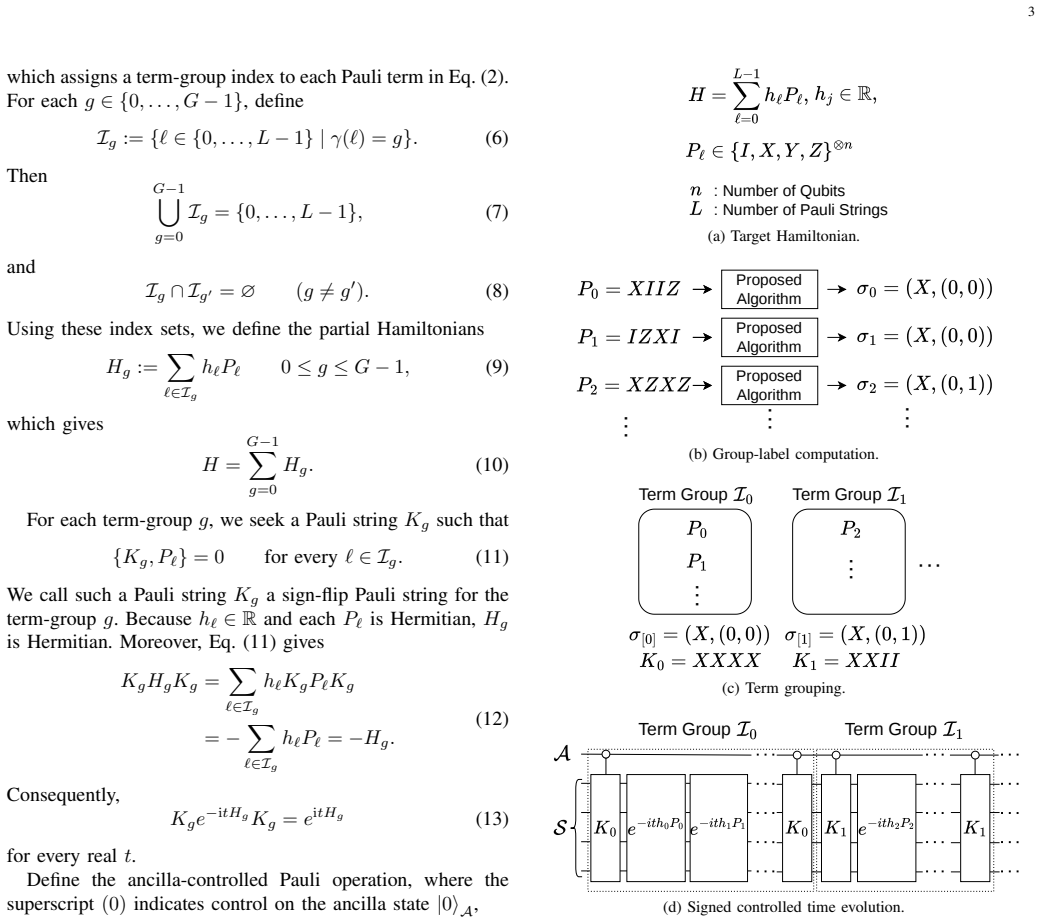
For an arbitrary Pauli-sum Hamiltonian, the input Pauli terms can be partitioned into groups and each group can be assigned a sign-flip Pauli string that anti-commutes with all terms in the group, thereby removing ancilla control from the grouped time-evolution blocks while exactly preserving the implemented unitary.
What carries the argument
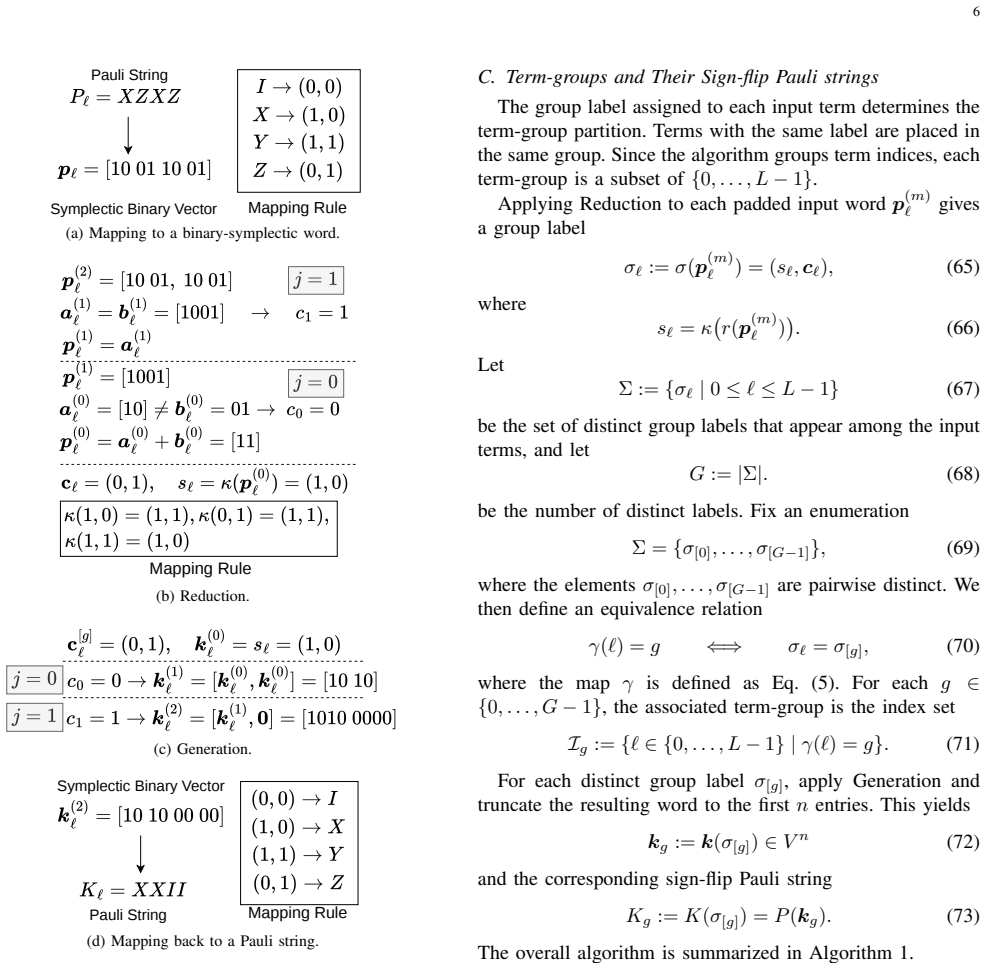
Recursive partitioning of Pauli terms together with assignment of anti-commuting sign-flip Pauli strings that allow ancilla-free implementation of each grouped block.
If this is right
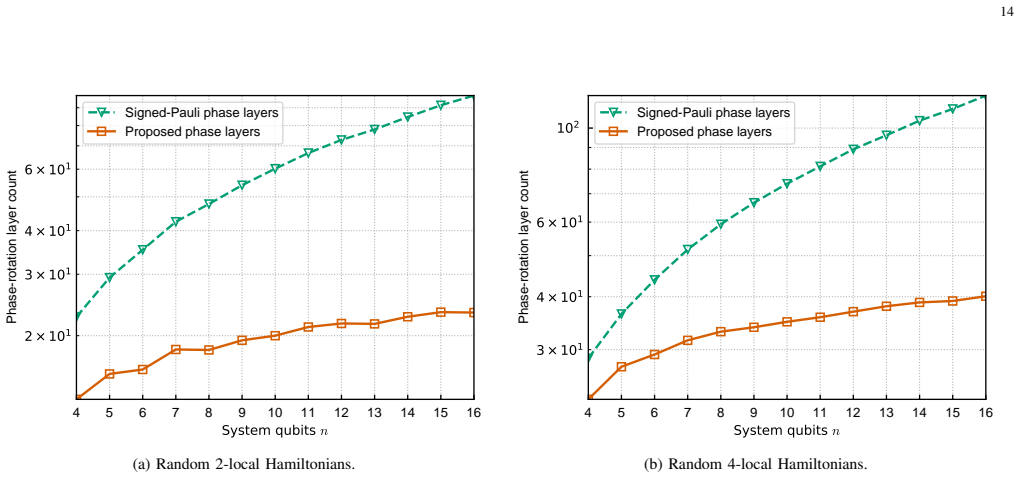
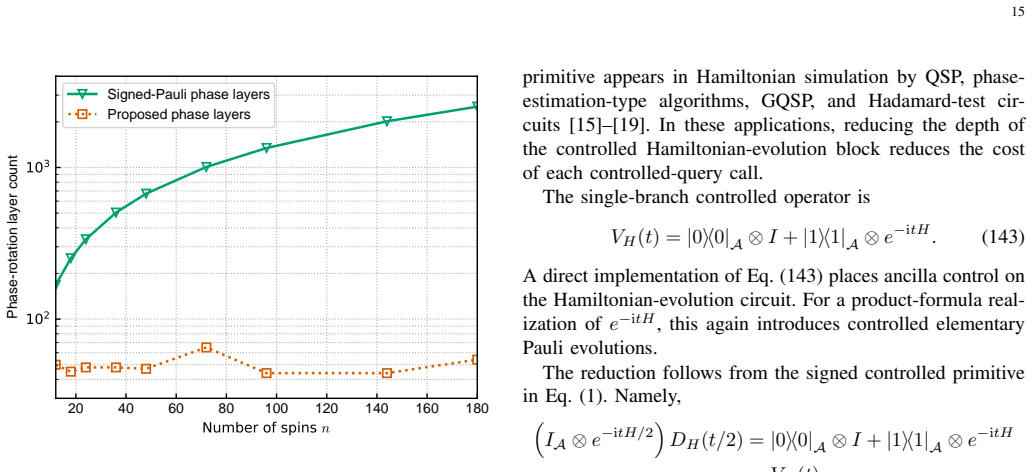
- Controlled time-evolution blocks for quantum eigenvalue transformation and Hamiltonian filtering become shallower for any Pauli-sum input.
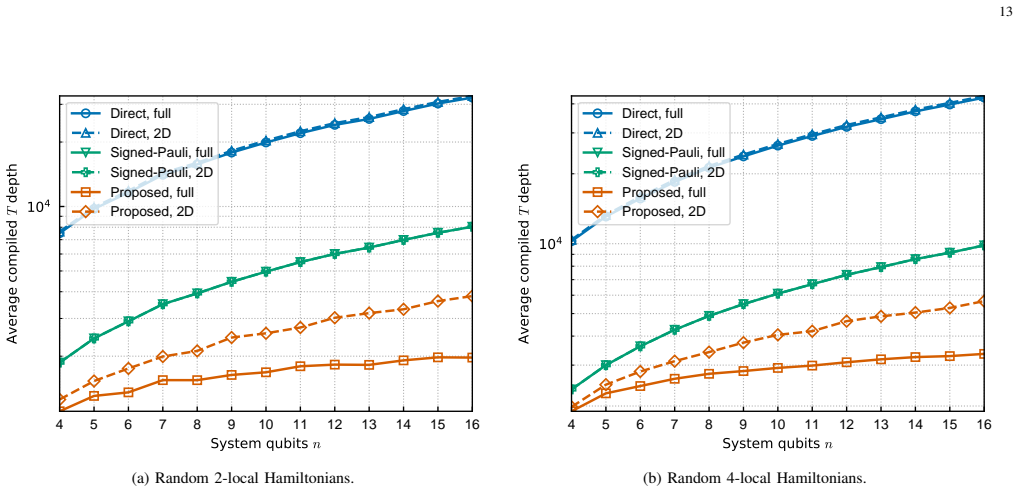
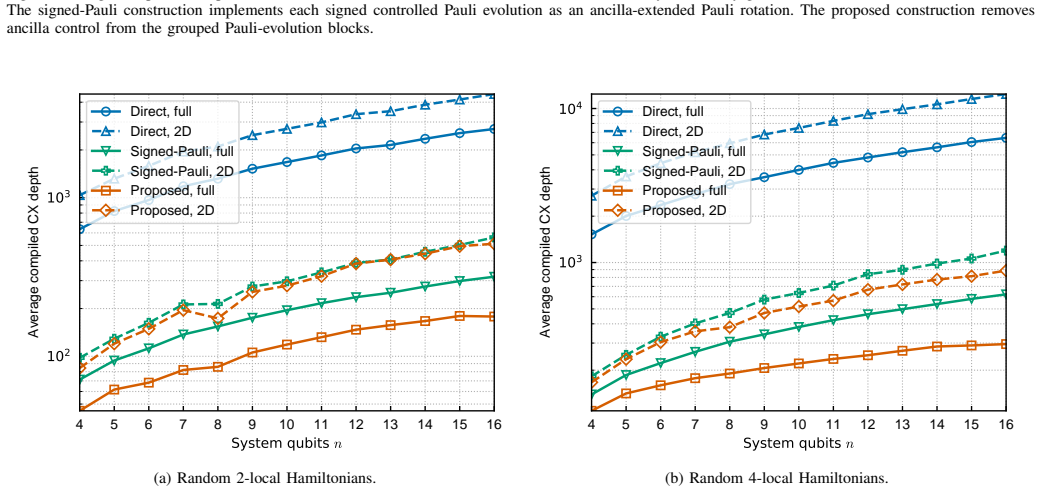
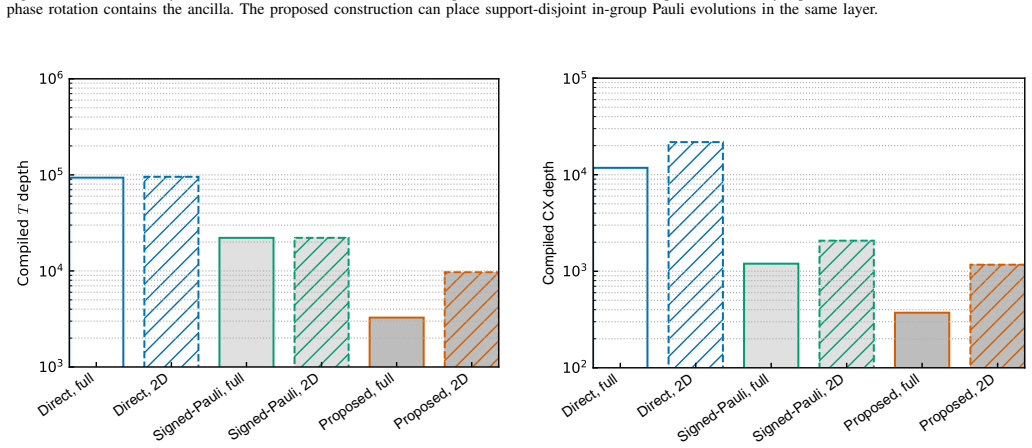
- Compiled T depth drops by up to 85.2 percent and CX depth by up to 68.9 percent on a fully connected 24-spin Kagome Hamiltonian.
- The same grouping technique applies uniformly to both random and structured spin Hamiltonians without requiring special structure.
- The method removes the need to control every elementary gate inside each grouped evolution operator.
Where Pith is reading between the lines
- The same grouping idea may extend to other controlled multi-qubit operations that currently add ancilla controls to every gate.
- Lower depth controlled evolution could improve resource estimates for phase estimation and filtering algorithms on near-term hardware.
- Scalability tests on Hamiltonians with hundreds of qubits or limited connectivity would reveal whether the recursive partitioning remains efficient.
Load-bearing premise
An efficient recursive partitioning always exists such that anti-commuting sign-flip strings can be assigned to groups without raising overall circuit complexity or changing the target unitary.
What would settle it
A concrete Pauli-sum Hamiltonian for which the recursive algorithm either fails to produce valid groups or produces a circuit whose compiled T or CX depth exceeds that of the direct per-term controlled implementation.
Figures
read the original abstract
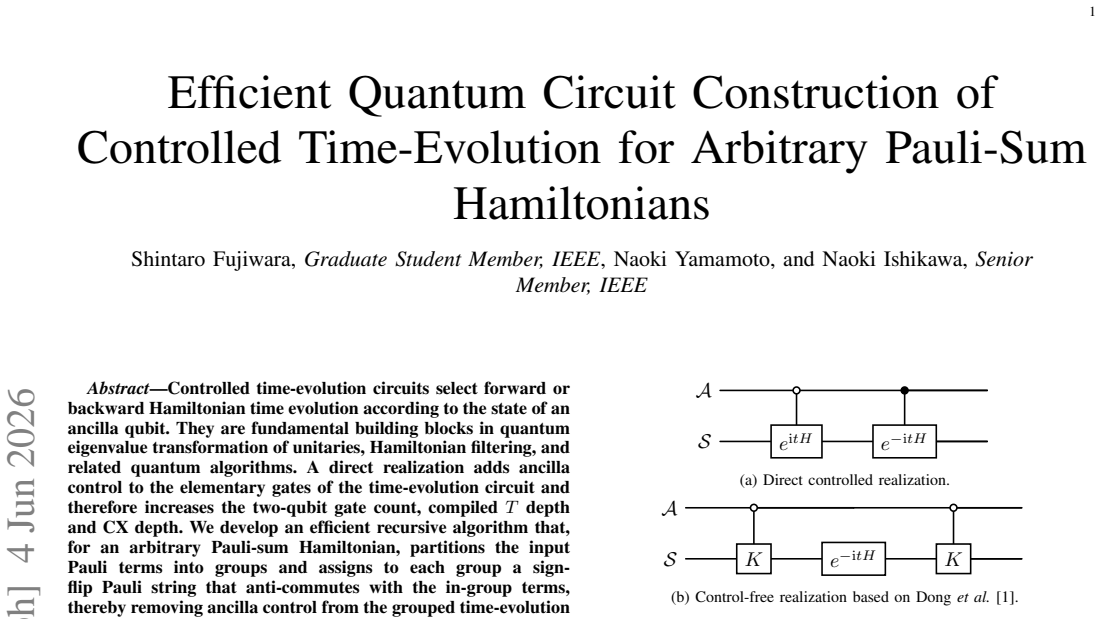
Controlled time-evolution circuits select forward or backward Hamiltonian time evolution according to the state of an ancilla qubit. They are fundamental building blocks in quantum eigenvalue transformation of unitaries, Hamiltonian filtering, and related quantum algorithms. A direct realization adds ancilla control to the elementary gates of the time-evolution circuit and therefore increases the two-qubit gate count, compiled T depth and CX depth. We develop an efficient recursive algorithm that, for an arbitrary Pauli-sum Hamiltonian, partitions the input Pauli terms into groups and assigns to each group a sign-flip Pauli string that anti-commutes with the in-group terms, thereby removing ancilla control from the grouped time-evolution blocks. Numerical benchmarks on random Hamiltonians and structured spin Hamiltonians show reductions in compiled T depth and compiled CX depth. For a Kagome Hamiltonian with 24 spins under full connectivity, the proposed construction reduces the compiled T depth by 85.2% and the compiled CX depth by 68.9%, compared with a conventional implementation that decomposes the Hamiltonian into individual Pauli terms and implements the controlled time evolution of each term by directly adding the ancilla qubit to the corresponding Pauli-rotation circuit.
Editorial analysis
A structured set of objections, weighed in public.
Referee Report
Summary. The paper claims to develop an efficient recursive algorithm for controlled time-evolution of arbitrary Pauli-sum Hamiltonians: it partitions the Pauli terms into groups and assigns each group a sign-flip Pauli string that anti-commutes with all terms in the group, thereby replacing per-term ancilla controls with a single controlled sign-flip per block and reducing compiled T and CX depths. Numerical benchmarks on random Hamiltonians and a 24-spin Kagome lattice under full connectivity report reductions of 85.2% in T depth and 68.9% in CX depth relative to the conventional per-term controlled implementation.
Significance. If the algorithm is correct and the partitioning is always constructible in polynomial time, the construction would materially lower the gate cost of controlled evolutions, which are core primitives in QETU, Hamiltonian filtering, and related algorithms; the reported depth reductions on structured spin models are substantial enough to be practically relevant for near-term implementations.
major comments (1)
- [Abstract] Abstract (and implied algorithm description): the central claim that an efficient recursive partitioning into anti-commuting groups always exists for arbitrary Pauli sums is not supported by any argument, complexity bound, or proof that a common anti-commuter can be found without exhaustive search or that the recursion terminates for every input; the numerical benchmarks on random and Kagome instances do not address this gap for the arbitrary case.
minor comments (1)
- The numerical results are reported without error bars, variance across random instances, or full benchmark tables, making it difficult to assess robustness.
Simulated Author's Rebuttal
We thank the referee for the careful review and constructive feedback. We address the major comment on the need for formal support of the recursive algorithm's properties for arbitrary Pauli sums.
read point-by-point responses
-
Referee: [Abstract] Abstract (and implied algorithm description): the central claim that an efficient recursive partitioning into anti-commuting groups always exists for arbitrary Pauli sums is not supported by any argument, complexity bound, or proof that a common anti-commuter can be found without exhaustive search or that the recursion terminates for every input; the numerical benchmarks on random and Kagome instances do not address this gap for the arbitrary case.
Authors: We agree that the manuscript lacks an explicit formal argument or complexity bound establishing that the recursive partitioning always succeeds efficiently for arbitrary Pauli sums. The algorithm is described as constructive and recursive, with numerical results on random and structured instances, but no proof of termination or polynomial-time construction of the anti-commuter is provided. In revision we will add a subsection proving that a common anti-commuting sign-flip string can be found in polynomial time by solving a system of linear equations over GF(2) (anti-commutation imposes independent parity constraints on the Pauli components) and that recursion terminates after at most N steps (N = number of terms) because each iteration removes at least one term. This will directly address the gap for the arbitrary case. revision: yes
Circularity Check
No circularity: algorithmic construction is self-contained
full rationale
The paper presents a recursive partitioning algorithm that groups Pauli terms and assigns anti-commuting sign-flip strings to eliminate ancilla controls. This is an explicit algorithmic procedure whose correctness follows from the anti-commutation property used in the grouping step, with no reduction of any derived quantity to a fitted parameter, self-definition, or self-citation chain. Benchmarks on concrete Hamiltonians serve as empirical validation rather than load-bearing proof. The derivation chain is independent of prior fitted results or tautological inputs.
Axiom & Free-Parameter Ledger
axioms (1)
- standard math Pauli operators satisfy standard anti-commutation relations used to enable sign flips without altering the unitary.
Reference graph
Works this paper leans on
-
[1]
Ground-state preparation and energy estimation on early fault-tolerant quantum computers via quantum eigenvalue transformation of unitary matrices,
Y . Dong, L. Lin, and Y . Tong, “Ground-state preparation and energy estimation on early fault-tolerant quantum computers via quantum eigenvalue transformation of unitary matrices,”PRX Quantum, vol. 3, no. 4, p. 040305, 2022
2022
-
[2]
Enhancing scalability of quantum eigenvalue transformation of unitary matrices for ground state preparation through adaptive finer filtering,
E. Karacan, Y . Chen, and C. B. Mendl, “Enhancing scalability of quantum eigenvalue transformation of unitary matrices for ground state preparation through adaptive finer filtering,”Quantum, vol. 9, p. 1624, 2025
2025
-
[3]
Y . Dong and L. Lin, “Multi-level quantum signal processing with ap- plications to ground state preparation using fast-forwarded hamiltonian evolution,”arXiv:2406.02086, 2024
arXiv 2024
-
[4]
T. R. M ¨uller, M. Geiger, and C. B. Mendl, “Ground-state prepara- tion of the Fermi–Hubbard model on a quantum computer with 2D topology via quantum eigenvalue transformation of unitary matrices,” arXiv:2411.18535, 2024
arXiv 2024
-
[5]
Filter-enhanced adiabatic quantum computing on a digital quantum processor,
E. Karacan, C. Mc Keever, M. Foss-Feig, D. Hayes, and M. Lubasch, “Filter-enhanced adiabatic quantum computing on a digital quantum processor,”arXiv:2503.20674, 2025
arXiv 2025
-
[6]
Nearly optimal state preparation for quantum simulations of lattice gauge theories,
C. F. Kane, N. Gomes, and M. Kreshchuk, “Nearly optimal state preparation for quantum simulations of lattice gauge theories,”Physical Review A, vol. 110, no. 1, p. 012455, 2024
2024
-
[7]
Imaginary-time evolution using forward and backward real-time evolution with a single ancilla: First-quantized eigensolver algorithm for quantum chemistry,
T. Kosugi, Y . Nishiya, H. Nishi, and Y .-i. Matsushita, “Imaginary-time evolution using forward and backward real-time evolution with a single ancilla: First-quantized eigensolver algorithm for quantum chemistry,” Physical Review Research, vol. 4, no. 3, p. 033121, 2022
2022
-
[8]
Optimal scheduling in probabilistic imaginary-time evolution on a quantum computer,
H. Nishi, K. Hamada, Y . Nishiya, T. Kosugi, and Y .-i. Matsushita, “Optimal scheduling in probabilistic imaginary-time evolution on a quantum computer,”Physical Review Research, vol. 5, no. 4, p. 043048, 2023
2023
-
[9]
Probabilistic imaginary-time evolution algorithm based on nonunitary quantum circuits,
H.-N. Xie, S.-J. Wei, F. Yang, Z.-A. Wang, C.-T. Chen, H. Fan, and G.-L. Long, “Probabilistic imaginary-time evolution algorithm based on nonunitary quantum circuits,”Physical Review A, vol. 109, no. 5, p. 052414, 2024
2024
-
[10]
Measurement of many-body chaos using a quantum clock,
G. Zhu, M. Hafezi, and T. Grover, “Measurement of many-body chaos using a quantum clock,”Physical Review A, vol. 94, no. 6, p. 062329, 2016
2016
-
[11]
Out-of- time-ordered-correlator quasiprobabilities robustly witness scrambling,
J. R. Gonz ´alez Alonso, N. Yunger Halpern, and J. Dressel, “Out-of- time-ordered-correlator quasiprobabilities robustly witness scrambling,” Physical Review Letters, vol. 122, no. 4, p. 040404, 2019
2019
-
[12]
Strengthening weak measurements of qubit out-of-time-order correla- tors,
J. Dressel, J. R. Gonz ´alez Alonso, M. Waegell, and N. Yunger Halpern, “Strengthening weak measurements of qubit out-of-time-order correla- tors,”Physical Review A, vol. 98, no. 1, p. 012132, 2018
2018
-
[13]
On the product of semi-groups of operators,
H. F. Trotter, “On the product of semi-groups of operators,”Proceedings of the American Mathematical Society, vol. 10, pp. 545–551, 1959
1959
-
[14]
Fractal decomposition of exponential operators with appli- cations to many-body theories and Monte Carlo simulations,
M. Suzuki, “Fractal decomposition of exponential operators with appli- cations to many-body theories and Monte Carlo simulations,”Physics Letters A, vol. 146, no. 6, pp. 319–323, 1990
1990
-
[15]
Optimal hamiltonian simulation by quantum signal processing,
G. H. Low and I. L. Chuang, “Optimal hamiltonian simulation by quantum signal processing,”Physical Review Letters, vol. 118, no. 1, p. 010501, 2017
2017
-
[16]
Quantum measurements and the Abelian Stabilizer Problem,
A. Y . Kitaev, “Quantum measurements and the Abelian Stabilizer Problem,”arXiv:quant-ph/9511026, 1995
Pith/arXiv arXiv 1995
-
[17]
Generalized quantum signal processing,
D. Motlagh and N. Wiebe, “Generalized quantum signal processing,” PRX Quantum, vol. 5, no. 2, p. 020368, 2024
2024
-
[18]
Doubling the efficiency of hamiltonian simulation via generalized quantum signal processing,
D. W. Berry, D. Motlagh, G. Pantaleoni, and N. Wiebe, “Doubling the efficiency of hamiltonian simulation via generalized quantum signal processing,”Physical Review A, vol. 110, no. 1, p. 012612, 2024
2024
-
[19]
Quantum algo- rithms revisited,
R. Cleve, A. Ekert, C. Macchiavello, and M. Mosca, “Quantum algo- rithms revisited,”Proceedings of the Royal Society A: Mathematical, Physical and Engineering Sciences, vol. 454, no. 1969, pp. 339–354, 1998
1969
-
[20]
Phase gadget synthesis for shallow circuits,
A. Cowtan, S. Dilkes, R. Duncan, W. Simmons, and S. Sivarajah, “Phase gadget synthesis for shallow circuits,”Electronic Proceedings in Theoretical Computer Science, vol. 318, pp. 213–228, 2020
2020
-
[21]
Pauli- hedral: A generalized block-wise compiler optimization framework for quantum simulation kernels,
G. Li, A. Wu, Y . Shi, A. Javadi-Abhari, Y . Ding, and Y . Xie, “Pauli- hedral: A generalized block-wise compiler optimization framework for quantum simulation kernels,” inProceedings of the 27th ACM Interna- tional Conference on Architectural Support for Programming Languages and Operating Systems, 2022, pp. 554–569
2022
-
[22]
Tetris: A compilation framework for VQA applications in quantum computing,
Y . Jin, Z. Li, F. Hua, T. Hao, H. Zhou, Y . Huang, and E. Z. Zhang, “Tetris: A compilation framework for VQA applications in quantum computing,” inProceedings of 2024 ACM/IEEE 51st Annual Interna- tional Symposium on Computer Architecture, 2024, pp. 277–292
2024
-
[23]
TARE: Block encoding lin- ear combinations of pauli strings without ancilla state preparation,
N. Schillo, A. Sturm, and R. Quay, “TARE: Block encoding lin- ear combinations of pauli strings without ancilla state preparation,” arXiv:2601.05740, 2026
Pith/arXiv arXiv 2026
-
[24]
Pauli partitioning with respect to gate sets,
A. Jena, S. Genin, and M. Mosca, “Pauli partitioning with respect to gate sets,”arXiv:1907.07859, 2019
Pith/arXiv arXiv 1907
-
[25]
Measurement optimiza- tion in the variational quantum eigensolver using a minimum clique cover,
V . Verteletskyi, T.-C. Yen, and A. F. Izmaylov, “Measurement optimiza- tion in the variational quantum eigensolver using a minimum clique cover,”Journal of Chemical Physics, vol. 152, no. 12, p. 124114, 2020
2020
-
[26]
Measuring all compat- ible operators in one series of single-qubit measurements using unitary transformations,
T.-C. Yen, V . Verteletskyi, and A. F. Izmaylov, “Measuring all compat- ible operators in one series of single-qubit measurements using unitary transformations,”Journal of Chemical Theory and Computation, vol. 16, no. 4, pp. 2400–2409, 2020
2020
-
[27]
Stabilizer codes and quantum error correction,
D. Gottesman, “Stabilizer codes and quantum error correction,” Ph.D. dissertation, California Institute of Technology, Pasadena, California, 1997
1997
-
[28]
The Clifford group, stabilizer states, and linear and quadratic operations over GF(2),
J. Dehaene and B. De Moor, “The Clifford group, stabilizer states, and linear and quadratic operations over GF(2),”Physical Review A, vol. 68, no. 4, p. 042318, 2003
2003
-
[29]
Universal quantum computation with ideal Clifford gates and noisy ancillas,
S. Bravyi and A. Kitaev, “Universal quantum computation with ideal Clifford gates and noisy ancillas,”Physical Review A, vol. 71, no. 2, p. 022316, 2005
2005
-
[30]
Surface codes: Towards practical large-scale quantum computation,
A. G. Fowler, M. Mariantoni, J. M. Martinis, and A. N. Cleland, “Surface codes: Towards practical large-scale quantum computation,”Physical Review A, vol. 86, no. 3, p. 032324, 2012
2012
-
[31]
Efficient magic state factories with a catalyzed|CCZ⟩to2|T⟩transformation,
C. Gidney and A. G. Fowler, “Efficient magic state factories with a catalyzed|CCZ⟩to2|T⟩transformation,”Quantum, vol. 3, p. 135, 2019
2019
-
[32]
Fast and efficient exact synthesis of single qubit unitaries generated by Clifford and T gates,
V . Kliuchnikov, D. Maslov, and M. Mosca, “Fast and efficient exact synthesis of single qubit unitaries generated by Clifford and T gates,” Quantum Information & Computation, vol. 13, no. 7–8, pp. 607–630, 2013
2013
-
[33]
Optimal ancilla-free Clifford+T approxima- tion ofz-rotations,
N. J. Ross and P. Selinger, “Optimal ancilla-free Clifford+T approxima- tion ofz-rotations,”Quantum Information & Computation, vol. 16, no. 11–12, pp. 901–953, 2016
2016
-
[34]
Polynomial-time T-depth optimiza- tion of Clifford+T circuits via matroid partitioning,
M. Amy, D. Maslov, and M. Mosca, “Polynomial-time T-depth optimiza- tion of Clifford+T circuits via matroid partitioning,”IEEE Transactions on Computer-Aided Design of Integrated Circuits and Systems, vol. 33, no. 10, pp. 1476–1489, 2014
2014
-
[35]
Quantum computing with Qiskit,
A. Javadi-Abhari, M. Treinish, K. Krsulich, C. J. Wood, J. Lishman, J. Gacon, S. Martiel, P. D. Nation, L. S. Bishop, A. W. Cross, B. R. Johnson, and J. M. Gambetta, “Quantum computing with Qiskit,” arXiv:2405.08810, 2024
Pith/arXiv arXiv 2024
-
[36]
Chiral spin liquid and emergent anyons in a kagome lattice Mott insulator,
B. Bauer, L. Cincio, B. P. Keller, M. Dolfi, G. Vidal, S. Trebst, and A. W. W. Ludwig, “Chiral spin liquid and emergent anyons in a kagome lattice Mott insulator,”Nature Communications, vol. 5, p. 5137, 2014
2014
-
[37]
Equivalence of the resonating- valence-bond and fractional quantum Hall states,
V . Kalmeyer and R. B. Laughlin, “Equivalence of the resonating- valence-bond and fractional quantum Hall states,”Physical Review Letters, vol. 59, no. 18, pp. 2095–2098, 1987
2095
-
[38]
Spin liquids in frustrated magnets,
L. Balents, “Spin liquids in frustrated magnets,”Nature, vol. 464, no. 7286, pp. 199–208, 2010
2010
-
[39]
Nearly optimal lattice simulation by product formulas,
A. M. Childs and Y . Su, “Nearly optimal lattice simulation by product formulas,”Physical Review Letters, vol. 123, no. 5, p. 050503, 2019
2019
-
[40]
Theory of Trotter error with commutator scaling,
A. M. Childs, Y . Su, M. C. Tran, N. Wiebe, and S. Zhu, “Theory of Trotter error with commutator scaling,”Physical Review X, vol. 11, no. 1, p. 011020, 2021. 18 Shintaro Fujiwara(Graduate Student Member, IEEE) received the B.E. and M.E. degrees in Engineering Science from Yokohama National University, Kanagawa, Japan, in 2024 and 2025, respectively. He is...
2021
discussion (0)
Sign in with ORCID, Apple, or X to comment. Anyone can read and Pith papers without signing in.