Mass-Orbital Period Distribution of Massive White Dwarfs Formed Through Stable Mass Transfer
Pith reviewed 2026-06-27 23:34 UTC · model grok-4.3
The pith
Intermediate-mass progenitors produce a mass-orbital period relation that explains long-period massive white dwarf binaries via stable mass transfer.
A machine-rendered reading of the paper's core claim, the machinery that carries it, and where it could break.
Core claim
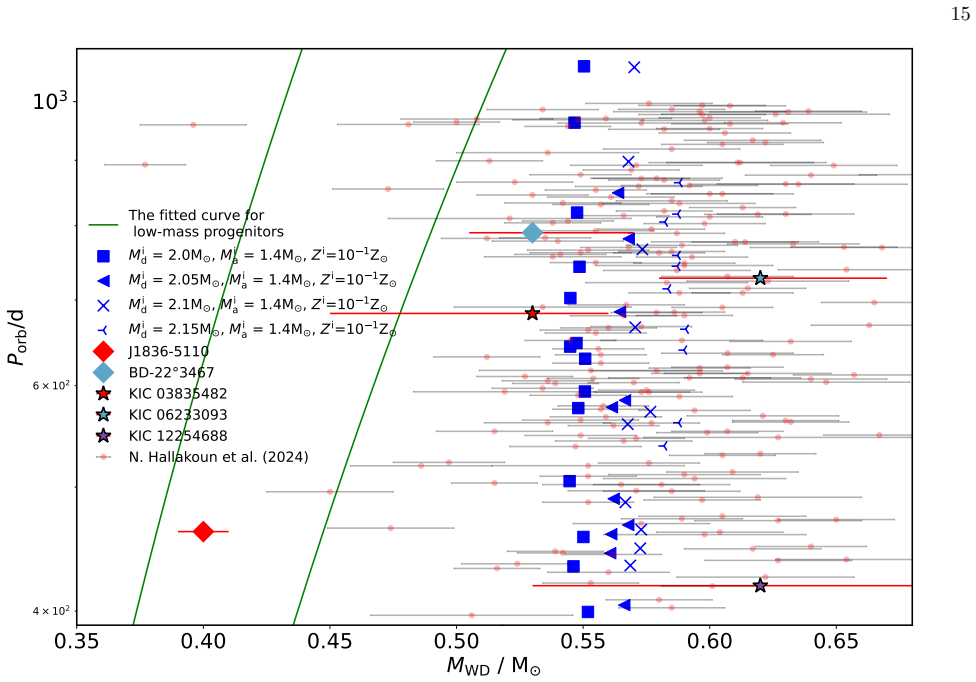
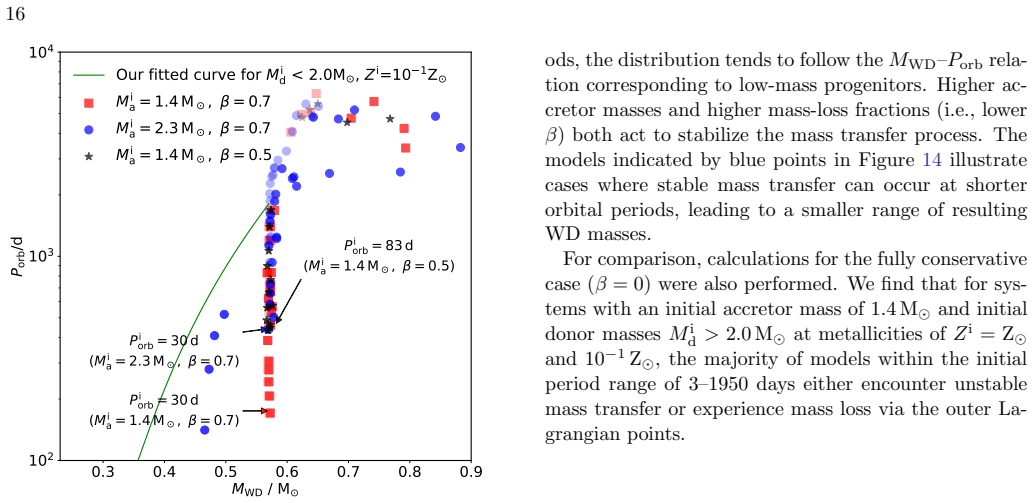
Our results show that the relations for intermediate-mass progenitors whose cores remain non-degenerate prior to central helium burning can account for the formation channels of long-period and massive WD binaries. The models employ the quasi-adiabatic criterion to enforce stable mass transfer, examine multiple transfer schemes and metallicities, and contrast the outcomes with those from low-mass progenitors.
What carries the argument
The mass-orbital period (M_WD - P_orb) relation computed from stable mass transfer sequences of intermediate-mass progenitors.
If this is right
- Long-period massive white dwarf binaries can form without common envelope evolution.
- The predicted distribution depends on the adopted mass-transfer scheme and metallicity.
- Low-mass progenitor relations alone are insufficient to explain the full observed population.
- Observed white dwarf binaries can be classified by evolutionary channel using their location on the relation.
Where Pith is reading between the lines
- Population synthesis codes will need to include these intermediate-mass channels to reproduce the observed white dwarf binary statistics.
- Direct comparison of the modeled relation with a larger observed sample could calibrate the stability criterion itself.
- Some of these massive white dwarfs may later accrete and become Type Ia supernova candidates if they reach the Chandrasekhar limit.
Load-bearing premise
The quasi-adiabatic criterion correctly separates stable mass transfer from common-envelope evolution.
What would settle it
A sample of long-period massive white dwarf binaries whose periods and masses fall systematically outside the modeled relations for intermediate-mass progenitors.
Figures
read the original abstract
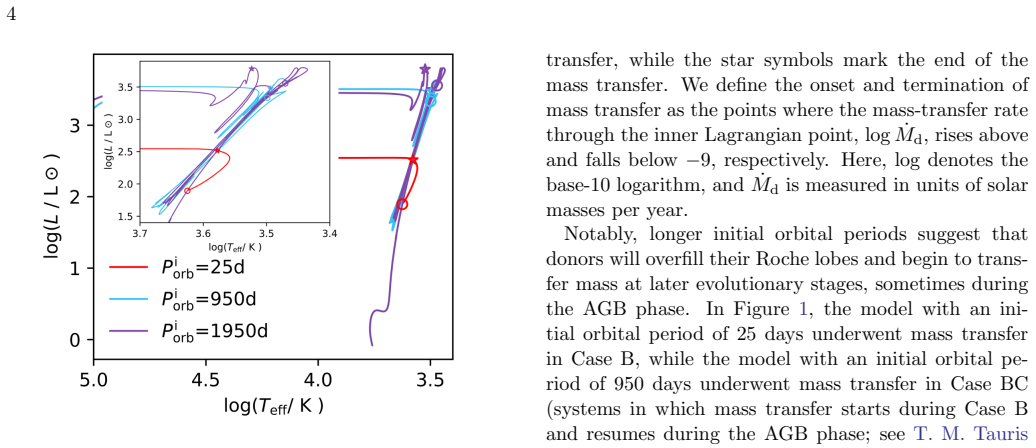
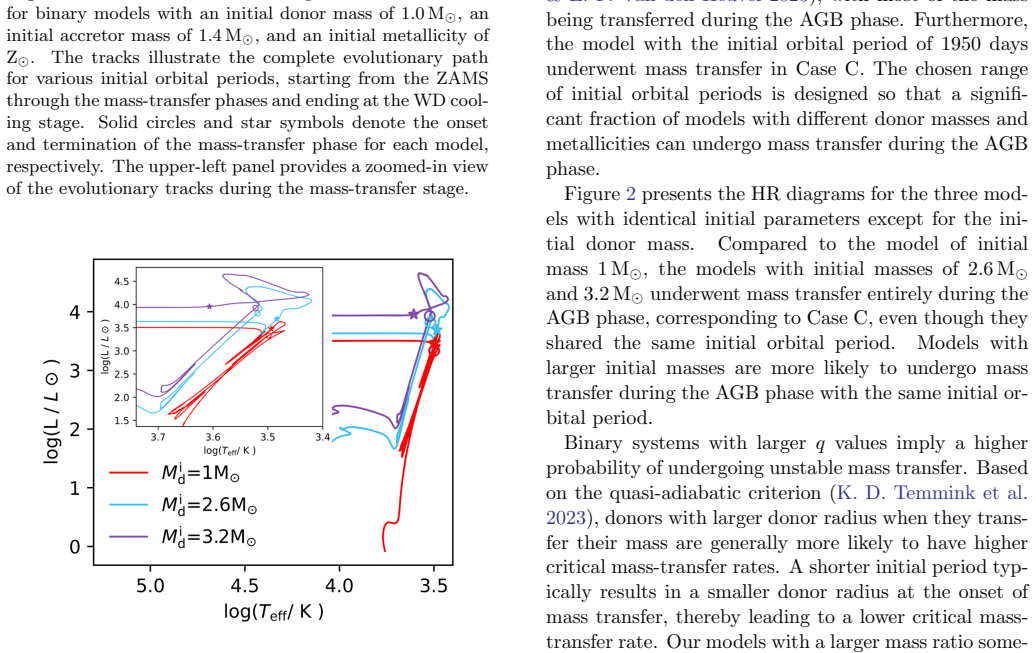
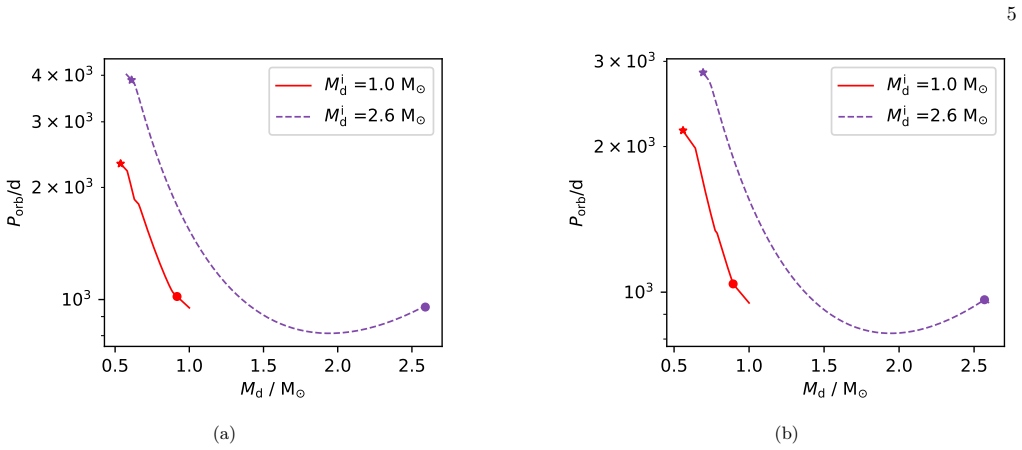
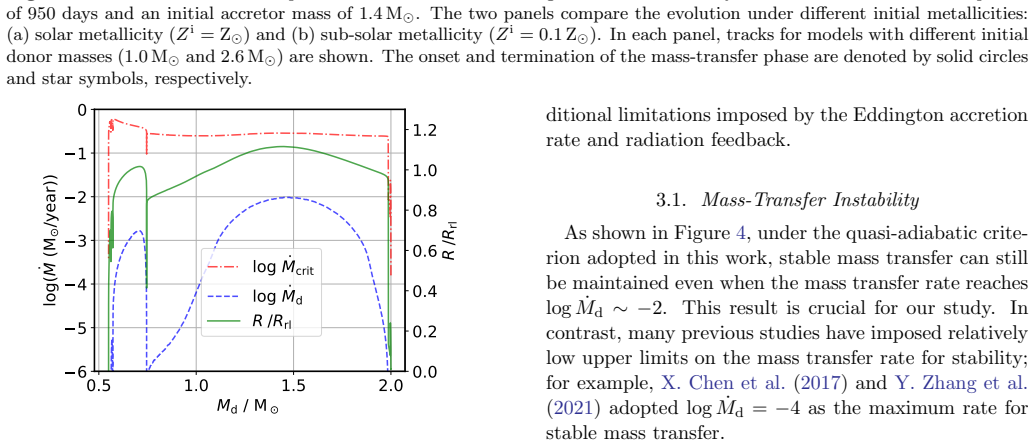
White dwarfs (WDs) in binaries can form through either the stable mass-transfer process or common envelope evolution (CEE). Compared to CEE, the stable mass-transfer process can lead to a distinct mass-orbital period ($M_{\mathrm{WD}}-P_{\mathrm{orb}}$) relation. Thus, this relation of WDs contains the information about the evolution channels. We can study the relation in WD binary systems to determine whether their progenitors undergo a CEE. We use the stellar evolution code MESA as our primary computational tool and adopt the quasi-adiabatic criterion to ensure that our models satisfy the conditions for stable mass transfer. Our study considers different mass-transfer schemes, varying metallicities, and the relation for both low-mass and intermediate-mass progenitors. Previous studies have focused on the relation for low-mass progenitors, which cannot explain some long-period, high-mass WD binaries. Our results show that the relations for intermediate-mass progenitors whose cores remain non-degenerate prior to central helium burning can account for the formation channels of long-period and massive WD binaries.
Editorial analysis
A structured set of objections, weighed in public.
Referee Report
Summary. The paper uses MESA to simulate stable mass transfer in binaries and derives M_WD–P_orb relations for white dwarfs. It adopts a quasi-adiabatic criterion to select stable-transfer models and concludes that intermediate-mass progenitors (cores non-degenerate before central He burning) produce long-period, high-mass WD binaries that low-mass progenitor channels cannot explain.
Significance. If validated, the result supplies a concrete formation channel for observed long-period massive WD systems and a diagnostic for distinguishing stable mass transfer from common-envelope evolution. The forward modeling with varying metallicities and mass-transfer schemes is a positive feature.
major comments (1)
- [Abstract / modeling approach] Abstract and modeling description: the quasi-adiabatic criterion is the central modeling choice used to identify stable mass transfer for the intermediate-mass, non-degenerate-core progenitors that underpin the main claim. The manuscript contains no direct comparison of this criterion’s stability boundaries to full MESA binary integrations that solve the donor’s thermal response and Roche-lobe overflow rate self-consistently. Without such a cross-check, the derived M_WD–P_orb tracks for these progenitors rest on an untested assumption.
minor comments (1)
- [Abstract] The abstract would be clearer if it stated the progenitor mass ranges adopted for the low-mass versus intermediate-mass cases and the metallicities explored.
Simulated Author's Rebuttal
We thank the referee for their constructive review and positive assessment of the paper's significance. We address the single major comment below.
read point-by-point responses
-
Referee: [Abstract / modeling approach] Abstract and modeling description: the quasi-adiabatic criterion is the central modeling choice used to identify stable mass transfer for the intermediate-mass, non-degenerate-core progenitors that underpin the main claim. The manuscript contains no direct comparison of this criterion’s stability boundaries to full MESA binary integrations that solve the donor’s thermal response and Roche-lobe overflow rate self-consistently. Without such a cross-check, the derived M_WD–P_orb tracks for these progenitors rest on an untested assumption.
Authors: We acknowledge the value of a direct cross-check. The quasi-adiabatic criterion is a standard, analytically motivated approximation (based on the donor's adiabatic mass-radius response versus the Roche-lobe response) that has been widely adopted in the binary-evolution literature to delineate stable mass transfer. Our MESA calculations evolve the binaries using the code's binary module; the criterion is applied only to select the subset of initial conditions that satisfy the stability condition before performing the full evolutionary sequences. Nevertheless, we agree that an explicit numerical comparison of the resulting stability boundaries against a set of fully self-consistent MESA runs (with thermal response and RLOF rate solved simultaneously) would strengthen the presentation. We will therefore add a short appendix or subsection in the revised manuscript that performs this comparison for a representative sample of intermediate-mass progenitors. revision: yes
Circularity Check
No circularity: forward MESA simulations produce M_WD-P_orb relations as output
full rationale
The paper performs forward stellar evolution calculations in MESA using an adopted quasi-adiabatic stability criterion as an input modeling choice. The reported M_WD-P_orb relations for intermediate-mass progenitors are generated as simulation outputs rather than being fitted to data or defined in terms of the target result. No equations, parameters, or self-citations are shown that would reduce the claimed relations to the inputs by construction. The derivation chain is therefore self-contained against external benchmarks.
Axiom & Free-Parameter Ledger
axioms (1)
- domain assumption quasi-adiabatic criterion ensures stable mass transfer
Reference graph
Works this paper leans on
-
[1]
Subhaloes in Self-Interacting Galactic Dark Matter Haloes
Antoniadis, J., Van Kerkwijk, M. H., Koester, D., et al. 2012, Monthly Notices of the Royal Astronomical Society, 423, 3316, doi: 10.1111/j.1365-2966.2012.21124.x
-
[2]
Jacques and Scott, Pat , year = 2009, month = sep, journal =
Asplund, M., Grevesse, N., Sauval, A. J., & Scott, P. 2009, Annual Review of Astronomy and Astrophysics, 47, 481, doi: 10.1146/annurev.astro.46.060407.145222
-
[3]
Bassa, C. G., Pleunis, Z., Hessels, J. W. T., et al. 2017, The Astrophysical Journal Letters, 846, L20, doi: 10.3847/2041-8213/aa8400
-
[4]
2026, arXiv preprint arXiv:2603.23756
Yamaguchi, N. 2026, arXiv preprint arXiv:2603.23756
arXiv 2026
-
[5]
1995, Astronomy and Astrophysics, 297, 727
Bloecker, T. 1995, Astronomy and Astrophysics, 297, 727
1995
-
[6]
2013, Monthly Notices of the Royal Astronomical Society, 434, 186, doi: 10.1093/mnras/stt992
Chen, X., Han, Z., Deca, J., & Podsiadlowski, P. 2013, Monthly Notices of the Royal Astronomical Society, 434, 186, doi: 10.1093/mnras/stt992
-
[7]
2017, Monthly Notices of the Royal Astronomical Society, stx115, doi: 10.1093/mnras/stx115
Chen, X., Maxted, P., Li, J., & Han, Z. 2017, Monthly Notices of the Royal Astronomical Society, stx115, doi: 10.1093/mnras/stx115
-
[8]
2016, ApJ, 823, 102, doi: 10.3847/0004-637X/823/2/102
Choi, J., Dotter, A., Conroy, C., et al. 2016, The Astrophysical Journal, 823, 102, doi: 10.3847/0004-637X/823/2/102
work page internal anchor Pith review doi:10.3847/0004-637x/823/2/102 2016
-
[9]
Ge, H., Hjellming, M. S., Webbink, R. F., Chen, X., & Han, Z. 2010, The Astrophysical Journal, 717, 724, doi: 10.1088/0004-637X/717/2/724
-
[10]
Ge, H., Webbink, R. F., Chen, X., & Han, Z. 2020a, The Astrophysical Journal, 899, 132, doi: 10.3847/1538-4357/aba7b7
-
[11]
Ge, H., Webbink, R. F., & Han, Z. 2020b, The Astrophysical Journal Supplement Series, 249, 9, doi: 10.3847/1538-4365/ab98f6
-
[12]
Ge, H., Tout, C. A., Webbink, R. F., et al. 2024, The Astrophysical Journal, 961, 202, doi: 10.3847/1538-4357/ad158e
-
[13]
Gonzalez, M. E., Stairs, I. H., Ferdman, R. D., et al. 2011, The Astrophysical Journal, 743, 102, doi: 10.1088/0004-637X/743/2/102
-
[14]
2024, The Astrophysical Journal Letters, 970, L11, doi: 10.3847/2041-8213/ad5e63
Ben-Ami, S. 2024, The Astrophysical Journal Letters, 970, L11, doi: 10.3847/2041-8213/ad5e63
-
[15]
Han, Z., Tout, C. A., & Eggleton, P. P. 2002, Monthly Notices of the Royal Astronomical Society, 319, 215, doi: 10.1046/j.1365-8711.2000.03839.x H¨ ofner, S., & Olofsson, H. 2018, The Astronomy and Astrophysics Review, 26, 1, doi: 10.1007/s00159-017-0106-5
-
[16]
Hurley, J. R., Tout, C. A., & Pols, O. R. 2002, Monthly Notices of the Royal Astronomical Society, 329, 897, doi: 10.1046/j.1365-8711.2002.05038.x
-
[17]
Ivanova, N., Justham, S., Chen, X., et al. 2013, The Astronomy and Astrophysics Review, 21, 59, doi: 10.1007/s00159-013-0059-2
-
[18]
Jermyn, A. S., Bauer, E. B., Schwab, J., et al. 2023, The Astrophysical Journal Supplement Series, 265, 15, doi: 10.3847/1538-4365/acae8d
-
[19]
Karakas, A. I., & Lattanzio, J. C. 2014, Publications of the Astronomical Society of Australia, 31, e030, doi: 10.1017/pasa.2014.21
-
[20]
2018, The Astronomical Journal, 155, 144, doi: 10.3847/1538-3881/aaaaaf
Kawahara, H., Masuda, K., MacLeod, M., et al. 2018, The Astronomical Journal, 155, 144, doi: 10.3847/1538-3881/aaaaaf
-
[21]
2012, Stellar Structure and Evolution (Berlin: Springer)
Kippenhahn, R., Weigert, A., & Weiss, A. 2012, Stellar Structure and Evolution (Berlin: Springer)
2012
-
[22]
2000, Astronomy and Astrophysics, v
Koester, D., & Reimers, D. 2000, Astronomy and Astrophysics, v. 364, p. L66-L69 (2000), 364, L66
2000
-
[23]
1990, Astronomy and Astrophysics, 236, 385
Kolb, U., & Ritter, H. 1990, Astronomy and Astrophysics, 236, 385
1990
-
[24]
Kosec, P., Kara, E., Fabian, A. C., et al. 2023, Nature Astronomy, 7, 715, doi: 10.1038/s41550-023-01929-7
-
[25]
and Prakash, Madappa , year = 2007, month = apr, journal =
Lattimer, J., & Prakash, M. 2007, Physics Reports, 442, 109, doi: 10.1016/j.physrep.2007.02.003
-
[26]
2011, The Astrophysical Journal, 732, 70, doi: 10.1088/0004-637X/732/2/70
Lin, J., Rappaport, S., Podsiadlowski, Ph., et al. 2011, The Astrophysical Journal, 732, 70, doi: 10.1088/0004-637X/732/2/70
-
[27]
Linial, I., & Sari, R. 2017, Monthly Notices of the Royal Astronomical Society, 469, 2441, doi: 10.1093/mnras/stx1041 L¨ obling, L., Maney, M., Rauch, T., et al. 2020, Monthly Notices of the Royal Astronomical Society, 492, 528 19
-
[28]
Manchester, R. N., Hobbs, G. B., Teoh, A., & Hobbs, M. 2005, The Astronomical Journal, 129, 1993, doi: 10.1086/428488
work page internal anchor Pith review doi:10.1086/428488 2005
-
[29]
Manchester, R. N., Newton, L. M., Cooke, D. J., & Lyne, A. G. 1980, The Astrophysical Journal, 236, L25, doi: 10.1086/183191
-
[30]
Marigo, P., Girardi, L., Chiosi, C., & Wood, P. R. 2001, Astronomy & Astrophysics, 371, 152, doi: 10.1051/0004-6361:20010309
-
[31]
Mathur, S., Huber, D., Batalha, N. M., et al. 2017, The Astrophysical Journal Supplement Series, 229, 30, doi: 10.3847/1538-4365/229/2/30
-
[32]
P., & Sion, E
McCook, G. P., & Sion, E. M. 1999, The Astrophysical Journal Supplement Series, 121, 1
1999
-
[33]
Miglio, A., Chiappini, C., Mackereth, J. T., et al. 2021, Astronomy & Astrophysics, 645, A85, doi: 10.1051/0004-6361/202038307
-
[34]
Moltzer, C. A. S., Pols, O. R., Winckel, H. V., Temmink, K. D., & Wijdeveld, M. W. 2025, Astronomy & Astrophysics, 703, A294, doi: 10.1051/0004-6361/202556437
-
[35]
Navarro, J., Anderson, S., & Freire, P. C. 2003, The Astrophysical Journal, 594, 943, doi: 10.1086/377153
-
[36]
1970, Acta Astronomica, Vol
Paczynski, B. 1970, Acta Astronomica, Vol. 20, p. 47, 20, 47
1970
-
[37]
1971b, Annual Review of Astronomy and Astrophysics, 9, 183, doi: 10.1146/annurev.aa.09.090171.001151
Paczynski, B. 1971b, Annual Review of Astronomy and Astrophysics, 9, 183, doi: 10.1146/annurev.aa.09.090171.001151
-
[38]
1976, in IAU Symposium, Vol
Paczynski, B. 1976, in IAU Symposium, Vol. 73, Structure and Evolution of Close Binary Systems, ed. P. Eggleton, S. Mitton, & J. Whelan, 75
1976
-
[39]
F., Raddi, R., Rebassa-Mansergas, A., et al
Pala, A. F., Raddi, R., Rebassa-Mansergas, A., et al. 2025, arXiv, doi: 10.48550/arXiv.2512.14800
-
[40]
Parsons, S. G., Hernandez, M. S., Toloza, O., et al. 2022, Monthly Notices of the Royal Astronomical Society, 518, 4579, doi: 10.1093/mnras/stac3368
-
[41]
2011, ApJS, 192, 3, doi: 10.1088/0067-0049/192/1/3
Paxton, B., Bildsten, L., Dotter, A., et al. 2011, The Astrophysical Journal Supplement Series, 192, 3, doi: 10.1088/0067-0049/192/1/3
-
[42]
Paxton, B., Cantiello, M., Arras, P., et al. 2013, The Astrophysical Journal Supplement Series, 208, 4, doi: 10.1088/0067-0049/208/1/4
work page internal anchor Pith review doi:10.1088/0067-0049/208/1/4 2013
-
[43]
2015, ApJS, 220, 15, doi: https://doi.org/10.1088/0067-0049/220/1/15
Paxton, B., Marchant, P., Schwab, J., et al. 2015, The Astrophysical Journal Supplement Series, 220, 15, doi: 10.1088/0067-0049/220/1/15
work page internal anchor Pith review doi:10.1088/0067-0049/220/1/15 2015
-
[44]
Paxton, B., Schwab, J., Bauer, E. B., et al. 2018, The Astrophysical Journal Supplement Series, 234, 34, doi: 10.3847/1538-4365/aaa5a8
work page internal anchor Pith review doi:10.3847/1538-4365/aaa5a8 2018
-
[45]
2019, The Astrophysical Journal Supplement Series, 243, 10, doi: 10.3847/1538-4365/ab2241
Paxton, B., Smolec, R., Schwab, J., et al. 2019, The Astrophysical Journal Supplement Series, 243, 10, doi: 10.3847/1538-4365/ab2241
-
[46]
Peters, P. C. 1964, Physical Review, 136, B1224, doi: 10.1103/PhysRev.136.B1224
-
[47]
doi:10.1046/j.1365-8711.2003.06206.x , archiveprefix =
Podsiadlowski, Ph., Rappaport, S., & Han, Z. 2003, Monthly Notices of the Royal Astronomical Society, 341, 385, doi: 10.1046/j.1365-8711.2003.06464.x
-
[48]
Pols, O. R. 2011, Stellar structure and evolution (Astronomical Institute Utrecht Utrecht)
2011
-
[49]
Ransom, S. M., Stairs, I. H., Archibald, A. M., et al. 2014, Nature, 505, 520, doi: 10.1038/nature12917
-
[50]
Rappaport, S., Joss, P. C., & Verbunt, F. 1983, The Astrophysical Journal, 275, 713, doi: 10.1086/161569
-
[51]
Rappaport, S., Podsiadlowski, Ph., Joss, P. C., Di Stefano, R., & Han, Z. 1995, Monthly Notices of the Royal Astronomical Society, 273, 731, doi: 10.1093/mnras/273.3.731
-
[52]
1975, Mem
Reimers, D. 1975, Mem. Soc. R. Sci. Liege, 8, 369
1975
-
[53]
1988, Astronomy and Astrophysics, 202, 93
Ritter, H. 1988, Astronomy and Astrophysics, 202, 93
1988
-
[54]
Romani, R. W., Kandel, D., Filippenko, A. V., Brink, T. G., & Zheng, W. 2022, The Astrophysical Journal Letters, 934, L17, doi: 10.3847/2041-8213/ac8007
-
[55]
2022, Physics Reports, 988, 1, doi: 10.1016/j.physrep.2022.09.001
Saumon, D., Blouin, S., & Tremblay, P.-E. 2022, Physics Reports, 988, 1, doi: 10.1016/j.physrep.2022.09.001
-
[56]
2024, MNRAS, 529, 3729, doi: 10.1093/mnras/stae773
Shahaf, S., Hallakoun, N., Mazeh, T., et al. 2024, Monthly Notices of the Royal Astronomical Society, 529, 3729, doi: 10.1093/mnras/stae773
-
[57]
2021, The Astrophysical Journal, 908, 67, doi: 10.3847/1538-4357/abd2b4
Shao, Y., & Li, X.-D. 2021, The Astrophysical Journal, 908, 67, doi: 10.3847/1538-4357/abd2b4
-
[58]
Wickramasinghe, D. T. 2014, Monthly Notices of the Royal Astronomical Society, 437, 2217, doi: 10.1093/mnras/stt2030
-
[59]
Stability Criteria for Mass Transfer in Binary Stellar Evolution
Soberman, G. E., Phinney, E. S., & van den Heuvel, E. P. J. 1997, arXiv, doi: 10.48550/arXiv.astro-ph/9703016
work page internal anchor Pith review Pith/arXiv arXiv doi:10.48550/arxiv.astro-ph/9703016 1997
-
[60]
M., & Savonije, G
Tauris, T. M., & Savonije, G. J. 1999, ASTRONOMY AND ASTROPHYSICS, 23, 229
1999
-
[61]
M., & Van den Heuvel, E
Tauris, T. M., & Van den Heuvel, E. P. 2023, Physics of binary star evolution: from stars to X-ray binaries and gravitational wave sources, Vol. 42 (Princeton University Press)
2023
-
[62]
M., & van den Heuvel, E
Tauris, T. M., & van den Heuvel, E. P. J. 2006, in Compact stellar X-ray sources, ed. W. H. G. Lewin & M. van der
2006
-
[63]
Formation and Evolution of Compact Stellar X-ray Sources
Klis, Vol. 39, 623–665, doi: 10.48550/arXiv.astro-ph/0303456
work page internal anchor Pith review Pith/arXiv arXiv doi:10.48550/arxiv.astro-ph/0303456
-
[64]
2023, Astronomy & Astrophysics, 669, A45, doi: 10.1051/0004-6361/202244137 20
Toonen, S. 2023, Astronomy & Astrophysics, 669, A45, doi: 10.1051/0004-6361/202244137 20
-
[65]
F., Christensen-Dalsgaard, J., Nordlund, ˚A., & Asplund, M
Trampedach, R., Stein, R. F., Christensen-Dalsgaard, J., Nordlund, ˚A., & Asplund, M. 2014, Monthly Notices of the Royal Astronomical Society, 445, 4366, doi: 10.1093/mnras/stu2084
-
[66]
1993, Astrophysical Journal, Part 1 (ISSN 0004-637X), vol
Vassiliadis, E., & Wood, P. 1993, Astrophysical Journal, Part 1 (ISSN 0004-637X), vol. 413, no. 2, p. 641-657., 413, 641
1993
-
[67]
2023, Monthly Notices of the Royal Astronomical Society, 527, 11719, doi: 10.1093/mnras/stad4005
Yamaguchi, N., El-Badry, K., Fuller, J., et al. 2023, Monthly Notices of the Royal Astronomical Society, 527, 11719, doi: 10.1093/mnras/stad4005
-
[68]
2021, Monthly Notices of the Royal Astronomical Society, 502, 383, doi: 10.1093/mnras/stab020
Zhang, Y., Chen, H., Chen, X., & Han, Z. 2021, Monthly Notices of the Royal Astronomical Society, 502, 383, doi: 10.1093/mnras/stab020
discussion (0)
Sign in with ORCID, Apple, or X to comment. Anyone can read and Pith papers without signing in.