Stacking-Dependent Magnetism and Tunable Half-Metallicity in Bilayer Janus 1T-MnSSe
Pith reviewed 2026-06-28 00:42 UTC · model grok-4.3
The pith
Bilayer Janus MnSSe has stacking-dependent magnetism with transition temperatures above room temperature and half-metallic states tunable by doping or strain.
A machine-rendered reading of the paper's core claim, the machinery that carries it, and where it could break.
Core claim
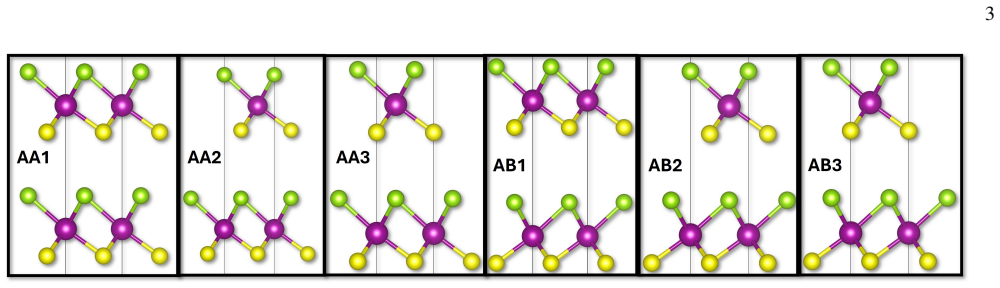
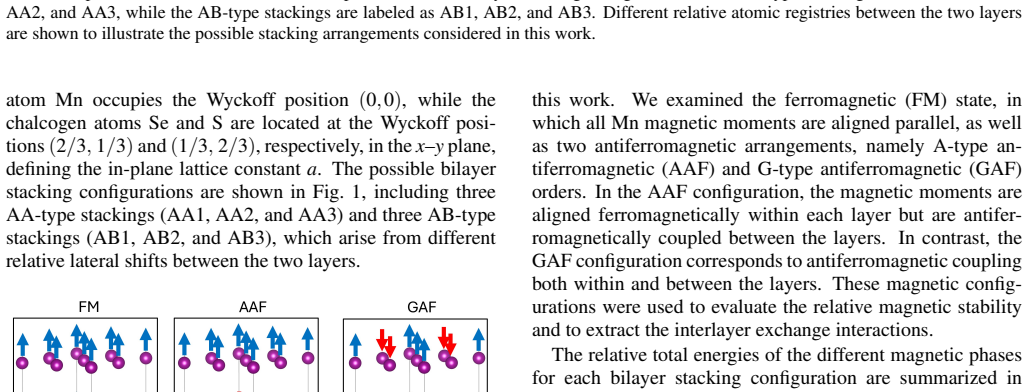
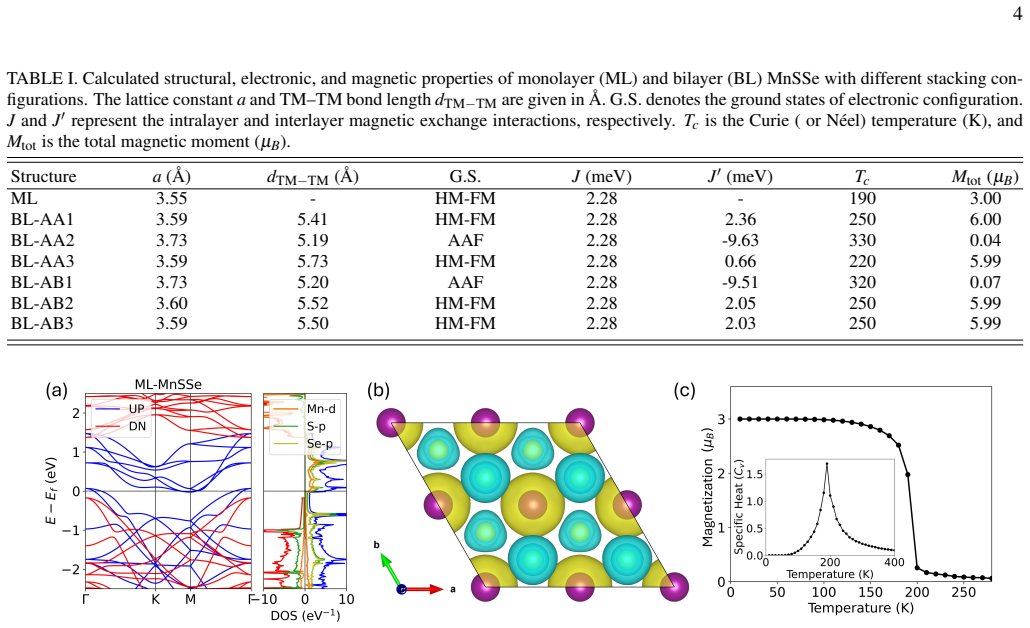
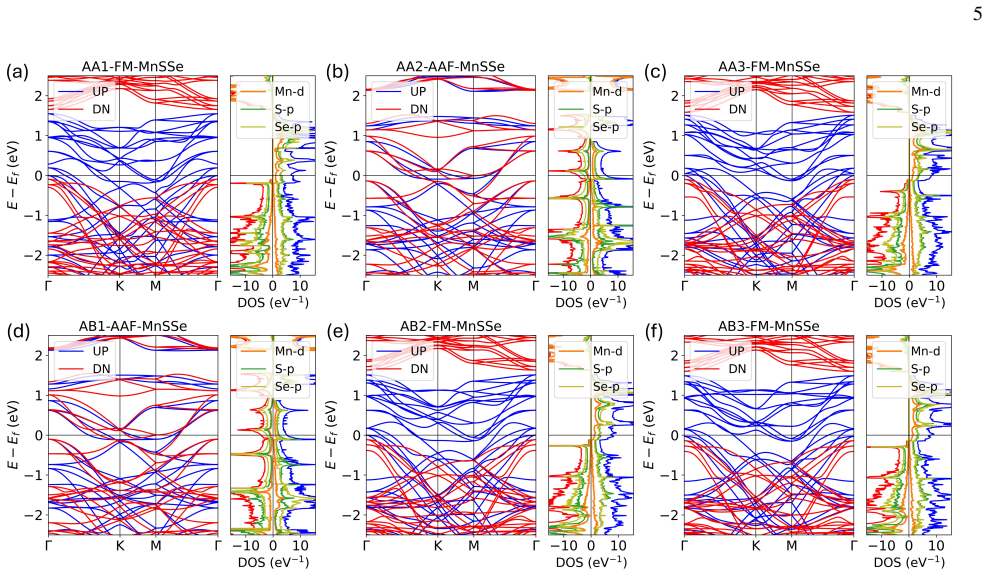
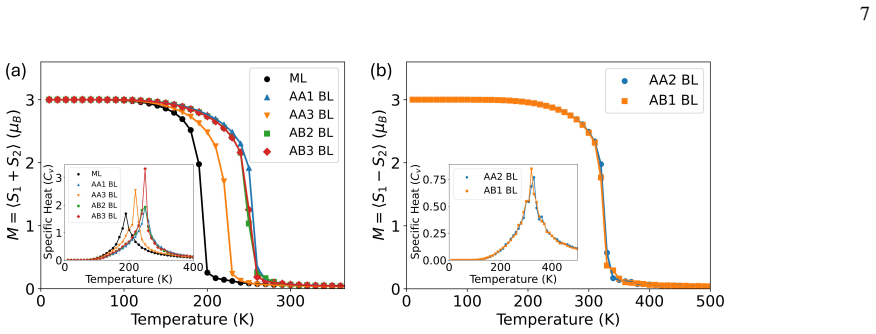
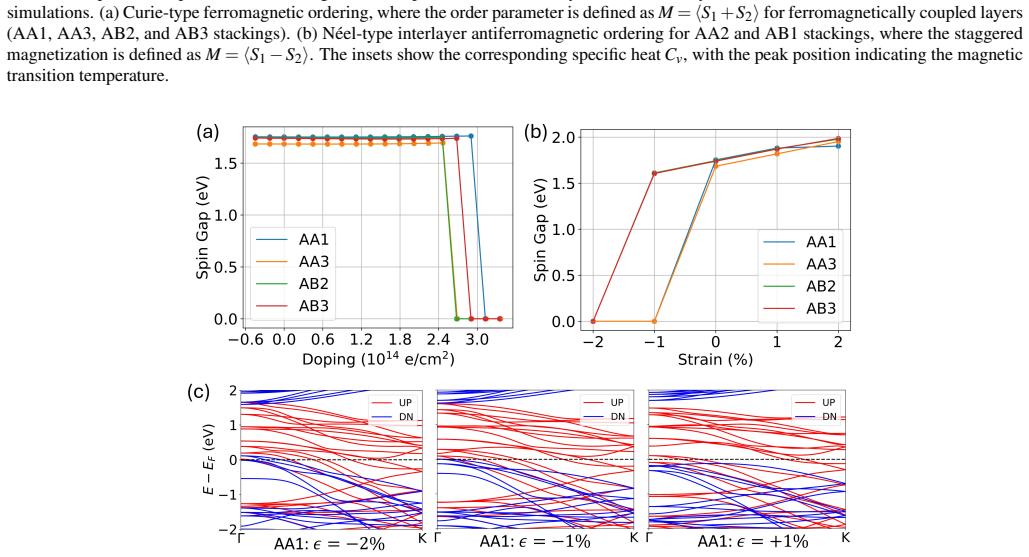
The AA2 stacking is the ground state and exhibits A-type antiferromagnetic ordering, indicating antiferromagnetic interlayer coupling. Monte Carlo simulations based on an effective Ising model reveal enhanced magnetic transition temperatures in the bilayer relative to the monolayer, with Néel temperatures above 300 K for antiferromagnetic stackings and Curie temperatures up to 250 K for ferromagnetic phases. Several stacking configurations exhibit robust half-metallic ferromagnetism with nearly 100% spin polarization at the Fermi level. The half-metallic state can be tuned and ultimately transformed into a metallic ferromagnetic phase through carrier doping and biaxial strain.
What carries the argument
The AA- and AB-type stacking configurations of the bilayer, which fix the relative positions of the S and Se atoms across the van der Waals gap and thereby set the sign and strength of the interlayer exchange and the spin-polarized band structure.
If this is right
- Antiferromagnetic stackings remain ordered well above room temperature while ferromagnetic ones order below it.
- Multiple stackings produce half-metallic ferromagnetism with essentially complete spin polarization at the Fermi level.
- The half-metallic gap can be closed and the system driven into a conventional metallic ferromagnet by either electron or hole doping or by biaxial strain.
- The nonmagnetic state is unstable for every stacking examined, so magnetism is intrinsic rather than induced.
Where Pith is reading between the lines
- If specific stackings can be selected during growth or by twisting, the same material could serve as either an antiferromagnetic insulator or a half-metallic conductor without external magnetic fields.
- The same stacking-to-property mapping may appear in other Janus transition-metal dichalcogenides that combine similar magnetic ions with different chalcogens.
- Carrier doping and strain act as orthogonal knobs that could allow gate-tunable switching between fully polarized and unpolarized transport in a single device geometry.
Load-bearing premise
The total energies obtained from first-principles calculations can be faithfully represented by a simple Ising model whose parameters, once extracted, allow Monte Carlo sampling to give accurate ordering temperatures without missing longer-range or anisotropic interactions.
What would settle it
Direct measurement of a Néel temperature above 300 K or a Curie temperature near 250 K in an AA2-stacked sample, or spectroscopic confirmation of 100 percent spin polarization at the Fermi level in a ferromagnetic stacking that disappears under moderate doping or strain.
Figures
read the original abstract
We investigate the structural, electronic, and magnetic properties of bilayer Janus 1T-MnSSe using first-principles calculations. Various AA- and AB-type stacking configurations are considered to examine the influence of interlayer registry on magnetic ordering and exchange interactions. The nonmagnetic state is unstable for all stackings, confirming intrinsic magnetism. The AA2 stacking is identified as the ground state and exhibits A-type antiferromagnetic ordering, indicating antiferromagnetic interlayer coupling. Monte Carlo simulations based on an effective Ising model reveal enhanced magnetic transition temperatures in the bilayer relative to the monolayer, with N\'eel temperatures above 300~K for antiferromagnetic stackings and Curie temperatures up to 250~K for ferromagnetic phases. Several stacking configurations exhibit robust half-metallic ferromagnetism with nearly 100\% spin polarization at the Fermi level. Moreover, the half-metallic state can be tuned and ultimately transformed into a metallic ferromagnetic phase through carrier doping and biaxial strain. These findings establish bilayer MnSSe as a promising platform for controllable interlayer magnetism and spintronic applications in two-dimensional materials.
Editorial analysis
A structured set of objections, weighed in public.
Referee Report
Summary. The manuscript reports first-principles DFT calculations on bilayer Janus 1T-MnSSe for multiple AA- and AB-type stackings. It identifies the AA2 configuration as the energetic ground state exhibiting A-type antiferromagnetic order, extracts effective Ising exchange parameters from total-energy differences among collinear spin states, performs Monte Carlo sampling to obtain Néel temperatures above 300 K for antiferromagnetic stackings and Curie temperatures up to 250 K for ferromagnetic phases, and identifies several half-metallic ferromagnetic configurations whose spin polarization can be tuned to metallic by carrier doping or biaxial strain.
Significance. If the mapping from DFT energies to the Ising model and the resulting transition temperatures prove robust, the work would demonstrate stacking-tunable interlayer magnetism and room-temperature ordering in a 2D Janus bilayer, offering a concrete platform for spintronic devices that combine half-metallicity with external control via doping and strain.
major comments (3)
- [Methods and §3] Methods and §3 (Magnetic Configurations): The Ising parameters are obtained from total-energy differences among a small number of collinear configurations; no additional magnetic configurations, explicit next-nearest-neighbor terms, or biquadratic exchange are reported, leaving open whether longer-range or anisotropic interactions (potentially comparable in magnitude to the fitted J) alter the Monte Carlo transition temperatures by tens of percent.
- [§4] §4 (Monte Carlo Simulations): The reported Néel (>300 K) and Curie (up to 250 K) temperatures rest on the effective Ising Hamiltonian; without finite-size scaling, explicit inclusion of single-ion anisotropy from SOC, or direct comparison of DFT energy differences to the Ising predictions for an independent set of spin arrangements, the quantitative reliability of these temperatures cannot be assessed.
- [Computational Details] Computational Details: No convergence tests with respect to k-point sampling, plane-wave cutoff, or Hubbard U value are provided, nor is the sensitivity of the extracted exchange parameters to these choices quantified; this directly affects the load-bearing claim that bilayer ordering temperatures exceed those of the monolayer.
minor comments (2)
- Figure captions and text should explicitly state the supercell size and number of magnetic configurations used to fit the Ising model.
- The abstract states 'nearly 100% spin polarization' while the main text should quantify the actual polarization value at the Fermi level for each half-metallic stacking.
Simulated Author's Rebuttal
We thank the referee for the careful reading and constructive comments on our manuscript. We address each major comment point by point below.
read point-by-point responses
-
Referee: [Methods and §3] Methods and §3 (Magnetic Configurations): The Ising parameters are obtained from total-energy differences among a small number of collinear configurations; no additional magnetic configurations, explicit next-nearest-neighbor terms, or biquadratic exchange are reported, leaving open whether longer-range or anisotropic interactions (potentially comparable in magnitude to the fitted J) alter the Monte Carlo transition temperatures by tens of percent.
Authors: We acknowledge that the effective Ising model is constructed from a limited set of collinear configurations, which is a standard mapping in the 2D-magnet literature. To address the concern, the revised manuscript will include additional spin configurations and a brief discussion of possible next-nearest-neighbor contributions. The dominant nearest-neighbor terms already reproduce the DFT ground-state ordering, supporting the robustness of the main conclusions. revision: partial
-
Referee: [§4] §4 (Monte Carlo Simulations): The reported Néel (>300 K) and Curie (up to 250 K) temperatures rest on the effective Ising Hamiltonian; without finite-size scaling, explicit inclusion of single-ion anisotropy from SOC, or direct comparison of DFT energy differences to the Ising predictions for an independent set of spin arrangements, the quantitative reliability of these temperatures cannot be assessed.
Authors: The Ising Hamiltonian reproduces the DFT energies of the fitted configurations by construction. We will add Monte Carlo results for larger lattices to illustrate finite-size behavior and include a short discussion of the expected small SOC anisotropy for Mn 3d systems. A direct validation against an independent set of DFT configurations will also be provided in the revision. revision: partial
-
Referee: [Computational Details] Computational Details: No convergence tests with respect to k-point sampling, plane-wave cutoff, or Hubbard U value are provided, nor is the sensitivity of the extracted exchange parameters to these choices quantified; this directly affects the load-bearing claim that bilayer ordering temperatures exceed those of the monolayer.
Authors: We agree that explicit convergence data strengthen the quantitative claims. The revised supplementary material will include tests for k-point density, plane-wave cutoff, and Hubbard U, together with the resulting variation in the extracted J values. These tests confirm that the bilayer-versus-monolayer ordering-temperature trend remains unchanged within the converged parameter range. revision: yes
Circularity Check
Néel/Curie temperatures obtained by Monte Carlo on Ising model whose J parameters are fitted directly to the DFT total energies being 'predicted'
specific steps
-
fitted input called prediction
[Abstract (and implied Results/Monte Carlo section)]
"Monte Carlo simulations based on an effective Ising model reveal enhanced magnetic transition temperatures in the bilayer relative to the monolayer, with Néel temperatures above 300 K for antiferromagnetic stackings and Curie temperatures up to 250 K for ferromagnetic phases."
The Ising J values are obtained by mapping DFT total energies of selected spin configurations onto the model; the subsequent MC sampling then yields Tc values that are mathematically determined by those fitted J's. The reported transition temperatures therefore reduce to a re-expression of the input DFT energy differences rather than an independent prediction.
full rationale
The paper's headline magnetic transition temperatures are not independent results; they are computed from an effective Ising Hamiltonian whose exchange parameters are extracted from the same first-principles total-energy differences that define the magnetic ground states. This matches the 'fitted input called prediction' pattern. The electronic and stacking claims remain independent of this step, so the circularity is partial rather than total. No self-citation load-bearing or self-definitional steps are evident from the supplied text.
Axiom & Free-Parameter Ledger
free parameters (1)
- Ising exchange parameters
axioms (2)
- domain assumption Density-functional theory with chosen functional and Hubbard correction accurately ranks magnetic states and interlayer energies in MnSSe.
- domain assumption The effective Ising model captures the dominant energetics for finite-temperature magnetism.
Reference graph
Works this paper leans on
-
[1]
Fert, Nobel lecture: Origin, development, and future of spin- tronics, Reviews of modern physics80, 1517 (2008)
A. Fert, Nobel lecture: Origin, development, and future of spin- tronics, Reviews of modern physics80, 1517 (2008)
2008
-
[2]
S. A. Wolf, D. D. Awschalom, R. A. Buhrman, J. Daughton, v. S. von Moln ´ar, M. L. Roukes, A. Y . Chtchelkanova, and D. M. Treger, Spintronics: a spin-based electronics vision for the future, science294, 1488 (2001)
2001
-
[3]
G. R. Bhimanapati, Z. Lin, V . Meunier, Y . Jung, J. Cha, S. Das, D. Xiao, Y . Son, M. S. Strano, V . R. Cooper,et al., Recent advances in two-dimensional materials beyond graphene, ACS nano9, 11509 (2015)
2015
-
[4]
K. S. Novoselov, A. Mishchenko, A. Carvalho, and A. Cas- tro Neto, 2d materials and van der waals heterostructures, Sci- ence353, aac9439 (2016)
2016
-
[5]
Mas-Balleste, C
R. Mas-Balleste, C. Gomez-Navarro, J. Gomez-Herrero, and F. Zamora, 2d materials: to graphene and beyond, Nanoscale 3, 20 (2011)
2011
-
[6]
J. R. Schaibley, H. Yu, G. Clark, P. Rivera, J. S. Ross, K. L. Seyler, W. Yao, and X. Xu, Valleytronics in 2d materials, Nature Reviews Materials1, 16055 (2016)
2016
-
[7]
H. Dery, P. Dalal, Ł. Cywi ´nski, and L. J. Sham, Spin-based logic in semiconductors for reconfigurable large-scale circuits, Nature447, 573 (2007)
2007
-
[8]
Li and J
X. Li and J. Yang, First-principles design of spintronics materi- als, National Science Review3, 365 (2016)
2016
-
[9]
Huang, G
B. Huang, G. Clark, E. Navarro-Moratalla, D. R. Klein, R. Cheng, K. L. Seyler, D. Zhong, E. Schmidgall, M. A. McGuire, D. H. Cobden,et al., Layer-dependent ferromag- netism in a van der waals crystal down to the monolayer limit, Nature546, 270 (2017)
2017
-
[10]
C. Gong, L. Li, Z. Li, H. Ji, A. Stern, Y . Xia, T. Cao, W. Bao, C. Wang, Y . Wang,et al., Discovery of intrinsic ferromagnetism in two-dimensional van der waals crystals, Nature546, 265 (2017)
2017
-
[11]
Qiao, X.-C
L.-Y . Qiao, X.-C. Jiang, Z. Ruan, and Y .-Z. Zhang, Tunable magnetism in bilayer transition metal dichalcogenides, Physical Review Materials8, 034003 (2024)
2024
-
[12]
K. S. Burch, D. Mandrus, and J.-G. Park, Magnetism in two- dimensional van der waals materials, Nature563, 47 (2018)
2018
-
[13]
Sivadas, S
N. Sivadas, S. Okamoto, X. Xu, C. J. Fennie, and D. Xiao, Stacking-dependent magnetism in bilayer cri3, Nano letters18, 7658 (2018)
2018
-
[14]
X. Zhu, J. Guo, J. Zhang, and E. Plummer, Misconceptions as- sociated with the origin of charge density waves, Advances in Physics: X2, 622 (2017)
2017
-
[15]
Johannes and I
M. Johannes and I. Mazin, Fermi surface nesting and the origin of charge density waves in metals, Physical Review B—Condensed Matter and Materials Physics77, 165135 (2008)
2008
-
[16]
J. ´A. Silva-Guill ´en, P. Ordej ´on, F. Guinea, and E. Canadell, Electronic structure of 2h-nbse2 single-layers in the cdw state, 2D Materials3, 035028 (2016)
2016
-
[17]
Dalal, J
A. Dalal, J. Ruhman, and J. W. Venderbos, Flat band physics in the charge-density wave state of 1 t-tas2 and 1 t-tase2, npj Quantum Materials10, 31 (2025)
2025
-
[18]
Bonilla, S
M. Bonilla, S. Kolekar, Y . Ma, H. C. Diaz, V . Kalappattil, R. Das, T. Eggers, H. R. Gutierrez, M.-H. Phan, and M. Batzill, Strong room-temperature ferromagnetism in vse2 monolayers on van der waals substrates, Nature nanotechnology13, 289 (2018)
2018
-
[19]
C. Wang, X. Zhou, L. Zhou, Y . Pan, Z.-Y . Lu, X. Wan, X. Wang, and W. Ji, Bethe-slater-curve-like behavior and interlayer spin- exchange coupling mechanisms in two-dimensional magnetic bilayers, Physical Review B102, 020402 (2020)
2020
-
[20]
A. Li, W. Zhou, J. Pan, Q. Xia, M. Long, and F. Ouyang, Cou- pling stacking orders with interlayer magnetism in bilayer h- vse2, Chinese Physics Letters37, 107101 (2020)
2020
-
[21]
Seeyangnok, U
J. Seeyangnok, U. Pinsook, and G. J. Ackland, Tunable super- conductivity in functionalized janus mosea (a= h, li) monolay- ers: Competition between lattice instability and electron pair- ing, ACS Applied Energy Materials (2026)
2026
-
[22]
Seeyangnok and U
J. Seeyangnok and U. Pinsook, Theoretical prediction of struc- tural stability and superconductivity in janus ti 2 csh mxene, Physical Review B113, 054510 (2026)
2026
-
[23]
Seeyangnok, M
J. Seeyangnok, M. Ul Hassan, U. Pinsook, and G. Ackland, Superconductivity and electron self-energy in tungsten-sulfur- hydride monolayer, 2D Materials11, 025020 (2024)
2024
-
[24]
Seeyangnok, U
J. Seeyangnok, U. Pinsook, and G. J. Ackland, Superconductiv- ity and strain-enhanced phase stability of janus tungsten chalco- genide hydride monolayers, Physical Review B110, 195408 (2024)
2024
-
[25]
He and S
J. He and S. Li, Two-dimensional janus transition-metal dichalcogenides with intrinsic ferromagnetism and half- metallicity, Computational Materials Science152, 151 (2018)
2018
-
[26]
Y . Chen, Q. Fan, Y . Liu, and G. Yao, Electrically tunable mag- netism and unique intralayer charge transfer in janus mono- layer mnsse for spintronics applications, Physical Review B 105, 195410 (2022)
2022
-
[27]
V . V . Kulish and W. Huang, Single-layer metal halides mx 2 (x= cl, br, i): stability and tunable magnetism from first principles 9 and monte carlo simulations, Journal of Materials Chemistry C 5, 8734 (2017)
2017
-
[28]
J. Seeyangnok, U. Pinsook, and G. J. Ackland, Competition between charge density wave and superconductivity in a janus mxene mo2nf2, arXiv preprint arXiv:2603.06284 (2026)
arXiv 2026
-
[29]
J. Seeyangnok, U. Pinsook, and G. J. Ackland, Charge density wave order and superconductivity in janus moxh monolayers, arXiv preprint arXiv:2601.02959 (2026)
arXiv 2026
-
[30]
Seeyangnok, U
J. Seeyangnok, U. Pinsook, and G. J. Ackland, Competition be- tween superconductivity and ferromagnetism in 2d janus mxh (m= ti, zr, hf, x= s, se, te) monolayer, Journal of Alloys and Compounds1033, 180900 (2025)
2025
-
[31]
Sukserm, J
A. Sukserm, J. Seeyangnok, and U. Pinsook, Half-metallic and ferromagnetic phases in crsh monolayers using dft+ u and bo-md calculations, Physical Chemistry Chemical Physics27, 3950 (2025)
2025
-
[32]
X. Qiu, B. Liu, L. Ge, L. Cao, K. Han, and H. Yang, High curie temperature ferromagnetic monolayer t-crsh and valley physics of t-crsh/ws 2 heterostructure, Physical Chemistry Chemical Physics26, 5589 (2024)
2024
-
[33]
Gibertini, M
M. Gibertini, M. Koperski, A. F. Morpurgo, and K. S. Novoselov, Magnetic 2d materials and heterostructures, Nature nanotechnology14, 408 (2019)
2019
-
[34]
Gong and X
C. Gong and X. Zhang, Two-dimensional magnetic crystals and emergent heterostructure devices, Science363, eaav4450 (2019)
2019
-
[35]
P. W. Anderson, Antiferromagnetism. theory of superexchange interaction, Physical Review79, 350 (1950)
1950
-
[36]
J. B. Goodenough, Theory of the role of covalence in the perovskite-type manganites [la, m (ii)] mn o 3, Physical Review 100, 564 (1955)
1955
-
[37]
Giannozzi, S
P. Giannozzi, S. Baroni, N. Bonini, M. Calandra, R. Car, C. Cavazzoni, D. Ceresoli, G. L. Chiarotti, M. Cococcioni, I. Dabo,et al., Quantum espresso: a modular and open-source software project for quantum simulations of materials, Journal of physics: Condensed matter21, 395502 (2009)
2009
-
[38]
J. P. Perdew, K. Burke, and M. Ernzerhof, Generalized gradient approximation made simple, Physical review letters77, 3865 (1996)
1996
-
[39]
H. J. Monkhorst and J. D. Pack, Special points for brillouin- zone integrations, Physical review B13, 5188 (1976)
1976
-
[40]
Methfessel and A
M. Methfessel and A. Paxton, High-precision sampling for brillouin-zone integration in metals, physical review B40, 3616 (1989)
1989
-
[41]
Grimme, J
S. Grimme, J. Antony, S. Ehrlich, and H. Krieg, A consistent and accurate ab initio parametrization of density functional dis- persion correction (dft-d) for the 94 elements h-pu, The Journal of chemical physics132(2010)
2010
discussion (0)
Sign in with ORCID, Apple, or X to comment. Anyone can read and Pith papers without signing in.