A New Member of the Fast and Furious Family: A Relativistic and Time-Variable UV Outflow in a Luminous Quasar
Pith reviewed 2026-06-28 00:37 UTC · model grok-4.3
The pith
A radio-quiet quasar at z=2.68 shows variable C IV and Si IV absorption from gas moving outward at up to 90,000 km/s.
A machine-rendered reading of the paper's core claim, the machinery that carries it, and where it could break.
Core claim
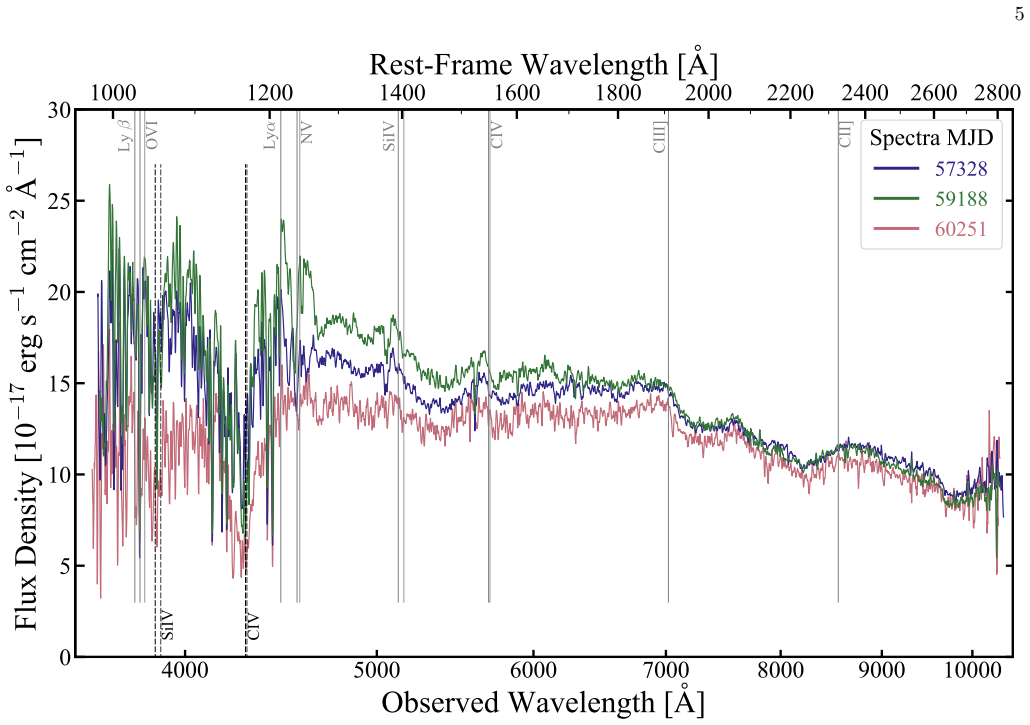
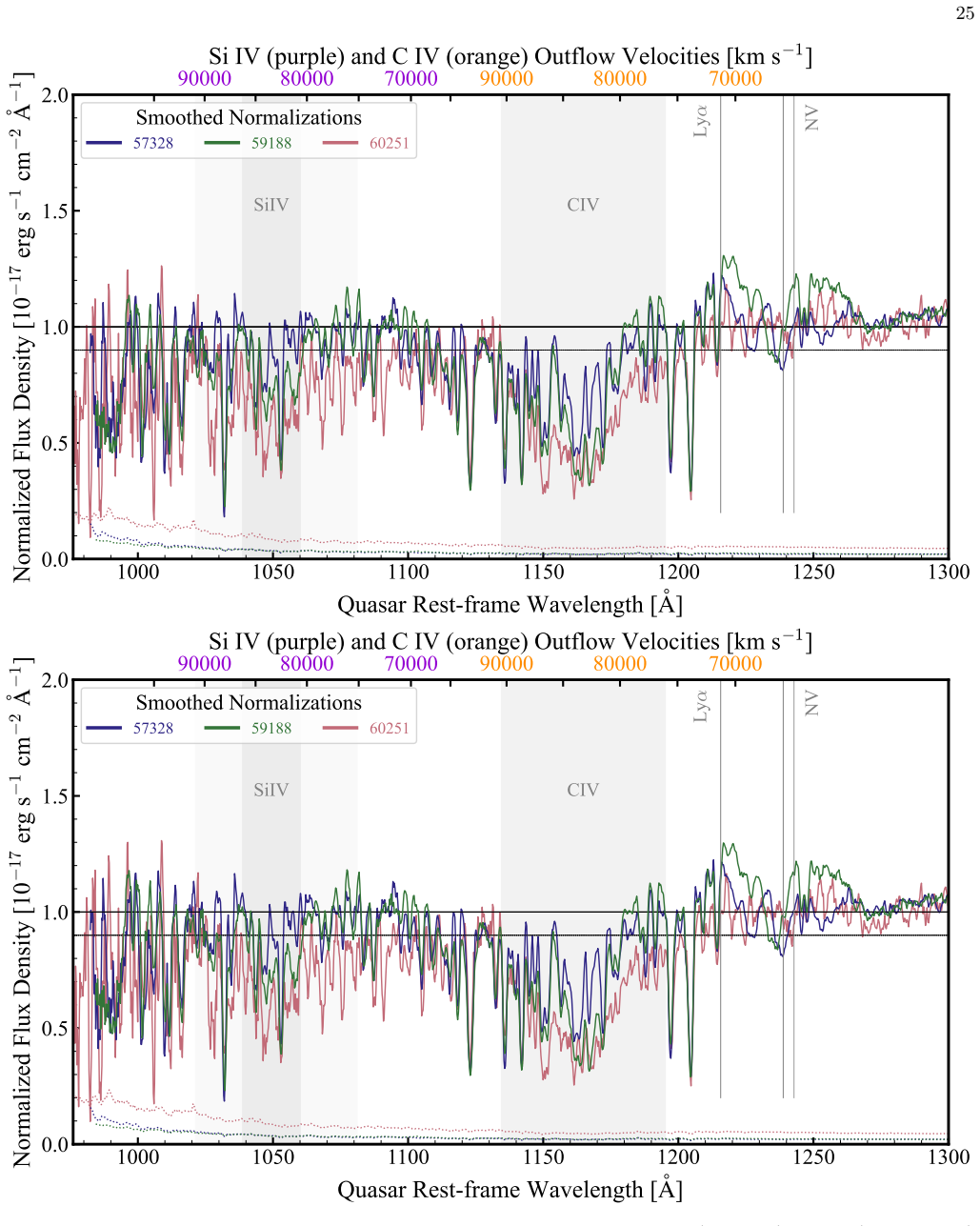
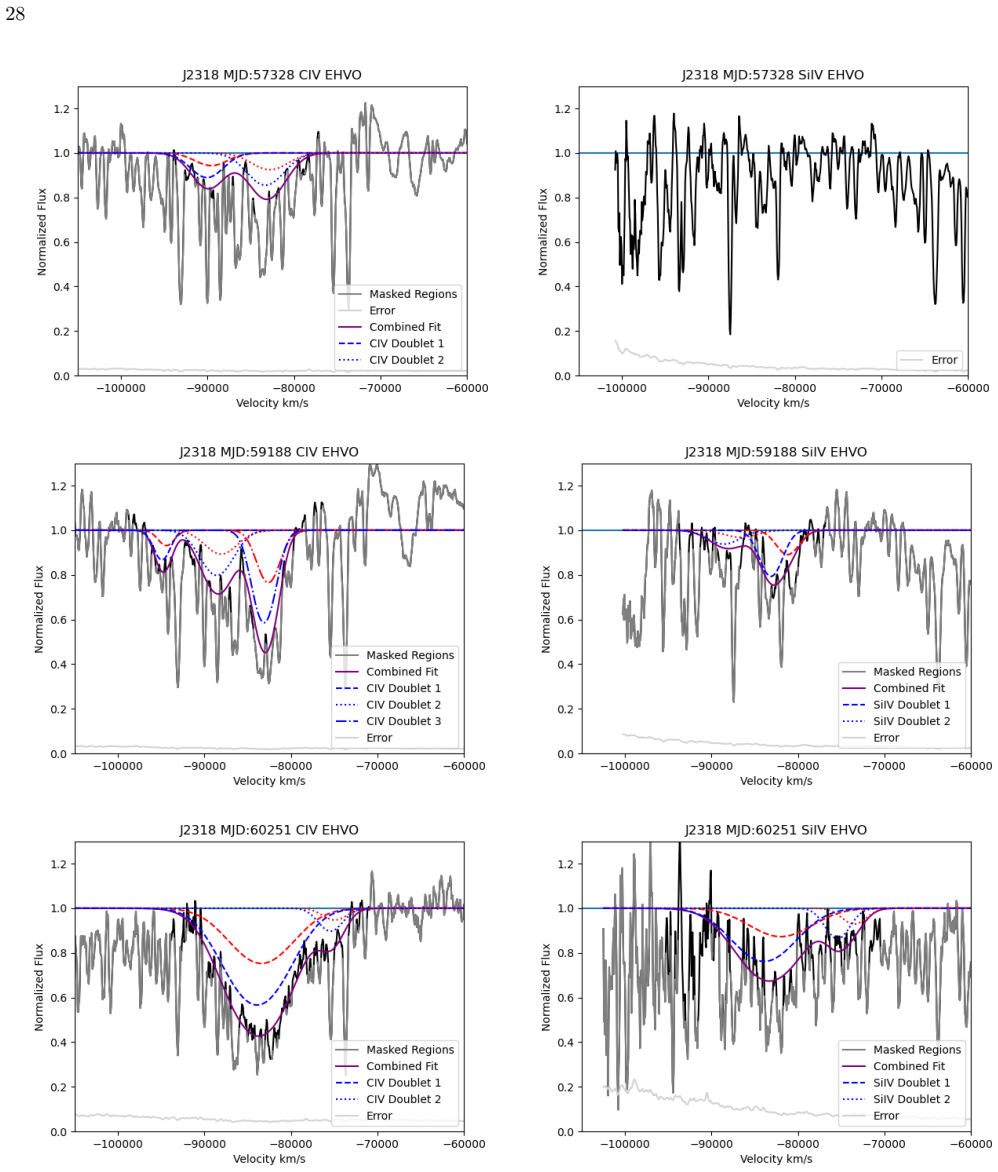
The central discovery is the first ultraviolet detection of a quasar outflow at velocities from -77,000 km s^{-1} to at least -90,000 km s^{-1}, traced by variable C IV and Si IV absorption that strengthens monotonically over ~2.2 rest-frame years in the radio-quiet quasar J2318. The quasar is weak-lined in the UV but has a measured H-alpha redshift of 2.6781 and an estimated black-hole mass of 1.65 times 10^9 solar masses. Using very conservative assumptions about radial distance, covering fraction, and ionization, the UV-absorbing outflow alone yields a mass-loss rate greater than 0.82 solar masses per year and a kinetic-to-bolometric luminosity ratio of at least 0.75 percent, just above t
What carries the argument
Variable C IV and Si IV ultraviolet absorption lines at extreme blueshifts that directly trace the high-velocity outflow and its time evolution.
If this is right
- Outflow models must accelerate gas to 0.3c while preserving C IV and Si IV ions or form those ions in already-accelerated gas.
- The UV-absorbing component alone supplies a mass-loss rate exceeding 0.82 solar masses per year.
- The kinetic luminosity ratio is at least 0.75 percent of bolometric luminosity, above the threshold usually required for significant feedback.
- The true mass-loss rate and kinetic luminosity could be up to two orders of magnitude higher, as suggested by comparison to PDS 456.
Where Pith is reading between the lines
- Multi-epoch UV spectroscopy of other weak-lined quasars could reveal whether such extreme outflows are common or rare.
- The required acceleration mechanism must operate efficiently enough that similar flows appear in radio-quiet systems as well as radio-loud ones.
- If the covering fraction or radial distance assumptions are revised upward, the feedback significance would fall below the cited threshold, making direct distance measurements via reverberation or other methods a key next step.
Load-bearing premise
The mass-loss rate and kinetic luminosity are calculated from the observed absorption assuming the gas lies at a radial distance and has a covering fraction and ionization state that produce the quoted lower limits.
What would settle it
A new spectrum of J2318 taken in a different epoch that shows the C IV and Si IV absorption features either absent, at velocities below 77,000 km/s, or unchanging over time would falsify the claimed outflow speed and variability.
Figures
read the original abstract
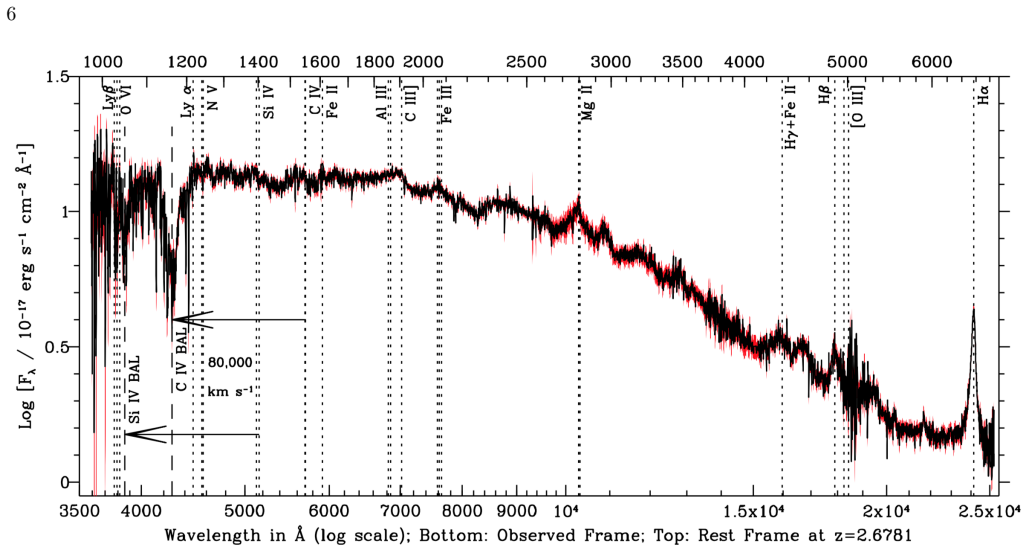
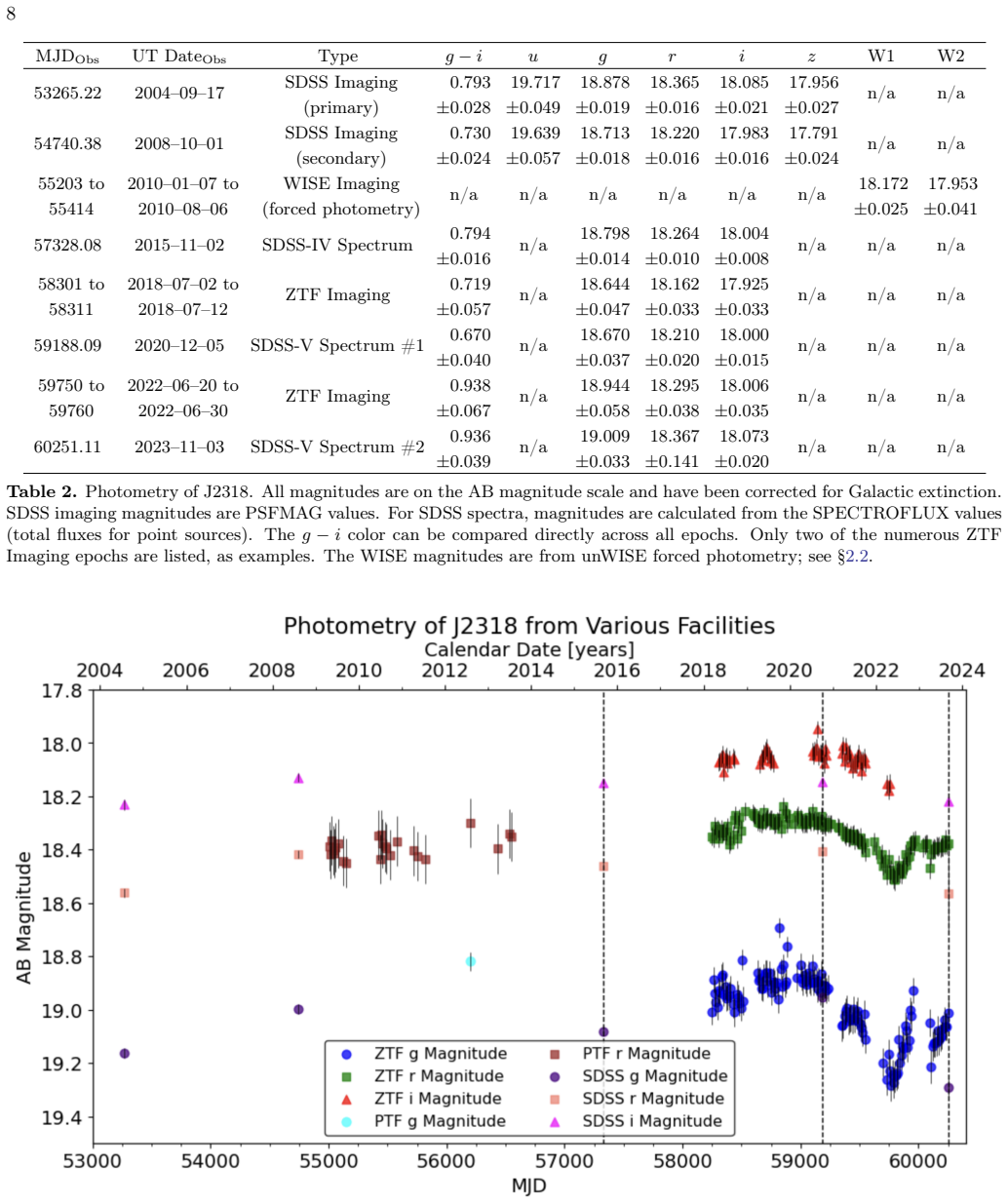
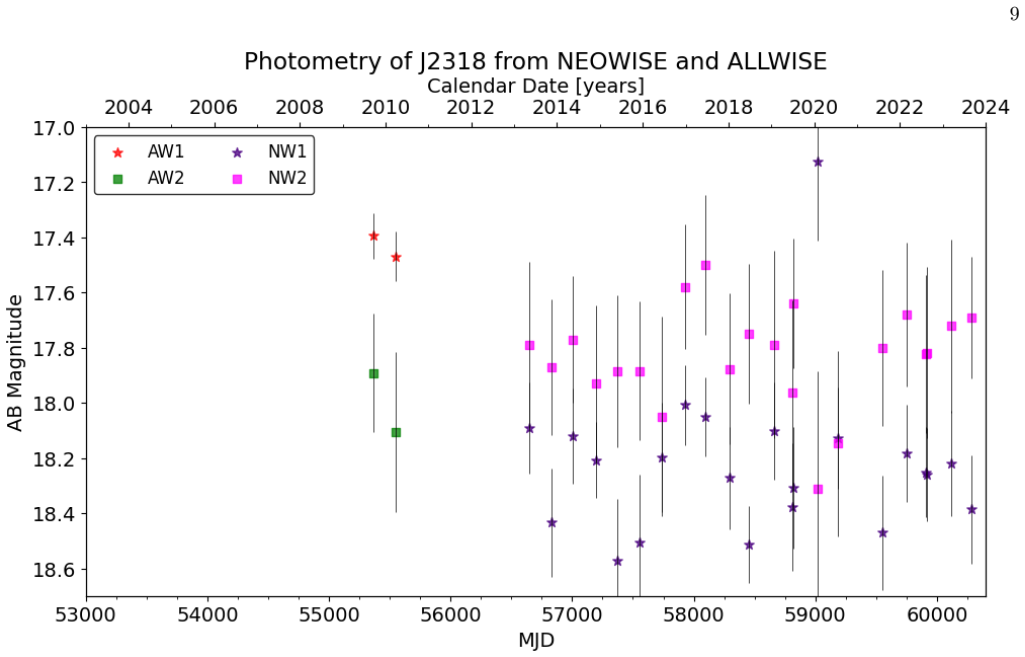
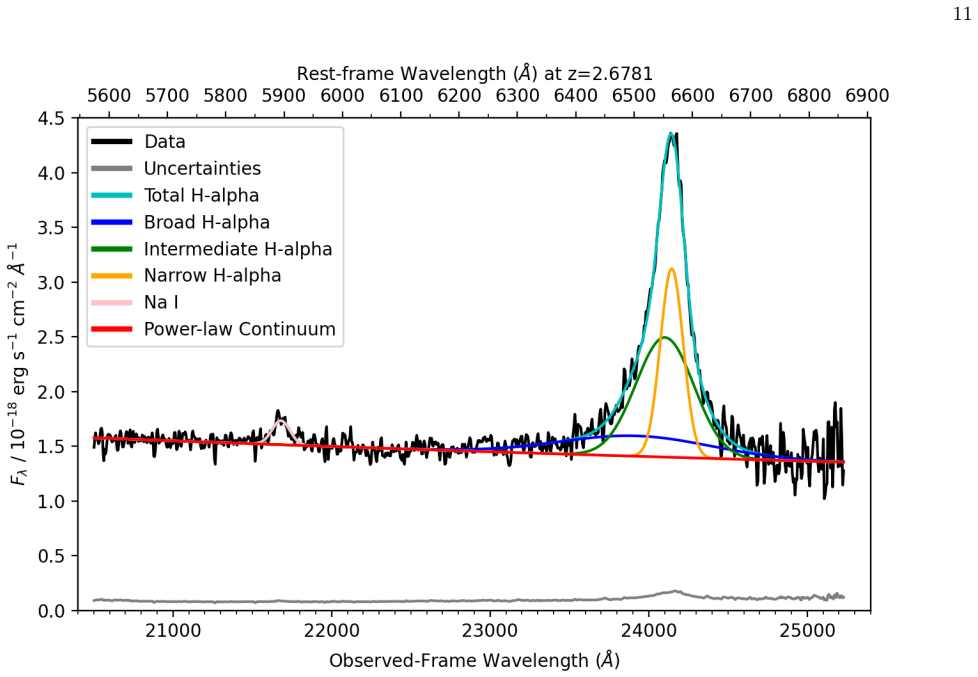
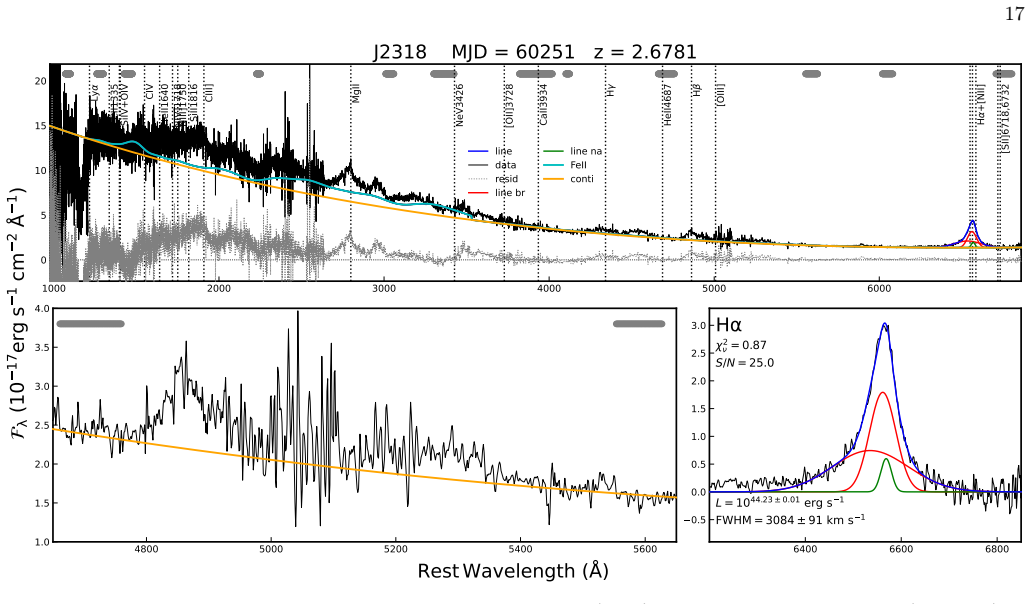
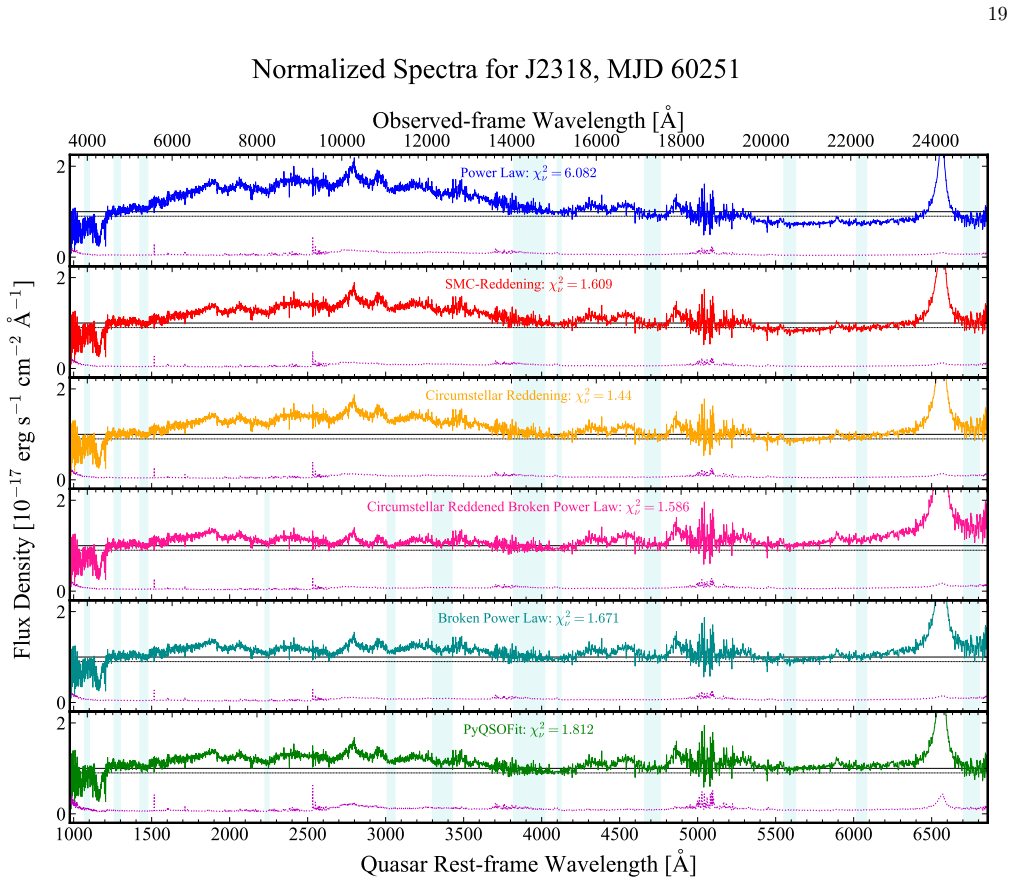
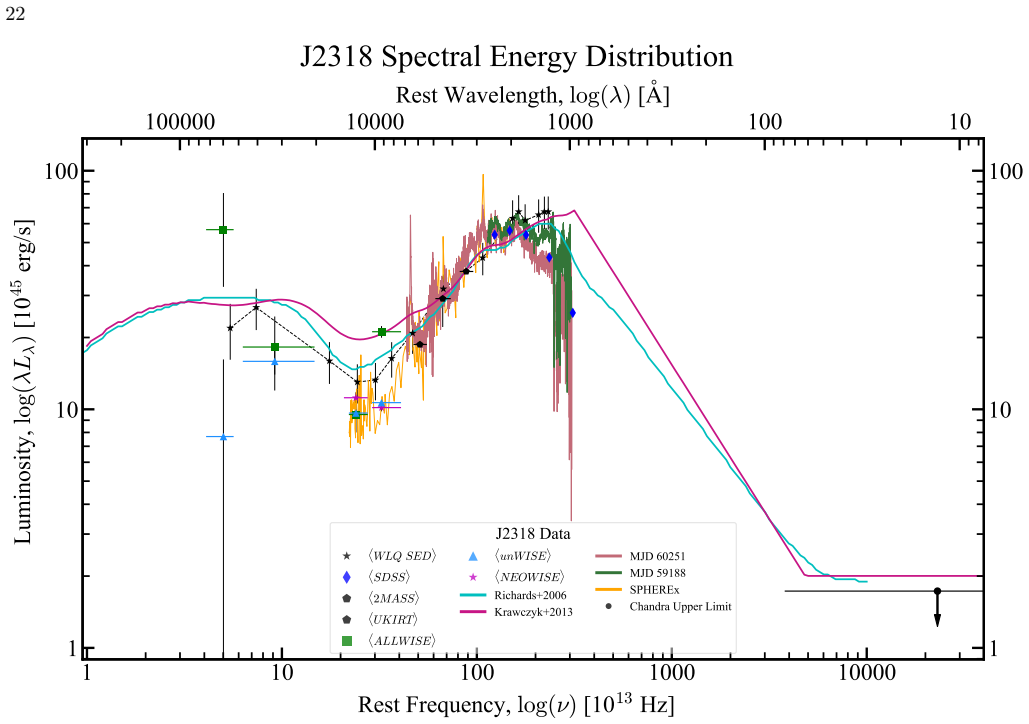
We report the fastest quasar outflow first detected in the ultraviolet, via variable C IV and Si IV absorption at outflow velocities $-77,000$ km s$^{-1}$ to at least $-90,000$ km s$^{-1}$, in the radio-quiet quasar SDSS J231854.31+243954.2 (J2318). J2318 is a weak-lined quasar in the rest-frame ultraviolet, but Gemini GNIRS spectroscopy reveals an H$\alpha$ redshift of $z=2.6781\pm0.0004$. A twenty-year photometric time series shows peak-to-peak variability of 0.5 mag in the $g$ band. The C IV outflow strengthened monotonically over three epochs spanning $\sim$2.2 rest-frame years. The existence of such a high-velocity outflow implies that models of quasar outflows must be able to either accelerate gas to $0.3c$ while still preserving C IV and Si IV ions, or enable the formation of C IV and Si IV ions in gas which has been accelerated to $0.3c$. Virial estimates reveal a black-hole mass of $1.65\times10^9~M_\odot$, which leads to an Eddington luminosity and Eddington ratio of $2.4\times10^{47}$ erg s$^{-1}$ and $0.45$, respectively. Using very conservative assumptions, the UV-absorbing outflow alone has an estimated mass loss of $>0.82~M_\odot~{\rm yr}^{-1}$ and a kinetic luminosity ratio $L_{kin}/L_{bol}\geq0.75$%. The lower limit is just above the threshold usually cited for significant feedback on the host galaxy. Comparison to PDS 456, the only other known quasar with a UV-absorbing outflow at $0.3c$, suggests that the true $\dot{M}$ and $L_{kin}/L_{bol}$ could be up to two orders of magnitude larger.
Editorial analysis
A structured set of objections, weighed in public.
Referee Report
Summary. The manuscript reports the discovery of a relativistic UV outflow in the radio-quiet quasar SDSS J231854.31+243954.2 (J2318) at z=2.6781, detected via variable C IV and Si IV absorption at velocities from −77,000 km s−1 to at least −90,000 km s−1. The outflow strengthens monotonically over three epochs spanning ~2.2 rest-frame years. A virial black-hole mass of 1.65×10^9 M_⊙ yields an Eddington ratio of 0.45. Using very conservative assumptions on radial distance, volume filling factor, ionization parameter and covering fraction, the authors derive a lower limit on the mass-loss rate of >0.82 M_⊙ yr−1 and L_kin/L_bol ≥0.75% for the UV-absorbing component alone, just above the canonical 0.5% feedback threshold; comparison to PDS 456 suggests the true values could be substantially higher. The work also notes implications for outflow acceleration models that must either preserve or form C IV/Si IV ions at 0.3c.
Significance. If the reported lower limit on L_kin/L_bol is robust, the result would be significant as only the second known quasar with a UV-absorbing outflow at ~0.3c and would directly address whether such outflows can supply energetically important feedback. The multi-epoch monotonic variability provides independent support for the reality of the absorption features. The paper correctly highlights the tension with existing acceleration and ionization models.
major comments (2)
- [Abstract] Abstract: The central claim that the UV-absorbing outflow supplies L_kin/L_bol ≥0.75% (just above the feedback threshold) rests on 'very conservative assumptions' for radial distance r, volume filling factor, ionization state and covering fraction, yet no numerical values, ranges or justification for these choices are supplied. Because Ṁ_out ∝ 1/r and scales linearly with covering fraction, even modest increases in r or decreases in covering fraction (both standard in the literature) would drop the ratio below 0.5%; a sensitivity analysis or explicit parameter table is required to substantiate the lower limit.
- [Abstract] Abstract (energetics paragraph): The mass-loss rate lower limit (>0.82 M_⊙ yr−1) and the statement that the true Ṁ and L_kin/L_bol 'could be up to two orders of magnitude larger' are presented without the explicit formula, adopted r, or covering-fraction value used to obtain the quoted numbers. This prevents the reader from reproducing or testing the conservative bound that underpins the feedback conclusion.
minor comments (2)
- [Abstract] The abstract states a twenty-year photometric time series with 0.5 mag g-band variability but does not indicate the source of the photometry or whether the variability correlates with the absorption changes; this context would strengthen the variability argument.
- [Abstract] The Hα redshift is given as z=2.6781±0.0004 from Gemini GNIRS, but the abstract provides no details on the spectral resolution, line-fitting method or uncertainty budget; these should appear in the methods section.
Simulated Author's Rebuttal
We thank the referee for the positive assessment of our work's significance and for the constructive comments on the abstract. We address each point below and will revise the manuscript to improve the clarity and reproducibility of the energetics discussion.
read point-by-point responses
-
Referee: [Abstract] Abstract: The central claim that the UV-absorbing outflow supplies L_kin/L_bol ≥0.75% (just above the feedback threshold) rests on 'very conservative assumptions' for radial distance r, volume filling factor, ionization state and covering fraction, yet no numerical values, ranges or justification for these choices are supplied. Because Ṁ_out ∝ 1/r and scales linearly with covering fraction, even modest increases in r or decreases in covering fraction (both standard in the literature) would drop the ratio below 0.5%; a sensitivity analysis or explicit parameter table is required to substantiate the lower limit.
Authors: We agree that the abstract would benefit from greater explicitness on the conservative parameters to allow readers to assess the robustness of the lower limit. The full manuscript (Section 4) provides the adopted values and justifications: minimum r from the ~2.2 yr variability timescale (r > 1.4 pc), volume filling factor f=0.01, ionization parameter log U = -1.5, and covering fraction C_f=0.5, all chosen to minimize Ṁ_out and L_kin. A parameter table already exists in the main text. In revision we will add a concise summary of these values and a one-sentence sensitivity note to the abstract energetics paragraph, while retaining the reference to the detailed section. revision: yes
-
Referee: [Abstract] Abstract (energetics paragraph): The mass-loss rate lower limit (>0.82 M_⊙ yr−1) and the statement that the true Ṁ and L_kin/L_bol 'could be up to two orders of magnitude larger' are presented without the explicit formula, adopted r, or covering-fraction value used to obtain the quoted numbers. This prevents the reader from reproducing or testing the conservative bound that underpins the feedback conclusion.
Authors: The standard mass-loss formula Ṁ_out = 4π r N_H μ m_p v C_f / f (with N_H from the photoionization solution) is stated in Section 4, together with the conservative inputs that yield the quoted >0.82 M_⊙ yr−1 lower limit. The factor-of-~100 upward revision is motivated by the higher column and smaller r measured in PDS 456. We acknowledge the abstract is too terse for immediate reproduction. Revision will insert the formula and the key conservative r and C_f values directly into the abstract energetics sentence, with a pointer to the full derivation. revision: yes
Circularity Check
No circularity; observational measurements and standard external relations
full rationale
The paper reports direct spectroscopic measurements of absorption-line velocities and monotonic variability across epochs. Black-hole mass uses standard virial scaling relations external to the dataset. The mass-loss rate and L_kin/L_bol lower limits are obtained by applying the usual outflow formula under explicitly conservative (though unquantified) choices for r, C_f and ionization; these choices do not reduce to a fit performed on the same data, nor do any equations loop back to the reported velocities or luminosities by construction. No self-citation chains, uniqueness theorems or ansatzes imported from prior author work are invoked as load-bearing steps. The derivation chain is therefore self-contained against external benchmarks.
Axiom & Free-Parameter Ledger
free parameters (1)
- outflow radial distance and covering fraction
axioms (1)
- domain assumption Virial theorem and broad-line region scaling relations yield reliable black-hole mass
Reference graph
Works this paper leans on
-
[1]
arXiv , author =:2003.08688 , journal =
doi:10.3847/1538-4365/ab66af , eid =. arXiv , author =:2003.08688 , journal =
-
[2]
arXiv , author =:2003.08689 , journal =
doi:10.3847/1538-4365/ab596a , eid =. arXiv , author =:2003.08689 , journal =
-
[3]
arXiv , author =:2505.15923 , journal =
doi:10.1051/0004-6361/202554859 , eid =. arXiv , author =:2505.15923 , journal =
-
[4]
doi:10.3847/2041-8213/abd8c6 , eid =. arXiv , author =:2101.03179 , journal =
-
[5]
NEOWISE-R Single Exposure (L1b) Source Table , url =. 2020 , bdsk-url-1 =. doi:10.26131/IRSA144 , publisher =
-
[6]
unWISE Catalog , url =. 2021 , bdsk-url-1 =. doi:10.26131/IRSA525 , publisher =
-
[7]
unWISE Time-Domain Catalog , url =. 2024 , bdsk-url-1 =. doi:10.26131/IRSA580 , publisher =
-
[8]
AllWISE Multiepoch Photometry Table , url =. 2020 , bdsk-url-1 =. doi:10.26131/IRSA134 , publisher =
-
[9]
WISE All-Sky Source Catalog , url =. 2020 , bdsk-url-1 =. doi:10.26131/IRSA142 , publisher =
-
[10]
PTF Lightcurve Table , url =. 2025 , bdsk-url-1 =. doi:10.26131/IRSA647 , publisher =
-
[11]
ZTF Lightcurves , url =. 2025 , bdsk-url-1 =. doi:10.26131/IRSA598 , publisher =
-
[12]
2MASS All-Sky Point Source Catalog , url =. 2003 , bdsk-url-1 =. doi:10.26131/IRSA2 , publisher =
-
[13]
SPHEREx Quick Release Spectral Images - QR2 , url =. 2025 , bdsk-url-1 =. doi:10.26131/IRSA652 , publisher =
-
[14]
arXiv , author =:2511.02985 , journal =
doi:10.48550/arXiv.2511.02985 , eid =. arXiv , author =:2511.02985 , journal =
-
[15]
arXiv , author =:2404.12443 , journal =
doi:10.3847/1538-4357/ad4a77 , eid =. arXiv , author =:2404.12443 , journal =
-
[16]
AJ , month = may, pages =
Colors of 2625 Quasars at 0 < z < 5 Measured in the Sloan Digital Sky Survey Photometric System , url =. AJ , month = may, pages =
-
[17]
AJ , month = aug, pages =
Composite Quasar Spectra from the Sloan Digital Sky Survey , url =. AJ , month = aug, pages =
-
[18]
ApJ , pages = 645, title =
-
[19]
AJ , month = sep, pages =
-
[20]
AJ , month = oct, pages =
-
[21]
AJ , pages = 485, title =
-
[22]
AJ , month = apr, pages =
-
[23]
in Mass Outflow in Active Galactic Nuclei: New Perspectives, eds. D. M. Crenshaw, S. B. Kraemer, & I. M. George , page =
-
[24]
ApJS , pages =
Unusual Broad Absorption Line Quasars From The Sloan Digital Sky Survey , volume =. ApJS , pages =
-
[25]
AJ , month = mar, pages =
-
[26]
doi:10.1086/368244 , journal =
-
[27]
doi:10.1086/379293 , journal =
-
[28]
Active Galactic Nuclei: From Central Engine to Host Galaxy , editor =
-
[29]
AJ , month = jul, pages =
-
[30]
, keywords =. doi:10.1086/378165 , eprint =
-
[31]
Data Release 1 , volume =
The Sloan Digital Sky Survey Quasar Catalog II. Data Release 1 , volume =. AJ , pages =
-
[32]
doi:10.1086/421365 , journal =
-
[33]
, keywords =. doi:10.1086/427544 , eprint =
-
[34]
doi:10.1086/431156 , journal =
-
[35]
doi:10.1086/497917 , journal =
-
[36]
, keywords =. doi:10.1086/518864 , eprint =
-
[37]
, keywords =. doi:10.1086/524984 , eprint =
-
[38]
doi:10.1088/0067-0049/182/2/543 , journal =
work page internal anchor Pith review doi:10.1088/0067-0049/182/2/543
-
[39]
The Eighth Data Release of the Sloan Digital Sky Survey: First Data from SDSS-III
doi:10.1088/0067-0049/193/2/29 , eid =. arXiv , author =:1101.1559 , journal =
work page internal anchor Pith review Pith/arXiv arXiv doi:10.1088/0067-0049/193/2/29
-
[40]
doi:10.1088/0067-0049/195/2/26 , eid =
ApJS , month = aug, pages =. doi:10.1088/0067-0049/195/2/26 , eid =
-
[41]
doi:10.1088/0067-0049/203/2/21 , eid =. arXiv , author =:1207.7137 , journal =
work page internal anchor Pith review Pith/arXiv arXiv doi:10.1088/0067-0049/203/2/21
-
[42]
doi:10.1088/0067-0049/211/2/17 , eid =. arXiv , author =:1307.7735 , journal =
work page internal anchor Pith review Pith/arXiv arXiv doi:10.1088/0067-0049/211/2/17
-
[43]
The Eleventh and Twelfth Data Releases of the Sloan Digital Sky Survey: Final Data from SDSS-III
doi:10.1088/0067-0049/219/1/12 , eid =. arXiv , author =:1501.00963 , journal =
work page internal anchor Pith review Pith/arXiv arXiv doi:10.1088/0067-0049/219/1/12
-
[44]
doi:10.1002/asna.200610655 , journal =
-
[45]
doi:10.1088/0004-6256/139/4/1628 , eprint =
, keywords =. doi:10.1088/0004-6256/139/4/1628 , eprint =
-
[46]
The Baryon Oscillation Spectroscopic Survey of SDSS-III
doi:10.1088/0004-6256/145/1/10 , eid =. arXiv , author =:1208.0022 , journal =
work page internal anchor Pith review Pith/arXiv arXiv doi:10.1088/0004-6256/145/1/10
-
[47]
The SDSS-IV extended Baryon Oscillation Spectroscopic Survey: Overview and Early Data
doi:10.3847/0004-6256/151/2/44 , eid =. arXiv , author =:1508.04473 , journal =
work page internal anchor Pith review Pith/arXiv arXiv doi:10.3847/0004-6256/151/2/44
-
[48]
The Sloan Digital Sky Survey quasar catalog: ninth data release
doi:10.1051/0004-6361/201220142 , eid =. arXiv , author =:1210.5166 , journal =
work page internal anchor Pith review Pith/arXiv arXiv doi:10.1051/0004-6361/201220142
-
[49]
The Sloan Digital Sky Survey quasar catalog: tenth data release
doi:10.1051/0004-6361/201322691 , eid =. arXiv , author =:1311.4870 , journal =
work page internal anchor Pith review Pith/arXiv arXiv doi:10.1051/0004-6361/201322691
-
[50]
The Multi-Object, Fiber-Fed Spectrographs for SDSS and the Baryon Oscillation Spectroscopic Survey
doi:10.1088/0004-6256/146/2/32 , eid =. arXiv , author =:1208.2233 , journal =
work page internal anchor Pith review Pith/arXiv arXiv doi:10.1088/0004-6256/146/2/32
-
[51]
Astropy: A Community Python Package for Astronomy
doi:10.1051/0004-6361/201322068 , eid =. arXiv , author =:1307.6212 , journal =
work page internal anchor Pith review Pith/arXiv arXiv doi:10.1051/0004-6361/201322068
-
[52]
The Astropy Project: Building an inclusive, open-science project and status of the v2.0 core package
doi:10.3847/1538-3881/aabc4f , eid =. arXiv , author =:1801.02634 , journal =
work page internal anchor Pith review Pith/arXiv arXiv doi:10.3847/1538-3881/aabc4f
-
[53]
doi:10.1086/430530 , journal =
-
[54]
arXiv , author =:2112.02026 , journal =
doi:10.3847/1538-4365/ac4414 , eid =. arXiv , author =:2112.02026 , journal =
-
[55]
doi:10.1038/279701a0 , journal =
-
[56]
Monthly Notices of the Royal Astronomical Society , author =
MNRAS , keywords =. doi:10.1111/j.1365-2966.2012.21881.x , eprint =
-
[57]
Apparent quasar disc sizes in the "bird's nest" paradigm
doi:10.1051/0004-6361/201628842 , eid =. arXiv , author =:1701.08957 , journal =
work page internal anchor Pith review Pith/arXiv arXiv doi:10.1051/0004-6361/201628842
-
[58]
1: An automated classification system , url =
The morphologies of distant galaxies. 1: An automated classification system , url =. ApJ , month = sep, pages =
-
[59]
The Morphologies of Distant Galaxies. II. Classifications from the Hubble Space Telescope Medium Deep Survey , url =. ApJS , month = nov, pages =
-
[60]
doi:10.1086/166683 , journal =
-
[61]
ApJL , month = oct, pages =
-
[62]
arXiv , author =:2504.03959 , journal =
doi:10.48550/arXiv.2504.03959 , eid =. arXiv , author =:2504.03959 , journal =
-
[63]
ArXiv Astrophysics e-prints , keywords =
-
[64]
doi:10.1103/PhysRevD.75.103003 , journal =
-
[65]
doi:10.1086/157657 , journal =
-
[66]
doi:10.1086/309512 , journal =
-
[67]
ApJS , month = jul, pages =
Mg II absorption in a sample of 56 steep-spectrum quasars , url =. ApJS , month = jul, pages =
-
[68]
Mass Ejection from Active Galactic Nuclei, ed
Variability in Radio-Loud Quasar Associated Absorption Lines , url =. Mass Ejection from Active Galactic Nuclei, ed. N. Arav, I. Shlosman, & R. J. Weymann (San Francisco: ASP) , pages =
-
[69]
doi:10.1111/j.1365-2966.2010.17489.x , journal =
-
[70]
doi:10.1093/mnras/stt151 , eprint =
MNRAS , keywords =. doi:10.1093/mnras/stt151 , eprint =
-
[71]
Allen's astrophysical quantities, 4th edition , url =
-
[72]
Astrophysics and Space Science Library , editor =
-
[73]
ApJ , month = apr, pages =
-
[74]
ApJ , month = dec, pages =
Evidence for the Ejection of Matter from the Nucleus of the Seyfert Galaxy NGC 4151 , url =. ApJ , month = dec, pages =
-
[75]
The absorption-line spectrum of NGC 4151. , url =. ApJ , month = apr, pages =
-
[76]
AJ , month = aug, pages =
Associated C IV absorption in radio-loud QSOs - The '3C mini-survey' , url =. AJ , month = aug, pages =
-
[77]
AJ , month = aug, pages =
-
[78]
A&A , month = jul, pages =
About the origin of extinction in the gravitational lens system MG J0414+0534 , url =. A&A , month = jul, pages =
-
[79]
arXiv , author =:1111.6619 , journal =
-
[80]
doi:10.1086/507438 , journal =
discussion (0)
Sign in with ORCID, Apple, or X to comment. Anyone can read and Pith papers without signing in.