Spinning bulk-to-boundary correlators in the massless theories with Poincar\'e symmetry
Pith reviewed 2026-06-28 00:09 UTC · model grok-4.3
The pith
Bulk-to-boundary correlators for integer spin-s operators are linear superpositions of ISO(2)-fixed tensor structures that map to tensor products of loop diagrams and extrapolate to type Ib multiplets in Carrollian CFT.
A machine-rendered reading of the paper's core claim, the machinery that carries it, and where it could break.
Core claim
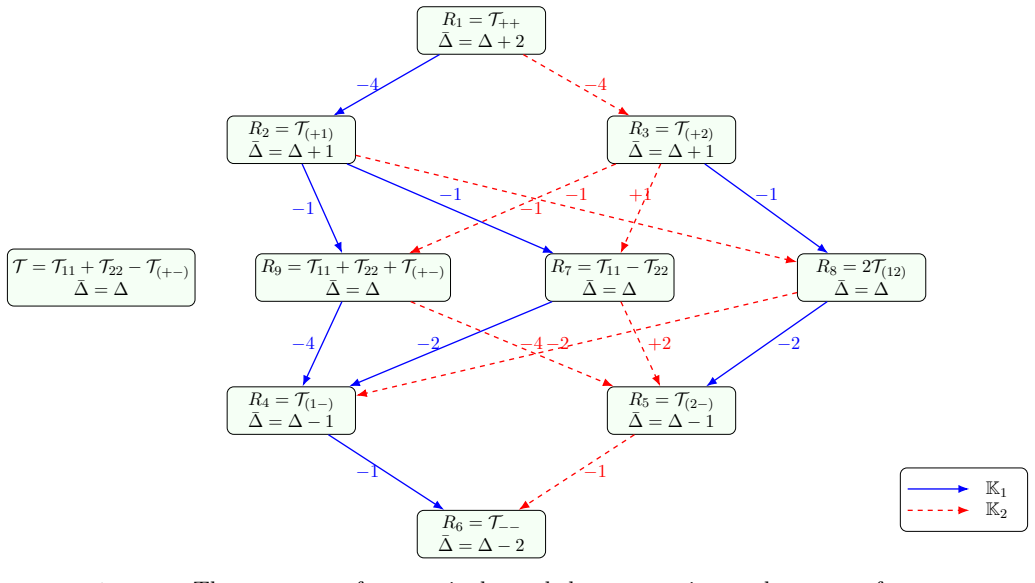
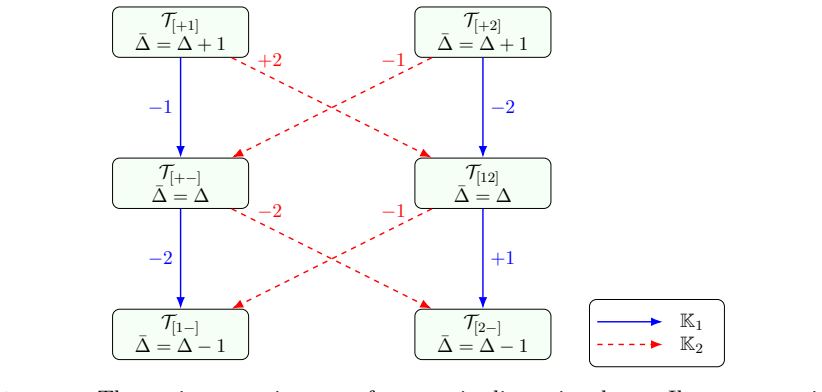
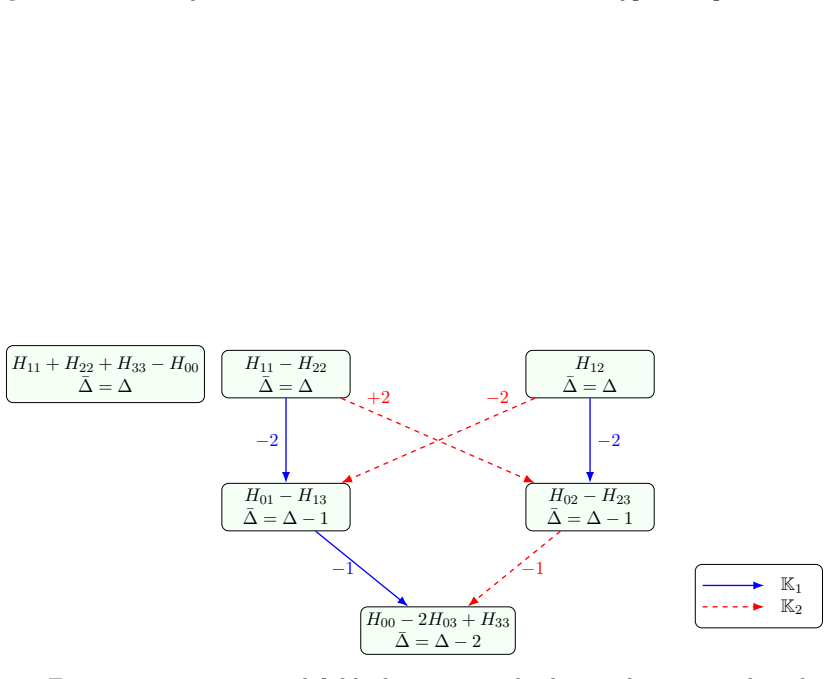
Any bulk-to-boundary correlator is a linear superposition of a set of basic tensor structures fixed by the little group ISO(2) of massless particles. We map the independent tensor structures to all possible non-crossing double-line diagrams. A further mapping of the double-line diagrams to circular diagrams shows that all independent tensor structures are tensor products of loop diagrams. By extrapolating the bulk-to-boundary correlators to boundary-to-boundary correlators, we find a rich structure for general spin-s operators. Furthermore, we show that the extrapolated operator lies in a type Ib spin-s multiplet representation of Carrollian conformal field theory (CCFT). This is a net repre
What carries the argument
The basic tensor structures fixed by the ISO(2) little group of massless particles, which are mapped to non-crossing double-line diagrams and then to circular diagrams of tensor products of loop diagrams.
If this is right
- All independent tensor structures for any integer spin s are tensor products of loop diagrams.
- The extrapolated boundary-to-boundary operators form type Ib spin-s multiplets in Carrollian CFT.
- The classification applies uniformly to general integer spins under the chosen fall-off conditions.
- Boundary-to-boundary correlators inherit the diagram structure and rich multiplet organization from the bulk ones.
Where Pith is reading between the lines
- The diagram mapping may offer a graphical method to construct explicit expressions for correlators at higher spins.
- The link to CCFT via Wigner translations suggests a direct dictionary between flat-space massless fields and Carrollian boundary operators.
- The approach could be extended to check whether similar structures appear when relaxing the integer-spin restriction or including interactions.
Load-bearing premise
The classification relies on imposing suitable fall-off conditions near future/past null infinity, which together with the little group ISO(2) of massless particles determine the basic tensor structures.
What would settle it
An explicit computation of the bulk-to-boundary correlator for a spin-1 or spin-2 operator that cannot be expressed as a linear superposition of the predicted ISO(2)-fixed tensor structures, or an extrapolated boundary operator that fails to transform as a type Ib multiplet under Wigner translations.
Figures

read the original abstract
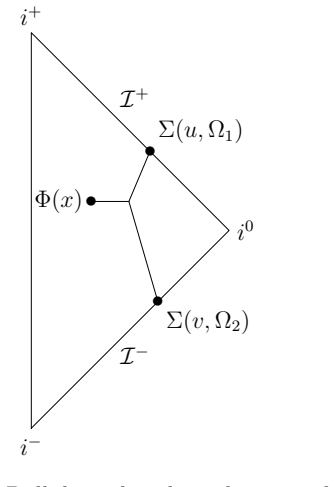
We classify the bulk-to-boundary correlators for general integer-spin $s$ operators in a Poincar\'e-invariant theory by imposing suitable fall-off conditions near future/past null infinity. Any bulk-to-boundary correlator is a linear superposition of a set of basic tensor structures fixed by the little group \text{ISO}(2) of massless particles. We map the independent tensor structures to all possible non-crossing double-line diagrams. A further mapping of the double-line diagrams to circular diagrams shows that all independent tensor structures are tensor products of loop diagrams. By extrapolating the bulk-to-boundary correlators to boundary-to-boundary correlators, we find a rich structure for general spin-$s$ operators. Furthermore, we show that the extrapolated operator lies in a type Ib spin-$s$ multiplet representation of Carrollian conformal field theory (CCFT). This is a net representation that generated by the Wigner translation generators.
Editorial analysis
A structured set of objections, weighed in public.
Referee Report
Summary. The manuscript classifies bulk-to-boundary correlators for general integer-spin s operators in Poincaré-invariant massless theories. By imposing fall-off conditions near future/past null infinity together with the ISO(2) little group, it identifies a basis of tensor structures, maps them to non-crossing double-line diagrams and then to circular diagrams (showing they are tensor products of loops), and extrapolates the structures to boundary-to-boundary correlators. The extrapolated operators are shown to realize type Ib spin-s multiplets in Carrollian CFT generated by Wigner translations.
Significance. If the classification and mappings are valid, the work supplies a diagrammatic enumeration of tensor structures for spinning massless correlators and a concrete link to CCFT representations. The explicit reduction to loop-diagram products and the identification of the Wigner-translation-generated multiplet would constitute a useful organizing principle for flat-space holography and Carrollian limits.
major comments (1)
- [Abstract and §2] Abstract and §2 (classification section): the fall-off conditions at null infinity are introduced as an external input ('suitable fall-off conditions') rather than derived from the Poincaré algebra or the massless wave equation. Because every subsequent step—the enumeration of ISO(2)-allowed tensor structures, the double-line and circular diagram mappings, and the extrapolation to the type-Ib CCFT multiplet—rests on precisely which structures survive these conditions, the lack of a derivation or completeness argument makes the central claim conditional on an unverified choice.
minor comments (2)
- [Diagram-mapping subsection] The notation for the basic tensor structures and the precise definition of 'non-crossing' in the double-line diagrams should be stated explicitly before the mapping is applied, to allow readers to reproduce the counting for small s.
- [Figures] Figure captions for the circular diagrams should include the explicit spin-s example that demonstrates the tensor-product decomposition into loops.
Simulated Author's Rebuttal
We thank the referee for their careful reading of the manuscript and for highlighting the need for greater clarity on the origin of the fall-off conditions. We address the single major comment below.
read point-by-point responses
-
Referee: [Abstract and §2] Abstract and §2 (classification section): the fall-off conditions at null infinity are introduced as an external input ('suitable fall-off conditions') rather than derived from the Poincaré algebra or the massless wave equation. Because every subsequent step—the enumeration of ISO(2)-allowed tensor structures, the double-line and circular diagram mappings, and the extrapolation to the type-Ib CCFT multiplet—rests on precisely which structures survive these conditions, the lack of a derivation or completeness argument makes the central claim conditional on an unverified choice.
Authors: We acknowledge that the fall-off conditions are presented as an input rather than derived in the current text. These conditions are the standard asymptotic requirements for massless integer-spin fields in Minkowski space that ensure compatibility with the wave equation, finite energy flux through null infinity, and preservation of Poincaré invariance. To address the referee's concern directly, we will revise §2 to include a short derivation showing how the stated fall-off behavior follows from the asymptotic expansion of the massless wave equation (or its spin-s generalization) in retarded coordinates near future/past null infinity. This addition will make the enumeration of surviving ISO(2) structures self-contained without altering the subsequent diagrammatic mappings or CCFT extrapolation. revision: yes
Circularity Check
No circularity; classification follows from external symmetries and explicit inputs
full rationale
The paper's derivation begins from Poincaré invariance and the ISO(2) little group of massless particles, then imposes fall-off conditions at null infinity as an explicit assumption to fix the basic tensor structures. Subsequent mappings to diagrams and extrapolation to CCFT multiplets are presented as consequences of these inputs. No quoted step reduces a claimed prediction or structure to a fitted parameter, self-definition, or load-bearing self-citation chain; the central claims remain independent of the target result by construction.
Axiom & Free-Parameter Ledger
axioms (3)
- domain assumption The theory is Poincaré-invariant
- domain assumption Suitable fall-off conditions near future/past null infinity determine the allowed tensor structures
- domain assumption The little group ISO(2) fixes the basic tensor structures for massless particles
Forward citations
Cited by 1 Pith paper
-
Massive fields in 3D Minkowski space and boundary correlators
The work identifies a broader class of 2D Carrollian CFT correlators that encode massive 3D Minkowski S-matrices and constructs the corresponding bulk-to-boundary propagator.
Reference graph
Works this paper leans on
-
[1]
Weinberg,The Quantum Theory of Fields
S. Weinberg,The Quantum Theory of Fields. 1995
1995
-
[2]
On Unitary Representations of the Inhomogeneous Lorentz Group,
E. Wigner, “On Unitary Representations of the Inhomogeneous Lorentz Group,”Annals of Mathematics40(Jan., 1939) 149–204
1939
-
[3]
Group Theoretical Discussion of Relativistic Wave Equations,
V. Bargmann and E. P. Wigner, “Group Theoretical Discussion of Relativistic Wave Equations,”Proceedings of the National Academy of Science34(May, 1948) 211–223
1948
-
[4]
On the definition of the Renormalization Constants in Quantum Electrodynamics,
G. Kallen, “On the definition of the Renormalization Constants in Quantum Electrodynamics,”Helv. Phys. Acta25(1952), no. 4, 417
1952
-
[5]
¨Uber eigenschaften von ausbreitungsfunktionen und renormierungskonstanten quantisierter felder,
H. Lehmann, “ ¨Uber eigenschaften von ausbreitungsfunktionen und renormierungskonstanten quantisierter felder,”Il Nuovo Cimento (1943-1954)11(1954) 342–357
1943
-
[6]
Conformal symmetry of critical fluctuations,
A. M. Polyakov, “Conformal symmetry of critical fluctuations,”JETP Lett.12(1970) 381–383
1970
-
[7]
Non-Hamiltonian approach to conformal quantum field theory,
A. M. Polyakov, “Non-Hamiltonian approach to conformal quantum field theory,”Sov. Phys. JETP39(1974), no. 1, 10–18
1974
-
[8]
Conformal algebra in space-time and operator product expansion,
S. Ferrara, R. Gatto, and A. F. Grillo, “Conformal algebra in space-time and operator product expansion,”Springer Tracts Mod. Phys.67(1973) 1–64
1973
-
[9]
Implications of conformal invariance in field theories for general dimensions,
H. Osborn and A. C. Petkou, “Implications of conformal invariance in field theories for general dimensions,”Annals Phys.231(1994) 311–362,hep-th/9307010
Pith/arXiv arXiv 1994
-
[10]
Spinning Conformal Correlators,
M. S. Costa, J. Penedones, D. Poland, and S. Rychkov, “Spinning Conformal Correlators,” JHEP11(2011) 071,1107.3554
Pith/arXiv arXiv 2011
-
[11]
Conformal four point functions and the operator product expansion,
F. A. Dolan and H. Osborn, “Conformal four point functions and the operator product expansion,”Nucl. Phys. B599(2001) 459–496,hep-th/0011040
Pith/arXiv arXiv 2001
-
[12]
Conformal partial waves and the operator product expansion,
F. A. Dolan and H. Osborn, “Conformal partial waves and the operator product expansion,” Nucl. Phys. B678(2004) 491–507,hep-th/0309180
Pith/arXiv arXiv 2004
-
[13]
M. S. Costa, J. Penedones, D. Poland, and S. Rychkov, “Spinning Conformal Blocks,”JHEP 11(2011) 154,1109.6321
Pith/arXiv arXiv 2011
-
[14]
Constraining bulk-to-boundary correlators in the theories with Poincar´ e symmetry,
J. Long and J.-L. Yang, “Constraining bulk-to-boundary correlators in the theories with Poincar´ e symmetry,”2601.18461
-
[15]
S matrices from AdS space-time,
J. Polchinski, “S matrices from AdS space-time,”hep-th/9901076
-
[16]
Holography in the flat space limit,
L. Susskind, “Holography in the flat space limit,”AIP Conf. Proc.493(1999), no. 1, 98–112, hep-th/9901079
Pith/arXiv arXiv 1999
-
[17]
The Boundary S matrix and the AdS to CFT dictionary,
S. B. Giddings, “The Boundary S matrix and the AdS to CFT dictionary,”Phys. Rev. Lett. 83(1999) 2707–2710,hep-th/9903048
Pith/arXiv arXiv 1999
-
[18]
What do CFTs tell us about Anti-de Sitter space-times?,
V. Balasubramanian, S. B. Giddings, and A. E. Lawrence, “What do CFTs tell us about Anti-de Sitter space-times?,”JHEP03(1999) 001,hep-th/9902052
Pith/arXiv arXiv 1999
-
[19]
A Holographic reduction of Minkowski space-time,
J. de Boer and S. N. Solodukhin, “A Holographic reduction of Minkowski space-time,”Nucl. Phys. B665(2003) 545–593,hep-th/0303006. 57
Pith/arXiv arXiv 2003
-
[20]
Local bulk S-matrix elements and CFT singularities,
M. Gary, S. B. Giddings, and J. Penedones, “Local bulk S-matrix elements and CFT singularities,”Phys. Rev. D80(2009) 085005,0903.4437
Pith/arXiv arXiv 2009
-
[21]
Gravitational waves in general relativity. 7. Waves from axisymmetric isolated systems,
H. Bondi, M. G. J. van der Burg, and A. W. K. Metzner, “Gravitational waves in general relativity. 7. Waves from axisymmetric isolated systems,”Proc. Roy. Soc. Lond. A269(1962) 21–52
1962
-
[22]
Gravitational waves in general relativity. 8. Waves in asymptotically flat space-times,
R. K. Sachs, “Gravitational waves in general relativity. 8. Waves in asymptotically flat space-times,”Proc. Roy. Soc. Lond. A270(1962) 103–126
1962
-
[23]
Asymptotic symmetries in gravitational theory,
R. Sachs, “Asymptotic symmetries in gravitational theory,”Phys. Rev.128(1962) 2851–2864
1962
-
[24]
Aspects of the BMS/CFT correspondence,
G. Barnich and C. Troessaert, “Aspects of the BMS/CFT correspondence,”JHEP05(2010) 062,1001.1541
Pith/arXiv arXiv 2010
-
[25]
On BMS Invariance of Gravitational Scattering,
A. Strominger, “On BMS Invariance of Gravitational Scattering,”JHEP07(2014) 152, 1312.2229
Pith/arXiv arXiv 2014
-
[26]
BMS supertranslations and Weinberg’s soft graviton theorem,
T. He, V. Lysov, P. Mitra, and A. Strominger, “BMS supertranslations and Weinberg’s soft graviton theorem,”JHEP05(2015) 151,1401.7026
Pith/arXiv arXiv 2015
-
[27]
A. Bagchi, A. Banerjee, P. Dhivakar, S. Mondal, and A. Shukla, “The Carrollian kaleidoscope,”Eur. Phys. J. C86(2026) 429,2506.16164
Pith/arXiv arXiv 2026
-
[28]
Carrollian physics and holography,
R. Ruzziconi, “Carrollian physics and holography,”Phys. Rept.1182(2026) 1–87, 2602.02644
arXiv 2026
-
[29]
Foundations of Carrollian Geometry,
L. Ciambelli and P. Jai-akson, “Foundations of Carrollian Geometry,”2510.21651
-
[30]
Flat Holography: Aspects of the dual field theory,
A. Bagchi, R. Basu, A. Kakkar, and A. Mehra, “Flat Holography: Aspects of the dual field theory,”JHEP12(2016) 147,1609.06203
Pith/arXiv arXiv 2016
-
[31]
Field Theories with Conformal Carrollian Symmetry,
A. Bagchi, A. Mehra, and P. Nandi, “Field Theories with Conformal Carrollian Symmetry,” JHEP05(2019) 108,1901.10147
Pith/arXiv arXiv 2019
-
[32]
BMS-invariant free scalar model,
P.-x. Hao, W. Song, X. Xie, and Y. Zhong, “BMS-invariant free scalar model,”Phys. Rev. D 105(2022), no. 12, 125005,2111.04701
arXiv 2022
-
[33]
Interacting Conformal Carrollian Theories: Cues from Electrodynamics,
K. Banerjee, R. Basu, A. Mehra, A. Mohan, and A. Sharma, “Interacting Conformal Carrollian Theories: Cues from Electrodynamics,”Phys. Rev. D103(2021), no. 10, 105001,2008.02829
arXiv 2021
-
[34]
Towards a Carrollian Description of Yang-Mills,
J. Opreij, D. Skinner, and H. Wang, “Towards a Carrollian Description of Yang-Mills,” 2604.09771
-
[35]
On Higher-dimensional Carrollian and Galilean Conformal Field Theories,
B. Chen, R. Liu, and Y.-f. Zheng, “On Higher-dimensional Carrollian and Galilean Conformal Field Theories,”2112.10514
-
[36]
An embedding space approach to Carrollian CFT correlators for flat space holography,
J. Salzer, “An embedding space approach to Carrollian CFT correlators for flat space holography,”JHEP10(2023) 084,2304.08292
arXiv 2023
-
[37]
Operator product expansion in Carrollian CFT,
K. Nguyen and J. Salzer, “Operator product expansion in Carrollian CFT,”JHEP07(2025) 193,2503.15607
Pith/arXiv arXiv 2025
-
[38]
AdS Witten diagrams to Carrollian correlators,
A. Bagchi, P. Dhivakar, and S. Dutta, “AdS Witten diagrams to Carrollian correlators,”JHEP 04(2023) 135,2303.07388
arXiv 2023
-
[39]
Carrollian approach to 1 + 3D flat holography,
A. Saha, “Carrollian approach to 1 + 3D flat holography,”JHEP06(2023) 051,2304.02696. 58
arXiv 2023
-
[41]
Carrollian conformal correlators and massless scattering amplitudes,
K. Nguyen, “Carrollian conformal correlators and massless scattering amplitudes,”JHEP01 (2024) 076,2311.09869
arXiv 2024
-
[42]
Holography in Flat Spacetimes: the case for Carroll,
A. Bagchi, P. Dhivakar, and S. Dutta, “Holography in Flat Spacetimes: the case for Carroll,” 2311.11246
-
[43]
Holographic Carrollian currents for massless scattering,
R. Ruzziconi and A. Saha, “Holographic Carrollian currents for massless scattering,”JHEP01 (2025) 169,2411.04902
arXiv 2025
-
[44]
Scattering Amplitudes: Celestial and Carrollian,
A. Bagchi, S. Banerjee, R. Basu, and S. Dutta, “Scattering Amplitudes: Celestial and Carrollian,”Phys. Rev. Lett.128(2022), no. 24, 241601,2202.08438
arXiv 2022
-
[45]
Carrollian Perspective on Celestial Holography,
L. Donnay, A. Fiorucci, Y. Herfray, and R. Ruzziconi, “Carrollian Perspective on Celestial Holography,”Phys. Rev. Lett.129(2022), no. 7, 071602,2202.04702
Pith/arXiv arXiv 2022
-
[46]
Bridging Carrollian and celestial holography,
L. Donnay, A. Fiorucci, Y. Herfray, and R. Ruzziconi, “Bridging Carrollian and celestial holography,”Phys. Rev. D107(2023), no. 12, 126027,2212.12553
arXiv 2023
-
[47]
Carrollian Amplitudes and Celestial Symmetries,
L. Mason, R. Ruzziconi, and A. Yelleshpur Srikant, “Carrollian Amplitudes and Celestial Symmetries,”2312.10138
-
[48]
Feynman rules and loop structure of Carrollian amplitude,
W.-B. Liu, J. Long, and X.-Q. Ye, “Feynman rules and loop structure of Carrollian amplitude,”2402.04120
-
[49]
Carrollian Amplitudes from Strings,
S. Stieberger, T. R. Taylor, and B. Zhu, “Carrollian Amplitudes from Strings,”2402.14062
-
[50]
On the definition of Carrollian amplitudes in general dimensions,
W.-B. Liu, J. Long, H.-Y. Xiao, and J.-L. Yang, “On the definition of Carrollian amplitudes in general dimensions,”JHEP11(2024) 027,2407.20816
arXiv 2024
-
[51]
Carrollian amplitudes from holographic correlators,
L. F. Alday, M. Nocchi, R. Ruzziconi, and A. Yelleshpur Srikant, “Carrollian amplitudes from holographic correlators,”JHEP03(2025) 158,2406.19343
arXiv 2025
-
[52]
Carrollian propagator and amplitude in Rindler spacetime,
A. Li, J. Long, and J.-L. Yang, “Carrollian propagator and amplitude in Rindler spacetime,” JHEP03(2025) 186,2410.20372
arXiv 2025
-
[53]
Carrollian partition functions and the flat limit of AdS,
P. Kraus and R. M. Myers, “Carrollian partition functions and the flat limit of AdS,”JHEP 01(2025) 183,2407.13668
arXiv 2025
-
[54]
Thermal correlator at null infinity,
J. Long and H.-Y. Xiao, “Thermal correlator at null infinity,”JHEP10(2025) 127, 2501.15714
arXiv 2025
-
[55]
Carrollian amplitudes and holographic correlators in AdS3/CFT2,
I. Surubaru and B. Zhu, “Carrollian amplitudes and holographic correlators in AdS3/CFT2,” Phys. Rev. D112(2025), no. 2, 026023,2504.07650
arXiv 2025
-
[56]
Towards a flat space Carrollian hologram from AdS 4/CFT3,
A. Lipstein, R. Ruzziconi, and A. Yelleshpur Srikant, “Towards a flat space Carrollian hologram from AdS 4/CFT3,”JHEP06(2025) 073,2504.10291
arXiv 2025
-
[57]
On Carrollian and celestial correlators in general dimensions,
H. Kulkarni, R. Ruzziconi, and A. Yelleshpur Srikant, “On Carrollian and celestial correlators in general dimensions,”JHEP10(2025) 187,2508.06602
arXiv 2025
-
[58]
From AdS correlators to Carrollian amplitudes with the scattering equations,
T. Adamo, I. Surubaru, and B. Zhu, “From AdS correlators to Carrollian amplitudes with the scattering equations,”JHEP02(2026) 198,2512.03677. 59
arXiv 2026
-
[59]
Carrollian correlators in black hole perturbation theory,
J. Long, Z.-J. Qu, and H.-Y. Xiao, “Carrollian correlators in black hole perturbation theory,” 2603.03033
-
[60]
On Carrollian Loop Amplitudes for Gauge Theory and Gravity,
V. Nenmeli and B. Zhu, “On Carrollian Loop Amplitudes for Gauge Theory and Gravity,” 2604.08498
-
[61]
Penrose and W
R. Penrose and W. Rindler,Spinors and space-time. Vol. 1: Two-spinor calculus and relativistic fields.1984
1984
-
[62]
Weyl,The Classical Groups: Their Invariants and Representations, vol
H. Weyl,The Classical Groups: Their Invariants and Representations, vol. 1 ofPrinceton Mathematical Series. Princeton University Press, Princeton, NJ, 2 ed., 1946
1946
-
[63]
Roman,An Introduction to Catalan Numbers
S. Roman,An Introduction to Catalan Numbers. Compact Textbooks in Mathematics. Springer Nature, Cham, 1st ed. 2015 ed., 2015
2015
-
[64]
On the Algorithm of Dirac spurs,
S. F. E. R. Caianiello, “On the Algorithm of Dirac spurs,”Nuovo Cim.9(1952) 1218–1226
1952
-
[65]
Bulk-to-bulk photon propagator in AdS,
R. N. Moga and K. Skenderis, “Bulk-to-bulk photon propagator in AdS,”2510.23770
-
[66]
Two-point functions and bootstrap applications in quantum field theories,
D. Karateev, “Two-point functions and bootstrap applications in quantum field theories,” JHEP02(2022) 186,2012.08538
arXiv 2022
-
[67]
One-loop divergencies in the theory of gravitation,
G. ’t Hooft and M. J. G. Veltman, “One-loop divergencies in the theory of gravitation,”Ann. Inst. H. Poincare Phys. Theor. A20(1974), no. 1, 69–94
1974
-
[68]
On ghost-free tensor lagrangians and linearized gravitation,
P. Van Nieuwenhuizen, “On ghost-free tensor lagrangians and linearized gravitation,”Nucl. Phys. B60(1973) 478–492
1973
-
[69]
Graviton Propagator in a 2-Parameter Family of de Sitter Breaking Gauges,
D. Glavan, S. P. Miao, T. Prokopec, and R. P. Woodard, “Graviton Propagator in a 2-Parameter Family of de Sitter Breaking Gauges,”JHEP10(2019) 096,1908.06064
arXiv 2019
-
[70]
Lehmann Spectral Representation for Anti-de Sitter Quantum Field Theory,
D. W. Dusedau and D. Z. Freedman, “Lehmann Spectral Representation for Anti-de Sitter Quantum Field Theory,”Phys. Rev. D33(1986) 389
1986
-
[71]
The K¨ all´ en-Lehmann representation in de Sitter spacetime,
M. Loparco, J. Penedones, K. Salehi Vaziri, and Z. Sun, “The K¨ all´ en-Lehmann representation in de Sitter spacetime,”JHEP12(2023) 159,2306.00090
arXiv 2023
-
[72]
Spectral representations for any spin,
I. Raszillier, “Spectral representations for any spin,”Il Nuovo Cimento A (1965-1970)48 (1967) 635–644
1965
-
[73]
On the covariant structure of the two-point function,
A. I. Oksak and I. T. Todorov, “On the covariant structure of the two-point function,” Commun. Math. Phys.14(1969) 271–304
1969
-
[74]
Spectral Representation of the Covariant Two-Point Function and Infinite-Component Fields with Arbitrary Mass Spectrum,
I. T. Todorov and R. P. Zaikov, “Spectral Representation of the Covariant Two-Point Function and Infinite-Component Fields with Arbitrary Mass Spectrum,”J. Math. Phys.10(1969), no. 11, 2014–2019
1969
-
[75]
Arbitrary spin fields - spectral representations for the two-point functions, and the connection between spin and statistics,
P. M. Mathews and M. Seetharaman, “Arbitrary spin fields - spectral representations for the two-point functions, and the connection between spin and statistics,”Nucl. Phys. B31(1971) 551–569
1971
-
[76]
Quantum flux operators in higher spin theories,
W.-B. Liu, J. Long, and X.-H. Zhou, “Quantum flux operators in higher spin theories,”Phys. Rev. D109(2024), no. 8, 086012,2311.11361
arXiv 2024
-
[77]
Carrollian Conformal Fields and Flat Holography,
K. Nguyen and P. West, “Carrollian Conformal Fields and Flat Holography,”Universe9 (Aug., 2023) 385,2305.02884. 60
arXiv 2023
-
[78]
Finite component field representations of the conformal group,
G. Mack and A. Salam, “Finite component field representations of the conformal group,” Annals Phys.53(1969) 174–202
1969
-
[79]
Constructing Carrollian field theories from null reduction,
B. Chen, R. Liu, H. Sun, and Y.-f. Zheng, “Constructing Carrollian field theories from null reduction,”JHEP11(2023) 170,2301.06011
arXiv 2023
-
[80]
Symmetry group at future null infinity II: Vector theory,
W.-B. Liu and J. Long, “Symmetry group at future null infinity II: Vector theory,”JHEP07 (2023) 152,2304.08347
arXiv 2023
-
[81]
On the formulation of quantized field theories. II,
H. Lehmann, K. Symanzik, and W. Zimmermann, “On the formulation of quantized field theories. II,”Nuovo Cim.6(1957) 319–333
1957
discussion (0)
Sign in with ORCID, Apple, or X to comment. Anyone can read and Pith papers without signing in.