Machine Learning for Predicting the Proton Structure Function F₂^P in QCD
Pith reviewed 2026-06-28 00:23 UTC · model grok-4.3
The pith
Supervised machine learning regression on BCDMS data predicts the proton structure function F_2^p without solving DGLAP evolution equations.
A machine-rendered reading of the paper's core claim, the machinery that carries it, and where it could break.
Core claim
Training SVR, GBR, GPR, and MLP regressors exclusively on BCDMS data for the proton structure function yields predictions whose accuracy matches or exceeds conventional DGLAP-based calculations, with MLP showing strongest response to nonlinear features and SVR most resistant to experimental noise; the near-equality of training and test metrics indicates that the models have captured the physical dependence without overfitting.
What carries the argument
Supervised regression models (MLP, GPR, SVR, GBR) fitted directly to BCDMS F_2^p measurements, bypassing explicit solution of the DGLAP equations.
If this is right
- ML regression can be used for rapid interpolation and modest extrapolation of F_2^p within the measured kinematic domain.
- The same workflow can be applied to other structure functions or to nuclear targets once sufficient experimental points exist.
- Model stability against experimental uncertainties offers a quantitative check on data quality before inclusion in global fits.
- The absence of explicit DGLAP evolution in the training step allows direct testing of whether observed scaling violations are reproduced by the learned mapping.
Where Pith is reading between the lines
- If the approach generalizes, it could reduce reliance on iterative DGLAP solutions for quick estimates in regions where data density is high.
- Extending the training set to include multiple experiments would test whether the learned function remains consistent with QCD factorization across datasets.
- The reported sensitivity of MLP to nonlinear gradients suggests it may be useful for detecting higher-twist contributions once larger datasets become available.
Load-bearing premise
That the BCDMS dataset alone supplies enough information to capture the full nonlinear x and Q^2 dependence of the proton structure function.
What would settle it
A systematic comparison of the trained models' predictions against an independent high-precision dataset (such as HERA or fixed-target measurements outside the BCDMS kinematic range) or against DGLAP-evolved values from a global PDF fit.
Figures
read the original abstract
We present a comparative study of four supervised machine learning regression algorithms -- Support Vector Regression (SVR), Gradient Boosting Regression (GBR), Gaussian Process Regression (GPR), and Multilayer Perceptron (MLP) -- for predicting the proton structure function $F_2^p(x, Q^2)$ using high-precision BCDMS experimental data. Unlike conventional methods that solve the DGLAP evolution equations, our data-driven framework directly captures the complex nonlinear dynamics of partonic structure. To ensure statistical robustness, we employ $k$-fold cross-validation and perform thorough hyperparameter optimization. Our results show that the MLP and GPR models achieve superior predictive accuracy. In particular, MLP exhibits the highest sensitivity to nonlinear gradients, while SVR proves most stable against experimental uncertainties. The close convergence of training and validation metrics confirms that the models learn the underlying QCD physics without overfitting to statistical fluctuations. This work highlights the potential of ML-based regression as a complementary tool for structure function analysis and kinematic extrapolation in high-energy physics.
Editorial analysis
A structured set of objections, weighed in public.
Referee Report
Summary. The manuscript presents a comparative study of four supervised machine learning regression algorithms (SVR, GBR, GPR, MLP) trained on BCDMS experimental data to predict the proton structure function F_2^p(x, Q^2). It claims these data-driven models capture the complex nonlinear dynamics of partonic structure without relying on DGLAP evolution equations, with MLP and GPR achieving superior accuracy, SVR most stable, and k-fold cross-validation confirming that the models learn underlying QCD physics without overfitting.
Significance. If validated through explicit comparisons, the work could offer a complementary data-driven approach for structure-function analysis and extrapolation. The emphasis on hyperparameter optimization and cross-validation is a positive methodological step, but the absence of theoretical constraints or benchmarks against standard QCD methods limits the assessed significance.
major comments (3)
- [Abstract] Abstract: the central claim that the models 'learn the underlying QCD physics' and achieve 'superior predictive accuracy' is load-bearing yet unsupported, as no quantitative metrics (RMSE, R^2, error bars), explicit DGLAP comparisons, or multi-experiment hold-outs (HERA, NMC) are reported.
- [Methods] Methods/Results: training supervised regressors solely on BCDMS data without incorporating DGLAP evolution equations, PDF sum rules, or constraints from other datasets does not substantiate generalization to QCD dynamics rather than dataset-specific interpolation.
- [Results] Results: convergence of training and validation metrics under k-fold CV is expected for any flexible regressor on smooth data and does not distinguish physics capture from interpolation; no test of learned gradients against perturbative QCD expectations is provided.
minor comments (2)
- [Abstract] Standardize notation between title (F_2^P) and abstract (F_2^p).
- Add explicit description of data preprocessing steps and the ranges explored in hyperparameter optimization.
Simulated Author's Rebuttal
We thank the referee for their insightful comments, which help clarify the scope and limitations of our work. We address each major comment below and indicate where revisions will be made.
read point-by-point responses
-
Referee: [Abstract] Abstract: the central claim that the models 'learn the underlying QCD physics' and achieve 'superior predictive accuracy' is load-bearing yet unsupported, as no quantitative metrics (RMSE, R^2, error bars), explicit DGLAP comparisons, or multi-experiment hold-outs (HERA, NMC) are reported.
Authors: We agree that quantitative metrics are necessary to support the claims of superior accuracy. In the revised manuscript, we will include tables or figures reporting RMSE, R^2 scores, and associated uncertainties from the k-fold cross-validation. We will also moderate the abstract's language regarding 'learning the underlying QCD physics' to emphasize the data-driven prediction on BCDMS data. Explicit DGLAP comparisons and tests on other datasets like HERA and NMC are not included in this study as it focuses on a single high-precision dataset; we will note this limitation. revision: partial
-
Referee: [Methods] Methods/Results: training supervised regressors solely on BCDMS data without incorporating DGLAP evolution equations, PDF sum rules, or constraints from other datasets does not substantiate generalization to QCD dynamics rather than dataset-specific interpolation.
Authors: The core of our approach is to demonstrate that ML regressors can model F_2^p directly from experimental data without explicit QCD evolution equations. The BCDMS data encodes the QCD dynamics, and the models' ability to generalize within the kinematic range via cross-validation suggests they capture the relevant functional dependence. We will add a section in the revised paper discussing how this complements traditional methods and the potential for interpolation vs. physics learning, including references to PDF sum rules as future extensions. revision: partial
-
Referee: [Results] Results: convergence of training and validation metrics under k-fold CV is expected for any flexible regressor on smooth data and does not distinguish physics capture from interpolation; no test of learned gradients against perturbative QCD expectations is provided.
Authors: While we acknowledge that metric convergence alone is not sufficient, the differential performance of the four models and the hyperparameter tuning process provide additional insight. In the revision, we will include an analysis of the models' sensitivity to variations in x and Q^2, such as computing numerical gradients, and discuss their consistency with expected QCD behavior like scaling violations at low x. revision: yes
- The current manuscript does not perform explicit comparisons to DGLAP-evolved PDFs or hold-out tests on independent experiments such as HERA or NMC, as the study is limited to BCDMS data.
Circularity Check
No significant circularity; standard empirical regression on external data
full rationale
The paper applies standard supervised regression (SVR, GBR, GPR, MLP) to BCDMS experimental measurements of F_2^p(x, Q^2), using k-fold cross-validation and hyperparameter tuning to report model accuracy. No derivation chain, equations, or self-citations are present that reduce any reported prediction to a fitted input by construction, nor is any ansatz, uniqueness theorem, or renaming of a known result invoked. The 'captures QCD physics' language is an interpretive claim about fit quality on held-out experimental points rather than a mathematical equivalence to the training inputs. This is self-contained empirical modeling with no load-bearing circular steps.
Axiom & Free-Parameter Ledger
free parameters (1)
- Hyperparameters of the four ML models
axioms (1)
- domain assumption BCDMS experimental data sufficiently samples the nonlinear dependence of F2^p on x and Q^2
Reference graph
Works this paper leans on
-
[1]
Hyperparameter Optimization 8 E
GBR Analysis 7 ∗atashbart3@gmail.com †astaraki.elham@razi.ac.ir ‡F.Arbabifar@cfu.ac.ir D. Hyperparameter Optimization 8 E. Summary of Findings 9 VI. Conclusion 11 Data and Code Availability 11 References 12 I. INTRODUCTON Understanding the partonic structure of the proton remains a central goal of quantum chromodynamics (QCD). Deep inelastic scattering (D...
Pith/arXiv arXiv 2026
-
[2]
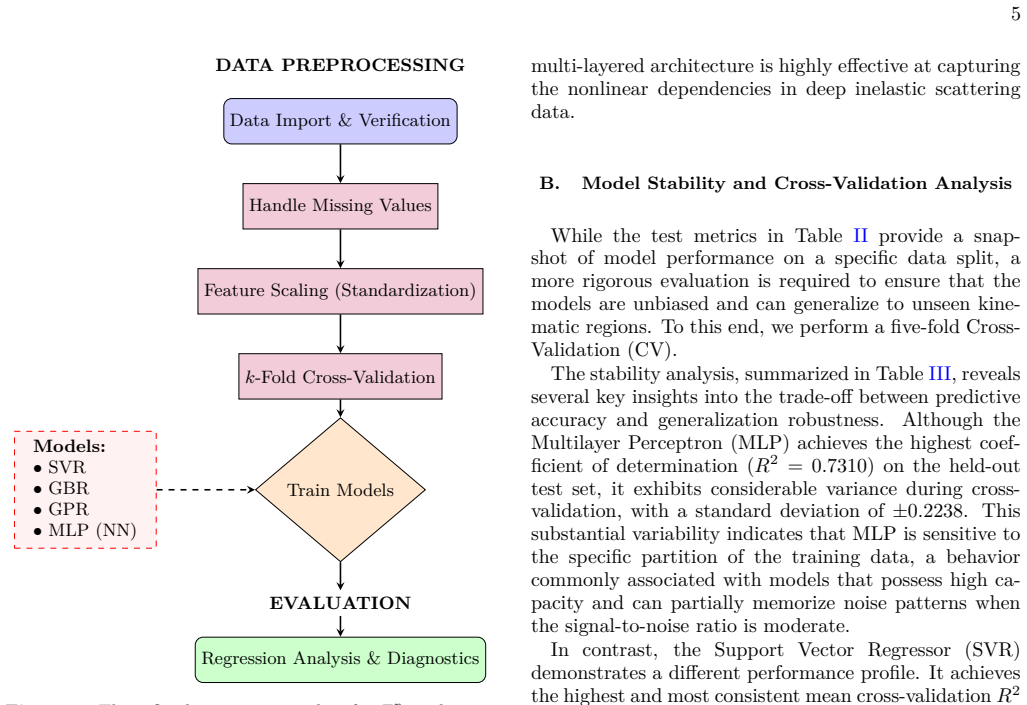
We first analyze the global performance metrics, followed by a detailed diagnostic analysis of each model’s predictive behavior. 5 DATA PREPROCESSING Data Import & Verification Handle Missing Values Feature Scaling (Standardization) k-Fold Cross-Validation Train Models Models: •SVR •GBR •GPR •MLP (NN) EVALUATION Regression Analysis & Diagnostics Figure 1:...
-
[3]
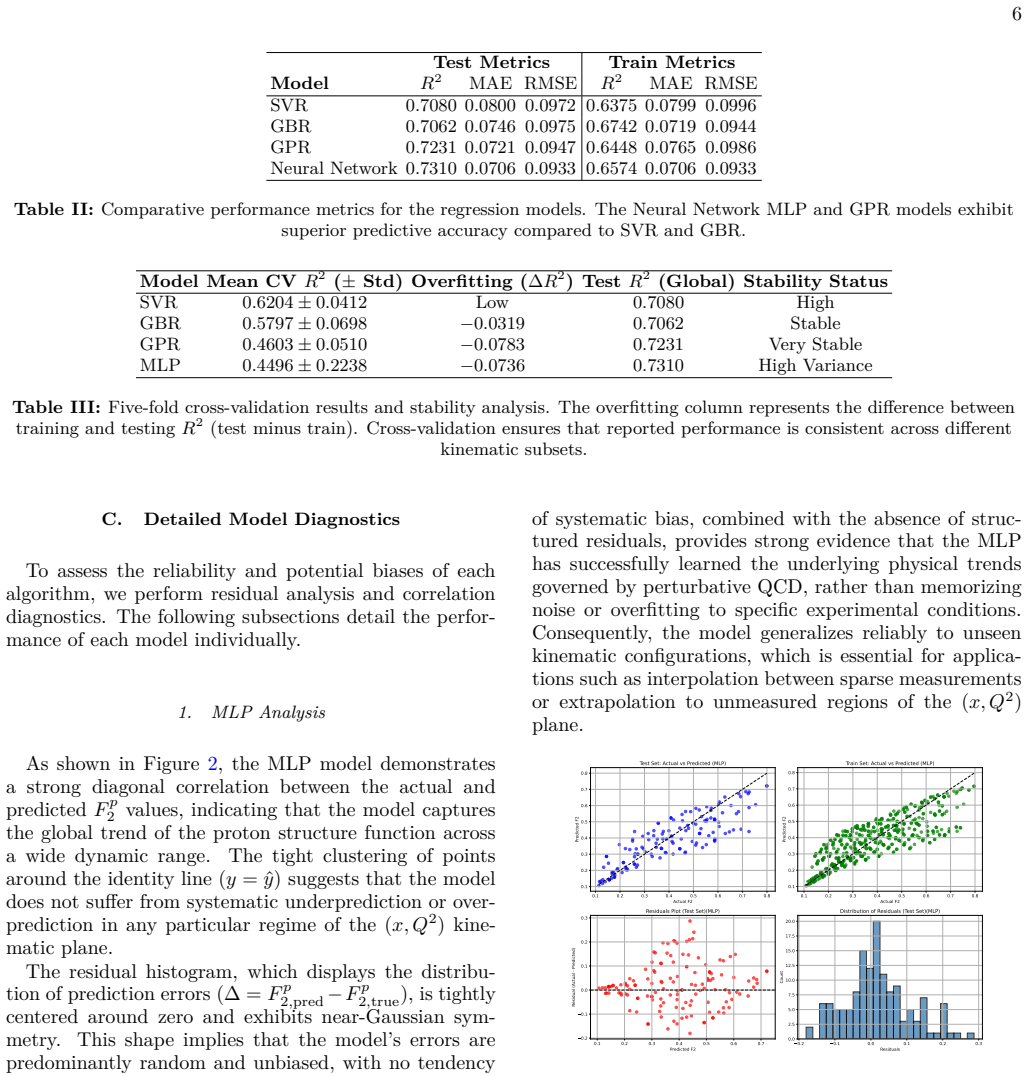
MLP Analysis As shown in Figure 2, the MLP model demonstrates a strong diagonal correlation between the actual and predictedF p 2 values, indicating that the model captures the global trend of the proton structure function across a wide dynamic range. The tight clustering of points around the identity line (y= ˆy) suggests that the model does not suffer f...
-
[4]
confirms that the model’s predictive uncertainty remains stable across the entire range of the structure function, from the low-Fp 2 region at highxto the high-Fp 2 regime at lowx. The lack of systematic bias, combined with the absence of struc- tured residuals, provides strong evidence that the MLP has successfully learned the underlying physical trends ...
-
[5]
Unlike de- terministic models that produce point estimates only, GPR provides a fully probabilistic framework that nat- urally captures uncertainty in predictions
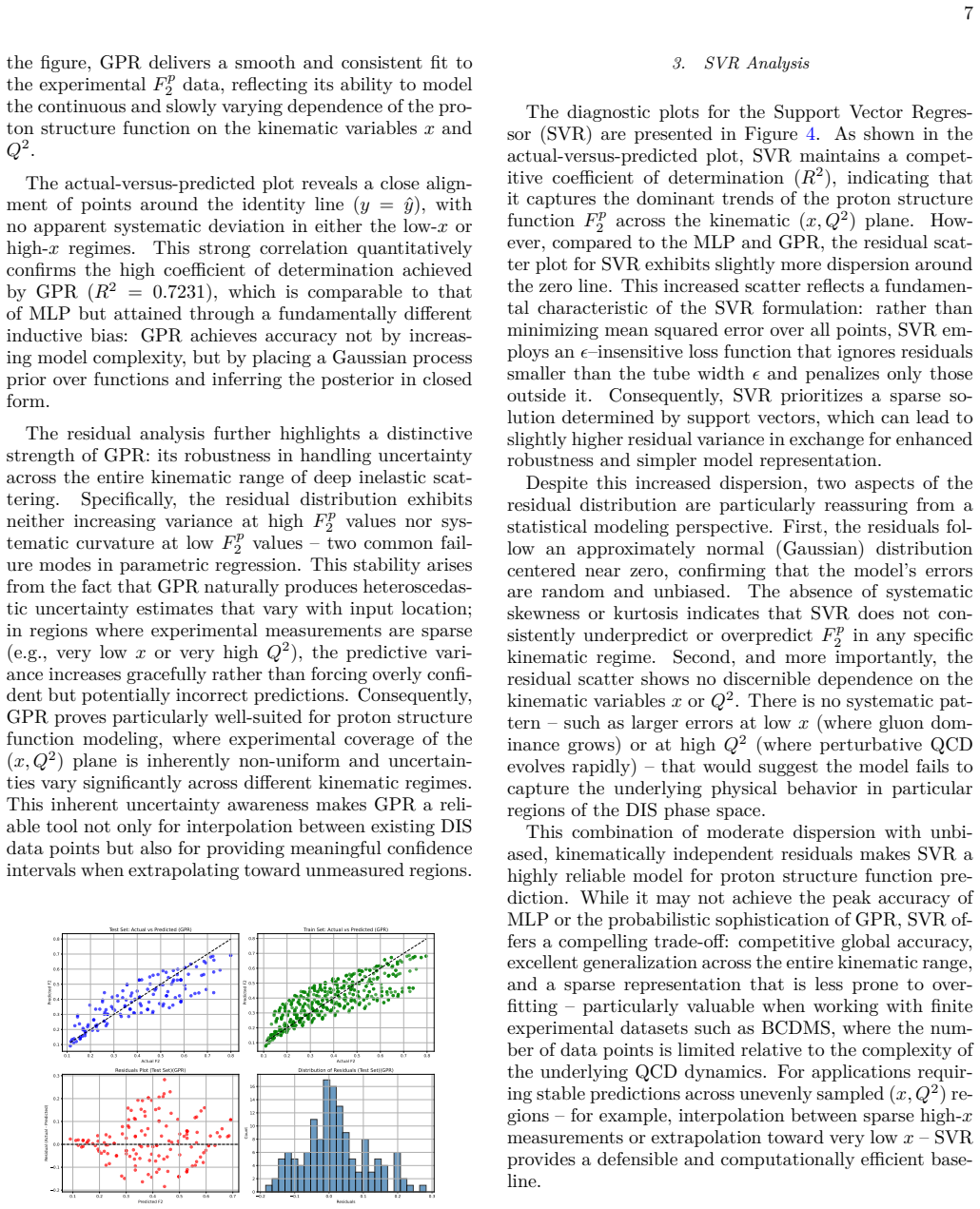
GPR Analysis Figure 3 illustrates the predictive performance of the Gaussian Process Regression (GPR) model. Unlike de- terministic models that produce point estimates only, GPR provides a fully probabilistic framework that nat- urally captures uncertainty in predictions. As shown in 7 the figure, GPR delivers a smooth and consistent fit to the experiment...
-
[6]
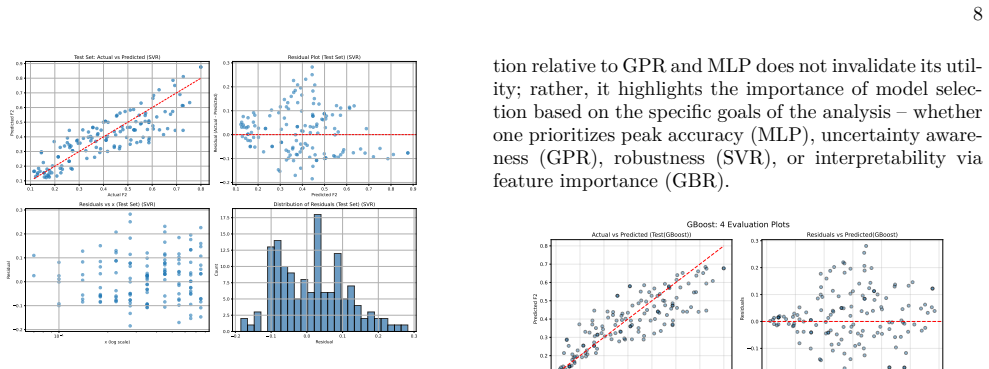
SVR Analysis The diagnostic plots for the Support Vector Regres- sor (SVR) are presented in Figure 4. As shown in the actual-versus-predicted plot, SVR maintains a compet- itive coefficient of determination (R2), indicating that it captures the dominant trends of the proton structure functionF p 2 across the kinematic(x,Q 2)plane. How- ever, compared to t...
-
[7]
GBR Analysis Figure 5 displays the diagnostic plots for the Gradient Boosting Regression (GBR) model. As a boosted ensem- 8 0.1 0.2 0.3 0.4 0.5 0.6 0.7 0.8 Actual F2 0.1 0.2 0.3 0.4 0.5 0.6 0.7 0.8 0.9Predicted F2 T est Set: Actual vs Predicted (SVR) 0.1 0.2 0.3 0.4 0.5 0.6 0.7 0.8 0.9 Predicted F2 0.2 0.1 0.0 0.1 0.2 0.3 Residual (Actual - Predicted) Res...
-
[8]
However, the residual distribution on the held-out test set is noticeably wider than those observed for GPR and MLP
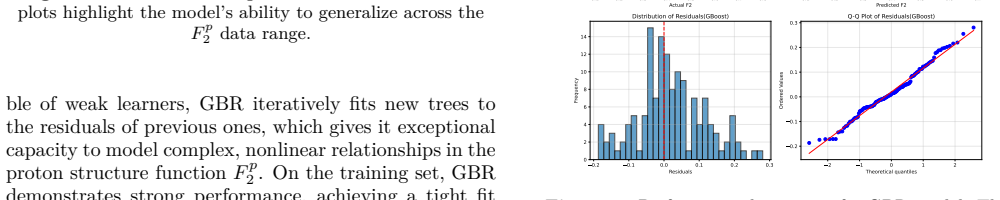
On the training set, GBR demonstrates strong performance, achieving a tight fit with low residuals – a direct consequence of its greedy ad- ditive optimization procedure, which can continue reduc- ing training error as long as additional trees are added. However, the residual distribution on the held-out test set is noticeably wider than those observed fo...
-
[9]
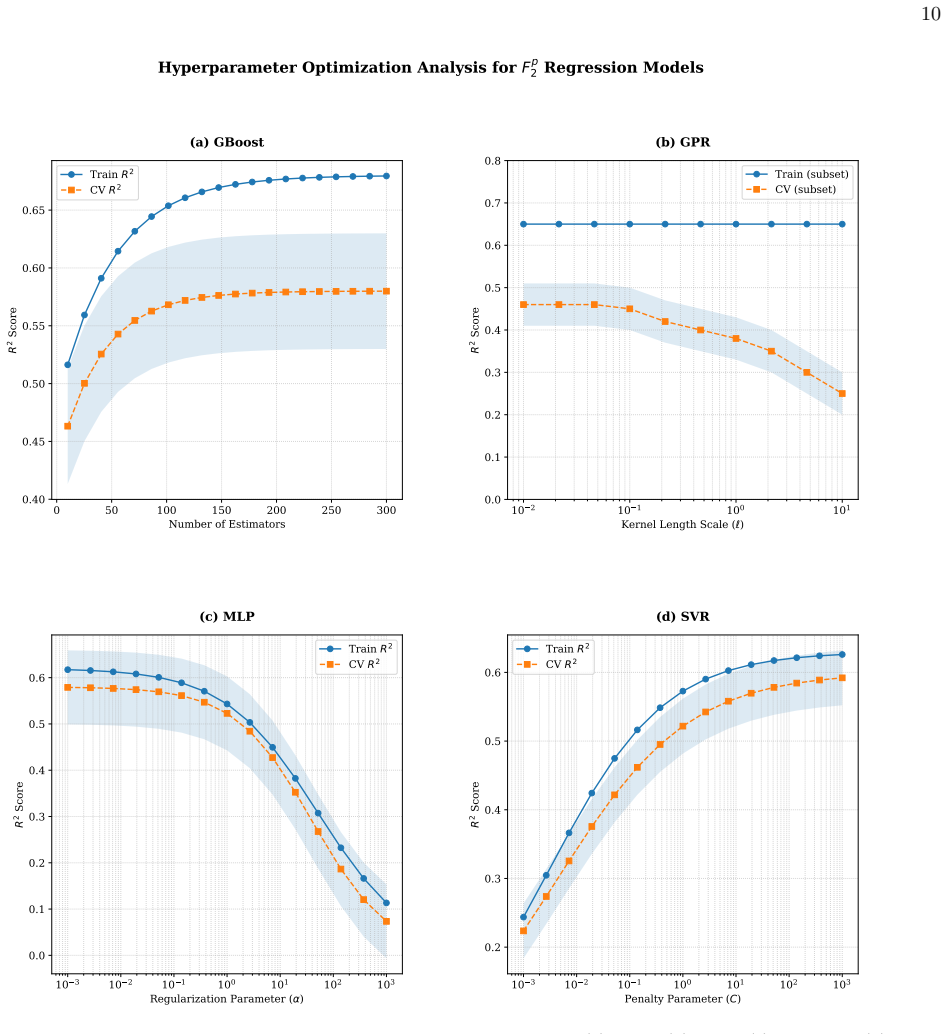
The optimalαregion (approximately10−4to10−2) provides sufficient constraint to prevent overfitting to ex- perimental noise while retaining the flexibility needed to model the complex dependence of the structure function on the kinematic variables. d. Support Vector Regression (SVR):The SVR model reveals remarkably stable performance across a wide range of...
-
[10]
This model-agnostic approach offers a complementary perspective to traditional perturbative QCD methods
Using the BCDMS deep inelastic scattering (DIS) dataset, we demonstrated that data-driven models can effectively ap- proximate the complex dependence of structure functions on the Bjorken scaling variablexand the momentum transferQ 2, without explicitly solving the DGLAP evo- lution equations. This model-agnostic approach offers a complementary perspectiv...
-
[11]
Y. L. Dokshitzer, Sov. Phys. JETP46, 641 (1977) [Zh. Eksp. Teor. Fiz.73, 1216 (1977)]
1977
-
[12]
V. N. Gribov and L. N. Lipatov, Sov. J. Nucl. Phys.15, 438 (1972) [Yad. Fiz.15, 781 (1972)]
1972
-
[13]
L. N. Lipatov, Sov. J. Nucl. Phys.20, 94 (1975) [Yad. Fiz.20, 181 (1974)]
1975
-
[14]
Altarelli and G
G. Altarelli and G. Parisi, Nucl. Phys. B126, 298 (1977)
1977
-
[15]
A. C. Benvenutiet al.[BCDMS], Phys. Lett. B223, 485- 489 (1989)
1989
-
[16]
Albertsson, P
K. Albertsson, P. Altoe, D. Anderson, J. Anderson, M. Andrews, J. P. Araque Espinosa, A. Aurisano, L. Basara, A. Bevan and W. Bhimji,et al.J. Phys. Conf. Ser.1085, no.2, 022008 (2018)
2018
-
[17]
Radovic, M
A. Radovic, M. Williams, D. Rousseau, M. Kagan, D. Bonacorsi, A. Himmel, A. Aurisano, K. Terao and T. Wongjirad, Nature560, no.7716, 41-48 (2018)
2018
-
[18]
5, 4308 (2014)
P.Baldi, P.SadowskiandD.Whiteson, NatureCommun. 5, 4308 (2014)
2014
-
[19]
Alexandru, P
A. Alexandru, P. F. Bedaque, H. Lamm and S. Lawrence, Phys. Rev. D96, no.9, 094505 (2017)
2017
- [20]
-
[21]
P. E. Shanahan, A. Trewartha and W. Detmold, Phys. Rev. D97, no.9, 094506 (2018)
2018
-
[22]
Efron, Annals Statist.7, no.1, 1-26 (1979)
B. Efron, Annals Statist.7, no.1, 1-26 (1979)
1979
-
[23]
Nonsinglet distri- bution functions using the neural network and ge- netic algorithm,
E. Astaraki and G. R. Boroun, “Nonsinglet distri- bution functions using the neural network and ge- netic algorithm,”Eur. Phys. J. A62, 26 (2026). doi:10.1140/epja/s10050-025-01768-2
-
[24]
Parton distributions from high-precision collider data
R. D. Ballet al.[NNPDF Collaboration], “Parton distri- butions for the LHC Run II,”Eur. Phys. J. C77, no.10, 663 (2017). doi:10.1140/epjc/s10052-017-5199-5
work page internal anchor Pith review doi:10.1140/epjc/s10052-017-5199-5 2017
-
[25]
https://www.scikit-learn.org
discussion (0)
Sign in with ORCID, Apple, or X to comment. Anyone can read and Pith papers without signing in.