Agentic Large Language Models for Automated Structural Analysis of 3D Frame Systems
Reviewed by Pith T0 review T1 audit T2 compute T3 formal T4 kernel 2026-06-28 07:12 UTCgrok-4.3pith:G7F3MEDFrecord.jsonopen to challenge →
The pith
An agentic LLM framework converts natural language descriptions of 3D frames into SAP2000 analysis scripts via 2D projections and a multi-agent pipeline.
A machine-rendered reading of the paper's core claim, the machinery that carries it, and where it could break.
Core claim
Irregular 3D frames can be captured by orthogonal 2D gridline projections together with a story-count matrix; this representation supports a multi-agent LLM pipeline that parses natural-language inputs into structured JSON, derives per-floor layouts, assembles geometry through node/girder/slab/column agents, assigns boundary and load conditions, and produces SAP2000 scripts, yielding 90 percent average accuracy on ten test frames.
What carries the argument
The 2D projection representation of 3D frames that encodes spatial coordinates with orthogonal gridlines and vertical extrusion with a matrix of story counts, which enables the subsequent multi-agent decomposition.
If this is right
- Natural language inputs can be turned directly into complete structural models and analysis scripts without intermediate manual modeling.
- The projection method preserves topological consistency across irregular 3D geometries during automated assembly.
- Task decomposition into distinct agents for parsing, geometry, loading, and code generation produces coordinated outputs.
- The generated scripts execute in commercial software such as SAP2000 to complete the analysis step.
- Repeated trials on representative frames establish 90 percent average accuracy as a baseline performance level.
Where Pith is reading between the lines
- The same pipeline structure could be retargeted to other finite-element packages by swapping only the final code-translation agent.
- Iterative text-based refinement loops could be added so that an engineer corrects an initial model by issuing further natural-language instructions.
- The projection technique might generalize to other volumetric modeling tasks where full 3D coordinate entry is cumbersome.
- Scaling tests on frames with hundreds of members would show whether token limits or long-horizon reasoning errors become dominant failure modes.
Load-bearing premise
The 2D projection representation using orthogonal gridlines and a matrix of number of stories can adequately capture irregular 3D frame geometries and maintain topological consistency for automated analysis.
What would settle it
Apply the framework to a set of 3D frames whose layouts contain non-orthogonal bays or curved boundaries and check whether the generated node and member coordinates match the input descriptions within the claimed accuracy.
Figures


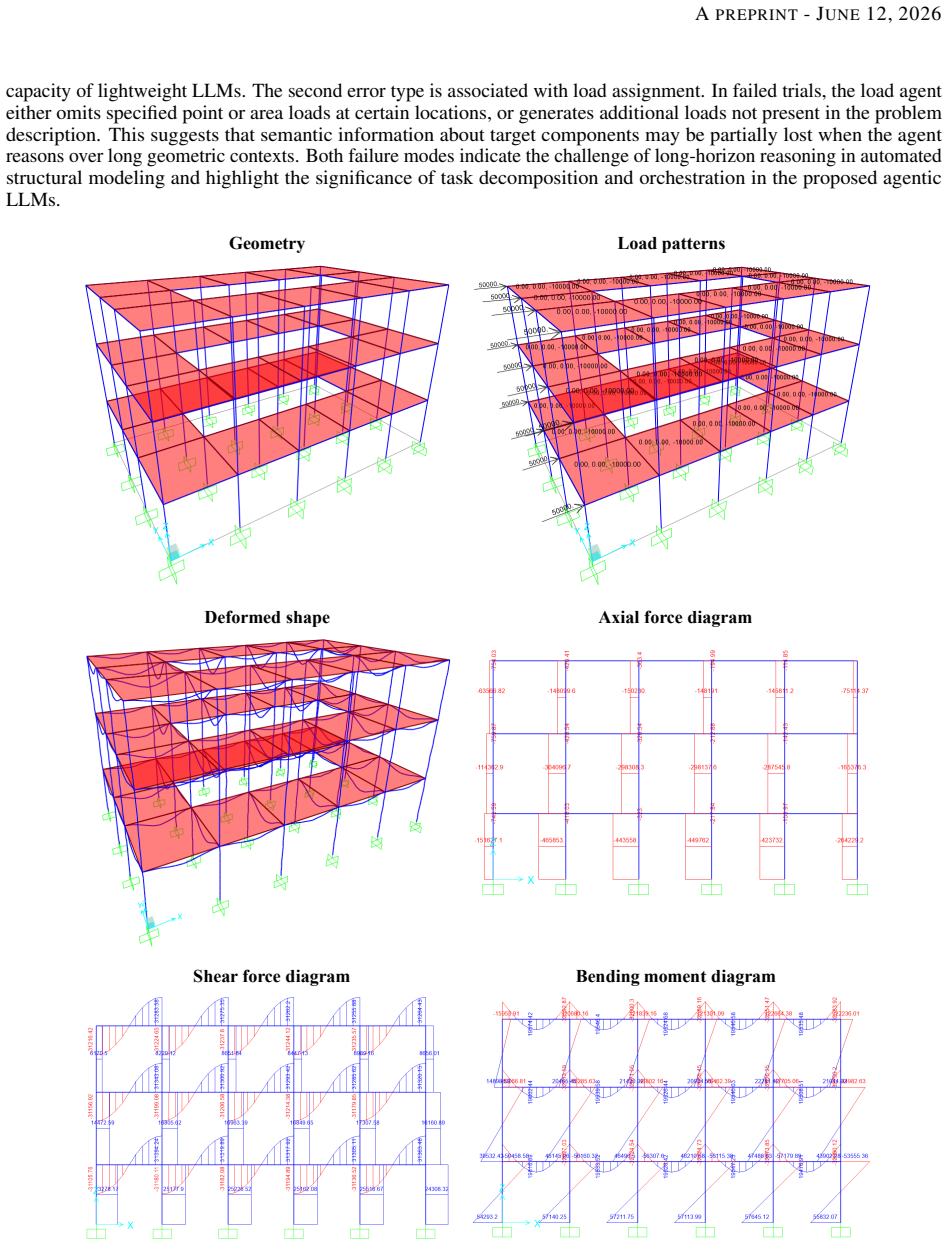


read the original abstract
Large language models (LLMs) have emerged as powerful foundation models with strong reasoning capabilities across domains. Beyond reactive text generation, agentic LLMs enable autonomous workflow execution through modular task decomposition and coordinated tool use. In structural engineering, recent efforts have developed agentic LLMs for automated analysis of plane frames. However, their extension to 3D frames remains underexplored due to challenges in irregular geometric representation, topological consistency, and long-horizon reasoning. This paper proposes an agentic LLM framework for automated structural analysis of 3D frames from natural language inputs. Irregular 3D frames are represented by projection onto a 2D plan, where orthogonal gridlines define spatial coordinates and a matrix of number of stories encodes vertical extrusion of each grid cell. Building on this representation, the framework establishes a multi-agent pipeline: a problem analysis agent parses input into structured JSON; a floor decomposition agent derives the spatial layout of each floor; the 3D geometry is assembled by node, girder, slab, and column agents; support and load agents assign boundary and loading conditions, and code translation agents generate executable SAP2000 script. Evaluated on ten representative 3D frames, the proposed framework achieves an average accuracy of 90% across repeated trials, demonstrating consistent and reliable performance.
Editorial analysis
A structured set of objections, weighed in public.
Referee Report
Summary. The manuscript proposes an agentic LLM framework for automated structural analysis of 3D frames from natural language inputs. Irregular 3D geometries are represented by 2D projection onto orthogonal gridlines (defining XY coordinates) plus a per-cell story matrix (encoding vertical extrusion). A multi-agent pipeline then parses the input to JSON, decomposes floor layouts, assembles 3D geometry via node/girder/slab/column agents, assigns supports and loads, and generates executable SAP2000 scripts. The central empirical claim is that the framework achieves 90% average accuracy across repeated trials on ten representative 3D frames.
Significance. If the 90% accuracy claim can be substantiated with explicit metrics, diverse test cases, and validation against ground-truth connectivity, the work would demonstrate a viable multi-agent decomposition for long-horizon structural engineering tasks and a compact representation for 3D frames. The empirical evaluation on multiple frames is a positive step toward reproducible automation; the projection-plus-matrix approach, if shown to preserve topology, offers a practical alternative to direct 3D mesh handling.
major comments (2)
- [Abstract] Abstract: the claim of 'average accuracy of 90%' provides no definition of the accuracy metric (e.g., script syntax validity, successful SAP2000 execution, or match to ground-truth nodal connectivity and member forces), no description of the ten test frames, and no per-component error rates or statistical tests. This information is required to evaluate the central performance assertion.
- [Abstract] Abstract (representation paragraph): the orthogonal-grid + story-matrix method is stated to handle 'irregular 3D frames,' yet the manuscript supplies no evidence that any of the ten test frames contain non-grid-aligned members, staggered columns, or floor-specific irregularities. Without such cases, the subsequent JSON parsing and node/girder/column agents cannot be shown to maintain topological consistency, which is load-bearing for the pipeline's correctness.
minor comments (1)
- The abstract would be clearer if it briefly indicated the mechanism used for inter-agent coordination and error recovery.
Simulated Author's Rebuttal
We thank the referee for the constructive feedback on our manuscript. We address each major comment below and will make revisions to improve clarity and substantiation of the claims.
read point-by-point responses
-
Referee: [Abstract] Abstract: the claim of 'average accuracy of 90%' provides no definition of the accuracy metric (e.g., script syntax validity, successful SAP2000 execution, or match to ground-truth nodal connectivity and member forces), no description of the ten test frames, and no per-component error rates or statistical tests. This information is required to evaluate the central performance assertion.
Authors: We agree that the abstract should more explicitly define the accuracy metric and reference the test cases. The metric, detailed in the Experiments section, measures the fraction of trials in which the generated SAP2000 script executes without errors and yields results matching ground-truth nodal connectivity and member forces within engineering tolerances. The ten frames are described there as representative 3D systems. In revision we will expand the abstract to include a concise definition of the metric, a brief characterization of the test frames, and a pointer to the per-component results and statistics already reported in the body. revision: yes
-
Referee: [Abstract] Abstract (representation paragraph): the orthogonal-grid + story-matrix method is stated to handle 'irregular 3D frames,' yet the manuscript supplies no evidence that any of the ten test frames contain non-grid-aligned members, staggered columns, or floor-specific irregularities. Without such cases, the subsequent JSON parsing and node/girder/column agents cannot be shown to maintain topological consistency, which is load-bearing for the pipeline's correctness.
Authors: The projection-plus-matrix representation encodes irregularities via per-cell story counts, which directly supports staggered columns and floor-specific extrusions while preserving topology. We acknowledge, however, that the manuscript does not explicitly document which of the ten frames exhibit these features. We will add a table or subsection in the Experiments section that lists the geometric characteristics of each test frame, including the presence or absence of non-grid-aligned elements and floor irregularities, thereby demonstrating that the agents maintain consistency on the evaluated cases. Should the current set prove limited, we will qualify the claim accordingly. revision: yes
Circularity Check
No circularity; empirical evaluation on independent test frames
full rationale
The paper describes a multi-agent LLM pipeline for converting natural language descriptions of 3D frames into SAP2000 scripts via a 2D orthogonal grid projection and story matrix. The central result is an empirical accuracy metric (90% average on ten frames) obtained from repeated trials. No equations, fitted parameters, or derivations are present that reduce by construction to the inputs. The representation choice is an explicit modeling assumption rather than a self-definitional step, and the reported performance is measured against external ground truth rather than being statistically forced by the method itself. No self-citation chains or uniqueness theorems are invoked as load-bearing elements. The derivation chain is therefore self-contained against external benchmarks.
Axiom & Free-Parameter Ledger
Reference graph
Works this paper leans on
-
[1]
Multi-agent large language model framework for code-compliant automated design of reinforced concrete structures
“Multi-agent large language model framework for code-compliant automated design of reinforced concrete structures.”Automation in Construction, 177: 106331. 15 APREPRINT- JUNE12, 2026 Chen, J. and Bao, Y
2026
-
[2]
Empowering llms with logical reasoning: A comprehensive survey
“Empowering llms with logical reasoning: A comprehensive survey.”arXiv preprint arXiv:2502.15652. Cheng, M., Wang, D., Yu, S., Li, Q., Ouyang, J., Luo, Y ., Zhang, Y ., Liu, Q., and Chen, E
-
[3]
Retrieval-Augmented Generation for Large Language Models: A Survey
“Retrieval- augmented generation for large language models: A survey.”arXiv preprint arXiv:2312.10997, 2 (1):
work page internal anchor Pith review Pith/arXiv arXiv
-
[4]
Geng, Z., Liu, J., Cao, R., Cheng, L., Frangopol, D. M., and Cheng, M. 2026a. “A novel multi-agent architecture to reduce hallucinations of large language models in multi-step structural modeling.”arXiv preprint arXiv:2603.07728. Geng, Z., Liu, J., Cao, R., Cheng, L., Wang, H., and Cheng, M
-
[5]
A lightweight large language model-based multi-agent system for 2D frame structural analysis
“A lightweight large language model-based multi-agent system for 2d frame structural analysis.”arXiv preprint arXiv:2510.05414. Geng, Z., Liu, J., Franklin, I., Cao, R., Frangopol, D. M., and Cheng, M. 2026b. “Automating structural analysis across multiple software platforms using large language models.”arXiv preprint arXiv:2604.09866. Google DeepMind
-
[6]
Livecodebench: Holistic and contamination free evaluation of large language models for code
“Livecodebench: Holistic and contamination free evaluation of large language models for code.”International Conference on Learning Representations, V ol. 2025, 58791–58831. Jimenez, C. E., Yang, J., Wettig, A., Yao, S., Pei, K., Press, O., and Narasimhan, K
2025
-
[7]
Integrating large language models for automated structural analysis
“Swe-bench: Can language models resolve real-world github issues?.”International Conference on Learning Representations, V ol. 2024, 54107–54157. Liang, H., Kalaleh, M. T., and Mei, Q. 2025a. “Integrating large language models for automated structural analysis.” arXiv preprint arXiv:2504.09754. Liang, H., Zhou, Y ., Kalaleh, M. T., and Mei, Q. 2025b. “Aut...
-
[8]
Gsm-symbolic: Understanding the limitations of mathematical reasoning in large language models
“Gsm-symbolic: Understanding the limitations of mathematical reasoning in large language models.”International Conference on Learning Representations, V ol. 2025, 94743–94765. OpenAI
2025
-
[9]
Infobench: Evaluating instruction following ability in large language models
“Infobench: Evaluating instruction following ability in large language models.”Findings of the Association for Computational Linguistics: ACL 2024, 13025–13048. Schick, T., Dwivedi-Yu, J., Dessì, R., Raileanu, R., Lomeli, M., Hambro, E., Zettlemoyer, L., Cancedda, N., and Scialom, T
2024
-
[10]
SoM- 1K: A Thousand-Problem Benchmark Dataset for Strength of Materials
“Som-1k: A thousand-problem benchmark dataset for strength of materials.”arXiv preprint arXiv:2509.21079. Wang, L., Ma, C., Feng, X., Zhang, Z., Yang, H., Zhang, J., Chen, Z., Tang, J., Chen, X., Lin, Y ., et al
-
[11]
Self-Consistency Improves Chain of Thought Reasoning in Language Models
“Self-consistency improves chain of thought reasoning in language models.”arXiv preprint arXiv:2203.11171. 16 APREPRINT- JUNE12, 2026 Wei, J., Wang, X., Schuurmans, D., Bosma, M., Xia, F., Chi, E., Le, Q. V ., Zhou, D., et al
work page internal anchor Pith review Pith/arXiv arXiv 2026
-
[12]
ReAct: Synergizing Reasoning and Acting in Language Models
“React: Synergizing reasoning and acting in language models.”arXiv preprint arXiv:2210.03629. Zeng, Z., Yu, J., Gao, T., Meng, Y ., Goyal, T., and Chen, D
work page internal anchor Pith review Pith/arXiv arXiv
-
[13]
Evaluating large language models at evaluating instruction following
“Evaluating large language models at evaluating instruction following.”International Conference on Learning Representations, V ol. 2024, 40193–40219. 17
2024
discussion (0)
Sign in with ORCID, Apple, or X to comment. Anyone can read and Pith papers without signing in.