Quantized AI Inference on Constrained Embedded Platforms for Small-Satellite Settings
Pith reviewed 2026-06-28 04:05 UTC · model grok-4.3
The pith
Measurements on Cortex-M platforms establish a structured reference for estimating execution times of quantized AI inference across orchestrated configurations in small-satellite settings.
A machine-rendered reading of the paper's core claim, the machinery that carries it, and where it could break.
Core claim
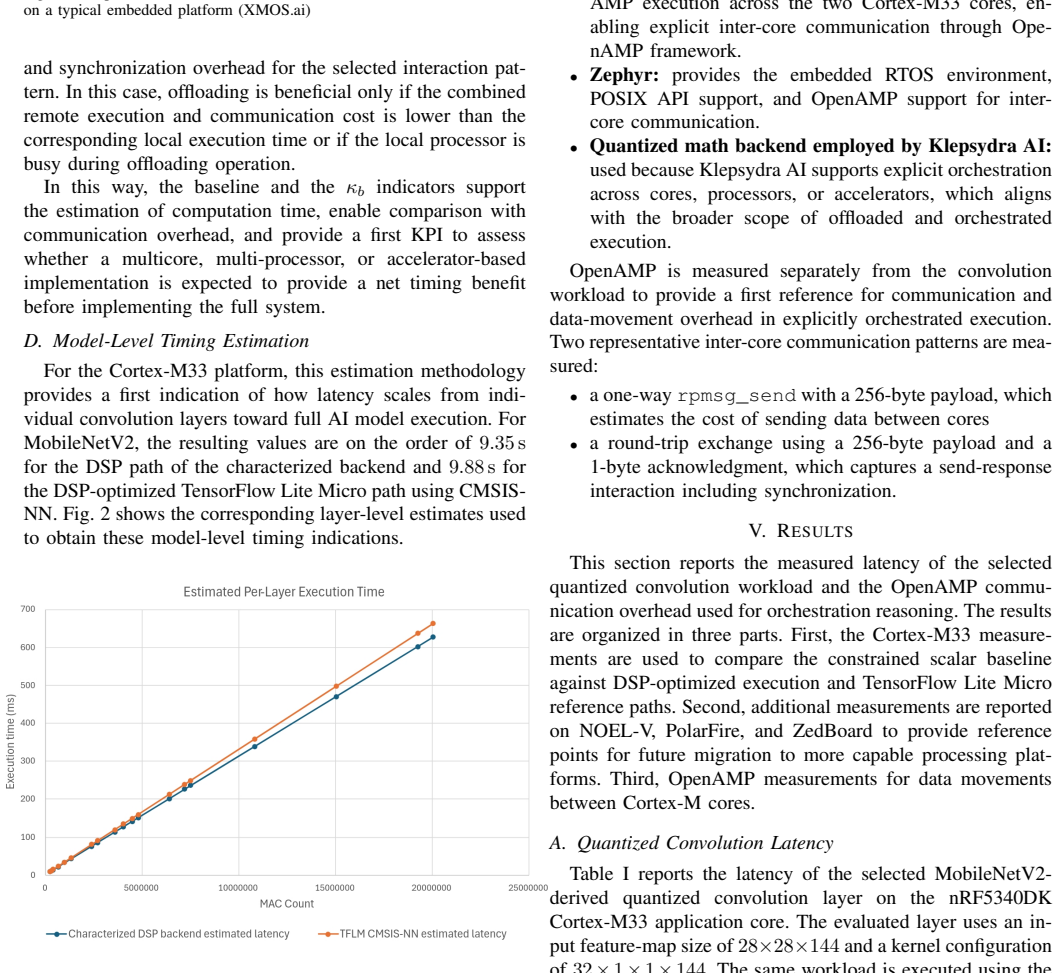
In resource-constrained small-satellite settings, a measurement-based characterization of quantized execution for an embedded-vision neural-network workload on Cortex-M class platforms serves as a lower-bound operating point. This provides a structured reference for estimating execution time across orchestrated configurations, treating orchestration and architectural variation as explicit design choices. Latency metrics alongside data-movement observations are reported and interpreted in light of ALU/SIMD utilization under quantized arithmetic, outlining a reference point for more space-typical embedded processor classes.
What carries the argument
The measurement-based characterization of quantized AI inference on Cortex-M platforms, which supplies a structured reference for execution-time estimation when orchestration and architecture are treated as explicit variables.
If this is right
- Execution times for multi-core and multi-device orchestrated setups can be estimated directly from the Cortex-M baseline without assuming OS-managed transparency.
- Instruction efficiency and memory-movement costs become primary factors in timing predictions under quantized arithmetic.
- The baseline serves as a reference point for comparing results obtained on LEON or NOEL-V class processors.
- ALU/SIMD utilization metrics provide an interpretive lens for latency and data-movement observations.
Where Pith is reading between the lines
- The baseline could be extended to include power-consumption measurements to link timing estimates with satellite energy budgets.
- Applying the same characterization method to additional neural-network workloads would test whether the reference remains stable across different model architectures.
- The explicit-orchestration framing suggests that custom scheduling policies could be evaluated by their deviation from the reported lower-bound timings.
Load-bearing premise
Measurements on Cortex-M class platforms under the chosen workload constitute a valid lower-bound operating point that generalizes to more space-typical embedded processor classes such as LEON/NOEL-V.
What would settle it
Execution-time predictions derived from the Cortex-M baseline would be falsified by direct measurements on LEON or NOEL-V processors that show consistent, large deviations under comparable workloads, quantization, and explicit orchestration.
Figures

read the original abstract
In resource-constrained small-satellite settings, AI inference must operate under tight size, power, and payload budgets, which tend to limit onboard compute capability and data handling. These conditions motivate establishing a clear baseline for quantized AI inference under bounded compute and memory resources. To instantiate this baseline, a representative embedded-vision neural-network workload serves as the reference case. With this motivation, this paper presents a measurement-based characterization of quantized execution for this AI workload on highly constrained embedded platforms (for instance, Cortex-M), grounded as a lower-bound operating point. In this regime, scaling tends to rely on explicit orchestration rather than OS-managed, transparent multicore scheduling, and timing behavior is shaped by instruction efficiency and memory movement. As a result, the characterization provides a structured reference for estimating execution time across orchestrated configurations (e.g., multiple cores and/or devices), treating orchestration and architectural variation as explicit design choices. We report latency metrics alongside data-movement observations, and interpret these measurements in light of ALU/SIMD utilization under quantized arithmetic for the Cortex-M. Finally, we outline how this baseline provides a reference point for positioning the results against more space-typical embedded processor classes (e.g., LEON/NOEL-V).
Editorial analysis
A structured set of objections, weighed in public.
Referee Report
Summary. The manuscript presents a measurement-based characterization of quantized AI inference execution on Cortex-M class embedded platforms, using a representative embedded-vision neural-network workload. It reports latency metrics and data-movement observations under quantized arithmetic, interprets ALU/SIMD utilization, and positions the results as a structured lower-bound reference for estimating execution time in explicitly orchestrated multi-core or multi-device configurations. The work further outlines how this Cortex-M baseline can serve as a reference point when positioning results against more space-typical embedded processors such as LEON or NOEL-V.
Significance. If the experimental details, workload specification, error analysis, and validation steps were supplied and the generalization to other architectures were grounded with data or models, the characterization could provide a practical reference for designers estimating AI inference timing under explicit orchestration in size/power-constrained small-satellite payloads. The explicit treatment of orchestration and architectural variation as design choices, rather than relying on OS-managed scheduling, is a constructive framing for constrained embedded settings.
major comments (2)
- [Abstract] Abstract: The claim that the Cortex-M characterization constitutes a valid lower-bound operating point and structured reference for LEON/NOEL-V (or other space-typical processors) is unsupported. No cross-architecture measurements, scaling model, or adjustment factors are supplied to account for ISA differences (SPARC/RISC-V vs. ARM), memory access patterns, instruction latencies, or SIMD availability. This assumption is load-bearing for the central claim that the baseline enables estimation across architectural variation.
- [Abstract] Abstract: The description of a 'measurement-based characterization' supplies no experimental details, workload specification, platform configurations, error analysis, or validation steps. Without these, the reported latency metrics and data-movement observations cannot be assessed for reproducibility or support of the baseline claim.
Simulated Author's Rebuttal
We thank the referee for the constructive comments on our manuscript. We address each major comment point by point below, clarifying the scope of our claims and indicating where revisions will be made.
read point-by-point responses
-
Referee: [Abstract] Abstract: The claim that the Cortex-M characterization constitutes a valid lower-bound operating point and structured reference for LEON/NOEL-V (or other space-typical processors) is unsupported. No cross-architecture measurements, scaling model, or adjustment factors are supplied to account for ISA differences (SPARC/RISC-V vs. ARM), memory access patterns, instruction latencies, or SIMD availability. This assumption is load-bearing for the central claim that the baseline enables estimation across architectural variation.
Authors: We agree that the manuscript does not supply cross-architecture measurements or a quantitative scaling model. The lower-bound framing is motivated by Cortex-M representing a more resource-constrained environment (lower frequency, narrower memory interfaces, and limited SIMD) than space-grade processors, providing a conservative reference point under explicit orchestration. However, this does not constitute empirical support for direct estimation across ISAs. We will revise the abstract and discussion to qualify the reference as conceptual, based on relative resource bounds rather than a validated mapping, and remove any implication of quantitative cross-architecture estimation. revision: partial
-
Referee: [Abstract] Abstract: The description of a 'measurement-based characterization' supplies no experimental details, workload specification, platform configurations, error analysis, or validation steps. Without these, the reported latency metrics and data-movement observations cannot be assessed for reproducibility or support of the baseline claim.
Authors: Abstracts are intentionally high-level summaries. The full manuscript provides the experimental details, including the embedded-vision neural-network workload, Cortex-M platform variants and configurations, measurement methodology for latency and data movement, ALU/SIMD utilization analysis, error considerations, and validation approach. We will make a partial revision to the abstract by adding one sentence referencing the key workload class and primary platform family to improve traceability without exceeding length constraints. revision: partial
Circularity Check
No circularity: purely empirical characterization with no derivations or self-referential steps
full rationale
The manuscript reports direct latency and data-movement measurements on Cortex-M platforms under a quantized vision workload. No equations, fitted parameters, predictions derived from subsets of the data, or self-citations appear in the provided text. The claim that the Cortex-M results serve as a reference point for other architectures (LEON/NOEL-V) is presented as an outline of future positioning rather than a mathematical derivation or fitted model that reduces to the inputs by construction. All load-bearing content is observational data; therefore the derivation chain is empty and the paper is self-contained against external benchmarks.
Axiom & Free-Parameter Ledger
axioms (1)
- domain assumption The representative embedded-vision neural-network workload is suitable for establishing a lower-bound reference for small-satellite AI inference.
Reference graph
Works this paper leans on
-
[1]
Ahmad and S
H. Ahmad and S. I. Jhara, ”AI-driven approaches for real- time satellite data processing and analysis,” presented at the NASA Accelerating Informatics for Earth Science Workshop, Arlington, V A, USA, Jun. 13, 2024. [Online]. Available: https://assets.science.nasa.gov/content/dam/science/cds/science- enabling-technology/events/2025/accelerating- informatic...
2024
-
[2]
B. Chintalapati, A. Precht, S. Hanra, R. Laufer, M. Liwicki, and J. Eickhoff, “Opportunities and challenges of on-board AI-based image recognition for small satellite Earth observation missions,”Advances in Space Research, vol. 75, no. 9, pp. 6734–6751, May 2025, doi: 10.1016/j.asr.2024.03.053
-
[3]
TensorFlow Lite Micro: Embedded machine learning on TinyML systems,
R. David, J. Duke, A. Jain, V . J. Reddi, N. Jeffries, J. Li, N. Kreeger, I. Nappier, M. Natraj, S. Regev, R. Rhodes, T. Wang, and P. Warden, “TensorFlow Lite Micro: Embedded machine learning on TinyML systems,”arXiv preprint arXiv:2010.08678, 2020, doi: 10.48550/arXiv.2010.08678
-
[4]
G. Giuffrida, L. Fanucci, G. Meoni, M. Batic, L. Buckley, A. Dunne, C. van Dijk, M. Esposito, J. Hefele, N. Vercruyssen, G. Furano, M. Pastena, and J. Aschbacher, “TheΦ-Sat-1 mission: The first on-board deep neural network demonstrator for satellite earth observation,”IEEE Transactions on Geoscience and Remote Sensing, vol. 60, pp. 1–14, 2022, doi: 10.110...
-
[5]
GR740 next generation microprocessor flight models,
CAES, “GR740 next generation microprocessor flight models,” presented at the TEC-ED & TEC-SW Final Presentation Day, European Space Agency, Jun. 2021. [Online]. Avail- able: http://microelectronics.esa.int/finalreport/GR740-NGMP- FinalPresentation-Public-2021-06-01.pdf
2021
-
[6]
Extending the NOEL-V platform with a RISC-V vector processor for space applications,
S. Di Mascio, A. Menicucci, E. Gill, and C. Monteleone, “Extending the NOEL-V platform with a RISC-V vector processor for space applications,”Journal of Aerospace Information Systems, vol. 20, no. 9, pp. 565–574, Sep. 2023, doi: 10.2514/1.I011097
-
[7]
RTG4™ radiation-tolerant FPGAs,
Microchip Technology Inc., “RTG4™ radiation-tolerant FPGAs,” Microchip Technology Inc. [Online]. Available: https://www.microchip.com/en-us/products/fpgas-and-plds/radiation- tolerant-fpgas/rtg4-radiation-tolerant-fpgas. [Accessed: Apr. 28, 2026]
2026
-
[8]
Microchip – Pioneering radiation-tolerant SoC FPGAs for space: Low power, zero configuration upsets, and RISC-V architecture,
H. P. de Almeida Nobre and M. Nguyen, “Microchip – Pioneering radiation-tolerant SoC FPGAs for space: Low power, zero configuration upsets, and RISC-V architecture,” presented at the SEFUW: SpacE FPGA Users Workshop, 6th ed., European Space Research and Technol- ogy Centre (ESTEC), Noordwijk, The Netherlands, Mar. 27, 2025. [On- line]. Available: https://...
2025
-
[9]
Application of AMD Versal™ adaptive SoC to radar space time adaptive processing in space,
J. Timpe, K. O’Neill, D. Qendri, B. Berkane, G. Chapman, and D. Quinn, “Application of AMD Versal™ adaptive SoC to radar space time adaptive processing in space,” inProc. 2023 European Data Handling & Data Processing Conf. (EDHPC), Juan Les Pins, France, Oct. 2–6, 2023, doi: 10.23919/EDHPC59100.2023.10396329
-
[10]
Quantization and Training of Neural Networks for Efficient Integer-Arithmetic-Only Inference
B. Jacob, S. Kligys, B. Chen, M. Zhu, M. Tang, A. Howard, H. Adam, and D. Kalenichenko, “Quantization and training of neural networks for efficient integer-arithmetic-only inference,” inProc. IEEE/CVF Conf. Computer Vision and Pattern Recognition (CVPR), Salt Lake City, UT, USA, Jun. 2018, pp. 2704–2713, doi: 10.1109/CVPR.2018.00286
-
[11]
TensorFlow Lite Micro: Embedded machine learning on TinyML systems,
R. David, J. Duke, A. Jain, V . J. Reddi, N. Jeffries, J. Li, N. Kreeger, I. Nappier, M. Natraj, S. Regev, R. Rhodes, T. Wang, and P. Warden, “TensorFlow Lite Micro: Embedded machine learning on TinyML systems,” inProc. 4th Conf. Machine Learning and Systems (MLSys), San Jose, CA, USA, 2021
2021
-
[12]
CMSIS-NN: Efficient Neural Network Kernels for Arm Cortex-M CPUs
L. Lai, N. Suda, and V . Chandra, “CMSIS-NN: Efficient neural network kernels for Arm Cortex-M CPUs,”arXiv preprint arXiv:1801.06601, 2018, doi: 10.48550/arXiv.1801.06601
work page internal anchor Pith review Pith/arXiv arXiv doi:10.48550/arxiv.1801.06601 2018
-
[13]
A secure and hardware-agnostic AI software framework for intelligent space systems,
P. Ghiglino, “A secure and hardware-agnostic AI software framework for intelligent space systems,” presented at INSIDE Connect 2025, Project Exhibition & Pitches, Valencia, Spain, Sep. 3, 2025. [Online]. Available: https://inside-association.eu/wp- content/uploads/presentations/3 sept/5 project exhibition pitches/3 pablo ghiglino psr pitch inside 2025.pdf...
2025
-
[14]
Achieving dependability of AI execution with radiation hardened processors,
C. R. T. Taquichiri, H. D. Doran, P. Ghiglino, and M. Harshe, “Achieving dependability of AI execution with radiation hardened processors,”arXiv preprint arXiv:2504.03680, 2025, doi: 10.48550/arXiv.2504.03680
-
[15]
Evalu- ating the OpenAMP framework in real-time embedded SoC platforms,
S. Alonso, J. L ´azaro, J. Jim ´enez, L. Muguira, and U. Bidarte, “Evalu- ating the OpenAMP framework in real-time embedded SoC platforms,” inProc. 2021 XXXVI Conf. Design of Circuits and Integrated Systems (DCIS), Vila do Conde, Portugal, Nov. 24–26, 2021, pp. 1–6, doi: 10.1109/DCIS53048.2021.9666157
discussion (0)
Sign in with ORCID, Apple, or X to comment. Anyone can read and Pith papers without signing in.