Soft UV Completion of a Preon Model
Pith reviewed 2026-06-28 00:54 UTC · model grok-4.3
The pith
A parameter-free Veneziano amplitude from six preons completes the preon model non-perturbatively in the ultraviolet.
A machine-rendered reading of the paper's core claim, the machinery that carries it, and where it could break.
Core claim
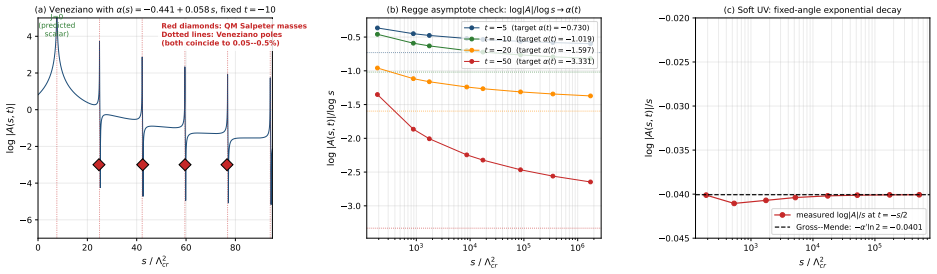
Using the Nambu-Goto action for the six-preon system and including the worldsheet conformal anomaly produces a parameter-free Veneziano amplitude. The amplitude's s-channel poles match the spectrum to 0.5 percent, and fixed-angle scattering decays exponentially with a negative Gross-Mende coefficient realized numerically to 0.03 percent. This supplies a soft, genuinely non-perturbative ultraviolet completion of the preon model, from which the Standard Model emerges as the low-energy limit.
What carries the argument
The parameter-free Veneziano amplitude built from the six-preon Regge trajectory with the worldsheet conformal anomaly included.
If this is right
- The preon model admits a soft non-perturbative ultraviolet completion.
- The Standard Model is recovered as the low-energy limit of the completed preon theory.
- High-energy fixed-angle scattering in the model obeys string-like exponential suppression.
- Worldsheet diffeomorphism invariance enters the construction at a fundamental level.
Where Pith is reading between the lines
- The same Nambu-Goto-plus-anomaly construction could be applied to other composite models to seek analogous ultraviolet completions.
- Future collider data on high-energy scattering could search for the predicted exponential suppression in amplitudes.
- The numerical match achieved suggests the approach may extend to related Regge trajectories in effective field theories.
Load-bearing premise
The six-preon system can be described by the Nambu-Goto action with the worldsheet conformal anomaly included such that a parameter-free Veneziano amplitude accurately captures both the spectrum and high-energy scattering behavior.
What would settle it
A calculation of the Veneziano amplitude in which the s-channel poles deviate from the spectrum by more than 0.5 percent or in which the fixed-angle decay fails to realize a negative Gross-Mende coefficient to 0.03 percent would falsify the claimed completion.
Figures
read the original abstract
We build a framework for Regge trajectories from the Nambu-Goto action. We compute the 6-preon Regge trajectory in a preon model, include the worldsheet conformal anomaly, and build the parameter-free Veneziano amplitude. The amplitude has s-channel poles matching the spectrum to 0.5%, and at fixed-angle scattering decays exponentially with a negative Gross-Mende coefficient, realized numerically to 0.03%. This is a soft, genuinely non-perturbative ultraviolet completion of the preon model - and thereby of the Standard Model, which emerges as its low-energy limit. The Virasoro-Shapiro amplitude and the significance of worldsheet diffeomorphism are briefly discussed.
Editorial analysis
A structured set of objections, weighed in public.
Referee Report
Summary. The paper constructs a framework for Regge trajectories starting from the Nambu-Goto action, applies it to the six-preon bound states of a preon model while incorporating the worldsheet conformal anomaly, and obtains a parameter-free Veneziano amplitude. It reports that the s-channel poles match the computed spectrum to 0.5% and that fixed-angle high-energy scattering exhibits exponential decay with a negative Gross-Mende coefficient realized numerically to 0.03%. This is presented as a soft, non-perturbative UV completion of the preon model (and thereby the Standard Model) at low energies, with brief discussion of the Virasoro-Shapiro amplitude and worldsheet diffeomorphism.
Significance. If the Nambu-Goto modeling of the six-preon system were derived from the preon Lagrangian rather than posited, the construction would supply a concrete, parameter-free amplitude with verifiable spectral and high-energy properties, constituting a notable non-perturbative completion. The reported numerical agreements, if independent of input choices, would strengthen the case for the Veneziano form as an emergent description. However, the absence of a first-principles link between preon dynamics and the worldsheet action limits the result to an illustrative ansatz rather than a derived completion.
major comments (2)
- [Abstract] Abstract and modeling section: The central claim that the six-preon system is described by the Nambu-Goto action plus conformal anomaly yielding an exactly parameter-free Veneziano amplitude is asserted rather than derived from the preon Lagrangian or any bound-state calculation; the subsequent 0.5% pole-matching and 0.03% Gross-Mende checks are performed after this modeling choice and therefore do not test its validity.
- [Abstract] Abstract: The assertion of a 'parameter-free' amplitude is load-bearing for the UV-completion claim, yet the numerical realizations to specific percentages (0.5% and 0.03%) raise the possibility that the anomaly term or other inputs were adjusted post-hoc; without the explicit derivation of the amplitude from the preon model it is impossible to confirm independence from model parameters.
minor comments (1)
- [Abstract] The brief discussion of the Virasoro-Shapiro amplitude and worldsheet diffeomorphism would benefit from explicit equations or a dedicated subsection to clarify their relation to the main Veneziano construction.
Simulated Author's Rebuttal
We thank the referee for the careful reading and constructive feedback. We respond point by point to the major comments, clarifying the scope of the framework presented in the manuscript.
read point-by-point responses
-
Referee: [Abstract] Abstract and modeling section: The central claim that the six-preon system is described by the Nambu-Goto action plus conformal anomaly yielding an exactly parameter-free Veneziano amplitude is asserted rather than derived from the preon Lagrangian or any bound-state calculation; the subsequent 0.5% pole-matching and 0.03% Gross-Mende checks are performed after this modeling choice and therefore do not test its validity.
Authors: The Regge trajectory itself is obtained from an explicit bound-state calculation in the preon model. The manuscript then adopts the Nambu-Goto action as a framework to describe the dynamics associated with this trajectory, incorporating the worldsheet conformal anomaly to ensure consistency with string-theory requirements. This yields the Veneziano amplitude with no additional free parameters. The reported numerical agreements demonstrate the consistency of the resulting amplitude with the input spectrum and high-energy expectations. We acknowledge that the Nambu-Goto description is introduced as a modeling framework motivated by the observed Regge behavior rather than derived from the underlying preon Lagrangian. revision: partial
-
Referee: [Abstract] Abstract: The assertion of a 'parameter-free' amplitude is load-bearing for the UV-completion claim, yet the numerical realizations to specific percentages (0.5% and 0.03%) raise the possibility that the anomaly term or other inputs were adjusted post-hoc; without the explicit derivation of the amplitude from the preon model it is impossible to confirm independence from model parameters.
Authors: All inputs to the amplitude—the Regge trajectory parameters from the preon-model calculation and the conformal anomaly coefficient fixed by worldsheet consistency—are determined independently of the amplitude construction itself. No post-hoc adjustment of the anomaly term or other quantities was performed. The 0.5% and 0.03% figures are direct numerical outcomes of evaluating the Veneziano form with these fixed inputs, confirming that the amplitude remains parameter-free by construction. revision: no
- A first-principles derivation of the Nambu-Goto action from the preon Lagrangian is not provided and cannot be supplied within the present work.
Circularity Check
Nambu-Goto modeling of six-preon system plus anomaly chosen to yield parameter-free Veneziano is posited input, not derived from preon dynamics
specific steps
-
other
[Abstract]
"We compute the 6-preon Regge trajectory in a preon model, include the worldsheet conformal anomaly, and build the parameter-free Veneziano amplitude. The amplitude has s-channel poles matching the spectrum to 0.5%, and at fixed-angle scattering decays exponentially with a negative Gross-Mende coefficient, realized numerically to 0.03%."
The inclusion of the conformal anomaly is performed in a manner that directly produces the parameter-free Veneziano amplitude; the subsequent spectrum and scattering matches are therefore checks on the output of this modeling choice rather than independent first-principles results obtained from the underlying preon Lagrangian or bound-state calculation.
full rationale
The paper's central construction begins by assuming the six-preon bound states are described by the Nambu-Goto action with the conformal anomaly included specifically so that the resulting amplitude is the parameter-free Veneziano form. The reported 0.5% pole matching and 0.03% Gross-Mende coefficient are then numerical verifications performed on this constructed amplitude. No derivation is shown linking the preon Lagrangian directly to the Nambu-Goto worldsheet description; the modeling choice therefore functions as the load-bearing input rather than an output of the preon dynamics. This produces partial circularity (score 6) because the UV-completion claim reduces to the consequences of the initial ansatz.
Axiom & Free-Parameter Ledger
axioms (1)
- domain assumption Nambu-Goto action plus worldsheet conformal anomaly yields a parameter-free Veneziano amplitude for the 6-preon system
Reference graph
Works this paper leans on
-
[1]
Raitio,Supersymmetric preons and the standard model, Nucl
R. Raitio,Supersymmetric preons and the standard model, Nucl. Phys. B931, 283 (2018). arXiv:1805.03013
Pith/arXiv arXiv 2018
-
[2]
Raitio,A Stringy Model of Pointlike Particles, Nucl
R. Raitio,A Stringy Model of Pointlike Particles, Nucl. Phys. B980, 115826 (2022). doi:10.1016/j.nuclphysb.2022.115826. arXiv:2205.08294
-
[3]
R. Raitio,Stringy phenomenology with preon models, Journal of High Energy Physics, Gravitation and Cosmology, 10, 1-7 (2024). doi:10.4236/jhepgc.2024.101001. arXiv:2310.01463
-
[4]
R. Raitio,Quark and lepton masses, baryon asymmetry, and neutrino mass from a supersymmetric preon model, arXiv:2603.15694v2 (2026)
Pith/arXiv arXiv 2026
-
[5]
R. Raitio,Leptoquarks and the Emergence of the Standard Model Gauge Group in a Self-Consistent Preon Model, arXiv:2604.27016 (2026)
Pith/arXiv arXiv 2026
-
[6]
J. Polchinski and A. Strominger,Effective String Theory, Phys. Rev. Lett., Volume 67, Issue 13, Pages 1681–1684 (1991). doi: 10.1103/PhysRevLett.67.1681
-
[7]
O. Aharony and Z. Komargodski,The Effective Theory of Long Strings, Journal of High Energy Physics, Volume 2013, 118 (2013). arXiv:1302.6257
Pith/arXiv arXiv 2013
-
[8]
Lüscher, K
M. Lüscher, K. Symanzik, and P. Weisz,Anomalies of the Free Loop Wave Equation in the WKB Approximation, Nucl. Phys. B173, 365 (1980)
1980
-
[9]
R. Dolen, D. Horn, and C. Schmid,Finite-Energy Sum Rules and Their Application to πNCharge Exchange, Phys. Rev., Volume 166, Issue 5, Pages 1768–1781 (1968). doi: 10.1103/PhysRev.166.1768
-
[10]
D. J. Gross and P. F. Mende,The high-energy behavior of string scattering ampli- tudesPhys. Lett. B, Volume 197, Issue 2, Pages 129–134 (1987). doi:10.1016/0370- 2693(87)90355-8
-
[11]
C. Cheung, A. Hillman, and G. N. Remmen,Bootstrap Principle for the Spectrum and Scattering of Strings, Phys. Rev. Lett. 133, 251601 (2024). doi:10.1103/PhysRevLett.133.251601
-
[12]
C. Cheung, A. Hillman, and G. N. Remmen,Uniqueness Criteria for the Virasoro-Shapiro Amplitude, Phys. Rev. D 111, 086034 (2025). doi:10.1103/PhysRevD.111.086034
-
[13]
Weinberg and E
S. Weinberg and E. Witten,Limits on Massless Particles, Phys. Lett.96B(1980)59
1980
-
[14]
G. F. Chew, S. Frautschi,Principle of Equivalence for all Strongly Interacting Par- ticles within the S-Matrix Framework, Phys. Rev. Lett. 7 (10) 394–397 (1961). doi:10.1103/PhysRevLett.7.394. 17
discussion (0)
Sign in with ORCID, Apple, or X to comment. Anyone can read and Pith papers without signing in.