REVIEW 3 major objections 1 minor 53 references
Bootstrap bounds for Quantum Spin Systems using String Operators
T0 review · 3 major / 1 minor · reviewed 2026-06-27 · grok-4.3
Pith's one-line read Non-local string operators tighten bootstrap bounds on observables in symmetry-broken phases of one-dimensional quantum spin models.
desk verdict String operators add independent constraints that tighten bootstrap bounds in 1D SSB phases and allow direct thermodynamic-limit runs, but the size of the gain and the explicit independence check are the parts that still need numbers. read the letter →
The pith
A machine-rendered reading of the paper's core claim, the machinery that carries it, and where it could break.
The reading
What carries the argument
Non-local string operators that connect distant sites and detect domain-wall configurations, thereby supplying additional independent positivity constraints inside the bootstrap semidefinite program.
What would settle it
Exact diagonalization or DMRG computation of the two-point correlation function in the transverse-field Ising model deep inside the ordered phase, showing that the bootstrap bounds obtained with string operators are no tighter than those obtained from the local operator set alone.
Extended reading notes
Core claim
By including non-local string-like operators among the bootstrap constraints, the method produces significantly tighter bounds on ground-state observables in the spontaneous symmetry-breaking phases of several one-dimensional quantum spin models, and these constraints remain valid when the program is taken directly to the infinite-volume limit without finite-size corrections or truncations.
Load-bearing premise
The chosen string operators supply independent constraints that are not already implied by the local operator set and that remain valid when the bootstrap is taken directly to the thermodynamic limit without additional finite-size corrections or truncations.
Editorial extensions
If this is right
- Tighter numerical bounds on two-point correlation functions inside the SSB phase of the transverse-field Ising model.
- Quantitative estimates for the locations of phase boundaries in the axial next-nearest-neighbor Ising model.
- Tracking of bound quality across the full phase diagram of the Z3 chiral clock model.
- Extension of the bootstrap approach to a broader class of symmetry-broken and topological phases that require non-local order parameters.
Reading between the lines
- The string construction could be extended to two-dimensional lattices to constrain vortex or domain-wall excitations.
- Similar non-local operators might improve bootstrap bounds for systems with topological order or anyonic statistics.
- Systematic addition of strings of varying lengths or topologies could reveal an optimal constraint set for a given model.
- Direct thermodynamic-limit bootstrapping may reduce reliance on finite-size scaling in other many-body numerical methods.
Editorial analysis
A structured set of objections, weighed in public.
Referee Report
Summary. The paper introduces non-local string-like operators into the bootstrap method for quantum spin systems, allowing the program to be formulated directly in the thermodynamic limit without finite-size extrapolations. It applies the construction to the 1D transverse-field Ising model (claiming significant tightening of bounds in the SSB phase), the axial next-nearest-neighbor Ising model (quantitative phase-boundary estimates), and the Z3 chiral clock model (tracking bounds across the phase diagram).
Significance. If the string operators generate linearly independent positivity constraints that remain valid in the infinite-volume limit, the work would meaningfully extend bootstrap techniques to symmetry-broken phases where local operators alone cannot exclude domain-wall excitations. The direct thermodynamic-limit formulation, if rigorously justified, is a technical strength that could apply to other 1D models with extended operators.
major comments (3)
- [Abstract] Abstract and introduction: the central claim of 'significant tightening' and 'independent constraints' from string operators is load-bearing, yet the manuscript provides no numerical tables, error estimates, or explicit operator lists (as noted in the abstract's assertions); without these, it is impossible to verify that the reported improvements are not due to post-hoc operator choices or redundant constraints already implied by the local basis.
- [Method section on thermodynamic limit] The thermodynamic-limit formulation (described in the method section): the claim that the SDP can be written directly on the infinite chain requires explicit demonstration that string-operator positivity conditions remain necessary and sufficient without implicit decay assumptions or truncations; if the two-point functions of the strings are already fixed by the local algebra, the tightening would not enlarge the feasible set.
- [Results sections on TFIM and ANNNI] Applications to TFIM and ANNNI: the phase-boundary utility and SSB-phase tightening rest on the assumption that the chosen strings supply constraints linearly independent from any finite local operator set; the manuscript should include a rank comparison of the moment matrix or a table showing bound changes upon adding strings to confirm independence.
minor comments (1)
- [Method] Notation for string operators should be defined more clearly with explicit examples of their support and commutation relations to aid reproducibility.
Simulated Author's Rebuttal
We thank the referee for their thorough review and valuable suggestions. We address each of the major comments below, indicating the revisions we plan to make to improve the clarity and verifiability of our results.
read point-by-point responses
-
Referee: [Abstract] Abstract and introduction: the central claim of 'significant tightening' and 'independent constraints' from string operators is load-bearing, yet the manuscript provides no numerical tables, error estimates, or explicit operator lists (as noted in the abstract's assertions); without these, it is impossible to verify that the reported improvements are not due to post-hoc operator choices or redundant constraints already implied by the local basis.
Authors: We agree that providing explicit numerical evidence would strengthen the manuscript. In the revised version, we will add an appendix or section with the explicit list of string operators used in each model, a table of bound values with and without the string operators (including SDP solver tolerances as error estimates), and a brief discussion confirming that the improvements exceed those from simply enlarging the local operator basis. revision: yes
-
Referee: [Method section on thermodynamic limit] The thermodynamic-limit formulation (described in the method section): the claim that the SDP can be written directly on the infinite chain requires explicit demonstration that string-operator positivity conditions remain necessary and sufficient without implicit decay assumptions or truncations; if the two-point functions of the strings are already fixed by the local algebra, the tightening would not enlarge the feasible set.
Authors: The string operators are non-local and their positivity constraints derive directly from the ground-state condition without requiring finite-size truncations or decay assumptions. We will revise the method section to include a more detailed justification: the constraints are necessary because they correspond to <Psi| O_string^dagger O_string |Psi> >= 0 for the infinite-volume ground state |Psi>, and they are not redundant with local operators as the strings probe extended correlations. We will also clarify that the two-point functions of strings are not fixed by the local algebra alone. revision: yes
-
Referee: [Results sections on TFIM and ANNNI] Applications to TFIM and ANNNI: the phase-boundary utility and SSB-phase tightening rest on the assumption that the chosen strings supply constraints linearly independent from any finite local operator set; the manuscript should include a rank comparison of the moment matrix or a table showing bound changes upon adding strings to confirm independence.
Authors: We will incorporate in the revised results sections a table that shows the bound values obtained by successively adding string operators to the local basis, demonstrating the tightening at each step. Additionally, we will report the rank of the moment matrix before and after inclusion to confirm that the new constraints are linearly independent. revision: yes
Circularity Check
No circularity: string-operator constraints presented as independent extension to local bootstrap set
full rationale
The derivation introduces non-local string operators as additional positivity constraints on the moment matrix and formulates the SDP directly in the thermodynamic limit. No quoted equations reduce these constraints to local-operator results by construction, nor do any self-citations supply load-bearing uniqueness theorems or ansatzes. The tightening in SSB phases is obtained by explicit numerical application to concrete Hamiltonians (TFIM, ANNNI, Z3 clock), with the independence of the string sector asserted as an empirical outcome of the enlarged operator basis rather than a definitional identity. This satisfies the self-contained criterion; the skeptic concern about linear independence is a correctness question, not a circularity reduction.
Assumptions & free parameters
assumptions (1)
- domain assumption Expectation values of local and non-local operators must satisfy positivity and consistency inequalities that bound ground-state observables.
Cite this review
Pith. "Pith review of Bootstrap bounds for Quantum Spin Systems using String Operators." pith.science (2026). https://pith.science/paper/G5I6V5RC
@misc{pith2026260606584,
  author       = {Pith},
  title        = {Pith review of: Bootstrap bounds for Quantum Spin Systems using String Operators},
  year         = {2026},
  howpublished = {\url{https://pith.science/paper/G5I6V5RC}},
  note         = {Machine review of arXiv:2606.06584}
}
abstract
Bootstrap is a numerical many-body method that provides rigorous bounds on ground-state observables by imposing a set of necessary constraints on the expectation values of operators. The quality of the resulting bounds is sensitive to the choice of operators entering the constraints. In particular, bounds on ground-state correlations are often loose in spontaneous symmetry-breaking (SSB) phases, since local operator sets cannot exclude domain-wall excitations. In this work, we introduce non-local, string-like operators into the bootstrap and show that the program can be formulated directly in thermodynamic limit. We then apply our construction to several 1D spin models. First, we obtain a significant tightening of the bounds in the SSB phase of the 1D transverse-field Ising model. Using the 1D axial next-nearest-neighbor Ising model, we further show that this tightening allows for a quantitative estimate of the locations of phase boundaries. Finally, we generalize the string operators to the 1D $\mathbb{Z}_3$ chiral clock model and track the behavior of the bounds across the phase diagram. Our results broaden the class of constraints available to the bootstrap and open a route toward bootstrapping more general symmetry-broken and topological phases, where the relevant constraints may involve non-local or extended operators.
Figures


Figures from the paper (1 more)

Reference graph
Works this paper leans on
-
[1]
Bootstrap bounds for Quantum Spin Systems using String Operators
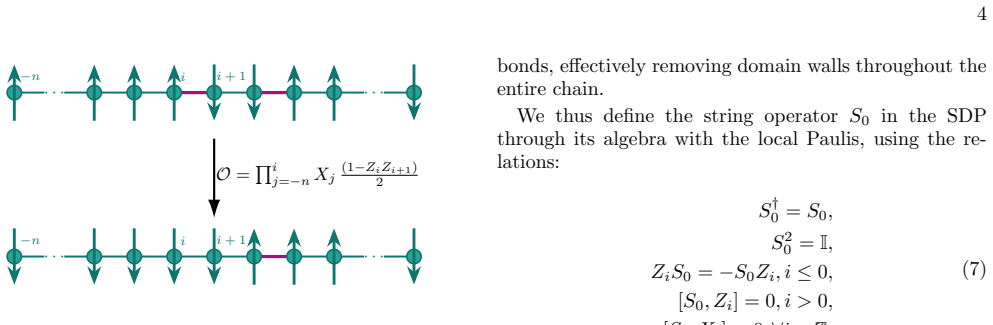
to incorporate a considerably larger number of con- straints. However, the bounds in the FM phase of the 1D TFIM only improved marginally despite coarse-graining to relatively larger operator sets. In a recent paper [30], we identified the key obstacle to bootstrapping spontaneous symmetry-broken (SSB) phases to be the presence of proliferating domain-wal...
work page Pith review arXiv 2026
-
[2]
Normalization:⟨I⟩= 1,
-
[3]
Positivity:⟨O †O⟩ ≥0,∀O ∈ B Λ,
-
[4]
Here,Iis the identity operator
Perturbative Positivity:⟨O †[H,O]⟩ ≥0,∀O ∈ B Λ. Here,Iis the identity operator. Normalization and positivity are the constraints defining a physical state. Perturbative positivity, on the other hand, excludes states whose energy can be lowered by conjugating with any operatorO∈ B Λ, and thus, defines the ground-state. A relaxation of the above constraints...
-
[5]
The action ofOon this state removes the domain wall ati, and produces a state with lower energy for the Ising Hamiltonian wheng= 0. ceives contributions from interactions between sitejand sites to its right: [Hn, S(n) j ] = 2S(n) j ZjZj+1, j < n−1.(6) Therefore, atg= 0, an operator set containing lo- cal operators together withS (n) j (1−Z jZj+1) for all ...
-
[6]
ClockZ:Z|m⟩=ω m |m⟩whereω=e 2πi/p,
-
[7]
ShiftX:X|m⟩=|m+ 1 modp⟩. FIG. 3.(a)Schematic phase diagram of the 1D ANNNI. (b)Uncertainty (difference between upper bound and lower bound) in energy density in theg−κplane. The dots rep- resent the peaks extracted from ∆E−gcuts at differentκ. The dashed line shows the Peschel-Emery disorder line where the Hamiltonian becomes frustration-free.(c)∆E−gcuts ...
-
[8]
R. O. Jones and O. Gunnarsson, Rev. Mod. Phys.61, 689 (1989)
1989
Show all 53 references
-
[9]
Burke, The Journal of chemical physics136(2012)
K. Burke, The Journal of chemical physics136(2012)
2012
-
[10]
Echenique and J
P. Echenique and J. L. Alonso, Molecular Physics105, 3057 (2007)
2007
-
[11]
Verstraete, V
F. Verstraete, V. Murg, and J. I. Cirac, Advances in physics57, 143 (2008)
2008
-
[12]
Vidal, Phys
G. Vidal, Phys. Rev. Lett.101, 110501 (2008)
2008
-
[13]
Tagliacozzo, G
L. Tagliacozzo, G. Evenbly, and G. Vidal, Phys. Rev. B 80, 235127 (2009)
2009
-
[14]
J. I. Cirac, D. P´ erez-Garc´ ıa, N. Schuch, and F. Ver- straete, Rev. Mod. Phys.93, 045003 (2021)
2021
-
[15]
Carleo and M
G. Carleo and M. Troyer, Science355, 602 (2017)
2017
-
[16]
Lange, A
H. Lange, A. Van de Walle, A. Abedinnia, and A. Bohrdt, Quantum Science and Technology9, 040501 (2024)
2024
-
[17]
Fawzi, O
H. Fawzi, O. Fawzi, and S. O. Scalet, Nature Communi- cations15, 7394 (2024)
2024
-
[18]
M. Cho, C. O. Nancarrow, P. Tadi´ c,et al., Journal of High Energy Physics2026, 222 (2026)
2026
-
[19]
M. Cho, B. Gabai, J. Sandor, and X. Yin, Journal of High Energy Physics2025, 1 (2025)
2025
-
[20]
M. G. Scheer, arXiv:2410.00810 (2024)
2024 arXiv
-
[21]
P. W. Anderson, Phys. Rev.83, 1260 (1951)
1951
-
[22]
C. K. Majumdar and B. S. Shastry, Philosophical Maga- zine33, 685 (1976)
1976
-
[23]
Tarrach and R
R. Tarrach and R. Valent´ ı, Phys. Rev. B41, 9611 (1990)
1990
-
[24]
A. J. Coleman, Rev. Mod. Phys.35, 668 (1963)
1963
-
[25]
Garrod and J
C. Garrod and J. K. Percus, Journal of Mathematical Physics5, 1756 (1964)
1964
-
[26]
Nakata, H
M. Nakata, H. Nakatsuji, M. Ehara, M. Fukuda, K. Nakata, and K. Fujisawa, The Journal of Chemical Physics114, 8282 (2001)
2001
-
[27]
D. A. Mazziotti, Phys. Rev. A65, 062511 (2002)
2002
-
[28]
D. A. Mazziotti, Phys. Rev. Lett.93, 213001 (2004). 9
2004
-
[29]
D. A. Mazziotti, Phys. Rev. Lett.108, 263002 (2012)
2012
-
[30]
Q. Gao, R. A. Lanzetta, P. Ledwith, J. Wang, and E. Khalaf, Phys. Rev. X15, 031034 (2025)
2025
-
[31]
Q. Gao, Z. Han, and E. Khalaf, Phys. Rev. Lett.136, 076503 (2026)
2026
-
[32]
Barthel and R
T. Barthel and R. H¨ ubener, Phys. Rev. Lett.108, 200404 (2012)
2012
-
[33]
Baumgratz and M
T. Baumgratz and M. B. Plenio, New Journal of Physics 14, 023027 (2012)
2012
-
[34]
Han, arXiv:2006.06002 (2020)
X. Han, arXiv:2006.06002 (2020)
2006
-
[35]
Bratteli and D
O. Bratteli and D. W. Robinson,Operator algebras and quantum statistical mechanics 1(Springer, Berlin, Ger- many, 1987)
1987
-
[36]
Bratteli and D
O. Bratteli and D. W. Robinson,Operator algebras and quantum statistical mechanics 2(Springer, Berlin, Ger- many, 1997)
1997
-
[37]
M. G. Scheer, N. Chadha, D.-C. Lu, and E. Khalaf, arXiv:2511.20860 (2025)
2025
-
[38]
J. Wang, J. Surace, I. Fr´ erot, B. Legat, M.-O. Renou, V. Magron, and A. Ac´ ın, Phys. Rev. X14, 031006 (2024)
2024
-
[39]
ApS,MOSEK Optimizer API for Julia, 11.0.3 (2026)
M. ApS,MOSEK Optimizer API for Julia, 11.0.3 (2026)
2026
-
[40]
M. E. Fisher and W. Selke, Phys. Rev. Lett.44, 1502 (1980)
1980
-
[41]
Selke, Physics Reports170, 213 (1988)
W. Selke, Physics Reports170, 213 (1988)
1988
-
[42]
Rieger and G
H. Rieger and G. Uimin, Zeitschrift f¨ ur Physik B Con- densed Matter101, 597 (1996), cond-mat/9604051
1996 arXiv
-
[43]
A. K. Chandra and S. Dasgupta, Phys. Rev. E75, 021105 (2007)
2007
-
[44]
Beccaria, M
M. Beccaria, M. Campostrini, and A. Feo, Phys. Rev. B 76, 094410 (2007)
2007
-
[45]
V. L. Pokrovsky and A. L. Talapov, Phys. Rev. Lett.42, 65 (1979)
1979
-
[46]
Peschel and V
I. Peschel and V. J. Emery, Zeitschrift f¨ ur Physik B43, 241 (1981)
1981
-
[47]
Wouters, H
J. Wouters, H. Katsura, and D. Schuricht, SciPost Physics Core4, 027 (2021)
2021
-
[48]
Beccaria, M
M. Beccaria, M. Campostrini, and A. Feo, Phys. Rev. B 73, 052402 (2006)
2006
-
[49]
Ostlund, Phys
S. Ostlund, Phys. Rev. B24, 398 (1981)
1981
-
[50]
Fendley, Journal of Statistical Mechanics: Theory and Experiment2012, P11020 (2012)
P. Fendley, Journal of Statistical Mechanics: Theory and Experiment2012, P11020 (2012)
2012
-
[51]
A. S. Jermyn, R. S. K. Mong, J. Alicea, and P. Fendley, Phys. Rev. B90, 165106 (2014)
2014
-
[52]
Zhuang, H
Y. Zhuang, H. J. Changlani, N. M. Tubman, and T. L. Hughes, Phys. Rev. B92, 035154 (2015)
2015
-
[53]
Hutter and D
A. Hutter and D. Loss, Phys. Rev. B93, 125105 (2016)
2016
Reviewed June 27, 2026 · model on record in the stance chip above.
Discussion (0). Continue with ORCID to comment.