Closing the loop on Φ⁴ in AdS₃
Pith reviewed 2026-06-27 23:58 UTC · model grok-4.3
The pith
One-loop anomalous dimensions for all double-trace operators in Φ⁴ on AdS₃ are given by closed hypergeometric expressions.
A machine-rendered reading of the paper's core claim, the machinery that carries it, and where it could break.
Core claim
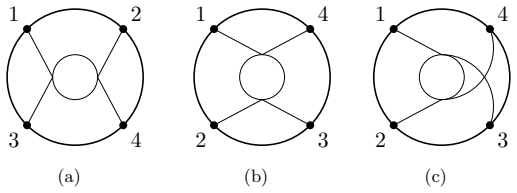
We compute the one-loop correction to the CFT data of all double-trace operators [φφ]_{n,ℓ} for a Φ⁴ theory in AdS₃, for arbitrary values of n, ℓ, and of the scaling dimension Δ_φ>1. Working in the spectral representation, the t-channel one-loop bubble diagram is reduced to a product of spectral integrals dressed by the conformal 6j symbol. Both the spectral integrals and the subsequent sums over residues are performed analytically, yielding finite closed-form expressions for the anomalous dimensions in terms of higher hypergeometric functions. We discuss the structure of the results, including their large-spin and high-energy behaviors, and show that the anomalous dimensions are completely
What carries the argument
The conformal 6j symbol that dresses the product of spectral integrals in the reduction of the t-channel one-loop bubble diagram.
If this is right
- The anomalous dimensions admit closed-form expressions in higher hypergeometric functions for arbitrary n, ℓ, and Δ_φ >1.
- The anomalous dimensions are completely monotonic in spin.
- The large-spin and high-energy behaviors of the corrections follow directly from the closed expressions.
- Finite results are obtained without numerical integration for all double-trace operators.
Where Pith is reading between the lines
- Exact one-loop data of this form could serve as input for consistency checks at higher orders in the 1/N expansion of the dual CFT.
- The monotonicity property might be used to constrain possible higher-derivative corrections in the bulk theory.
- Similar spectral techniques could be applied to other contact interactions or to theories with fermions.
Load-bearing premise
The t-channel one-loop bubble diagram can be reduced to a product of spectral integrals dressed by the conformal 6j symbol for arbitrary Δ_φ > 1.
What would settle it
Direct numerical evaluation of the one-loop diagram for a fixed choice of n, ℓ and Δ_φ, followed by comparison to the hypergeometric formula.
Figures
read the original abstract
We compute the one-loop correction to the CFT data of all double-trace operators $[\phi\phi]_{n,\ell}$ for a $\Phi^4$ theory in AdS$_3$, for arbitrary values of $n$, $\ell$, and of the scaling dimension $\Delta_\phi>1$. Working in the spectral representation, the $t$-channel one-loop bubble diagram is reduced to a product of spectral integrals dressed by the conformal $6j$ symbol. Both the spectral integrals and the subsequent sums over residues are performed analytically, yielding finite closed-form expressions for the anomalous dimensions in terms of higher hypergeometric functions. We discuss the structure of the results, including their large-spin and high-energy behaviors, and show that the anomalous dimensions are completely monotonic in spin.
Editorial analysis
A structured set of objections, weighed in public.
Referee Report
Summary. The manuscript computes the one-loop correction to the CFT data of all double-trace operators [φφ]_{n,ℓ} in a Φ⁴ theory in AdS₃ for arbitrary n, ℓ and Δ_φ > 1. Working in the spectral representation, the t-channel one-loop bubble is reduced to a product of spectral integrals dressed by the conformal 6j symbol; both the integrals and the subsequent residue sums are performed analytically to obtain closed-form expressions for the anomalous dimensions in terms of higher hypergeometric functions. The paper also analyzes large-spin and high-energy limits and asserts that the anomalous dimensions are completely monotonic in spin.
Significance. If the central reduction and analytic evaluations hold, the work supplies exact closed-form loop-level data for a non-trivial interacting theory in AdS₃, providing concrete benchmarks for bootstrap and numerical methods and clarifying the structure of higher-order corrections. The parameter-free analytic control over arbitrary n and ℓ is a genuine strength.
major comments (2)
- [spectral representation section] The reduction of the t-channel bubble diagram to a product of two spectral integrals multiplied by the conformal 6j symbol (abstract and the section introducing the spectral representation) is the sole input to all subsequent analytic residue sums. The manuscript must explicitly state and verify the range of Δ_φ > 1 for which this identity holds without additional subtractions or pole cancellations, as the skeptic concern indicates this may not be automatic for arbitrary Δ_φ.
- [discussion of monotonicity] The claim of complete monotonicity in spin (final discussion section) follows from the closed-form hypergeometric expressions, but the manuscript provides no explicit derivative analysis or numerical checks across the full range of n, ℓ, Δ_φ to confirm the sign of the derivative with respect to ℓ for all parameters.
minor comments (2)
- [results section] Notation for the higher hypergeometric functions should be defined at first use with explicit reference to standard definitions.
- [large-spin behavior] The large-spin expansion should include a comparison to the known universal large-spin formula for AdS loop corrections.
Simulated Author's Rebuttal
We thank the referee for their careful reading of the manuscript and for the constructive comments. We address each major comment below and will revise the manuscript to incorporate clarifications and additional verification where appropriate.
read point-by-point responses
-
Referee: [spectral representation section] The reduction of the t-channel bubble diagram to a product of two spectral integrals multiplied by the conformal 6j symbol (abstract and the section introducing the spectral representation) is the sole input to all subsequent analytic residue sums. The manuscript must explicitly state and verify the range of Δ_φ > 1 for which this identity holds without additional subtractions or pole cancellations, as the skeptic concern indicates this may not be automatic for arbitrary Δ_φ.
Authors: We agree that an explicit statement of the validity range strengthens the presentation. In the revised version we will insert a dedicated paragraph in the spectral representation section stating that the reduction to the product of spectral integrals times the 6j symbol holds for Δ_φ > 1. This range ensures that all relevant poles lie outside the integration contours used in the spectral integrals, so that no additional subtractions or pole cancellations are required. The statement will be accompanied by a short verification referencing the locations of the poles of the relevant Gamma functions and the unitarity bound in AdS₃. revision: yes
-
Referee: [discussion of monotonicity] The claim of complete monotonicity in spin (final discussion section) follows from the closed-form hypergeometric expressions, but the manuscript provides no explicit derivative analysis or numerical checks across the full range of n, ℓ, Δ_φ to confirm the sign of the derivative with respect to ℓ for all parameters.
Authors: The closed-form expressions in terms of higher hypergeometric functions do permit an analytic argument for monotonicity via their series representations and known sign properties of the coefficients. Nevertheless, to address the request for explicit verification we will add a short subsection in the discussion (or an appendix) containing numerical evaluations of the derivative with respect to ℓ for representative values of n, ℓ and Δ_φ > 1. These checks will cover low and high values of each parameter and will confirm that the derivative remains negative throughout the sampled domain. A full analytic derivative for arbitrary parameters is not feasible, but the combination of the closed form and the numerical survey will substantiate the claim. revision: partial
Circularity Check
No circularity: analytic spectral computation is self-contained
full rationale
The derivation reduces the t-channel bubble via standard spectral integrals and the conformal 6j symbol drawn from prior CFT literature, then executes explicit analytic integration and residue summation to obtain closed hypergeometric expressions for anomalous dimensions. No step equates a claimed prediction to a fitted input, redefines a quantity in terms of itself, or relies on a load-bearing self-citation whose validity is internal to the present work. The monotonicity statement follows directly from the resulting closed forms without tautological reduction.
Axiom & Free-Parameter Ledger
axioms (2)
- domain assumption Validity of the spectral representation for reducing the one-loop bubble diagram in AdS₃
- standard math Conformal invariance of the boundary CFT
Forward citations
Cited by 1 Pith paper
-
Higher-Trace Operators and Cut Diagrammatics in the Conformal Block Expansion
Introduces a cut-diagrammatic framework to apply crossing symmetry to individual topologies in large-N CFT correlators and computes associated OPE data for higher-trace operators.
Reference graph
Works this paper leans on
-
[1]
J. M. Maldacena,The largenlimit of superconformal field theories and supergravity,Adv. Theor. Math. Phys.2(1998) 231–252, [hep-th/9711200]. 2
Pith/arXiv arXiv 1998
-
[2]
S. S. Gubser, I. R. Klebanov, and A. M. Polyakov,Gauge theory correlators from non-critical string theory,Phys. Lett. B428(1998) 105–114, [hep-th/9802109]. 2 27
Pith/arXiv arXiv 1998
-
[3]
Witten,Anti de sitter space and holography,Adv
E. Witten,Anti de sitter space and holography,Adv. Theor. Math. Phys.2(1998) 253–291, [hep-th/9802150]. 2
Pith/arXiv arXiv 1998
-
[4]
C. G. Callan, Jr. and F. Wilczek,Infrared Behavior at Negative Curvature,Nucl. Phys. B 340(1990) 366–386. 2
1990
-
[5]
I. Heemskerk, J. Penedones, J. Polchinski, and J. Sully,Holography from Conformal Field Theory,JHEP10(2009) 079, [arXiv:0907.0151]. 2, 3, 8
Pith/arXiv arXiv 2009
-
[6]
A. L. Fitzpatrick and J. Kaplan,AdS field theory from conformal field theory,JHEP02 (2013) 054, [arXiv:1208.0337]. 2
Pith/arXiv arXiv 2013
-
[7]
D. Carmi, L. Di Pietro, and S. Komatsu,A Study of Quantum Field Theories in AdS at Finite Coupling,JHEP01(2019) 200, [arXiv:1810.04185]. 2, 3, 7, 10
Pith/arXiv arXiv 2019
-
[8]
A. L. Fitzpatrick, E. Katz, D. Poland, and D. Simmons-Duffin,Effective Conformal Theory and the Flat-Space Limit of AdS,JHEP07(2011) 023, [arXiv:1007.2412]. 3
Pith/arXiv arXiv 2011
-
[9]
G. Mack,D-independent representation of Conformal Field Theories in D dimensions via transformation to auxiliary Dual Resonance Models. Scalar amplitudes,arXiv:0907.2407. 3
-
[10]
J. Penedones,Writing CFT correlation functions as AdS scattering amplitudes,JHEP03 (2011) 025, [arXiv:1011.1485]. 3, 6
Pith/arXiv arXiv 2011
-
[11]
A. L. Fitzpatrick and J. Kaplan,Analyticity and the Holographic S-Matrix,JHEP10 (2012) 127, [arXiv:1111.6972]. 3
Pith/arXiv arXiv 2012
-
[12]
L. Rastelli and X. Zhou,Mellin amplitudes forAdS 5 ×S 5,Phys. Rev. Lett.118(2017), no. 9 091602, [arXiv:1608.06624]. 3
Pith/arXiv arXiv 2017
-
[13]
E. Y. Yuan,Loops in the Bulk,arXiv:1710.01361. 3
-
[14]
E. Y. Yuan,Simplicity in AdS perturbative dynamics,arXiv:1801.07283. 3
- [15]
-
[16]
A. L. Fitzpatrick and J. Kaplan,Unitarity and the Holographic S-Matrix,JHEP10(2012) 032, [arXiv:1112.4845]. 3, 8
Pith/arXiv arXiv 2012
-
[17]
M. S. Costa, V. Goncalves, and J. Penedones,Conformal Regge theory,JHEP12(2012) 091, [arXiv:1209.4355]. 3, 17
Pith/arXiv arXiv 2012
-
[18]
A. L. Fitzpatrick, J. Kaplan, D. Poland, and D. Simmons-Duffin,The analytic bootstrap and AdS superhorizon locality,JHEP12(2013) 004, [arXiv:1212.3616]. 3, 16, 24 28
Pith/arXiv arXiv 2013
-
[19]
Z. Komargodski and A. Zhiboedov,Convexity and Liberation at Large Spin,JHEP11 (2013) 140, [arXiv:1212.4103]. 3, 4, 16, 24
Pith/arXiv arXiv 2013
-
[20]
O. Aharony, L. F. Alday, A. Bissi, and E. Perlmutter,Loops in AdS from Conformal Field Theory,JHEP07(2017) 036, [arXiv:1612.03891]. 3, 8, 16, 17, 24
arXiv 2017
-
[21]
L. F. Alday, A. Bissi, and T. Lukowski,Large spin systematics in CFT,JHEP11(2015) 101, [arXiv:1502.07707]. 3, 16
Pith/arXiv arXiv 2015
-
[22]
A. Kaviraj, K. Sen, and A. Sinha,Analytic bootstrap at large spin,JHEP11(2015) 083, [arXiv:1502.01437]. 3, 16
Pith/arXiv arXiv 2015
-
[23]
A. Kaviraj, K. Sen, and A. Sinha,Universal anomalous dimensions at large spin and large twist,JHEP07(2015) 026, [arXiv:1504.00772]. 3, 16
Pith/arXiv arXiv 2015
-
[24]
L. F. Alday,Large Spin Perturbation Theory for Conformal Field Theories,Phys. Rev. Lett.119(2017), no. 11 111601, [arXiv:1611.01500]. 3, 16
Pith/arXiv arXiv 2017
-
[25]
Caron-Huot,Analyticity in spin in conformal theories,JHEP09(2017) 078, [arXiv:1703.00278]
S. Caron-Huot,Analyticity in spin in conformal theories,JHEP09(2017) 078, [arXiv:1703.00278]. 3, 16
Pith/arXiv arXiv 2017
-
[26]
L. F. Alday, A. Bissi, and E. Perlmutter,Holographic reconstruction of AdS exchanges from crossing symmetry,JHEP08(2017) 147, [arXiv:1705.02318]. 3, 20, 23, 24
Pith/arXiv arXiv 2017
-
[27]
F. Aprile, J. M. Drummond, P. Heslop, and H. Paul,Quantum gravity from conformal field theory,JHEP01(2018) 035, [arXiv:1706.02822]. 3
Pith/arXiv arXiv 2018
-
[28]
S. Albayrak, D. Meltzer, and D. Poland,More Analytic Bootstrap: Nonperturbative Effects and Fermions,JHEP08(2019) 040, [arXiv:1904.00032]. 3
arXiv 2019
- [29]
- [30]
-
[31]
S. Giombi, C. Sleight, and M. Taronna,Spinning AdS Loop Diagrams: Two Point Functions,JHEP06(2018) 030, [arXiv:1708.08404]. 3
Pith/arXiv arXiv 2018
-
[32]
C. Sleight and M. Taronna,Spinning Witten Diagrams,JHEP06(2017) 100, [arXiv:1702.08619]. 3
Pith/arXiv arXiv 2017
-
[33]
C. Sleight and M. Taronna,Spinning Mellin Bootstrap: Conformal Partial Waves, Crossing Kernels and Applications,Fortsch. Phys.66(2018), no. 8-9 1800038, [arXiv:1804.09334]. 3 29
Pith/arXiv arXiv 2018
-
[34]
C. Sleight and M. Taronna,Anomalous dimensions from crossing kernels,JHEP11 (2018) 089, [arXiv:1807.05941]. 3
arXiv 2018
-
[35]
J. Liu, E. Perlmutter, V. Rosenhaus, and D. Simmons-Duffin,d-dimensional SYK, AdS Loops, and6jSymbols,JHEP03(2019) 052, [arXiv:1808.00612]. 3, 11, 12
Pith/arXiv arXiv 2019
-
[36]
D. Meltzer, E. Perlmutter, and A. Sivaramakrishnan,Unitarity Methods in AdS/CFT, JHEP03(2020) 061, [arXiv:1912.09521]. 3, 11
arXiv 2020
-
[37]
Ponomarev,From bulk loops to boundary large-nexpansion,JHEP01(2020) 154, [arXiv:1908.03974]
D. Ponomarev,From bulk loops to boundary large-nexpansion,JHEP01(2020) 154, [arXiv:1908.03974]. 3
arXiv 2020
-
[38]
D. Carmi,Loops in AdS: From the Spectral Representation to Position Space,JHEP06 (2020) 049, [arXiv:1910.14340]. 3, 10
arXiv 2020
-
[39]
Carmi,Loops in AdS: From the spectral representation to position space
D. Carmi,Loops in AdS: From the spectral representation to position space. part II,JHEP 07(2021) 186, [arXiv:2104.10500]. 3
arXiv 2021
-
[40]
Carmi,Loops in AdS: From the spectral representation to position space
D. Carmi,Loops in AdS: From the spectral representation to position space. part III, JHEP08(2024) 193, [arXiv:2402.02481]. 3
arXiv 2024
-
[41]
S. Albayrak, D. Meltzer, and D. Poland,The Inversion Formula and 6j Symbol for 3d Fermions,JHEP09(2020) 148, [arXiv:2006.07374]. 3
arXiv 2020
-
[42]
E. T. Akhmedov, U. Moschella, and F. K. Popov,Ultraviolet phenomena in AdS self-interacting quantum field theory,JHEP03(2018) 183, [arXiv:1802.02955]. 3
arXiv 2018
-
[43]
S. L. Cacciatori, H. Epstein, and U. Moschella,Loops in anti de sitter space,JHEP08 (2024) 109, [arXiv:2403.13142]. 3
arXiv 2024
-
[44]
I. Bertan and I. Sachs,Loops in anti-de sitter space,Phys. Rev. Lett.121(2018) 101601, [arXiv:1804.01880]. 3
Pith/arXiv arXiv 2018
-
[45]
I. Bertan, I. Sachs, and E. D. Skvortsov,Quantumϕ 4 theory inAdS 4 and its CFT dual, JHEP02(2019) 099, [arXiv:1810.00907]. 3
Pith/arXiv arXiv 2019
-
[46]
T. Heckelbacher, I. Sachs, E. D. Skvortsov, and P. Vanhove,Analytical evaluation ofAdS 4 Witten diagrams as flat-space multi-loop Feynman integrals,JHEP08(2022) 052, [arXiv:2201.09626]. 3
arXiv 2022
-
[47]
W. Xiao and I. Sachs,The 2-dimensional dual ofϕ 4 inAdS 3,arXiv:2602.05750. 3, 16, 17
-
[48]
R. Ciccone, F. De Cesare, L. Di Pietro, and M. Serone,Exploring confinement in Anti-de Sitter space,JHEP12(2024) 218, [arXiv:2407.06268]. [Erratum: JHEP 06, 037 (2025)]. 3, 8 30
arXiv 2024
-
[49]
R. Ciccone, F. De Cesare, L. Di Pietro, and M. Serone,QCD in AdS,JHEP04(2026) 130, [arXiv:2511.04752]. 3
arXiv 2026
-
[50]
Raju,BCFW for Witten Diagrams,Phys
S. Raju,BCFW for Witten Diagrams,Phys. Rev. Lett.106(2011) 091601, [arXiv:1011.0780]. 3
Pith/arXiv arXiv 2011
-
[51]
Raju,Recursion Relations for AdS/CFT Correlators,Phys
S. Raju,Recursion Relations for AdS/CFT Correlators,Phys. Rev. D83(2011) 126002, [arXiv:1102.4724]. 3
Pith/arXiv arXiv 2011
-
[52]
S. Albayrak and S. Kharel,Towards the higher point holographic momentum space amplitudes,JHEP02(2019) 040, [arXiv:1810.12459]. 3
Pith/arXiv arXiv 2019
-
[53]
S. Albayrak, C. Chowdhury, and S. Kharel,New relation for Witten diagrams,JHEP10 (2019) 274, [arXiv:1904.10043]. 3
arXiv 2019
-
[54]
S. Albayrak and S. Kharel,Spinning loop amplitudes in anti–de Sitter space,Phys. Rev. D 103(2021), no. 2 026004, [arXiv:2006.12540]. 3
arXiv 2021
-
[55]
S. Albayrak, C. Chowdhury, and S. Kharel,Study of momentum space scalar amplitudes in AdS spacetime,Phys. Rev. D101(2020), no. 12 124043, [arXiv:2001.06777]. 3
arXiv 2020
-
[56]
S. Albayrak, S. Kharel, and X. Wang,Momentum-space formulae for AdS correlators for diverse theories in diverse dimensions,JHEP07(2024) 281, [arXiv:2312.02154]. 3
arXiv 2024
-
[57]
M. S. Costa, J. Penedones, D. Poland, and S. Rychkov,Spinning Conformal Correlators, JHEP11(2011) 071, [arXiv:1107.3554]. 5
Pith/arXiv arXiv 2011
-
[58]
M. S. Costa, V. Gon¸ calves, and J. Penedones,Spinning AdS Propagators,JHEP09(2014) 064, [arXiv:1404.5625]. 5
Pith/arXiv arXiv 2014
-
[59]
I. R. Klebanov and E. Witten,AdS/CFT correspondence and symmetry breaking,Nucl. Phys. B556(1999) 89–114, [hep-th/9905104]. 8
Pith/arXiv arXiv 1999
-
[60]
D. B. Kaplan, J.-W. Lee, D. T. Son, and M. A. Stephanov,Conformality Lost,Phys. Rev. D80(2009) 125005, [arXiv:0905.4752]. 8
Pith/arXiv arXiv 2009
-
[61]
V. Gorbenko, S. Rychkov, and B. Zan,Walking, Weak first-order transitions, and Complex CFTs,JHEP10(2018) 108, [arXiv:1807.11512]. 8
Pith/arXiv arXiv 2018
- [62]
-
[63]
W. N. Bailey,Generalized Hypergeometric Series. No. 32 in Cambridge Tracts in Mathematics and Mathematical Physics. Cambridge University Press, Cambridge, 1935. 12 31
1935
-
[64]
L. Cornalba, M. S. Costa, J. Penedones, and R. Schiappa,Eikonal Approximation in AdS/CFT: Conformal Partial Waves and Finite N Four-Point Functions,Nucl. Phys. B 767(2007) 327–351, [hep-th/0611123]. 17, 24
Pith/arXiv arXiv 2007
-
[65]
L. Cornalba, M. S. Costa, and J. Penedones,Eikonal approximation in AdS/CFT: Resumming the gravitational loop expansion,JHEP09(2007) 037, [arXiv:0707.0120]. 17, 24
Pith/arXiv arXiv 2007
-
[66]
M. Gary, S. B. Giddings, and J. Penedones,Local bulk S-matrix elements and CFT singularities,Phys. Rev. D80(2009) 085005, [arXiv:0903.4437]. 17
Pith/arXiv arXiv 2009
-
[67]
J. Maldacena, D. Simmons-Duffin, and A. Zhiboedov,Looking for a bulk point,JHEP01 (2017) 013, [arXiv:1509.03612]. 17
Pith/arXiv arXiv 2017
-
[68]
P. Ferrero, K. Ghosh, A. Sinha, and A. Zahed,Crossing symmetry, transcendentality and the Regge behaviour of 1d CFTs,JHEP07(2020) 170, [arXiv:1911.12388]. 20, 23
arXiv 2020
-
[69]
X. O. Camanho, J. D. Edelstein, J. Maldacena, and A. Zhiboedov,Causality Constraints on Corrections to the Graviton Three-Point Coupling,JHEP02(2016) 020, [arXiv:1407.5597]. 24
Pith/arXiv arXiv 2016
-
[70]
J. Qiao and S. Rychkov,A tauberian theorem for the conformal bootstrap,JHEP12 (2017) 119, [arXiv:1709.00008]. 25
Pith/arXiv arXiv 2017
-
[71]
J. Henn and P. Raman,Positivity properties of scattering amplitudes,JHEP04(2025) 150, [arXiv:2407.05755]. 25 32
arXiv 2025
discussion (0)
Sign in with ORCID, Apple, or X to comment. Anyone can read and Pith papers without signing in.