The colour variability of low-z SNe Ia is entirely explained by dust
Pith reviewed 2026-06-27 23:42 UTC · model grok-4.3
The pith
Dust fully explains the colour-magnitude correlation in low-redshift Type Ia supernovae after accounting for selection effects from colour cuts.
A machine-rendered reading of the paper's core claim, the machinery that carries it, and where it could break.
Core claim
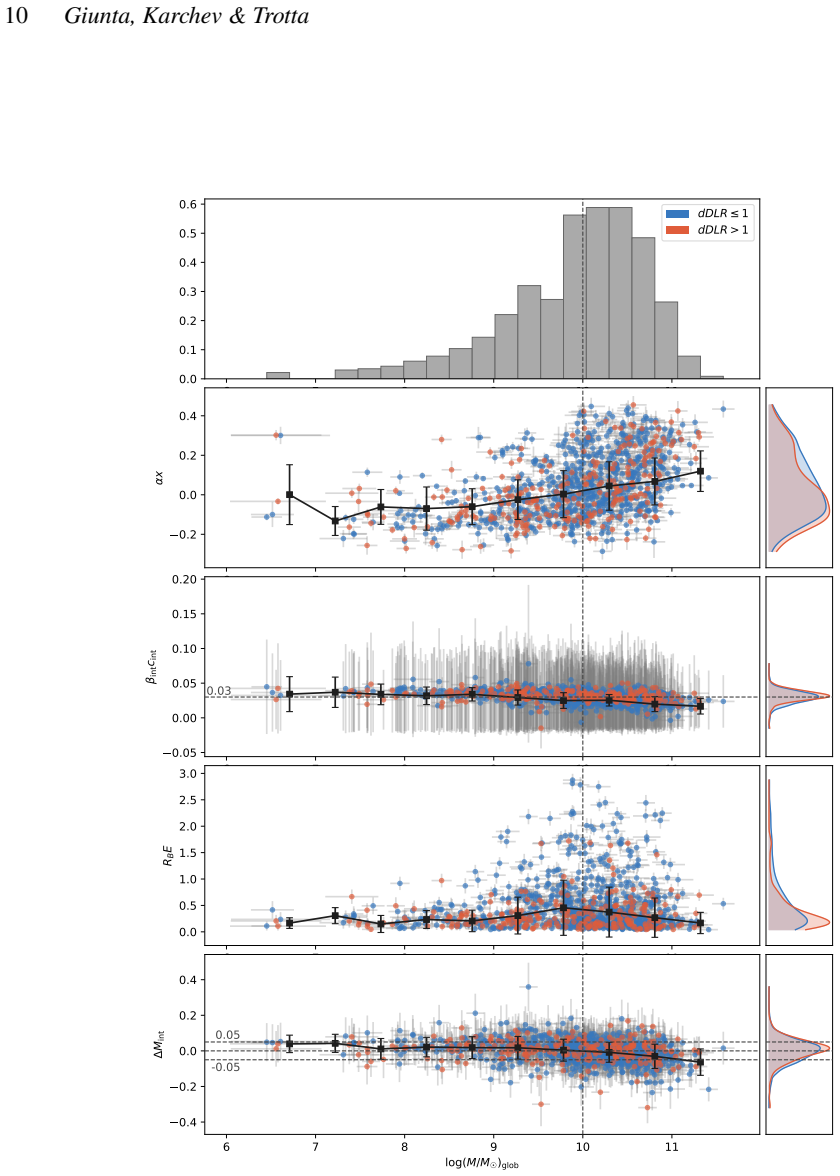
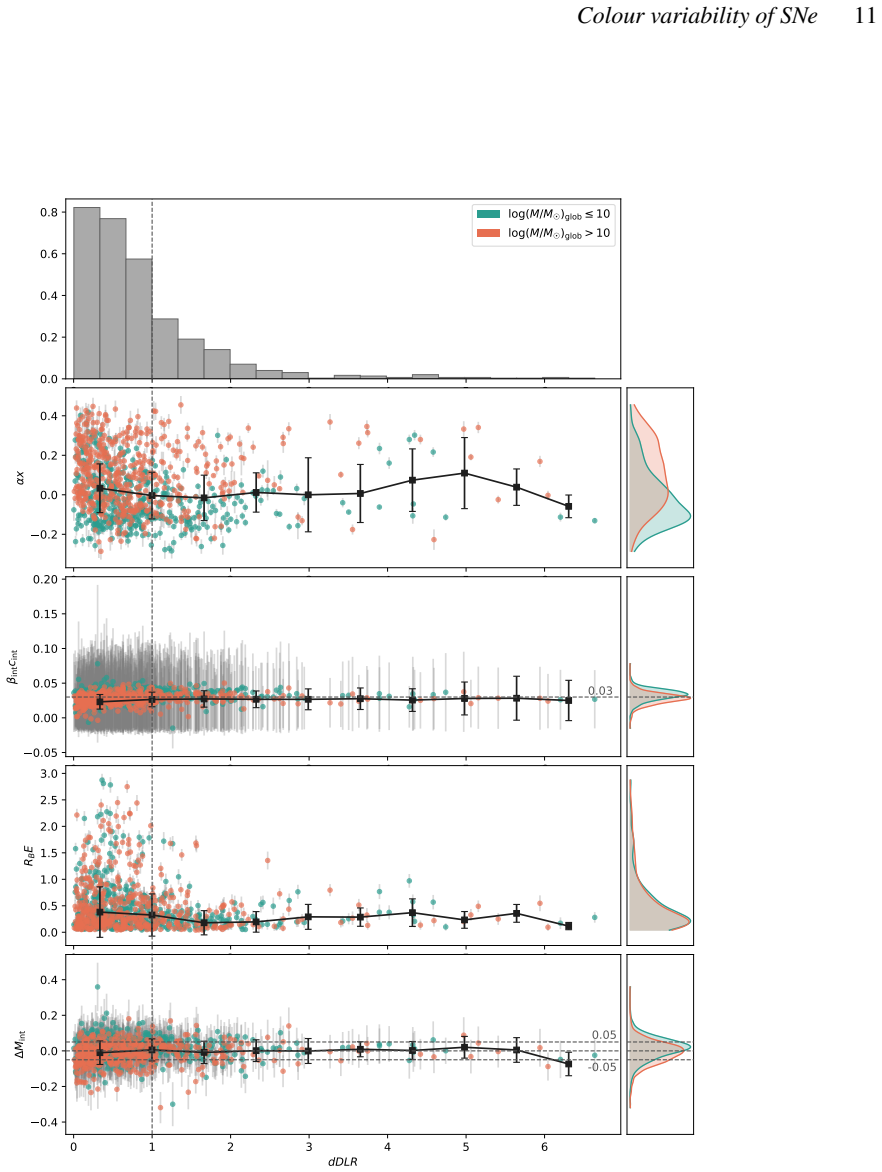
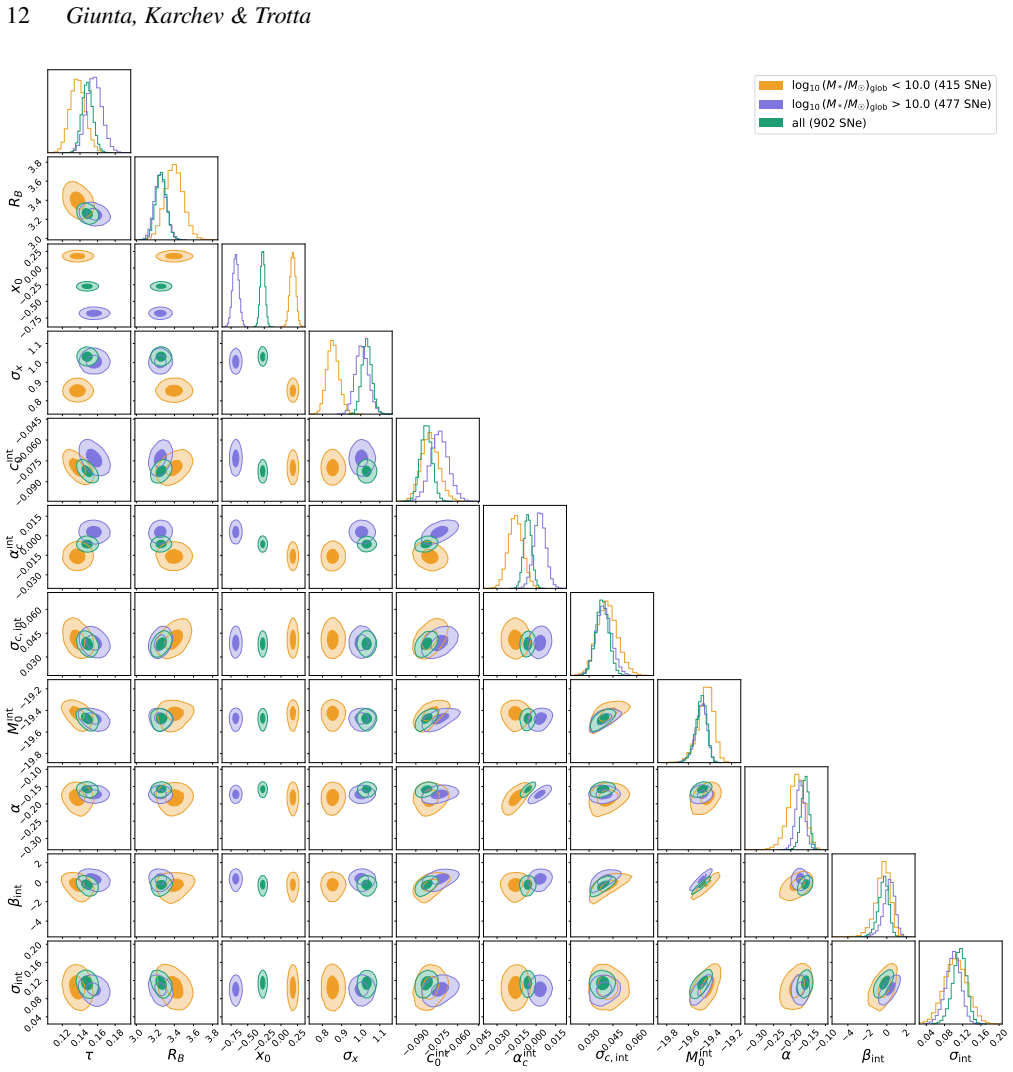
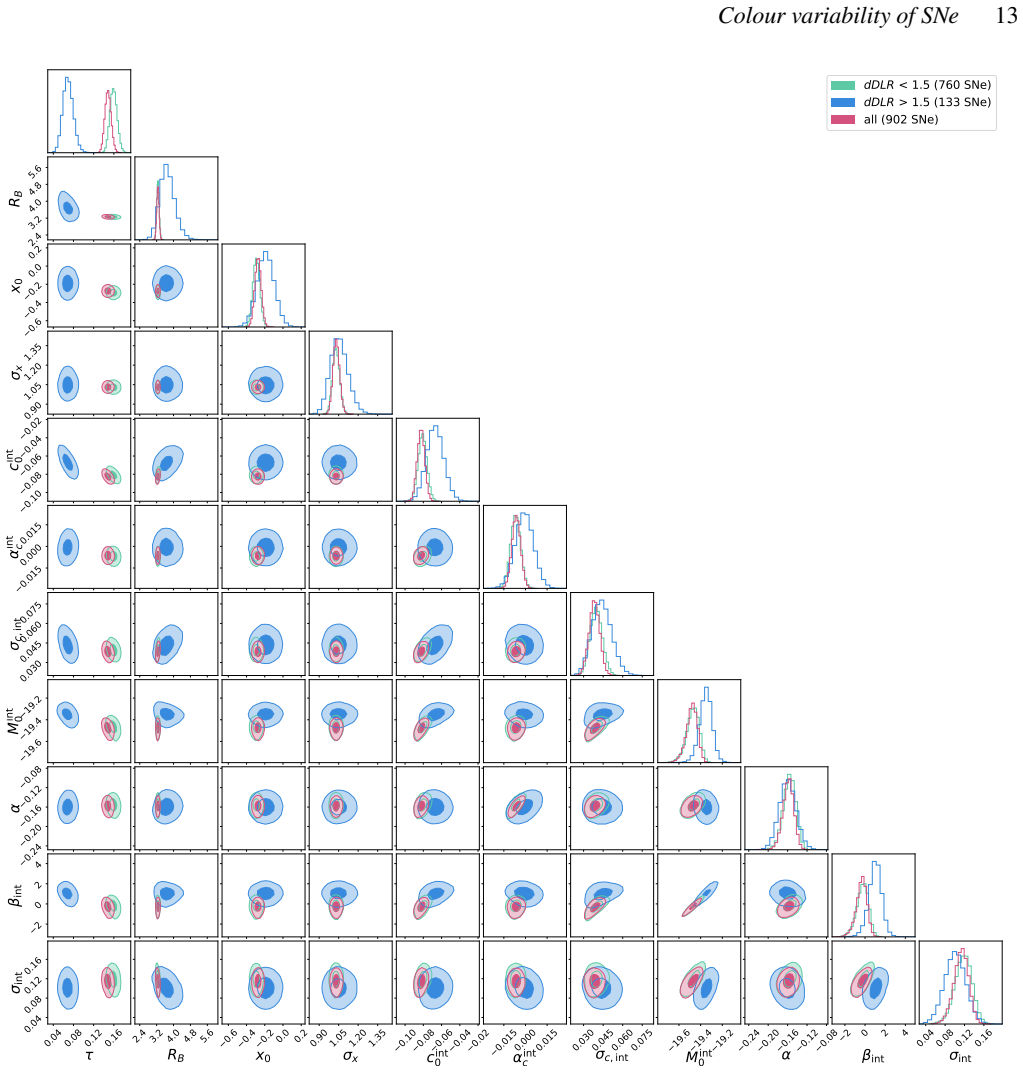
Once the selection effect induced by traditional colour cuts is accounted for, the entirety of the colour-magnitude correlation in low-redshift Type Ia supernovae is explained by dust effects, with no need for an intrinsic colour correlation. This result is robust with respect to a host galaxy mass split and projected distance from the center of the host. The traditional linear Tripp correction therefore maintains empirical validity even though it should be ascribed to dust rather than intrinsic colour variation.
What carries the argument
The Bayesian hierarchical model Simple-BayeSN that jointly parametrizes dust reddening, intrinsic scatter, and the selection bias induced by colour cuts.
If this is right
- The Tripp linear correction continues to work for cosmological inference but arises from dust rather than intrinsic colour variation.
- No intrinsic colour correlation is required to describe the data once colour-cut selection is modeled.
- The dust-only explanation remains unchanged when the sample is divided by host-galaxy mass or distance from the host center.
Where Pith is reading between the lines
- Dust properties in different galactic environments may now need to be modeled more explicitly for future supernova cosmology analyses.
- Surveys could avoid traditional colour cuts altogether and rely on the full hierarchical model to recover unbiased distances.
- Previously reported environmental correlations with supernova colour might be reinterpreted as variations in host dust rather than changes in the supernovae themselves.
Load-bearing premise
The Bayesian hierarchical model Simple-BayeSN and its parametrization of dust and selection effects correctly describe the true underlying distributions without leftover misspecification.
What would settle it
A new independent low-redshift supernova sample analyzed with the same selection-effect modeling still shows a statistically significant residual intrinsic colour term.
Figures
read the original abstract
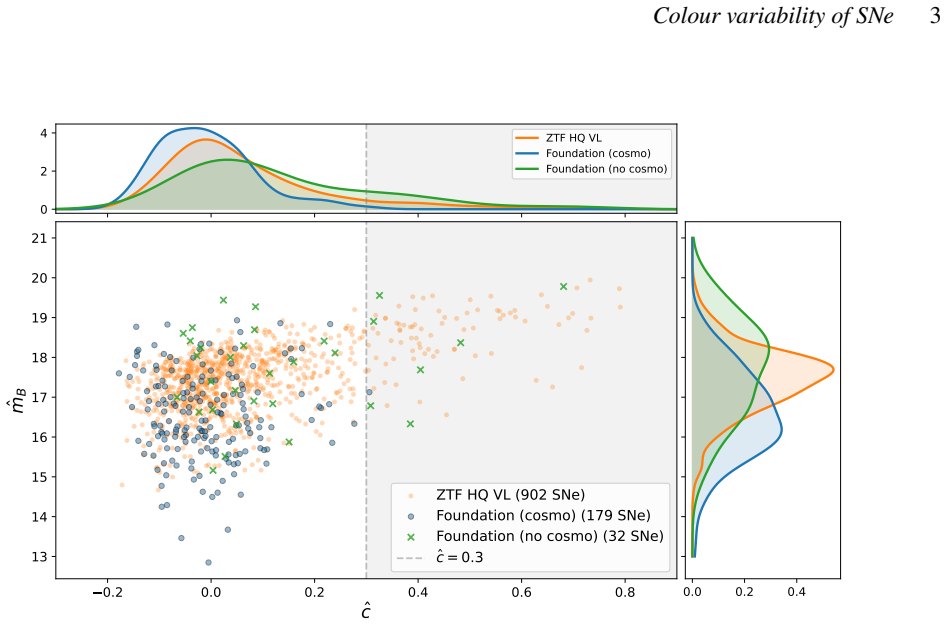
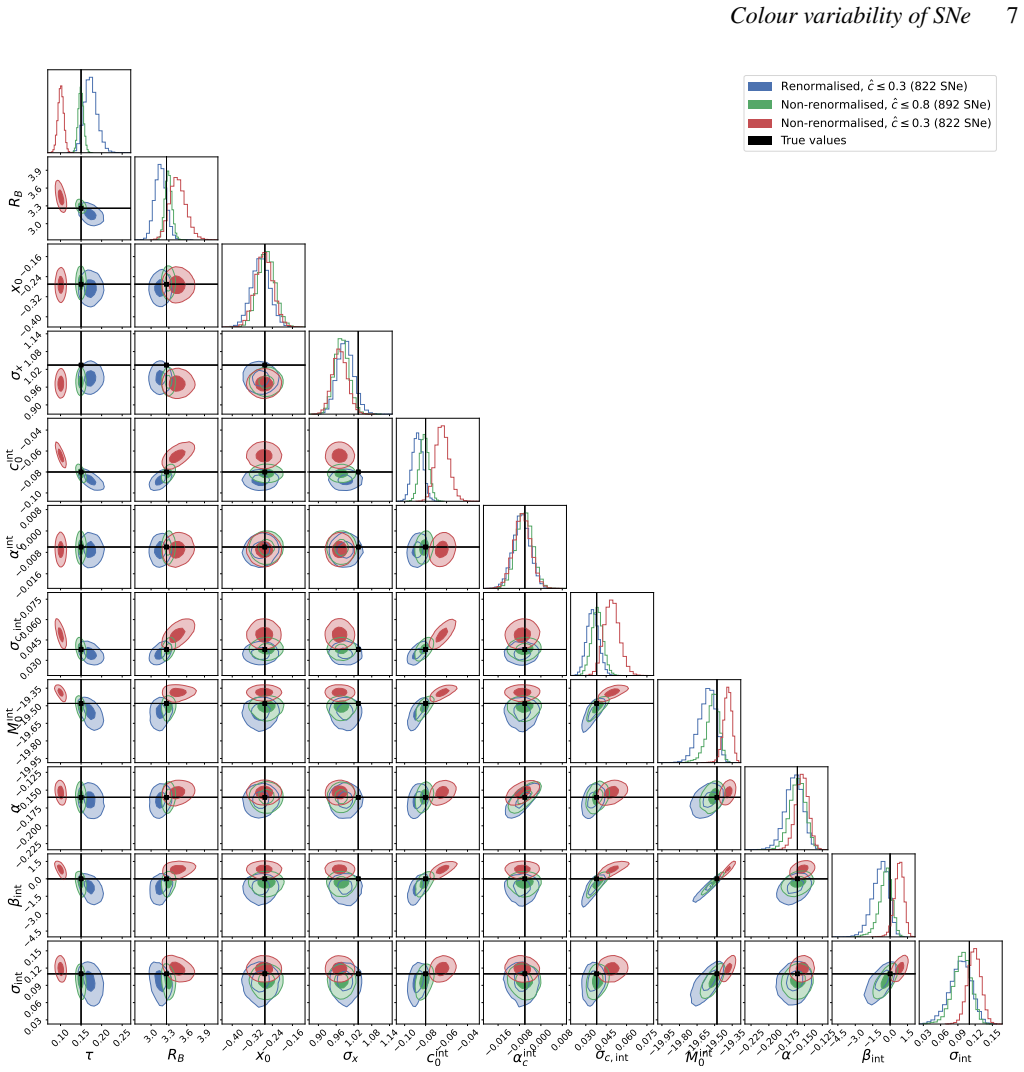
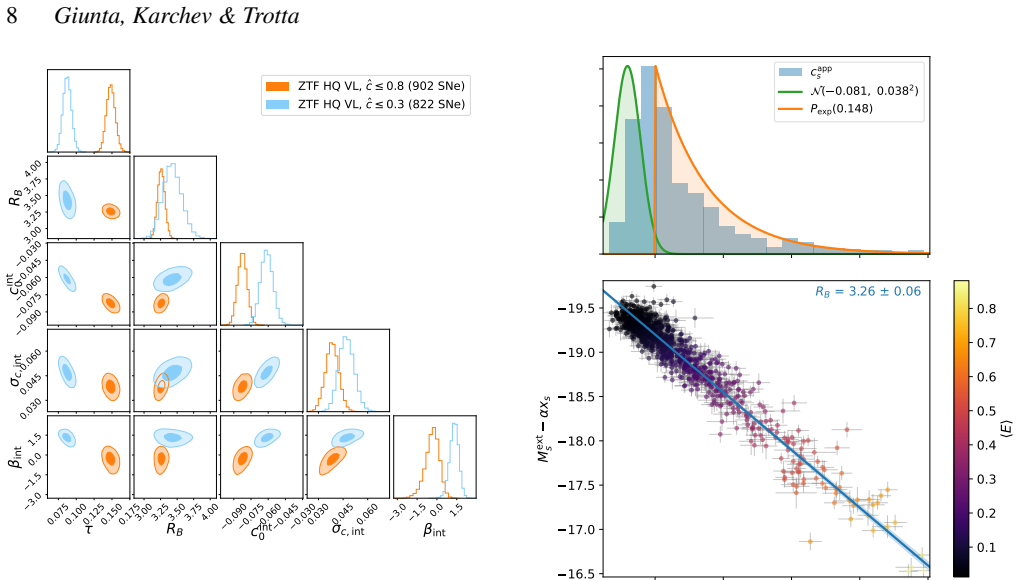
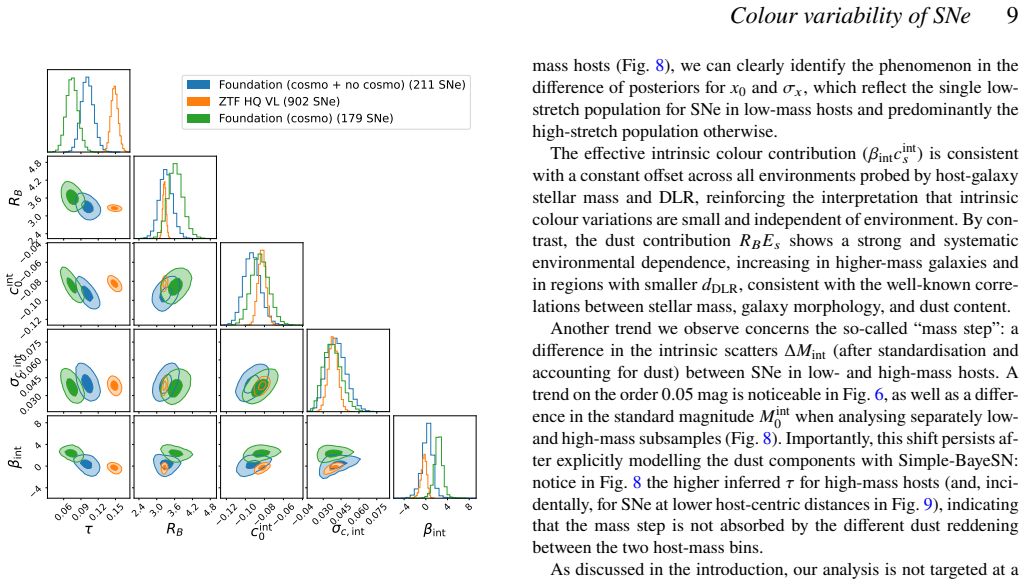
The relative importance of intrinsic colour variability of supernovae type Ia (SN Ia) versus dust-induced reddening remains an open question with important ramifications for understanding their environmental dependence, as well as for the validity of the traditionally employed Tripp linear correction for cosmological inference. We revisit this question in the light of two low-redshift, homogeneous datasets, the ZTF DR2 and Foundation DR1, which we analyse within the framework of the Bayesian hierarchical model Simple-BayeSN. We demonstrate both with simulation and on real data that traditional colour cuts, which remove highly reddened samples, induce a previously unrecognized selection effect, which may have biased previous conclusions on the origin of SN Ia colour variability. Once this is accounted for, we are able to explain the entirety of the colour--magnitude correlation as due to dust effects, with no need for an intrinsic colour correlation. This result is robust with respect to a host galaxy mass split and projected distance from the center of the host. Our findings imply that the traditional linear Tripp correction maintains an empirical validity, even though it should be ascribed to dust rather than intrinsic colour variation.
Editorial analysis
A structured set of objections, weighed in public.
Referee Report
Summary. The paper analyzes low-redshift Type Ia supernovae from ZTF DR2 and Foundation DR1 within the Simple-BayeSN Bayesian hierarchical model. It claims that traditional color cuts induce a selection effect that has biased prior inferences; once this is modeled, the entire observed color-magnitude correlation is attributable to dust extinction, with no residual intrinsic color-luminosity correlation required. The result is reported to hold in both simulations and real data and to be robust under host-mass and projected-distance splits, implying that the empirical Tripp correction remains valid but should be interpreted as a dust effect.
Significance. If the central separation of dust versus intrinsic color holds, the result would clarify the physical origin of SN Ia color variability, strengthen the empirical basis for the Tripp correction in cosmological analyses, and redirect attention from intrinsic SN properties to dust and host-environment modeling. The use of public datasets and an explicit hierarchical model with simulation validation is a positive feature.
major comments (2)
- [Methods (Simple-BayeSN parametrization and selection modeling)] The central claim that the intrinsic-color coefficient can be set to zero rests on the adequacy of the dust-law and selection-function parametrizations inside Simple-BayeSN. The reported robustness test (host-mass split) does not directly probe whether residual misspecification in these components could absorb an undetected intrinsic term; a concrete test (e.g., posterior predictive checks on the color distribution after selection or recovery of injected intrinsic color in simulations with varied dust priors) is needed to establish that the separation is not an artifact of model assumptions.
- [Simulation validation section] The abstract states that the result is demonstrated 'both with simulation and on real data,' yet the strength of the simulation validation (recovery of zero intrinsic color under the fitted selection function) is not quantified in a way that directly addresses the skeptic concern about model misspecification mimicking the dust-only solution.
minor comments (2)
- Notation for the color-cut selection probability and the dust-extinction parameters should be defined explicitly at first use to improve readability for readers unfamiliar with Simple-BayeSN.
- The manuscript would benefit from a table summarizing the posterior constraints on the intrinsic-color coefficient both with and without the selection-effect term, for direct comparison with prior literature.
Simulated Author's Rebuttal
We thank the referee for their detailed and constructive report. The two major comments both concern the strength of the evidence that the intrinsic-color term can be set to zero once selection is modeled. We agree that additional, more targeted validation is warranted and will revise the manuscript accordingly.
read point-by-point responses
-
Referee: [Methods (Simple-BayeSN parametrization and selection modeling)] The central claim that the intrinsic-color coefficient can be set to zero rests on the adequacy of the dust-law and selection-function parametrizations inside Simple-BayeSN. The reported robustness test (host-mass split) does not directly probe whether residual misspecification in these components could absorb an undetected intrinsic term; a concrete test (e.g., posterior predictive checks on the color distribution after selection or recovery of injected intrinsic color in simulations with varied dust priors) is needed to establish that the separation is not an artifact of model assumptions.
Authors: We accept that the host-mass split, while useful, is an indirect robustness check and does not directly test for possible absorption of an intrinsic term by misspecification in the dust law or selection function. In the revised manuscript we will add (i) posterior predictive checks comparing the observed post-selection color distribution to draws from the fitted model and (ii) a suite of injection-recovery tests in which a non-zero intrinsic-color coefficient is injected and the model is re-run under varied dust-law priors. These tests will be reported in a new subsection of the simulation-validation section. revision: yes
-
Referee: [Simulation validation section] The abstract states that the result is demonstrated 'both with simulation and on real data,' yet the strength of the simulation validation (recovery of zero intrinsic color under the fitted selection function) is not quantified in a way that directly addresses the skeptic concern about model misspecification mimicking the dust-only solution.
Authors: We agree that the current simulation section would benefit from more explicit quantitative metrics. The revised version will report bias, scatter, and coverage of the recovered intrinsic-color coefficient across an ensemble of 50–100 simulated datasets that include the fitted selection function, and will also show the distribution of the posterior probability that the intrinsic coefficient is consistent with zero. These additions will directly quantify how well the model recovers the dust-only solution under the selection model. revision: yes
Circularity Check
No circularity; external datasets and hierarchical model yield independent result
full rationale
The derivation applies the named Simple-BayeSN hierarchical model to public external catalogs (ZTF DR2, Foundation DR1). The model explicitly parametrizes both dust extinction and an intrinsic color term; the posterior finding that the intrinsic coefficient is consistent with zero after modeling the color-cut selection function is a data-driven outcome, not a definitional identity or a fitted parameter relabeled as a prediction. No self-citation chain, ansatz smuggling, or uniqueness theorem imported from the same authors is invoked to force the dust-only conclusion. The result remains falsifiable by the same external data under alternative model specifications.
Axiom & Free-Parameter Ledger
Reference graph
Works this paper leans on
-
[1]
Bayes in the sky: Bayesian inference and model selection in cosmology , volume=
Trotta, Roberto , year=. Bayes in the sky: Bayesian inference and model selection in cosmology , volume=. Contemporary Physics , publisher=. doi:10.1080/00107510802066753 , number=
-
[2]
CIGaRS I: combined simulation-based inference from type Ia supernovae and host photometry , ISSN=
Karchev, Konstantin and Trotta, Roberto and Jiménez, Raúl , year=. CIGaRS I: combined simulation-based inference from type Ia supernovae and host photometry , ISSN=. doi:10.1038/s41550-026-02842-5 , journal=
-
[3]
Mandel, Kaisey S. and Scolnic, Daniel M. and Shariff, Hikmatali and Foley, Ryan J. and Kirshner, Robert P. , year=. The Type Ia Supernova Color–Magnitude Relation and Host Galaxy Dust: A Simple Hierarchical Bayesian Model , volume=. The Astrophysical Journal , publisher=. doi:10.3847/1538-4357/aa6038 , number=
-
[4]
A hierarchical Bayesian SED model for Type Ia supernovae in the optical to near-infrared , volume=
Mandel, Kaisey S and Thorp, Stephen and Narayan, Gautham and Friedman, Andrew S and Avelino, Arturo , year=. A hierarchical Bayesian SED model for Type Ia supernovae in the optical to near-infrared , volume=. Monthly Notices of the Royal Astronomical Society , publisher=. doi:10.1093/mnras/stab3496 , number=
-
[5]
Type Ia Supernova Light Curve Inference: Hierarchical Bayesian Analysis in the Near Infrared
Type Ia Supernova Light-Curve Inference: Hierarchical Bayesian Analysis in the Near-Infrared. , keywords =. doi:10.1088/0004-637X/704/1/629 , archivePrefix =. 0908.0536 , primaryClass =
work page internal anchor Pith review Pith/arXiv arXiv doi:10.1088/0004-637x/704/1/629
-
[6]
Type Ia Supernova Light Curve Inference: Hierarchical Models in the Optical and Near Infrared
Type Ia Supernova Light Curve Inference: Hierarchical Models in the Optical and Near-infrared. , keywords =. doi:10.1088/0004-637X/731/2/120 , archivePrefix =. 1011.5910 , primaryClass =
work page internal anchor Pith review Pith/arXiv arXiv doi:10.1088/0004-637x/731/2/120
-
[7]
Improved Distances to Type Ia Supernovae with Multicolor Light Curve Shapes: MLCS2k2
Improved Distances to Type Ia Supernovae with Multicolor Light-Curve Shapes: MLCS2k2. , keywords =. doi:10.1086/512054 , archivePrefix =. astro-ph/0612666 , primaryClass =
work page internal anchor Pith review Pith/arXiv arXiv doi:10.1086/512054
-
[8]
Ginolin, M. and Rigault, M. and Copin, Y. and Popovic, B. and Dimitriadis, G. and Goobar, A. and Johansson, J. and Maguire, K. and Nordin, J. and Smith, M. and Aubert, M. and Barjou-Delayre, C. and Burgaz, U. and Carreres, B. and Dhawan, S. and Deckers, M. and Feinstein, F. and Fouchez, D. and Galbany, L. and Ganot, C. and de Jaeger, T. and Kim, Y.-L. and...
-
[9]
ZTF SN Ia DR2: Overview. , keywords =. doi:10.1051/0004-6361/202450388 , archivePrefix =. 2409.04346 , primaryClass =
-
[10]
Barbary, Kyle and Bailey, Stephen and Barentsen, Geert and Barclay, Tom and Biswas, Rahul and Boone, Kyle and Craig, Matt and Feindt, Ulrich and Friesen, Brian and Goldstein, Danny and Jha, Saurabh W. and Jones, David O. and Mondon, Florian and Papadogiannakis, Seméli and Perrefort, Daniel and Pierel, Justin and Rodney, Steve and Rose, Benjamin and Saunde...
-
[11]
ZTF SN Ia DR2: Simulations and volume-limited sample. , keywords =. doi:10.1051/0004-6361/202452134 , archivePrefix =. 2409.04650 , primaryClass =
-
[12]
The Foundation Supernova Survey: Motivation, Design, Implementation, and First Data Release
The Foundation Supernova Survey: motivation, design, implementation, and first data release. , keywords =. doi:10.1093/mnras/stx3136 , archivePrefix =. 1711.02474 , primaryClass =
work page internal anchor Pith review Pith/arXiv arXiv doi:10.1093/mnras/stx3136
-
[13]
The Foundation Supernova Survey: Measuring Cosmological Parameters with Supernovae from a Single Telescope. , keywords =. doi:10.3847/1538-4357/ab2bec , archivePrefix =. 1811.09286 , primaryClass =
-
[14]
Constraining R _ V variation using highly reddened Type Ia supernovae from the Pantheon+ sample. , keywords =. doi:10.1093/mnras/stac2500 , archivePrefix =. 2206.09950 , primaryClass =
-
[15]
, keywords =
A two-parameter luminosity correction for Type IA supernovae. , keywords =
-
[16]
SALT2: using distant supernovae to improve the use of type Ia supernovae as distance indicators *** , DOI= "10.1051/0004-6361:20066930", url= "https://doi.org/10.1051/0004-6361:20066930", journal =
-
[17]
The Supernova Legacy Survey 3-year sample: Type Ia supernovae photometric distances and cosmological constraints , DOI= "10.1051/0004-6361/201014468", url= "https://doi.org/10.1051/0004-6361/201014468", journal =
-
[18]
Improved cosmological constraints from a joint analysis of the SDSS-II and SNLS supernova samples⋆⋆⋆ , DOI= "10.1051/0004-6361/201423413", url= "https://doi.org/10.1051/0004-6361/201423413", journal =
-
[19]
Monthly Notices of the Royal Astronomical Society , volume =
Taylor, G and Lidman, C and Tucker, B E and Brout, D and Hinton, S R and Kessler, R , title =. Monthly Notices of the Royal Astronomical Society , volume =. 2021 , month =. doi:10.1093/mnras/stab962 , url =
-
[20]
Kenworthy, W. D. and Jones, D. O. and Dai, M. and Kessler, R. and Scolnic, D. and Brout, D. and Siebert, M. R. and Pierel, J. D. R. and Dettman, K. G. and Dimitriadis, G. and Foley, R. J. and Jha, S. W. and Pan, Y.-C. and Riess, A. and Rodney, S. and Rojas-Bravo, C. , title =. The Astrophysical Journal , abstract =. 2021 , month =. doi:10.3847/1538-4357/a...
-
[21]
SALT2 versus SALT3: updated model surfaces and their impacts on type Ia supernova cosmology. , keywords =. doi:10.1093/mnras/stad320 , archivePrefix =. 2301.10644 , primaryClass =
-
[22]
Monthly Notices of the Royal Astronomical Society , volume =
Karchev, Konstantin and Trotta, Roberto and Weniger, Christoph , title =. Monthly Notices of the Royal Astronomical Society , volume =. 2022 , month =. doi:10.1093/mnras/stac3785 , url =
-
[23]
Vincenzi, M. and Brout, D. and Armstrong, P. and Popovic, B. and Taylor, G. and Acevedo, M. and Camilleri, R. and Chen, R. and Davis, T. M. and Lee, J. and Lidman, C. and Hinton, S. R. and Kelsey, L. and Kessler, R. and Möller, A. and Qu, H. and Sako, M. and Sanchez, B. and Scolnic, D. and Smith, M. and Sullivan, M. and Wiseman, P. and Asorey, J. and Bass...
-
[24]
The Dark Energy Survey Supernova Program: A Reanalysis Of Cosmology Results And Evidence For Evolving Dark Energy With An Updated Type Ia Supernova Calibration. arXiv e-prints , keywords =. doi:10.48550/arXiv.2511.07517 , archivePrefix =. 2511.07517 , primaryClass =
work page internal anchor Pith review Pith/arXiv arXiv doi:10.48550/arxiv.2511.07517
-
[25]
ZTF SN Ia DR2: Environmental dependencies of stretch and luminosity for a volume-limited sample of 1000 type Ia supernovae. , keywords =. doi:10.1051/0004-6361/202450378 , archivePrefix =. 2405.20965 , primaryClass =
-
[26]
Planck 2018 results. VI. Cosmological parameters. , keywords =. doi:10.1051/0004-6361/201833910 , archivePrefix =. 1807.06209 , primaryClass =
work page internal anchor Pith review Pith/arXiv arXiv doi:10.1051/0004-6361/201833910 2018
-
[27]
The Astropy Project: Sustaining and Growing a Community-oriented Open-source Project and the Latest Major Release (v5.0) of the Core Package. , keywords =. doi:10.3847/1538-4357/ac7c74 , archivePrefix =. 2206.14220 , primaryClass =
work page internal anchor Pith review Pith/arXiv arXiv doi:10.3847/1538-4357/ac7c74
-
[28]
The Astropy Project: Building an Open-science Project and Status of the v2.0 Core Package. , archivePrefix = "arXiv", eprint =. doi:10.3847/1538-3881/aabc4f , adsurl =
-
[29]
Astropy: A community Python package for astronomy. , keywords =. doi:10.1051/0004-6361/201322068 , adsurl =
-
[30]
The Astrophysical Journal , abstract =
Brout, Dillon and Scolnic, Daniel , title =. The Astrophysical Journal , abstract =. 2021 , month =. doi:10.3847/1538-4357/abd69b , url =
-
[31]
The Pantheon+ Analysis: Forward Modeling the Dust and Intrinsic Color Distributions of Type Ia Supernovae, and Quantifying Their Impact on Cosmological Inferences. , keywords =. doi:10.3847/1538-4357/aca273 , archivePrefix =. 2112.04456 , primaryClass =
-
[32]
Monthly Notices of the Royal Astronomical Society , volume =
Grayling, Matthew and Thorp, Stephen and Mandel, Kaisey S and Dhawan, Suhail and Uzsoy, Ana Sofia M and Boyd, Benjamin M and Hayes, Erin E and Ward, Sam M , title =. Monthly Notices of the Royal Astronomical Society , volume =. 2024 , month =. doi:10.1093/mnras/stae1202 , url =
-
[33]
Monthly Notices of the Royal Astronomical Society , volume =
Grayling, M and Popovic, B , title =. Monthly Notices of the Royal Astronomical Society , volume =. 2025 , month =. doi:10.1093/mnras/staf1345 , url =
-
[34]
2026 , eprint=
On the origin of the environmental step: A BayeSN view of the ZTF SN Ia DR2 , author=. 2026 , eprint=
2026
- [35]
-
[36]
and Jones, David O
Barbary, Kyle and Bailey, Stephen and Barentsen, Geert and Barclay, Tom and Biswas, Rahul and Boone, Kyle and Craig, Matt and Feindt, Ulrich and Friesen, Brian and Goldstein, Danny and Jha, Saurabh W. and Jones, David O. and Mondon, Florian and Papadogiannakis, Seméli and Perrefort, Daniel and Pierel, Justin and Rodney, Steve and Rose, Benjamin and Saunde...
-
[37]
ZTF SN Ia DR2: The diversity and relative rates of the thermonuclear supernova population. , keywords =. doi:10.1051/0004-6361/202451852 , archivePrefix =. 2409.04200 , primaryClass =
-
[38]
Hubble Residuals of Nearby Type Ia Supernovae Are Correlated with Host Galaxy Masses
Hubble Residuals of Nearby Type Ia Supernovae are Correlated with Host Galaxy Masses. , keywords =. doi:10.1088/0004-637X/715/2/743 , archivePrefix =. 0912.0929 , primaryClass =
work page internal anchor Pith review Pith/arXiv arXiv doi:10.1088/0004-637x/715/2/743
-
[39]
The Effect of Host Galaxies on Type Ia Supernovae in the SDSS-II Supernova Survey
The Effect of Host Galaxies on Type Ia Supernovae in the SDSS-II Supernova Survey. , keywords =. doi:10.1088/0004-637X/722/1/566 , archivePrefix =. 1005.4687 , primaryClass =
work page internal anchor Pith review Pith/arXiv arXiv doi:10.1088/0004-637x/722/1/566
-
[40]
The dependence of Type Ia Supernovae luminosities on their host galaxies. , keywords =. doi:10.1111/j.1365-2966.2010.16731.x , archivePrefix =. 1003.5119 , primaryClass =
-
[41]
2026 , eprint=
Examining extinction distributions for type Ia supernovae in simulated 3D galaxies , author=. 2026 , eprint=
2026
-
[42]
Supercal: Cross-calibration of Multiple Photometric Systems to Improve Cosmological Measurements with Type Ia Supernovae. , keywords =. doi:10.1088/0004-637X/815/2/117 , archivePrefix =. 1508.05361 , primaryClass =
work page internal anchor Pith review Pith/arXiv arXiv doi:10.1088/0004-637x/815/2/117
-
[43]
SNANA: A Public Software Package for Supernova Analysis
SNANA: A Public Software Package for Supernova Analysis. , keywords =. doi:10.1086/605984 , archivePrefix =. 0908.4280 , primaryClass =
work page internal anchor Pith review Pith/arXiv arXiv doi:10.1086/605984
discussion (0)
Sign in with ORCID, Apple, or X to comment. Anyone can read and Pith papers without signing in.