Instanton-Induced Closed-String Amplitudes in Minimal Superstring Theory at Subleading Order
Pith reviewed 2026-06-27 23:55 UTC · model grok-4.3
The pith
String field theory regulation makes instanton-induced amplitudes in minimal superstring theory match DDK-KPZ scaling.
A machine-rendered reading of the paper's core claim, the machinery that carries it, and where it could break.
Core claim
The disk one-point, disk two-point, and annulus one-point functions of the cosmological constant operator in minimal superstring theory with (1,1) ZZ instantons match the DDK-KPZ scaling predictions once all open-string channel divergences are properly regulated via string field theory vertices and vertical integration.
What carries the argument
Open-closed string field theory interaction vertices with chosen picture-changing operator positions, regulated by vertical integration to handle moduli space divergences from degenerations.
If this is right
- The computed amplitudes are finite and agree with scaling laws.
- The technical construction of interaction vertices applies to higher-dimensional cases like type IIB superstring.
- All physical contributions are captured without additional boundary terms after the procedure.
Where Pith is reading between the lines
- The same regulation method could resolve similar issues in ten-dimensional superstring amplitudes at subleading order.
- Different choices for picture-changing locations might lead to equivalent physical results if vertical integration is applied consistently.
- This approach may extend to computing higher-point functions or other operators in the theory.
Load-bearing premise
That the specified locations for picture-changing operators together with vertical integration account for every physical amplitude contribution without leftover degeneration effects.
What would settle it
An explicit computation of one of these amplitudes using an alternative regularization method that yields a result inconsistent with DDK-KPZ scaling would falsify the claim.
Figures


read the original abstract
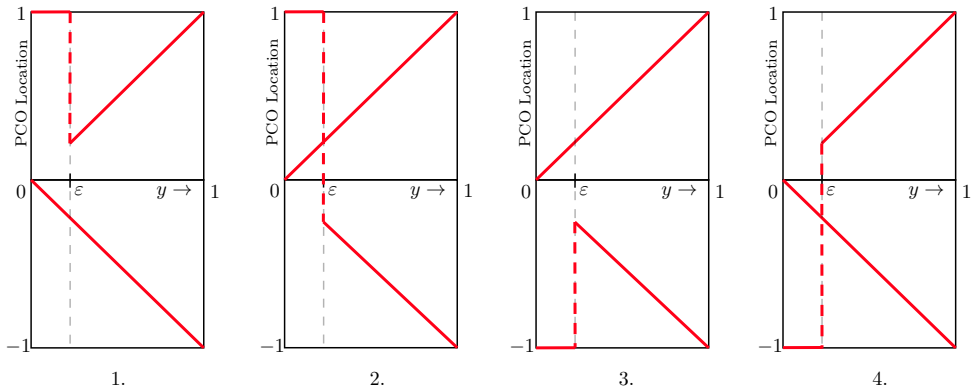
We compute the disk one-point function, the disk two-point function, and the annulus one-point function of the cosmological constant operator in the type 0A and type 0B minimal superstring theories with (1,1) ZZ instanton boundary conditions. The moduli-space integrals appearing in the disk two-point function and the annulus one-point function have divergences associated with open-string-channel degenerations, which must be regulated using open-closed string field theory. The definition of the string field theory interaction vertices requires a choice of locations for the picture-changing operators, which we specify in detail. After carefully taking into account all contributions, including those from vertical integration, we find that the results precisely match the expectations from DDK-KPZ scaling. Our technical results on the detailed construction of interaction vertices are a first step toward understanding the analogous quantities in the ten-dimensional type IIB superstring, where one also needs to understand how to treat the bosonic and fermionic collective coordinates at subleading order.
Editorial analysis
A structured set of objections, weighed in public.
Referee Report
Summary. The manuscript computes the disk one-point function, the disk two-point function, and the annulus one-point function of the cosmological constant operator in type 0A and type 0B minimal superstring theories with (1,1) ZZ instanton boundary conditions. Divergences in the moduli-space integrals for the disk two-point and annulus one-point functions are regulated via open-closed string field theory vertices whose definition fixes picture-changing operator locations. After including all contributions (including vertical integration), the results are reported to match DDK-KPZ scaling expectations. Technical details on vertex construction are presented as a step toward analogous computations in ten-dimensional type IIB superstring theory.
Significance. If the central claim is robust, the work supplies a concrete check that SFT-regulated instanton amplitudes in minimal superstring theory reproduce the expected scaling at subleading order, together with explicit vertex constructions that may prove useful for handling bosonic and fermionic collective coordinates in higher-dimensional cases.
major comments (1)
- [Definition of SFT interaction vertices (as described in the abstract and relevant technical sections)] The section describing the definition of the string field theory interaction vertices: the claim that the final results match DDK-KPZ scaling after vertical integration rests on the assumption that the chosen PCO locations plus the vertical-integration procedure exhaust all physical contributions and leave no residual boundary or degeneration terms. No argument is supplied showing that the finite part of the amplitude is independent of this specific PCO placement; an alternative valid choice could shift the result and remove the reported agreement.
minor comments (1)
- [Abstract] The abstract asserts that 'all contributions were accounted for' and that results 'precisely match' DDK-KPZ scaling, but supplies no explicit equations, numerical values, or error estimates that would permit an independent cross-check of the matching.
Simulated Author's Rebuttal
We thank the referee for their careful reading and constructive feedback on our manuscript. We respond to the single major comment below.
read point-by-point responses
-
Referee: [Definition of SFT interaction vertices (as described in the abstract and relevant technical sections)] The section describing the definition of the string field theory interaction vertices: the claim that the final results match DDK-KPZ scaling after vertical integration rests on the assumption that the chosen PCO locations plus the vertical-integration procedure exhaust all physical contributions and leave no residual boundary or degeneration terms. No argument is supplied showing that the finite part of the amplitude is independent of this specific PCO placement; an alternative valid choice could shift the result and remove the reported agreement.
Authors: We agree that the manuscript would benefit from an explicit statement on independence of the finite part from the PCO placement. The locations are fixed by the requirement that the vertices satisfy the picture number assignments and the homotopy relations of open-closed SFT. Vertical integration is defined to cover the full relevant moduli space, including all degenerations, so that any boundary contributions from alternative valid placements cancel. In the revised version we will add a concise paragraph making this independence argument explicit. The computed results and their agreement with DDK-KPZ scaling remain unchanged. revision: yes
Circularity Check
No circularity: explicit SFT computation verified against external DDK-KPZ scaling
full rationale
The paper performs a direct moduli-space integration for the disk one-point, disk two-point, and annulus one-point functions, regulating open-string degenerations via explicitly constructed open-closed SFT vertices with chosen PCO locations and vertical integration. The final agreement with DDK-KPZ scaling is reported as the outcome of this calculation rather than an input or definitional constraint. No self-definitional loops, fitted parameters renamed as predictions, or load-bearing self-citations appear in the derivation chain; the technical construction of vertices is presented as independent content whose result is then compared to the known scaling law.
Axiom & Free-Parameter Ledger
axioms (2)
- domain assumption Moduli-space integrals over disk and annulus surfaces with open-string-channel degenerations can be regulated by open-closed string field theory vertices.
- domain assumption A specific choice of picture-changing operator locations defines the interaction vertices unambiguously.
Reference graph
Works this paper leans on
-
[1]
Polchinski,String theory
J. Polchinski,String theory. Vol. 1: An introduction to the bosonic string, Cambridge Monographs on Mathematical Physics (Cambridge University Press, 2007) ISBN 978-0-511-25227-3, 978-0-521- 67227-6, 978-0-521-63303-1
2007
-
[2]
Conformal invariance, supersymmetry and string theory,
Daniel Friedan, Emil J. Martinec, and Stephen H. Shenker, “Conformal invariance, supersymmetry and string theory,” Nucl. Phys. B271, 93–165 (1986)
1986
-
[3]
Picture changing operators in supergeometry and superstring theory,
Alexander Belopolsky, “Picture changing operators in supergeometry and superstring theory,” (6 1997), arXiv:hep-th/9706033
Pith/arXiv arXiv 1997
-
[4]
Polchinski,String theory
J. Polchinski,String theory. Vol. 2: Superstring theory and beyond, Cambridge Monographs on Mathematical Physics (Cambridge University Press, 2007) ISBN 978-0-511-25228-0, 978-0-521- 63304-8, 978-0-521-67228-3
2007
-
[5]
Michael B. Green and Michael Gutperle, “Effects of D instantons,” Nucl. Phys. B498, 195–227 (1997), arXiv:hep-th/9701093
Pith/arXiv arXiv 1997
-
[6]
D instanton induced interactions on a D3-brane,
Michael B. Green and Michael Gutperle, “D instanton induced interactions on a D3-brane,” JHEP 02, 014 (2000), arXiv:hep-th/0002011
Pith/arXiv arXiv 2000
-
[7]
Combinatorics of boundaries in string theory,
Joseph Polchinski, “Combinatorics of boundaries in string theory,” Phys. Rev. D50, R6041–R6045 (1994), arXiv:hep-th/9407031
Pith/arXiv arXiv 1994
-
[8]
Closed Superstring Field Theory and its Applications,
Corinne de Lacroix, Harold Erbin, Sitender Pratap Kashyap, Ashoke Sen, and Mritunjay Verma, “Closed Superstring Field Theory and its Applications,” Int. J. Mod. Phys. A32, 1730021 (2017), arXiv:1703.06410 [hep-th]
Pith/arXiv arXiv 2017
-
[9]
String Field Theory: A Review,
Ashoke Sen and Barton Zwiebach, “String Field Theory: A Review,” (5 2024), arXiv:2405.19421 [hep-th]
arXiv 2024
-
[10]
ZZ instantons and the non-perturbative dual of c = 1 string theory,
Bruno Balthazar, Victor A. Rodriguez, and Xi Yin, “ZZ instantons and the non-perturbative dual of c = 1 string theory,” JHEP05, 048 (2023), arXiv:1907.07688 [hep-th]
arXiv 2023
-
[11]
Fixing an Ambiguity in Two Dimensional String Theory Using String Field Theory,
Ashoke Sen, “Fixing an Ambiguity in Two Dimensional String Theory Using String Field Theory,” JHEP03, 005 (2020), arXiv:1908.02782 [hep-th]
arXiv 2020
-
[12]
D-instantons, string field theory and two dimensional string theory,
Ashoke Sen, “D-instantons, string field theory and two dimensional string theory,” JHEP11, 061 (2021), arXiv:2012.11624 [hep-th]
arXiv 2021
-
[13]
Normalization of D-instanton amplitudes,
Ashoke Sen, “Normalization of D-instanton amplitudes,” JHEP11, 077 (2021), arXiv:2101.08566 [hep-th] 72
arXiv 2021
-
[14]
Instantons in sine-Liouville theory,
Sergei Alexandrov, Raghu Mahajan, and Ashoke Sen, “Instantons in sine-Liouville theory,” JHEP 01, 141 (2024), arXiv:2311.04969 [hep-th]
arXiv 2024
-
[15]
c = 1, R = 1 and N≫1: ZZ instantons in 2D string theory and matrix integrals,
Rishabh Kaushik, “c = 1, R = 1 and N≫1: ZZ instantons in 2D string theory and matrix integrals,” JHEP08, 177 (2025), arXiv:2501.14023 [hep-th]
arXiv 2025
-
[16]
Multi-instantons in 2d string theory,
Sergei Alexandrov and Rishabh Kaushik, “Multi-instantons in 2d string theory,” JHEP03, 052 (2026), arXiv:2509.03293 [hep-th]
arXiv 2026
-
[17]
Normalization of ZZ instanton amplitudes in minimal string theory,
Dan Stefan Eniceicu, Raghu Mahajan, Chitraang Murdia, and Ashoke Sen, “Normalization of ZZ instanton amplitudes in minimal string theory,” JHEP07, 139 (2022), arXiv:2202.03448 [hep-th]
arXiv 2022
-
[18]
Multi-instantons in minimal string theory and in matrix integrals,
Dan Stefan Eniceicu, Raghu Mahajan, Chitraang Murdia, and Ashoke Sen, “Multi-instantons in minimal string theory and in matrix integrals,” JHEP10, 065 (2022), arXiv:2206.13531 [hep-th]
arXiv 2022
-
[19]
The ZZ annulus one-point function in non-critical string theory: A string field theory analysis,
Dan Stefan Eniceicu, Raghu Mahajan, Pronobesh Maity, Chitraang Murdia, and Ashoke Sen, “The ZZ annulus one-point function in non-critical string theory: A string field theory analysis,” JHEP 12, 151 (2022), arXiv:2210.11473 [hep-th]
arXiv 2022
-
[20]
D-instanton Effects in Type IIB String Theory,
Nathan B. Agmon, Bruno Balthazar, Minjae Cho, Victor A. Rodriguez, and Xi Yin, “D-instanton Effects in Type IIB String Theory,” (5 2022), arXiv:2205.00609 [hep-th]
arXiv 2022
-
[21]
Normalization of type IIB D-instanton amplitudes,
Ashoke Sen, “Normalization of type IIB D-instanton amplitudes,” JHEP12, 146 (2021), arXiv:2104.11109 [hep-th]
arXiv 2021
-
[22]
Muti-instanton amplitudes in type IIB string theory,
Ashoke Sen, “Muti-instanton amplitudes in type IIB string theory,” JHEP12, 065 (2021), arXiv:2104.15110 [hep-th]
arXiv 2021
-
[23]
D-instantons in Type IIA string theory on Calabi-Yau threefolds,
Sergei Alexandrov, Ashoke Sen, and Bogdan Stefa´ nski, “D-instantons in Type IIA string theory on Calabi-Yau threefolds,” JHEP11, 018 (2021), arXiv:2108.04265 [hep-th]
arXiv 2021
-
[24]
Euclidean D-branes in type IIB string theory on Calabi-Yau threefolds,
Sergei Alexandrov, Ashoke Sen, and Bogdan Stefa´ nski, “Euclidean D-branes in type IIB string theory on Calabi-Yau threefolds,” JHEP12, 044 (2021), arXiv:2110.06949 [hep-th]
arXiv 2021
-
[25]
D- instanton induced superpotential,
Sergei Alexandrov, Atakan Hilmi Fırat, Manki Kim, Ashoke Sen, and Bogdan Stefa´ nski, “D- instanton induced superpotential,” JHEP07, 090 (2022), arXiv:2204.02981 [hep-th]
arXiv 2022
-
[26]
The S-matrix of 2D type 0B string theory. Part II. D-instanton effects,
Bruno Balthazar, Victor A. Rodriguez, and Xi Yin, “The S-matrix of 2D type 0B string theory. Part II. D-instanton effects,” JHEP05, 235 (2023), arXiv:2204.01747 [hep-th]
arXiv 2023
-
[27]
Infrared finite semi-inclusive cross section in two dimensional type 0B string theory,
Ashoke Sen, “Infrared finite semi-inclusive cross section in two dimensional type 0B string theory,” JHEP04, 101 (2023), arXiv:2208.07385 [hep-th]
arXiv 2023
-
[28]
Normalization of D instanton amplitudes in two dimen- sional type 0B string theory,
Joydeep Chakravarty and Ashoke Sen, “Normalization of D instanton amplitudes in two dimen- sional type 0B string theory,” JHEP02, 170 (2023), arXiv:2207.07138 [hep-th] 73
arXiv 2023
-
[29]
Normaliza- tion of ZZ instanton amplitudes in type 0B minimal superstring theory,
Vivek Chakrabhavi, Dan Stefan Eniceicu, Raghu Mahajan, and Chitraang Murdia, “Normaliza- tion of ZZ instanton amplitudes in type 0B minimal superstring theory,” JHEP09, 114 (2024), arXiv:2406.16867 [hep-th]
arXiv 2024
-
[30]
D-instanton Effects on a D3-brane,
Jaroslav Scheinpflug, Yuchen Wang, and Xi Yin, “D-instanton Effects on a D3-brane,” (2 2026), arXiv:2602.21281 [hep-th]
arXiv 2026
-
[31]
thesis, Harvard U
Nathan Benjamin Agmon,D-instantons and String Field Theory, Ph.D. thesis, Harvard U. (2023)
2023
-
[32]
A New hat for the c=1 matrix model,
Michael R. Douglas, Igor R. Klebanov, D. Kutasov, Juan Martin Maldacena, Emil John Martinec, and N. Seiberg, “A New hat for the c=1 matrix model,” inFrom Fields to Strings: Circum- navigating Theoretical Physics: A Conference in Tribute to Ian Kogan(2003) pp. 1758–1827, arXiv:hep-th/0307195
Pith/arXiv arXiv 2003
-
[33]
Branes, rings and matrix models in minimal (super)string the- ory,
Nathan Seiberg and David Shih, “Branes, rings and matrix models in minimal (super)string the- ory,” JHEP02, 021 (2004), arXiv:hep-th/0312170
Pith/arXiv arXiv 2004
-
[34]
Unitary and complex matrix models as 1-d type 0 strings,
Igor R. Klebanov, Juan Martin Maldacena, and N. Seiberg, “Unitary and complex matrix models as 1-d type 0 strings,” Commun. Math. Phys.252, 275–323 (2004), arXiv:hep-th/0309168
Pith/arXiv arXiv 2004
-
[35]
Checkered surfaces and complex matrices,
T. R. Morris, “Checkered surfaces and complex matrices,” Nucl. Phys. B356, 703–728 (1991)
1991
-
[36]
Multicritical complex matrix models and nonperturbative 2-D quantum gravity,
Simon Dalley, Clifford V. Johnson, and Tim R. Morris, “Multicritical complex matrix models and nonperturbative 2-D quantum gravity,” Nucl. Phys. B368, 625–654 (1992)
1992
-
[37]
Nonperturbative two-dimensional quan- tum gravity,
Simon Dalley, Clifford V. Johnson, and Tim R. Morris, “Nonperturbative two-dimensional quan- tum gravity,” Nucl. Phys. B368, 655–670 (1992)
1992
-
[38]
Nonperturbative two-dimensional quan- tum gravity, again,
Simon Dalley, Clifford V. Johnson, and Tim R. Morris, “Nonperturbative two-dimensional quan- tum gravity, again,” Nucl. Phys. B Proc. Suppl.25, 87–91 (1992), arXiv:hep-th/9108016
Pith/arXiv arXiv 1992
-
[39]
Unitary matrix models and 2-D quantum gravity,
S. Dalley, C. V. Johnson, T. R. Morris, and A. Watterstam, “Unitary matrix models and 2-D quantum gravity,” Mod. Phys. Lett. A7, 2753–2762 (1992), arXiv:hep-th/9206060
Pith/arXiv arXiv 1992
-
[40]
Possible Third Order Phase Transition in the Large N Lattice Gauge Theory,
D. J. Gross and Edward Witten, “Possible Third Order Phase Transition in the Large N Lattice Gauge Theory,” Phys. Rev. D21, 446–453 (1980)
1980
-
[41]
N= Infinity Phase Transition in a Class of Exactly Soluble Model Lattice Gauge Theories,
Spenta R. Wadia, “N= Infinity Phase Transition in a Class of Exactly Soluble Model Lattice Gauge Theories,” Phys. Lett. B93, 403–410 (1980)
1980
-
[42]
Unitary matrix models as exactly solvable string theories,
Vipul Periwal and Danny Shevitz, “Unitary matrix models as exactly solvable string theories,” Phys. Rev. Lett.64, 1326 (1990)
1990
-
[43]
Painleve-II and odd polynomials,
Chiara R. Nappi, “Painleve-II and odd polynomials,” Mod. Phys. Lett. A5, 2773–2776 (1990) 74
1990
-
[44]
Physical solutions for unitary matrix models,
C. Crnkovic, Michael R. Douglas, and Gregory W. Moore, “Physical solutions for unitary matrix models,” Nucl. Phys. B360, 507–523 (1991)
1991
-
[45]
JT gravity and the ensembles of random matrix theory,
Douglas Stanford and Edward Witten, “JT gravity and the ensembles of random matrix theory,” Adv. Theor. Math. Phys.24, 1475–1680 (2020), arXiv:1907.03363 [hep-th]
arXiv 2020
-
[46]
Dan Stefan Eniceicu, Raghu Mahajan, and Chitraang Murdia, “Complex eigenvalue instantons and the Fredholm determinant expansion in the Gross-Witten-Wadia model,” JHEP01, 129 (2024), arXiv:2308.06320 [hep-th]
arXiv 2024
-
[47]
Jackiw-Teitelboim supergravity as a double-cut matrix model,
Clifford V. Johnson, Felipe Rosso, and Andrew Svesko, “Jackiw-Teitelboim supergravity as a double-cut matrix model,” Phys. Rev. D104, 086019 (2021), arXiv:2102.02227 [hep-th]
arXiv 2021
-
[48]
Phase transitions for deformations of JT supergravity and matrix models,
Felipe Rosso and Gustavo J. Turiaci, “Phase transitions for deformations of JT supergravity and matrix models,” JHEP02, 187 (2022), arXiv:2111.09330 [hep-th]
arXiv 2022
-
[49]
Liouville field theory on a pseudo- sphere,
Alexander B. Zamolodchikov and Alexei B. Zamolodchikov, “Liouville field theory on a pseudo- sphere,” SQS, 280–299(1 2001), arXiv:hep-th/0101152
Pith/arXiv arXiv 2001
-
[50]
Exact one point function of N=1 super- Liouville theory with boundary,
Changrim Ahn, Chaiho Rim, and Marian Stanishkov, “Exact one point function of N=1 super- Liouville theory with boundary,” Nucl. Phys. B636, 497–513 (2002), arXiv:hep-th/0202043
Pith/arXiv arXiv 2002
-
[51]
Super Liouville theory with boundary,
Takeshi Fukuda and Kazuo Hosomichi, “Super Liouville theory with boundary,” Nucl. Phys. B 635, 215–254 (2002), arXiv:hep-th/0202032
Pith/arXiv arXiv 2002
-
[52]
Conformal Field Theories Coupled to 2D Gravity in the Conformal Gauge,
F. David, “Conformal Field Theories Coupled to 2D Gravity in the Conformal Gauge,” Mod. Phys. Lett. A3, 1651 (1988)
1988
-
[53]
Conformal Field Theory and 2D Quantum Gravity,
Jacques Distler and Hikaru Kawai, “Conformal Field Theory and 2D Quantum Gravity,” Nucl. Phys. B321, 509–527 (1989)
1989
-
[54]
Fractal Structure of 2D Quantum Gravity,
V. G. Knizhnik, Alexander M. Polyakov, and A. B. Zamolodchikov, “Fractal Structure of 2D Quantum Gravity,” Mod. Phys. Lett. A3, 819 (1988)
1988
-
[55]
Liouville field theory: A Decade after the revolution,
Yu Nakayama, “Liouville field theory: A Decade after the revolution,” Int. J. Mod. Phys. A19, 2771–2930 (2004), arXiv:hep-th/0402009
Pith/arXiv arXiv 2004
-
[56]
Superconformal Invariance in Two- Dimensions and the Tricritical Ising Model,
Daniel Friedan, Zong-an Qiu, and Stephen H. Shenker, “Superconformal Invariance in Two- Dimensions and the Tricritical Ising Model,” Phys. Lett. B151, 37–43 (1985)
1985
-
[57]
Multiloop Calculations in Covariant Superstring The- ory,
Erik P. Verlinde and Herman L. Verlinde, “Multiloop Calculations in Covariant Superstring The- ory,” Phys. Lett. B192, 95–102 (1987)
1987
-
[58]
On the normalization of open-closed string amplitudes,
Ashoke Sen and Barton Zwiebach, “On the normalization of open-closed string amplitudes,” JHEP 05, 188 (2025), arXiv:2405.03784 [hep-th] 75
arXiv 2025
-
[59]
Scattering of D0-branes and Strings,
Ashoke Sen and Bogdan Stef´ anski, jr., “Scattering of D0-branes and Strings,” JHEP01, 033 (2026), arXiv:2509.02716 [hep-th]
arXiv 2026
-
[60]
Flux vacua and branes of the minimal superstring,
Nathan Seiberg and David Shih, “Flux vacua and branes of the minimal superstring,” JHEP01, 055 (2005), arXiv:hep-th/0412315
Pith/arXiv arXiv 2005
-
[61]
Notes on D-branes and dualities in (p,q) minimal superstring theory,
Hirotaka Irie, “Notes on D-branes and dualities in (p,q) minimal superstring theory,” Nucl. Phys. B794, 402–428 (2008), arXiv:0706.4471 [hep-th]
Pith/arXiv arXiv 2008
-
[62]
Unitary Representations of the Virasoro and Supervi- rasoro Algebras,
P. Goddard, A. Kent, and David I. Olive, “Unitary Representations of the Virasoro and Supervi- rasoro Algebras,” Commun. Math. Phys.103, 105–119 (1986)
1986
-
[63]
NonBPS states and Branes in string theory,
Ashoke Sen, “NonBPS states and Branes in string theory,” inAdvanced School on Supersymmetry in the Theories of Fields, Strings and Branes(1999) pp. 187–234, arXiv:hep-th/9904207
Pith/arXiv arXiv 1999
-
[64]
Anomalies and Nonsupersymmetric D-Branes,
Edward Witten, “Anomalies and Nonsupersymmetric D-Branes,” (5 2023), arXiv:2305.01012
arXiv 2023
-
[65]
D-instanton Perturbation Theory,
Ashoke Sen, “D-instanton Perturbation Theory,” JHEP08, 075 (2020), arXiv:2002.04043 [hep-th]
arXiv 2020
-
[66]
The Geometry of String Perturbation Theory,
Eric D’Hoker and D. H. Phong, “The Geometry of String Perturbation Theory,” Rev. Mod. Phys. 60, 917 (1988)
1988
-
[67]
Theta function: Relation to the weierstrass elliptic function,
Wikipedia contributors, “Theta function: Relation to the weierstrass elliptic function,” https://en.wikipedia.org/wiki/Theta_function#Relation_to_the_Weierstrass_ elliptic_function(2026), accessed: 2026-05-24
2026
-
[68]
NIST Digital Library of Mathematical Functions, equation 23.6.6,
“NIST Digital Library of Mathematical Functions, equation 23.6.6,”https://dlmf.nist.gov/23. 6.E6, Release 1.2.6 of 2026-03-15
2026
-
[69]
Lawden,Elliptic Functions and Applications, Applied Mathematical Sciences (Springer New York, 2013) ISBN 9781475739800 76
D.F. Lawden,Elliptic Functions and Applications, Applied Mathematical Sciences (Springer New York, 2013) ISBN 9781475739800 76
2013
discussion (0)
Sign in with ORCID, Apple, or X to comment. Anyone can read and Pith papers without signing in.