Prolate spheroidal wave functions enable fast and exponent-aware long-range machine learning interatomic potentials
Pith reviewed 2026-06-27 23:00 UTC · model grok-4.3
The pith
Prolate spheroidal wave functions let long-range MLIPs represent 1/r^p interactions with fewer Fourier modes and threefold faster simulations.
A machine-rendered reading of the paper's core claim, the machinery that carries it, and where it could break.
Core claim
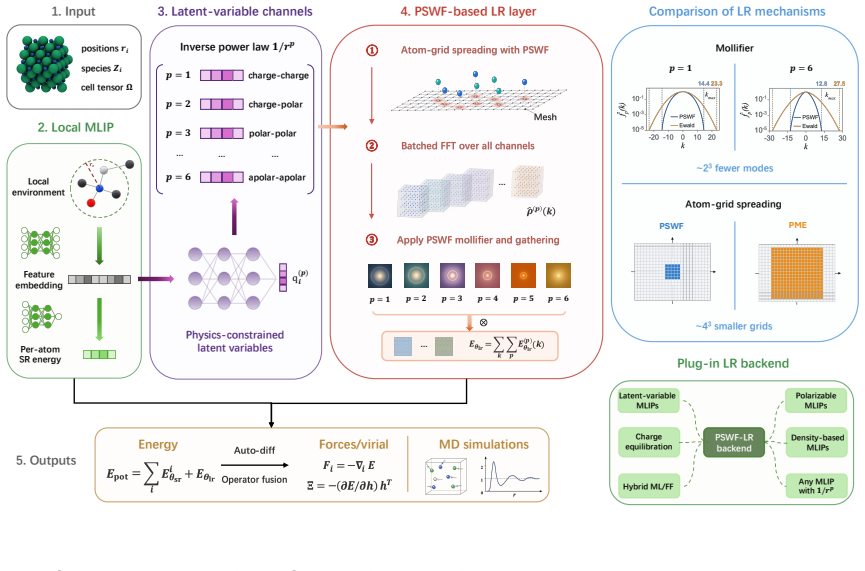
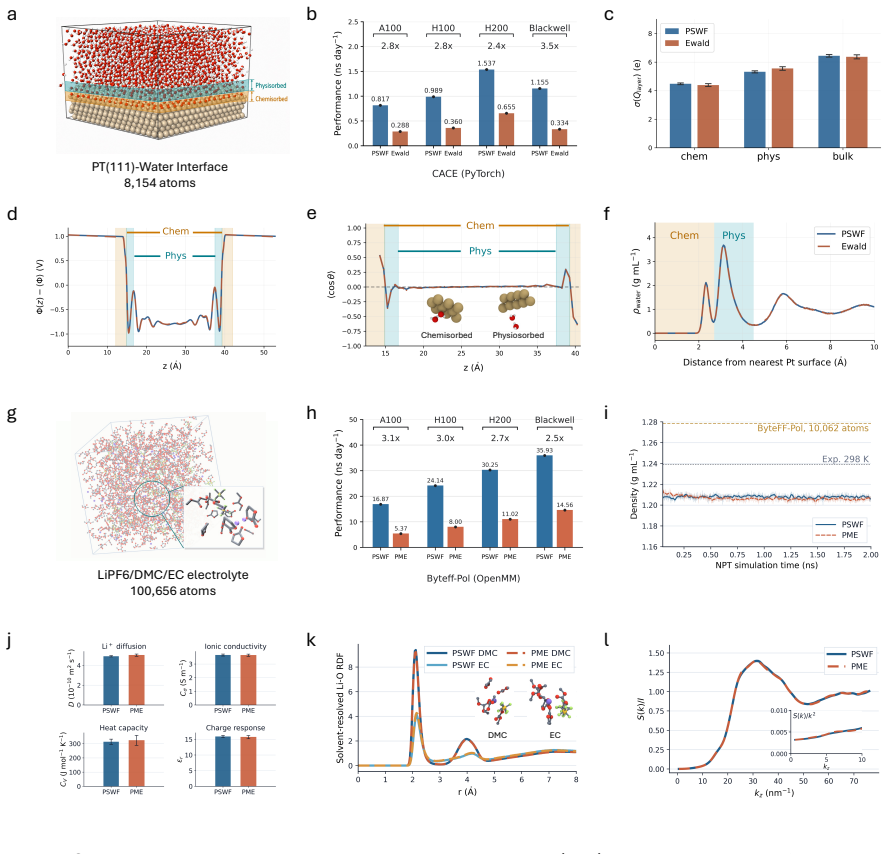
PSWF-LR is an exponent-aware long-range framework based on prolate spheroidal wave functions that uses PSWF-based mollification and atom-grid spreading to enable compact and efficient representation of arbitrary inverse-power channels 1/r^p while treating the decay exponent as a physical prior. This framework can be incorporated into existing model architectures and across diverse benchmarks reduces Fourier-mode requirements, improves energy and force accuracy, accelerates production-level simulations by about threefold, and extends long-range MLIP simulations beyond the memory limits of conventional MLIPs.
What carries the argument
PSWF-based mollification and atom-grid spreading, which produce compact representations of arbitrary 1/r^p channels when the decay exponent is supplied as a fixed physical input.
If this is right
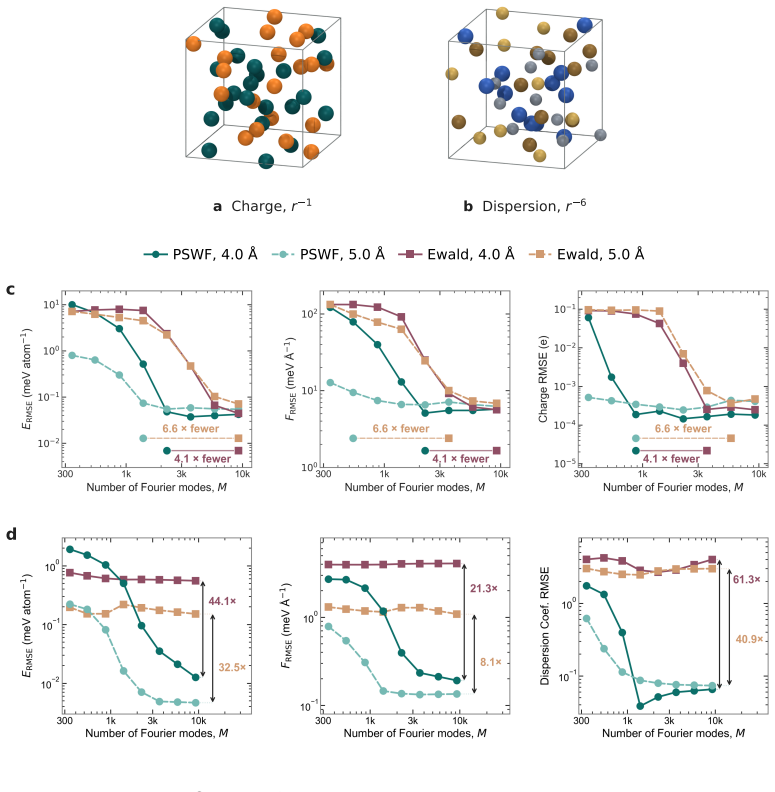
- Fourier-mode counts for long-range terms drop below those required by standard Ewald reciprocal-space methods.
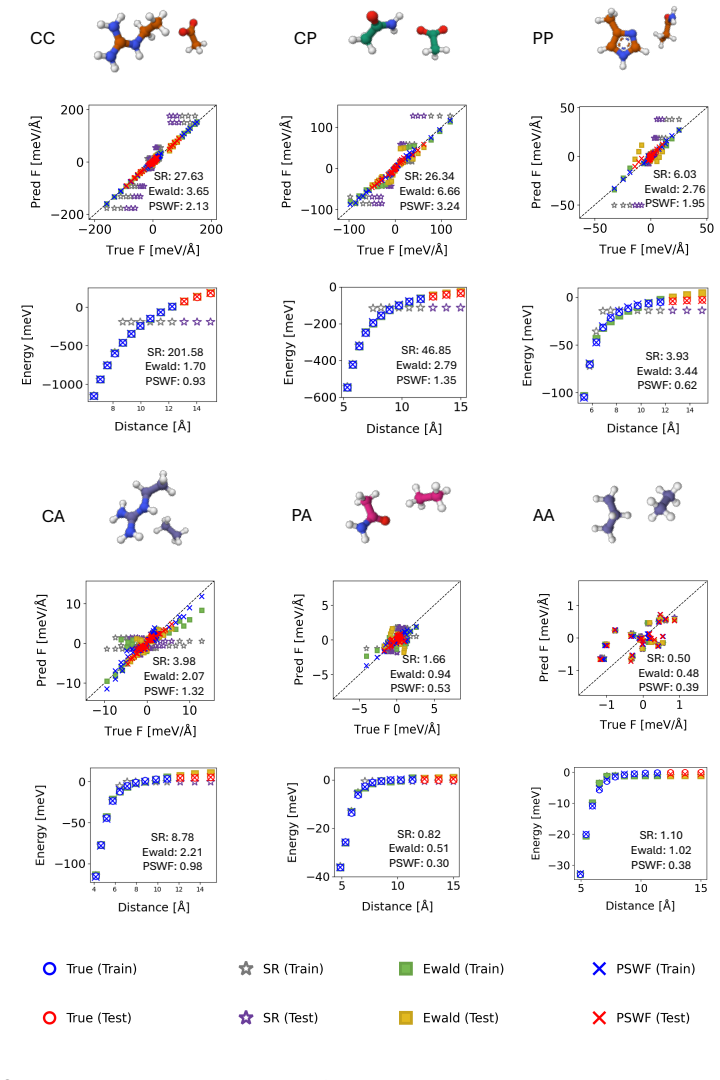
- Energy and force errors decrease on long-range benchmarks relative to conventional approaches.
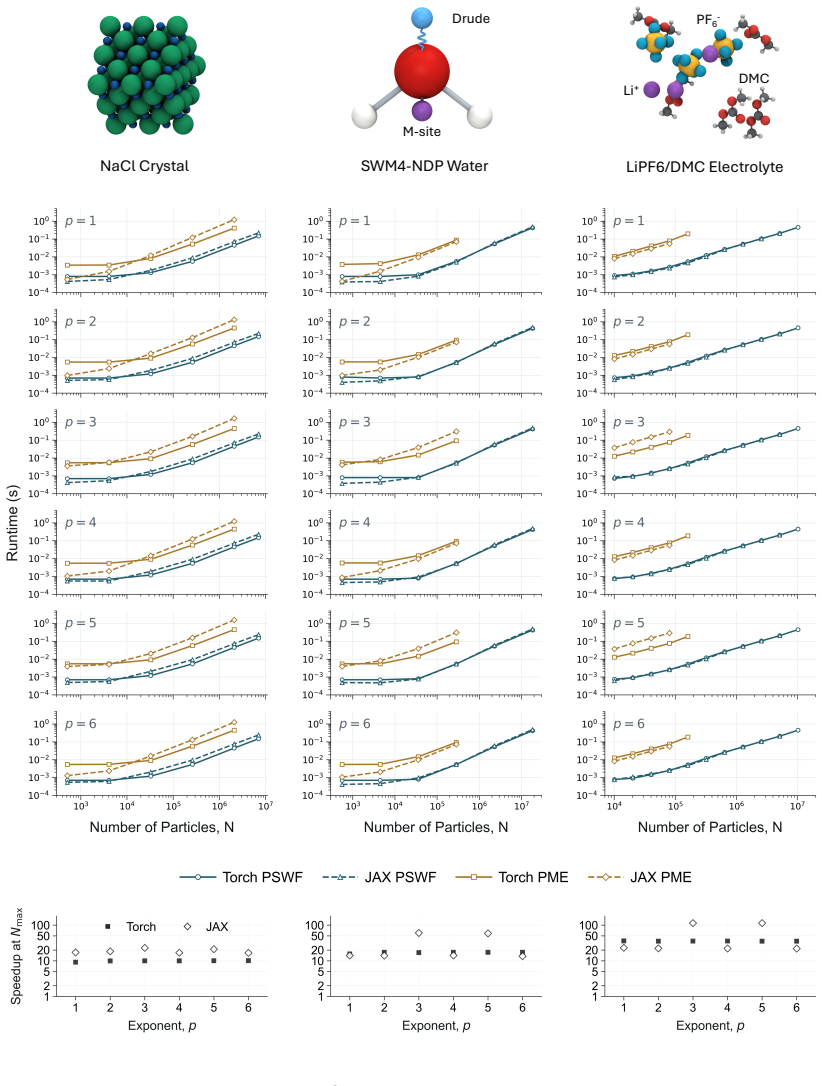
- Production molecular-dynamics runs finish approximately three times faster.
- Simulations of systems previously blocked by memory limits of dense Fourier grids become feasible.
Where Pith is reading between the lines
- The same mollification and spreading operations could be dropped into other reciprocal-space MLIP architectures without retraining the short-range part.
- The method may generalize to additional nonlocal kernels whose decay is known a priori, such as screened Coulomb or Yukawa forms.
- Large-scale interfacial simulations that currently truncate long-range forces could be rerun with the exponent fixed to test whether the reported accuracy gains appear in production settings.
Load-bearing premise
That PSWF-based mollification and atom-grid spreading can deliver compact representations of arbitrary inverse-power channels 1/r^p while treating the decay exponent as an independent physical prior that does not require additional fitting.
What would settle it
A side-by-side benchmark on an ionic or polar system in which the PSWF-LR model either matches or exceeds the energy and force accuracy of a dense-grid Ewald implementation while using at least 30 percent fewer Fourier modes and staying within a fixed memory budget; failure on either accuracy or memory would falsify the central claim.
Figures
read the original abstract
Long-range interactions such as electrostatics and dispersion remain a central bottleneck for machine learning interatomic potentials (MLIPs), especially in ionic, polar and interfacial systems. Ewald-based reciprocal-space mechanisms provide a physically grounded route for capturing these nonlocal effects, but often require dense Fourier grids and can become memory-limited at scale. This problem is particularly pronounced in molecular dynamics, where high efficiency requirements make accurate long-range modelling particularly costly. Here we introduce PSWF-LR, an exponent-aware long-range framework based on prolate spheroidal wave functions (PSWFs) that can be easily incorporated into existing model architectures. Its core components are PSWF-based mollification and atom-grid spreading, which enable compact and efficient representation of arbitrary inverse-power channels $1/r^p$ while treating the decay exponent as a physical prior. Across diverse long-range benchmarks, PSWF-LR reduces Fourier-mode requirements, improves energy and force accuracy, accelerates production-level simulations by about threefold, and extends long-range MLIP simulations beyond the memory limits of conventional MLIPs.
Editorial analysis
A structured set of objections, weighed in public.
Referee Report
Summary. The manuscript introduces PSWF-LR, a long-range extension for machine-learning interatomic potentials that employs prolate spheroidal wave functions (PSWFs) for mollification and atom-grid spreading. The central claim is that this approach yields compact Fourier representations of arbitrary inverse-power channels 1/r^p, with the decay exponent supplied only as an unfitted physical prior, thereby reducing the number of Fourier modes required, improving energy/force accuracy, delivering an approximately threefold speedup in production MD, and extending simulations beyond the memory limits of conventional Ewald-based MLIPs.
Significance. If the exponent-aware compactness property holds uniformly across physical p values, the method would directly mitigate a persistent scalability bottleneck in long-range MLIPs for ionic, polar, and interfacial systems. The work also supplies an explicit route for incorporating physical priors (the exponent) without additional fitting, which is a positive feature when the derivation is parameter-free.
major comments (2)
- [Abstract / §3] Abstract and §3 (PSWF mollification): the claim that PSWF-based mollification plus atom-grid spreading produces compact representations of 1/r^p for arbitrary physical p, with p treated strictly as an external prior, is load-bearing for every downstream performance number. The skeptic note correctly identifies that the spectral content of 1/r^p changes with p; the manuscript must therefore demonstrate (via explicit mode-count vs. p curves or concentration-parameter tables) that the minimal number of PSWFs needed for a fixed accuracy tolerance remains independent of p. No such demonstration is visible in the provided abstract, and the absence of quantitative benchmarks, error bars, or baseline comparisons leaves the independence claim unverified.
- [Results] Results section (benchmarks): the reported reductions in Fourier-mode count, accuracy gains, and threefold acceleration are presented without tabulated comparisons to standard Ewald or other long-range MLIP baselines, without error bars, and without explicit statements of the p values tested. Because every performance metric rests on the compactness property, these omissions make it impossible to assess whether the gains are uniform or p-dependent.
minor comments (2)
- [Abstract] The abstract states performance gains but supplies no numerical values, error bars, or baseline comparisons; these should be added even at the abstract level for a methods paper.
- [Methods] Notation for the PSWF concentration parameter and the spreading operator should be defined once in a dedicated subsection before first use.
Simulated Author's Rebuttal
We thank the referee for the constructive report and for noting the potential impact of the exponent-aware compactness property. We address each major comment below and will revise the manuscript to incorporate the requested demonstrations and clarifications.
read point-by-point responses
-
Referee: [Abstract / §3] Abstract and §3 (PSWF mollification): the claim that PSWF-based mollification plus atom-grid spreading produces compact representations of 1/r^p for arbitrary physical p, with p treated strictly as an external prior, is load-bearing for every downstream performance number. The skeptic note correctly identifies that the spectral content of 1/r^p changes with p; the manuscript must therefore demonstrate (via explicit mode-count vs. p curves or concentration-parameter tables) that the minimal number of PSWFs needed for a fixed accuracy tolerance remains independent of p. No such demonstration is visible in the provided abstract, and the absence of quantitative benchmarks, error bars, or baseline comparisons leaves the independence claim unverified.
Authors: We agree that explicit verification of p-independence is required to support the central claim. Section 3 derives that the PSWF basis, with concentration parameter c chosen to match the desired spatial support, yields a compact representation whose mode count for a fixed tolerance depends primarily on c rather than p. However, the manuscript does not include the requested mode-count versus p curves. In the revision we will add these curves (for p = 1 to 6 at fixed tolerances of 10^{-4} and 10^{-5}), concentration-parameter tables, error bars on all metrics, and direct Ewald baseline comparisons. These additions will be placed in §3 and the results section. revision: yes
-
Referee: [Results] Results section (benchmarks): the reported reductions in Fourier-mode count, accuracy gains, and threefold acceleration are presented without tabulated comparisons to standard Ewald or other long-range MLIP baselines, without error bars, and without explicit statements of the p values tested. Because every performance metric rests on the compactness property, these omissions make it impossible to assess whether the gains are uniform or p-dependent.
Authors: We accept that the results presentation lacks the requested tabulated format and explicit p values. The benchmarks were performed for representative physical exponents (p=1 for Coulomb, p=6 for dispersion), but these details and error bars are not tabulated. In the revised manuscript we will expand the results section with tables listing Fourier-mode counts, energy/force errors (with standard deviations from replicate runs), explicit p values, and side-by-side Ewald comparisons for each system. This will allow direct evaluation of uniformity across p. revision: yes
Circularity Check
No circularity in derivation chain
full rationale
The provided abstract and description introduce PSWF-LR as a new framework whose core components (PSWF-based mollification and atom-grid spreading) are presented as enabling compact representations of 1/r^p channels, with performance gains reported as empirical outcomes across benchmarks. No equations, parameter-fitting loops, self-citations, or uniqueness theorems are quoted that would reduce any central claim to an input by construction. The exponent is treated as an external prior, and no load-bearing step collapses to a self-referential definition or fitted prediction. This matches the default case of a self-contained paper whose claims rest on external properties of PSWFs rather than internal identities.
Axiom & Free-Parameter Ledger
Reference graph
Works this paper leans on
-
[1]
, author Gokcan, H
author Kalita, B. , author Gokcan, H. & author Isayev, O. title Machine learning interatomic potentials at the centennial crossroads of quantum mechanics . journal Nature Computational Science volume 5 , pages 1120--1132 ( year 2025 )
2025
-
[2]
, author H \"a se, F
author Friederich, P. , author H \"a se, F. , author Proppe, J. & author Aspuru-Guzik, A. title Machine-learned potentials for next-generation matter simulations . journal Nature Materials volume 20 , pages 750--761 ( year 2021 )
2021
-
[3]
author Unke, O. T. et al. title Machine learning force fields . journal Chemical Reviews volume 121 , pages 10142--10186 ( year 2021 )
2021
-
[4]
author Deng, J. et al. title The potential for bridgmanite megacrysts to drive magma ocean segregation . journal Nature pages 1--6 ( year 2026 )
2026
-
[5]
title Density functional and density matrix method scaling linearly with the number of atoms
author Kohn, W. title Density functional and density matrix method scaling linearly with the number of atoms . journal Physical Review Letters volume 76 , pages 3168 ( year 1996 )
1996
-
[6]
, author Han, J
author Zhang, L. , author Han, J. , author Wang, H. , author Car, R. & author E, W. title Deep potential molecular dynamics: a scalable model with the accuracy of quantum mechanics . journal Physical Review Letters volume 120 , pages 143001 ( year 2018 )
2018
-
[7]
author Ko, T. W. & author Ong, S. P. title Recent advances and outstanding challenges for machine learning interatomic potentials . journal Nature Computational Science volume 3 , pages 998--1000 ( year 2023 )
2023
-
[8]
author Bart \'o k, A. P. , author Payne, M. C. , author Kondor, R. & author Cs \'a nyi, G. title Gaussian approximation potentials: T he accuracy of quantum mechanics, without the electrons . journal Physical Review Letters volume 104 , pages 136403 ( year 2010 )
2010
-
[9]
author Niblett, S. P. , author Galib, M. & author Limmer, D. T. title Learning intermolecular forces at liquid--vapor interfaces . journal The Journal of Chemical Physics volume 155 ( year 2021 )
2021
-
[10]
author Sch \"u tt, K. et al. title Schnet: A continuous-filter convolutional neural network for modeling quantum interactions . journal Advances in Neural Information Processing Systems volume 30 ( year 2017 )
2017
-
[11]
, author Kovacs, D
author Batatia, I. , author Kovacs, D. P. , author Simm, G. , author Ortner, C. & author Cs \'a nyi, G. title MACE: H igher order equivariant message passing neural networks for fast and accurate force fields . journal Advances in Neural Information Processing Systems volume 35 , pages 11423--11436 ( year 2022 )
2022
-
[12]
author Batzner, S. et al. title E (3)-equivariant graph neural networks for data-efficient and accurate interatomic potentials . journal Nature Communications volume 13 , pages 2453 ( year 2022 )
2022
-
[13]
author Batatia, I. et al. title The design space of E (3)-equivariant atom-centred interatomic potentials . journal Nature Machine Intelligence volume 7 , pages 56--67 ( year 2025 )
2025
-
[14]
author Unke, O. T. & author Meuwly, M. title Physnet: A neural network for predicting energies, forces, dipole moments, and partial charges . journal Journal of Chemical Theory and Computation volume 15 , pages 3678--3693 ( year 2019 )
2019
-
[15]
author Ko, T. W. , author Finkler, J. A. , author Goedecker, S. & author Behler, J. title A fourth-generation high-dimensional neural network potential with accurate electrostatics including non-local charge transfer . journal Nature Communications volume 12 , pages 398 ( year 2021 )
2021
-
[16]
, author Pellegrini, F
author Shaidu, Y. , author Pellegrini, F. , author K \"u c \"u kbenli, E. , author Lot, R. & author de Gironcoli, S. title Incorporating long-range electrostatics in neural network potentials via variational charge equilibration from shortsighted ingredients . journal npj Computational Materials volume 10 , pages 47 ( year 2024 )
2024
-
[17]
author Gong, S. et al. title A predictive machine learning force-field framework for liquid electrolyte development . journal Nature Machine Intelligence pages 1--10 ( year 2025 )
2025
-
[18]
author Rappe, A. K. & author Goddard III, W. A. title Charge equilibration for molecular dynamics simulations . journal The Journal of Physical Chemistry volume 95 , pages 3358--3363 ( year 1991 )
1991
-
[19]
author Deng, B. et al. title CHGNet as a pretrained universal neural network potential for charge-informed atomistic modelling . journal Nature Machine Intelligence volume 5 , pages 1031--1041 ( year 2023 )
2023
-
[20]
author Zhang, L. et al. title A deep potential model with long-range electrostatic interactions . journal The Journal of Chemical Physics volume 156 ( year 2022 )
2022
-
[21]
& author Remsing, R
author Gao, A. & author Remsing, R. C. title Self-consistent determination of long-range electrostatics in neural network potentials . journal Nature Communications volume 13 , pages 1572 ( year 2022 )
2022
-
[22]
author Ewald, P. P. title Die Berechnung optischer und elektrostatischer Gitterpotentiale . journal Ann. Phys. volume 369 , pages 253--287 ( year 1921 )
1921
-
[23]
, author York, D
author Darden, T. , author York, D. & author Pedersen, L. title Particle mesh E wald: An N (N) method for E wald sums in large systems . journal The Journal of Chemical Physics volume 98 , pages 10089--10092 ( year 1993 )
1993
-
[24]
author Loche, P. et al. title Fast and flexible long-range models for atomistic machine learning . journal The Journal of Chemical Physics volume 162 ( year 2025 )
2025
-
[25]
& author Lee, J
author Greengard, L. & author Lee, J. title Accelerating the nonuniform fast F ourier transform . journal SIAM Review volume 46 , pages 443--454 ( year 2004 )
2004
-
[26]
author Barnett, A. H. , author Magland, J. & author Af Klinteberg, L. title A parallel nonuniform fast Fourier transform library based on an ``exponential of semicircle" kernel . journal SIAM Journal on Scientific Computing volume 41 , pages C479--C504 ( year 2019 )
2019
-
[27]
, author Gasteiger, J
author Kosmala, A. , author Gasteiger, J. , author Gao, N. & author G \"u nnemann, S. title Ewald-based long-range message passing for molecular graphs . In booktitle International Conference on Machine Learning , pages 17544--17563 ( organization PMLR , year 2023 )
2023
-
[28]
& author Ceriotti, M
author Grisafi, A. & author Ceriotti, M. title Incorporating long-range physics in atomic-scale machine learning . journal The Journal of Chemical Physics volume 151 ( year 2019 )
2019
-
[29]
author Huguenin-Dumittan, K. K. , author Loche, P. , author Haoran, N. & author Ceriotti, M. title Physics-inspired equivariant descriptors of nonbonded interactions . journal The Journal of Physical Chemistry Letters volume 14 , pages 9612--9618 ( year 2023 )
2023
-
[30]
, author Kaltak, M
author Faller, C. , author Kaltak, M. & author Kresse, G. title Density-based long-range electrostatic descriptors for machine learning force fields . journal The Journal of Chemical Physics volume 161 ( year 2024 )
2024
-
[31]
title Latent E wald summation for machine learning of long-range interactions
author Cheng, B. title Latent E wald summation for machine learning of long-range interactions . journal npj Computational Materials volume 11 , pages 80 ( year 2025 )
2025
-
[32]
author King, D. S. , author Kim, D. , author Zhong, P. & author Cheng, B. title Machine learning of charges and long-range interactions from energies and forces . journal Nature Communications volume 16 , pages 8763 ( year 2025 )
2025
-
[33]
author Gao, R. et al. title A foundation machine learning potential with polarizable long-range interactions for materials modelling . journal Nature Communications volume 16 , pages 10484 ( year 2025 )
2025
-
[34]
, author Liang, J
author Ji, Y. , author Liang, J. & author Xu, Z. title Machine-learning interatomic potentials for long-range systems . journal Physical Review Letters volume 135 , pages 178001 ( year 2025 )
2025
-
[35]
, author Liang, J
author Ji, Y. , author Liang, J. & author Xu, Z. title Accurate learning of long-range interatomic potentials by coupling C artesian atomic cluster expansion and sum-of- G aussians neural networks . journal The Journal of Chemical Physics volume 164 ( year 2026 )
2026
-
[36]
author Li, J. et al. title Scaling neural-network-based molecular dynamics with long-range electrostatic interactions to 51 nanoseconds per day . journal arXiv preprint arXiv:2504.15508 ( year 2025 )
arXiv 2025
-
[37]
& author Pollak, H
author Slepian, D. & author Pollak, H. O. title Prolate spheroidal wave functions, F ourier analysis and uncertainty— I . journal Bell System Technical Journal volume 40 , pages 43--63 ( year 1961 )
1961
-
[38]
author Zheng, T. et al. title Bridging quantum mechanics to liquid properties via a universal organic force field . journal Nature Communications ( year 2026 ). ://doi.org/10.1038/s41467-026-73566-3
-
[39]
author Eastman, P. et al. title OpenMM 8: molecular dynamics simulation with machine learning potentials . journal The Journal of Physical Chemistry B volume 128 , pages 109--116 ( year 2023 )
2023
-
[40]
title Atomic cluster expansion for accurate and transferable interatomic potentials
author Drautz, R. title Atomic cluster expansion for accurate and transferable interatomic potentials . journal Physical Review B volume 99 , pages 014104 ( year 2019 )
2019
-
[41]
title Cartesian atomic cluster expansion for machine learning interatomic potentials
author Cheng, B. title Cartesian atomic cluster expansion for machine learning interatomic potentials . journal npj Computational Materials volume 10 , pages 157 ( year 2024 )
2024
-
[42]
author Musaelian, A. et al. title Learning local equivariant representations for large-scale atomistic dynamics . journal Nature Communications volume 14 , pages 579 ( year 2023 )
2023
-
[43]
author Burns, L. A. et al. title The BioFragment Database (BFDb): An open-data platform for computational chemistry analysis of noncovalent interactions . journal The Journal of Chemical Physics volume 147 ( year 2017 )
2017
-
[44]
author Maruf, M. U. , author Kim, S. & author Ahmad, Z. title Learning long-range interactions in equivariant machine learning interatomic potentials via electronic degrees of freedom . journal The Journal of Physical Chemistry Letters volume 16 , pages 9078--9087 ( year 2025 )
2025
-
[45]
, author Bochkarev, A
author Rinaldi, M. , author Bochkarev, A. , author Lysogorskiy, Y. & author Drautz, R. title Charge-constrained atomic cluster expansion . journal Physical Review Materials volume 9 , pages 033802 ( year 2025 )
2025
-
[46]
, author Sharma, V
author Morawietz, T. , author Sharma, V. & author Behler, J. title A neural network potential-energy surface for the water dimer based on environment-dependent atomic energies and charges . journal The Journal of Chemical Physics volume 136 ( year 2012 )
2012
-
[47]
, author Wang, H
author Zhang, L. , author Wang, H. , author Car, R. & author E, W. title Phase diagram of a deep potential water model . journal Physical Review Letters volume 126 , pages 236001 ( year 2021 )
2021
-
[48]
author Batatia, I. et al. title A foundation model for atomistic materials chemistry . journal The Journal of Chemical Physics volume 163 ( year 2025 )
2025
-
[49]
author Kulichenko, M. et al. title Uncertainty-driven dynamics for active learning of interatomic potentials . journal Nature Computational Science volume 3 , pages 230--239 ( year 2023 )
2023
-
[50]
author Zheng, H. et al. title Learning from models beyond fine-tuning . journal Nature Machine Intelligence volume 7 , pages 6--17 ( year 2025 )
2025
-
[51]
, author Rokhlin, V
author Osipov, A. , author Rokhlin, V. , author Xiao, H. et al. title Prolate spheroidal wave functions of order zero . journal Springer Series: Applied Mathematical Sciences volume 187 ( year 2013 )
2013
-
[52]
title Some comments on F ourier analysis, uncertainty and modeling
author Slepian, D. title Some comments on F ourier analysis, uncertainty and modeling . journal SIAM Review volume 25 , pages 379--393 ( year 1983 )
1983
-
[53]
author Davenport, M. A. & author Wakin, M. B. title Compressive sensing of analog signals using discrete prolate spheroidal sequences . journal Applied and Computational Harmonic Analysis volume 33 , pages 438--472 ( year 2012 )
2012
-
[54]
& author Vaidyanathan, P
author Chen, C.-Y. & author Vaidyanathan, P. P. title MIMO radar space--time adaptive processing using prolate spheroidal wave functions . journal IEEE Transactions on Signal Processing volume 56 , pages 623--635 ( year 2008 )
2008
-
[55]
& author Greengard, L
author Jiang, S. & author Greengard, L. title A dual-space multilevel kernel-splitting framework for discrete and continuous convolution . journal Commun. Pure Appl. Math. volume 78 , pages 1086--1143 ( year 2025 )
2025
-
[56]
author Liang, J. , author Lu, L. , author Barnett, A. , author Greengard, L. & author Jiang, S. title Accelerating molecular dynamics simulations using fast Ewald summation with prolates . journal Nature Communications ( year 2026 ). ://doi.org/10.1038/s41467-026-73232-8
-
[57]
title Infinite boundary terms of E wald sums and pairwise interactions for electrostatics in bulk and at interfaces
author Hu, Z. title Infinite boundary terms of E wald sums and pairwise interactions for electrostatics in bulk and at interfaces . journal Journal of Chemical Theory and Computation volume 10 , pages 5254--5264 ( year 2014 )
2014
-
[58]
author Essmann, U. et al. title A smooth particle mesh E wald method . journal The Journal of Chemical Physics volume 103 , pages 8577--8593 ( year 1995 )
1995
-
[59]
, author Xu, Y
author Wang, X. , author Xu, Y. , author Zheng, H. & author Yu, K. title A scalable graph neural network method for developing an accurate force field of large flexible organic molecules . journal The Journal of Physical Chemistry Letters volume 12 , pages 7982--7987 ( year 2021 )
2021
-
[60]
author Zheng, T. et al. title Data-driven parametrization of molecular mechanics force fields for expansive chemical space coverage . journal Chemical Science volume 16 , pages 2730--2740 ( year 2025 )
2025
-
[61]
author Thompson, A. P. et al. title LAMMPS-A flexible simulation tool for particle-based materials modeling at the atomic, meso, and continuum scales . journal Computer Physics Communications volume 271 , pages 108171 ( year 2021 )
2021
-
[62]
, author Scuseria, G
author Heyd, J. , author Scuseria, G. E. & author Ernzerhof, M. title Hybrid functionals based on a screened C oulomb potential . journal The Journal of Chemical Physics volume 118 , pages 8207--8215 ( year 2003 )
2003
-
[63]
, author Aviat, F
author Lagardere, L. , author Aviat, F. & author Piquemal, J.-P. title Pushing the limits of multiple-time-step strategies for polarizable point dipole molecular dynamics . journal The Journal of Physical Chemistry Letters volume 10 , pages 2593--2599 ( year 2019 )
2019
discussion (0)
Sign in with ORCID, Apple, or X to comment. Anyone can read and Pith papers without signing in.