Collective decay of interacting bosons
Pith reviewed 2026-06-28 00:29 UTC · model grok-4.3
The pith
Interacting bosons under collective decay cross from superradiant to subradiant emission, with weak-regime dynamics captured by Dicke-like rate equations.
A machine-rendered reading of the paper's core claim, the machinery that carries it, and where it could break.
Core claim
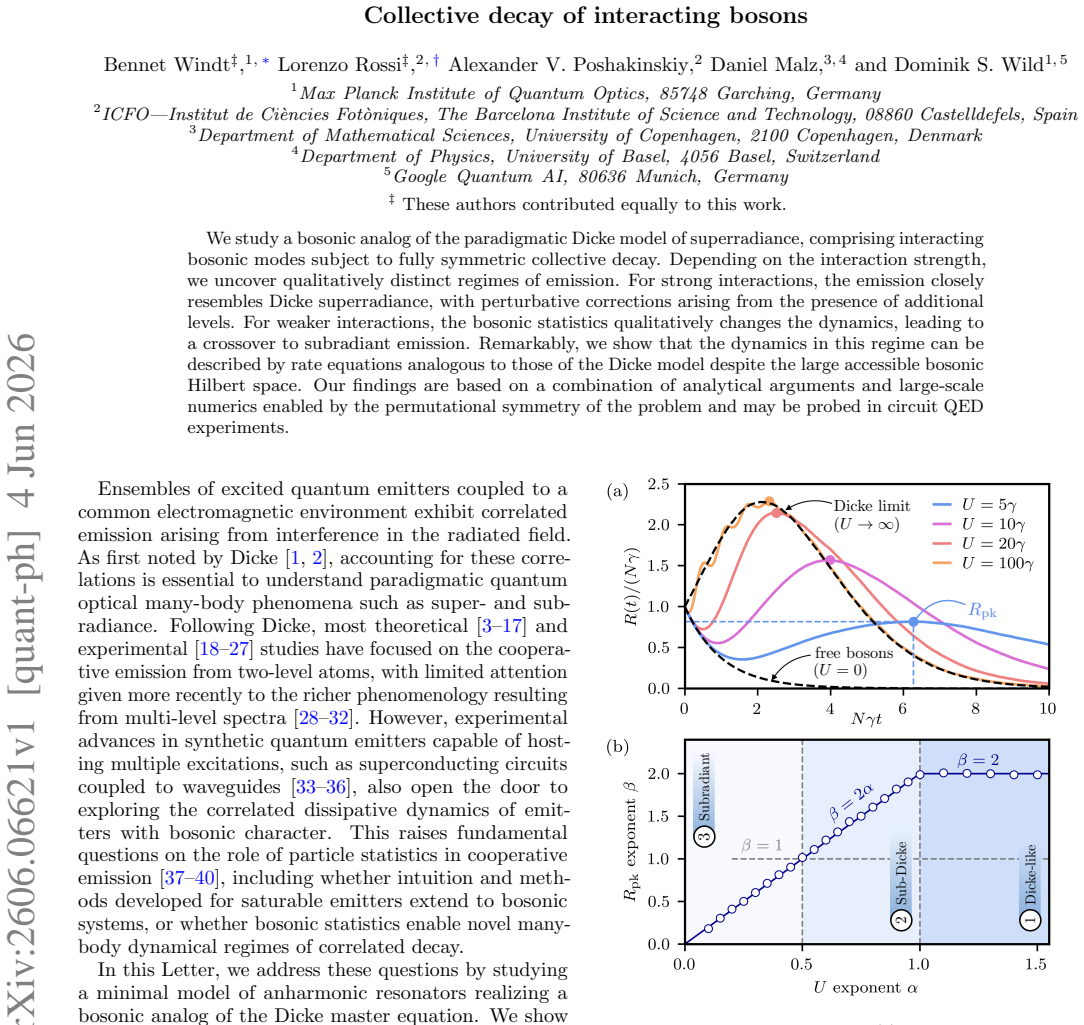
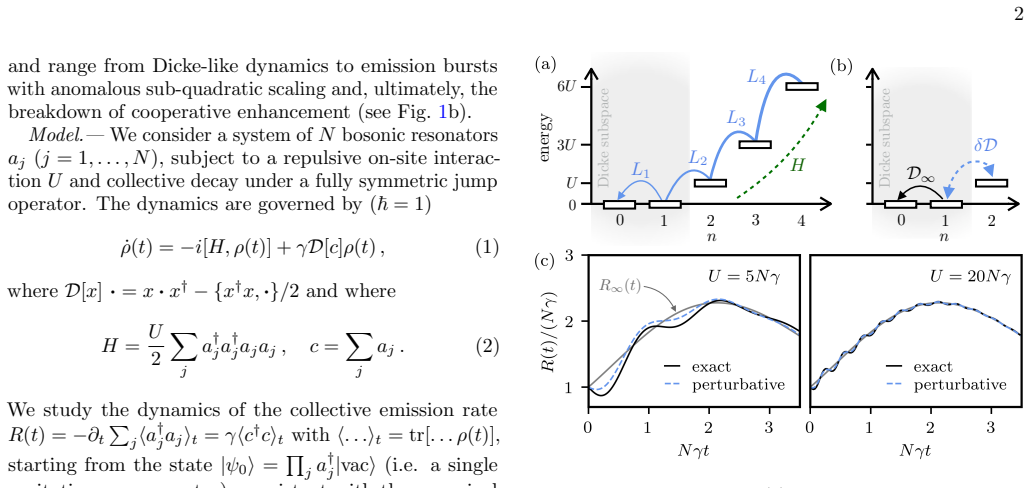
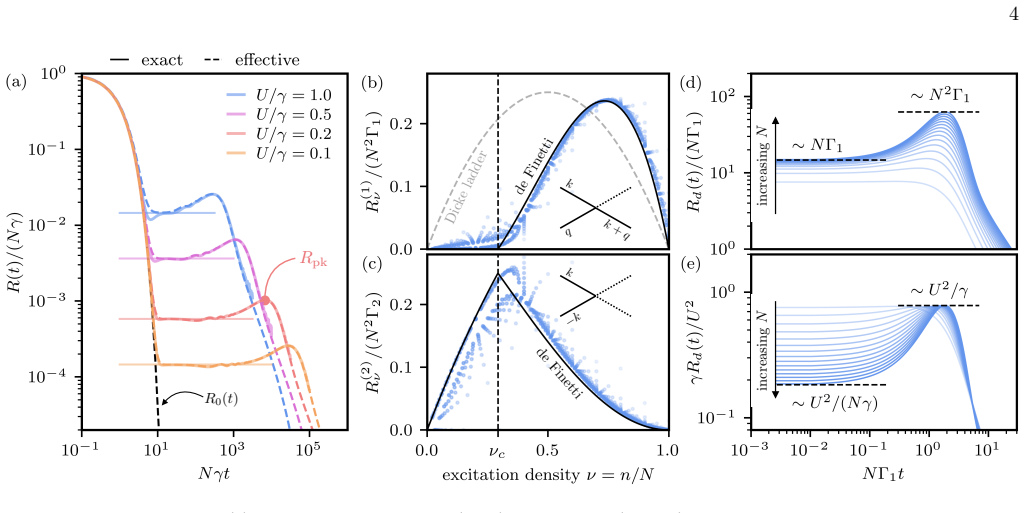
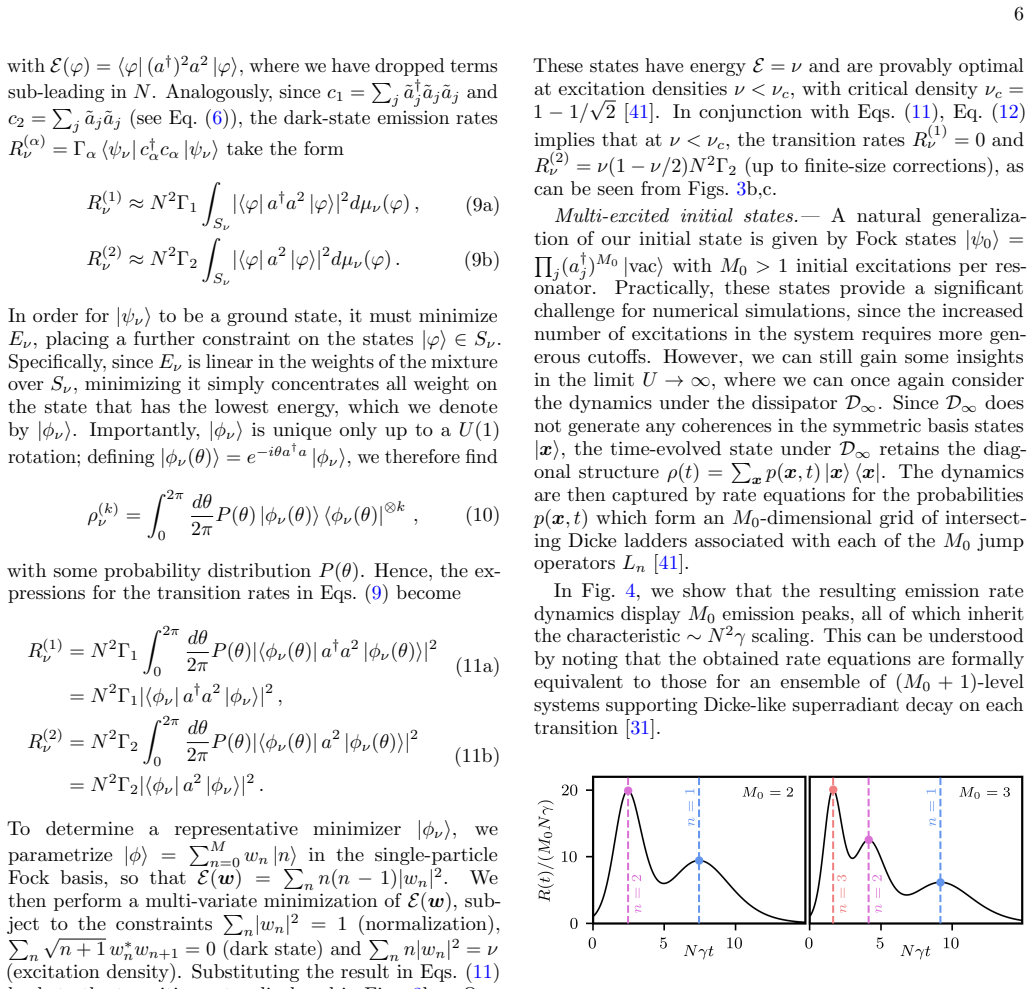
In a bosonic analog of the Dicke model consisting of interacting bosonic modes subject to fully symmetric collective decay, strong interactions yield superradiant emission resembling the standard Dicke case with perturbative corrections from additional levels, while weaker interactions drive a crossover to subradiant emission whose dynamics are described by rate equations analogous to the Dicke model despite the large bosonic Hilbert space; the analysis relies on analytical arguments and large-scale numerics made possible by permutational symmetry.
What carries the argument
Permutational symmetry of the bosonic system under fully symmetric collective decay, which reduces the effective description across interaction regimes and enables both the analytical treatment and the mapping to Dicke-like rate equations in the weak-interaction limit.
If this is right
- Strong interactions produce Dicke-like superradiance with only perturbative corrections from extra levels.
- Weaker interactions induce subradiant emission due to bosonic statistics.
- The weak-interaction dynamics are captured by rate equations that are formally analogous to the spin Dicke model.
- Permutational symmetry enables both analytical arguments and large-scale numerics across the regimes.
- The predicted behaviors are in principle accessible in circuit QED experiments.
Where Pith is reading between the lines
- The crossover point between the two regimes should depend on the ratio of interaction strength to decay rate and could be located by scanning that ratio in experiment.
- The same symmetry reduction might apply to other bosonic open systems with collective loss, allowing rate-equation descriptions beyond the present model.
- Engineering the interaction strength could be used to switch between fast superradiant and slow subradiant emission in bosonic platforms.
- The result highlights that bosonic statistics can produce qualitatively different collective decay compared with two-level systems even when the decay channel is identical.
Load-bearing premise
The collective decay remains fully symmetric and the system preserves permutational symmetry at all times.
What would settle it
Numerical or experimental time traces in the weak-interaction regime that deviate from the predicted rate-equation dynamics or that show no crossover to subradiance as interaction strength is lowered.
Figures
read the original abstract
We study a bosonic analog of the paradigmatic Dicke model of superradiance, comprising interacting bosonic modes subject to fully symmetric collective decay. Depending on the interaction strength, we uncover qualitatively distinct regimes of emission. For strong interactions, the emission closely resembles Dicke superradiance, with perturbative corrections arising from the presence of additional levels. For weaker interactions, the bosonic statistics qualitatively changes the dynamics, leading to a crossover to subradiant emission. Remarkably, we show that the dynamics in this regime can be described by rate equations analogous to those of the Dicke model despite the large accessible bosonic Hilbert space. Our findings are based on a combination of analytical arguments and large-scale numerics enabled by the permutational symmetry of the problem and may be probed in circuit QED experiments.
Editorial analysis
A structured set of objections, weighed in public.
Referee Report
Summary. The manuscript examines collective decay in a bosonic analog of the Dicke model consisting of interacting bosonic modes subject to fully symmetric collective decay. It identifies distinct regimes: strong interactions yield emission resembling Dicke superradiance with perturbative corrections from additional levels, while weaker interactions produce a crossover to subradiant emission whose dynamics are nevertheless captured by closed rate equations analogous to the Dicke model. These findings rest on analytical arguments combined with large-scale numerics that exploit permutational symmetry to handle the bosonic Hilbert space, with possible realization in circuit QED.
Significance. If the reduction to rate equations holds, the work offers a valuable extension of superradiance and subradiance concepts to bosonic systems, showing how symmetry enables both analytical closure and scalable numerics despite the large state space. The explicit combination of analytical arguments with symmetry-enabled numerics, together with experimental accessibility, strengthens its contribution to collective quantum dynamics.
major comments (2)
- [weak-interaction analysis / rate-equation derivation] The central claim that weak-interaction dynamics close under Dicke-like rate equations despite the bosonic Hilbert space (abstract and the section presenting the weak-interaction analysis) requires an explicit derivation showing how the master equation reduces without further approximations; the permutational symmetry argument should be stated with the relevant commutation relations or projection steps to confirm closure.
- [numerics section] The numerical confirmation of the rate-equation description (the numerics section) should report the effective Hilbert-space dimension after symmetry reduction and any truncation thresholds or convergence checks, as these directly support the claim that the equations capture the full dynamics.
minor comments (2)
- [rate-equation section] A short table or paragraph comparing the bosonic rate equations to the standard Dicke form would improve clarity for readers.
- [figures] Figure captions should explicitly label which curves correspond to the strong- versus weak-interaction regimes and note the interaction-strength values used.
Simulated Author's Rebuttal
We thank the referee for the positive assessment and constructive suggestions. We address each major comment below and will revise the manuscript to incorporate the requested clarifications.
read point-by-point responses
-
Referee: [weak-interaction analysis / rate-equation derivation] The central claim that weak-interaction dynamics close under Dicke-like rate equations despite the bosonic Hilbert space (abstract and the section presenting the weak-interaction analysis) requires an explicit derivation showing how the master equation reduces without further approximations; the permutational symmetry argument should be stated with the relevant commutation relations or projection steps to confirm closure.
Authors: We agree that an explicit derivation would improve clarity. The current manuscript relies on analytical arguments invoking permutational symmetry to argue closure, but does not spell out the commutation relations or projection steps in full detail. In the revision we will add a dedicated paragraph (or short subsection) in the weak-interaction analysis that derives the reduction: we will show that the collective jump operators commute with the total boson number and with the interaction term in the symmetric subspace, allowing the master equation to close exactly on the populations of the Dicke-like states without further approximations. revision: yes
-
Referee: [numerics section] The numerical confirmation of the rate-equation description (the numerics section) should report the effective Hilbert-space dimension after symmetry reduction and any truncation thresholds or convergence checks, as these directly support the claim that the equations capture the full dynamics.
Authors: We will expand the numerics section to include these details. After symmetry reduction the effective dimension scales polynomially rather than exponentially with the number of modes; we will state the exact scaling and the concrete dimensions used for the largest simulations. We will also report the truncation thresholds applied to the density-matrix elements and the convergence tests performed by comparing results across increasing system sizes and integration tolerances. revision: yes
Circularity Check
No significant circularity; derivation self-contained via symmetry
full rationale
The paper's central reduction—that fully symmetric collective decay plus permutational symmetry closes the bosonic dynamics into rate equations analogous to the Dicke model—is presented as an analytical consequence of the commutation properties of the decay operator with the permutation group, with the interaction term assumed to preserve the symmetry. This is then confirmed by large-scale numerics that exploit the same symmetry reduction. No step equates a fitted parameter to a prediction, renames a known result, or relies on a load-bearing self-citation whose content is itself unverified; the symmetry argument is external to the target result and the numerics are independent verification rather than tautological. The derivation therefore remains non-circular.
Axiom & Free-Parameter Ledger
Reference graph
Works this paper leans on
-
[1]
Journal of Physics B: Atomic, Molecular and Optical Physics , abstract =
Maciej Lewenstein and J Ignacio Cirac and Luis Santos , title =. Journal of Physics B: Atomic, Molecular and Optical Physics , abstract =. 2000 , month =. doi:10.1088/0953-4075/33/19/321 , url =
-
[2]
Zanner, Maximilian and Orell, Tuure and Schneider, Christian M. F. and Albert, Romain and Oleschko, Stefan and Juan, Mathieu L. and Silveri, Matti and Kirchmair, Gerhard , year =. Coherent control of a multi-qubit dark state in waveguide quantum electrodynamics , volume =. Nature Physics , publisher =. doi:10.1038/s41567-022-01527-w , number =
-
[3]
Integer Partitions
Andrews, George E and Eriksson, Kimmo. Integer Partitions
-
[4]
Dynamic programming: Introductory concepts
Sniedovich, Moshe. Dynamic programming: Introductory concepts
-
[5]
jl: A Julia framework for simulating open quantum systems , author=
QuantumOptics. jl: A Julia framework for simulating open quantum systems , author=. Computer Physics Communications , volume=. 2018 , publisher=
2018
-
[6]
New Journal of Physics , author =
Simulating quantum-optical phenomena with cold atoms in optical lattices , volume =. New Journal of Physics , author =. 2011 , pages =. doi:10.1088/1367-2630/13/2/023024 , number =
-
[7]
Superradiance:. Physics Reports , author =. 1982 , keywords =. doi:10.1016/0370-1573(82)90102-8 , abstract =
-
[8]
Master-. Physical Review A , author =. 1970 , keywords =. doi:10.1103/PhysRevA.2.2038 , number =
-
[9]
Nature Communications , author =
Universality of. Nature Communications , author =. 2022 , keywords =. doi:10.1038/s41467-022-29805-4 , abstract =
-
[10]
A quantum engineer's guide to superconducting qubits , volume =. Applied Physics Reviews , author =. 2019 , keywords =. doi:10.1063/1.5089550 , abstract =
-
[11]
Permutational symmetry for identical multilevel systems:. Physical Review A , author =. 2022 , pages =. doi:10.1103/PhysRevA.105.043704 , number =
-
[12]
Large-. Physical Review A , author =. 2022 , keywords =. doi:10.1103/PhysRevA.106.013716 , number =
-
[13]
Physical Review Letters , author =
Superradiance for. Physical Review Letters , author =. 2015 , keywords =. doi:10.1103/PhysRevLett.115.063601 , number =
-
[14]
Collective bosonic effects in an array of transmon devices , volume =. Physical Review A , author =. 2022 , keywords =. doi:10.1103/PhysRevA.105.063701 , number =
-
[15]
Physical Review Research , author =
Dicke. Physical Review Research , author =. 2022 , keywords =. doi:10.1103/PhysRevResearch.4.023207 , number =
-
[16]
and Zager, Zoe and Asenjo-Garcia, Ana , month = mar, year =
Cardenas-Lopez, Silvia and Masson, Stuart J. and Zager, Zoe and Asenjo-Garcia, Ana , month = mar, year =. Many-body superradiance and dynamical symmetry breaking in waveguide
-
[17]
Theoretical study of early-time superradiance for atom clouds and arrays , volume =. Physical Review A , author =. 2021 , keywords =. doi:10.1103/PhysRevA.104.063706 , number =
-
[18]
Physical Review Letters , author =
Laser-. Physical Review Letters , author =. 2021 , keywords =. doi:10.1103/PhysRevLett.127.243602 , number =
-
[19]
Nature Communications , author =
Observation of. Nature Communications , author =. 2014 , keywords =. doi:10.1038/ncomms6186 , number =
-
[20]
Journal of the Optical Society of America B , author =
Monte. Journal of the Optical Society of America B , author =. 1993 , keywords =. doi:10.1364/JOSAB.10.000524 , number =
-
[21]
Quantum. Physical Review A , author =. 1972 , keywords =. doi:10.1103/PhysRevA.5.1457 , number =
-
[22]
Superradiant pulses and directed angular momentum states , volume =. Physical Review A , author =. 1976 , keywords =. doi:10.1103/PhysRevA.13.357 , number =
-
[23]
Observation of superradiant bursts in a cascaded quantum system , url =
Liedl, Christian and Tebbenjohanns, Felix and Bach, Constanze and Pucher, Sebastian and Rauschenbeutel, Arno and Schneeweiss, Philipp , month = jun, year =. Observation of superradiant bursts in a cascaded quantum system , url =
-
[24]
Super-. Nano Letters , author =. 2018 , keywords =. doi:10.1021/acs.nanolett.8b01133 , abstract =
-
[25]
Coherence in cooperative photon emission from indistinguishable quantum emitters , volume =. Science Advances , author =. 2022 , keywords =. doi:10.1126/sciadv.abm8171 , abstract =
-
[26]
Coherence in. Physical Review , author =. 1954 , keywords =. doi:10.1103/PhysRev.93.99 , number =
-
[27]
Physical Review Letters , author =
Wave-function approach to dissipative processes in quantum optics , volume =. Physical Review Letters , author =. 1992 , keywords =. doi:10.1103/PhysRevLett.68.580 , number =
-
[28]
Approximate. Physical Review A , author =. 1971 , pages =. doi:10.1103/PhysRevA.4.2415 , number =
-
[29]
Optics Communications , author =
Statistical properties of superradiant pulses , volume =. Optics Communications , author =. 1970 , pages =
1970
-
[30]
Superradiance and subradiance in inverted atomic arrays , volume =. Physical Review A , author =. 2022 , keywords =. doi:10.1103/PhysRevA.106.053717 , number =
-
[31]
Input-output theory for waveguide. Physical Review A , author =. 2013 , pages =. doi:10.1103/PhysRevA.88.043806 , number =
-
[32]
The bosonic skin effect:. SciPost Physics , author =. 2024 , pages =. doi:10.21468/SciPostPhys.16.1.029 , abstract =
-
[33]
Physical Review Letters , author =
Unified. Physical Review Letters , author =. 2025 , pages =. doi:10.1103/PhysRevLett.134.207102 , abstract =
-
[34]
Excitable quantum systems: the bosonic avalanche laser , shorttitle =
Garbe, Louis and Rabl, Peter , month = sep, year =. Excitable quantum systems: the bosonic avalanche laser , shorttitle =. doi:10.48550/arXiv.2509.05290 , abstract =
-
[35]
Dicke. PRX Quantum , author =. 2024 , pages =. doi:10.1103/PRXQuantum.5.010344 , abstract =
-
[36]
Generalized. Physical Review A , author =. 2012 , pages =. doi:10.1103/PhysRevA.86.012126 , number =
-
[37]
Emergent. Physical Review X , author =. 2022 , pages =. doi:10.1103/PhysRevX.12.011054 , number =
-
[38]
Holzinger, Raphael and Yelin, Susanne F. , month = nov, year =. Superradiant. doi:10.48550/arXiv.2504.09985 , abstract =
-
[39]
Physical Review Letters , author =
Quantum. Physical Review Letters , author =. 1977 , pages =. doi:10.1103/PhysRevLett.38.764 , number =
-
[40]
Physical Review Letters , author =
Observation of. Physical Review Letters , author =. 1976 , pages =. doi:10.1103/PhysRevLett.36.1035 , number =
-
[41]
Physical Review Letters , author =
Observation of. Physical Review Letters , author =. 1973 , pages =. doi:10.1103/PhysRevLett.30.309 , number =
-
[42]
Cooperative radiation processes in two-level systems:. Physical Review A , author =. 1975 , pages =. doi:10.1103/PhysRevA.11.1507 , number =
-
[43]
Exact diffusion equation for a model for superradiant emission , volume =. Physical Review A , author =. 1974 , pages =. doi:10.1103/PhysRevA.9.829 , number =
-
[44]
Superradiance , volume =. Physical Review A , author =. 1971 , pages =. doi:10.1103/PhysRevA.3.1735 , number =
-
[45]
Sanchez, Hugo and Silva, Luis F. A. da and Ponte, Mickel A. and Moussa, Miled H. Y. and Almeida, Norton G. de , month = feb, year =. From superradiance to collective. doi:10.48550/arXiv.2602.16892 , abstract =
-
[46]
Amplifying ultraweak transitions in collective systems via quantum interference , volume =. Physical Review A , author =. 2017 , pages =. doi:10.1103/PhysRevA.96.063814 , number =
-
[47]
Physical Review Letters , author =
Squeezing. Physical Review Letters , author =. 2024 , pages =. doi:10.1103/PhysRevLett.132.033601 , number =
-
[48]
Superradiance in spin- j particles:. Physical Review A , author =. 2012 , pages =. doi:10.1103/PhysRevA.85.033831 , number =
-
[49]
Superradiance in inverted multilevel atomic clouds , volume =. Physical Review A , author =. 2017 , pages =. doi:10.1103/PhysRevA.95.033839 , number =
-
[50]
Communications in Mathematical Physics , author =
One-and-a-. Communications in Mathematical Physics , author =. 2007 , pages =. doi:10.1007/s00220-007-0189-3 , number =
-
[51]
Journal of Physics A: Mathematical and General , author =
Quantum theory of optical bistability. Journal of Physics A: Mathematical and General , author =. 1980 , keywords =. doi:10.1088/0305-4470/13/2/034 , abstract =
-
[52]
Exact steady state of a. Physical Review A , author =. 2016 , keywords =. doi:10.1103/PhysRevA.94.033841 , number =
-
[53]
Critical dynamical properties of a first-order dissipative phase transition , volume =. Physical Review A , author =. 2017 , keywords =. doi:10.1103/PhysRevA.95.012128 , number =
-
[54]
Power laws in the dynamic hysteresis of quantum nonlinear photonic resonators , volume =. Physical Review A , author =. 2016 , keywords =. doi:10.1103/PhysRevA.93.033824 , number =
-
[55]
Optics Communications , author =
Volterra cycles and the cooperative fluorescence critical point , volume =. Optics Communications , author =. 1978 , keywords =. doi:10.1016/0030-4018(78)90198-0 , number =
-
[56]
Exact steady-state density operator for a collective atomic system in an external field , volume =. Physics Letters A , author =. 1979 , keywords =. doi:10.1016/0375-9601(79)90003-3 , number =
-
[57]
Journal of Physics B: Atomic and Molecular Physics , author =
Non-resonant effects in the fluorescent. Journal of Physics B: Atomic and Molecular Physics , author =. 1982 , keywords =. doi:10.1088/0022-3700/15/7/012 , abstract =
-
[58]
Advanced Quantum Technologies , author =
Introduction to the. Advanced Quantum Technologies , author =. 2019 , keywords =. doi:10.1002/qute.201800043 , number =
-
[59]
Heisenberg-
Somech, Ori and Shimshi, Yoav and Shahmoon, Ephraim , month = apr, year =. Heisenberg-
-
[60]
The. Philosophical Transactions of the Royal Society A: Mathematical, Physical and Engineering Sciences , author =. 2011 , keywords =. doi:10.1098/rsta.2010.0333 , abstract =
-
[61]
Goncalves, Daniel and Bombieri, Lisa and Ferioli, Giovanni and Pancaldi, Sara and Ferrier-Barbut, Igor and Browaeys, Antoine and Shahmoon, Ephraim and Chang, Darrick E. , month = mar, year =. Driven-dissipative phase separation in free-space atomic ensembles , url =. doi:10.48550/arXiv.2403.15237 , abstract =
-
[62]
Directional. PRX Quantum , author =. 2024 , keywords =. doi:10.1103/PRXQuantum.5.040335 , abstract =
-
[63]
Many-Body Super- and Subradiance in Ordered Atomic Arrays
Douglas, Alec and Su, Lin and Szurek, Michal and Groth, Robin and Brandstetter, Sandra and Markovic, Ognjen and Rubies-Bigorda, Oriol and Ostermann, Stefan and Yelin, Susanne F. and Greiner, Markus , month = apr, year =. Many-. doi:10.48550/arXiv.2604.11795 , urldate =
work page internal anchor Pith review Pith/arXiv arXiv doi:10.48550/arxiv.2604.11795
-
[64]
Coherent gamma photon generation in a. Physics Letters B , author =. 2018 , pages =. doi:10.1016/j.physletb.2017.12.036 , urldate =
-
[65]
Physical Review Letters , author =
Superradiant. Physical Review Letters , author =. 2025 , pages =. doi:10.1103/l3c1-yg2l , abstract =
-
[66]
Lin, Hanzhen and Lu, Yukun and Ketterle, Wolfgang , month = oct, year =. Can. doi:10.48550/arXiv.2510.21692 , abstract =
-
[67]
Fundamental impossibility of a superradiant neutrino laser , url =
Lu, Yu-Kun and Lin, Hanzhen and Ketterle, Wolfgang , month = oct, year =. Fundamental impossibility of a superradiant neutrino laser , url =. doi:10.48550/arXiv.2510.21705 , abstract =
-
[68]
Programmable Superradiance in an Interacting Qubit Array
Du, Botao and Guo, Qihao and Ma, Ruichao , month = may, year =. Programmable. doi:10.48550/arXiv.2605.12442 , abstract =
work page internal anchor Pith review Pith/arXiv arXiv doi:10.48550/arxiv.2605.12442
discussion (0)
Sign in with ORCID, Apple, or X to comment. Anyone can read and Pith papers without signing in.