Ultraviolet Radiation Effects on the Optical Properties of Water-Dominated Exoplanet Hazes
Pith reviewed 2026-06-27 23:09 UTC · model grok-4.3
The pith
UV irradiation makes laboratory haze analogs more absorbing between 0.5 and 8 micrometers.
A machine-rendered reading of the paper's core claim, the machinery that carries it, and where it could break.
Core claim
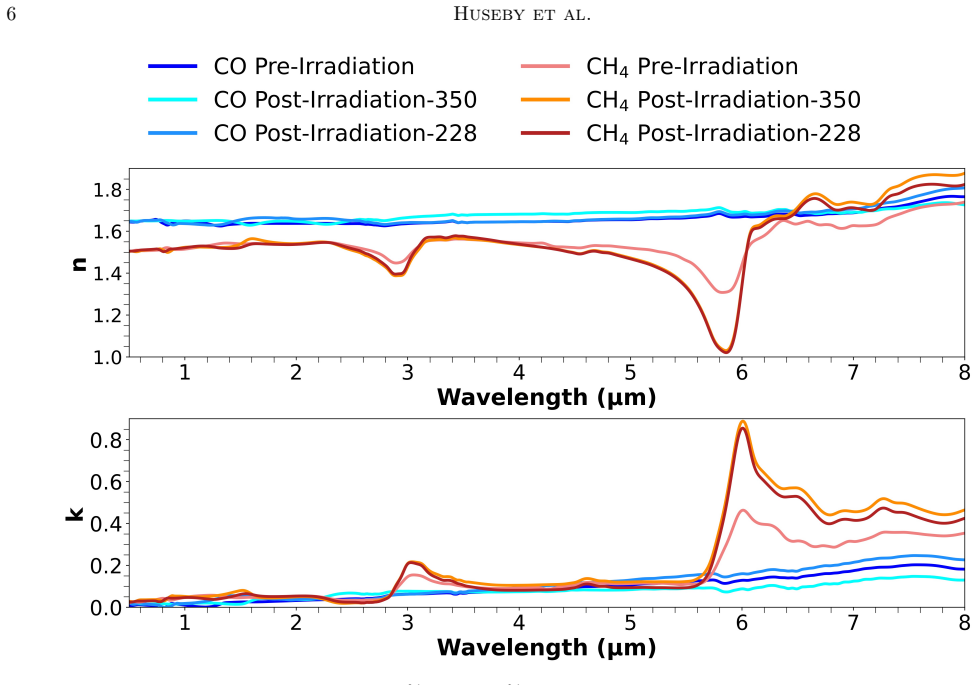
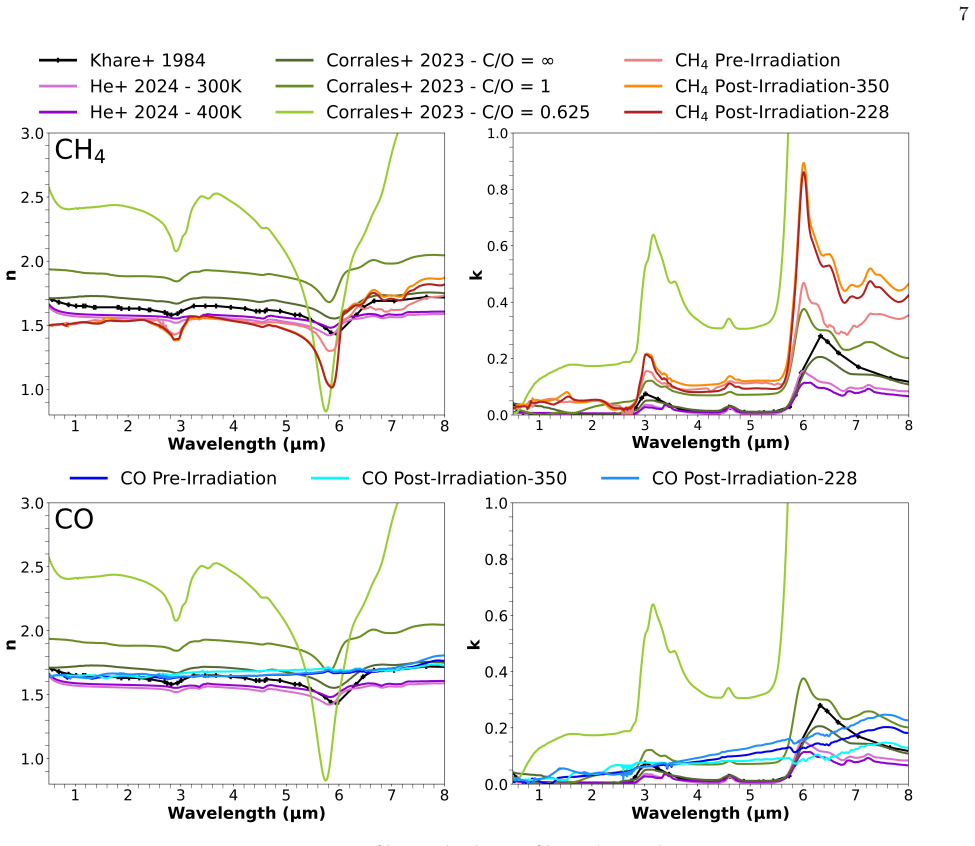
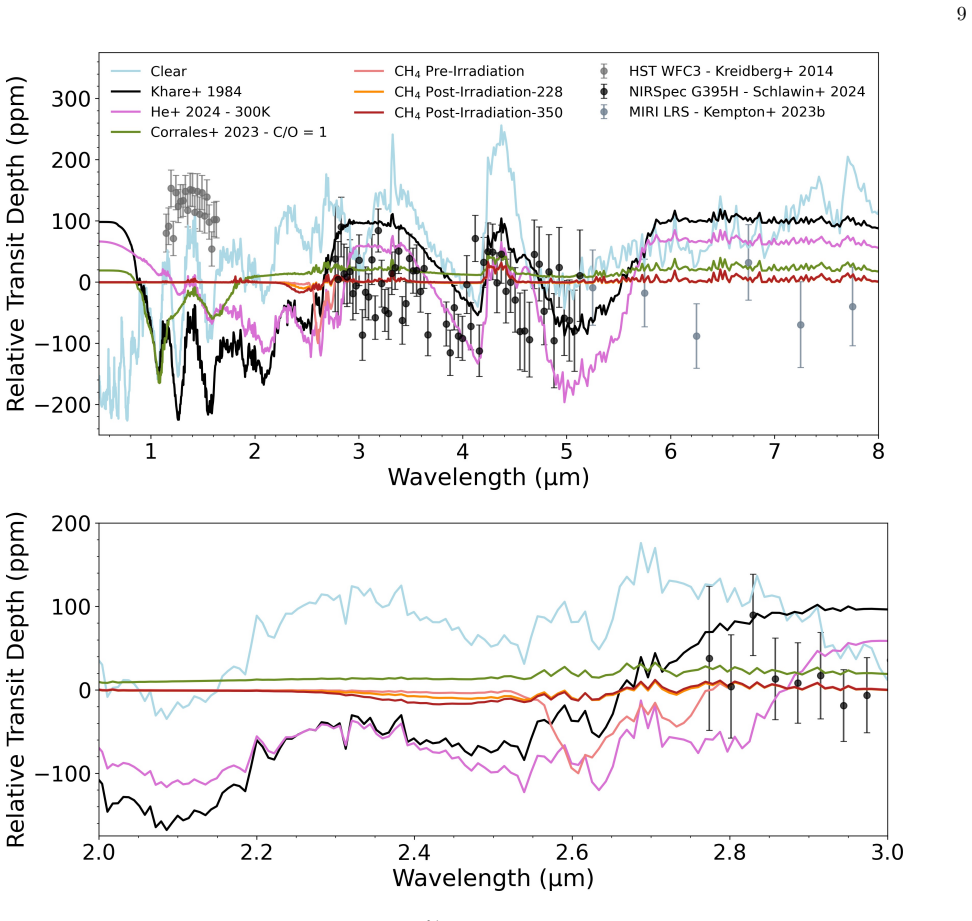
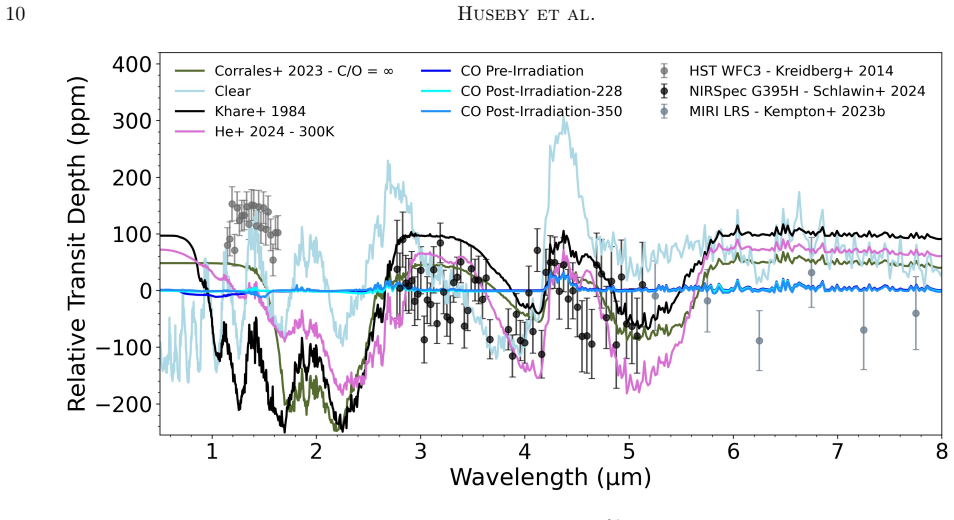
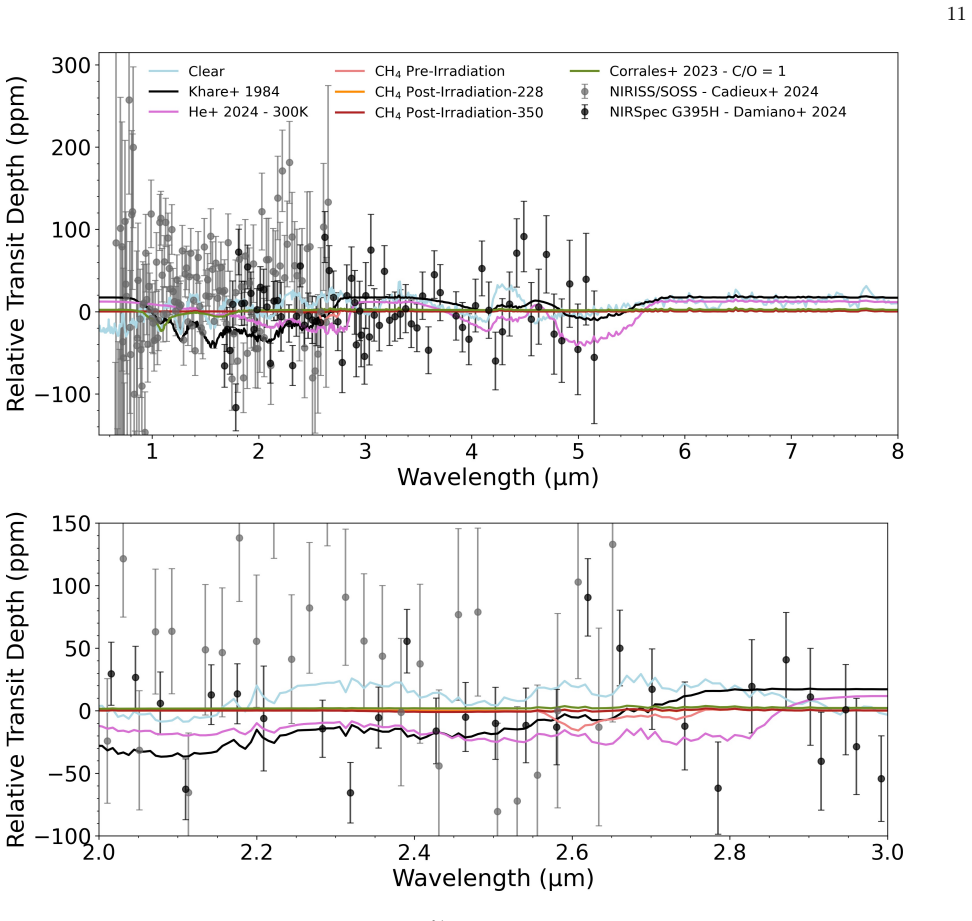
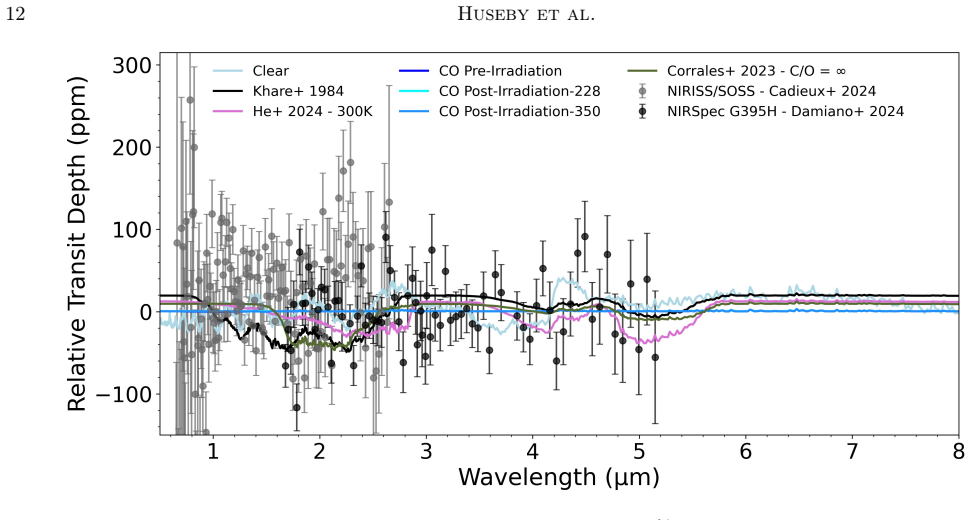
UV-irradiation alters haze optical constants which become generally more absorbing in the 0.5 to 8 μm wavelength range, hypothesized due to more oxygen-rich absorbing bands post irradiation. Simulations with Virga and PICASO for GJ 1214b and LHS 1140b show that for the CH4-rich haze case on GJ 1214b, the N-H feature at 2.6 μm differs between irradiated and unaltered haze in a way observable with JWST.
What carries the argument
Laboratory-generated sub-Neptune haze analogs and their pre- and post-UV-irradiation optical constants, applied in atmospheric transmission models.
If this is right
- Altered optical constants lead to different transmission spectra that can be tested with current instruments.
- For GJ 1214b, the difference appears in the N-H absorption at 2.6 μm.
- Using representative optical constants improves accuracy of atmospheric composition retrievals.
- Stellar UV radiation, including flares, must be considered when modeling hazes on close-in planets.
Where Pith is reading between the lines
- Future observations could use the 2.6 μm feature to distinguish between irradiated and static haze models on sub-Neptunes.
- Similar experiments on other haze compositions might reveal how oxygen content affects absorption after irradiation.
- Atmospheric escape models may need to incorporate changes in haze opacity due to UV processing.
Load-bearing premise
The chemical composition and structure of the lab-generated haze analogs match those of hazes actually present in water-dominated exoplanet atmospheres.
What would settle it
JWST transmission spectrum of GJ 1214b showing no detectable difference at 2.6 μm between models with irradiated and non-irradiated hazes would indicate the optical constant changes do not produce observable effects.
Figures
read the original abstract
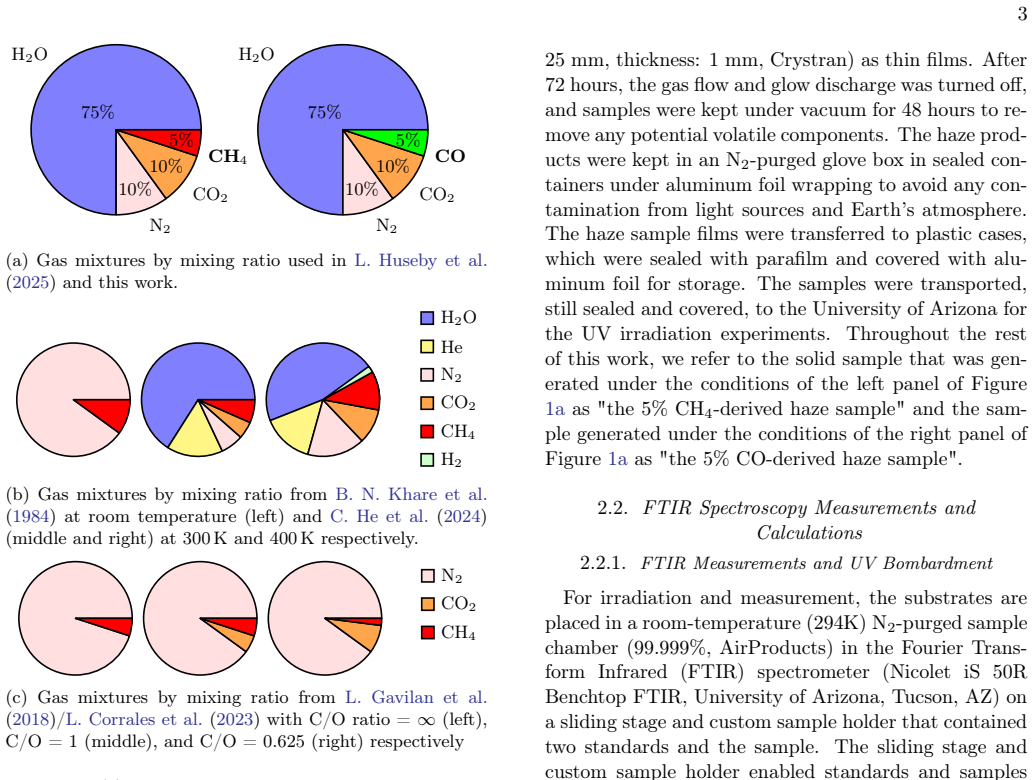
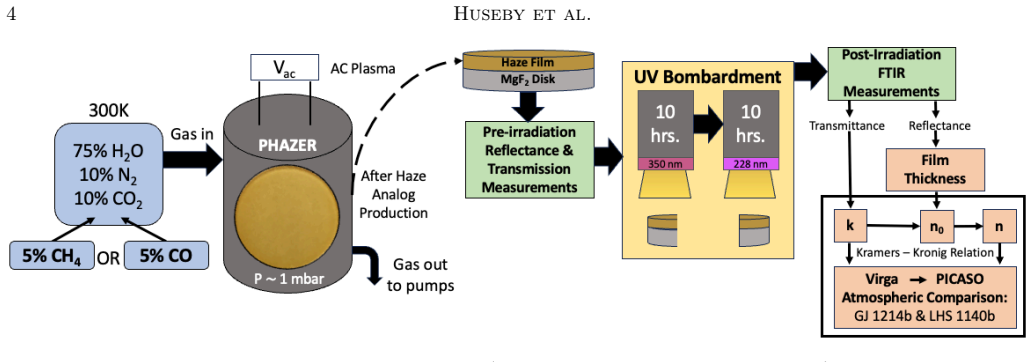
Temperate sub-Neptune and terrestrial exoplanets could contain large inventories of water in various phases, such as water-dominated atmospheres or even oceans. Observations have shown that many exoplanets, including water worlds, likely contain photochemically-generated hazes. Haze particles are a key source of organic matter and may impact the evolution or origin of life; their optical properties are imperative for interpreting observations through theoretical atmospheric modeling. Modelers have thus far assumed haze optical properties that may not represent hazes under sub-Neptune and terrestrial atmospheric conditions. Often orbiting close to M-dwarf stars, these planets receive large amounts of radiation, especially during flaring events, which may accelerate atmospheric escape and affect atmospheric compositions. Here, we present optical constants of experimentally-generated sub-Neptune haze analogs before and after UV irradiation across a broad wavelength range (0.5 to 8 {\mu}m). We find that UV-irradiation alters haze optical constants which become generally more absorbing in this wavelength range, which we hypothesize is due to our sample containing more oxygen-rich absorbing bands post irradiation. We use Virga and PICASO to simulate transmission spectra of potentially hazy water-dominated planets GJ 1214b and LHS 1140b, accounting for irradiated haze layers in their atmospheres. For our GJ 1214b CH4-rich haze modeled case, we see a difference in the N-H feature at 2.6 {\mu}m in the resulting transmission spectrum between irradiated and unaltered haze that should be observable within current JWST capabilities. Broadly, we demonstrate the importance of using more representative optical constants, as they have an impact on current and future atmospheric composition interpretations.
Editorial analysis
A structured set of objections, weighed in public.
Referee Report
Summary. The manuscript reports laboratory measurements of optical constants for sub-Neptune haze analogs before and after UV irradiation over 0.5–8 μm. It finds that irradiation increases absorption across this range (hypothesized to arise from additional oxygen-rich bands), then feeds the altered constants into Virga/PICASO forward models of GJ 1214b and LHS 1140b transmission spectra. For the CH4-rich haze case of GJ 1214b the models show a difference in the 2.6 μm N-H feature that the authors state should be detectable with current JWST capabilities.
Significance. If the laboratory analogs accurately reproduce the composition and UV response of hazes in water-dominated atmospheres, the work supplies the first direct experimental constraints on how stellar UV modifies haze optical properties and demonstrates that these changes can produce observationally relevant spectral differences. The provision of wavelength-dependent optical constants before and after irradiation is a concrete, reusable data product for the community.
major comments (2)
- [Abstract] Abstract and modeling description: the claim that the 2.6 μm N-H feature difference is observable with JWST rests on the laboratory optical constants being directly applicable to GJ 1214b. No validation is presented that the lab samples reproduce the C/O ratio, nitrogen speciation, or oxygen content predicted by photochemical models for water-rich sub-Neptune atmospheres; without this step the modeled contrast cannot be taken as representative of the actual planet.
- [Abstract] Abstract: the statement that post-irradiation absorption increases because the sample contains “more oxygen-rich absorbing bands” is presented as a hypothesis but is not accompanied by any compositional or functional-group analysis (e.g., FTIR peak assignments or elemental ratios) that would substantiate the attribution.
minor comments (1)
- [Abstract] The abstract states that the difference “should be observable within current JWST capabilities” but provides neither the magnitude of the feature contrast nor the assumed noise floor or number of transits used to reach that conclusion.
Simulated Author's Rebuttal
We thank the referee for their constructive and detailed comments. We address each major comment below. We agree that the manuscript would benefit from additional caveats on the scope of the laboratory analogs and will revise accordingly to clarify limitations without overstating applicability.
read point-by-point responses
-
Referee: [Abstract] Abstract and modeling description: the claim that the 2.6 μm N-H feature difference is observable with JWST rests on the laboratory optical constants being directly applicable to GJ 1214b. No validation is presented that the lab samples reproduce the C/O ratio, nitrogen speciation, or oxygen content predicted by photochemical models for water-rich sub-Neptune atmospheres; without this step the modeled contrast cannot be taken as representative of the actual planet.
Authors: We acknowledge that the laboratory analogs were not validated against specific photochemical model outputs for exact C/O ratios, nitrogen speciation, or oxygen content in GJ 1214b. The experiments were designed to generate water-dominated haze analogs under UV exposure to measure changes in optical properties, and the forward models illustrate the potential spectral impact of those measured changes for our specific haze case. We will revise the abstract and modeling sections to add explicit caveats stating that the analogs are representative rather than identical to planetary conditions and that the modeled difference demonstrates a possible observable effect rather than a direct prediction for the planet. revision: partial
-
Referee: [Abstract] Abstract: the statement that post-irradiation absorption increases because the sample contains “more oxygen-rich absorbing bands” is presented as a hypothesis but is not accompanied by any compositional or functional-group analysis (e.g., FTIR peak assignments or elemental ratios) that would substantiate the attribution.
Authors: The relevant sentence in the abstract already qualifies the attribution as a hypothesis. No compositional or functional-group analysis (FTIR assignments or elemental ratios) was performed in this study, as the primary results are the measured optical constants themselves. The hypothesis is offered as a possible explanation based on the precursor chemistry and the direction of the observed absorption change. We do not intend to present it as substantiated and will ensure the wording remains clearly hypothetical; no further revision is required on this point. revision: no
Circularity Check
No circularity: results from lab measurements and standard forward modeling
full rationale
The paper's chain consists of experimental measurement of optical constants on lab-generated haze analogs (pre- and post-UV irradiation) followed by direct insertion of those constants into Virga/PICASO for transmission spectra of GJ 1214b and LHS 1140b. No equations, parameters, or predictions are defined in terms of the target outputs; the N-H feature contrast at 2.6 μm is an output of the radiative-transfer code applied to the measured k(λ) values. No self-citations, ansatzes, or fitted-input renamings appear in the load-bearing steps. The derivation is therefore self-contained against external lab data and established modeling tools.
Axiom & Free-Parameter Ledger
axioms (1)
- domain assumption Laboratory-generated hazes under the described conditions accurately represent those in water-dominated exoplanet atmospheres.
Reference graph
Works this paper leans on
-
[1]
Adams, D., Gao, P., de Pater, I., & Morley, C. V. 2019, ApJ, 874, 61, doi: 10.3847/1538-4357/ab074c
-
[2]
Arney, G., Domagal-Goldman, S. D., Meadows, V. S., et al. 2016, Astrobiology, 16, 873, doi: 10.1089/ast.2015.1422
-
[3]
Arney, G. N., Meadows, V. S., Domagal-Goldman, S. D., et al. 2017, ApJ, 836, 49, doi: 10.3847/1538-4357/836/1/49
-
[4]
2022,, v3.0 Zenodo, doi: 10.5281/zenodo.7254818
Batalha, N., Rooney, C., Mukherjee, S., et al. 2022,, v3.0 Zenodo, doi: 10.5281/zenodo.7254818
-
[5]
2025,, v1.0 Zenodo, doi: 10.5281/zenodo.16914937
Batalha, N., Rooney, C., Mukherjee, S., et al. 2025,, v1.0 Zenodo, doi: 10.5281/zenodo.16914937
-
[6]
Benneke, B., Roy, P.-A., Coulombe, L.-P., et al. 2024, arXiv e-prints, arXiv:2403.03325, doi: 10.48550/arXiv.2403.03325
-
[7]
Borucki, W. J., Koch, D. G., Basri, G., et al. 2011, ApJ, 736, 19, doi: 10.1088/0004-637X/736/1/19
-
[8]
Cadieux, C., Doyon, R., MacDonald, R. J., et al. 2024, ApJL, 970, L2, doi: 10.3847/2041-8213/ad5afa
-
[9]
Gudipati, M. S. 2018, Nature Astronomy, 2, 489, doi: 10.1038/s41550-018-0439-7
-
[10]
Astudillo-Defru, N. 2021, AJ, 162, 174, doi: 10.3847/1538-3881/ac1584
-
[11]
Corrales, L., Gavilan, L., Teal, D. J., & Kempton, E. M. R. 2023, ApJL, 943, L26, doi: 10.3847/2041-8213/acaf86
-
[12]
2024, ApJL, 968, L22, doi: 10.3847/2041-8213/ad5204 do Amaral, L
Damiano, M., Bello-Arufe, A., Yang, J., & Hu, R. 2024, ApJL, 968, L22, doi: 10.3847/2041-8213/ad5204 do Amaral, L. N. R., Barnes, R., Segura, A., & Luger, R. 2022, ApJ, 928, 12, doi: 10.3847/1538-4357/ac53af do Amaral, L. N. R., Shkolnik, E. L., Loyd, R. O. P., &
-
[13]
2025, ApJ, 985, 100, doi: 10.3847/1538-4357/adc932
Peacock, S. 2025, ApJ, 985, 100, doi: 10.3847/1538-4357/adc932
-
[14]
Dragomir, D., Benneke, B., Pearson, K. A., et al. 2015, ApJ, 814, 102, doi: 10.1088/0004-637X/814/2/102
-
[15]
2024, A&A, 682, A6, doi: 10.1051/0004-6361/202346820
Drant, T., Garcia-Caurel, E., Perrin, Z., et al. 2024, A&A, 682, A6, doi: 10.1051/0004-6361/202346820
-
[16]
2026, A&A, 706, A167, doi: 10.1051/0004-6361/202555916
Drant, T., Sciamma-O’Brien, E., Jovanovic, L., et al. 2026, A&A, 706, A167, doi: 10.1051/0004-6361/202555916
-
[17]
2013, ApJ, 766, 81, doi: 10.1088/0004-637X/766/2/81
Fressin, F., Torres, G., Charbonneau, D., et al. 2013, ApJ, 766, 81, doi: 10.1088/0004-637X/766/2/81
-
[18]
Fulton, B. J., Petigura, E. A., Howard, A. W., et al. 2017, VizieR Online Data Catalog, J/AJ/154/109, doi: 10.26093/cds/vizier.51540109
-
[19]
2018, ApJ, 863, 165, doi: 10.3847/1538-4357/aad461
Gao, P., & Benneke, B. 2018, ApJ, 863, 165, doi: 10.3847/1538-4357/aad461
-
[20]
Gao, P., Thorngren, D. P., Lee, E. K. H., et al. 2020, Nature Astronomy, 4, 951, doi: 10.1038/s41550-020-1114-3
-
[21]
Gao, P., Piette, A. A. A., Steinrueck, M. E., et al. 2023, ApJ, 951, 96, doi: 10.3847/1538-4357/acd16f
-
[22]
Gavilan, L., Carrasco, N., Vrønning Hoffmann, S., Jones, N. C., & Mason, N. J. 2018, ApJ, 861, 110, doi: 10.3847/1538-4357/aac8df
-
[23]
He, C., Hörst, S. M., Radke, M., & Yant, M. 2022, PSJ, 3, 25, doi: 10.3847/PSJ/ac4793
-
[24]
He, C., Hörst, S. M., Riemer, S., et al. 2017, ApJL, 841, L31, doi: 10.3847/2041-8213/aa74cc
-
[25]
He, C., Hörst, S. M., Lewis, N. K., et al. 2018b, AJ, 156, 38, doi: 10.3847/1538-3881/aac883
-
[26]
He, C., Radke, M., Moran, S. E., et al. 2024, Nature Astronomy, 8, 182, doi: 10.1038/s41550-023-02140-4 14Huseby et al
-
[27]
Henry, T. J., Jao, W. C., Winters, J. G., et al. 2019, VizieR Online Data Catalog, J/AJ/155/265, doi: 10.26093/cds/vizier.51550265 Hörst, S. M., He, C., Lewis, N. K., et al. 2018, Nature Astronomy, 2, 303, doi: 10.1038/s41550-018-0397-0
-
[28]
Howard, W. S., Corbett, H., Law, N. M., et al. 2020, ApJ, 902, 115, doi: 10.3847/1538-4357/abb5b4
-
[29]
Huseby, L., Moran, S. E., Pearson, N., et al. 2025, PSJ, 6, 145, doi: 10.3847/PSJ/adda4a
-
[30]
Jaziri, A. Y., & Drant, T. 2025, A&A, 702, L20, doi: 10.1051/0004-6361/202556905
-
[31]
2018, ApJ, 853, 7, doi: 10.3847/1538-4357/aaa0c5
Kawashima, Y., & Ikoma, M. 2018, ApJ, 853, 7, doi: 10.3847/1538-4357/aaa0c5
-
[32]
2019, ApJ, 877, 109, doi: 10.3847/1538-4357/ab1b1d
Kawashima, Y., & Ikoma, M. 2019, ApJ, 877, 109, doi: 10.3847/1538-4357/ab1b1d
-
[33]
Kempton, E. M. R., Lessard, M., Malik, M., et al. 2023a, ApJ, 953, 57, doi: 10.3847/1538-4357/ace10d
-
[34]
Kempton, E. M. R., Zhang, M., Bean, J. L., et al. 2023b, Nature, 620, 67, doi: 10.1038/s41586-023-06159-5
-
[35]
Khare, B. N., Sagan, C., Arakawa, E. T., et al. 1984, Icarus, 60, 127, doi: 10.1016/0019-1035(84)90142-8
-
[36]
Kiefer, S., Samra, D., Lewis, D. A., et al. 2024, A&A, 690, A244, doi: 10.1051/0004-6361/202450526
-
[37]
A., Benneke, B., Deming, D., & Homeier, D
Knutson, H. A., Benneke, B., Deming, D., & Homeier, D. 2014a, Nature, 505, 66, doi: 10.1038/nature12887
-
[38]
A., Dragomir, D., Kreidberg, L., et al
Knutson, H. A., Dragomir, D., Kreidberg, L., et al. 2014b, ApJ, 794, 155, doi: 10.1088/0004-637X/794/2/155
-
[39]
2022, A&A, 667, A15, doi: 10.1051/0004-6361/202243436
Konings, T., Baeyens, R., & Decin, L. 2022, A&A, 667, A15, doi: 10.1051/0004-6361/202243436
-
[40]
Kreidberg, L., Bean, J. L., Désert, J.-M., et al. 2014, Nature, 505, 69, doi: 10.1038/nature12888
-
[41]
Kreidberg, L., Mollière, P., Crossfield, I. J. M., et al. 2022, AJ, 164, 124, doi: 10.3847/1538-3881/ac85be
-
[42]
2017, ApJ, 847, 32, doi: 10.3847/1538-4357/aa88ce
Lavvas, P., & Koskinen, T. 2017, ApJ, 847, 32, doi: 10.3847/1538-4357/aa88ce
-
[43]
E., García Muñoz, A., & Showman, A
Lavvas, P., Koskinen, T., Steinrueck, M. E., García Muñoz, A., & Showman, A. P. 2019, ApJ, 878, 118, doi: 10.3847/1538-4357/ab204e
-
[44]
Lavvas, P., Yelle, R. V., & Vuitton, V. 2009, Icarus, 201, 626, doi: 10.1016/j.icarus.2009.01.004
-
[45]
2025, ApJL, 990, L66, doi: 10.3847/2041-8213/adfa87
Li, H., He, C., Wang, S., et al. 2025, ApJL, 990, L66, doi: 10.3847/2041-8213/adfa87
-
[46]
Libby-Roberts, J. E., Berta-Thompson, Z. K., Désert, J.-M., et al. 2020, AJ, 159, 57, doi: 10.3847/1538-3881/ab5d36
-
[47]
Mahajan, A. S., Eastman, J. D., & Kirk, J. 2024, ApJL, 963, L37, doi: 10.3847/2041-8213/ad29f3
-
[48]
Moran, S. E., Lodge, M. G., Batalha, N. E., et al. 2025, arXiv e-prints, arXiv:2509.06708, doi: 10.48550/arXiv.2509.06708
-
[49]
Moran, S. E., Hörst, S. M., Vuitton, V., et al. 2020, PSJ, 1, 17, doi: 10.3847/PSJ/ab8eae
-
[50]
Moran, S. E., Hörst, S. M., He, C., et al. 2022, Journal of Geophysical Research (Planets), 127, e06984, doi: 10.1029/2021JE006984
-
[51]
2009, A&A, 501, 1139, doi: 10.1051/0004-6361/200810301
Mordasini, C., Alibert, Y., & Benz, W. 2009, A&A, 501, 1139, doi: 10.1051/0004-6361/200810301
-
[52]
Morley, C. V., Fortney, J. J., Kempton, E. M. R., et al. 2013, ApJ, 775, 33, doi: 10.1088/0004-637X/775/1/33
-
[53]
Morley, C. V., Fortney, J. J., Marley, M. S., et al. 2015, ApJ, 815, 110, doi: 10.1088/0004-637X/815/2/110
-
[54]
Moses, J. I., Line, M. R., Visscher, C., et al. 2013, ApJ, 777, 34, doi: 10.1088/0004-637X/777/1/34
-
[55]
Mukherjee, S., Batalha, N. E., Fortney, J. J., & Marley, M. S. 2023, ApJ, 942, 71, doi: 10.3847/1538-4357/ac9f48 Müller, M. J., & Dobener, F. 2025,, v0.22.4 Zenodo, doi: 10.5281/zenodo.15762213
-
[56]
1987, Journal of Physics E Scientific Instruments, 20, 894, doi: 10.1088/0022-3735/20/7/015
Neri, F., Saitta, G., & Chiofalo, S. 1987, Journal of Physics E Scientific Instruments, 20, 894, doi: 10.1088/0022-3735/20/7/015
-
[57]
2020, ApJL, 895, L47, doi: 10.3847/2041-8213/ab93d7
Ohno, K., & Kawashima, Y. 2020, ApJL, 895, L47, doi: 10.3847/2041-8213/ab93d7
-
[58]
2020, ApJ, 891, 131, doi: 10.3847/1538-4357/ab44bd
Ohno, K., Okuzumi, S., & Tazaki, R. 2020, ApJ, 891, 131, doi: 10.3847/1538-4357/ab44bd
-
[59]
1988, Applied Spectroscopy, 42, 952, doi: 10.1366/0003702884430380
Ohta, K., & Ishida, H. 1988, Applied Spectroscopy, 42, 952, doi: 10.1366/0003702884430380
-
[60]
Pesciotta, C., Hörst, S. M., Radke, M. J., et al. 2026, ApJ, 1002, 221, doi: 10.3847/1538-4357/ae5b99
-
[61]
I., Coll, P., da Silva, A., et al
Ramirez, S. I., Coll, P., da Silva, A., et al. 2002, Icarus, 156, 515, doi: 10.1006/icar.2001.6783
-
[62]
Schlawin, E., Ohno, K., Bell, T. J., et al. 2024, ApJL, 974, L33, doi: 10.3847/2041-8213/ad7fef
-
[63]
Sumlin, B. J., Heinson, W. R., & Chakrabarty, R. K. 2018, JQSRT, 205, 127, doi: 10.1016/j.jqsrt.2017.10.012
-
[64]
Toon, O. B., Tolbert, M. A., Koehler, B. G., Middlebrook, A. M., & Jordan, J. 1994, J. Geophys. Res., 99, 25,631, doi: 10.1029/94JD02388
-
[65]
Ugelow, M. S., De Haan, D. O., Hörst, S. M., & Tolbert, M. A. 2018, ApJL, 859, L2, doi: 10.3847/2041-8213/aac2c7
-
[66]
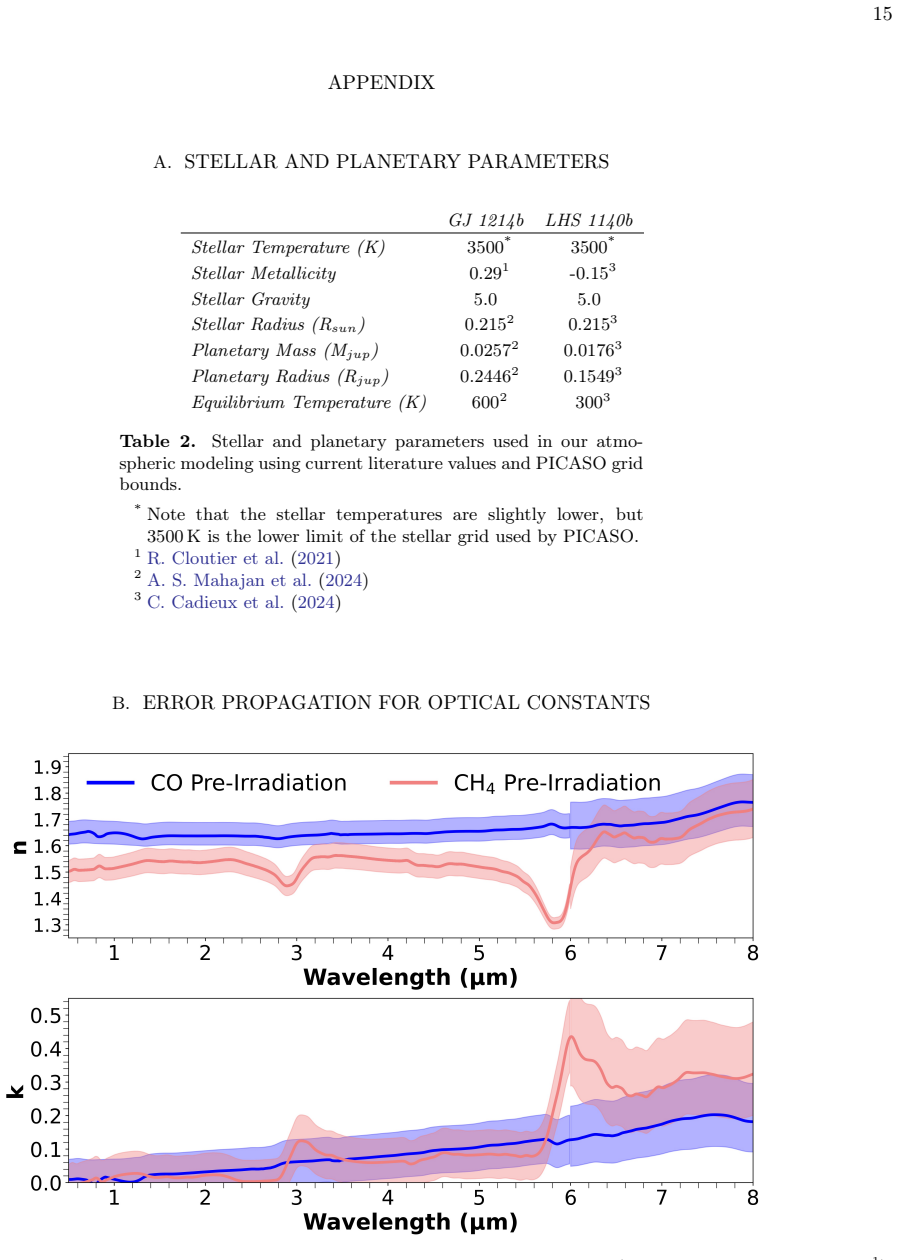
Yoon, Y. H., Hörst, S. M., Hicks, R. K., et al. 2014, Icarus, 233, 233, doi: 10.1016/j.icarus.2014.02.006 15 APPENDIX A.STELLAR AND PLANETARY PARAMETERS GJ 1214b LHS 1140b Stellar Temperature (K)3500 * 3500* Stellar Metallicity0.29 1 -0.153 Stellar Gravity5.0 5.0 Stellar Radius (R sun)0.215 2 0.2153 Planetary Mass (M jup)0.0257 2 0.01763 Planetary Radius ...
discussion (0)
Sign in with ORCID, Apple, or X to comment. Anyone can read and Pith papers without signing in.