Plasticity of Neutron Star Crusts
Pith reviewed 2026-06-27 23:57 UTC · model grok-4.3
The pith
Neutron star crusts enter steady plastic flow after breaking at shear strains of 0.05 to 0.11, independent of crystal structure.
A machine-rendered reading of the paper's core claim, the machinery that carries it, and where it could break.
Core claim
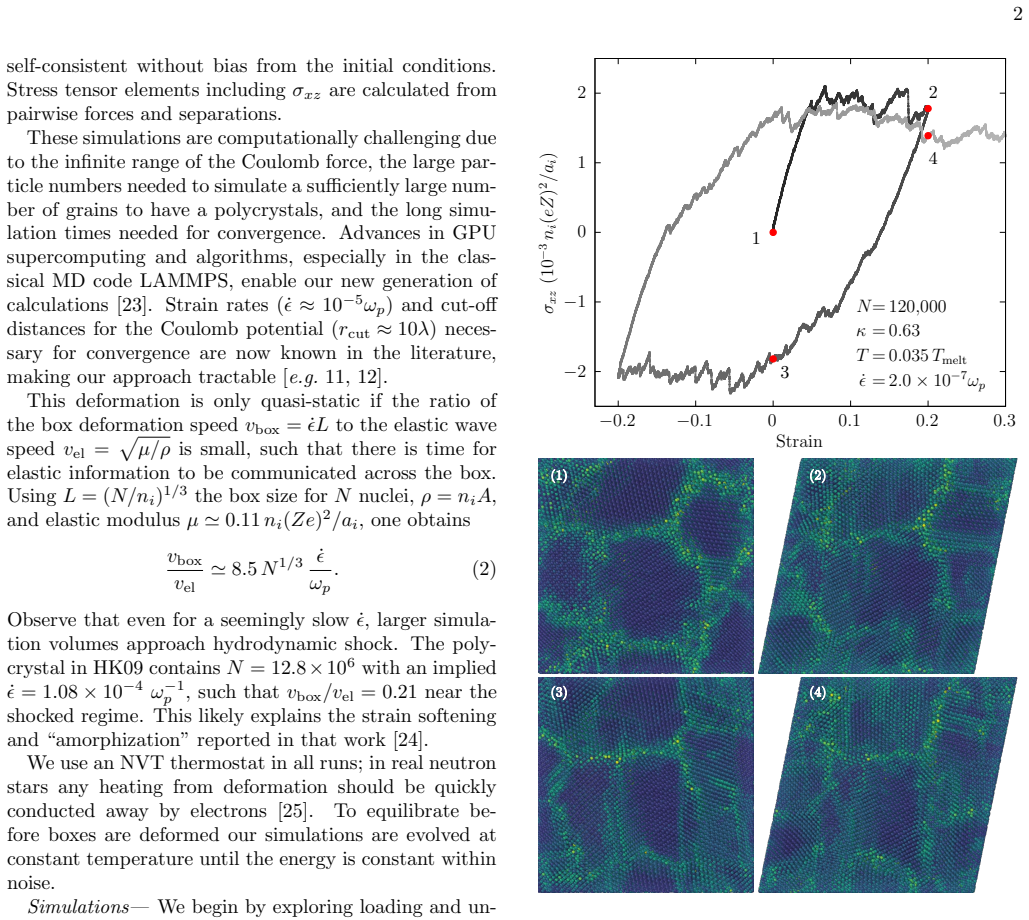
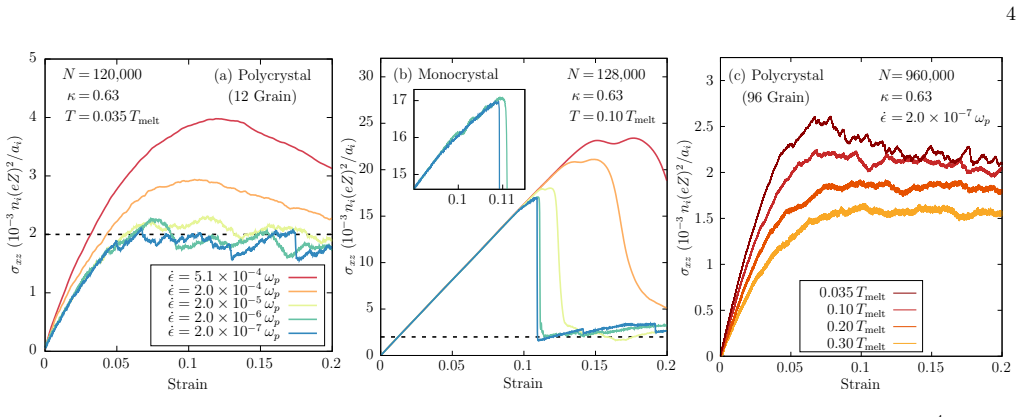
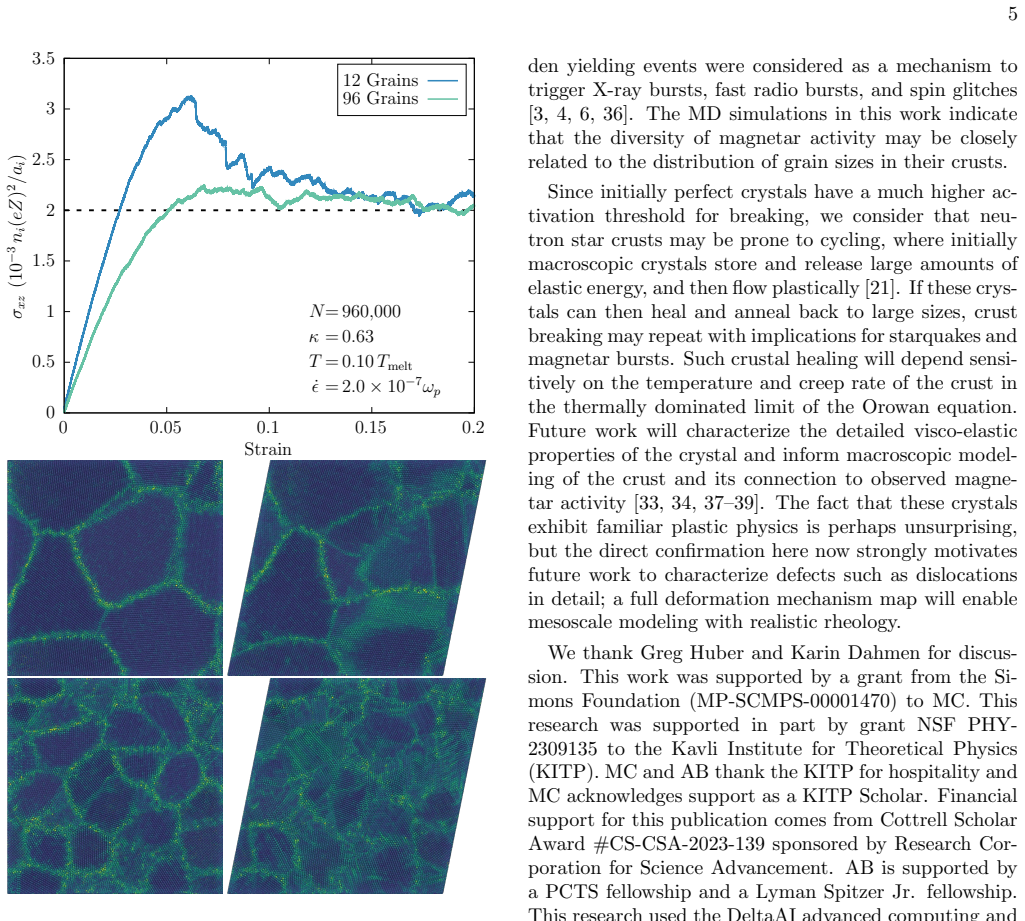
We use first-principles molecular dynamics simulations to study the deformation and breaking of neutron star crusts. When simulating with strain rates several orders of magnitude slower than prior work, we find a new regime of steady plastic flow beyond the breaking point that is independent of the initial crystal structure. Polycrystals exhibit a robust transition from linear elasticity to perfect plastic flow at shear strains of ε = 0.05, while monocrystals break at ε = 0.11 and then flow plastically. The universal post-break plasticity may arise because the crystal self-consistently assumes a defect density to accommodate the imposed strain rate. If broken crusts can re-anneal to large cr
What carries the argument
First-principles molecular dynamics simulations that apply shear strain and track the transition to plastic flow through self-consistent defect density.
If this is right
- Broken crusts may re-anneal to large crystal sizes and then break again.
- Repeated crust breaking carries implications for the timing and energy of magnetar bursts and flares.
- The plastic flow after breaking occurs regardless of whether the initial structure is polycrystalline or monocrystalline.
- The transition to flow occurs at fixed shear strains: 0.05 for polycrystals and 0.11 for monocrystals.
Where Pith is reading between the lines
- If the self-consistent defect mechanism is general, similar plastic flow could appear in other slowly strained crystal systems studied in materials science.
- Analog laboratory materials deformed at comparably slow rates could be used to test whether the universal flow persists outside the simulation.
- Neutron star quake models that include this plastic regime would predict different flare recurrence times than purely elastic models.
Load-bearing premise
The chosen strain rates, though slower than earlier studies, still produce behavior that matches the much slower rates inside real neutron stars, and the defect density forms without other external drivers.
What would settle it
A sequence of magnetar flares showing repeated crust-breaking events separated by re-annealing times, or a simulation run at strain rates closer to astrophysical values that fails to show the same universal plastic flow.
Figures
read the original abstract
We use first-principles molecular dynamics simulations to study the deformation and breaking of neutron star crusts. When simulating with strain rates several orders of magnitude slower than prior work, we find a new regime of steady plastic flow beyond the breaking point that is independent of the initial crystal structure. Polycrystals exhibit a robust transition from linear elasticity to perfect plastic flow at shear strains of $\epsilon = 0.05$, while monocrystals break at $\epsilon = 0.11$ and then flow plastically. The universal post-break plasticity may arise because the crystal self-consistently assumes a defect density to accommodate the imposed strain rate. If broken crusts can re-anneal to large crystal sizes, crust breaking may repeat with implications for magnetar bursts and flares.
Editorial analysis
A structured set of objections, weighed in public.
Referee Report
Summary. The paper reports first-principles molecular dynamics simulations of neutron star crust deformation at strain rates orders of magnitude slower than prior work. It claims that polycrystals transition from linear elasticity to perfect plastic flow at shear strain ε=0.05 while monocrystals break at ε=0.11 and then exhibit steady plastic flow independent of initial crystal structure; the universal post-break regime is suggested to arise from the crystal self-consistently assuming a defect density that accommodates the imposed strain rate, with possible implications for repeatable crust breaking in magnetars if re-annealing occurs.
Significance. If the reported transition to steady plastic flow at these specific strains holds under the claimed conditions, the result would provide a new regime for modeling neutron star crust failure and could affect interpretations of magnetar burst energetics and recurrence. The use of slower strain rates is a clear methodological advance over prior simulations, though the absence of parameter-free derivations or machine-checked elements limits the strength of the assessment.
major comments (2)
- [§3] §3 (Methods): No details are provided on the interatomic potentials employed, the simulated system sizes (number of ions), convergence tests, or statistical error bars on the reported breaking strains ε=0.05 and ε=0.11; without these, it is impossible to evaluate whether the claimed independence from initial structure is robust or an artifact of the specific setup.
- [§5] §5 (Discussion): The proposed mechanism that 'the crystal self-consistently assumes a defect density to accommodate the imposed strain rate' is presented without any reported measurements of defect populations, comparisons to the Orowan relation or equivalent strain-rate accommodation formulas, or auxiliary simulations that isolate defect dynamics; this leaves the explanation for the universal post-break flow unsupported and vulnerable to alternative interpretations such as rate-specific transients.
minor comments (2)
- [Figure 2] Figure 2 and associated text: The strain-rate values used should be explicitly compared numerically to those in the cited prior work to quantify the 'several orders of magnitude slower' claim.
- [Abstract] Abstract and §1: The term 'first-principles' is used but the methods rely on molecular dynamics with (presumably) effective potentials; a brief clarification of this usage would improve precision.
Simulated Author's Rebuttal
We thank the referee for their careful reading of the manuscript and for the constructive comments. We address each major comment below and indicate where revisions will be made to the manuscript.
read point-by-point responses
-
Referee: [§3] §3 (Methods): No details are provided on the interatomic potentials employed, the simulated system sizes (number of ions), convergence tests, or statistical error bars on the reported breaking strains ε=0.05 and ε=0.11; without these, it is impossible to evaluate whether the claimed independence from initial structure is robust or an artifact of the specific setup.
Authors: We acknowledge that the Methods section as currently written does not include these technical specifications. In the revised manuscript we will expand §3 to report the interatomic potentials, the number of ions in each simulation cell, the results of convergence tests with respect to system size and timestep, and statistical uncertainties (including error bars or standard deviations) on the measured breaking strains of 0.05 and 0.11. These additions will allow readers to assess the robustness of the reported independence from initial crystal structure. revision: yes
-
Referee: [§5] §5 (Discussion): The proposed mechanism that 'the crystal self-consistently assumes a defect density to accommodate the imposed strain rate' is presented without any reported measurements of defect populations, comparisons to the Orowan relation or equivalent strain-rate accommodation formulas, or auxiliary simulations that isolate defect dynamics; this leaves the explanation for the universal post-break flow unsupported and vulnerable to alternative interpretations such as rate-specific transients.
Authors: The manuscript presents the defect-density mechanism as a possible explanation rather than a definitively demonstrated one, motivated by the observed structural independence of the post-break flow. We agree that direct measurements of defect populations and auxiliary simulations isolating defect dynamics are absent. In the revision we will rephrase §5 to make the hypothetical nature of the suggestion explicit, add a brief qualitative comparison to the Orowan relation, and note that distinguishing this mechanism from rate-specific transients would require future work. The core observational result—the existence of a universal post-break regime at the reported strains—remains independent of this interpretation. revision: partial
Circularity Check
No circularity: simulation results are direct numerical outputs, not reductions to fitted inputs or self-citations
full rationale
The paper reports measured transition strains (ε=0.05 for polycrystals, ε=0.11 for monocrystals) and a post-break flow regime directly from first-principles MD simulations at specified strain rates. These quantities are simulation observables, not quantities obtained by fitting parameters defined in terms of the target result or by invoking a self-citation chain. The suggested defect-density mechanism is offered only as a possible explanation ('may arise') and is not used to derive or predict the reported strains. No self-citations, ansatzes, or uniqueness theorems appear in the provided text as load-bearing steps. The derivation chain is therefore self-contained against the external benchmark of the simulation runs themselves.
Axiom & Free-Parameter Ledger
axioms (1)
- domain assumption The interatomic potential used in the molecular dynamics accurately captures nuclear interactions in neutron star crust material.
Reference graph
Works this paper leans on
-
[1]
M. A. Ruderman, Crystallization and Torsional Oscilla- tions of Superdense Stars, Nature (London)218, 1128 (1968)
1968
-
[2]
Blaes, R
O. Blaes, R. Blandford, P. Goldreich, and P. Madau, Neu- tron Starquake Models for Gamma-Ray Bursts, The As- trophysical Journal343, 839 (1989)
1989
-
[3]
Thompson and R
C. Thompson and R. C. Duncan, The soft gamma re- peaters as very strongly magnetized neutron stars - I. 6 Radiative mechanism for outbursts, Monthly Notices of the Royal Astronomical Society275, 255 (1995)
1995
-
[4]
Thompson and R
C. Thompson and R. C. Duncan, The Soft Gamma Re- peaters as Very Strongly Magnetized Neutron Stars. II. Quiescent Neutrino, X-Ray, and Alfven Wave Emission, Astrophys. J.473, 322 (1996)
1996
-
[5]
A. M. Beloborodov and Y. Levin, Thermoplastic Waves in Magnetars, The Astrophysical Journal Letters794, L24 (2014), arXiv:1406.4850 [astro-ph.HE]
Pith/arXiv arXiv 2014
-
[6]
A. Bransgrove, A. M. Beloborodov, and Y. Levin, A Quake Quenching the Vela Pulsar, The Astrophysi- cal Journal897, 173 (2020), arXiv:2001.08658 [astro- ph.HE]
arXiv 2020
-
[7]
P. D. Lasky, Gravitational Waves from Neutron Stars: A Review, PASA32, e034 (2015), arXiv:1508.06643 [astro- ph.HE]
Pith/arXiv arXiv 2015
-
[8]
K. Riles, Searches for continuous-wave gravitational ra- diation, Living Reviews in Relativity26, 3 (2023), arXiv:2206.06447 [astro-ph.HE]
arXiv 2023
-
[9]
Haskell and M
B. Haskell and M. Bejger, Astrophysics with continuous gravitational waves, Nature Astronomy7, 1160 (2023)
2023
-
[10]
Horowitz and K
C. Horowitz and K. Kadau, Breaking strain of neutron star crust and gravitational waves, Physical Review Let- ters102, 191102 (2009)
2009
-
[11]
A. I. Chugunov and C. J. Horowitz, Breaking stress of neutron star crust, MNRAS407, L54 (2010), arXiv:1006.2279 [astro-ph.SR]
Pith/arXiv arXiv 2010
-
[12]
K. Hoffman and J. Heyl, Mechanical properties of non- accreting neutron star crusts, MNRAS426, 2404 (2012), arXiv:1208.3258 [astro-ph.SR]
Pith/arXiv arXiv 2012
-
[13]
D. A. Baiko, Shear modulus of neutron star crust, MN- RAS416, 22 (2011), arXiv:1104.0173 [astro-ph.SR]
Pith/arXiv arXiv 2011
-
[14]
D. Kobyakov and C. J. Pethick, Towards a Metallurgy of Neutron Star Crusts, Phys. Rev. Lett.112, 112504 (2014), arXiv:1309.1891 [nucl-th]
Pith/arXiv arXiv 2014
-
[15]
D. Kobyakov and C. J. Pethick, Elastic properties of polycrystalline dense matter., Monthly Notices of the Royal Astronomical Society449, L110 (2015), arXiv:1502.02461 [astro-ph.SR]
Pith/arXiv arXiv 2015
-
[16]
A. I. Chugunov, Neutron star crust in Voigt approxima- tion: general symmetry of the stress-strain tensor and an universal estimate for the effective shear modulus, MN- RAS500, L17 (2021), arXiv:2010.08398 [astro-ph.HE]
arXiv 2021
-
[17]
A. A. Kozhberov, Elastic properties of Yukawa crystals, Physics of Plasmas29, 043701 (2022), arXiv:2204.05058 [astro-ph.HE]
arXiv 2022
-
[18]
A. A. Kozhberov, Breaking properties of multicompo- nent neutron star crust, MNRAS523, 4855 (2023), arXiv:2307.14194 [astro-ph.HE]
arXiv 2023
-
[19]
N. A. Zemlyakov and A. I. Chugunov, Constraining the shear modulus of a polycrystalline neutron star crust: Hashin-Shtrikman variational approach, Phys. Rev. D 112, 043032 (2025), arXiv:2507.12266 [astro-ph.HE]
arXiv 2025
-
[20]
D. A. Baiko and A. I. Chugunov, Breaking proper- ties of neutron star crust, MNRAS480, 5511 (2018), arXiv:1808.06415 [astro-ph.HE]
Pith/arXiv arXiv 2018
-
[21]
D. A. Baiko, Liquid-phase epitaxy of neutron star crusts and white dwarf cores, MNRAS528, 408 (2024), arXiv:2312.17544 [astro-ph.SR]
arXiv 2024
-
[22]
Baiko and A
D. Baiko and A. Chugunov, Ab initio thermodynamics of one-component plasma for astrophysics of white dwarfs and neutron stars, Monthly Notices of the Royal Astro- nomical Society510, 2628 (2022)
2022
-
[23]
A. P. Thompson, H. M. Aktulga, R. Berger, D. S. Bolin- tineanu, W. M. Brown, P. S. Crozier, P. J. In’t Veld, A. Kohlmeyer, S. G. Moore, T. D. Nguyen,et al., Lammps-a flexible simulation tool for particle-based ma- terials modeling at the atomic, meso, and continuum scales, Computer physics communications271, 108171 (2022)
2022
-
[24]
M. E. Caplan and A. Bransgrove, Revisiting the rheology of neutron star crusts with molecular dynamics, Research Notes of the AAS10, 107 (2026)
2026
-
[25]
M. E. Tuckerman, J. Alejandre, R. L´ opez-Rend´ on, A. L. Jochim, and G. J. Martyna, A Liouville-operator derived measure-preserving integrator for molecular dynamics simulations in the isothermal isobaric ensemble, Journal of Physics A Mathematical General39, 5629 (2006)
2006
-
[26]
Negahban,The mechanical and thermodynamical the- ory of plasticity(Crc New York, NY, 2012)
M. Negahban,The mechanical and thermodynamical the- ory of plasticity(Crc New York, NY, 2012)
2012
-
[27]
J. P. Sethna, K. A. Dahmen, and C. R. Myers, Crack- ling noise, Nature (London)410, 242 (2001), arXiv:cond- mat/0102091 [cond-mat.stat-mech]
arXiv 2001
-
[28]
P. J. Steinhardt, D. R. Nelson, and M. Ronchetti, Bond- orientational order in liquids and glasses, Physical Re- view B28, 784 (1983)
1983
-
[29]
M. E. Caplan, Structure of multicomponent Coulomb crystals, Phys. Rev. E101, 023201 (2020), arXiv:1911.05230 [cond-mat.soft]
arXiv 2020
-
[30]
Orowan, Problems of plastic gliding, Proceedings of the Physical Society52, 8 (1940)
E. Orowan, Problems of plastic gliding, Proceedings of the Physical Society52, 8 (1940)
1940
-
[31]
M. E. Caplan, N. T. Smith, D. Yaacoub, R. F. Serrano, E. Taira, and A. Bransgrove, Grain Boundary Diffusion in Yukawa Crystals, arXiv e-prints , arXiv:2510.20980 (2025), arXiv:2510.20980 [physics.plasm-ph]
arXiv 2025
-
[32]
Strohmayer, S
T. Strohmayer, S. Ogata, H. Iyetomi, S. Ichimaru, and H. M. van Horn, The Shear Modulus of the Neutron Star Crust and Nonradial Oscillations of Neutron Stars, As- trophys. J.375, 679 (1991)
1991
-
[33]
X. Li, Y. Levin, and A. M. Beloborodov, Magnetar out- bursts from avalanches of hall waves and crustal failures, The Astrophysical Journal833, 189 (2016)
2016
-
[34]
C. Thompson, H. Yang, and N. Ortiz, Global Crustal Dy- namics of Magnetars in Relation to Their Bright X-Ray Outbursts, The Astrophysical Journal841, 54 (2017), arXiv:1608.02633 [astro-ph.HE]
Pith/arXiv arXiv 2017
-
[35]
V. M. Kaspi and A. M. Beloborodov, Magnetars, ARA&A55, 261 (2017), arXiv:1703.00068 [astro-ph.HE]
Pith/arXiv arXiv 2017
-
[36]
Y. Yuan, A. M. Beloborodov, A. Y. Chen, and Y. Levin, Plasmoid Ejection by Alfv´ en Waves and the Fast Radio Bursts from SGR 1935+2154, ApJL900, L21 (2020), arXiv:2006.04649 [astro-ph.HE]
arXiv 1935
-
[37]
S. K. Lander and K. N. Gourgouliatos, Magnetic-field evolution in a plastically failing neutron-star crust, Monthly Notices of the Royal Astronomical Society486, 4130–4143 (2019)
2019
- [38]
- [39]
discussion (0)
Sign in with ORCID, Apple, or X to comment. Anyone can read and Pith papers without signing in.