Engineering magnetic anisotropy and ferromagnetism in topological Kagome metal GdV6Sn6 via Nd substitution
Pith reviewed 2026-06-28 00:09 UTC · model grok-4.3
The pith
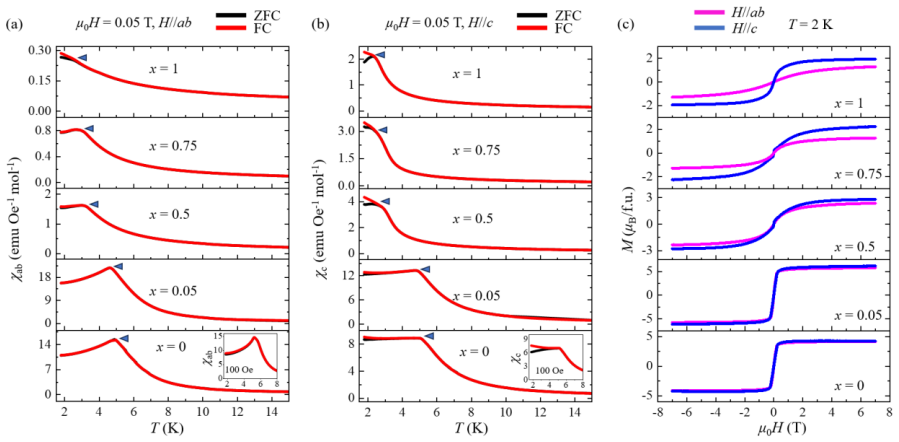
Nd substitution turns the magnetic state of GdV6Sn6 ferromagnetic-like and sets the c-axis as easy axis.
A machine-rendered reading of the paper's core claim, the machinery that carries it, and where it could break.
Core claim
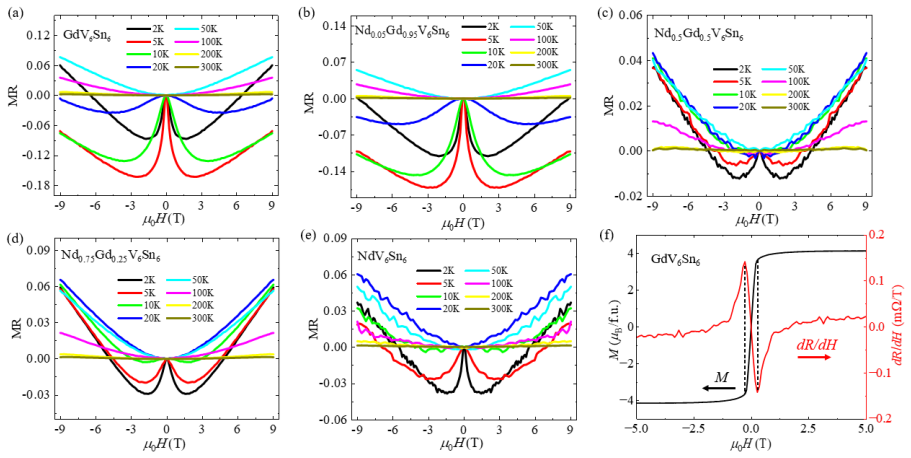
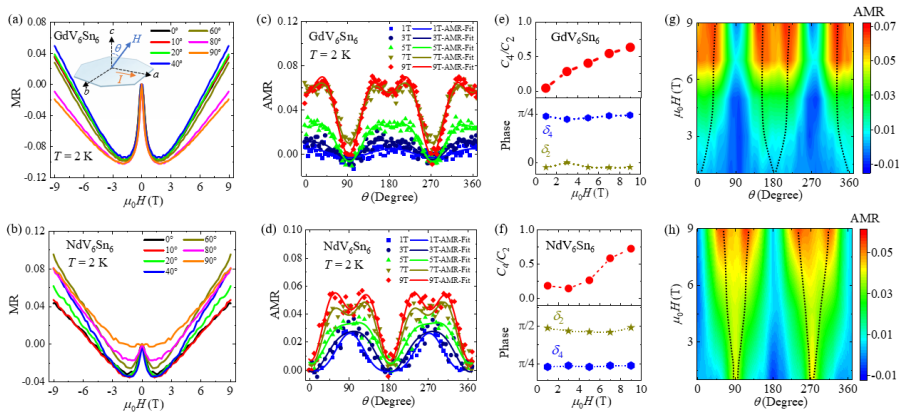
Substituting lighter Nd atoms at the Gd site tunes the complex magnetic ground state of GdV6Sn6 into a ferromagnetic-like one. Moreover, the isotropic magnetization of GdV6Sn6 becomes anisotropic, with the c-axis emerging as the easy axis. Transport measurements reveal a strong coupling between magnetism and electronic properties, with negative magnetoresistance observed at low magnetic fields in all compositions. In addition, a fourfold anisotropy component tends to emerge in end compounds at higher magnetic fields.
What carries the argument
Nd substitution on the rare-earth site of the (NdxGd1-x)V6Sn6 Kagome lattice, which alters the magnetic interactions between the rare-earth moments and the non-magnetic Kagome layer.
If this is right
- The magnetic ground state changes from complex to ferromagnetic-like upon Nd substitution.
- Magnetization becomes anisotropic, with the c-axis as the preferred direction.
- Negative magnetoresistance is present at low fields for every Nd concentration examined.
- A fourfold anisotropy component develops in the pure Gd and pure Nd end compounds at higher fields.
- Magnetism and electronic transport remain strongly coupled across the substitution series.
Where Pith is reading between the lines
- The same substitution approach may be used to tune magnetic anisotropy in other RM6X6 Kagome metals that share the non-magnetic transition-metal layer.
- The induced c-axis preference could modify the coupling between magnetic order and any topological electronic bands hosted by the Kagome lattice.
- Systematic variation of Nd content between the end members could locate a doping threshold where the magnetic transition occurs.
- Neutron diffraction on oriented single crystals would directly map the ordered moment directions and test the reported anisotropy.
Load-bearing premise
The shift to ferromagnetic-like order and the appearance of c-axis anisotropy are caused by the Nd atoms occupying the Gd site rather than by changes in sample stoichiometry, impurity phases, or measurement conditions.
What would settle it
Magnetic measurements on a series of GdV6Sn6 samples prepared with deliberate small changes in overall stoichiometry but without any Nd would show whether the ferromagnetic-like state and c-axis preference still appear.
Figures
read the original abstract
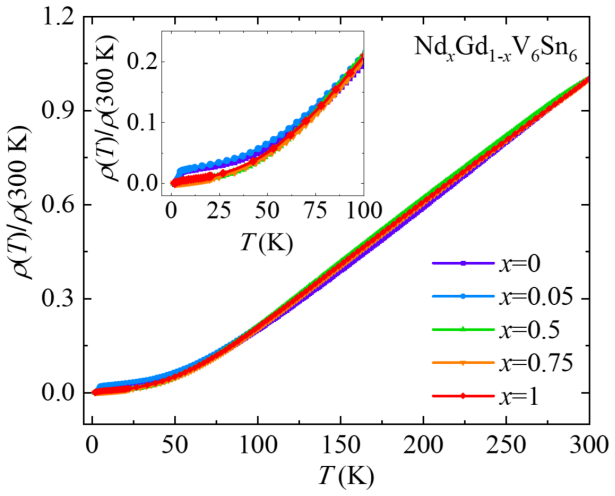
Kagome metals with the formula RM6X6 (R = rare-earth, M = 3d transition metal, and X = Sn/Ge) provide a rich platform for exploring magnetic and electronic phenomena, with tunable properties enabled by the combination of rare-earth elements and transition metals. In this study, we report the structural, electrical and magnetic properties of Kagome metal (NdxGd1-x)V6Sn6. We demonstrate that substituting lighter Nd atoms at the Gd site tunes the complex magnetic ground state of GdV6Sn6 into a ferromagnetic-like one. Moreover, the isotropic magnetization of GdV6Sn6 becomes anisotropic, with the c-axis emerging as the easy axis. Transport measurements reveal a strong coupling between magnetism and electronic properties, with negative magnetoresistance observed at low magnetic fields in all compositions. In addition, a fourfold anisotropy component tends to emerge in end compounds at higher magnetic fields. These findings highlight the role of rare-earth substitution in tuning magnetic anisotropy and magneto-transport behaviour in RM6X6 compounds, featuring a non-magnetic Kagome layer, with potential implications for spintronic and topological applications.
Editorial analysis
A structured set of objections, weighed in public.
Referee Report
Summary. The manuscript reports structural, magnetic, and transport measurements on the series (Nd_x Gd_{1-x})V_6Sn_6. It claims that partial substitution of lighter Nd for Gd converts the complex magnetic ground state of the parent GdV6Sn6 compound into a ferromagnetic-like state, simultaneously converting the previously isotropic magnetization into an anisotropic response with the crystallographic c-axis as the easy axis. Negative magnetoresistance is reported at low fields for all x, while a fourfold anisotropy component appears at higher fields in the end-member compositions; the work concludes that rare-earth substitution provides a route to tune both magnetic anisotropy and magneto-transport in this family of Kagome metals.
Significance. If the reported changes in magnetic order and anisotropy can be shown to arise specifically from controlled Nd occupancy on the rare-earth site, the result would establish a practical chemical handle for engineering easy-axis ferromagnetism and magneto-transport coupling in RM6X6 Kagome metals whose transition-metal layers are non-magnetic. Such tunability would be relevant to efforts aimed at realizing topological spintronic functionalities in this materials class.
major comments (3)
- [Abstract] Abstract and results sections: the central claim that Nd substitution at the rare-earth site is responsible for the shift to ferromagnetic-like order and c-axis anisotropy rests on the assumption that the measured samples are single-phase with actual Nd/Gd ratios matching the nominal values. No quantitative Rietveld refinements, EDX/WDS microprobe data, or impurity-phase limits are cited, leaving open the possibility that the observed magnetic changes arise from secondary effects such as Sn vacancies, V-site disorder, or undetected impurity phases.
- [Magnetic properties] Magnetic measurements: the conversion from isotropic to anisotropic magnetization (with c-axis easy) is presented without independent verification that the c-axis orientation was consistently aligned and confirmed (e.g., via Laue or pole-figure analysis) across the series; small misalignments or changes in lattice parameters could produce apparent anisotropy even without Nd substitution.
- [Transport measurements] Transport data: negative low-field magnetoresistance is reported for all compositions, yet no quantitative comparison of the magnitude, field scale, or temperature dependence is given relative to the parent compound or to control samples with deliberate off-stoichiometry; this weakens the assertion of strong, substitution-tuned magneto-electronic coupling.
minor comments (2)
- [Abstract] The abstract states qualitative outcomes without any numerical values, error bars, or sample-characterization metrics; adding at least a summary table of lattice parameters, actual compositions, and key transition temperatures would improve clarity.
- [Throughout] Notation for the substitution series is given as (NdxGd1-x)V6Sn6; consistent use of subscripts (Nd_x Gd_{1-x}) throughout the text and figures would avoid ambiguity.
Simulated Author's Rebuttal
We thank the referee for the constructive and detailed comments. We address each major point below and will revise the manuscript to incorporate additional characterization and analysis where feasible.
read point-by-point responses
-
Referee: [Abstract] Abstract and results sections: the central claim that Nd substitution at the rare-earth site is responsible for the shift to ferromagnetic-like order and c-axis anisotropy rests on the assumption that the measured samples are single-phase with actual Nd/Gd ratios matching the nominal values. No quantitative Rietveld refinements, EDX/WDS microprobe data, or impurity-phase limits are cited, leaving open the possibility that the observed magnetic changes arise from secondary effects such as Sn vacancies, V-site disorder, or undetected impurity phases.
Authors: We agree that explicit confirmation of composition and phase purity would strengthen the central claim. The submitted manuscript includes powder XRD patterns for the series that index to the expected RM6Sn6 structure with no detectable impurity peaks, and the evolution of magnetic properties is systematic with nominal x. In the revision we will add quantitative Rietveld refinements of the XRD data together with EDX measurements on representative crystals to verify actual Nd/Gd ratios and place limits on secondary phases. revision: yes
-
Referee: [Magnetic properties] Magnetic measurements: the conversion from isotropic to anisotropic magnetization (with c-axis easy) is presented without independent verification that the c-axis orientation was consistently aligned and confirmed (e.g., via Laue or pole-figure analysis) across the series; small misalignments or changes in lattice parameters could produce apparent anisotropy even without Nd substitution.
Authors: All single-crystal magnetization data were collected on specimens whose crystallographic axes were determined by back-reflection Laue diffraction prior to measurement. The observed switch from isotropic (x=0) to c-axis easy-axis behavior occurs systematically with increasing nominal Nd content and is reproducible across multiple crystals. We will expand the methods section in the revision to describe the Laue orientation procedure explicitly. revision: yes
-
Referee: [Transport measurements] Transport data: negative low-field magnetoresistance is reported for all compositions, yet no quantitative comparison of the magnitude, field scale, or temperature dependence is given relative to the parent compound or to control samples with deliberate off-stoichiometry; this weakens the assertion of strong, substitution-tuned magneto-electronic coupling.
Authors: The negative low-field MR is present in every composition, including the parent, yet its characteristic field scale and temperature range do vary with x. In the revision we will add direct quantitative overlays and tabulated values comparing MR magnitude, crossover field, and temperature dependence across the series, including explicit comparison to the x=0 parent. Deliberate off-stoichiometry control samples were not prepared; the systematic trend with Nd substitution nevertheless supports the claimed tuning of magneto-transport coupling. revision: partial
Circularity Check
No circularity: purely experimental report with no derivations or fitted predictions
full rationale
The paper is an experimental materials study reporting structural, transport, and magnetic measurements on (NdxGd1-x)V6Sn6 samples. The abstract and available text contain no equations, no claimed first-principles derivations, no parameter fitting presented as prediction, and no self-citation chains used to justify uniqueness or ansatzes. All claims reduce directly to measured data (magnetization curves, resistivity, etc.) without any reduction to inputs by construction. This matches the default case of a self-contained experimental report; no load-bearing step can be quoted that exhibits circularity.
Axiom & Free-Parameter Ledger
Reference graph
Works this paper leans on
-
[1]
Such observation agrees with the significantly enhanced magnetic anisotropy and the out-of-plane magnetic easy axis in NdV6Sn6
and broadens with the rotation of the field away. Such observation agrees with the significantly enhanced magnetic anisotropy and the out-of-plane magnetic easy axis in NdV6Sn6. To gain more insight into the anisotropic MR, in Figs. 6(c) and (d) we present the angular dependent MR (AMR) measured at various fixed magnetic fields for GdV 6Sn6 and NdV6Sn6, r...
-
[2]
C. S. Gruber and M. Abdel -Hafiez, Interplay of Electronic Orders in Topological Quantum Materials, ACS Mater. Au 5, 72 (2025)
2025
-
[3]
G. R. Stewart, Unconventional superconductivity, Advances in Physics 66, 75 (2017). 15
2017
-
[4]
M. M. Sharma, P. Sharma, N. K. Karn, and V . P. S. Awana, Comprehensive review on topological superconducting materials and interfaces, Supercond. Sci. Technol. 35, 083003 (2022)
2022
-
[5]
Schnyder, M
Xianxin Wu, Tilman Schwemmer, Tobias Müller, Armando Consiglio, Giorgio Sangiovanni, Domenico Di Sante, Yasir Iqbal, Werner Hanke, Andreas P. Schnyder, M. Michael Denner, Mark H. Fischer, Titus Neupert, and Ronny Thomale, Nature of Unconventional Pairing in the Kagome Superconductors A V3Sb5 (A = K, Rb, Cs), Phys. Rev. Lett. 127, 177001 (2021)
2021
-
[6]
S. C. Holbæk, M. H. Christensen, A. Kreisel, and B. M. Andersen, Unconventional superconductivity protected from disorder on the kagome lattice, Phys. Rev. B 108, 144508 (2023)
2023
-
[7]
Y . Chen, J. Gaudet, G. G. Marcus, T. Nomoto, T. Chen, T. Tomita, M. Ikhlas, H. S. Suzuki, Y . Zhao, W. C. Chen, J. Strempfer8, R. Arita, S. Nakatsuji, and C. Broholm, Intertwined charge and spin density waves in a topological kagome material, Phys. Rev. Re s. 6, L032016 (2024)
2024
-
[8]
9, 1 (2024)
Seongyong Lee, Choongjae Won, Jimin Kim, Jonggyu Yoo, Sudong Park, Jonathan Denlinger, Chris Jozwiak, Aaron Bostwick, Eli Rotenberg, Nature of charge density wave in kagome metal ScV6Sn6, Npj Quantum Mater. 9, 1 (2024)
2024
-
[9]
Masayoshi Fujihala, Katsuhiro Morita, Richard Mole, Setsuo Mitsuda, Takami Tohyama, Shin-ichiro Yano, Dehong Yu, Shigetoshi Sota, Tomohiko Kuwai, Akihiro Koda, Hirotaka Okabe, Hua Lee, Shinichi Itoh, Takafumi Hawai, Takatsugu Masuda, Hajime Sagayama, Akira Matsuo, Koichi Kindo, Seiko Ohira-Kawamura & Kenji Nakajima, Gapless spin liquid in a square-kagome ...
2020
-
[10]
Y . Zhou, K. Kanoda, and T.-K. Ng, Quantum spin liquid states, Rev. Mod. Phys. 89, 025003 (2017)
2017
-
[11]
Rüegg, A pinwheel without wind, Nature Phys 6, 837 (2010)
C. Rüegg, A pinwheel without wind, Nature Phys 6, 837 (2010)
2010
-
[12]
M. M. Sharma, Santosh Karki Chhetri, Gokul Acharya, David Graf, Dinesh Upreti, Sagar Dahal, Md Rafique Un Nabi, Sumaya Rahman, Josh Sakon, Hugh O.H. Churchill, Jin Hu, Quantum oscillation studies of the nodal line semimetal Ni3In2S2-xSex, Acta Materialia 289, 120884 (2025)
2025
-
[13]
China Mater
Hongwei Fang, Meng Lyu, Hao Su, Jian Yuan, Yiwei Li, Lixuan Xu, Shuai Liu, Liyang Wei, Xinqi Liu, Haifeng Yang, Qi Yao, Meixiao Wang, Yanfeng Guo, Wujun Shi, Yulin Chen, Enke Liu and Zhongkai Liu , Record-high mobility and extreme magnetoresistance on kagome- lattice in compensated semimetal Ni3In2S2, Sci. China Mater. 66, 2032 (2023)
2032
-
[14]
Man Li, Qi Wang, Guangwei Wang, Zhihong Yuan, Wenhua Song, Rui Lou, Zhengtai Liu,Yaobo Huang, Zhonghao Liu, Hechang Lei, Zhiping Yin and Shancai Wang, Dirac cone, flat band and saddle point in kagome magnet YMn6Sn6, Nat Commun 12, 3129 (2021)
2021
-
[15]
Zhiyong Lin, Chongze Wang, Pengdong Wang, Seho Yi, Lin Li, Qiang Zhang, Yifan Wang, Zhongyi Wang, Hao Huang, Yan Sun, Yaobo Huang, Dawei Shen, Donglai Feng, Zhe Sun, Jun-Hyung Cho, Changgan Zeng, and Zhenyu Zhang, Dirac fermions in antiferromagnetic FeSn kagome lattices with combined space inversion and time -reversal symmetry, Phys. Rev. B 102, 155103 (2020). 16
2020
-
[16]
M. Li, H. Ma, R. Lou, and S. Wang, Electronic band structures of topological kagome materials, Chinese Phys. B 34, 017101 (2025)
2025
-
[17]
B. He, M. Yao, Y . Pan, K. E. Arpino, D. Chen, F. M. Serrano-Sanchez, S. Ju, M. Shi, Y . Sun, and C. Felser, Enhanced Weyl semimetal signature in Co3Sn2S2 Kagome ferromagnet by chlorine doping, Commun Mater 5, 275 (2024)
2024
-
[18]
D. F. Liu, A. J. Liang, E. K. Liu, Q. N. Xu, Y . W. Li , C. Chen, D. Pei,W. J. Shi, S. K. Mo, P. Dudin, T. Kim, C. Cacho, G. Li, Y . Sun, L. X. Yang, Z. K. Liu, S. S. P. Parkin, C. Felser, and Y . L. Chen, Magnetic Weyl semimetal phase in a Kagomé crystal, Science 365, 1282 (2019)
2019
-
[19]
Kumar Pradhan, S
S. Kumar Pradhan, S. Pradhan, P. Mal, P. Rambabu, A. Lakhani, B. Das, B. Lingam Chittari, G. R. Turpu, and P. Das, Endless Dirac nodal lines and high mobility in kagome semimetal Ni 3In2Se2 : a theoretical and experimental study, J. Phys.: Condens. Matter 36, 445601 (2024)
2024
-
[20]
Ortiz, Sailong Ju, Xinloong Han, Junzhang Ma, Nicholas C
Yong Hu, Xianxin Wu, Brenden R. Ortiz, Sailong Ju, Xinloong Han, Junzhang Ma, Nicholas C. Plumb, Milan Radovic, Ronny Thomale, Stephen D. Wilson, Andreas P. Schnyder, and Ming Shi, Rich nature of Van Hove singularities in Kagome superconductor CsV3Sb5, Nat Commun 13, 2220 (2022)
2022
-
[21]
Yang Luo, Yulei Han, Jinjin Liu, Hui Chen, Zihao Huang, Linwei Huai, Hongyu Li, Bingqian Wang, Jianchang Shen, Shuhan Ding, Zeyu Li, Shuting Peng, Zhiyuan Wei, Yu Miao, Xiupeng Sun, Zhipeng Ou, Ziji Xiang, Makoto Hashimoto, Donghui Lu, Yugui Yao, Haitao Yang, Xianhui Chen, Hong-Jun Gao, Zhenhua Qiao, Zhiwei Wang, and Junfeng He, A unique van Hove singular...
2023
-
[22]
Checkelsky and Riccardo Comin, Topological flat bands in frustrated kagome lattice CoSn, Nat Commun 11, 4004 (2020)
Mingu Kang, Shiang Fang, Linda Ye, Hoi Chun Po, Jonathan Denlinger, Chris Jozwiak, Aaron Bostwick, Eli Rotenberg, Efthimios Kaxiras, Joseph G. Checkelsky and Riccardo Comin, Topological flat bands in frustrated kagome lattice CoSn, Nat Commun 11, 4004 (2020)
2020
-
[23]
Okamoto, N
S. Okamoto, N. Mohanta, E. Dagotto, and D. N. Sheng, Topological flat bands in a kagome lattice multiorbital system, Commun Phys 5, 1 (2022)
2022
-
[24]
C.-X. Liu, S. -C. Zhang, and X. -L. Qi, The Quantum Anomalous Hall Effect: Theory and Experiment, Annual Review of Condensed Matter Physics 7, 301 (2016)
2016
-
[25]
Cui-Zu Chang, Jinsong Zhang, Xiao Feng, Jie Shen, Zuocheng Zhang, Minghua Guo, Kang Li, Yunbo Ou, Pang Wei, Li-Li Wang, Zhong-Qing Ji, Yang Feng, Shuaihua Ji, Xi Chen, Jinfeng Jia, Xi Dai, Zhong Fang, Shou-Cheng Zhang, Ke He, Yayu Wang, Li Lu, Xu-Cun Ma, and Qi -Kun Xue, Experimental Observation of the Quantum Anomalous Hall Effect in a Magnetic Topologic...
2013
-
[26]
Y . Wan, J. Li, and Q. Liu, Topological magnetoelectric response in ferromagnetic axion insulators, National Science Review 11, nwac138 (2024)
2024
-
[27]
J. Wang, B. Lian, X. -L. Qi, and S. -C. Zhang, Quantized topological magnetoelectric effect of the zero-plateau quantum anomalous Hall state, Phys. Rev. B 92, 081107 (2015)
2015
-
[28]
B. C. Sales, W. R. Meier, A. F. May, J. Xing, J.-Q. Yan, S. Gao, Y . H. Liu, M. B. Stone, A. D. Christianson, Q. Zhang and M. A. McGuire, Tuning the flat bands of the kagome metal CoSn with Fe, In, or Ni doping, Phys. Rev. Mater. 5, 044202 (2021). 17
2021
-
[29]
Q. Wang, Y . Xu, R. Lou, Z. Liu, M. Li, Y . Huang, D. Shen, H. Weng, S. Wang, and H. Lei, Large intrinsic anomalous Hall effect in half-metallic ferromagnet Co3Sn2S2 with magnetic Weyl fermions, Nat Commun 9, 3681 (2018)
2018
-
[30]
Kumar, M
K. Kumar, M. M. Sharma, and V . P. S. Awana, Weak antilocalization and ferromagnetism in magnetic Weyl semimetal Co 3Sn2S2, Journal of Applied Physics 133, 023901 (2023)
2023
-
[31]
Zhang, Guoqing Chang, Qi Wang, Stepan S
Jia-Xin Yin, Songtian S. Zhang, Guoqing Chang, Qi Wang, Stepan S. Tsirkin, Zurab Guguchia, Biao Lian, Huibin Zhou, Kun Jiang, Ilya Belopolski, Nana Shumiya, Daniel Multer, Maksim Litskevich, Tyler A. Cochran, Hsin Lin, Ziqiang Wang, Titus Neupert, Shuang Jia, Hechang Lei and M. Zahid Hasan, Negative flat band magnetism in a spin –orbit-coupled correlated ...
2019
-
[32]
W. Ma, X. Xu, Z. Wang, H. Zhou, M. Marshall, Z. Qu, W. Xie, and S. Jia, Anomalous Hall effect in the distorted kagome magnets (Nd,Sm)Mn6Sn6, Phys. Rev. B 103, 235109 (2021)
2021
-
[33]
Xu, J.-X
X. Xu, J.-X. Yin, Z. Qu, and S. Jia, Quantum interactions in topological R166 kagome magnet, Rep. Prog. Phys. 86, 114502 (2023)
2023
-
[34]
Venturini, R
G. Venturini, R. Welter, B. Malaman, and E. Ressouche, Magnetic structure of YMn6Ge6 and room temperature magnetic structure of LuMn 6Sn6 obtained from neutron diffraction study, Journal of Alloys and Compounds 200, 51 (1993)
1993
-
[35]
Venturini, B
G. Venturini, B. C. E. Idrissi, and B. Malaman, Magnetic properties of RMn 6Sn6 (R = Sc, Y , Gd−Tm, Lu) compounds with HfFe 6Ge6 type structure, Journal of Magnetism and Magnetic Materials 94, 35 (1991)
1991
-
[36]
Fruhling, A
K. Fruhling, A. Streeter, S. Mardanya, X. Wang, P. Baral, O. Zaharko, I. I. Mazin, S. Chowdhury, W. D. Ratcliff, and F. Tafti, Topological Hall effect induced by chiral fluctuations in ErMn6Sn6, Phys. Rev. Materials 8, 094411 (2024)
2024
-
[37]
Zahid Hasan and Shuang Jia, Rare Earth Engineering in RMn6Sn6 ( R = Gd−Tm, Lu) Topological Kagome Magnets, Phys
Wenlong Ma, Xitong Xu, Jia -Xin Yin, Hui Yang, Huibin Zhou, Zi-Jia Cheng, Yuqing Huang, Zhe Qu, Fa Wang, M. Zahid Hasan and Shuang Jia, Rare Earth Engineering in RMn6Sn6 ( R = Gd−Tm, Lu) Topological Kagome Magnets, Phys. Rev. Lett. 126, 246602 (2021)
2021
-
[38]
Jia-Xin Yin, Wenlong Ma, Tyler A Cochran, Xitong Xu, Songtian S Zhang, Hung -Ju Tien, Nana Shumiya, Guangming Cheng, Kun Jiang, Biao Lian, Zhida Song, Guoqing Chang, Ilya Belopolski, Daniel Multer, Maksim Litskevich, Zi -Jia Cheng, Xian P Yang, Bianca Swidler, Huibin Zhou, Hsin Lin, Titus Neupert, Ziqiang Wang, Nan Yao, Tay -Rong Chang, Shuang Jia, M Zahi...
2020
-
[39]
Yishui Zhou, Min -Kai Lee, Sabreen Hammouda, Sheetal Devi, Shin -IchiroYano, Romain Sibille, Oksana Zaharko, Wolfgang Schmidt, Karin Schmalzl, Ketty Beauvois, Eric Ressouche, Po-Chun Chang, Chun-Hao Huang, Lieh-Jeng Chang, Thomas Brückel, and Yixi Su, Ground-state magnetic structures of topological kagome metals RV6Sn6 ( R = Tb , Dy , Ho , Er ), Phys. Rev...
2024
-
[40]
Y . Hu, X. Wu, Y . Yang, S. Gao, N. C. Plumb, A. P. Schnyder, W. Xie, J. Ma, and M. Shi, Tunable topological Dirac surface states and van Hove singularities in kagome metal GdV6Sn6, Sci. Adv. 8, eadd2024 (2022)
2022
-
[41]
Domenico Di Sante, Chiara Bigi, Philipp Eck, Stefan Enzner, Armando Consiglio, Ganesh Pokharel, Pietro Carrara, Pasquale Orgiani, Vincent Polewczyk, Jun Fujii, Phil D. C. 18 King, Ivana V obornik, Giorgio Rossi, Ilija Zeljkovic, Stephen D. Wilson, Ronny Thomale, Giorgio Sangiovanni, Giancarlo Panaccione and Federico Mazzola, Flat band separation and robus...
2023
-
[42]
K. Guo, J. Ye, S. Guan, and S. Jia, Triangular Kondo lattice in YbV6Sn6 and its quantum critical behavior in a magnetic field, Phys. Rev. B 107, 205151 (2023)
2023
-
[43]
Xing Huang, Zhiqiang Cui, Chaoxin Huang, Mengwu Huo, Hui Liu, Jingyuan Li, Feixiang Liang, Lan Chen, Hualei Sun, Bing Shen, Yunwei Zhang, and Meng Wang, Anisotropic magnetism and electronic properties of the kagome metal SmV 6Sn6, Phys. Rev. Materials 7, 054403 (2023)
2023
-
[44]
Dhital, G
C. Dhital, G. Pokharel, B. Wilson, I. Kendrick, M. M. Asmar, D. Graf, J. Guerrero - Sanchez, R. Gonzalez -Hernandez, and S. D. Wilson, Fermi surface of the magnetic kagome compound GdV6Sn6 investigated using de Haas –van Alphen oscillations, Phys. Rev. B 109, 235145 (2024)
2024
-
[45]
Porter, G
Z. Porter, G. Pokharel, J. -W. Kim, P. J. Ryan, and S. D. Wilson, Incommensurate magnetic order in the Z2 kagome metal GdV6Sn6, Phys. Rev. B 108, 035134 (2023)
2023
-
[46]
Yang, David Graf, Eun Sang Choi, Krishna Pandey, Md Rafique Un Nabi, Santosh Karki Chhetri, Rabindra Basnet, Sumaya Rahman, Jian Wang, Zhengxin Hu, Bo Da, Hugh O
Gokul Acharya, Bimal Neupane, Chia-Hsiu Hsu, Xian P. Yang, David Graf, Eun Sang Choi, Krishna Pandey, Md Rafique Un Nabi, Santosh Karki Chhetri, Rabindra Basnet, Sumaya Rahman, Jian Wang, Zhengxin Hu, Bo Da, Hugh O. H Churchill, Guoqing Chang, M. Zahid Hasan, Yuanxi Wang, and Jin Hu, Insulator‐to‐Metal Transition and Isotropic Gigantic Magnetoresistance i...
2024
-
[47]
Simon X. M. Riberolles, Tianxiong Han, Tyler J. Slade, J. M. Wilde, A. Sapkota, Wei Tian, Qiang Zhang, D. L. Abernathy, L. D. Sanjeewa, S. L. Bud'ko, P. C. Canfield, R. J. McQueeney, and B. G. Ueland, New insight into tuning magnetic phases of RMn6Sn6 kagome metals, Npj Quantum Mater. 9, 42 (2024)
2024
-
[48]
See Supplemental Material at [URL will be inserted by publisher] for additional data of NdxGd1-xV6Sn6 crystals
-
[49]
Ishikawa, T
H. Ishikawa, T. Yajima, M. Kawamura, H. Mitamura, and K. Kindo, GdV6Sn6: A Multi- carrier Metal with Non -magnetic 3d-electron Kagome Bands and 4 f-electron Magnetism, J. Phys. Soc. Jpn. 90, 124704 (2021)
2021
-
[50]
Pokharel, S
G. Pokharel, S. M. L. Teicher, B. R. Ortiz, P. M. Sarte, G. Wu, S. Peng, J. He, R. Seshadri, and S. D. Wilson, Electronic properties of the topological kagome metals YV 6Sn6 and GdV6Sn6, Phys. Rev. B 104, 235139 (2021)
2021
-
[51]
Santosh Karki Chhetri, Gokul Acharya, David Graf, Rabindra Basnet, Sumaya Rahman, M. M. Sharma, Dinesh Upreti, Md Rafique Un Nabi, Serhii Kryvyi, Josh Sakon, Mansour Mortazavi, Bo Da, Hugh Churchill, and Jin Hu, Large negative magnetoresistance in antiferromagnetic Gd2Se3, Phys. Rev. B 111, 014431 (2025)
2025
-
[52]
J. Hu, S. -Y . Xu, N. Ni, and Z. Mao, Transport of Topological Semimetals, Annual Review of Materials Research 49, 207 (2019)
2019
-
[53]
Fecher, Chandra Shekhar, Yan Sun, and Claudia Felser, From Colossal to Zero: Controlling 19 the Anomalous Hall Effect in Magnetic Heusler Compounds via Berry Curvature Design, Phys
Kaustuv Manna, Lukas Muechler, Ting-Hui Kao, Rolf Stinshoff, Yang Zhang, Johannes Gooth, Nitesh Kumar, Guido Kreiner, Klaus Koepernik, Roberto Car, Jürgen Kübler, Gerhard H. Fecher, Chandra Shekhar, Yan Sun, and Claudia Felser, From Colossal to Zero: Controlling 19 the Anomalous Hall Effect in Magnetic Heusler Compounds via Berry Curvature Design, Phys. R...
2018
-
[54]
P. Li, C. Jin, E. Y . Jiang, and H. L. Bai, Origin of the twofold and fourfold symmetric anisotropic magnetoresistance in epitaxial Fe3O4 films, Journal of Applied Physics 108, 093921 (2010)
2010
-
[55]
J. Li, S. L. Li, Z. W. Wu, S. Li, H. F. Chu, J. Wang, Y . Zhang, H. Y . Tian, and D. N. Zheng, A phenomenological approach to the anisotropic magnetoresistance and planar Hall effect in tetragonal La2/3Ca1/3MnO3 thin films, J. Phys.: Condens. Matter 22, 146006 (2010)
2010
-
[56]
Ghosh, A
S. Ghosh, A. Low, N. Devaraj, S. Changdar, A. Narayan, and S. Thirupathaiah, Extremely large and angle-dependent magnetoresistance in kagome Dirac semimetal RFe 6Sn6 (R=Ho, Dy), Journal of Alloys and Compounds 1040, 183506 (2025)
2025
-
[57]
M. N. Ali, L. M. Schoop, C. Garg, J. M. Lippmann, E. Lara, B. Lotsch, and S. S. P. Parkin, Butterfly magnetoresistance, quasi -2D Dirac Fermi surface and topological phase transition in ZrSiS, Science Advances 2, e1601742 (2016)
2016
-
[58]
N. P. Ong, Geometric interpretation of the weak -field Hall conductivity in two - dimensional metals with arbitrary Fermi surface, Phys. Rev. B 43, 193 (1991)
1991
-
[59]
4, 58 (2019)
Jialu Wang, Haiyang Yang, Linchao Ding, Wei You, Chuanying Xi, Jie Cheng, Zhixiang Shi, Chao Cao, Yongkang Luo, Zengwei Zhu, Jianhui Dai, Mingliang Tian, Yuke Li, Angle - dependent magnetoresistance and its implications for Lifshitz transition in W 2As3, Npj Quantum Mater. 4, 58 (2019)
2019
-
[60]
Zhang, Q
S. Zhang, Q. Wu, Y . Liu, and O. V . Yazyev, Magnetoresistance from Fermi surface topology, Phys. Rev. B 99, 035142 (2019)
2019
-
[61]
Senhao Lv, Hui Guo, Qi Qi, Yuhui Li, Guojing Hu, Qi Zheng, Ruwen Wang, Nan Si, Ke Zhu, Zhen Zhao, Yechao Han, Weiqi Yu, Guoyu Xian, Li Huang, Lihong Bao, Xiao Lin, Jinbo Pan, Shixuan Du, Jun He, Haitao Yang, and Hong-Jun Gao, Field‐Induced Butterfly‐Like Anisotropic Magnetoresistance in a Kagome Semimetal Co 3In2S2, Adv Funct Materials 35, 2412876 (2025)
2025
-
[62]
Y . Dai, Y . W. Zhao, L. Ma, M. Tang, X. P. Qiu, Y . Liu, Z. Yuan, and S. M. Zhou, Fourfold Anisotropic Magnetoresistance of L 10FePt Due to Relaxation Time Anisotropy, Phys. Rev. Lett. 128, 247202 (2022)
2022
-
[63]
H.-W. Ko, H. -J. Park, G. Go, J. H. Oh, K. -W. Kim, and K. -J. Lee, Role of orbital hybridization in anisotropic magnetoresistance, Phys. Rev. B 101, 184413 (2020)
2020
-
[64]
D. Li, F. Pauly, and A. Smogunov, Giant anisotropic magnetoresistance through a tilted molecular π -orbital, Phys. Rev. Research 2, 033184 (2020). 20 Figures: Fig. 1 : Unit cell structure of the synthesized Nd xGd1-xV6Sn6 single crystals (a) unit cell structure for x < 0.5, where the atomic sites of the rare earth elements are not split (b) unit cell stru...
2020
discussion (0)
Sign in with ORCID, Apple, or X to comment. Anyone can read and Pith papers without signing in.