Machine-Learning Optimization and Characterization of a High-Optical-Depth Two-Color Nanofiber Trap
Pith reviewed 2026-06-27 22:10 UTC · model grok-4.3
The pith
Machine learning optimization raises on-resonance optical depth above 15 in a two-color nanofiber atom trap.
A machine-rendered reading of the paper's core claim, the machinery that carries it, and where it could break.
Core claim
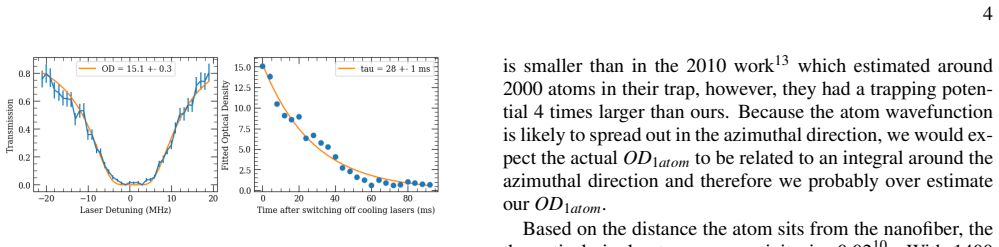
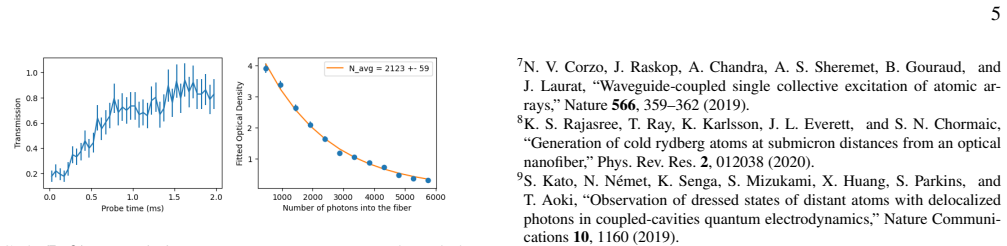
The authors realize a two-color dipole trap around an optical nanofiber and use machine-learning optimization to increase the on-resonance optical depth from 0.5 to values above 15, corresponding to roughly 1400 trapped atoms with a measured lifetime of 28 ms.
What carries the argument
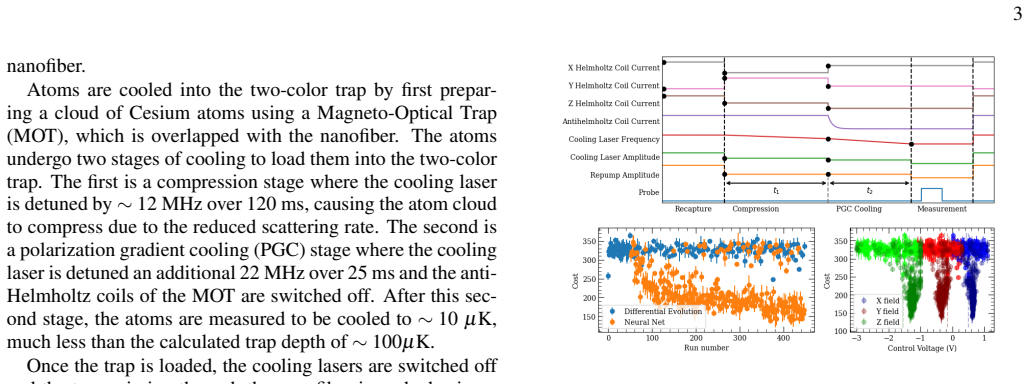
Machine-learning optimization of the trap laser powers and detunings, with optical depth extracted from resonant transmission through the nanofiber.
If this is right
- Stronger atom-light coupling becomes available for fiber-mediated quantum gates or entanglement distribution.
- The trap lifetime of 28 ms sets a practical window for coherent operations before atoms are lost.
- Machine-learning tuning can be reused on similar multi-parameter traps without exhaustive manual search.
- Optical depths above 15 open the regime where collective scattering or superradiant effects may appear in the fiber mode.
Where Pith is reading between the lines
- The same optimization loop could shorten setup time when replicating the trap in other laboratories.
- Higher atom numbers may enable studies of many-body physics near the nanofiber surface that were previously inaccessible.
- If the transmission calibration holds, the method supplies a ready-made high-density sample for hybrid quantum systems.
Load-bearing premise
The transmission signal through the nanofiber directly measures the number of trapped atoms without large unaccounted losses or background effects from the fiber itself.
What would settle it
An independent atom-number measurement, such as calibrated fluorescence imaging from outside the fiber, that returns far fewer than 1400 atoms while the transmission signal remains high.
Figures
read the original abstract
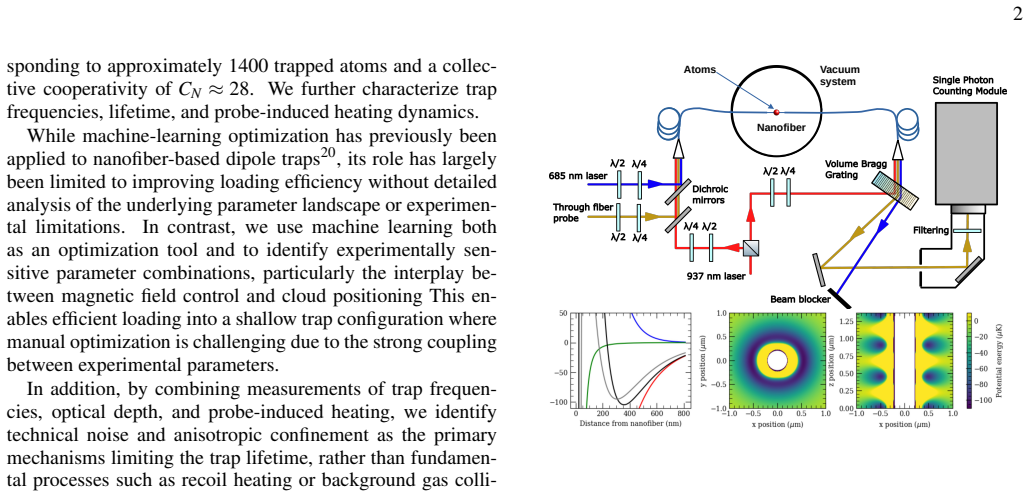
Optical nanofibers provide a way of coupling quantum information in cold atoms across large distances, however, this coupling requires atoms to reside close to the nanofiber surface. Atoms can be trapped close to the surface using a two-color dipole trap. Here we present our experimental realization of a two-color dipole trap. We optimize the number of trapped atoms using a machine learning algorithm and measure the optical density via the transmission. We estimate the number of atoms in the trap to be approximately 1400 and the lifetime of the atoms in the trap to be 28 ms. Machine-learning optimization improved the on-resonance optical depth from 0.5 in the initial optimization stage to optical depths exceeding 15.
Editorial analysis
A structured set of objections, weighed in public.
Referee Report
Summary. The manuscript reports the experimental realization of a two-color dipole trap for cold atoms near an optical nanofiber. Using machine-learning optimization of trap parameters, the authors achieve an on-resonance optical depth exceeding 15 (corresponding to ~1400 atoms) with a measured lifetime of 28 ms, representing an improvement from an initial OD of 0.5. Optical depth is extracted from transmission measurements through the nanofiber.
Significance. If the transmission-to-OD conversion is shown to be free of the systematics noted in the stress-test (resonance accuracy, evanescent overlap, power-dependent fiber effects), the result would constitute a meaningful experimental advance in atom-nanofiber interfaces for quantum networking. The application of ML to trap optimization is a positive methodological feature that could be adopted more broadly.
major comments (2)
- [Abstract] Abstract and measurement description: the central claim (OD rise from 0.5 to >15, N≈1400) rests entirely on converting nanofiber transmission into on-resonance optical depth, yet no calibration procedure, resonance verification, evanescent-field overlap factor, or background-subtraction method is supplied. Without these, the data cannot be assessed and the reported improvement cannot be distinguished from possible fiber or probe systematics.
- [Results] Results section on atom number and lifetime: no error bars, statistical uncertainties, or repeated-measurement statistics are provided for the OD=15 value or the 28 ms lifetime. This absence makes it impossible to judge whether the ML-optimized configuration is reproducibly superior to the initial stage.
Simulated Author's Rebuttal
We thank the referee for the detailed and constructive report. The two major comments identify important omissions in the presentation of the optical-depth extraction and statistical characterization. We address each point below and will revise the manuscript to incorporate the requested information.
read point-by-point responses
-
Referee: [Abstract] Abstract and measurement description: the central claim (OD rise from 0.5 to >15, N≈1400) rests entirely on converting nanofiber transmission into on-resonance optical depth, yet no calibration procedure, resonance verification, evanescent-field overlap factor, or background-subtraction method is supplied. Without these, the data cannot be assessed and the reported improvement cannot be distinguished from possible fiber or probe systematics.
Authors: We agree that the conversion from measured transmission to on-resonance optical depth requires explicit documentation. The current manuscript states only that OD is obtained from transmission but does not supply the supporting procedures. In the revised version we will add a dedicated subsection (likely in Methods) that (i) describes the frequency calibration and resonance verification against the atomic transition, (ii) gives the calculated evanescent-field overlap factor together with the mode-area model used, (iii) details the background-subtraction routine applied to the transmission traces, and (iv) discusses checks performed to bound power-dependent fiber effects. These additions will allow the reader to evaluate the quoted OD values and the improvement from the initial 0.5 to >15. revision: yes
-
Referee: [Results] Results section on atom number and lifetime: no error bars, statistical uncertainties, or repeated-measurement statistics are provided for the OD=15 value or the 28 ms lifetime. This absence makes it impossible to judge whether the ML-optimized configuration is reproducibly superior to the initial stage.
Authors: We acknowledge that the absence of uncertainties and repeated-trial statistics prevents a quantitative assessment of reproducibility. The original submission omitted these details. In the revision we will include error bars on both the initial and final OD values, derived from multiple independent optimization runs and transmission measurements. We will also report the standard deviation and number of repetitions for the 28 ms lifetime. This will demonstrate that the ML-optimized trap is reproducibly superior to the starting configuration. revision: yes
Circularity Check
No circularity: experimental reporting only
full rationale
The paper reports experimental realization of a two-color nanofiber trap, ML-based optimization of atom number, and direct transmission measurements converted to optical depth. No derivations, equations, fitted predictions, or self-citation chains appear in the provided text or abstract. All claims rest on measured data rather than any reduction to inputs by construction. This matches the reader's 0.0 assessment.
Axiom & Free-Parameter Ledger
axioms (1)
- domain assumption Standard relation between on-resonance optical depth and atom number in transmission spectroscopy of cold atoms
Reference graph
Works this paper leans on
-
[1]
Nayak, K. P. and Melentiev, P. N. and Morinaga, M. and Kien, Fam Le and Balykin, V. I. and Hakuta, K. , title =. Optics Express , volume =. 2007 , publisher =
2007
-
[2]
and Vetsch, E
Sagué, G. and Vetsch, E. and Alt, W. and Meschede, D. and Rauschenbeutel, A. , title =. Physical Review Letters , volume =. 2007 , doi =
2007
-
[3]
and Balykin, V
Le Kien, Fam and Dutta Gupta, S. and Balykin, V. I. and Hakuta, K. , title =. Physical Review A , volume =. 2005 , doi =
2005
-
[4]
S. K. Ruddell and K. E. Webb and I. Herrera and A. S. Parkins and M. D. Hoogerland , title =. Optica , volume =. 2017 , publisher =
2017
-
[5]
Physical Review Letters , volume =
Shinya Kato and Takao Aoki , title =. Physical Review Letters , volume =. 2015 , publisher =
2015
-
[6]
Nayak and Jie Wang and Jameesh Keloth , title =
Kali P. Nayak and Jie Wang and Jameesh Keloth , title =. Physical Review Letters , volume =. 2019 , publisher =
2019
-
[7]
Ulanov and Arno Rauschenbeutel and Philipp Schneeweiss and Jürgen Volz , title =
Aisling Johnson and Martin Blaha and Alexander E. Ulanov and Arno Rauschenbeutel and Philipp Schneeweiss and Jürgen Volz , title =. Physical Review Letters , volume =. 2019 , publisher =
2019
-
[8]
Nature , volume =
Waveguide-coupled single collective excitation of atomic arrays , author =. Nature , volume =. 2019 , doi =
2019
-
[9]
Nature Communications , volume =
Observation of dressed states of distant atoms with delocalized photons in coupled-cavities quantum electrodynamics , author =. Nature Communications , volume =. 2019 , doi =
2019
-
[10]
Generation of cold Rydberg atoms at submicron distances from an optical nanofiber , author =. Phys. Rev. Res. , volume =. 2020 , month =. doi:10.1103/PhysRevResearch.2.012038 , url =
-
[11]
Le Kien, Fam and Balykin, V. I. and Hakuta, K. , title =. Physical Review A , volume =. 2004 , doi =
2004
-
[12]
Le Kien, Fam and Balykin, V. I. and Hakuta, K. , title =. Journal of the Physical Society of Japan , volume =. 2005 , doi =
2005
-
[13]
and Reitz, D
Vetsch, E. and Reitz, D. and Sagu. Optical interface created by laser-cooled atoms trapped in the evanescent field surrounding an optical nanofiber , journal =. 2010 , doi =
2010
-
[14]
A state-insensitive, compensated nanofiber trap , journal =
Lacro. A state-insensitive, compensated nanofiber trap , journal =. 2012 , doi =
2012
-
[15]
and Choi, K
Goban, A. and Choi, K. S. and Alton, D. J. and Ding, D. and Lacro. Demonstration of a State-Insensitive, Compensated Nanofiber Trap , journal =. 2012 , doi =
2012
-
[16]
Magic‑wavelength nanofiber‑based two‑color dipole trap with sub‑ /2 spacing , journal =
Pache, Lucas and Cordier, Martin and Letellier, Hector and Schemmer, Max and Schneeweiss, Philipp and Volz, J. Magic‑wavelength nanofiber‑based two‑color dipole trap with sub‑ /2 spacing , journal =. 2025 , doi =
2025
-
[17]
Hilton, A. P. and Perrella, C. and Luiten, A. N. and Light, P. S. , title =. Physical Review Applied , volume =. 2019 , doi =
2019
-
[18]
and Everett, Jesse L
Gupta, Ratnesh K. and Everett, Jesse L. and Tranter, Aaron D. and Henke, R. Machine learner optimization of optical nanofiber-based dipole traps , journal =. 2022 , doi =
2022
-
[19]
Journal of Optics , volume =
Polarisation control for optical nanofibres by imaging through a single lens , author =. Journal of Optics , volume =. 2019 , doi =
2019
-
[20]
Journal of Optics , volume =
Nanofiber quantum photonics , author =. Journal of Optics , volume =. 2018 , doi =
2018
-
[21]
Optical Interface Based on a Nanofiber Atom-Trap , author =. 2011 , address =. doi:10.25358/openscience-4782 , url =
-
[22]
2024 , howpublished =
M-LOOP: Machine-learning Online Optimization Package , author =. 2024 , howpublished =
2024
-
[23]
Scientific Reports , volume =
Fast machine-learning online optimization of ultra-cold-atom experiments , author =. Scientific Reports , volume =. 2016 , doi =
2016
-
[24]
2020 , address =
Quantum optics with single collective excitations of nanofiber-trapped arrays of atoms , author =. 2020 , address =
2020
-
[25]
2015 , url =
Grover, Jeffrey Aaron , title =. 2015 , url =
2015
-
[26]
Nature , volume=
The quantum internet , author=. Nature , volume=. 2008 , publisher=
2008
-
[27]
Long-distance cascaded fluorescence of cold cesium atoms coupled to an optical nanofiber , author =. Phys. Rev. A , volume =. 2026 , month =. doi:10.1103/jt3z-mf13 , url =
-
[28]
, title =
Tavis, Michael and Cummings, Frederick W. , title =. Physical Review , volume =. 1968 , doi =
1968
-
[29]
Review of Scientific Instruments , volume =
Contributed Review: Optical micro- and nanofiber pulling rig , author =. Review of Scientific Instruments , volume =. 2014 , publisher =
2014
discussion (0)
Sign in with ORCID, Apple, or X to comment. Anyone can read and Pith papers without signing in.