Architecture Shapes Transfer Specificity in Implicit Neural Representations
Pith reviewed 2026-06-27 22:46 UTC · model grok-4.3
The pith
Architecture shapes transfer specificity in implicit neural representations, separating source-specific structure from generic weight reuse.
A machine-rendered reading of the paper's core claim, the machinery that carries it, and where it could break.
Core claim
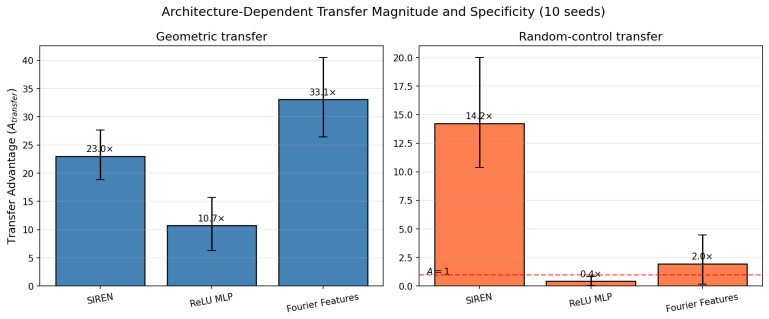
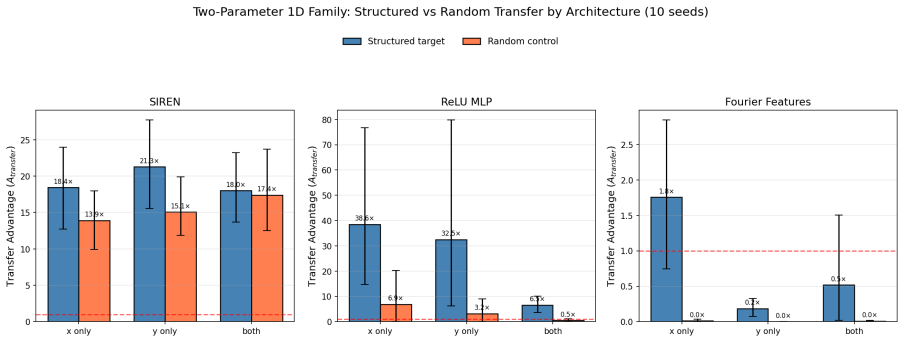
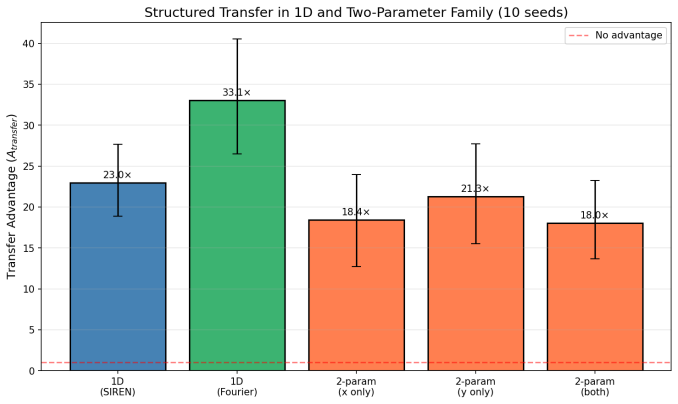
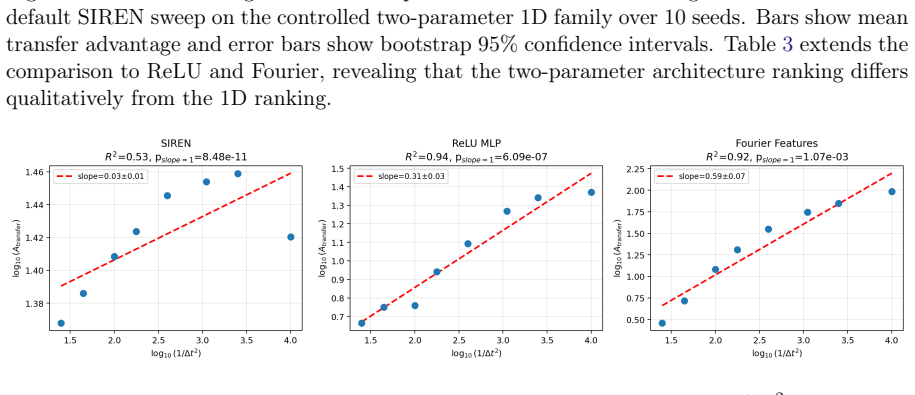
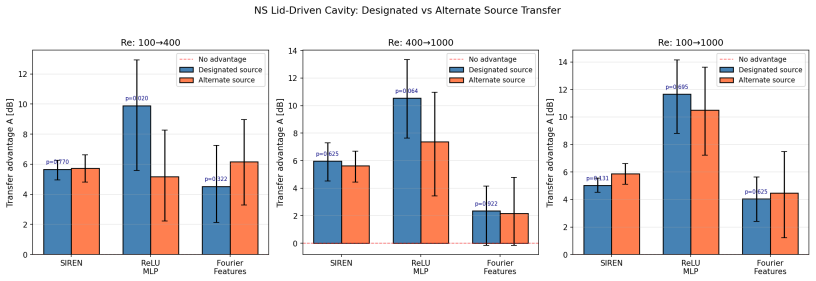
Across settings, transfer magnitude and transfer specificity separate clearly. In a 10-seed controlled 1D geometric test, Fourier Features show the largest structured transfer (33.1×), followed by SIREN (23.0×) and ReLU (10.7×), but ReLU is far more selective: random-control transfer is 0.41× for ReLU versus 14.24× for SIREN. On a controlled two-parameter 1D family, the ranking changes: ReLU gives the clearest structured-versus-control separation at default settings, whereas Fourier Features improve only after bandwidth retuning. In Navier--Stokes and the broader 1D PDE suite, no single architecture dominates every equation, yet the same pattern remains: SIREN often reuses weights broadly, w
What carries the argument
Transfer specificity, defined by the ratio of structured transfer to transfer under random-seed or alternate same-family source controls, as the quantity that isolates source-specific structure from generic weight reuse.
If this is right
- Architecture selection for transfer in scientific machine learning should use explicit control conditions instead of transfer magnitude alone.
- SIREN tends to reuse weights broadly while ReLU tends to be source-selective.
- Fourier features achieve high structured transfer in geometric tests but require bandwidth retuning for clear separation on some parametric families.
- The proposed scaling law A_transfer proportional to 1 over delta t squared does not hold in the 1D PDE audit.
- Static diagnostics fail to predict transfer behavior across the tested settings.
Where Pith is reading between the lines
- Tasks requiring precise source matching may favor ReLU while tasks tolerant of broad reuse may favor SIREN.
- The observed patterns could be tested on additional coordinate-based tasks such as image or 3D reconstruction to check consistency.
- If controls prove insufficient, future work could introduce more varied initialization distributions or cross-family sources to refine the isolation of specificity.
Load-bearing premise
The chosen random-seed and alternate same-family source controls are sufficient to isolate source-specific structure from generic weight reuse without residual confounding from the particular PDE families or initialization distributions used in the benchmarks.
What would settle it
A controlled experiment in which transfer to random controls equals structured transfer after matching seed and family would falsify the claimed separation of magnitude from specificity.
Figures
read the original abstract
Transfer in coordinate networks is often measured by warm-start gain, but whether that gain reflects source-specific structure or generic weight reuse is less clear. We study this question across three implicit neural representation (INR) families, SIREN, ReLU MLPs, and Fourier-feature MLPs, using controlled analytic tests, a 2D lid-driven-cavity Navier--Stokes benchmark, and 1D PDE reference-solution suites for heat, viscous Burgers, and focusing cubic NLS. The analytic tests use independent-seed random controls, while the PDE benchmarks use alternate same-family source controls and auxiliary ablations. Across settings, transfer magnitude and transfer specificity separate clearly. In a 10-seed controlled 1D geometric test, Fourier Features show the largest structured transfer ($33.1\times$), followed by SIREN ($23.0\times$) and ReLU ($10.7\times$), but ReLU is far more selective: random-control transfer is $0.41\times$ for ReLU versus $14.24\times$ for SIREN. On a controlled two-parameter 1D family, the ranking changes: ReLU gives the clearest structured-versus-control separation at default settings, whereas Fourier Features improve only after bandwidth retuning. In Navier--Stokes and the broader 1D PDE suite, no single architecture dominates every equation, yet the same pattern remains: SIREN often reuses weights broadly, whereas ReLU and, in some equations, Fourier Features are more source-selective. Static diagnostics remain weak, and the heuristic scaling law $A_{\text{transfer}} \propto 1/\Delta t^2$ is rejected in the implemented 1D audit. These results position transfer specificity as a useful diagnostic for coordinate networks and suggest that architecture selection in scientific machine learning should be evaluated under explicit control conditions, not by transfer magnitude alone.
Editorial analysis
A structured set of objections, weighed in public.
Referee Report
Summary. The paper empirically examines transfer in implicit neural representations (INRs) across SIREN, ReLU MLPs, and Fourier-feature MLPs. It distinguishes transfer magnitude from transfer specificity using controlled 1D geometric tests with independent-seed random controls, a 2D Navier-Stokes lid-driven cavity benchmark, and 1D PDE suites (heat, Burgers, NLS) with alternate same-family source controls. Key findings include architecture-dependent patterns: Fourier features yield highest structured transfer (33.1×) but low selectivity, while ReLU shows lower magnitude (10.7×) yet high selectivity (0.41× random control); SIREN reuses weights more broadly. No architecture dominates all equations, static diagnostics are weak, and a proposed scaling law is rejected.
Significance. If the reported separations between structured and control transfer hold under the stated controls, the work supplies a practical diagnostic for INR architecture choice in scientific machine learning, shifting evaluation from raw warm-start gain to explicit specificity tests. The controlled multi-architecture, multi-equation design and rejection of the heuristic scaling law are concrete strengths.
major comments (2)
- [§3 and PDE benchmark sections] §3 (1D geometric test) and PDE benchmark sections: The random-seed controls are stated to use independent seeds, and PDE controls use alternate same-family sources, but the manuscript does not confirm that random initializations are sampled from the identical distribution as the trained sources or that PDE-family features do not introduce residual correlations surviving the control construction. This directly affects whether the headline specificity gap (ReLU 0.41× vs SIREN 14.24× random) isolates architecture-driven selectivity or reflects distribution mismatch.
- [Abstract and §4] Abstract and §4 (Navier-Stokes and 1D PDE suite): The claim that 'the same pattern remains' (SIREN broad reuse, ReLU/Fourier more selective) is presented without per-equation statistical tests or data-exclusion criteria; given the reader's note on missing methods details, it is unclear whether the cross-equation consistency survives multiple-comparison correction or seed variance.
minor comments (2)
- Notation for transfer ratios (e.g., 33.1×) should be defined once with explicit baseline (random or same-family) to avoid ambiguity across sections.
- Figure captions for the 1D geometric test should state the exact number of seeds and whether error bars reflect standard deviation or standard error.
Simulated Author's Rebuttal
We thank the referee for the constructive comments on control validity and statistical presentation. We address each point below and will revise the manuscript to improve clarity and rigor where the concerns are valid.
read point-by-point responses
-
Referee: [§3 and PDE benchmark sections] The random-seed controls are stated to use independent seeds, and PDE controls use alternate same-family sources, but the manuscript does not confirm that random initializations are sampled from the identical distribution as the trained sources or that PDE-family features do not introduce residual correlations surviving the control construction. This directly affects whether the headline specificity gap isolates architecture-driven selectivity or reflects distribution mismatch.
Authors: We agree that explicit confirmation of the initialization distribution is necessary for the controls to isolate architecture effects. The current text states only that independent-seed random controls were used. In revision we will add a methods paragraph in §3 and the PDE sections specifying that random controls are drawn from the identical initialization scheme and hyper-parameters (variance, bias initialization, etc.) as the trained sources. For the PDE same-family controls we will add a short ablation note or supplementary check confirming that alternate sources within the family do not retain measurable residual correlations beyond those already controlled by the construction. These additions will directly support the reported specificity ratios. revision: yes
-
Referee: [Abstract and §4] The claim that 'the same pattern remains' (SIREN broad reuse, ReLU/Fourier more selective) is presented without per-equation statistical tests or data-exclusion criteria; given the reader's note on missing methods details, it is unclear whether the cross-equation consistency survives multiple-comparison correction or seed variance.
Authors: The manuscript presents the cross-equation pattern as a qualitative observation supported by the figures rather than as a set of formally tested hypotheses. We acknowledge that formal per-equation tests and explicit discussion of multiple-comparison issues would strengthen the claim. In revision we will qualify the abstract and §4 statement to note that the pattern is descriptive, add seed-wise standard deviations or ranges to the relevant tables/figures, and include a brief methods note on data-exclusion criteria if any were applied. We do not believe a full multiple-testing correction is required for the current descriptive framing, but the added variance information will allow readers to assess robustness directly. revision: partial
Circularity Check
Empirical benchmark study with no derivation chain or self-referential reductions.
full rationale
The paper is an empirical comparison of transfer magnitude and specificity across INR architectures (SIREN, ReLU, Fourier features) using controlled tests with independent-seed random controls and same-family source controls. No equations, predictions, or first-principles derivations are presented that reduce reported quantities (e.g., transfer ratios like 33.1×) to fitted parameters or self-citations by construction. All claims rest on direct experimental measurements, making the work self-contained against external benchmarks with no load-bearing circular steps.
Axiom & Free-Parameter Ledger
axioms (1)
- domain assumption Random-seed and alternate same-family source controls isolate source-specific structure from generic weight reuse
Reference graph
Works this paper leans on
-
[1]
Parameterized Physics-informed Neural Networks for Parameterized
Woojin Cho and Minju Jo and Haksoo Lim and Kookjin Lee and Dongeun Lee and Sanghyun Hong and Noseong Park , booktitle=. Parameterized Physics-informed Neural Networks for Parameterized. 2024 , url=
2024
-
[2]
2026 , eprint=
Sparse-Supervised Hybrid Parameterized Physics-Informed Neural Networks for Incompressible Flows Across Reynolds Numbers , author=. 2026 , eprint=
2026
-
[3]
A pseudo-time stepping and parameterized physics-informed neural network framework for Navier--Stokes equations , volume=. Physics of Fluids , author=. 2025 , month=. doi:10.1063/5.0259583 , number=
-
[4]
Chen, Yanlai and Koohy, Shawn , title =. 2024 , issue_date =. doi:10.1016/j.finel.2023.104047 , journal =
-
[5]
IEEE Transactions on Knowledge and Data Engineering , volume =
Pan, Sinno Jialin and Yang, Qiang , title =. IEEE Transactions on Knowledge and Data Engineering , volume =. 2010 , doi =
2010
-
[6]
and Kutz, J
Brunton, Steven L. and Kutz, J. Nathan , title =. Nature Computational Science , volume =. 2024 , doi =
2024
-
[7]
2023 , url=
Shinjan Ghosh and Amit Chakraborty and Georgia Olympia Brikis and Biswadip Dey , booktitle=. 2023 , url=
2023
-
[8]
Physics of Fluids , volume=
Modular fine-tuning of physics-informed neural networks for natural convection in eccentric geometries , author=. Physics of Fluids , volume=. 2025 , publisher=
2025
-
[9]
Roy, Nityananda , title =. 2025 , month =. doi:10.1088/1402-4896/adea1e , url =
-
[10]
International Journal of Mechanical System Dynamics , volume =
Wang, Yizheng and Bai, Jinshuai and Eshaghi, Mohammad Sadegh and Anitescu, Cosmin and Zhuang, Xiaoying and Rabczuk, Timon and Liu, Yinghua , title =. International Journal of Mechanical System Dynamics , volume =. doi:10.1002/msd2.70030 , url =
-
[11]
Advanced Modeling and Simulation in Engineering Sciences , year =
Geometry aware physics informed neural network surrogate for solving Navier--Stokes equation (GAPINN) , author =. Advanced Modeling and Simulation in Engineering Sciences , year =
-
[12]
Adaptive transfer learning for PINN , journal =. 2023 , issn =. doi:https://doi.org/10.1016/j.jcp.2023.112291 , url =
-
[13]
Science Advances , volume =
Sifan Wang and Hanwen Wang and Paris Perdikaris , title =. Science Advances , volume =. 2021 , doi =
2021
-
[14]
Nature Machine Intelligence , volume=
Learning nonlinear operators via DeepONet based on the universal approximation theorem of operators , author=. Nature Machine Intelligence , volume=. 2021 , publisher=
2021
-
[15]
Journal of Machine Learning Research , year =
Zongyi Li and Daniel Zhengyu Huang and Burigede Liu and Anima Anandkumar , title =. Journal of Machine Learning Research , year =
-
[16]
Journal of Machine Learning Research , volume =
Kovachki, Nikola and Li, Zongyi and Liu, Burigede and Azizzadenesheli, Kamyar and Bhattacharya, Kaushik and Stuart, Andrew and Anandkumar, Anima , title =. Journal of Machine Learning Research , volume =. 2023 , url =
2023
-
[17]
2024 , eprint =
A physics-informed transformer neural operator for learning generalized solutions of initial boundary value problems , author =. 2024 , eprint =
2024
-
[18]
Wenqian Chen and Yucheng Fu and Michael Penwarden and Pratanu Roy and Panos Stinis , year =. 2602.11626 , archivePrefix =
-
[19]
International Conference on Learning Representations , year=
Fourier Neural Operator for Parametric Partial Differential Equations , author=. International Conference on Learning Representations , year=
-
[20]
CoRR , volume=
Alasdair Tran and Alexander Patrick Mathews and Lexing Xie and Cheng Soon Ong , title=. CoRR , volume=. 2021 , cdate=
2021
-
[21]
and Kutz, J
Pan, Shaowu and Brunton, Steven L. and Kutz, J. Nathan , title =. J. Mach. Learn. Res. , month = jan, articleno =. 2023 , issue_date =
2023
-
[22]
Continuous
Yuan Yin and Matthieu Kirchmeyer and Jean-Yves Franceschi and Alain Rakotomamonjy and Patrick Gallinari , booktitle=. Continuous. 2023 , url=
2023
-
[23]
arXiv preprint arXiv:2412.05233 , year=
Physics-informed reduced order model with conditional neural fields , author=. arXiv preprint arXiv:2412.05233 , year=
-
[24]
Advances in Neural Information Processing Systems , year =
Meta-Learning Sparse Implicit Neural Representations , author =. Advances in Neural Information Processing Systems , year =
-
[25]
Reza. A physics-informed meta-learning framework for the continuous solution of parametric PDEs on arbitrary geometries , journal =. 2026 , issn =. doi:https://doi.org/10.1016/j.compstruc.2026.108102 , url =
-
[26]
Matthaios Chatzopoulos and Phaedon-Stelios Koutsourelakis , keywords =. Physics-Aware Neural Implicit Solvers for multiscale, parametric PDEs with applications in heterogeneous media , journal =. 2024 , issn =. doi:https://doi.org/10.1016/j.cma.2024.117342 , url =
-
[27]
2025 , url=
Liming Shen and Liang Deng and Chongke Bi and Yu Wang and Xinhai Chen and Yueqing Wang and Jie Liu , booktitle=. 2025 , url=
2025
-
[28]
Transactions on Machine Learning Research , issn=
Where Do We Stand with Implicit Neural Representations? A Technical and Performance Survey , author=. Transactions on Machine Learning Research , issn=. 2025 , url=
2025
-
[29]
and Bergman, Alexander W
Sitzmann, Vincent and Martel, Julien N.P. and Bergman, Alexander W. and Lindell, David B. and Wetzstein, Gordon , title =. Advances in Neural Information Processing Systems , year=
-
[30]
Geometric priors for single-patch neural
Eng, D Yang , journal=. Geometric priors for single-patch neural. 2026 , doi=
2026
-
[31]
2025 , eprint=
Improving Accuracy and Efficiency of Implicit Neural Representations: Making SIREN a WINNER , author=. 2025 , eprint=
2025
-
[32]
Proceedings of the IEEE/CVF Computer Vision and Pattern Recognition Conference (CVPR) , pages =
FINER: Flexible spectral-bias tuning in Implicit NEural Representation by Variable-periodic Activation Functions , author =. Proceedings of the IEEE/CVF Computer Vision and Pattern Recognition Conference (CVPR) , pages =
-
[33]
and Mildenhall, Ben and Fridovich-Keil, Sara and Raghavan, Nithin and Singhal, Utkarsh and Ramamoorthi, Ravi and Barron, Jonathan T
Tancik, Matthew and Srinivasan, Pratul P. and Mildenhall, Ben and Fridovich-Keil, Sara and Raghavan, Nithin and Singhal, Utkarsh and Ramamoorthi, Ravi and Barron, Jonathan T. and Ng, Ren , title =. Proceedings of the 34th International Conference on Neural Information Processing Systems , articleno =. 2020 , isbn =
2020
-
[34]
Instant neural graphics primitives with a multiresolution hash encoding , volume=
Thomas M\"uller and Alex Evans and Christoph Schied and Alexander Keller , title =. ACM Trans. Graph. , issue_date =. 2022 , pages =. doi:10.1145/3528223.3530127 , publisher =
-
[35]
Proceedings of the IEEE/CVF Winter Conference on Applications of Computer Vision (WACV) , month =
Wang, Yifan and Gong, Yi and Zeng, Yuan , title =. Proceedings of the IEEE/CVF Winter Conference on Applications of Computer Vision (WACV) , month =. 2024 , pages =
2024
-
[36]
2025 , eprint=
A New Perspective To Understanding Multi-resolution Hash Encoding For Neural Fields , author=. 2025 , eprint=
2025
-
[37]
International Conference on Learning Representations , year=
Sharpness-aware Minimization for Efficiently Improving Generalization , author=. International Conference on Learning Representations , year=
-
[38]
, title =
Berkooz, Gal and Holmes, Philip and Lumley, John L. , title =. Annual Review of Fluid Mechanics , volume =. 1993 , doi =
1993
-
[39]
SIAM Review , volume =
Benner, Peter and Gugercin, Serkan and Willcox, Karen , title =. SIAM Review , volume =. 2015 , doi =
2015
-
[40]
2015 , doi =
Quarteroni, Alfio and Manzoni, Andrea and Negri, Federico , title =. 2015 , doi =
2015
discussion (0)
Sign in with ORCID, Apple, or X to comment. Anyone can read and Pith papers without signing in.