Are Large Language Models Suitable for Graph Computation? Progress and Prospects
Pith reviewed 2026-06-27 22:13 UTC · model grok-4.3
The pith
Large language models handle simple small-scale graph tasks but stay unreliable for large or exact computations.
A machine-rendered reading of the paper's core claim, the machinery that carries it, and where it could break.
Core claim
Through the role-based taxonomy of LLMs as executors and LLMs as planners, the review concludes that LLMs are promising for simple, small-scale tasks but remain unreliable for large-scale and exactness-demanding tasks, after examining strengths, limitations, available datasets, and open challenges in each paradigm.
What carries the argument
Role-based taxonomy that splits LLM use into executors solving tasks directly from descriptions and planners that decompose steps and invoke tools or agents.
If this is right
- LLMs can be used standalone for small simple graph problems but require hybrid planner-plus-tool setups for anything larger or more precise.
- New evaluation datasets must systematically vary graph scale and demand exact outputs rather than approximate answers.
- Pipeline design should route easy subtasks to LLMs and route hard subtasks to conventional graph algorithms.
- Research effort should target the identified failure modes of scale and exactness instead of further small-task demonstrations.
Where Pith is reading between the lines
- Similar reliability boundaries likely appear in other structured reasoning domains such as code synthesis or theorem proving, suggesting a general limit rather than a graph-specific one.
- Pure end-to-end LLM graph solvers may remain impractical; the more durable path is modular systems where LLMs only handle high-level planning.
- If the scale and exactness limitations persist, specialized graph libraries will continue to dominate production use even as LLMs improve at language interfaces.
Load-bearing premise
The body of published work reviewed accurately captures the current capabilities and limitations of LLMs on graph tasks without major gaps or biases in the selected literature.
What would settle it
A controlled experiment in which an LLM achieves high exact accuracy on shortest-path or connectivity queries over graphs with thousands of nodes, without external tools, would directly test the unreliability claim for large-scale tasks.
Figures
read the original abstract
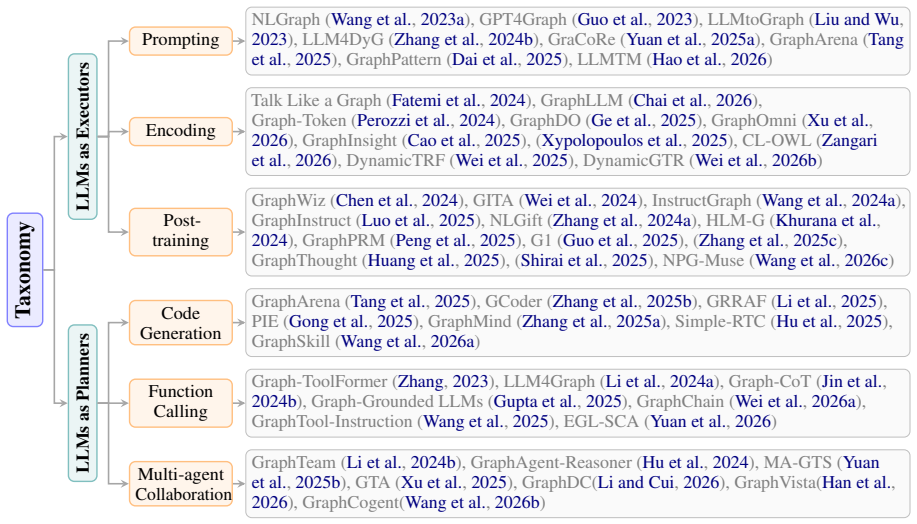
Large language models (LLMs) have been increasingly explored for graph computation, where tasks require reasoning over structured relationships and algorithmic operations. Yet, it remains unclear when LLMs can reliably support such computation and how they should be incorporated into graph-solving pipelines. Existing surveys at the intersection of LLMs and graphs primarily focus on graph learning, text-attributed graphs, or graph-language modeling. To bridge this gap, we provide a comprehensive review of LLMs for graph computation through a role-based taxonomy. Specifically, we identify two major paradigms: i) LLMs as executors, where models directly solve graph tasks from graph descriptions and instructions; and ii) LLMs as planners, where models formulate problems, decompose reasoning steps, and invoke external tools or agents for execution. Based on this taxonomy, we analyze the strengths and limitations of current methods. Our review indicates that LLMs are promising for simple, small-scale tasks, but remain unreliable for large-scale and exactness-demanding tasks. Finally, we summarize available datasets and suggest four future directions.
Editorial analysis
A structured set of objections, weighed in public.
Referee Report
Summary. The paper provides a comprehensive review of large language models (LLMs) for graph computation tasks. It introduces a role-based taxonomy classifying methods into LLMs as executors, which directly solve graph tasks from descriptions and instructions, and LLMs as planners, which formulate problems and invoke external tools. Based on this, it analyzes strengths and limitations, concluding that LLMs are promising for simple, small-scale tasks but unreliable for large-scale and exactness-demanding tasks. The review also summarizes available datasets and suggests four future directions.
Significance. This survey addresses a gap left by prior reviews focused on graph learning or text-attributed graphs. The executor/planner taxonomy supplies a clear organizing framework for categorizing LLM-graph work and for deciding when to integrate LLMs versus external solvers. The explicit statement of the reliability boundary (promising on small/simple tasks, unreliable on large/exact ones) and the dataset summary are practical contributions that can orient follow-up research on hybrid systems.
major comments (1)
- [Introduction / §2] The central synthesis—that LLMs remain unreliable for large-scale and exactness-demanding tasks—rests on the claim of a comprehensive review. The manuscript provides no description of the literature search protocol, keywords, date cutoff, databases queried, or inclusion/exclusion criteria (Introduction and §2). Without this information it is impossible to evaluate selection bias or omitted negative results, which directly affects in the assessed reliability boundary.
minor comments (2)
- [Taxonomy] The taxonomy definitions would benefit from one or two concrete paper examples per category to illustrate the boundary between executor and planner roles.
- [Datasets] Dataset summary table: include columns for task scale (node/edge count) and whether exact or approximate solutions are required, to make the limitations discussion easier to map onto the reviewed work.
Simulated Author's Rebuttal
We thank the referee for the constructive feedback and positive evaluation of the survey's contributions. We agree that explicitly documenting the literature search protocol will improve transparency and allow better assessment of the review's scope and potential biases. We will incorporate this information in the revised manuscript.
read point-by-point responses
-
Referee: [Introduction / §2] The central synthesis—that LLMs remain unreliable for large-scale and exactness-demanding tasks—rests on the claim of a comprehensive review. The manuscript provides no description of the literature search protocol, keywords, date cutoff, databases queried, or inclusion/exclusion criteria (Introduction and §2). Without this information it is impossible to evaluate selection bias or omitted negative results, which directly affects in the assessed reliability boundary.
Authors: We acknowledge this omission. In the revised version, we will add a dedicated subsection (likely in §2) that describes the literature search protocol in full, including: search keywords (e.g., combinations of “large language model”, “LLM”, “graph computation”, “graph reasoning”, “graph algorithm”), databases and venues queried (arXiv, ACL Anthology, NeurIPS/ICML/ICLR proceedings, Web of Science), date cutoff (papers up to December 2023), and explicit inclusion/exclusion criteria (e.g., focus on graph computation tasks rather than graph learning or text-attributed graphs, requirement of empirical results on graph tasks). This addition will directly address concerns about selection bias and omitted negative results. revision: yes
Circularity Check
No circularity: external literature synthesis only
full rationale
This is a survey paper whose central claims consist of a taxonomy and summary of strengths/limitations drawn from reviewed external works. No equations, fitted parameters, self-citations, or internal derivations are load-bearing; the abstract and described structure rely on analysis of other papers rather than reducing any result to the paper's own inputs by construction. The derivation is therefore self-contained against external benchmarks.
Axiom & Free-Parameter Ledger
Reference graph
Works this paper leans on
-
[2]
On the Planning Abilities of Large Language Models - A Critical Investigation , url =
Valmeekam, Karthik and Marquez, Matthew and Sreedharan, Sarath and Kambhampati, Subbarao , booktitle =. On the Planning Abilities of Large Language Models - A Critical Investigation , url =
-
[3]
2026 , eprint=
A Survey of Large Language Models , author=. 2026 , eprint=
2026
-
[9]
2025 , eprint=
InterCorpRel-LLM: Enhancing Financial Relational Understanding with Graph-Language Models , author=. 2025 , eprint=
2025
-
[10]
2023 , eprint=
Large Models for Time Series and Spatio-Temporal Data: A Survey and Outlook , author=. 2023 , eprint=
2023
-
[11]
I nstruct M ol: Multi-Modal Integration for Building a Versatile and Reliable Molecular Assistant in Drug Discovery
Cao, He and Liu, Zijing and Lu, Xingyu and Yao, Yuan and Li, Yu. I nstruct M ol: Multi-Modal Integration for Building a Versatile and Reliable Molecular Assistant in Drug Discovery. Proceedings of the 31st International Conference on Computational Linguistics. 2025
2025
-
[12]
2025 , eprint=
Computational Protein Science in the Era of Large Language Models (LLMs) , author=. 2025 , eprint=
2025
-
[13]
and Raskhodnikova, Sofya and Shi, Jessica and Shun, Julian and Yu, Shangdi , booktitle=
Dhulipala, Laxman and Liu, Quanquan C. and Raskhodnikova, Sofya and Shi, Jessica and Shun, Julian and Yu, Shangdi , booktitle=. Differential Privacy from Locally Adjustable Graph Algorithms: k-Core Decomposition, Low Out-Degree Ordering, and Densest Subgraphs , year=
-
[14]
2024 , eprint=
Attention Instruction: Amplifying Attention in the Middle via Prompting , author=. 2024 , eprint=
2024
-
[16]
2024 , eprint=
Privacy-Preserving In-Context Learning with Differentially Private Few-Shot Generation , author=. 2024 , eprint=
2024
-
[17]
2022 , eprint=
Differentially Private Triangle and 4-Cycle Counting in the Shuffle Model , author=. 2022 , eprint=
2022
-
[18]
2023 , eprint=
Are Chatbots Ready for Privacy-Sensitive Applications? An Investigation into Input Regurgitation and Prompt-Induced Sanitization , author=. 2023 , eprint=
2023
-
[19]
2021 , eprint=
Locally Differentially Private Analysis of Graph Statistics , author=. 2021 , eprint=
2021
-
[20]
Truss Decomposition Under Edge Local Differential Privacy , year=
Zhang, Yuting and Ni, Wei and Wang, Kai and He, Yizhang and Li, Conggai , booktitle=. Truss Decomposition Under Edge Local Differential Privacy , year=
-
[21]
Das, Debarati and Gupta, Ishaan and Srivastava, Jaideep and Kang, Dongyeop. Which Modality should I use - Text, Motif, or Image? : Understanding Graphs with Large Language Models. Findings of the Association for Computational Linguistics: NAACL 2024. 2024. doi:10.18653/v1/2024.findings-naacl.34
-
[25]
Social network analysis: An overview , volume =
Tabassum, Shazia and Pereira, Fabiola and Fernandes, Sofia and Gama, João , year =. Social network analysis: An overview , volume =. Wiley Interdisciplinary Reviews: Data Mining and Knowledge Discovery , doi =
-
[27]
The Structure of Information Pathways in a Social Communication Network , journal =
Kossinets, Gueorgi and Kleinberg, Jon and Watts, Duncan , year =. The Structure of Information Pathways in a Social Communication Network , journal =
-
[28]
NETAL: A new graph-based method for global alignment of protein-protein interaction networks , volume =
Neyshabur, Behnam and Khadem, Ahmadreza and Hashemifar, Somaye and Arab, Seyed Shahriar , year =. NETAL: A new graph-based method for global alignment of protein-protein interaction networks , volume =. Bioinformatics (Oxford, England) , doi =
-
[30]
Analyzing Online Transaction Networks with Network Motifs , doi =
Jiawei, Jiang and Hu, Yusong and Li, Xiaosen and Ouyang, Wen and Wang, Zhitao and Fu, Fangcheng and Cui, Bin , year =. Analyzing Online Transaction Networks with Network Motifs , doi =
-
[31]
Segment Anything Model for Road Network Graph Extraction , doi =
Hetang, Congrui and Xue, Haoru and Le, Cindy and Yue, Tianwei and Wang, Wenping and He, Ethan , year =. Segment Anything Model for Road Network Graph Extraction , doi =
-
[32]
Graph-Theoretic Analysis of Power Systems , volume =
Ishizaki, Takayuki and Chakrabortty, Aranya and Imura, Jun-Ichi , year =. Graph-Theoretic Analysis of Power Systems , volume =. Proceedings of the IEEE , doi =
-
[33]
Proceedings of the 29th ACM SIGKDD Conference on Knowledge Discovery and Data Mining , pages =
Xu, Minkai and Liu, Meng and Jin, Wengong and Ji, Shuiwang and Leskovec, Jure and Ermon, Stefano , title =. Proceedings of the 29th ACM SIGKDD Conference on Knowledge Discovery and Data Mining , pages =. 2023 , isbn =. doi:10.1145/3580305.3599559 , abstract =
-
[34]
Proceedings of the 36th International Conference on Neural Information Processing Systems , articleno =
Kojima, Takeshi and Gu, Shixiang Shane and Reid, Machel and Matsuo, Yutaka and Iwasawa, Yusuke , title =. Proceedings of the 36th International Conference on Neural Information Processing Systems , articleno =. 2022 , isbn =
2022
-
[35]
Language Models are Few-Shot Learners , url =
Brown, Tom and Mann, Benjamin and Ryder, Nick and Subbiah, Melanie and Kaplan, Jared D and Dhariwal, Prafulla and Neelakantan, Arvind and Shyam, Pranav and Sastry, Girish and Askell, Amanda and Agarwal, Sandhini and Herbert-Voss, Ariel and Krueger, Gretchen and Henighan, Tom and Child, Rewon and Ramesh, Aditya and Ziegler, Daniel and Wu, Jeffrey and Winte...
-
[36]
2023 , eprint=
Self-Consistency Improves Chain of Thought Reasoning in Language Models , author=. 2023 , eprint=
2023
-
[37]
2023 , eprint=
Least-to-Most Prompting Enables Complex Reasoning in Large Language Models , author=. 2023 , eprint=
2023
-
[38]
Chain of Thought Prompting Elicits Reasoning in Large Language Models , doi =
Wei, Jason and Wang, Xuezhi and Schuurmans, Dale and Bosma, Maarten and Chi, Ed and Le, Quoc and Zhou, Denny , year =. Chain of Thought Prompting Elicits Reasoning in Large Language Models , doi =
-
[39]
Graph Markup Language (
Brandes, Ulrik and Eiglsperger, Markus and Lerner, J. Graph Markup Language (. Handbook of Graph Drawing and Visualization , editor =. 2013 , publisher =
2013
-
[40]
University of Passau , year=
GML: Graph modelling language , author=. University of Passau , year=
-
[41]
Proceedings of the 26th international conference on world wide web , pages=
Neural collaborative filtering , author=. Proceedings of the 26th international conference on world wide web , pages=
-
[42]
Computer , volume=
Matrix factorization techniques for recommender systems , author=. Computer , volume=. 2009 , publisher=
2009
-
[43]
Advances in neural information processing systems , volume=
Translating embeddings for modeling multi-relational data , author=. Advances in neural information processing systems , volume=
-
[44]
Advances in neural information processing systems , volume=
Interaction networks for learning about objects, relations and physics , author=. Advances in neural information processing systems , volume=
-
[45]
International conference on machine learning , pages=
Neural message passing for quantum chemistry , author=. International conference on machine learning , pages=. 2017 , organization=
2017
-
[46]
Nature , volume=
Proteome survey reveals modularity of the yeast cell machinery , author=. Nature , volume=. 2006 , publisher=
2006
-
[47]
Nature , volume=
Lethality and centrality in protein networks , author=. Nature , volume=. 2001 , publisher=
2001
-
[48]
Proceedings of the 14th ACM SIGKDD international conference on Knowledge discovery and data mining , pages=
Microscopic evolution of social networks , author=. Proceedings of the 14th ACM SIGKDD international conference on Knowledge discovery and data mining , pages=
-
[49]
SIAM review , volume=
The structure and function of complex networks , author=. SIAM review , volume=. 2003 , publisher=
2003
-
[50]
Communications of the ACM , volume=
Topological sorting of large networks , author=. Communications of the ACM , volume=. 1962 , publisher=
1962
-
[52]
Canadian journal of Mathematics , volume=
Maximal flow through a network , author=. Canadian journal of Mathematics , volume=. 1956 , publisher=
1956
-
[53]
Proceedings of the twenty-second annual ACM symposium on Theory of computing , pages=
An optimal algorithm for on-line bipartite matching , author=. Proceedings of the twenty-second annual ACM symposium on Theory of computing , pages=
-
[54]
Graphs and Combinatorics , volume=
Advances on the Hamiltonian problem--a survey , author=. Graphs and Combinatorics , volume=. 2003 , publisher=
2003
-
[55]
2023 , eprint=
GPT4Graph: Can Large Language Models Understand Graph Structured Data ? An Empirical Evaluation and Benchmarking , author=. 2023 , eprint=
2023
-
[56]
Advances in Neural Information Processing Systems , volume=
Can language models solve graph problems in natural language? , author=. Advances in Neural Information Processing Systems , volume=
-
[59]
G ra C o R e: Benchmarking Graph Comprehension and Complex Reasoning in Large Language Models
Yuan, Zike and Liu, Ming and Wang, Hui and Qin, Bing. G ra C o R e: Benchmarking Graph Comprehension and Complex Reasoning in Large Language Models. Proceedings of the 31st International Conference on Computational Linguistics. 2025
2025
-
[60]
International Conference on Learning Representations , volume=
Grapharena: Evaluating and exploring large language models on graph computation , author=. International Conference on Learning Representations , volume=
-
[61]
Findings of the Association for Computational Linguistics: EMNLP 2024 , pages=
Can LLM graph reasoning generalize beyond pattern memorization? , author=. Findings of the Association for Computational Linguistics: EMNLP 2024 , pages=
2024
-
[62]
International Conference on Learning Representations , volume=
How do large language models understand graph patterns? a benchmark for graph pattern comprehension , author=. International Conference on Learning Representations , volume=
-
[63]
GraphLLM: Boosting Graph Reasoning Ability of Large Language Model , year=
Chai, Ziwei and Zhang, Tianjie and Wu, Liang and Han, Kaiqiao and Hu, Xiaohai and Huang, Xuanwen and Yang, Yang , journal=. GraphLLM: Boosting Graph Reasoning Ability of Large Language Model , year=
-
[65]
2026 , eprint=
Colorful Talks with Graphs: Human-Interpretable Graph Encodings for Large Language Models , author=. 2026 , eprint=
2026
-
[66]
2025 , eprint=
Graph Linearization Methods for Reasoning on Graphs with Large Language Models , author=. 2025 , eprint=
2025
-
[67]
Ye, Ruosong and Zhang, Caiqi and Wang, Runhui and Xu, Shuyuan and Zhang, Yongfeng. Language is All a Graph Needs. Findings of the Association for Computational Linguistics: EACL 2024. 2024. doi:10.18653/v1/2024.findings-eacl.132
-
[70]
2025 , eprint=
GraphInstruct: Empowering Large Language Models with Graph Understanding and Reasoning Capability , author=. 2025 , eprint=
2025
-
[76]
2025 , eprint=
Rethinking and Benchmarking Large Language Models for Graph Reasoning , author=. 2025 , eprint=
2025
-
[78]
Advances in Neural Information Processing Systems , volume=
Can large language models analyze graphs like professionals? a benchmark, datasets and models , author=. Advances in Neural Information Processing Systems , volume=
-
[80]
Advances in Neural Information Processing Systems , volume=
GraphChain: Large Language Models for Large-Scale Graph Analysis via Tool Chaining , author=. Advances in Neural Information Processing Systems , volume=
-
[84]
Gta: Graph theory agent and benchmark for algorithmic graph reasoning with llms , author=
-
[85]
2024 , eprint=
A Survey of Graph Meets Large Language Model: Progress and Future Directions , author=. 2024 , eprint=
2024
-
[87]
Large Language Models on Graphs: A Comprehensive Survey , year=
Jin, Bowen and Liu, Gang and Han, Chi and Jiang, Meng and Ji, Heng and Han, Jiawei , journal=. Large Language Models on Graphs: A Comprehensive Survey , year=
-
[88]
ACM Transactions on Intelligent Systems and Technology16(5), 1–72 (Oct 2025)
Naveed, Humza and Khan, Asad Ullah and Qiu, Shi and Saqib, Muhammad and Anwar, Saeed and Usman, Muhammad and Akhtar, Naveed and Barnes, Nick and Mian, Ajmal , title =. ACM Trans. Intell. Syst. Technol. , month = aug, articleno =. 2025 , issue_date =. doi:10.1145/3744746 , abstract =
-
[89]
Talk like a Graph: Encoding Graphs for Large Language Models , url =
Fatemi, Bahare and Halcrow, Jonathan and Perozzi, Bryan , booktitle =. Talk like a Graph: Encoding Graphs for Large Language Models , url =
-
[91]
2024 , eprint=
Let Your Graph Do the Talking: Encoding Structured Data for LLMs , author=. 2024 , eprint=
2024
-
[93]
Proceedings of the 30th ACM SIGKDD Conference on Knowledge Discovery and Data Mining , pages =
Behrouz, Ali and Hashemi, Farnoosh , title =. Proceedings of the 30th ACM SIGKDD Conference on Knowledge Discovery and Data Mining , pages =. 2024 , isbn =. doi:10.1145/3637528.3672044 , abstract =
-
[94]
Journal of Machine Learning Research , year =
William Fedus and Barret Zoph and Noam Shazeer , title =. Journal of Machine Learning Research , year =
-
[95]
2024 , eprint=
Mixtral of Experts , author=. 2024 , eprint=
2024
-
[96]
and Gao, Huazuo and Chen, Deli and Li, Jiashi and Zeng, Wangding and Yu, Xingkai and Wu, Y
Dai, Damai and Deng, Chengqi and Zhao, Chenggang and Xu, R.x. and Gao, Huazuo and Chen, Deli and Li, Jiashi and Zeng, Wangding and Yu, Xingkai and Wu, Y. and Xie, Zhenda and Li, Y.k. and Huang, Panpan and Luo, Fuli and Ruan, Chong and Sui, Zhifang and Liang, Wenfeng. D eep S eek M o E : Towards Ultimate Expert Specialization in Mixture-of-Experts Language...
-
[97]
Toolformer: Language Models Can Teach Themselves to Use Tools , url =
Schick, Timo and Dwivedi-Yu, Jane and Dessi, Roberto and Raileanu, Roberta and Lomeli, Maria and Hambro, Eric and Zettlemoyer, Luke and Cancedda, Nicola and Scialom, Thomas , booktitle =. Toolformer: Language Models Can Teach Themselves to Use Tools , url =
-
[98]
2023 , eprint=
DSPy: Compiling Declarative Language Model Calls into Self-Improving Pipelines , author=. 2023 , eprint=
2023
-
[99]
SWE-agent: Agent-Computer Interfaces Enable Automated Software Engineering , url =
Yang, John and Jimenez, Carlos and Wettig, Alexander and Lieret, Kilian and Yao, Shunyu and Narasimhan, Karthik and Press, Ofir , booktitle =. SWE-agent: Agent-Computer Interfaces Enable Automated Software Engineering , url =. doi:10.52202/079017-1601 , editor =
-
[101]
2025 , eprint=
G1: Teaching LLMs to Reason on Graphs with Reinforcement Learning , author=. 2025 , eprint=
2025
-
[102]
2025 , eprint=
From Local to Global: A Graph RAG Approach to Query-Focused Summarization , author=. 2025 , eprint=
2025
-
[103]
Li, Shilong and He, Yancheng and Guo, Hangyu and Bu, Xingyuan and Bai, Ge and Liu, Jie and Liu, Jiaheng and Qu, Xingwei and Li, Yangguang and Ouyang, Wanli and Su, Wenbo and Zheng, Bo. G raph R eader: Building Graph-based Agent to Enhance Long-Context Abilities of Large Language Models. Findings of the Association for Computational Linguistics: EMNLP 2024...
-
[104]
2026 , eprint=
GraphOmni: A Comprehensive and Extensible Benchmark Framework for Large Language Models on Graph-theoretic Tasks , author=. 2026 , eprint=
2026
-
[105]
2023 , eprint=
ReAct: Synergizing Reasoning and Acting in Language Models , author=. 2023 , eprint=
2023
-
[106]
2025 , eprint=
MCP-Zero: Active Tool Discovery for Autonomous LLM Agents , author=. 2025 , eprint=
2025
-
[107]
2026 , eprint=
SkillsBench: Benchmarking How Well Agent Skills Work Across Diverse Tasks , author=. 2026 , eprint=
2026
-
[108]
2024 , eprint=
Are Large-Language Models Graph Algorithmic Reasoners? , author=. 2024 , eprint=
2024
-
[109]
2024 , eprint=
The CLRS-Text Algorithmic Reasoning Language Benchmark , author=. 2024 , eprint=
2024
-
[110]
2023 , eprint=
LongNet: Scaling Transformers to 1,000,000,000 Tokens , author=. 2023 , eprint=
2023
-
[111]
Proceedings of the 41st International Conference on Machine Learning , articleno =
Ding, Yiran and Zhang, Li Lyna and Zhang, Chengruidong and Xu, Yuanyuan and Shang, Ning and Xu, Jiahang and Yang, Fan and Yang, Mao , title =. Proceedings of the 41st International Conference on Machine Learning , articleno =. 2024 , publisher =
2024
-
[112]
2024 , eprint=
RULER: What's the Real Context Size of Your Long-Context Language Models? , author=. 2024 , eprint=
2024
discussion (0)
Sign in with ORCID, Apple, or X to comment. Anyone can read and Pith papers without signing in.