MOSES -- The MONET Star and Exoplanet Spectrograph
Pith reviewed 2026-06-27 21:11 UTC · model grok-4.3
The pith
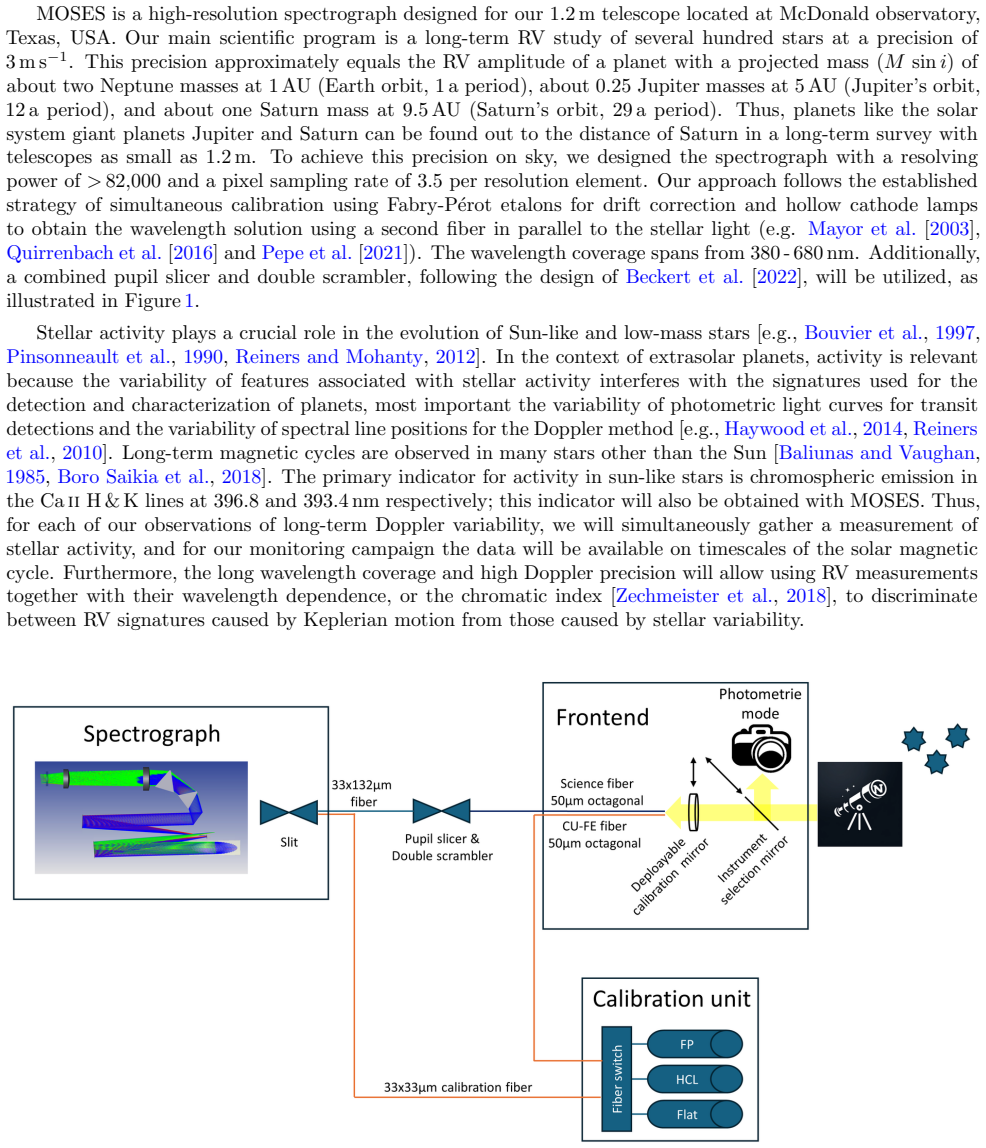
MOSES is a new high-resolution echelle spectrograph for the MONET telescope designed to reach radial velocity precision below 2 m/s.
A machine-rendered reading of the paper's core claim, the machinery that carries it, and where it could break.
Core claim
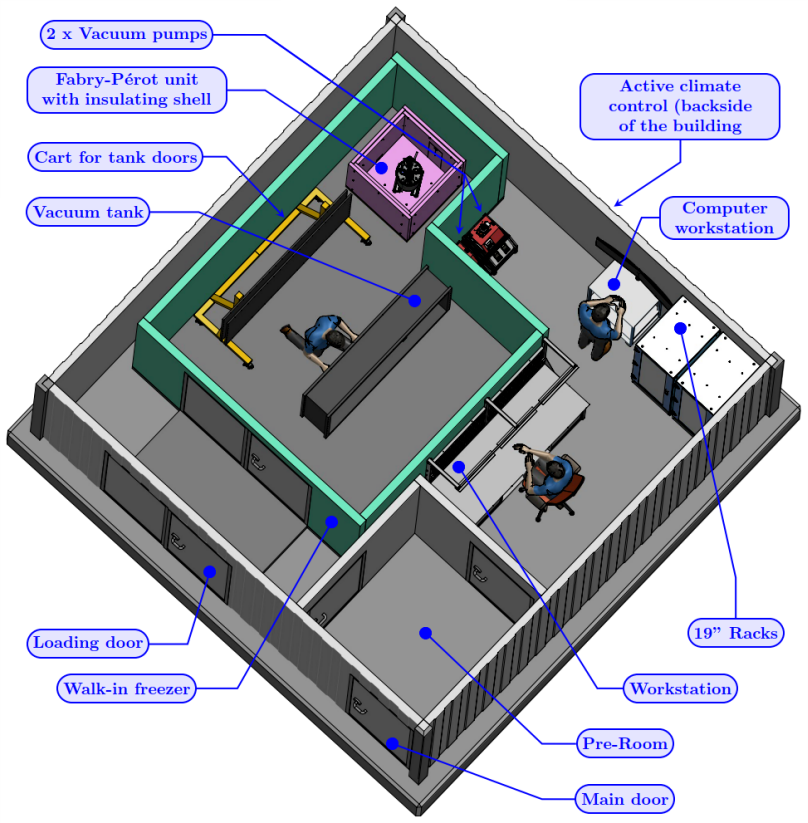
MOSES features a white pupil design and aims for a spectral resolution greater than 80,000 over the 380-680 nm wavelength range. It incorporates a pixel sampling rate of 3.5 and uses two fibers to facilitate a simultaneous calibration mode. Encased within a vacuum vessel and operating in a temperature-stabilized environment, MOSES is expected to achieve a radial velocity precision below 2 m/s, aided by a Fabry-Pérot etalon calibration system.
What carries the argument
The white pupil layout with dual-fiber simultaneous calibration and Fabry-Pérot etalon reference, which supplies a stable wavelength scale while the vacuum and thermal enclosure maintain mechanical stability.
If this is right
- The instrument will support radial velocity surveys and stellar activity monitoring on the MONET 1.2 m telescope starting in 2026.
- Simultaneous calibration with the Fabry-Pérot etalon will provide a continuous wavelength reference during science exposures.
- The vacuum vessel and temperature control are intended to minimize instrumental drifts over long observing campaigns.
- The 380-680 nm coverage at resolution above 80,000 will capture multiple spectral lines for velocity extraction.
Where Pith is reading between the lines
- If the design meets its targets, similar fiber-fed white-pupil instruments on other 1 m class telescopes could reach comparable precision without major new infrastructure.
- The dual-fiber mode may allow direct comparison of activity-induced signals between target and reference fibers on the same exposure.
- Success would demonstrate that moderate-aperture telescopes can contribute to exoplanet radial-velocity follow-up when equipped with vacuum-stabilized spectrographs.
Load-bearing premise
The assumption that the white pupil design, dual-fiber injection, vacuum enclosure, and temperature stabilization will together deliver the stated spectral resolution and RV precision once installed and commissioned.
What would settle it
On-sky measurement of radial velocity scatter on a set of stable reference stars after installation and commissioning in 2026.
Figures
read the original abstract
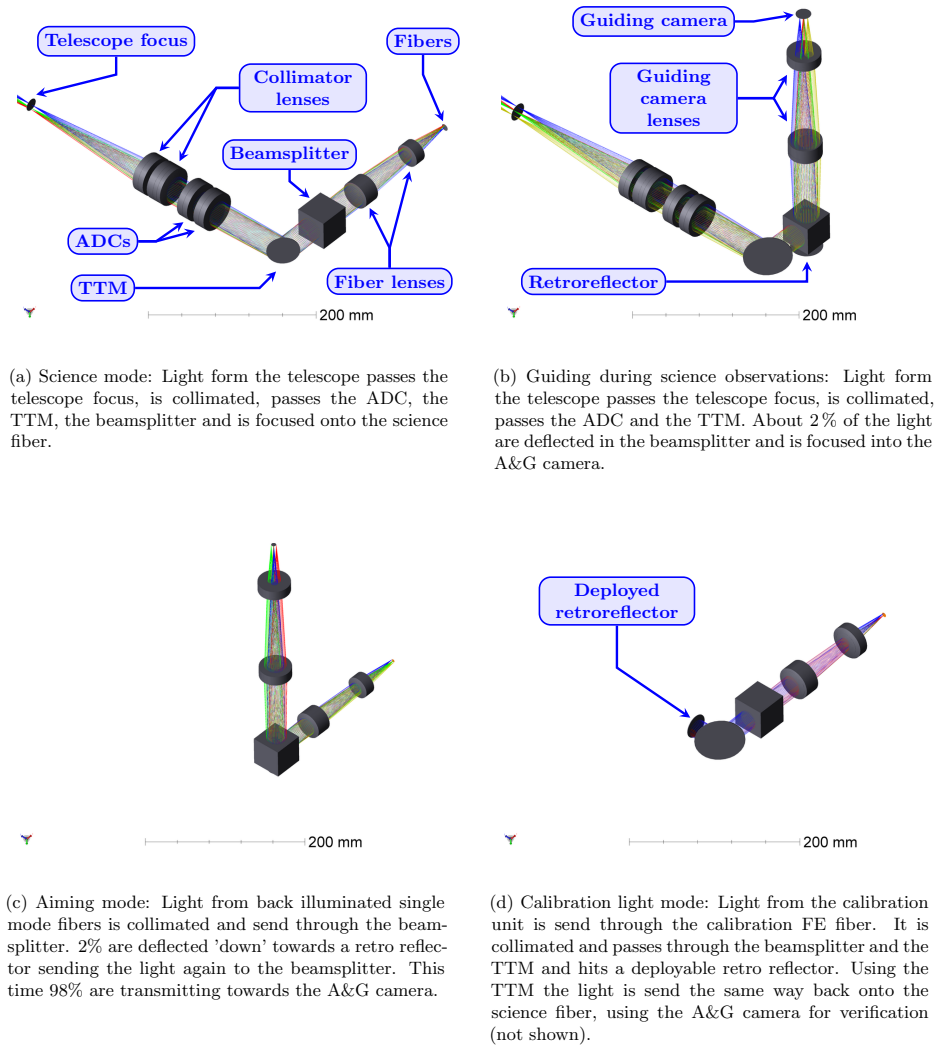
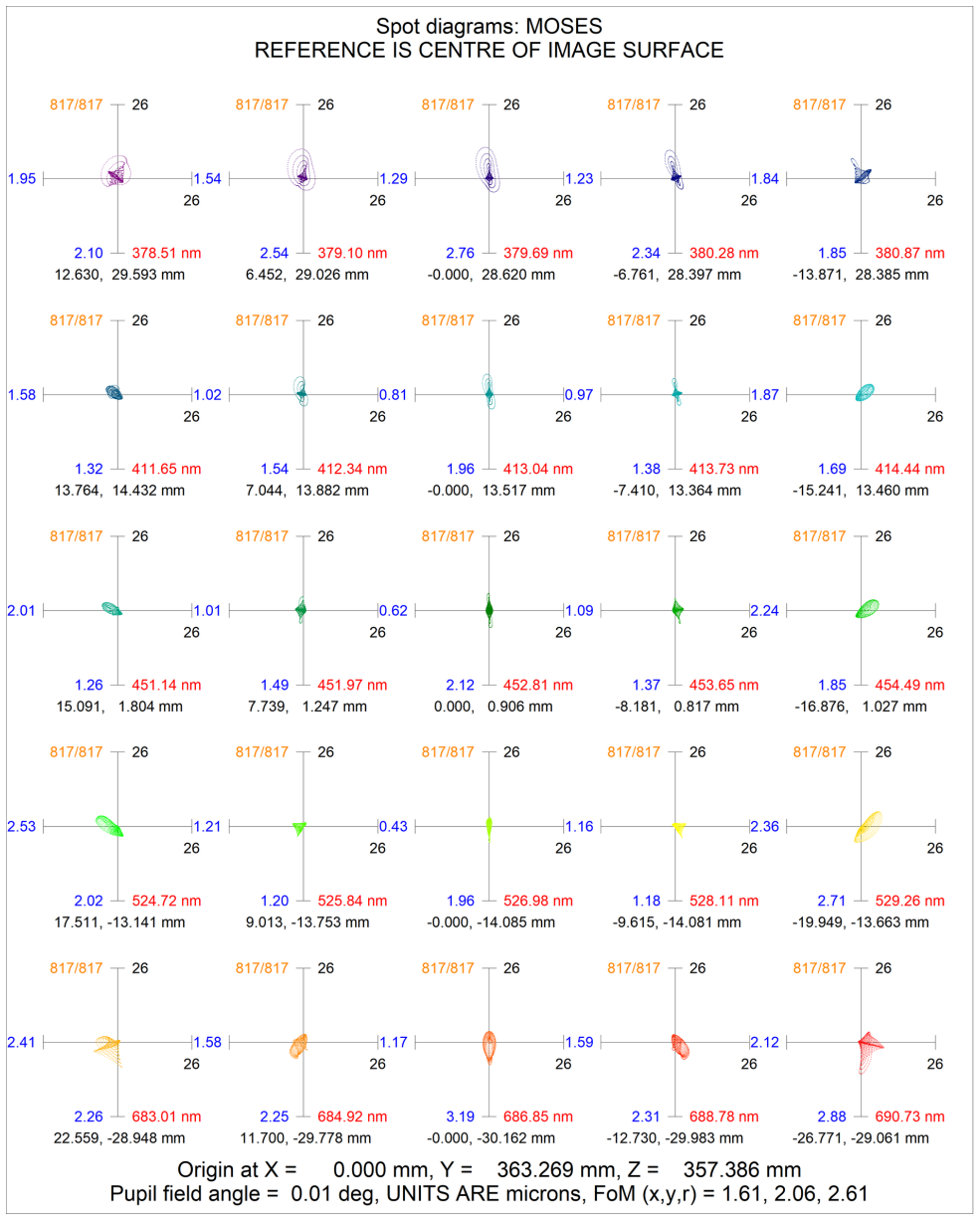
We introduce MOSES, the new High-Resolution Echelle Spectrograph designated for the 1.2m MONET telescope at McDonald Observatory, Texas, USA. The science drivers are radial velocity experiments and activity monitoring in Sun-like stars. Set for installation in the final quarter of 2026, MOSES features a white pupil design and aims for a spectral resolution greater than 80,000 over the 380-680 nm wavelength range. It incorporates a pixel sampling rate of 3.5 and uses two fibers to facilitate a simultaneous calibration mode. Encased within a vacuum vessel and operating in a temperature-stabilized environment, MOSES is expected to achieve a radial velocity precision below 2 m/s, aided by a Fabry-P\'erot etalon calibration system. This paper outlines the implementation of the fiber injection unit, the optical layout of the spectrograph, and the present status of the various subsystems under development.
Editorial analysis
A structured set of objections, weighed in public.
Referee Report
Summary. The manuscript introduces MOSES, a new high-resolution echelle spectrograph for the 1.2 m MONET telescope at McDonald Observatory. It describes a white-pupil design with dual-fiber injection, vacuum enclosure, temperature stabilization, and Fabry-Pérot etalon calibration, targeting spectral resolution >80,000 over 380-680 nm and radial velocity precision below 2 m/s for Sun-like star RV experiments and activity monitoring. The paper outlines the fiber injection unit, optical layout, and development status of subsystems, with installation planned for late 2026.
Significance. If the stated performance targets are realized, MOSES would add a dedicated RV instrument to a 1.2 m telescope, enabling new exoplanet and stellar activity studies. The detailed subsystem descriptions are of practical value to the instrumentation community for similar white-pupil designs. However, the paper provides no machine-checked proofs, reproducible simulations, or empirical validation, limiting its immediate impact to a design overview.
major comments (2)
- [Abstract] Abstract: The central claim that MOSES 'is expected to achieve a radial velocity precision below 2 m/s' is stated as a design goal but is unsupported by any error budget (thermal, mechanical, optical, or calibration terms), end-to-end line-profile simulations, wavelength-solution residuals, or scaling from comparable instruments. This directly affects the soundness of the performance target.
- [Design and subsystems description] Throughout the manuscript (e.g., sections describing the vacuum vessel, temperature stabilization, and Fabry-Pérot system): No quantitative modeling or stability analysis is provided to show how the white-pupil layout, dual-fiber injection, and environmental controls combine to meet the <2 m/s target; the 2 m/s figure therefore remains an unanchored expectation rather than a derived prediction.
minor comments (2)
- [Abstract] The abstract and text refer to a 'pixel sampling rate of 3.5' without specifying the units or the rationale for this choice relative to the resolution target.
- [Present status of subsystems] The manuscript would benefit from a dedicated section or table summarizing the current development status of each subsystem (e.g., completed vs. in-progress) to clarify the timeline to the 2026 installation.
Simulated Author's Rebuttal
We thank the referee for the constructive review of our design overview for MOSES. The comments correctly note that the <2 m/s RV target is presented without supporting quantitative analysis in this pre-construction manuscript. We address the points below and have made targeted revisions to clarify the status of the performance goals while preserving the paper's scope as a design description.
read point-by-point responses
-
Referee: [Abstract] Abstract: The central claim that MOSES 'is expected to achieve a radial velocity precision below 2 m/s' is stated as a design goal but is unsupported by any error budget (thermal, mechanical, optical, or calibration terms), end-to-end line-profile simulations, wavelength-solution residuals, or scaling from comparable instruments. This directly affects the soundness of the performance target.
Authors: We agree the claim requires better anchoring. The manuscript is a design paper with installation planned for late 2026; full error budgets and simulations will appear in a future commissioning paper. In revision we have changed the abstract wording from 'is expected to achieve' to 'aims to achieve' and added a short paragraph in the introduction that scales the target from published performance of similar vacuum-stabilized white-pupil instruments (HARPS, ESPRESSO) that use dual-fiber FP calibration. This provides the requested scaling justification without claiming new modeling. revision: partial
-
Referee: [Design and subsystems description] Throughout the manuscript (e.g., sections describing the vacuum vessel, temperature stabilization, and Fabry-Pérot system): No quantitative modeling or stability analysis is provided to show how the white-pupil layout, dual-fiber injection, and environmental controls combine to meet the <2 m/s target; the 2 m/s figure therefore remains an unanchored expectation rather than a derived prediction.
Authors: We concur that no original quantitative stability analysis is included. As the instrument remains in the design phase, detailed thermal/mechanical modeling is still underway. We have added a brief qualitative subsection linking the vacuum enclosure (pressure stability), temperature control (<0.01 K), and simultaneous FP calibration to the RV goal, supported by references to equivalent subsystems in existing sub-2 m/s instruments. This makes the design rationale explicit while acknowledging the absence of new simulations. revision: partial
- A complete quantitative error budget, end-to-end line-profile simulations, or wavelength-solution residuals cannot be supplied at present because the instrument has not been built and the associated engineering analyses are ongoing.
Circularity Check
No circularity: purely descriptive instrument design paper with no derivations
full rationale
The manuscript is a hardware design summary. It states design targets (R>80k, RV precision <2 m/s) and lists components (white-pupil layout, dual-fiber injection, vacuum vessel, Fabry-Pérot etalon) but contains no equations, no fitted parameters, no error budgets, no simulations, and no predictions derived from inputs. No self-citations, uniqueness theorems, or ansatzes appear. The <2 m/s figure is presented as an untested expectation rather than the output of any derivation chain, so no reduction to inputs exists. This is the normal case of a non-circular descriptive paper.
Axiom & Free-Parameter Ledger
free parameters (2)
- target radial velocity precision =
<2 m/s
- target spectral resolution =
>80,000
axioms (1)
- domain assumption White pupil layout combined with vacuum and thermal stabilization will meet the resolution and stability targets
Reference graph
Works this paper leans on
-
[1]
doi: 10.1038/nature19106. S. L. Baliunas and A. H. Vaughan. Stellar activity cycles.ARA&A, 23:379–412, January
-
[2]
doi: 10.1146/ annurev.aa.23.090185.002115. F. F. Bauer, M. Zechmeister, and A. Reiners. Calibrating echelle spectrographs with fabry-perot etalons.As- tronomy & Astrophysics, 581:A117, September
-
[3]
doi: 10.1051/0004-6361/201526462. F. F. Bauer, M Zechmeister, A Kaminski, C Rodr´ ıguez L´ opez, J A Caballero, M Azzaro, O Stahl, D Kossakowski, A Quirrenbach, S Becerril Jarque, E Rodr´ ıguez, P J Amado, W Seifert, A Reiners, S Sch¨ afer, I Ribas, V J S B´ ejar, M Cort´ es-Contreras, S Dreizler, A Hatzes, T Henning, S V Jeffers, M K¨ urster, M Lafarga, ...
-
[4]
URLhttps://doi.org/10.1117/12.2631756
doi: 10.1117/12.2631756. URLhttps://doi.org/10.1117/12.2631756. Sarah Blunt, Michael Endl, Lauren M. Weiss, William D. Cochran, Andrew W. Howard, Phillip J. MacQueen, Benjamin J. Fulton, Gregory W. Henry, Marshall C. Johnson, Molly R. Kosiarek, Kellen D. Lawson, Bruce Macintosh, Sean M. Mills, Eric L. Nielsen, Erik A. Petigura, Glenn Schneider, Andrew Van...
-
[5]
doi: 10.3847/1538-3881/ab3e63. S. Boro Saikia, C. J. Marvin, S. V. Jeffers, A. Reiners, R. Cameron, S. C. Marsden, P. Petit, J. Warnecke, and A. P. Yadav. Chromospheric activity catalogue of 4454 cool stars. Questioning the active branch of stellar activity cycles.A&A, 616:A108, August
-
[6]
doi: 10.1051/0004-6361/201629518. J. Bouvier, M. Forestini, and S. Allain. The angular momentum evolution of low-mass stars.A&A, 326:1023–1043, October
-
[7]
doi: 10.3847/0004-637X/818/1/34. Benjamin J. Fulton, Lee J. Rosenthal, Lea A. Hirsch, Howard Isaacson, Andrew W. Howard, Cayla M. Dedrick, Ilya A. Sherstyuk, Sarah C. Blunt, Erik A. Petigura, Heather A. Knutson, Aida Behmard, Ashley Chontos, Justin R. Crepp, Ian J. M. Crossfield, Paul A. Dalba, Debra A. Fischer, Gregory W. Henry, Stephen R. Kane, Molly Ko...
-
[8]
doi: 10.3847/1538-4365/abfcc1. R. D. Haywood, A. Collier Cameron, D. Queloz, S. C. C. Barros, M. Deleuil, R. Fares, M. Gillon, A. F. Lanza, C. Lovis, C. Moutou, F. Pepe, D. Pollacco, A. Santerne, D. S´ egransan, and Y. C. Unruh. Planets and stellar activity: hide and seek in the CoRoT-7 system.MNRAS, 443(3):2517–2531, September
-
[9]
doi: 10.1093/mnras/stu1320. F. V. Hessman. The MONET project and beyond.Astronomische Nachrichten, 325(6):533–536, October
-
[10]
doi: 10.1002/asna.200410274. M. Mayor, F. Pepe, D. Queloz, F. Bouchy, G. Rupprecht, G. Lo Curto, G. Avila, W. Benz, J. L. Bertaux, X. Bonfils, Th. Dall, H. Dekker, B. Delabre, W. Eckert, M. Fleury, A. Gilliotte, D. Gojak, J. C. Guzman, D. Kohler, J. L. Lizon, A. Longinotti, C. Lovis, D. Megevand, L. Pasquini, J. Reyes, J. P. Sivan, D. Sosnowska, R. Soto, ...
-
[11]
On-sky performance and first results
ISSN 1432-0746. doi: 10.1051/0004-6361/202038306. URL http://dx.doi.org/10.1051/0004-6361/202038306. M. H. Pinsonneault, Steven D. Kawaler, and P. Demarque. Rotation of Low-Mass Stars: A New Probe of Stellar Evolution.ApJS, 74:501, October
-
[12]
doi: 10.1086/191507. H. L. Pleteit, M. Debus, S. Sch¨ afer, and A. Reiners. Second-Generation Fabry-Perot Unit for CARMENES. International Society for Optics and Photonics, SPIE,
-
[13]
doi: 10.1117/12.2231880. A. Reiners, J. L. Bean, K. F. Huber, S. Dreizler, A. Seifahrt, and S. Czesla. Detecting Planets Around Very Low Mass Stars with the Radial Velocity Method.ApJ, 710:432–443, February
-
[14]
Ansgar Reiners and Subhanjoy Mohanty
doi: 10.1088/0004-637X/710/ 1/432. Ansgar Reiners and Subhanjoy Mohanty. Radius-dependent Angular Momentum Evolution in Low-mass Stars. I.ApJ, 746(1):43, February
-
[15]
Ansgar Reiners and Mathias Zechmeister
doi: 10.1088/0004-637X/746/1/43. Ansgar Reiners and Mathias Zechmeister. Radial Velocity Photon Limits for the Dwarf Stars of Spectral Classes F-M.ApJS, 247(1):11, March
-
[16]
doi: 10.3847/1538-4365/ab609f. I. Ribas, M. Tuomi, A. Reiners, R. P. Butler, J. C. Morales, M. Perger, S. Dreizler, C. Rodr´ ıguez-L´ opez, J. I. Gonz´ alez Hern´ andez, A. Rosich, F. Feng, T. Trifonov, S. S. Vogt, J. A. Caballero, A. Hatzes, E. Herrero, S. V. Jeffers, M. Lafarga, F. Murgas, R. P. Nelson, E. Rodr´ ıguez, J. B. P. Strachan, L. Tal-Or, J. T...
-
[17]
doi: 10.1038/s41586-018-0677-y. Sebastian Sch¨ afer, Eike W Guenther, Ansgar Reiners, Johannes Winkler, Michael Pluto, and J¨ org Schiller. Two Fabry-P´ erots and two calibration units for CARMENES. In Hideki Takami, Christopher J Evans, and Luc Simard, editors,Ground-based and Airborne Instrumentation for Astronomy VII. SPIE, July
-
[18]
Andreas Seifahrt, Julian St¨ urmer, Jacob L
doi: 10.1051/0004-6361/200912136. Andreas Seifahrt, Julian St¨ urmer, Jacob L. Bean, and Christian Schwab. Maroon-x: A radial velocity spectro- graph for the gemini observatory,
-
[19]
doi: 10.1117/12.2629327. M. Zechmeister, A. Reiners, P. J. Amado, M. Azzaro, F. F. Bauer, V. J. S. B´ ejar, J. A. Caballero, E. W. Guenther, H. J. Hagen, S. V. Jeffers, A. Kaminski, M. K¨ urster, R. Launhardt, D. Montes, J. C. Morales, A. Quirrenbach, S. Reffert, I. Ribas, W. Seifert, L. Tal-Or, and V. Wolthoff. Spectrum radial velocity analyser (SERVAL)....
-
[20]
doi: 10.1051/0004-6361/201731483
discussion (0)
Sign in with ORCID, Apple, or X to comment. Anyone can read and Pith papers without signing in.