Modeling U.S. Attitudes Toward China via an Event-Steered Multi-Agent Simulator
Pith reviewed 2026-06-27 20:40 UTC · model grok-4.3
The pith
An event-steered multi-agent simulator reproduces real U.S. attitude shifts toward China more closely than static-rule models.
A machine-rendered reading of the paper's core claim, the machinery that carries it, and where it could break.
Core claim
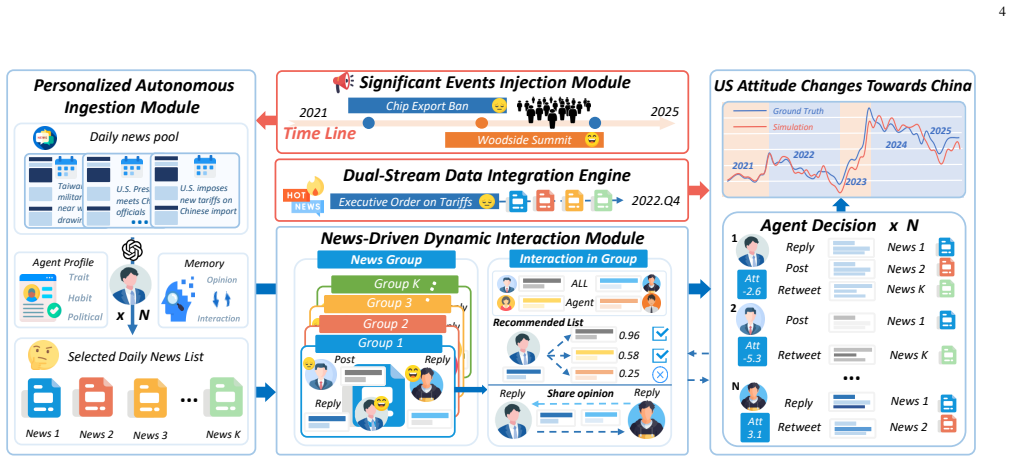
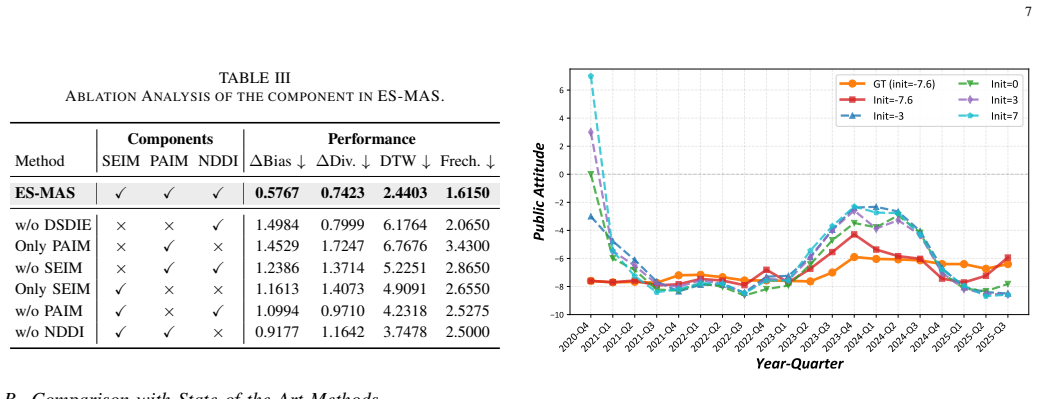
The paper claims that steering multi-agent simulations with continuous macro-level events and daily news, aligned through the Dual-Stream Data Integration Engine and localized via the News-Driven Dynamic Interaction module, produces bottom-up opinion evolution that reproduces real historical trends on the CURE dataset more accurately than simulators using static rules.
What carries the argument
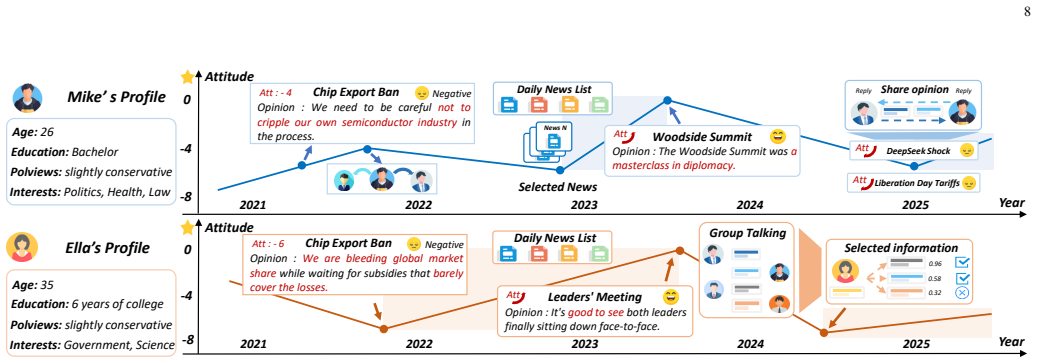
The Event-Steered Multi-Agent Simulator (ES-MAS) together with its Dual-Stream Data Integration Engine and News-Driven Dynamic Interaction module, which continuously feed events and personalized news into agent interactions.
If this is right
- The simulator supplies a scalable framework that can ingest new event streams to model ongoing opinion dynamics.
- Adaptive grouping of agents by shared news interests reduces the formation of isolated information cocoons while still allowing localized consensus.
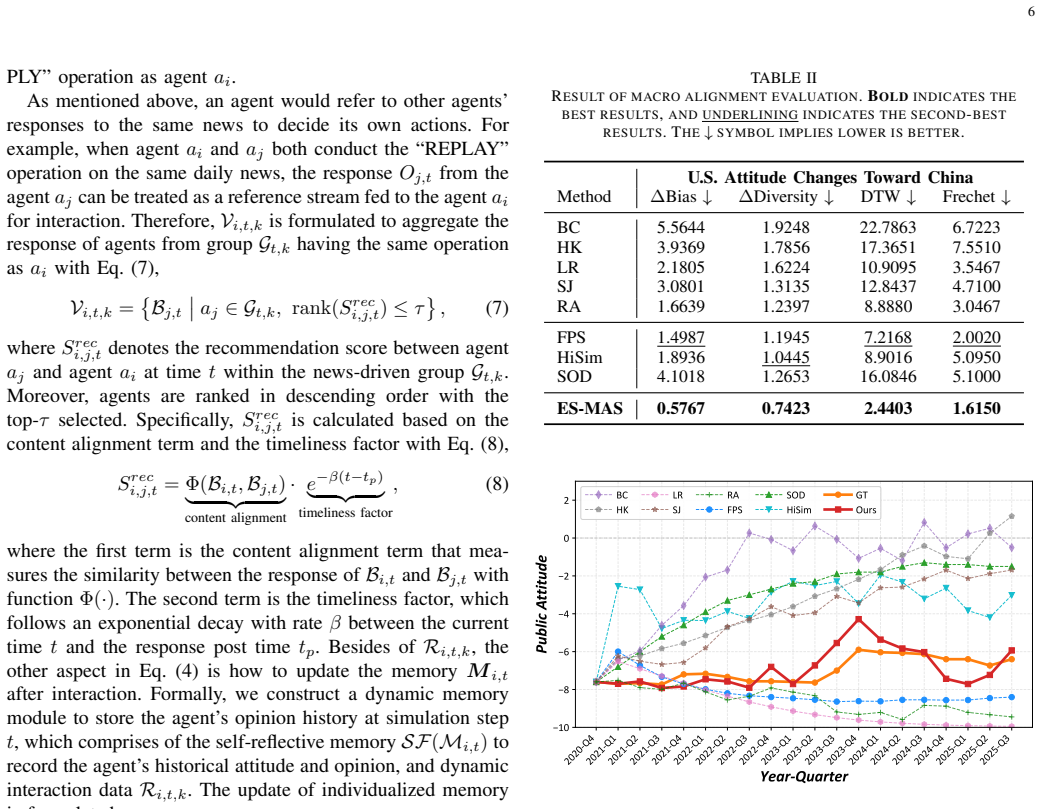
- Dual-stream alignment of macro events with micro-level news exposure produces opinion trajectories that track real historical records more closely than fixed-rule baselines.
- The approach can be applied to other topics by swapping the underlying event and news corpus while keeping the same interaction structure.
Where Pith is reading between the lines
- The same event-steering structure could be tested on attitude data from additional countries or issue domains to check whether the performance gain generalizes.
- Running the simulator forward on upcoming scheduled events would generate testable forecasts that can be compared against future polls.
- Adding real-time social-media signals as extra contextual inputs might further refine the personalization of news exposure without breaking the bottom-up interaction design.
- The CURE dataset itself provides a public benchmark that other modeling groups can use to measure progress on event-driven opinion simulation.
Load-bearing premise
Significant events and daily news items can be aligned with individual agent profiles to generate realistic opinion changes without the simulation requiring post-hoc tuning or collapsing into isolated information cocoons.
What would settle it
Running ES-MAS on a held-out quarter or post-2025 events from the CURE dataset and finding that the resulting opinion distributions on U.S. attitudes toward China diverge from independent public polls or surveys.
Figures
read the original abstract
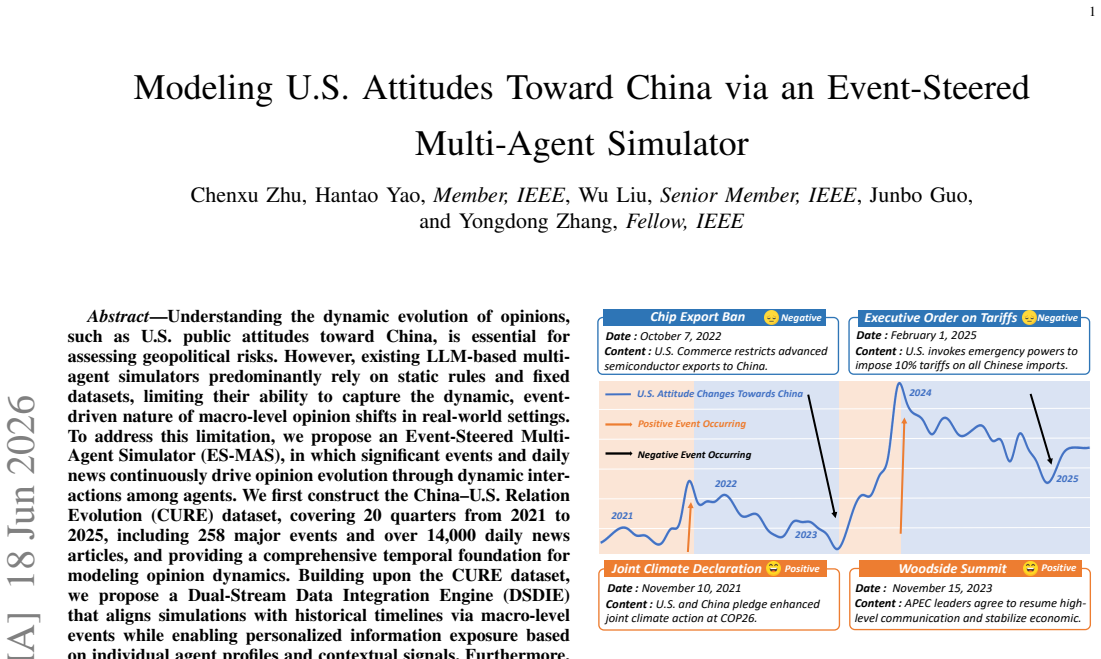
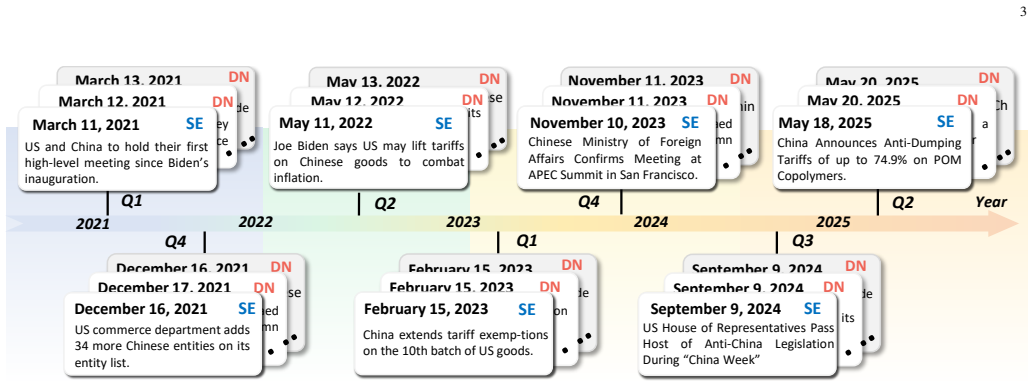
Understanding the dynamic evolution of opinions, such as U.S. public attitudes toward China, is essential for assessing geopolitical risks. However, existing LLM-based multiagent simulators predominantly rely on static rules and fixed datasets, limiting their ability to capture the dynamic, event-driven nature of macro-level opinion shifts in real-world settings. To address this limitation, we propose an Event-Steered Multi-Agent Simulator (ES-MAS), in which significant events and daily news continuously drive opinion evolution through dynamic interactions among agents. We first construct the China-U.S. Relation Evolution (CURE) dataset, covering 20 quarters from 2021 to 2025, including 258 major events and over 14,000 daily news articles, and providing a comprehensive temporal foundation for modeling opinion dynamics. Building upon the CURE dataset, we propose a Dual-Stream Data Integration Engine (DSDIE) that aligns simulations with historical timelines via macro-level events while enabling personalized information exposure based on individual agent profiles and contextual signals. Furthermore, we design a News-Driven Dynamic Interaction (NDDI) module, which adaptively groups agents with shared news interests into localized interaction contexts, facilitating bottom-up consensus formation while mitigating the risk of isolated information cocoons. Experimental results on the CURE dataset demonstrate that ES-MAS substantially outperforms existing simulators in reproducing real-world historical trends, offering a scalable and effective framework for modeling dynamic opinion evolution.
Editorial analysis
A structured set of objections, weighed in public.
Referee Report
Summary. The paper proposes an Event-Steered Multi-Agent Simulator (ES-MAS) to model dynamic opinion evolution, specifically U.S. attitudes toward China. It constructs the China-U.S. Relation Evolution (CURE) dataset spanning 20 quarters (2021-2025) with 258 major events and over 14,000 daily news articles. It introduces a Dual-Stream Data Integration Engine (DSDIE) for aligning macro events with personalized news exposure and a News-Driven Dynamic Interaction (NDDI) module for grouping agents by shared interests to enable bottom-up consensus. The central empirical claim is that ES-MAS substantially outperforms existing simulators in reproducing real-world historical trends on the CURE dataset.
Significance. If the outperformance claim is substantiated with quantitative metrics and validation protocols, the work would contribute a scalable event-driven framework for multi-agent opinion modeling and supply the CURE dataset as a reusable temporal resource for geopolitical and computational social science research. The emphasis on mitigating information cocoons via adaptive grouping is a constructive direction if empirically validated.
major comments (1)
- [Abstract / Experimental Results] Abstract and Experimental Results: The assertion that 'ES-MAS substantially outperforms existing simulators in reproducing real-world historical trends' supplies no metrics (e.g., MAE, correlation, or accuracy scores), baseline definitions, data splits, error bars, or exclusion rules. Without these, the central claim cannot be evaluated and is load-bearing for the paper's contribution.
Simulated Author's Rebuttal
Thank you for your constructive review of our manuscript on ES-MAS. We appreciate the identification of the need for explicit quantitative support for the central outperformance claim, which is indeed load-bearing. We will revise the abstract and experimental results accordingly to include the requested metrics and protocol details.
read point-by-point responses
-
Referee: [Abstract / Experimental Results] Abstract and Experimental Results: The assertion that 'ES-MAS substantially outperforms existing simulators in reproducing real-world historical trends' supplies no metrics (e.g., MAE, correlation, or accuracy scores), baseline definitions, data splits, error bars, or exclusion rules. Without these, the central claim cannot be evaluated and is load-bearing for the paper's contribution.
Authors: We agree that the current abstract and experimental results section do not report specific quantitative metrics such as MAE, correlation coefficients, or accuracy scores, nor do they explicitly define baselines, data splits, error bars, or exclusion rules. This omission prevents full evaluation of the claim. In the revised manuscript, we will update the abstract to incorporate key results (e.g., specific MAE and correlation values showing outperformance) and expand the Experimental Results section to specify: baseline simulators used for comparison, the temporal data split (e.g., first 15 quarters for calibration and last 5 for validation), error bars computed over multiple runs, and any event exclusion criteria. These changes will directly address the concern and allow readers to assess the empirical contribution. revision: yes
Circularity Check
No significant circularity identified
full rationale
The paper introduces ES-MAS, DSDIE, and NDDI as architectural components for an event-driven simulator, constructs the CURE dataset from external events and news, and reports comparative performance on historical trend reproduction. No equations, parameter-fitting procedures, or self-referential definitions are described in the provided abstract or architecture summary. The central claim of outperformance rests on empirical comparison against prior simulators rather than any reduction of outputs to inputs by construction, self-citation chains, or renamed ansatzes. The derivation chain is therefore self-contained against external benchmarks.
Axiom & Free-Parameter Ledger
axioms (1)
- domain assumption Opinion evolution is continuously driven by significant events and daily news through dynamic agent interactions
invented entities (4)
-
ES-MAS simulator
no independent evidence
-
CURE dataset
no independent evidence
-
DSDIE module
no independent evidence
-
NDDI module
no independent evidence
Reference graph
Works this paper leans on
-
[1]
Destined for war?
G. T. Allison, “Destined for war?”The National Interest, no. 149, pp. 9–21, 2017
2017
-
[2]
Media consumption patterns and public hostility toward china in the united states,
X. Li and Y . Y . Ang, “Media consumption patterns and public hostility toward china in the united states,”Communication and the Public, p. 20570473251401708, 2025
2025
-
[3]
The china reckoning: how beijing defied american expectations,
K. M. Campbell and E. Ratner, “The china reckoning: how beijing defied american expectations,”Foreign Aff., vol. 97, p. 60, 2018
2018
-
[4]
Silver, C
L. Silver, C. Huang, L. Clancy, and M. Fagan,Americans Are Critical of China’s Global Role-as Well as Its Relationship With Russia. JSTOR, 2023, vol. 12
2023
-
[5]
Artificial intelligence techniques for political risk man- agement: An nlp analysis of the 2019 us-china trade war,
M. D. Wang, “Artificial intelligence techniques for political risk man- agement: An nlp analysis of the 2019 us-china trade war,” inMachine Learning and Data Mining Annual Volume 2023. IntechOpen, 2023
2019
-
[6]
Mixing beliefs among interacting agents,
G. Deffuant, D. Neau, F. Amblard, and G. Weisbuch, “Mixing beliefs among interacting agents,”Advances in Complex Systems, vol. 3, no. 01n04, pp. 87–98, 2000
2000
-
[7]
How can extremism prevail? a study based on the relative agreement interaction model,
G. Deffuant, F. Amblard, G. Weisbuch, and T. Faure, “How can extremism prevail? a study based on the relative agreement interaction model,”Journal of artificial societies and social simulation, vol. 5, no. 4, 2002
2002
-
[8]
Computa- tional social science,
D. Lazer, A. Pentland, L. Adamic, S. Aral, A.-L. Barab ´asi, D. Brewer, N. Christakis, N. Contractor, J. Fowler, M. Gutmannet al., “Computa- tional social science,”Science, vol. 323, no. 5915, pp. 721–723, 2009
2009
-
[9]
War and peace (waragent): Large language model-based multi-agent simulation of world wars,
W. Hua, L. Fan, L. Li, K. Mei, J. Ji, Y . Ge, L. Hemphill, and Y . Zhang, “War and peace (waragent): Large language model-based multi-agent simulation of world wars,”arXiv preprint arXiv:2311.17227, 2023
-
[10]
Richelieu: Self-evolving llm-based agents for ai diplomacy,
Z. Guan, X. Kong, F. Zhong, and Y . Wang, “Richelieu: Self-evolving llm-based agents for ai diplomacy,”Advances in Neural Information Processing Systems, vol. 37, pp. 123 471–123 497, 2024
2024
-
[11]
Unveiling the truth and facilitating change: Towards agent-based large-scale social movement simulation,
X. Mou, Z. Wei, and X.-J. Huang, “Unveiling the truth and facilitating change: Towards agent-based large-scale social movement simulation,” inFindings of the Association for Computational Linguistics: ACL 2024, 2024, pp. 4789–4809
2024
-
[12]
S$^3$: Social-network Simulation System with Large Language Model-Empowered Agents
C. Gao, X. Lan, Z. Lu, J. Mao, J. Piao, H. Wang, D. Jin, and Y . Li, “S3: Social-network simulation system with large language model- empowered agents,”arXiv preprint arXiv:2307.14984, 2023
work page internal anchor Pith review Pith/arXiv arXiv 2023
-
[13]
Debiasing international attitudes: Llm agents for simulating us-china perception changes,
N. Sukiennik, Y . Xu, Y . Kan, J. Piao, Y . Yan, C. Gao, and Y . Li, “Debiasing international attitudes: Llm agents for simulating us-china perception changes,”arXiv preprint arXiv:2508.08837, 2025
-
[14]
T. C. Schelling,Micromotives and macrobehavior. WW Norton & Company, 2006
2006
-
[15]
Reaching a consensus,
M. H. DeGroot, “Reaching a consensus,”Journal of the American Statistical association, vol. 69, no. 345, pp. 118–121, 1974
1974
-
[16]
Birds of a feather: Homophily in social networks,
M. McPherson, L. Smith-Lovin, and J. M. Cook, “Birds of a feather: Homophily in social networks,”Annual review of sociology, vol. 27, no. 1, pp. 415–444, 2001
2001
-
[17]
Collective dynamics of ‘small- world’networks,
D. J. Watts and S. H. Strogatz, “Collective dynamics of ‘small- world’networks,”nature, vol. 393, no. 6684, pp. 440–442, 1998
1998
-
[18]
Recent research on selective exposure to information,
D. Frey, “Recent research on selective exposure to information,”Ad- vances in experimental social psychology, vol. 19, pp. 41–80, 1986
1986
-
[19]
The social identity theory of intergroup behavior,
H. Tajfel and J. C. Turner, “The social identity theory of intergroup behavior,” inPolitical psychology. Psychology Press, 2004, pp. 276– 293
2004
-
[20]
Individual attitude change and societal dynamics: Computational experiments with psychological theories
J. Lorenz, M. Neumann, and T. Schr ¨oder, “Individual attitude change and societal dynamics: Computational experiments with psychological theories.”Psychological Review, vol. 128, no. 4, p. 623, 2021
2021
-
[21]
Adaptive agents, intelligence, and emergent human organization: Capturing complexity through agent- based modeling,
B. J. Berry, L. D. Kiel, and E. Elliott, “Adaptive agents, intelligence, and emergent human organization: Capturing complexity through agent- based modeling,”Proceedings of the National Academy of Sciences, vol. 99, no. suppl 3, pp. 7187–7188, 2002
2002
-
[22]
Simulating social media using large language models to evaluate alternative news feed algorithms,
P. T ¨ornberg, D. Valeeva, J. Uitermark, and C. Bail, “Simulating social media using large language models to evaluate alternative news feed algorithms,”arXiv preprint arXiv:2310.05984, 2023
-
[23]
Out of one, many: Using language models to simulate human samples,
L. P. Argyle, E. C. Busby, N. Fulda, J. R. Gubler, C. Rytting, and D. Wingate, “Out of one, many: Using language models to simulate human samples,”Political Analysis, vol. 31, no. 3, pp. 337–351, 2023
2023
-
[24]
Using large language models to simulate multiple humans and replicate human subject studies,
G. V . Aher, R. I. Arriaga, and A. T. Kalai, “Using large language models to simulate multiple humans and replicate human subject studies,” in International conference on machine learning. PMLR, 2023, pp. 337– 371
2023
-
[25]
Zaller,The nature and origins of mass opinion
J. Zaller,The nature and origins of mass opinion. Cambridge university press, 1992. 10
1992
-
[26]
The rise and potential of large language model based agents: A survey,
Z. Xi, W. Chen, X. Guo, W. He, Y . Ding, B. Hong, M. Zhang, J. Wang, S. Jin, E. Zhouet al., “The rise and potential of large language model based agents: A survey,”Science China Information Sciences, vol. 68, no. 2, p. 121101, 2025
2025
-
[27]
A survey on large language model based autonomous agents,
L. Wang, C. Ma, X. Feng, Z. Zhang, H. Yang, J. Zhang, Z. Chen, J. Tang, X. Chen, Y . Linet al., “A survey on large language model based autonomous agents,”Frontiers of Computer Science, vol. 18, no. 6, p. 186345, 2024
2024
-
[28]
CyberJurors: A Multi-Agent Simulation Task for E-Commerce Disputes Verdict
Y . Sun, W. Liu, H. Ming, X. Wang, H. Yao, and Y . Zhang, “Cyberjurors: A multi-agent simulation task for e-commerce disputes verdict,”arXiv preprint arXiv:2605.28369, 2026
work page internal anchor Pith review Pith/arXiv arXiv 2026
-
[29]
Generative agents: Interactive simulacra of human behavior,
J. S. Park, J. O’Brien, C. J. Cai, M. R. Morris, P. Liang, and M. S. Bernstein, “Generative agents: Interactive simulacra of human behavior,” inProceedings of the 36th annual acm symposium on user interface software and technology, 2023, pp. 1–22
2023
-
[30]
Oasis: Open agent social interaction simulations with one million agents,
Z. Yang, Z. Zhang, Z. Zheng, Y . Jiang, Z. Gan, Z. Wang, Z. Ling, J. Chen, M. Ma, B. Donget al., “Oasis: Open agent social interaction simulations with one million agents,”arXiv preprint arXiv:2411.11581, 2024
-
[31]
J. Piao, Y . Yan, J. Zhang, N. Li, J. Yan, X. Lan, Z. Lu, Z. Zheng, J. Y . Wang, D. Zhouet al., “Agentsociety: Large-scale simulation of llm- driven generative agents advances understanding of human behaviors and society,”arXiv preprint arXiv:2502.08691, 2025
work page internal anchor Pith review Pith/arXiv arXiv 2025
-
[32]
From skepticism to acceptance: Simulating the attitude dynamics toward fake news,
Y . Liu, X. Chen, X. Zhang, X. Gao, J. Zhang, and R. Yan, “From skepticism to acceptance: Simulating the attitude dynamics toward fake news,”arXiv preprint arXiv:2403.09498, 2024
-
[33]
GASim: A Graph-Accelerated Hybrid Framework for Social Simulation
X. Zhou, Y . Sun, H. Yao, A. He, Y . Zhang, and W. Liu, “Gasim: A graph-accelerated hybrid framework for social simulation,”arXiv preprint arXiv:2605.07692, 2026
work page internal anchor Pith review Pith/arXiv arXiv 2026
-
[34]
Dy- namix: Large-scale dynamic social network simulator,
Y . Sun, W. Liu, W. Wang, H. Yao, J. Luo, and Y . Zhang, “Dy- namix: Large-scale dynamic social network simulator,”arXiv preprint arXiv:2507.19929, 2025
-
[35]
Simulating opinion dynamics with networks of llm-based agents,
Y .-S. Chuang, A. Goyal, N. Harlalka, S. Suresh, R. Hawkins, S. Yang, D. Shah, J. Hu, and T. Rogers, “Simulating opinion dynamics with networks of llm-based agents,” inFindings of the association for computational linguistics: NAACL 2024, 2024, pp. 3326–3346
2024
-
[36]
Social simulacra: Creating populated prototypes for social computing systems,
J. S. Park, L. Popowski, C. Cai, M. R. Morris, P. Liang, and M. S. Bernstein, “Social simulacra: Creating populated prototypes for social computing systems,” inProceedings of the 35th Annual ACM Symposium on User Interface Software and Technology, 2022, pp. 1–18
2022
-
[37]
arXiv preprint (2024) arXiv:2410.20746
X. Zhang, J. Lin, L. Sun, W. Qi, Y . Yang, Y . Chen, H. Lyu, X. Mou, S. Chen, J. Luo, X. Huang, S. Tang, and Z. Wei, “Electionsim: Massive population election simulation powered by large language model driven agents,”CoRR, vol. abs/2410.20746, 2024. [Online]. Available: https://doi.org/10.48550/arXiv.2410.20746
-
[38]
Gensim: A general social simulation platform with large language model based agents,
J. Tang, H. Gao, X. Pan, L. Wang, H. Tan, D. Gao, Y . Chen, X. Chen, Y . Lin, Y . Liet al., “Gensim: A general social simulation platform with large language model based agents,” inProceedings of the 2025 Conference of the Nations of the Americas Chapter of the Association for Computational Linguistics: Human Language Technologies (System Demonstrations),...
2025
-
[39]
M ¨uller,Information retrieval for music and motion
M. M ¨uller,Information retrieval for music and motion. Springer, 2007
2007
-
[40]
Computing discrete fr ´echet distance,
T. Eiter, H. Mannilaet al., “Computing discrete fr ´echet distance,” 1994
1994
-
[41]
Link recommendation algorithms and dynamics of polarization in online social networks,
F. P. Santos, Y . Lelkes, and S. A. Levin, “Link recommendation algorithms and dynamics of polarization in online social networks,” Proceedings of the National Academy of Sciences, vol. 118, no. 50, p. e2102141118, 2021
2021
-
[42]
Opinion dynamics and bounded confidence: models, analysis and simulation,
R. Hegselmann, “Opinion dynamics and bounded confidence: models, analysis and simulation,”The Journal of Artificial Societies and Social Simulation, 2015
2015
-
[43]
Uniformity, bipolarization and pluriformity captured as generic stylized behavior with an agent-based simulation model of attitude change,
W. Jager and F. Amblard, “Uniformity, bipolarization and pluriformity captured as generic stylized behavior with an agent-based simulation model of attitude change,”Computational & Mathematical Organization Theory, vol. 10, no. 4, pp. 295–303, 2005
2005
discussion (0)
Sign in with ORCID, Apple, or X to comment. Anyone can read and Pith papers without signing in.