A Min-Max Gradient Search Method for Constrained Simulation Optimization
Pith reviewed 2026-06-27 21:28 UTC · model grok-4.3
The pith
The min-max gradient search algorithm converges to a KKT point for constrained simulation optimization at rate tilde O of T to the minus one third.
A machine-rendered reading of the paper's core claim, the machinery that carries it, and where it could break.
Core claim
MGS performs alternating gradient descent and ascent on the primal and dual variables using stochastic estimators, converging to a stationary solution that is a Karush-Kuhn-Tucker point under mild conditions at a rate of tilde O of T to the minus one third.
What carries the argument
The min-max gradient search (MGS) framework that alternates primal descent and dual ascent to penalize constraint violations while optimizing the objective.
If this is right
- Single-loop CSO algorithms can now have finite-time convergence guarantees for the first time.
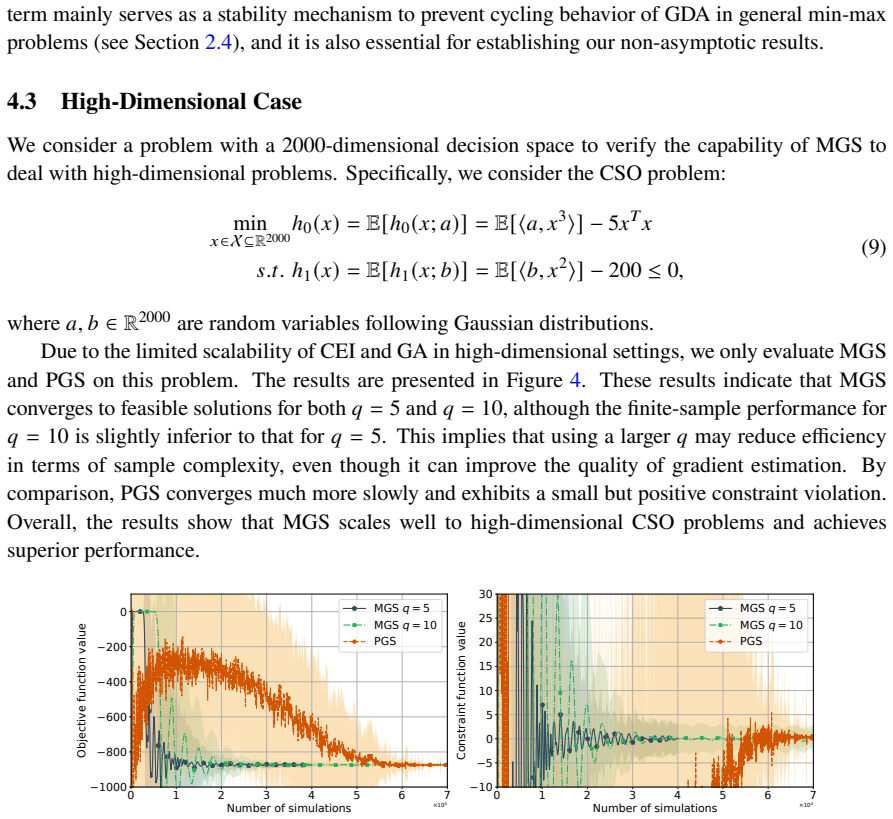
- The method scales effectively to high-dimensional problems such as 2000 dimensions.
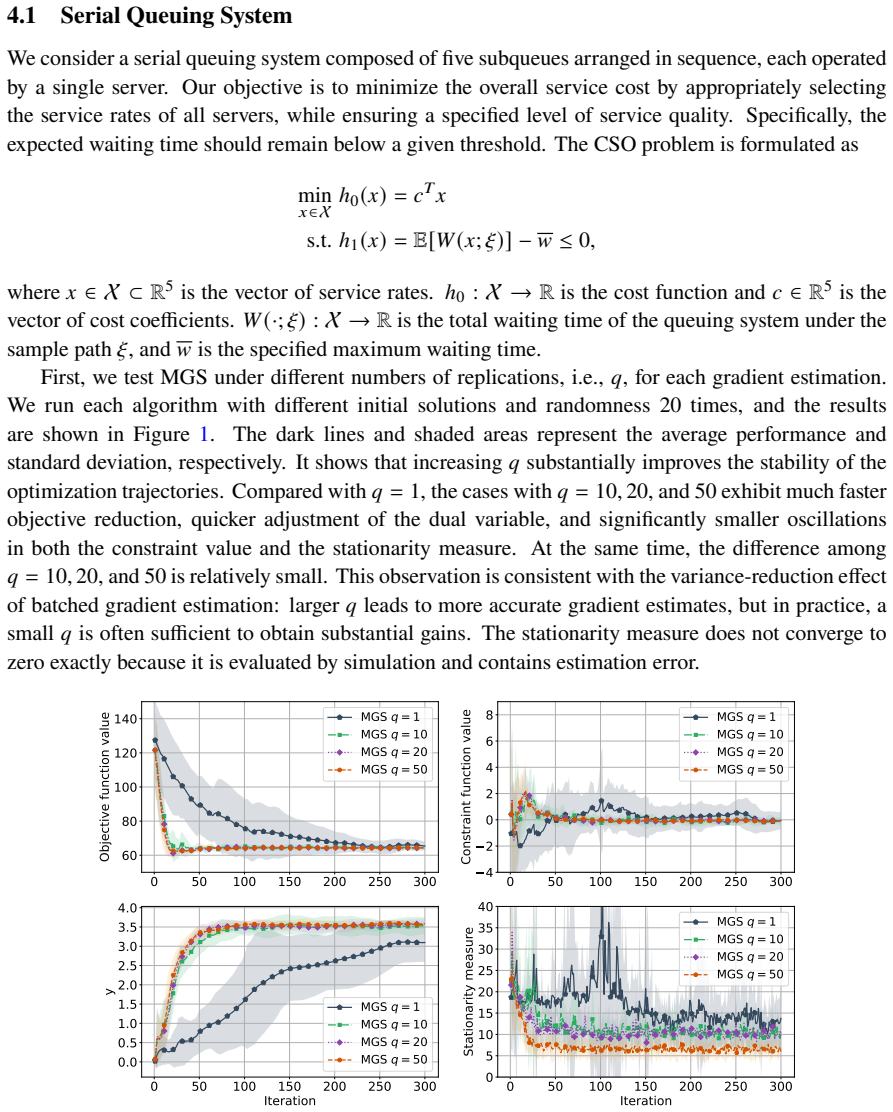
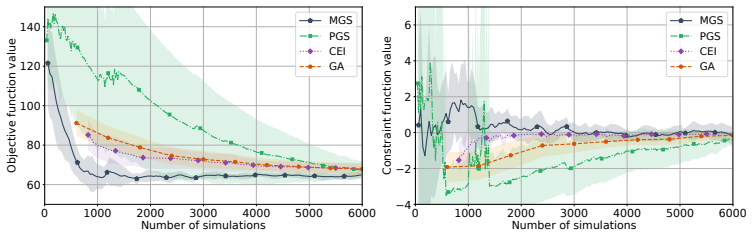
- It shows improved performance on serial queuing systems compared to prior approaches.
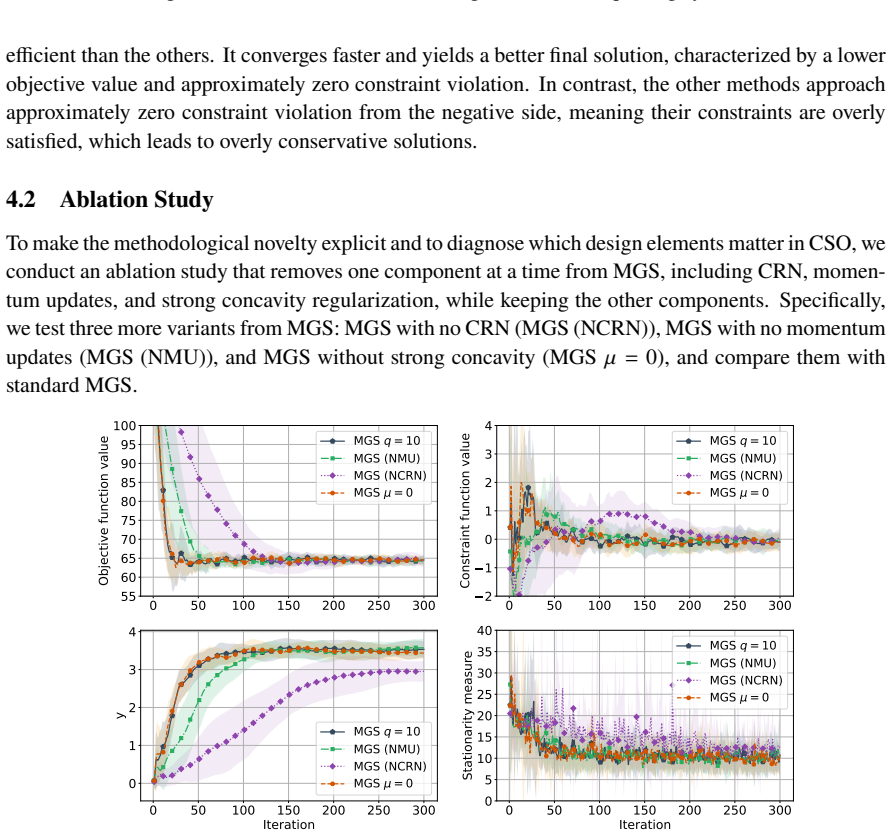
- Alternating updates improve the objective while handling constraint violations in stochastic environments.
Where Pith is reading between the lines
- Similar alternating update strategies might apply to other constrained stochastic problems beyond simulation optimization.
- Testing the rate on problems where gradient estimators have varying noise levels could reveal practical limits.
- The approach may connect to min-max optimization in game theory or adversarial training.
- Extensions could include adapting the method for discrete or mixed-variable constraints.
Load-bearing premise
The analysis assumes the availability of suitable stochastic gradient estimators for both the objective and the constraints, plus mild conditions that ensure convergence to a KKT point.
What would settle it
Running the algorithm on a problem where the stochastic gradients are available but the iterates do not approach a KKT point at the claimed rate would disprove the convergence guarantee.
Figures
read the original abstract
Constrained simulation optimization (CSO) is a general framework for optimizing stochastic systems under performance constraints. It arises widely in practice where objective and constraint evaluations are available only through noisy simulation outputs. Compared with the unconstrained setting, the lack of accessible analytical gradients for simulation-based constraints makes it more challenging to develop efficient solution methods and establish non-asymptotic guarantees. To address this gap, we propose a novel single-loop algorithm, called min-max gradient search (MGS), which integrates a primal-dual framework with stochastic gradient estimators. Unlike conventional stochastic approximation methods based on gradient descent for solving simulation optimization problems, such as Zhou and Bhatnagar (2017) and Hu and Fu (2025), MGS performs alternating gradient descent and ascent on the primal and dual variables, which improves the objective while penalizing constraint violations. For the first time, we establish a finite-time convergence guarantee for single-loop CSO algorithms by showing that MGS converges to a stationary solution (a Karush-Kuhn-Tucker point under mild conditions) at a rate of $\tilde{O}(T^{-1/3})$, where $T$ is the number of iterations. Numerical experiments on a serial queuing system and a 2000-dimensional optimization problem demonstrate the superior performance and scalability of MGS.
Editorial analysis
A structured set of objections, weighed in public.
Referee Report
Summary. The paper introduces a single-loop min-max gradient search (MGS) algorithm for constrained simulation optimization (CSO) that combines primal-dual stochastic gradient updates to optimize a stochastic objective subject to simulation-based constraints. It claims this is the first finite-time convergence result for single-loop CSO methods, establishing that MGS reaches a KKT stationary point at rate ãO(T^{-1/3}) under suitable stochastic gradient estimators and mild conditions, supported by experiments on a queuing system and a 2000-dimensional problem.
Significance. If the non-asymptotic KKT convergence guarantee can be rigorously established with explicit assumptions on estimator bias/variance and constraint qualifications, the result would address a documented gap in finite-time analysis for simulation-based constrained problems and improve upon prior stochastic approximation approaches. The reported scalability to high dimensions and practical performance on queuing examples would strengthen the contribution.
major comments (2)
- [Abstract] Abstract: the central claim of ãO(T^{-1/3}) convergence to a KKT point for single-loop CSO rests on 'suitable' stochastic gradient estimators for objective and constraints together with unspecified 'mild conditions.' No variance bounds, bias controls, step-size restrictions, or constraint-qualification statements are supplied, so it is impossible to confirm whether the rate survives when the estimators are obtained from finite simulation runs whose variance may grow with the number of constraints.
- [Abstract / Introduction] The comparison with Zhou and Bhatnagar (2017) and Hu and Fu (2025) asserts that MGS improves upon conventional gradient-descent stochastic approximation, yet the manuscript provides no explicit statement of how the alternating descent-ascent updates avoid the bias accumulation that those methods encounter under the same simulation noise model.
minor comments (1)
- [Abstract] The abstract states the rate as ilde{O}(T^{-1/3}) but does not define the hidden logarithmic factors or the precise dependence on problem dimension and number of constraints.
Simulated Author's Rebuttal
We thank the referee for the detailed and constructive report. We address each major comment below and indicate the revisions we will make to strengthen the presentation of assumptions and comparisons.
read point-by-point responses
-
Referee: [Abstract] Abstract: the central claim of ãO(T^{-1/3}) convergence to a KKT point for single-loop CSO rests on 'suitable' stochastic gradient estimators for objective and constraints together with unspecified 'mild conditions.' No variance bounds, bias controls, step-size restrictions, or constraint-qualification statements are supplied, so it is impossible to confirm whether the rate survives when the estimators are obtained from finite simulation runs whose variance may grow with the number of constraints.
Authors: We agree that the abstract is highly condensed and does not enumerate the precise technical conditions. The full analysis in Theorem 3.1 and Assumptions 2.1–2.4 supplies explicit bounds on estimator bias and variance (independent of the number of constraints), step-size restrictions of the form α_t = Θ(t^{-2/3}), and Slater’s constraint qualification. We will revise the abstract to include a parenthetical reference to these assumptions and add a short remark clarifying that the stated rate holds only when variance remains bounded independently of constraint dimension; if variance grows, the analysis indicates a degradation that we will note explicitly. revision: yes
-
Referee: [Abstract / Introduction] The comparison with Zhou and Bhatnagar (2017) and Hu and Fu (2025) asserts that MGS improves upon conventional gradient-descent stochastic approximation, yet the manuscript provides no explicit statement of how the alternating descent-ascent updates avoid the bias accumulation that those methods encounter under the same simulation noise model.
Authors: The current text notes that MGS performs alternating descent-ascent on the Lagrangian but does not spell out the mechanism that limits bias accumulation. We will insert a concise paragraph in the introduction (and a corresponding sentence in the abstract) explaining that the simultaneous primal-dual updates, combined with the min-max structure, keep the dual variables responsive to constraint violations at each step, thereby preventing the progressive drift in feasibility that pure primal descent methods can exhibit under persistent simulation noise. This distinction is already implicit in the convergence proof but will now be stated explicitly for the reader. revision: yes
Circularity Check
No circularity: convergence claim derived from primal-dual construction under external assumptions
full rationale
The paper proposes the MGS algorithm via primal-dual stochastic gradient updates and states a new finite-time rate to KKT points. No quoted step reduces the claimed ilde{O}(T^{-1/3}) rate or stationarity conclusion to a fitted parameter, self-definition, or load-bearing self-citation; the cited prior works (Zhou-Bhatnagar, Hu-Fu) are external. The analysis is presented as following from the algorithm under 'mild conditions' on estimators, which are independent of the target result. This is the standard non-circular pattern for theoretical convergence proofs.
Axiom & Free-Parameter Ledger
Reference graph
Works this paper leans on
-
[1]
Proceedings of the 37th International Conference on Machine Learning , pages=
On gradient descent ascent for nonconvex-concave minimax problems , author=. Proceedings of the 37th International Conference on Machine Learning , pages=. 2020 , volume =
2020
-
[2]
INFORMS Journal on Optimization , volume=
Stochastic zeroth-order functional constrained optimization: Oracle complexity and applications , author=. INFORMS Journal on Optimization , volume=. 2023 , publisher=
2023
-
[3]
Proceedings of the 26th International Conference on Artificial Intelligence and Statistics , pages=
Adagda: Faster adaptive gradient descent ascent methods for minimax optimization , author=. Proceedings of the 26th International Conference on Artificial Intelligence and Statistics , pages=. 2023 , organization=
2023
-
[4]
Proceedings of the 26th International Conference on Artificial Intelligence and Statistics , pages =
AdaGDA: Faster Adaptive Gradient Descent Ascent Methods for Minimax Optimization , author =. Proceedings of the 26th International Conference on Artificial Intelligence and Statistics , pages =. 2023 , series =
2023
-
[5]
Mathematical Programming , volume=
A unified single-loop alternating gradient projection algorithm for nonconvex--concave and convex--nonconcave minimax problems , author=. Mathematical Programming , volume=. 2023 , publisher=
2023
-
[6]
Foundations of Computational Mathematics , volume=
A theoretical and empirical comparison of gradient approximations in derivative-free optimization , author=. Foundations of Computational Mathematics , volume=. 2022 , publisher=
2022
-
[7]
Simulation , volume=
Constrained optimization via genetic algorithms , author=. Simulation , volume=. 1994 , publisher=
1994
-
[8]
Proceedings of the Winter Simulation Conference 2014 , pages=
A penalty function approach for simulation optimization with stochastic constraints , author=. Proceedings of the Winter Simulation Conference 2014 , pages=. 2014 , organization=
2014
-
[9]
Operations Research , volume=
Penalty function with memory for discrete optimization via simulation with stochastic constraints , author=. Operations Research , volume=. 2015 , publisher=
2015
-
[10]
Journal of Global Optimization , volume=
GOSAC: global optimization with surrogate approximation of constraints , author=. Journal of Global Optimization , volume=. 2017 , publisher=
2017
-
[11]
European Journal of Operational Research , volume=
Genetic-algorithm-based simulation optimization considering a single stochastic constraint , author=. European Journal of Operational Research , volume=. 2014 , publisher=
2014
-
[12]
Proceedings of the 36th International Conference on Machine Learning , pages=
Improved zeroth-order variance reduced algorithms and analysis for nonconvex optimization , author=. Proceedings of the 36th International Conference on Machine Learning , pages=. 2019 , volume =
2019
-
[13]
2015 , publisher=
Handbook of simulation optimization , author=. 2015 , publisher=
2015
-
[14]
Optimization and Engineering , volume=
A taxonomy of constraints in black-box simulation-based optimization , author=. Optimization and Engineering , volume=. 2024 , publisher=
2024
-
[15]
The Annals of Mathematical Statistics , volume=
A stochastic approximation method , author=. The Annals of Mathematical Statistics , volume=. 1951 , publisher=
1951
-
[16]
The Annals of Mathematical Statistics , volume=
Stochastic Estimation of the Maximum of a Regression Function , author=. The Annals of Mathematical Statistics , volume=. 1952 , publisher=
1952
-
[17]
Mathematical Programming , volume=
Constrained stochastic blackbox optimization using a progressive barrier and probabilistic estimates , author=. Mathematical Programming , volume=. 2023 , publisher=
2023
-
[18]
Acta Numerica , volume=
Derivative-free optimization methods , author=. Acta Numerica , volume=. 2019 , publisher=
2019
-
[19]
Mathematical Programming , volume=
Stochastic first-order methods for convex and nonconvex functional constrained optimization , author=. Mathematical Programming , volume=. 2023 , publisher=
2023
-
[20]
Operations Research , volume=
General bounds and finite-time improvement for the Kiefer-Wolfowitz stochastic approximation algorithm , author=. Operations Research , volume=. 2011 , publisher=
2011
-
[21]
Journal of the Royal Statistical Society Series B: Statistical Methodology , volume=
The proximal robbins--monro method , author=. Journal of the Royal Statistical Society Series B: Statistical Methodology , volume=. 2021 , publisher=
2021
-
[22]
Operations Research , volume=
A surrogate-based asynchronous decomposition technique for realistic security-constrained optimal power flow problems , author=. Operations Research , volume=. 2023 , publisher=
2023
-
[23]
Artificial Intelligence Review , volume=
An exhaustive review of the metaheuristic algorithms for search and optimization: taxonomy, applications, and open challenges , author=. Artificial Intelligence Review , volume=. 2023 , publisher=
2023
-
[24]
Journal of Optimization Theory and Applications , volume=
Subgradient methods for saddle-point problems , author=. Journal of Optimization Theory and Applications , volume=. 2009 , publisher=
2009
-
[25]
Journal of Machine Learning Research , volume=
Accelerated zeroth-order and first-order momentum methods from mini to minimax optimization , author=. Journal of Machine Learning Research , volume=
-
[26]
Journal of the Operations Research Society of China , pages=
An Alternating Gradient Projection Algorithm with Momentum for Nonconvex--Concave Minimax Problems , author=. Journal of the Operations Research Society of China , pages=. 2024 , publisher=
2024
-
[27]
Operations Research , volume=
Distributionally constrained black-box stochastic gradient estimation and optimization , author=. Operations Research , volume=. 2025 , publisher=
2025
-
[28]
SIAM Journal on Optimization , volume=
Approximate primal solutions and rate analysis for dual subgradient methods , author=. SIAM Journal on Optimization , volume=. 2009 , publisher=
2009
-
[29]
Proceedings of the 33rd International Conference on Neural Information Processing Systems , pages=
Momentum-based variance reduction in non-convex SGD , author=. Proceedings of the 33rd International Conference on Neural Information Processing Systems , pages=
-
[30]
, author=
Bayesian optimization with inequality constraints. , author=. Proceedings of the 31st International Conference on International Conference on Machine Learning , volume =
-
[31]
ACM Transactions on Modeling and Computer Simulation , volume=
Bayesian optimisation for constrained problems , author=. ACM Transactions on Modeling and Computer Simulation , volume=. 2024 , publisher=
2024
-
[32]
Structural and Multidisciplinary Optimization , volume=
A constrained Bayesian Optimization framework for structural vibrations with local nonlinearities , author=. Structural and Multidisciplinary Optimization , volume=. 2024 , publisher=
2024
-
[33]
ACM Computing Surveys , volume=
Recent advances in Bayesian optimization , author=. ACM Computing Surveys , volume=. 2023 , publisher=
2023
-
[34]
European Journal of Operational Research , volume=
Constrained optimization in expensive simulation: Novel approach , author=. European Journal of Operational Research , volume=. 2010 , publisher=
2010
-
[35]
IEEE Transactions on Smart Grid , volume=
Gradient-free accelerated event-triggered scheme for constrained network optimization in smart grids , author=. IEEE Transactions on Smart Grid , volume=. 2023 , publisher=
2023
-
[36]
Operations Research , volume=
On the accuracy of fluid models for capacity sizing in queueing systems with impatient customers , author=. Operations Research , volume=. 2010 , publisher=
2010
-
[37]
Annals of Operations Research , volume=
Simulation optimization: a review of algorithms and applications , author=. Annals of Operations Research , volume=. 2016 , publisher=
2016
-
[38]
Omega , volume=
Stochastic simulation based genetic algorithm for chance constrained data envelopment analysis problems , author=. Omega , volume=. 2011 , publisher=
2011
-
[39]
INFORMS Journal on Computing , volume=
Gradient-based adaptive stochastic search for simulation optimization over continuous space , author=. INFORMS Journal on Computing , volume=. 2017 , publisher=
2017
-
[40]
Operations Research , volume=
On the convergence rate of stochastic approximation for gradient-based stochastic optimization , author=. Operations Research , volume=. 2025 , publisher=
2025
-
[41]
Proceedings of the 27th International Conference on Machine Learning , pages=
Gaussian Process Optimization in the Bandit Setting: No Regret and Experimental Design , author=. Proceedings of the 27th International Conference on Machine Learning , pages=
-
[42]
Annals of Operations Research , pages=
Maximizing network reliability through simulation optimization: a component configuration strategy , author=. Annals of Operations Research , pages=. 2025 , publisher=
2025
-
[43]
Proceedings of The 24th International Conference on Artificial Intelligence and Statistics , pages =
Scalable Constrained Bayesian Optimization , author =. Proceedings of The 24th International Conference on Artificial Intelligence and Statistics , pages =. 2021 , volume =
2021
-
[44]
IISE Transactions , volume=
Solving Bayesian risk optimization via nested stochastic gradient estimation , author=. IISE Transactions , volume=. 2021 , publisher=
2021
-
[45]
Quantitative Finance , volume=
Gradient-based simulated maximum likelihood estimation for stochastic volatility models using characteristic functions , author=. Quantitative Finance , volume=. 2016 , publisher=
2016
-
[46]
INFORMS Journal on Computing , volume=
A stochastic approximation method for simulation-based quantile optimization , author=. INFORMS Journal on Computing , volume=. 2022 , publisher=
2022
-
[47]
Foundations of Computational Mathematics , volume=
Random gradient-free minimization of convex functions , author=. Foundations of Computational Mathematics , volume=. 2017 , publisher=
2017
-
[48]
INFORMS Journal on Computing , volume=
Gradient-based simulation optimization algorithms via multi-resolution system approximations , author=. INFORMS Journal on Computing , volume=. 2023 , publisher=
2023
-
[49]
arXiv preprint arXiv:2510.19165 , year=
Query-Efficient Zeroth-Order Algorithms for Nonconvex Optimization , author=. arXiv preprint arXiv:2510.19165 , year=
-
[50]
A Scenario-Based MPC Approach , author=
Optimal Energy Management in Multi-Microgrids. A Scenario-Based MPC Approach , author=. 2024 European Control Conference (ECC) , pages=. 2024 , organization=
2024
-
[51]
Operations Research , volume=
Gaussian process-based random search for continuous optimization via simulation , author=. Operations Research , volume=. 2025 , publisher=
2025
-
[52]
INFORMS Journal on Computing , volume=
Surrogate-based promising area search for Lipschitz continuous simulation optimization , author=. INFORMS Journal on Computing , volume=. 2018 , publisher=
2018
-
[53]
Proceedings of the AAAI Conference on Artificial Intelligence , volume=
Zeroth-order optimization for composite problems with functional constraints , author=. Proceedings of the AAAI Conference on Artificial Intelligence , volume=
-
[54]
Robust and Faster Zeroth-Order Minimax Optimization: Complexity and Applications , volume =
An, Weixin and Liu, Yuanyuan and Shang, Fanhua and Liu, Hongying , booktitle =. Robust and Faster Zeroth-Order Minimax Optimization: Complexity and Applications , volume =
-
[55]
International Journal of Control , volume=
Stochastic optimisation with inequality constraints using simultaneous perturbations and penalty functions , author=. International Journal of Control , volume=. 2008 , publisher=
2008
-
[56]
Journal of Machine Learning Research , volume=
A general framework for constrained Bayesian optimization using information-based search , author=. Journal of Machine Learning Research , volume=
-
[57]
ACM Transactions on Modeling and Computer Simulation (TOMACS) , volume=
Stochastic approximation algorithms for constrained optimization via simulation , author=. ACM Transactions on Modeling and Computer Simulation (TOMACS) , volume=. 2011 , publisher=
2011
-
[58]
Annals of Statistics , pages=
Adaptive estimation of a quadratic functional by model selection , author=. Annals of Statistics , pages=. 2000 , publisher=
2000
-
[59]
Management Science , volume=
Simulation-based optimization with stochastic approximation using common random numbers , author=. Management Science , volume=. 1999 , publisher=
1999
-
[60]
INFORMS Journal on Computing , volume=
Finite difference gradient approximation: To randomize or not? , author=. INFORMS Journal on Computing , volume=. 2022 , publisher=
2022
-
[61]
Proceedings of the 37th International Conference on Machine Learning , pages =
Min-Max Optimization without Gradients: Convergence and Applications to Black-Box Evasion and Poisoning Attacks , author =. Proceedings of the 37th International Conference on Machine Learning , pages =. 2020 , volume =
2020
-
[62]
V., Sharda, B., and Bury, S
Amaran, S., Sahinidis, N. V., Sharda, B., and Bury, S. J. (2016). Simulation optimization: a review of algorithms and applications. Annals of Operations Research , 240(1):351--380
2016
-
[63]
An, W., Liu, Y., Shang, F., and Liu, H. (2024). Robust and faster zeroth-order minimax optimization: Complexity and applications. In Proceedings of the 38th International Conference on Neural Information Processing Systems , volume 37, pages 37050--37069
2024
-
[64]
and Randhawa, R
Bassamboo, A. and Randhawa, R. S. (2010). On the accuracy of fluid models for capacity sizing in queueing systems with impatient customers. Operations Research , 58(5):1398--1413
2010
-
[65]
S., Cao, L., Choromanski, K., and Scheinberg, K
Berahas, A. S., Cao, L., Choromanski, K., and Scheinberg, K. (2022). A theoretical and empirical comparison of gradient approximations in derivative-free optimization. Foundations of Computational Mathematics , 22(2):507--560
2022
-
[66]
Bhatnagar, S., Hemachandra, N., and Mishra, V. K. (2011). Stochastic approximation algorithms for constrained optimization via simulation. ACM Transactions on Modeling and Computer Simulation (TOMACS) , 21(3):1--22
2011
-
[67]
Cakmak, S., Wu, D., and Zhou, E. (2021). Solving bayesian risk optimization via nested stochastic gradient estimation. IISE Transactions , 53(10):1081--1093
2021
-
[68]
F., and Chiu, S.-F
Chang, P.-C., Yeh, C.-T., Yu, V. F., and Chiu, S.-F. (2025). Maximizing network reliability through simulation optimization: a component configuration strategy. Annals of Operations Research , pages 1--36
2025
-
[69]
and Ruiz, F
Cordoba-Pacheco, A. and Ruiz, F. (2024). Optimal energy management in multi-microgrids. a scenario-based mpc approach. In 2024 European Control Conference (ECC) , pages 3709--3714. IEEE
2024
-
[70]
and Orabona, F
Cutkosky, A. and Orabona, F. (2019). Momentum-based variance reduction in non-convex sgd. In Proceedings of the 33rd International Conference on Neural Information Processing Systems , volume 32, pages 15236--15245
2019
-
[71]
and Poloczek, M
Eriksson, D. and Poloczek, M. (2021). Scalable constrained bayesian optimization. In Proceedings of The 24th International Conference on Artificial Intelligence and Statistics , volume 130, pages 730--738. PMLR
2021
-
[72]
and Hu, J
Fan, Q. and Hu, J. (2018). Surrogate-based promising area search for lipschitz continuous simulation optimization. INFORMS Journal on Computing , 30(4):677--693
2018
-
[73]
Fu, M. C. et al. (2015). Handbook of simulation optimization , volume 216. Springer
2015
-
[74]
R., Kusner, M
Gardner, J. R., Kusner, M. J., Xu, Z. E., Weinberger, K. Q., and Cunningham, J. P. (2014). Bayesian optimization with inequality constraints. In Proceedings of the 31st International Conference on International Conference on Machine Learning , volume 32, pages 937--945
2014
-
[75]
M., Gelbart, M
Hern \'a ndez-Lobato, J. M., Gelbart, M. A., Adams, R. P., Hoffman, M. W., and Ghahramani, Z. (2016). A general framework for constrained bayesian optimization using information-based search. Journal of Machine Learning Research , 17(160):1--53
2016
-
[76]
and Fu, M
Hu, J. and Fu, M. C. (2025). On the convergence rate of stochastic approximation for gradient-based stochastic optimization. Operations Research , 73(2):1143--1150
2025
-
[77]
Hu, J., Peng, Y., Zhang, G., and Zhang, Q. (2022). A stochastic approximation method for simulation-based quantile optimization. INFORMS Journal on Computing , 34(6):2889--2907
2022
-
[78]
Huang, F., Gao, S., Pei, J., and Huang, H. (2022). Accelerated zeroth-order and first-order momentum methods from mini to minimax optimization. Journal of Machine Learning Research , 23(36):1--70
2022
-
[79]
Huang, F., Wu, X., and Hu, Z. (2023). Adagda: Faster adaptive gradient descent ascent methods for minimax optimization. In Proceedings of the 26th International Conference on Artificial Intelligence and Statistics , volume 206, pages 2365--2389. PMLR
2023
-
[80]
and Wolfowitz, J
Kiefer, J. and Wolfowitz, J. (1952). Stochastic estimation of the maximum of a regression function. The Annals of Mathematical Statistics , 23(3):462--466
1952
discussion (0)
Sign in with ORCID, Apple, or X to comment. Anyone can read and Pith papers without signing in.