Hierarchical Forecast Reconciliation for Urban Rail Transit Demand Prediction under Operational Disruptions
Pith reviewed 2026-06-27 22:16 UTC · model grok-4.3
The pith
A neural Fully Connected Reconciler learns non-linear mappings from incoherent base forecasts to produce exactly consistent hierarchical predictions for urban rail demand.
A machine-rendered reading of the paper's core claim, the machinery that carries it, and where it could break.
Core claim
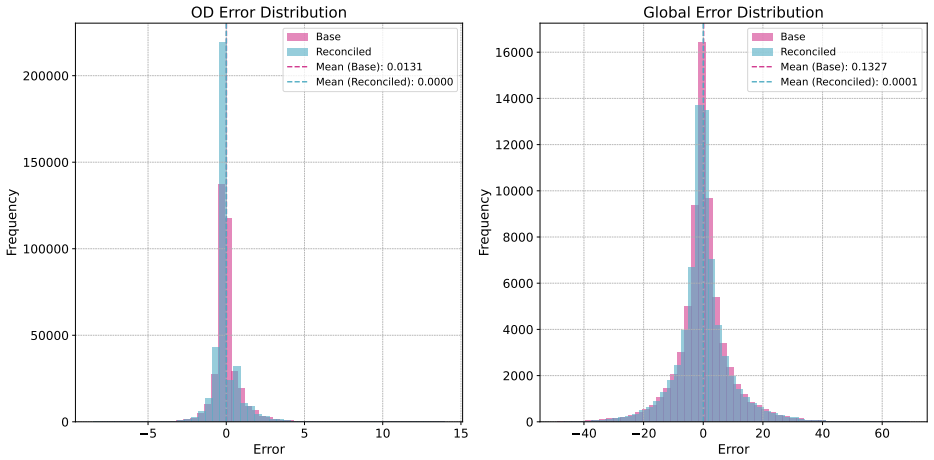
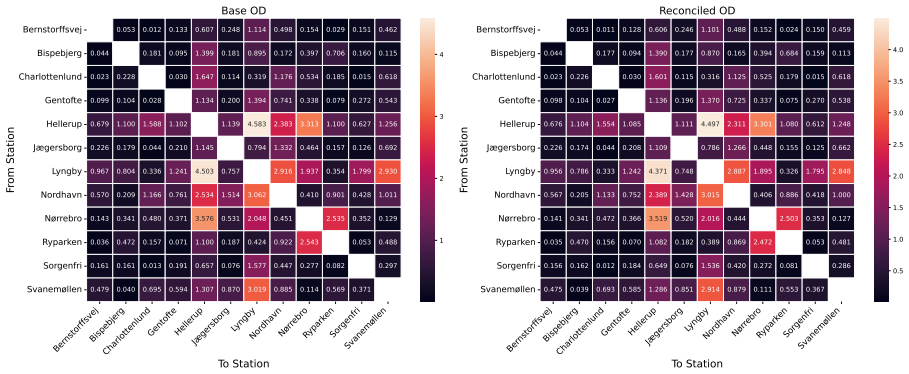
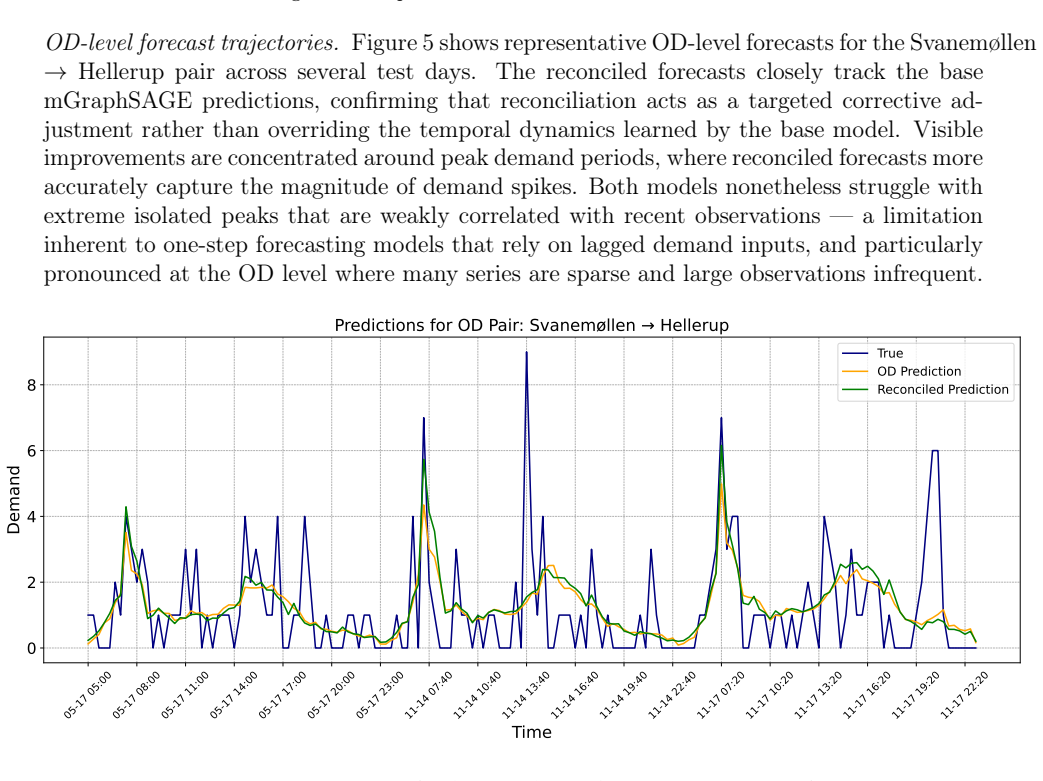
The neural Fully Connected Reconciler learns a non-linear mapping from incoherent base forecasts to coherent hierarchical predictions while guaranteeing exact structural consistency by construction, reducing OD forecasting error by up to 17.45 percent in multi-step destination-side delay scenarios.
What carries the argument
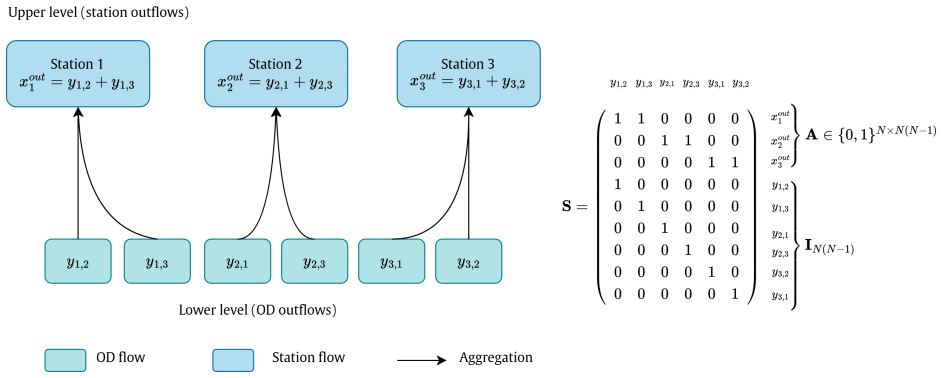
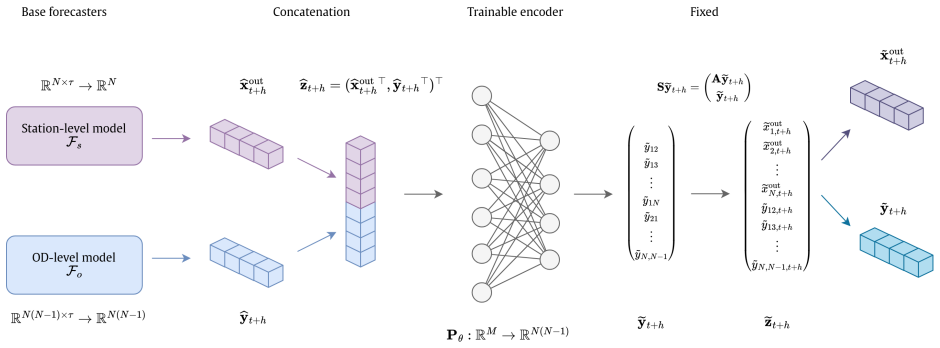
The neural Fully Connected Reconciler, a feed-forward network that maps a vector of base forecasts into reconciled outputs while embedding the linear conservation constraints between OD flows and station inflows/outflows directly into its architecture.
If this is right
- Reconciliation improves OD forecasting accuracy while ensuring hierarchical coherence across all tested scenarios.
- Under normal conditions the neural method performs competitively with Minimum Trace reconciliation.
- Perfect station-level forecasts could reduce OD prediction error by up to 34 percent according to oracle analysis.
- The largest error reductions occur under severe multi-step disruption conditions where classical linear methods degrade.
Where Pith is reading between the lines
- Better station-level base forecasts would amplify the benefits of reconciliation for OD accuracy.
- The same architecture could be applied to other transportation networks whose demand obeys similar inflow-outflow conservation rules.
- Training data that includes a wider variety of disruption types would likely strengthen generalization to novel events.
Load-bearing premise
The conservation constraints between station inflows/outflows and OD flows are the only structural requirements that must be satisfied, and a mapping learned from historical data will generalize to disruption patterns not seen during training.
What would settle it
Apply the trained reconciler to a set of base forecasts generated under disruption patterns absent from the training data and check whether the outputs still satisfy the conservation constraints exactly and whether OD error remains lower than the unreconciled baselines.
Figures
read the original abstract
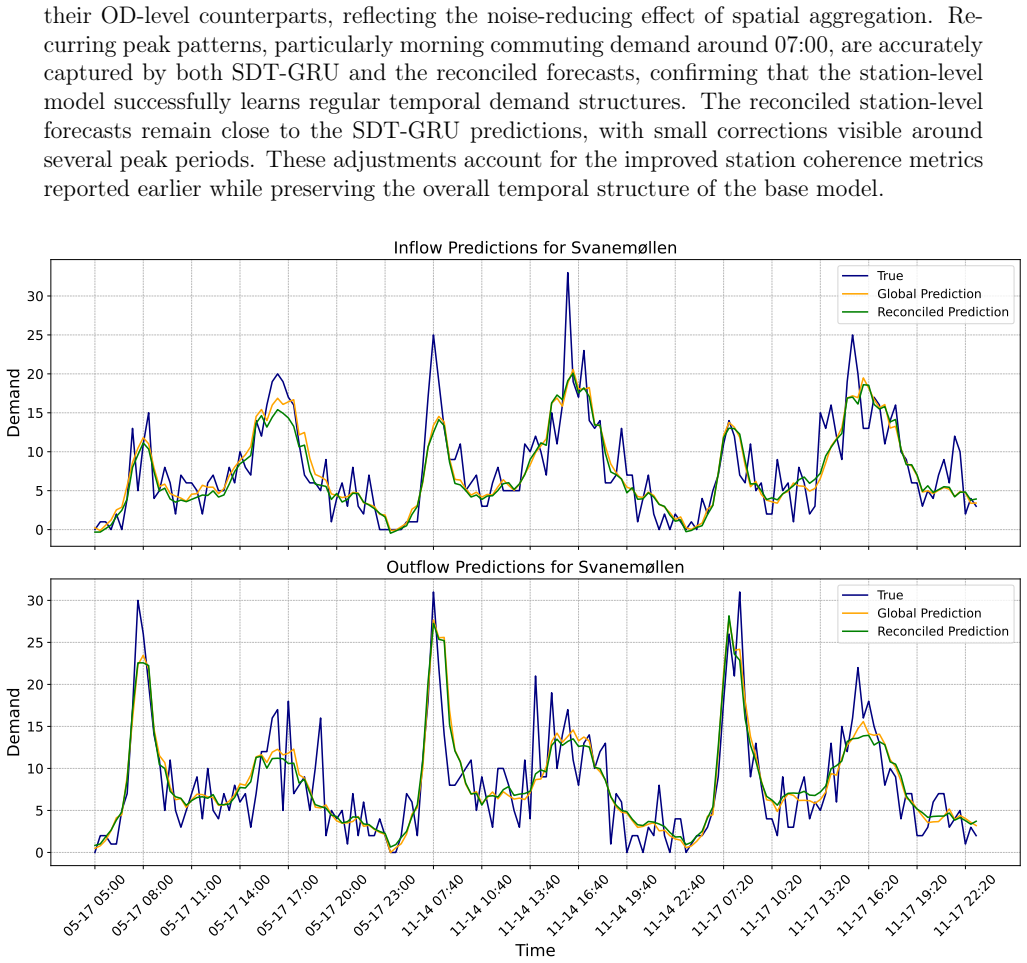
Accurate and coherent passenger demand forecasting is essential for Urban Rail Transit (URT) operations. Passenger demand has a hierarchical structure in which origin-destination (OD) flows aggregate to station-level inflows and outflows through conservation constraints. In practice, station-level and OD-level forecasts are often generated independently, producing incoherent predictions that violate these constraints and introduce inconsistencies into operational decision-making. Such issues become more severe during disruptions, when forecasting reliability is most critical. This paper presents the first hierarchical forecast reconciliation framework for joint station-level and OD-level URT demand prediction. A neural Fully Connected Reconciler (FCR) learns a non-linear mapping from incoherent base forecasts to coherent hierarchical predictions while guaranteeing exact structural consistency by construction. The method is benchmarked against OLS, WLS, and Minimum Trace (MinT) variants using Rejsekort smart-card data from the Copenhagen S-train network under one-step, multi-step, and disruption forecasting scenarios. Results show that reconciliation consistently improves OD forecasting accuracy while ensuring hierarchical coherence. Under normal conditions, FCR performs competitively with MinT-based methods. An oracle analysis indicates that perfect station-level forecasts could reduce OD prediction error by up to 34 percent, highlighting the value of improved base forecasts. Under severe disruptions, FCR outperforms classical methods, reducing OD forecasting error by up to 17.45 percent in multi-step destination-side delay scenarios. These findings establish hierarchical reconciliation as an effective mechanism for improving forecast robustness, with the largest benefits occurring under the most challenging operating conditions.
Editorial analysis
A structured set of objections, weighed in public.
Referee Report
Summary. The paper proposes the first hierarchical forecast reconciliation framework for joint station-level and OD-level urban rail transit demand prediction. A neural Fully Connected Reconciler (FCR) learns a non-linear mapping from incoherent base forecasts to coherent predictions while enforcing exact structural consistency with conservation constraints by construction. It is benchmarked against OLS, WLS, and MinT on Copenhagen S-train smart-card data under one-step, multi-step, and disruption scenarios, reporting competitive performance with MinT under normal conditions and up to 17.45% OD error reduction in multi-step destination-side delay disruptions, plus an oracle analysis showing up to 34% potential improvement from perfect station forecasts.
Significance. If the empirical results hold under rigorous validation, the work establishes hierarchical reconciliation as a practical tool for improving forecast robustness in transportation systems, with largest gains under challenging disruption conditions. The by-construction guarantee of structural consistency is a clear methodological strength, and the oracle analysis provides a useful upper-bound reference for future base-forecast improvements.
major comments (2)
- [Abstract] Abstract: the 17.45% OD-error reduction and oracle 34% figure are presented without details on training procedure, hyperparameter selection, statistical significance tests, error bars, or multiple-testing correction, making it impossible to evaluate whether the reported gains are robust or reproducible.
- [Abstract and experimental setup] The generalization claim for the learned non-linear mapping to unseen disruption patterns is load-bearing for the central result but rests on an untested assumption that disruption-induced base-forecast errors remain within the span of historical variation; no explicit out-of-distribution or disruption-specific hold-out experiments are described to support this.
minor comments (1)
- [Abstract] Clarify the precise definition and construction of the 'multi-step destination-side delay scenarios' used for the 17.45% result.
Simulated Author's Rebuttal
We thank the referee for the constructive feedback. We address the major comments point by point below, proposing revisions where they strengthen the manuscript without altering its core claims.
read point-by-point responses
-
Referee: [Abstract] Abstract: the 17.45% OD-error reduction and oracle 34% figure are presented without details on training procedure, hyperparameter selection, statistical significance tests, error bars, or multiple-testing correction, making it impossible to evaluate whether the reported gains are robust or reproducible.
Authors: The abstract provides a concise summary of key findings; the full training procedure, hyperparameter selection process, and evaluation protocol are detailed in Sections 3.3, 4, and 5. We agree that including error bars, statistical significance tests, and notes on multiple-testing correction would aid evaluation of robustness. We will revise the experimental results section to incorporate these elements and add a brief reference in the abstract. revision: yes
-
Referee: [Abstract and experimental setup] The generalization claim for the learned non-linear mapping to unseen disruption patterns is load-bearing for the central result but rests on an untested assumption that disruption-induced base-forecast errors remain within the span of historical variation; no explicit out-of-distribution or disruption-specific hold-out experiments are described to support this.
Authors: Disruption scenarios are drawn from real historical events in the Copenhagen dataset and are temporally separated from the training window, so the base-forecast errors during these periods are unseen at training time. We will add explicit text in the experimental setup clarifying this temporal hold-out structure and how it tests generalization to disruption-induced error patterns. Further synthetic OOD experiments are not described because the real disruption hold-outs already serve this purpose. revision: partial
Circularity Check
No significant circularity detected in derivation chain
full rationale
The paper introduces a neural Fully Connected Reconciler that enforces exact structural consistency by architectural construction and reports empirical accuracy gains via benchmarking against OLS/WLS/MinT on held-out data. No equation reduces the claimed error reductions (e.g., 17.45 %) to quantities defined by the model's own fitted parameters, no self-citation chain supports a load-bearing uniqueness claim, and no ansatz or renaming is presented as a first-principles derivation. The central results rest on external data-driven validation rather than internal self-definition.
Axiom & Free-Parameter Ledger
free parameters (1)
- FCR neural network weights
axioms (1)
- domain assumption Station inflows/outflows and OD flows obey exact conservation constraints that must be satisfied by any valid forecast.
Reference graph
Works this paper leans on
-
[1]
D. Li, S. Du, Y. Hou, Long-Term Passenger Flow Forecasting for Rail Transit Based on Complex Networks and Informer, Sensors 24 (2024). doi:10.3390/s24216894
-
[2]
S. Lv, K. Wang, H. Yang, P. Wang, An origin–destination passenger flow prediction system based on convolutional neural network and passenger source- based attention mechanism, Expert Systems with Applications 238 (2024) 121989. doi:10.1016/J.ESWA.2023.121989
-
[3]
S. Halyal, R. H. Mulangi, M. M. Harsha, Forecasting public transit passenger demand: With neural networks using APC data, Case Studies on Transport Policy 10 (2022) 965–975. doi:10.1016/J.CSTP.2022.03.011
-
[5]
S. L. Wickramasuriya, G. Athanasopoulos, R. J. Hyndman, Optimal fore- cast reconciliation for hierarchical and grouped time series through trace mini- mization, Journal of the American Statistical Association 114 (2019) 804–819. doi:10.1080/01621459.2018.1448825
-
[6]
R. J. Hyndman, R. A. Ahmed, G. Athanasopoulos, H. L. Shang, Optimal combination forecastsforhierarchicaltimeseries, ComputationalStatistics&DataAnalysis55(2011) 2579–2589. doi:10.1016/j.csda.2011.03.006
-
[7]
G. Athanasopoulos, R. J. Hyndman, N. Kourentzes, A. Panagiotelis, Forecast rec- onciliation: A review, International Journal of Forecasting 40 (2024) 430–456. doi:10.1016/j.ijforecast.2023.10.010
-
[8]
R. Hollyman, F. Petropoulos, M. E. Tipping, Understanding forecast rec- onciliation, European Journal of Operational Research 294 (2021) 149–160. doi:10.1016/j.ejor.2021.01.017
-
[9]
R. J. Hyndman, A. J. Lee, E. Wang, Fast computation of reconciled forecasts for hierarchical and grouped time series, Computational Statistics & Data Analysis 97 (2016) 16–32. doi:10.1016/j.csda.2015.11.007
- [10]
-
[11]
S. S. Rangapuram, L. D. Werner, K. Benidis, P. Mercado, J. Gasthaus, T. Januschowski, End-to-end learning of coherent probabilistic forecasts for hierarchical time series, in: Proceedings of the 38th International Conference on Machine Learning, 2021, pp. 8832–
2021
-
[12]
URL:http://proceedings.mlr.press/v139/rangapuram21a.html
-
[13]
J. Wang, Y. Zhang, Y. Wei, Y. Hu, X. Piao, B. Yin, Metro passenger flow predic- tion via dynamic hypergraph convolution networks, IEEE Transactions on Intelligent Transportation Systems 22 (2021) 7891–7903
2021
-
[14]
L. Liu, J. Chen, H. Wu, J. Zhen, G. Li, L. Lin, Physical-virtual collaboration modeling for intra- and inter-station metro ridership prediction, IEEE Transactions on Intelligent Transportation Systems 23 (2020) 3377–3391
2020
-
[15]
X. Ma, J. Zhang, B. Du, C. Ding, L. Sun, Parallel architecture of convolutional bi- directional LSTM neural networks for network-wide metro ridership prediction, IEEE Transactions on Intelligent Transportation Systems 20 (2019) 2278–2288
2019
-
[16]
J. Bao, J. Kang, Z. Yang, X. Chen, Forecasting network-wide multi-step metro ridership with an attention-weighted multi-view graph to sequence learning approach, Expert Systems with Applications 210 (2022) 118475
2022
-
[17]
P. Li, S. Wang, H. Zhao, J. Yu, L. Hu, H. Yin, Z. Liu, IG-Net: An interaction graph network model for metro passenger flow forecasting, IEEE Transactions on Intelligent Transportation Systems 24 (2023) 4147–4157
2023
-
[18]
Fang, C.-H
H. Fang, C.-H. Chen, F.-J. Hwang, C.-C. Chang, C.-C. Chang, Metro station functional clustering and dual-view recurrent graph convolutional network for metro passenger flow prediction, Expert Systems with Applications 247 (2024) 122550
2024
-
[19]
W. Lu, Y. Zhang, H. L. Vu, J. Xu, P. Li, A novel integrative prediction framework for metro passenger flow, Journal of Intelligent Transportation Systems (2025) 1–26
2025
-
[20]
W. Lu, J. Xu, Y. Zhang, T. Wang, P. Li, MOHP-EC: A Multiobjective Hierarchical Prediction Framework for Urban Rail Transit Passenger Flow, IEEE Intelligent Trans- portation Systems Magazine 15 (2023) 86–105. doi:10.1109/MITS.2023.3242465
-
[21]
Hornik, Approximation capabilities of multilayer feedforward networks, Neural net- works 4 (1991) 251–257
K. Hornik, Approximation capabilities of multilayer feedforward networks, Neural net- works 4 (1991) 251–257
1991
-
[22]
D. V. A. Nguyen, J. V. Flensburg, F. Cerreto, B. Pascariu, P. Pellegrini, C. L. Azevedo, F. Rodrigues, Multi-graph inductive representation learning for large-scale urban rail de- mand prediction under disruptions, Computers & Industrial Engineering (2026) 111924
2026
-
[23]
Q. Yang, X. Xu, Z. Wang, J. Yu, X. Hu, Are Graphs and GCNs necessary for short-term metro ridership forecasting?, Expert Systems with Applications 254 (2024). doi:10.1016/j.eswa.2024.124431
-
[24]
E. Spiliotis, M. Abolghasemi, R. J. Hyndman, F. Petropoulos, V. Assimakopoulos, Hi- erarchical forecast reconciliation with machine learning, Applied Soft Computing 112 (2020). URL:https://arxiv.org/pdf/2006.02043. doi:10.1016/j.asoc.2021.107756. 32
-
[25]
L. Liu, J. Chen, H. Wu, J. Zhen, G. Li, L. Lin, Physical-Virtual Collabo- ration Modeling for Intra-and Inter-Station Metro Ridership Prediction, IEEE Transactions on Intelligent Transportation Systems 23 (2020) 3377–3391. URL: https://arxiv.org/abs/2001.04889v3. doi:10.1109/TITS.2020.3036057. 33
discussion (0)
Sign in with ORCID, Apple, or X to comment. Anyone can read and Pith papers without signing in.