Skyrmions in Synthetic Antiferromagnets: Collapse and Nucleation
Pith reviewed 2026-06-27 21:44 UTC · model grok-4.3
The pith
Skyrmion pairs in synthetic antiferromagnets collapse layer-sequentially with size-independent saddle energies but nucleate over much higher barriers.
A machine-rendered reading of the paper's core claim, the machinery that carries it, and where it could break.
Core claim
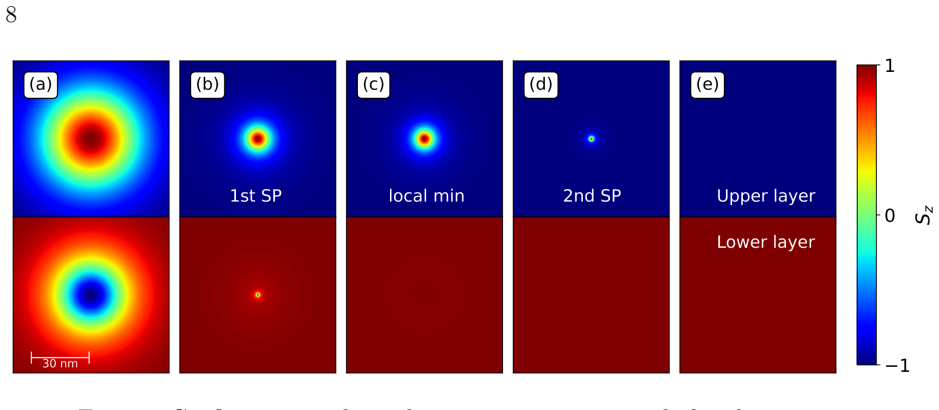
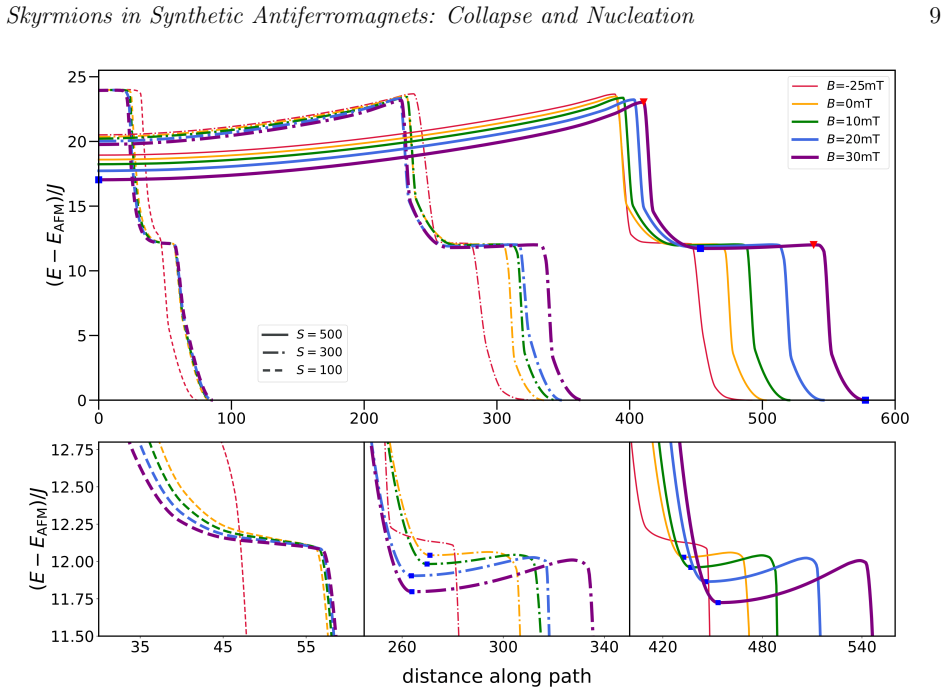
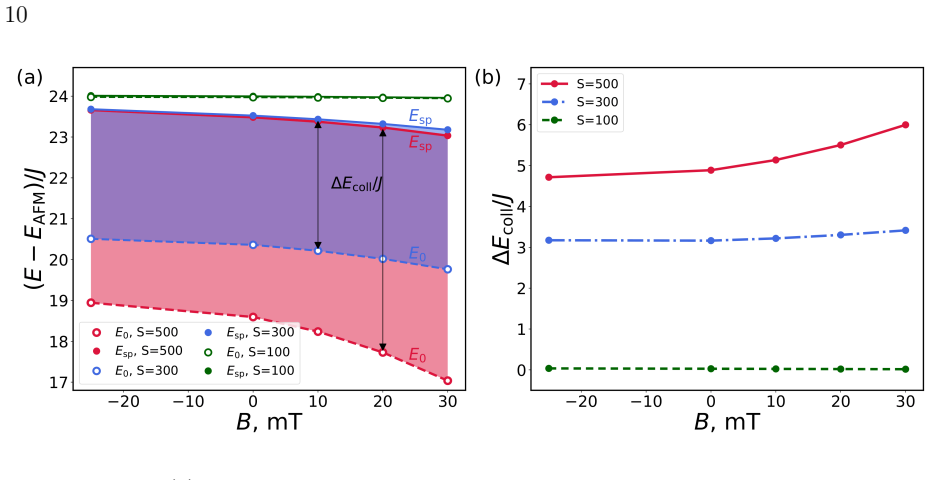
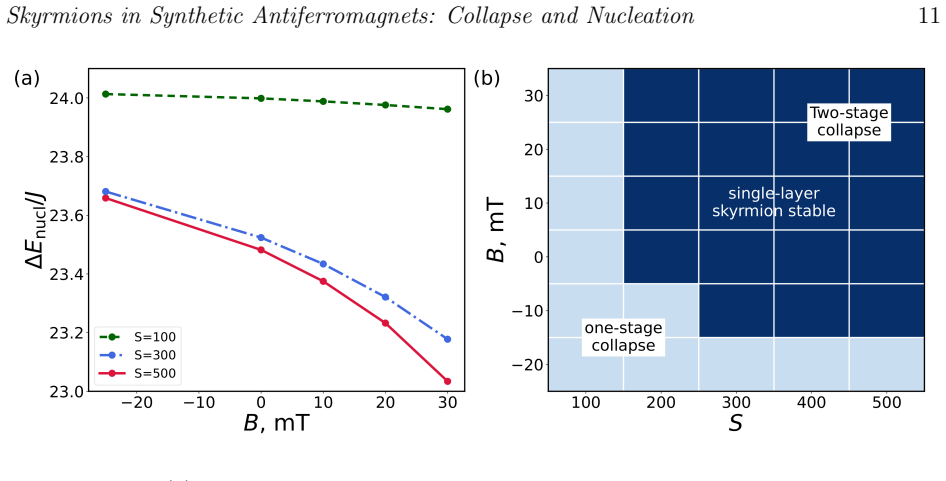
With antiferromagnetically pinned boundaries, the main saddle energy changes only weakly with pinned-island size, whereas the skyrmion-pair minimum carries a strong size-dependent boundary penalty. For large pinned islands, collapse is layer-sequential and can pass through a single-layer skyrmion intermediate whenever this state satisfies the relaxation criterion. The much larger reverse barrier for nucleation shows a strong asymmetry with collapse in the same pinned-boundary model and is consistent with assisted layer-sequential writing.
What carries the argument
Minimum energy paths computed on a reduced lattice model between the antiferromagnetically bound skyrmion pair and the pinned antiferromagnetic reference state.
If this is right
- Collapse proceeds sequentially through layers once the pinned island exceeds a size set by the relaxation criterion.
- Single-layer skyrmion states appear as possible intermediates during the collapse of large islands.
- Nucleation barriers remain substantially higher than collapse barriers under identical boundary conditions.
- The boundary penalty on the skyrmion-pair minimum grows with island size while the saddle energy does not.
- The resulting asymmetry favors designs in which written pairs remain stable once created.
Where Pith is reading between the lines
- Device engineers could select island sizes that keep the pair minimum low enough for writing while preserving the high nucleation barrier for retention.
- Layer-by-layer dynamics open the possibility of addressing individual layers independently in a multilayer stack.
- The same pinned-boundary construction may stabilize other topological objects such as merons if their energy landscapes follow similar patterns.
- Comparison against full micromagnetic or atomistic simulations would reveal whether additional corrections alter the reported layer-sequential paths.
Load-bearing premise
The reduced lattice model is sufficient to determine the minimum energy paths and the relaxation criteria that govern both collapse and nucleation.
What would settle it
Experimental observation that skyrmion pairs in synthetic antiferromagnets with pinned islands collapse simultaneously in both layers or that the nucleation barrier is comparable in height to the collapse barrier would falsify the reported asymmetry and size dependence.
Figures
read the original abstract
Magnetic skyrmions in synthetic antiferromagnets are promising nanoscale bits, but their usefulness depends on how reliably a written pair survives and can be created. Using a reduced lattice model, we compute minimum energy paths for collapse of an antiferromagnetically bound skyrmion pair and for reverse nucleation from a pinned antiferromagnetic reference state. With antiferromagnetically pinned boundaries, the main saddle energy changes only weakly with pinned-island size, whereas the skyrmion-pair minimum carries a strong size-dependent boundary penalty. For large pinned islands, collapse is layer-sequential and can pass through a single-layer skyrmion intermediate whenever this state satisfies the relaxation criterion. The much larger reverse barrier for nucleation shows a strong asymmetry with collapse in the same pinned-boundary model and is consistent with assisted layer-sequential writing.
Editorial analysis
A structured set of objections, weighed in public.
Referee Report
Summary. The paper uses a reduced lattice model to compute minimum-energy paths for collapse of an antiferromagnetically bound skyrmion pair and the reverse nucleation process in synthetic antiferromagnets with antiferromagnetically pinned boundaries. Key findings are that the main saddle energy depends only weakly on pinned-island size while the skyrmion-pair minimum carries a strong size-dependent boundary penalty; for large islands collapse proceeds layer-sequentially and can pass through a single-layer skyrmion intermediate; and the nucleation barrier is substantially larger, producing a strong asymmetry consistent with assisted layer-sequential writing.
Significance. If the reduced-model results are robust, the work supplies concrete, falsifiable predictions for the size dependence of collapse versus nucleation barriers and for the existence of a single-layer intermediate, which are directly relevant to the stability and writing reliability of skyrmion-pair bits. The explicit computation of MEPs under pinned boundaries offers a clear computational route to quantify the asymmetry that is often invoked qualitatively in the skyrmion literature.
major comments (1)
- [Methods] Methods and § on numerical details: all reported MEPs, saddle energies, and relaxation criteria are obtained exclusively inside the reduced lattice model with truncated interactions and antiferromagnetically pinned boundaries; no comparison to a full atomistic Heisenberg model, complete dipolar sums, or micromagnetic continuum limit is presented. Because the central claims (weak saddle-size dependence, layer-sequential collapse through a single-layer state, and nucleation asymmetry) rest on the fidelity of these paths and the stated relaxation criterion, the absence of such validation is load-bearing.
minor comments (1)
- [Figures] Figure captions and text should explicitly state the numerical convergence criteria (force tolerance, path discretization) used for the MEP calculations so that the relaxation criterion mentioned in the abstract can be reproduced.
Simulated Author's Rebuttal
We thank the referee for the positive assessment of our work's significance and for the detailed comment on the methods. We address the concern point by point below.
read point-by-point responses
-
Referee: [Methods] Methods and § on numerical details: all reported MEPs, saddle energies, and relaxation criteria are obtained exclusively inside the reduced lattice model with truncated interactions and antiferromagnetically pinned boundaries; no comparison to a full atomistic Heisenberg model, complete dipolar sums, or micromagnetic continuum limit is presented. Because the central claims (weak saddle-size dependence, layer-sequential collapse through a single-layer state, and nucleation asymmetry) rest on the fidelity of these paths and the stated relaxation criterion, the absence of such validation is load-bearing.
Authors: We acknowledge that direct numerical comparisons to a full atomistic Heisenberg model with complete dipolar sums or to the micromagnetic limit are absent. The reduced lattice model with truncated interactions was selected specifically to make MEP calculations tractable for the relevant island sizes; equivalent calculations in an unreduced model remain computationally prohibitive. The truncation is physically motivated by the antiferromagnetic pinning, which localizes the relevant energetics. We will revise the Methods section to add an explicit discussion of the model approximations, the justification for truncation under pinned boundaries, the relaxation criterion, and the expected regime of validity for the reported size dependence, layer-sequential pathways, and nucleation asymmetry. This addition will clarify the fidelity of the results within the stated framework. revision: yes
Circularity Check
No significant circularity; results from direct numerical computation of paths in reduced model.
full rationale
The paper reports minimum-energy paths and barriers obtained by direct computation inside a reduced lattice model with pinned boundaries. No equations are presented that define a quantity in terms of itself, no fitted parameters are relabeled as predictions, and no load-bearing uniqueness theorems or ansatzes are imported via self-citation. The central claims (weak size dependence of the saddle, strong boundary penalty on the pair minimum, layer-sequential collapse, nucleation asymmetry) are outputs of the numerical procedure rather than rearrangements of its inputs. The model assumptions are explicit and external to the reported numbers, so the derivation chain does not reduce to its own definitions.
Axiom & Free-Parameter Ledger
Reference graph
Works this paper leans on
-
[1]
Nanoscale magnetic skyrmions in metallic films and multilayers: a new twist for spintronics.Nat
Wiesendanger R. Nanoscale magnetic skyrmions in metallic films and multilayers: a new twist for spintronics.Nat. Rev. Mater., 2016,1, P. 16044
2016
-
[2]
Magnetic skyrmions: from funda- mental to applications.J
Finocchio G., B¨ uttner F., Tomasello R., Carpentieri M., Kl¨ aui M. Magnetic skyrmions: from funda- mental to applications.J. Phys. D: Appl. Phys., 2016,49, P. 423001
2016
-
[3]
Magnetic skyrmions: advances in physics and potential applications.Nat
Fert A., Reyren N., Cros V. Magnetic skyrmions: advances in physics and potential applications.Nat. Rev. Mater., 2017,2, P. 17031
2017
-
[4]
B¨ uttner F., Lemesh I., Beach G. S. D. Theory of isolated magnetic skyrmions: from fundamentals to room temperature applications.Sci. Rep., 2018,8, P. 4464
2018
-
[5]
M., Hessing P., Churikova A., Klose C., Schneider M., Engel D., Marcus C., Bono D., Bagschik K., Eisebitt S., Beach G
Caretta L., Mann M., B¨ uttner F., Ueda K., Pfau B., G¨ unther C. M., Hessing P., Churikova A., Klose C., Schneider M., Engel D., Marcus C., Bono D., Bagschik K., Eisebitt S., Beach G. S. D. Fast current- driven domain walls and small skyrmions in a compensated ferrimagnet.Nat. Nanotechnol., 2018,13, P. 1154
2018
-
[6]
N., Lobanov I
Potkina M. N., Lobanov I. S., J´ onsson H., Uzdin V. M. Skyrmions in antiferromagnets: thermal stability and the effect of external field and impurities.J. Appl. Phys., 2020,127, P. 213906
2020
-
[7]
A., Lee K.-J., Parkin S
Duine R. A., Lee K.-J., Parkin S. S. P., Stiles M. D. Synthetic antiferromagnetic spintronics.Nat. Phys., 2018,14, P. 217
2018
-
[8]
Thermally stable magnetic skyrmions in multilayer synthetic antiferro- magnetic racetracks.Phys
Zhang X., Ezawa M., Zhou Y. Thermally stable magnetic skyrmions in multilayer synthetic antiferro- magnetic racetracks.Phys. Rev. B, 2016,94, P. 064406
2016
-
[9]
Theory of skyrmions in bilayer systems.Sci
Koshibae W., Nagaosa N. Theory of skyrmions in bilayer systems.Sci. Rep., 2017,7, P. 42645
2017
-
[10]
R., Lu Y., Lew W
Li Y., Feng Q., Li S., Huang K., Ma M., Gan W., Zhou H., Jin X., Wang X. R., Lu Y., Lew W. S. An artificial skyrmion platform with robust tunability in synthetic antiferromagnetic multilayers.Adv. Funct. Mater., 2020,30, P. 1907140
2020
-
[11]
Formation and current-induced motion of synthetic antiferromagnetic skyrmion bubbles.Nat
Dohi T., DuttaGupta S., Fukami S., Ohno H. Formation and current-induced motion of synthetic antiferromagnetic skyrmion bubbles.Nat. Commun., 2019,10, P. 5153
2019
-
[12]
Room-temperature stabilization of antiferromagnetic skyrmions in synthetic antiferromagnets
Legrand W., Maccariello D., Ajejas F., Collin S., Vecchiola A., Bouzehouane K., Reyren N., Cros V., Fert A. Room-temperature stabilization of antiferromagnetic skyrmions in synthetic antiferromagnets. Nat. Mater., 2020,19, P. 34
2020
-
[13]
Realization of isolated and high-density skyrmions at room temperature in uncompensated synthetic antiferromagnets.Nano Lett., 2020,20, P
Chen R., Gao Y., Zhang X., Zhang R., Yin S., Chen X., Zhou X., Zhou Y., Xia J., Zhou Y., Wang S. Realization of isolated and high-density skyrmions at room temperature in uncompensated synthetic antiferromagnets.Nano Lett., 2020,20, P. 3299
2020
-
[14]
Material systems for FM-/AFM-coupled skyrmions in Co/Pt-based multilayers.Phys
Jia H., Zimmermann B., Hoffmann M., Sallermann M., Bihlmayer G., Bl¨ ugel S. Material systems for FM-/AFM-coupled skyrmions in Co/Pt-based multilayers.Phys. Rev. Mater., 2020,4, P. 094407
2020
-
[15]
T., Rana K
Juge R., Sisodia N., Urrestarazu-Larra˜ naga J., Zhang Q., Pham V. T., Rana K. G., Sarpi B., Mille N., Stanescu S., Belkhou R., Mawass M.-A., Novakovic-Marinkovic N., Kronast F., Weigand M., Gr¨ afe J., Wintz S., Finizio S., Raabe J., Aballe L., Foerster M., Belmeguenai M., Buda-Prejbeanu L. D., Shaw J. M., Nembach H. T., Ranno L., Gaudin G., Boulle O. Sk...
2022
-
[16]
T., Sisodia N.,
Pham V. T., Sisodia N.,. Di Manici I, Urrestarazu-Larra˜ naga J., Bairagi K., Pelloux-Prayer J., Guedas R., Buda-Prejbeanu L. D., Auffret S., Locatelli A., Mentes T. O., Pizzini S., Kumar P., Finco A., Jacques V., Gaudin G., Boulle O. Fast current-induced skyrmion motion in synthetic antiferromagnets. Science, 2024,384, P. 307
2024
-
[17]
Writing skyrmion at a specific position in synthetic antiferro- magnetic racetrack by voltage.J
Qiu S., Liu J., Chen Y., Qi X., Fang L. Writing skyrmion at a specific position in synthetic antiferro- magnetic racetrack by voltage.J. Magn. Magn. Mater., 2022,554, P. 169144
2022
-
[18]
Controllable generation of antiferromagnetic skyrmions in synthetic antiferromagnets with thermal effect.Adv
Chen R., Cui Q., Han L., Xue X., Liang J., Bai H., Zhou Y., Pan F., Yang H., Song C. Controllable generation of antiferromagnetic skyrmions in synthetic antiferromagnets with thermal effect.Adv. Funct. Mater., 2022,32, P. 2111906
2022
-
[19]
N., Lobanov I
Potkina M. N., Lobanov I. S., Uzdin V. M. Nonmagnetic impurities in skyrmion racetrack memory. Nanosyst. Phys. Chem. Math., 2020,11, P. 628–635
2020
-
[20]
N., Lobanov I
Potkina M. N., Lobanov I. S. Nucleation of magnetic skyrmions at a notch.Nanosyst. Phys. Chem. Math., 2024,15, P. 192–200
2024
-
[21]
N., Lobanov I
Potkina M. N., Lobanov I. S. Optimality of linear vacancy defect for skyrmion nucleation.Nanosyst. Phys. Chem. Math., 2025,16, P. 317–324
2025
-
[22]
Mirroring skyrmions in synthetic antiferromagnets via modular design.Nanomaterials, 2023,13, P
Deng P., Zhuo F., Li H., Cheng Z. Mirroring skyrmions in synthetic antiferromagnets via modular design.Nanomaterials, 2023,13, P. 859. Skyrmions in Synthetic Antiferromagnets: Collapse and Nucleation17
2023
-
[23]
S., Potkina M
Lobanov I. S., Potkina M. N., Uzdin V. M. Stability and lifetimes of magnetic states of nano- and microstructures (brief review).JETP Lett., 2021,113, P. 801
2021
-
[24]
S., Uzdin V
Lobanov I. S., Uzdin V. M. The lifetime of micron scale topological chiral magnetic states with atomic resolution.Comput. Phys. Commun., 2021,269, P. 108136
2021
-
[25]
S., Potkina M
Varentsova A. S., Potkina M. N., von Malottki S., Heinze S., Bessarab P. F. Interplay between size and stability of magnetic skyrmions.Nanosyst. Phys. Chem. Math., 2018,9, P. 356–363
2018
-
[26]
N., Lobanov I
Potkina M. N., Lobanov I. S., Uzdin V. M. Nucleation and collapse of magnetic topological solitons in external magnetic field.Nanosyst. Phys. Chem. Math., 2023,14, P. 216–222
2023
-
[27]
F., Heinze S
Schrautzer H., von Malottki S., Bessarab P. F., Heinze S. Effects of interlayer exchange on collapse mechanisms and stability of magnetic skyrmions.Phys. Rev. B, 2022,105, P. 014414
2022
-
[28]
V., Lobanov I
Voronin K. V., Lobanov I. S., Uzdin V. M. Activation energy and mechanisms for skyrmion collapse in synthetic antiferromagnets.JETP Lett., 2022,116, P. 240–245
2022
-
[29]
V., Pina Velasquez J
Correia M. V., Pina Velasquez J. C., de Souza Silva C. C. Stability and dynamics of synthetic antifer- romagnetic skyrmions in asymmetric multilayers.Phys. Rev. B, 2024110, P. 094430
-
[30]
F., Uzdin V
Bessarab P. F., Uzdin V. M., J´ onsson H. Method for finding mechanism and activation energy of magnetic transitions, applied to skyrmion and antivortex annihilation.Comput. Phys. Commun., 2015 196, P. 335–347
2015
-
[31]
S., Potkina M
Lobanov I. S., Potkina M. N., J´ onsson H., Uzdin V. M. Truncated minimum energy path method for finding first order saddle points.Nanosyst. Phys. Chem. Math., 2017,8, P. 586–595. Information about the author: Maria N. Potkina– Infochemistry Scientific Center, ITMO University, 197101 St. Peters- burg, Russia; ORCID 0000-0002-1380-2454; potkina.maria@yande...
2017
discussion (0)
Sign in with ORCID, Apple, or X to comment. Anyone can read and Pith papers without signing in.