Experimental Demonstration of Free-Space Unidimensional Continuous-Variable Quantum Key Distribution Under High Detector Noise
Pith reviewed 2026-06-27 22:03 UTC · model grok-4.3
The pith
Free-space unidimensional CV-QKD generates positive secret key rates only when detector electronic noise is treated as trusted.
A machine-rendered reading of the paper's core claim, the machinery that carries it, and where it could break.
Core claim
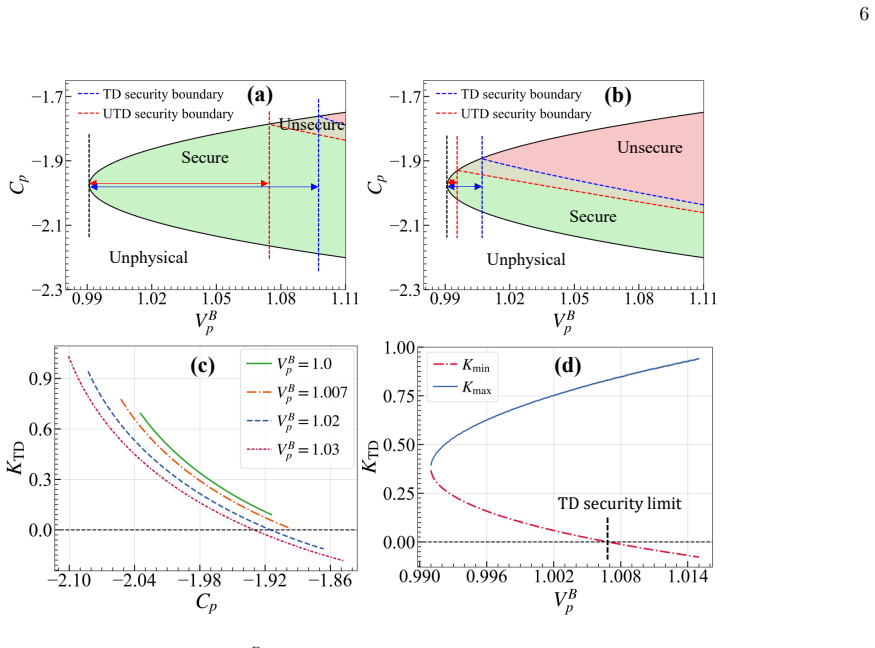
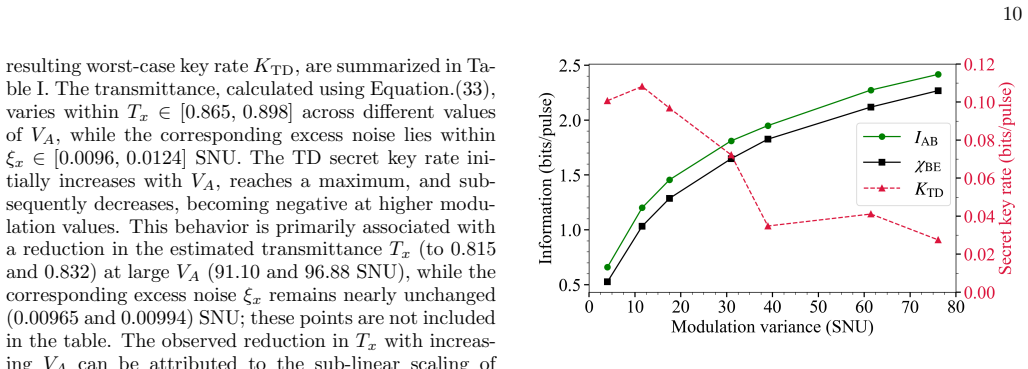
The experiment establishes that a free-space Gaussian-modulated UD-CVQKD link with polarized coherent states achieves a maximum secret key rate of 270 kbps at modulation variance 11.57 when electronic noise is modeled as trusted and independent of any eavesdropper; the same data yield zero rate under the untrusted detector model, and secure operation further requires high-transmittance channels.
What carries the argument
The trusted detector (TD) versus untrusted detector (UTD) noise model distinction, which treats electronic noise as eavesdropper-independent only under TD and thereby enables finite secret key rates.
If this is right
- Secure key rates exist only for a bounded interval of modulation variances under the TD model.
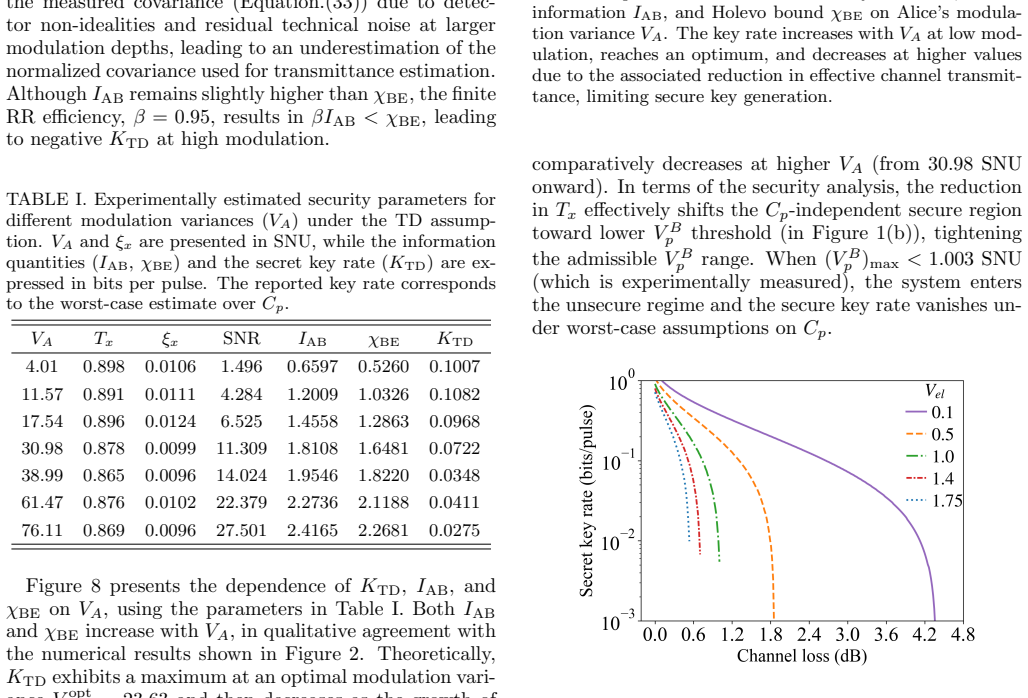
- High channel transmittance is required to maintain positive rates when detector noise reaches 1.4 shot-noise units.
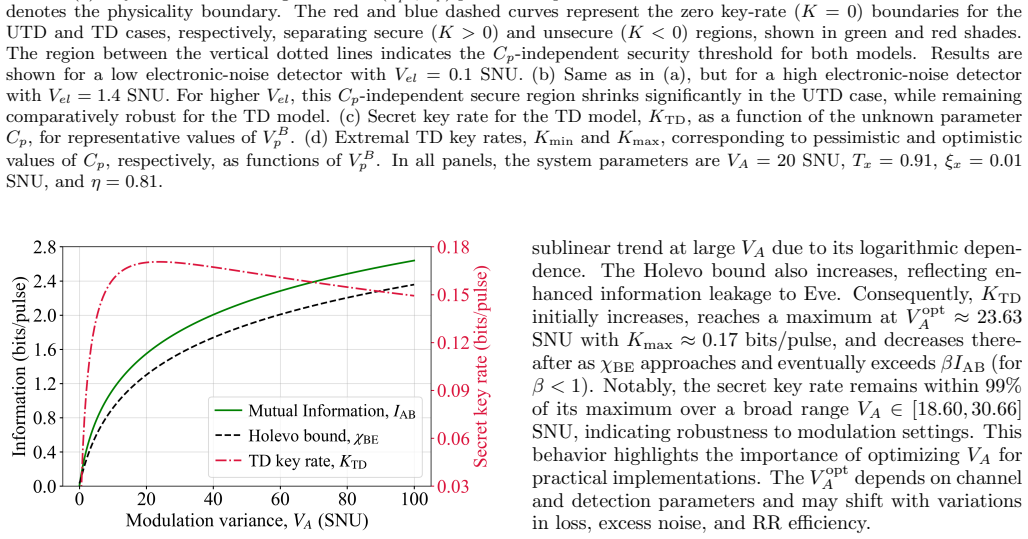
- The co-propagating orthogonal-polarization geometry stabilizes interference without active phase locking.
- Maximum rate occurs at modulation variance 11.57 under the reported noise level.
Where Pith is reading between the lines
- Systems with comparable detector noise will need either lower-loss channels or explicit trust assumptions to reach usable distances.
- The zero-rate result under UTD underscores that practical CV-QKD deployments may require hardware-level isolation of detector noise from the quantum channel.
- Extending the same setup to lower noise detectors would widen the usable modulation range and increase achievable distance.
Load-bearing premise
Electronic detector noise can be treated as independent of any eavesdropper.
What would settle it
An experimental demonstration that detector electronic noise is correlated with an eavesdropper's measurements would eliminate all positive key rates under the TD model.
Figures

read the original abstract
Continuous-variable quantum key distribution (CV-QKD), which uses quadratures of the electromagnetic field, enables practical quantum communication using standard telecommunication technologies. Unidimensional CV-QKD (UD-CVQKD) simplifies the implementation by restricting modulation to a single quadrature. In this work, we experimentally demonstrate a free-space Gaussian-modulated UD-CVQKD system operating under a high detector electronic-noise regime (1.4 shot-noise units). The system employs polarized coherent states with signal and local oscillator co-propagating in the same spatial mode in orthogonal polarizations, ensuring stable interference. System security is analyzed under both untrusted (UTD) and trusted (TD) detector noise models. While no positive secret key rate is obtained under the UTD model, the TD model enables secure key generation over a finite range of modulation variances, highlighting the critical role of detector trust in high-noise conditions. A maximum secret key rate of 270 kbps is achieved at an optimal modulation variance of 11.57. Furthermore, secure operation requires high-transmittance (low-loss) channels under such noise conditions. This study demonstrates the practical feasibility of free-space UD-CVQKD in realistic high electronic-noise detection constraints and highlights detector electronic noise as a key limiting factor in practical systems.
Editorial analysis
A structured set of objections, weighed in public.
Referee Report
Summary. The manuscript experimentally demonstrates a free-space unidimensional CV-QKD system using Gaussian-modulated polarized coherent states with co-propagating signal and local oscillator in orthogonal polarizations. It operates under high detector electronic noise (1.4 SNU) and reports a maximum secret key rate of 270 kbps at modulation variance 11.57 under the trusted detector (TD) noise model, while the untrusted detector (UTD) model yields zero key rate for the same data. The work analyzes security under both models and concludes that secure operation requires high-transmittance channels, highlighting detector trust as critical in high-noise regimes.
Significance. If the TD model is valid, the result shows practical feasibility of UD-CVQKD in free-space links with realistic high electronic noise, achieving usable key rates when detector noise can be treated as trusted. The experimental choice of co-propagating orthogonal-polarization beams for stable interference is a clear strength. The data explicitly contrast TD and UTD outcomes, underscoring detector noise as a limiting factor. The significance is reduced by the absence of independent verification for the trust assumption and by missing uncertainty quantification on the reported rates.
major comments (2)
- [Security Analysis] Security Analysis section: The positive key rate (270 kbps) under the TD model rests entirely on the assumption that the 1.4 SNU electronic noise is independent of any eavesdropper. No experimental test (e.g., injected-probe correlation or side-channel characterization) is described to support this premise for an open free-space link in which the detector is physically accessible. This assumption is load-bearing because the same quadrature statistics produce zero key rate under the UTD model.
- [Results] Results and Abstract: The reported maximum secret key rate of 270 kbps at modulation variance 11.57 is given without error bars, statistical uncertainties, or raw quadrature data. No detailed steps of the security proof (e.g., explicit covariance matrix elements or finite-size corrections) are supplied, preventing independent assessment of the TD-model claim.
minor comments (2)
- [Abstract] The manuscript would benefit from explicit units and a brief definition when stating the optimal modulation variance of 11.57 in the abstract and results.
- Figure captions (e.g., key-rate versus modulation variance) should include both TD and UTD curves on the same plot for direct visual comparison.
Simulated Author's Rebuttal
We thank the referee for the careful review and constructive comments on our manuscript. We address the major comments point by point below.
read point-by-point responses
-
Referee: [Security Analysis] Security Analysis section: The positive key rate (270 kbps) under the TD model rests entirely on the assumption that the 1.4 SNU electronic noise is independent of any eavesdropper. No experimental test (e.g., injected-probe correlation or side-channel characterization) is described to support this premise for an open free-space link in which the detector is physically accessible. This assumption is load-bearing because the same quadrature statistics produce zero key rate under the UTD model.
Authors: We acknowledge that the TD model relies on the standard assumption that electronic noise is internal to the detector and inaccessible to an eavesdropper. No additional experimental tests such as injected-probe correlation were performed in this work. We will revise the manuscript to include an expanded discussion of the conditions and limitations under which the TD model is applied in free-space channels. revision: partial
-
Referee: [Results] Results and Abstract: The reported maximum secret key rate of 270 kbps at modulation variance 11.57 is given without error bars, statistical uncertainties, or raw quadrature data. No detailed steps of the security proof (e.g., explicit covariance matrix elements or finite-size corrections) are supplied, preventing independent assessment of the TD-model claim.
Authors: We agree that the presentation would benefit from additional details. In the revised manuscript we will add statistical error bars to the reported key rates, provide the explicit covariance matrix elements used in the security analysis, and clarify the finite-size corrections. The full raw quadrature dataset will be made available upon reasonable request. revision: yes
- Absence of independent experimental verification (e.g., injected-probe correlation or side-channel characterization) for the trusted detector noise assumption in the open free-space link.
Circularity Check
No circularity; experimental key rates from measured data via standard formulas
full rationale
The paper is an experimental demonstration that applies established CV-QKD security formulas (under TD/UTD models) to measured quadrature statistics. The positive key rate under TD is a direct consequence of the modeling assumption that electronic noise is trusted, not a derivation that reduces to fitted inputs or self-citations by construction. No load-bearing self-citation chains, self-definitional steps, or renamed known results are present. The result is self-contained against external benchmarks (standard CV-QKD literature) and receives the default low score for experimental work.
Axiom & Free-Parameter Ledger
free parameters (1)
- modulation variance
axioms (1)
- domain assumption Standard Gaussian-modulated coherent-state CV-QKD security bounds apply under the stated channel and detection model.
Reference graph
Works this paper leans on
-
[1]
The Xquadrature is Gaussian modulated asx A,k ∈ N(0, V A), whilep A,k = 0
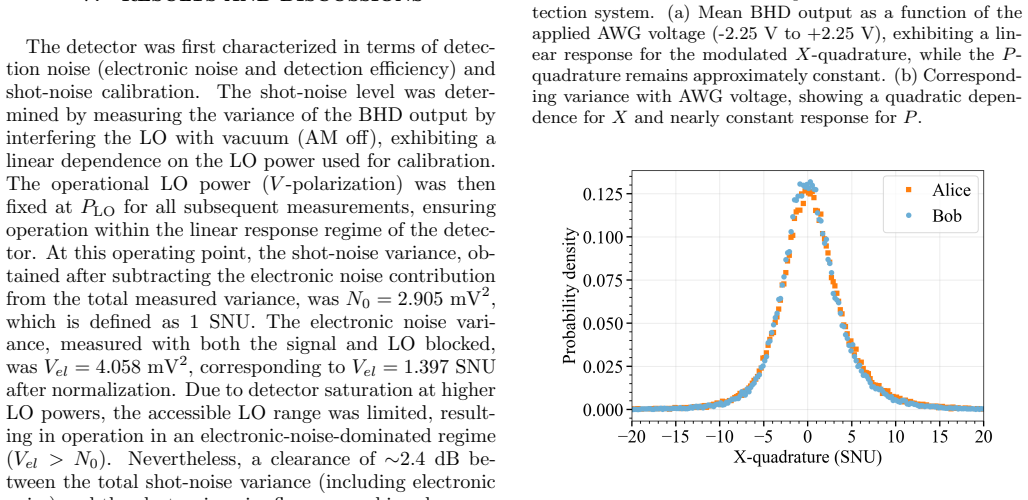
Alice prepares a sequence of displaced coherent states|α k⟩, whereα k = 1√ 2(xA,k +ip A,k). The Xquadrature is Gaussian modulated asx A,k ∈ N(0, V A), whilep A,k = 0. The total variance in the modulated quadrature isV=V A + 1. 4
-
[2]
The prepared states are transmitted through an un- trusted quantum channel characterized by trans- mittancesT x andT p, and channel excess noisesξ x andξ p in theXandPquadratures, respectively, referred to the channel input
-
[3]
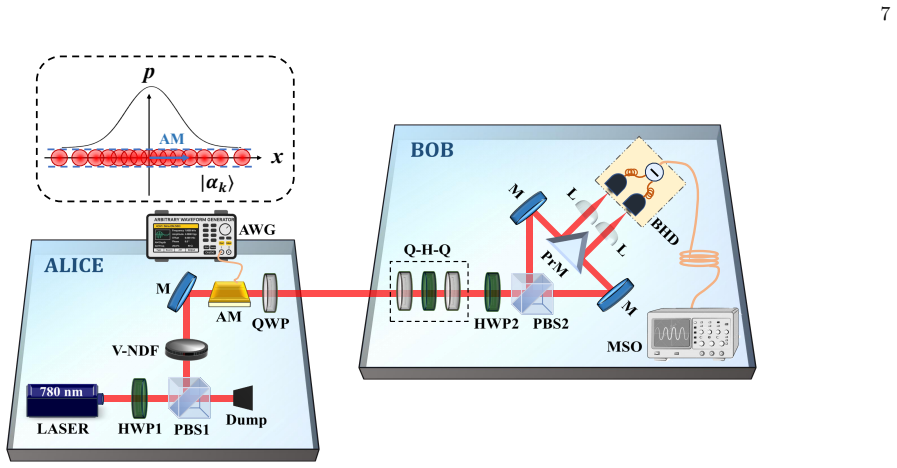
The measured quadrature is selected via the LO phase, withϕ B = 0 for theX quadrature andϕ B =π/2 for thePquadrature, measured in separate acquisition runs
Bob performs homodyne detection on the received states, characterized by detection efficiencyηand electronic noiseV el. The measured quadrature is selected via the LO phase, withϕ B = 0 for theX quadrature andϕ B =π/2 for thePquadrature, measured in separate acquisition runs
-
[4]
Since theP- quadrature is unmodulated,T p andξ p cannot be directly estimated
After quantum transmission, Alice and Bob pub- licly disclose a subset of their data to estimate the channel parametersT x andξ x. Since theP- quadrature is unmodulated,T p andξ p cannot be directly estimated
-
[5]
These continuous outcomes are directly used for parameter estimation and subsequent classical post-processing, in accordance with the Gaussian- modulated CV-QKD framework
Bob’s measurement outcomes in theXquadrature, xB, are continuous variables correlated with Alice’s data. These continuous outcomes are directly used for parameter estimation and subsequent classical post-processing, in accordance with the Gaussian- modulated CV-QKD framework
-
[6]
Finally, the secret key rate is evaluated using the estimated channel parameters and a reconciliation efficiencyβ= 0.95. C. Noise Models In CV-QKD, system performance is determined by the channel transmittance and associated noise contribu- tions. The total noise is decomposed into channel noise, χch, referred to the channel input and potentially accessi-...
2000
-
[7]
C. H. Bennett and G. Brassard, Quantum cryptogra- phy: Public key distribution and coin tossing, Theoreti- cal computer science560, 7 (2014)
2014
-
[8]
Scarani, H
V. Scarani, H. Bechmann-Pasquinucci, N. J. Cerf, M. Duˇ sek, N. L¨ utkenhaus, and M. Peev, The security of practical quantum key distribution, Reviews of modern physics81, 1301 (2009)
2009
-
[9]
Pirandola, U
S. Pirandola, U. L. Andersen, L. Banchi, M. Berta, D. Bunandar, R. Colbeck, D. Englund, T. Gehring, C. Lupo, C. Ottaviani,et al., Advances in quantum cryp- tography, Advances in optics and photonics12, 1012 (2020)
2020
-
[10]
Ribordy, J
G. Ribordy, J. Brendel, J.-D. Gautier, N. Gisin, and H. Zbinden, Long-distance entanglement-based quantum key distribution, Physical Review A63, 012309 (2000)
2000
-
[11]
Liao, W.-Q
S.-K. Liao, W.-Q. Cai, W.-Y. Liu, L. Zhang, Y. Li, J.-G. Ren, J. Yin, Q. Shen, Y. Cao, Z.-P. Li,et al., Satellite-to- ground quantum key distribution, Nature549, 43 (2017). 12
2017
-
[12]
Grosshans and P
F. Grosshans and P. Grangier, Continuous variable quan- tum cryptography using coherent states, Physical review letters88, 057902 (2002)
2002
-
[13]
T. C. Ralph, Continuous variable quantum cryptography, Physical Review A61, 010303 (1999)
1999
-
[14]
Weedbrook, S
C. Weedbrook, S. Pirandola, R. Garc´ ıa-Patr´ on, N. J. Cerf, T. C. Ralph, J. H. Shapiro, and S. Lloyd, Gaus- sian quantum information, Reviews of Modern Physics 84, 621 (2012)
2012
-
[15]
Continuous-variable quantum key distribution system: Past, present, and future , volume=
Y. Zhang, Y. Bian, Z. Li, S. Yu, and H. Guo, Continuous-variable quantum key distribution system: Past, present, and future, Applied Physics Reviews11, 10.1063/5.0179566 (2024)
-
[16]
S. Pirandola, Composable security for continuous vari- able quantum key distribution: Trust levels and prac- tical key rates in wired and wireless networks, Physical Review Research3, 043014 (2021)
2021
-
[17]
Zhang, Y
X. Zhang, Y. Zhang, Z. Li, S. Yu, and H. Guo, 1.2- ghz balanced homodyne detector for continuous-variable quantum information technology, IEEE Photonics Jour- nal10, 1 (2018)
2018
-
[18]
Huang, J
D. Huang, J. Fang, C. Wang, P. Huang, and G.-H. Zeng, A 300-mhz bandwidth balanced homodyne detector for continuous variable quantum key distribution, Chinese Physics Letters30, 114209 (2013)
2013
-
[19]
T. Wang, P. Huang, Y. Zhou, W. Liu, H. Ma, S. Wang, and G. Zeng, High key rate continuous-variable quan- tum key distribution with a real local oscillator, Optics express26, 2794 (2018)
2018
-
[20]
Schrenk, F
B. Schrenk, F. Laudenbach, C.-H. F. Fung, C. Pacher, A. Poppe, R. Lieger, D. Hillerkuss, E. Querasser, G. Humer, M. Hentschel,et al., High-rate continuous- variables quantum key distribution with piloted- disciplined local oscillator, in2017 European Conference on Optical Communication (ECOC)(IEEE, 2017) pp. 1– 3
2017
-
[21]
Grosshans, G
F. Grosshans, G. Van Assche, J. Wenger, R. Brouri, N. J. Cerf, and P. Grangier, Quantum key distribution using gaussian-modulated coherent states, Nature421, 238 (2003)
2003
-
[22]
Lodewyck, M
J. Lodewyck, M. Bloch, R. Garc´ ıa-Patr´ on, S. Fossier, E. Karpov, E. Diamanti, T. Debuisschert, N. J. Cerf, R. Tualle-Brouri, S. W. McLaughlin,et al., Quantum key distribution over 25 km with an all-fiber continuous- variable system, Physical Review A—Atomic, Molecular, and Optical Physics76, 042305 (2007)
2007
-
[23]
Qi, L.-L
B. Qi, L.-L. Huang, L. Qian, and H.-K. Lo, Experimental study on the gaussian-modulated coherent-state quan- tum key distribution over standard telecommunication fibers, Physical Review A—Atomic, Molecular, and Op- tical Physics76, 052323 (2007)
2007
-
[24]
Garc´ ıa-Patr´ on and N
R. Garc´ ıa-Patr´ on and N. J. Cerf, Unconditional optimal- ity of gaussian attacks against continuous-variable quan- tum key distribution, Physical review letters97, 190503 (2006)
2006
-
[25]
Leverrier, F
A. Leverrier, F. Grosshans, and P. Grangier, Finite-size analysis of a continuous-variable quantum key distribu- tion, Physical Review A—Atomic, Molecular, and Opti- cal Physics81, 062343 (2010)
2010
-
[26]
Leverrier, Composable security proof for continuous- variable quantum key distribution with coherent states, Physical review letters114, 070501 (2015)
A. Leverrier, Composable security proof for continuous- variable quantum key distribution with coherent states, Physical review letters114, 070501 (2015)
2015
-
[27]
V. C. Usenko and F. Grosshans, Unidimensional continuous-variable quantum key distribution, Physical Review A92, 062337 (2015)
2015
-
[28]
P. Wang, X. Wang, J. Li, and Y. Li, Finite-size analysis of unidimensional continuous-variable quantum key dis- tribution under realistic conditions, Optics Express25, 27995 (2017)
2017
-
[29]
Q. Liao, Y. Guo, C. Xie, D. Huang, P. Huang, and G. Zeng, Composable security of unidimensional continuous-variable quantum key distribution, Quantum Information Processing17, 113 (2018)
2018
-
[30]
X. Wang, W. Liu, P. Wang, and Y. Li, Experimen- tal study on all-fiber-based unidimensional continuous- variable quantum key distribution, Physical Review A 95, 062330 (2017)
2017
-
[31]
Shen, M.-W
S.-Y. Shen, M.-W. Dai, X.-T. Zheng, Q.-Y. Sun, G.- C. Guo, and Z.-F. Han, Free-space continuous-variable quantum key distribution of unidimensional gaussian modulation using polarized coherent states in an urban environment, Physical Review A100, 012325 (2019)
2019
-
[32]
Lorenz, N
S. Lorenz, N. Korolkova, and G. Leuchs, Continuous- variable quantum key distribution using polarization en- coding and post selection, Applied Physics B79, 273 (2004)
2004
-
[33]
Lorenz, J
S. Lorenz, J. Rigas, M. Heid, U. L. Andersen, N. L¨ utkenhaus, and G. Leuchs, Witnessing effective en- tanglement in a continuous variable prepare-and-measure setup and application to a quantum key distribution scheme using postselection, Physical Review A—Atomic, Molecular, and Optical Physics74, 042326 (2006)
2006
-
[34]
Elser, T
D. Elser, T. Bartley, B. Heim, C. Wittmann, D. Sych, and G. Leuchs, Feasibility of free space quantum key dis- tribution with coherent polarization states, New Journal of Physics11, 045014 (2009)
2009
-
[35]
B. Heim, D. Elser, T. Bartley, M. Sabuncu, C. Wittmann, D. Sych, C. Marquardt, and G. Leuchs, Atmospheric channel characteristics for quantum communication with continuous polarization variables, Applied Physics B98, 635 (2010)
2010
-
[36]
B. Heim, C. Peuntinger, N. Killoran, I. Khan, C. Wittmann, C. Marquardt, and G. Leuchs, At- mospheric continuous-variable quantum communication, New Journal of Physics16, 113018 (2014)
2014
-
[37]
S. Pan, D. Monokandylos, and B. Qi, Detector noise in continuous-variable quantum key distribution, Physical Review A112, 052607 (2025)
2025
-
[38]
Fossier, E
S. Fossier, E. Diamanti, T. Debuisschert, R. Tualle- Brouri, and P. Grangier, Improvement of continuous- variable quantum key distribution systems by using op- tical preamplifiers, Journal of Physics B: Atomic, Molec- ular and Optical Physics42, 114014 (2009)
2009
-
[39]
Korolkova, G
N. Korolkova, G. Leuchs, R. Loudon, T. C. Ralph, and C. Silberhorn, Polarization squeezing and continuous- variable polarization entanglement, Physical Review A 65, 052306 (2002)
2002
-
[40]
R. C. Jones, A new calculus for the treatment of opti- cal systems i. description and discussion of the calculus, Journal of the Optical Society of America31, 488 (1941)
1941
-
[41]
Virtual Entanglement and Reconciliation Protocols for Quantum Cryptography with Continuous Variables
F. Grosshans, N. J. Cerf, J. Wenger, R. Tualle- Brouri, and P. Grangier, Virtual entanglement and rec- onciliation protocols for quantum cryptography with continuous variables, arXiv preprint quant-ph/0306141 10.48550/arXiv.quant-ph/0306141 (2003)
work page internal anchor Pith review Pith/arXiv arXiv doi:10.48550/arxiv.quant-ph/0306141 2003
-
[42]
A. S. Holevo and R. F. Werner, Evaluating capaci- ties of bosonic gaussian channels, arXiv preprint quant- ph/9912067 10.48550/arXiv.quant-ph/9912067 (1999)
work page internal anchor Pith review doi:10.48550/arxiv.quant-ph/9912067 1999
discussion (0)
Sign in with ORCID, Apple, or X to comment. Anyone can read and Pith papers without signing in.