TOPSIS-RAD: Ranking According to Desires
Pith reviewed 2026-06-27 22:05 UTC · model grok-4.3
The pith
TOPSIS-RAD lets decision makers set vetoed and desired performance levels to align rankings with their requirements instead of data extremes.
A machine-rendered reading of the paper's core claim, the machinery that carries it, and where it could break.
Core claim
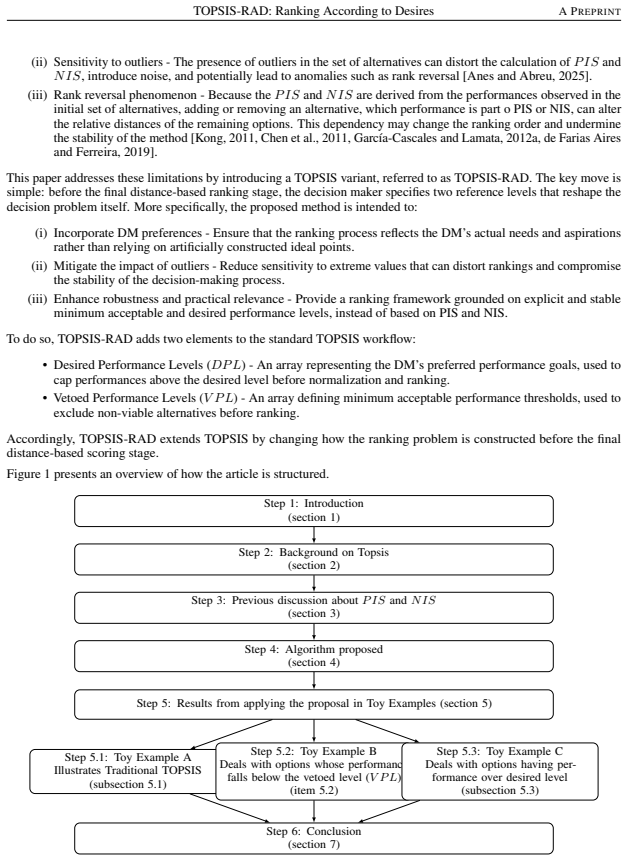
Traditional TOPSIS derives its reference points—the Positive Ideal Solution and Negative Ideal Solution—from the observed alternative set, making rankings susceptible to misalignment with decision-maker requirements, sensitivity to outlier performances, and rank reversal. TOPSIS-RAD addresses these issues by incorporating two arrays of DM-defined reference levels. Vetoed Performance Levels exclude non-viable alternatives before normalisation, preventing them from distorting the ranking frontiers. Desired Performance Levels cap performances at the DM's desired level before normalisation, anchoring the positive ideal solution in explicit aspirations rather than dataset extremes.
What carries the argument
Vetoed Performance Levels (VPL) and Desired Performance Levels (DPL), two DM-specified arrays that reshape normalisation boundaries and the positive ideal solution before the standard TOPSIS distance calculations are applied.
If this is right
- Non-viable alternatives are removed before normalisation so they do not shift the reference points for the remaining options.
- Performances well above the desired level are capped, so they no longer pull the positive ideal solution toward unrealistic extremes.
- Rankings become insensitive to the addition or removal of alternatives whose values lie outside the DM-specified ranges.
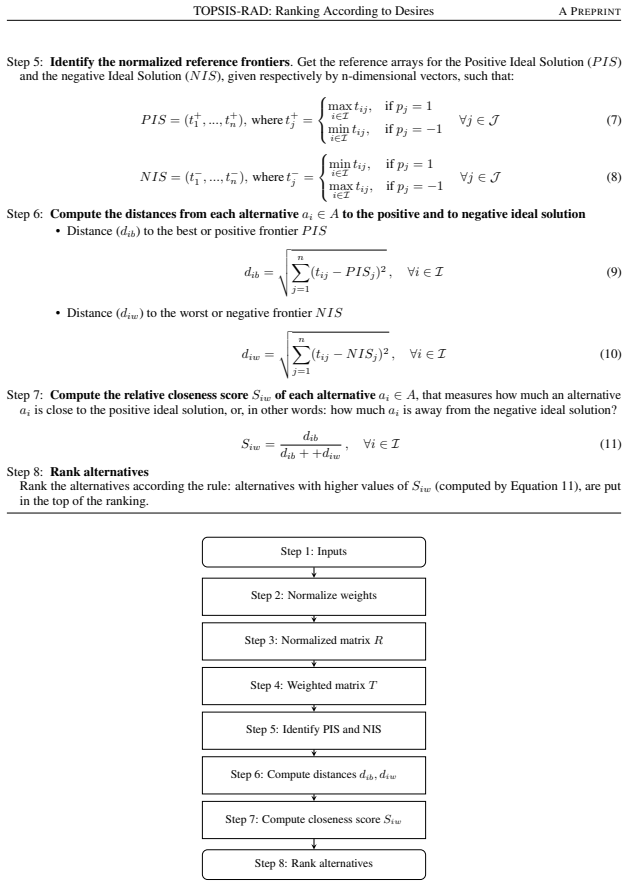
- The familiar distance-to-ideal structure is retained while the reference points are now controlled by explicit DM inputs rather than data statistics.
Where Pith is reading between the lines
- The same reference-level mechanism could be added to other distance-based or reference-point MCDM methods that currently derive ideals from the data.
- Sequential decision settings, where alternatives arrive over time, would benefit because new options cannot retroactively alter previously computed normalisation boundaries.
- Empirical tests could measure how often standard TOPSIS produces rankings that DMs later reject when shown the effect of their own VPL and DPL values.
Load-bearing premise
Decision makers can and will supply accurate VPL and DPL values that correctly exclude non-viable alternatives and cap aspirations without introducing new forms of bias.
What would settle it
Apply both standard TOPSIS and TOPSIS-RAD to a dataset containing one extreme outlier that exceeds any reasonable aspiration level, then verify whether the RAD ranking matches an independent DM judgment of viability and stays unchanged when the outlier is removed.
Figures
read the original abstract
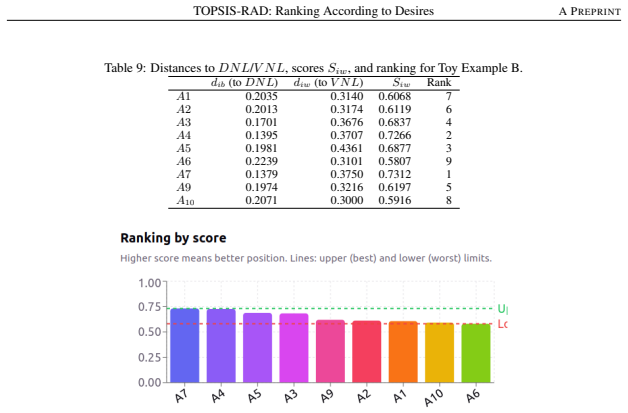
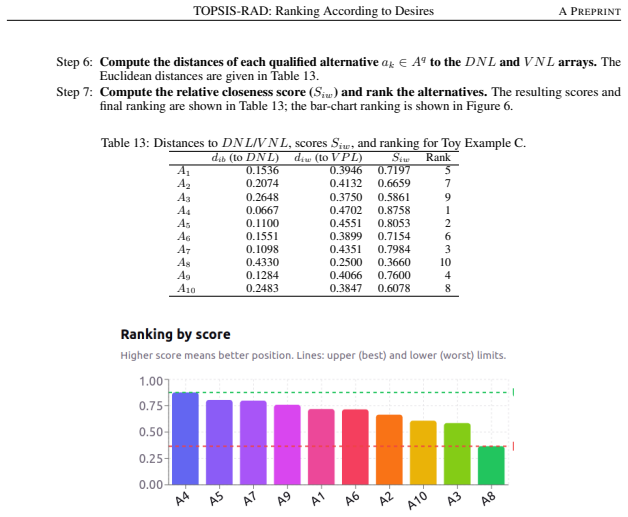
Traditional TOPSIS derives its reference points -- the Positive Ideal Solution ($PIS$) and Negative Ideal Solution ($NIS$) -- from the observed alternative set, making rankings susceptible to misalignment with decision-maker (DM) requirements, sensitivity to outlier performances, and rank reversal. This paper proposes TOPSIS-RAD, which addresses these issues by incorporating two arrays of DM-defined reference levels. Vetoed Performance Levels ($VPL$) exclude non-viable alternatives before normalisation, preventing them from distorting the ranking frontiers. Desired Performance Levels ($DPL$) cap performances at the DM's desired level before normalisation, anchoring the $PIS$ in explicit aspirations rather than dataset extremes. Three toy examples demonstrate each mechanism: $VPL$ reshapes normalisation boundaries by removing a non-viable alternative; fixed $DPL$ frontiers stabilise rankings by limiting the influence of performances well above the desired level. The method preserves the familiar distance-based structure of TOPSIS while grounding the ranking in stable, DM-specified boundaries. Limitations and future research directions are also discussed.
Editorial analysis
A structured set of objections, weighed in public.
Referee Report
Summary. The paper claims that traditional TOPSIS derives PIS and NIS from the observed alternatives, leading to misalignment with DM requirements, outlier sensitivity, and rank reversal. It proposes TOPSIS-RAD, which adds two DM-defined pre-normalization arrays—Vetoed Performance Levels (VPL) to exclude non-viable alternatives and Desired Performance Levels (DPL) to cap performances at explicit aspirations—thereby anchoring the ideal solutions in stable boundaries while preserving the standard distance-based TOPSIS structure. The approach is illustrated via three toy examples showing isolated effects of each mechanism.
Significance. If the mechanisms operate as described, TOPSIS-RAD offers a lightweight, DM-grounded extension to TOPSIS that could improve stability and alignment in multi-criteria decision problems where veto thresholds and aspiration levels are known a priori. The retention of the core distance calculations after pre-processing is a practical strength, as it supports incremental adoption without requiring changes to existing TOPSIS implementations or solvers.
minor comments (2)
- The abstract and description reference three toy examples but provide no explicit decision matrices, normalization formulas, or distance calculations; including these in a dedicated section or appendix would improve reproducibility.
- Notation for VPL and DPL arrays should be defined with explicit dimensions and integration steps relative to the standard TOPSIS normalization (e.g., how they modify the decision matrix before min-max scaling).
Simulated Author's Rebuttal
We thank the referee for the careful summary of our work and for the positive assessment of its significance. We are pleased with the recommendation for minor revision. Since no specific major comments were raised, we interpret this as an invitation to make minor clarifications or improvements as needed in the revised manuscript.
Circularity Check
No significant circularity
full rationale
The paper defines VPL and DPL explicitly as external inputs supplied by the decision maker, applied as pre-processing steps prior to standard TOPSIS normalization and distance calculations. No equations derive these reference levels from the alternative set, from fitted parameters, or from self-referential relations within the method. The central construction preserves the familiar TOPSIS distance structure after the two DM-specified pre-processing operations, with no load-bearing self-citations, uniqueness theorems, or ansatzes smuggled via prior work. The three toy examples illustrate isolated mechanisms without reducing any claimed prediction to its own inputs by construction.
Axiom & Free-Parameter Ledger
invented entities (2)
-
Vetoed Performance Levels (VPL)
no independent evidence
-
Desired Performance Levels (DPL)
no independent evidence
Reference graph
Works this paper leans on
-
[1]
doi:10.1016/j.eswa.2012.05.056. Vitor Anes and António Abreu. Adaptive cluster-based normalization for robust topsis in multicriteria decision-making.Multicriteria Decision-Making. Applied Sciences, 15(7),
-
[2]
doi:10.3390/app15074044. Feng Kong. Rank reversal and rank preservation in topsis. In H Zhang, G Shen, and D Jin, editors, ADVANCED RESEARCH ON INDUSTRY, INFORMATION SYSTEMS AND MATERIAL ENGINEER- ING, PTS 1-7, volume 204-210 ofAdvanced Materials Research, pages 36–41. Int Sci & Educ Res Assoc; Beijing Spon Res Inst; Beijing Gireida Educ Co Ltd,
-
[3]
Observability a nalysis of SINS/GPS during in-motion alignment using singular value decomposition,
ISBN 978-3-03785-027-5. doi:10.4028/www.scientific.net/AMR.204-210.36. International Conference on Industry, Information System and Material Engineering, Guangzhou, PEOPLES R CHINA, APR 16-17,
-
[4]
ISSN 08957177. doi:10.1016/j.mcm.2010.10.001. M. Socorro García-Cascales and M. Teresa Lamata. On rank reversal and topsis method. Mathematical and Computer Modelling, 56(5):123–132, 2012a. ISSN 0895-7177. doi:https://doi.org/10.1016/j.mcm.2011.12.022. Renan Felinto de Farias Aires and Luciano Ferreira. A new approach to avoid rank reversal cases in the t...
-
[5]
ISSN 0360-8352. doi:10.1016/j.cie.2019.04.023. M. Socorro García-Cascales and M. Teresa Lamata. On rank reversal and topsis method.Mathematical and Computer Modelling, 56(5-6):123–132, 2012b. doi:10.1016/j.mcm.2011.12.022. Bitong Li and Ali Abbas. A trend analysis of rank reversal in widely used decision-making methods. Journal of Multi-Criteria Decision ...
-
[6]
weighted aggregated sum product assessment
doi:10.1002/mcda.70027. Adil Baykasoglu and Elif Ercan. Analysis of rank reversal problems in “weighted aggregated sum product assessment” method.Soft Computing, 25(24):15243–15254,
-
[7]
doi:10.1007/s00500-021-06405-w. Jiancheng Tu and Zhibin Wu. Analytic hierarchy process rank reversals: causes and solutions.Annals of Operations Research, 346(2):1785–1809,
-
[8]
Zorica Dodevska, Andrija Petrovic, Sandro Radovanovic, and Boris Delibasic
doi:10.1007/s10479-023-05278-6. Zorica Dodevska, Andrija Petrovic, Sandro Radovanovic, and Boris Delibasic. Changing criteria weights to achieve fair vikor ranking: a postprocessing reranking approach.Autonomous Agents and Multi- Agent Systems, 37(1):9,
-
[9]
doi:10.1007/s10458-022-09591-5. E. Cables, M. T. Lamata, and J. L. V erdegay. Rim-reference ideal method in multicriteria de- cision making.INFORMATION SCIENCES, 337:1–10, APR 10
-
[10]
ISSN 0020-0255. doi:10.1016/j.ins.2015.12.011. Jafar Rezaei. Best-worst multi-criteria decision-making method.Omega, 53:49–57,
discussion (0)
Sign in with ORCID, Apple, or X to comment. Anyone can read and Pith papers without signing in.