Performance analysis of classical adiabatic annealing on Ising machines
Pith reviewed 2026-06-27 21:48 UTC · model grok-4.3
The pith
Hybrid classical adiabatic annealing on Ising machines yields only marginal gains and no practical advantage over simpler methods.
A machine-rendered reading of the paper's core claim, the machinery that carries it, and where it could break.
Core claim
Although a hybrid classical adiabatic annealing schedule can be derived from continuation analysis and occasionally produces slightly better low-energy states, systematic tests on MaxCut problems with up to 800 spins and on problems with external fields demonstrate that the gains remain marginal and do not outweigh the simplicity of existing non-annealing heuristics.
What carries the argument
The hybrid classical adiabatic annealing strategy, formed by combining a gradual Hamiltonian transformation with additional optimization steps and analyzed through continuation methods.
If this is right
- On MaxCut instances up to 800 spins the hybrid schedule produces only marginal improvement for a limited subset of graphs.
- Problems that include external fields likewise receive limited benefit from the hybrid approach.
- Simpler existing techniques remain the preferable choice for practical use on Ising machines.
- Theoretical motivation drawn from the quantum adiabatic theorem does not translate into substantial performance gains in the classical setting.
Where Pith is reading between the lines
- If the marginal-gain result generalizes, development effort on classical Ising machines could shift toward heuristics that avoid annealing schedules altogether.
- Continuation methods could be reused to diagnose why other proposed annealing variants also fail to deliver large advantages.
- For problem classes larger than those tested, any small gains observed here may shrink further relative to direct methods.
Load-bearing premise
The MaxCut instances up to 800 spins and the problems with external fields are representative of the optimization tasks where classical adiabatic annealing would be applied.
What would settle it
A controlled experiment on a wider collection of problem sizes or different combinatorial tasks that records consistently large improvements from the hybrid schedule would falsify the claim that it offers insufficient practical advantage.
Figures
read the original abstract
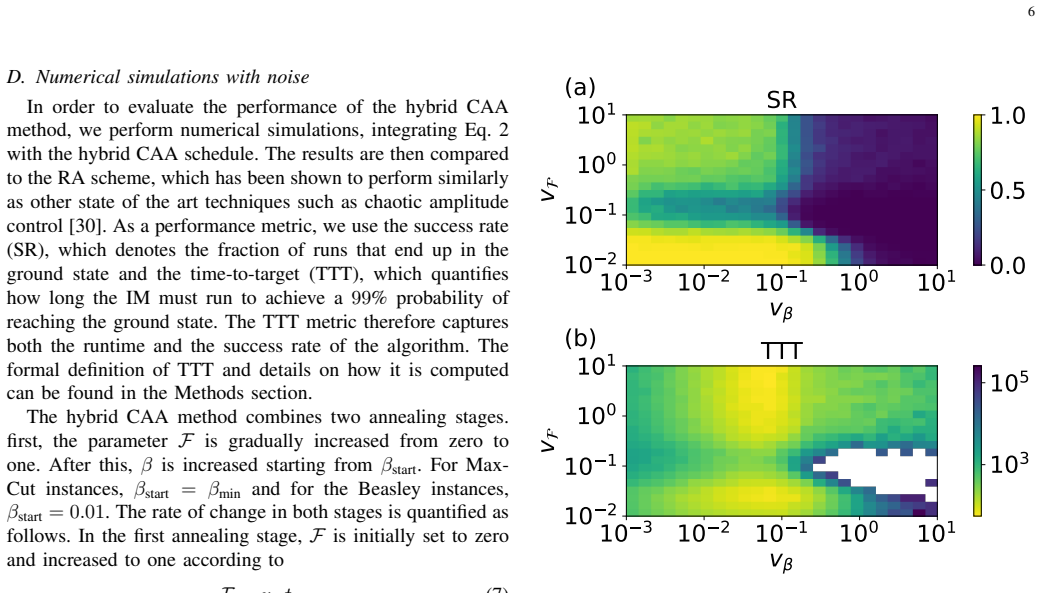
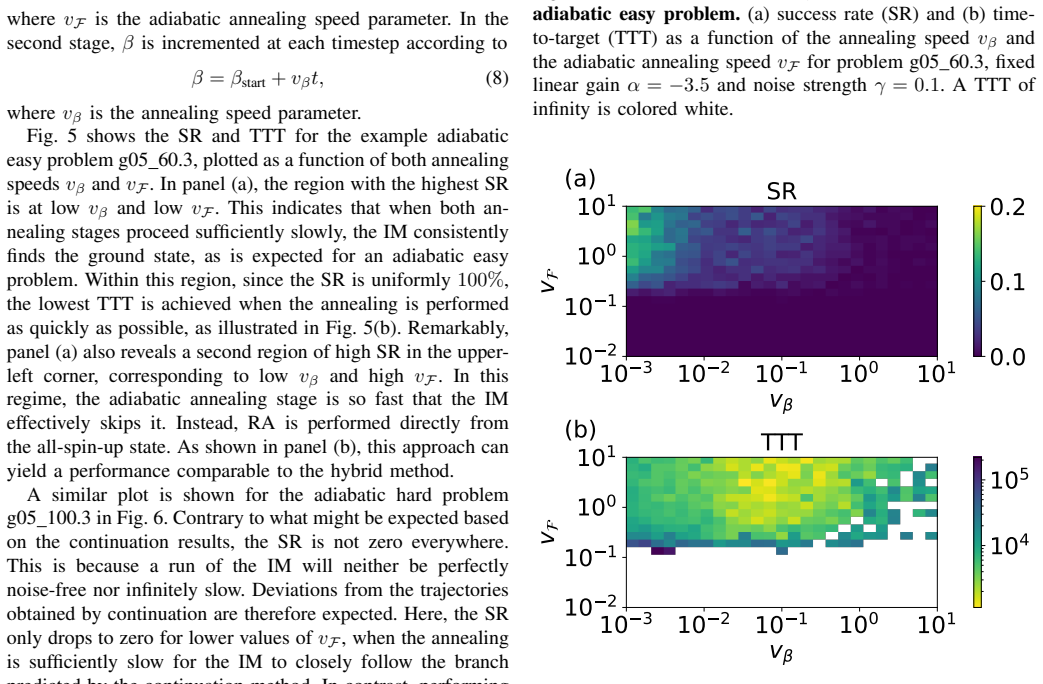
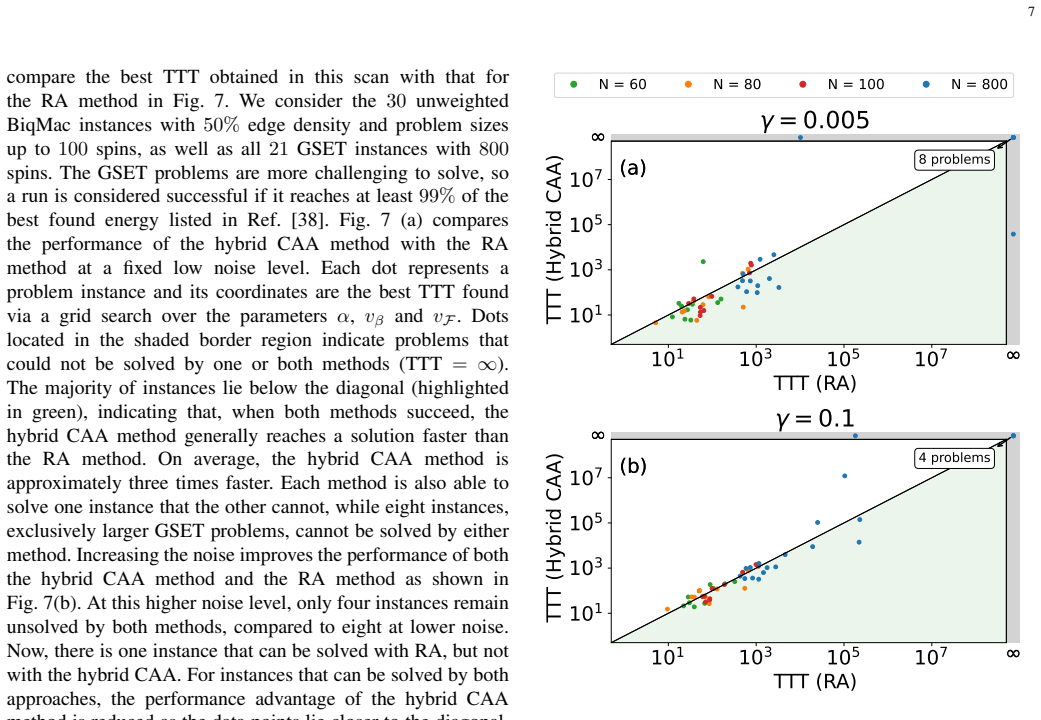
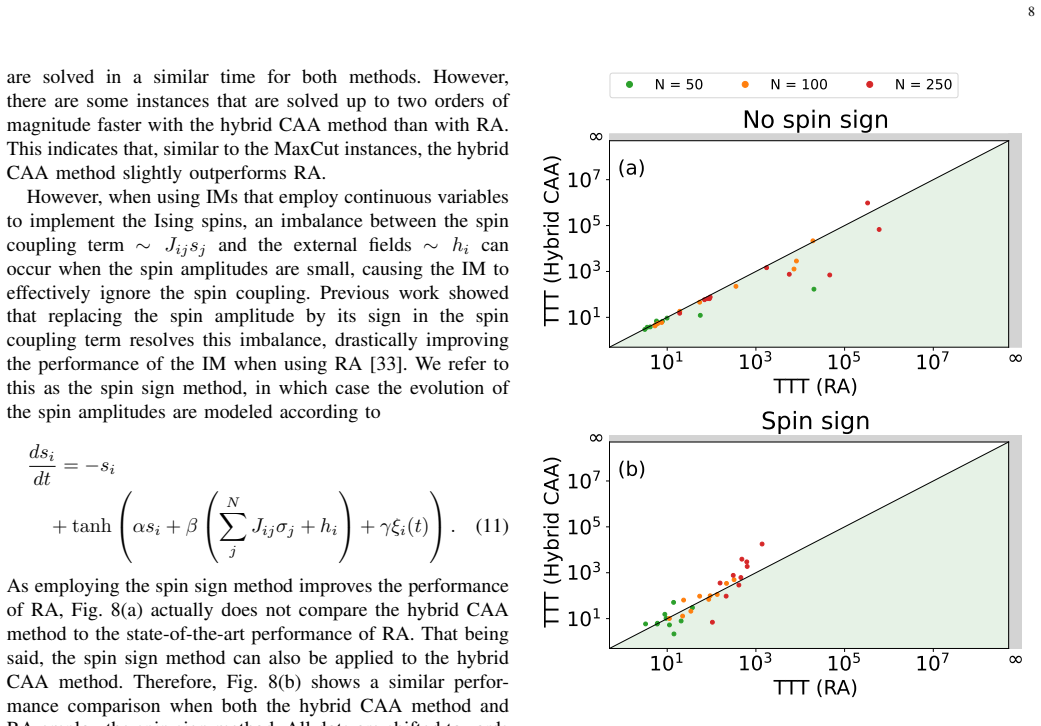
Ising machines are a promising approach to solve combinatorial optimization problems. They map these problems onto the Ising model and search for low-energy configurations. However, navigating the rugged energy landscapes of these systems remains difficult. To improve this navigation, classical adiabatic annealing has been proposed in the literature as a heuristic optimization method for classical Ising machines. Using this technique, the Hamiltonian of the Ising machine is gradually transformed from an easily solvable Hamiltonian to the target Hamiltonian. However, its purported effectiveness is primarily motivated by an analogy to quantum adiabatic annealing, and systematic benchmarking has remained limited. In this work, we analyze the classical adiabatic annealing technique using continuation methods. Motivated by insights from this analysis, we propose an optimized annealing strategy we refer to as hybrid classical adiabatic annealing. We benchmark our proposed strategy using MaxCut instances with up to 800 spins and problems with external fields, for which it achieves a marginal improvement for a limited set of problems. We conclude that, although theoretically motivated and occasionally beneficial, the hybrid strategy does not offer a sufficient practical advantage over simpler, existing techniques.
Editorial analysis
A structured set of objections, weighed in public.
Referee Report
Summary. The paper analyzes classical adiabatic annealing for Ising machines via continuation methods, proposes a hybrid annealing strategy motivated by this analysis, and benchmarks the hybrid approach on MaxCut instances (up to 800 spins) and problems with external fields. It reports marginal improvement on only a limited subset of problems and concludes that the hybrid strategy lacks sufficient practical advantage over simpler existing techniques, despite its theoretical motivation from the quantum adiabatic analogy.
Significance. If the empirical results hold under scrutiny, the work offers a useful caution against over-reliance on quantum-inspired heuristics for classical Ising machines, grounded in continuation-method analysis rather than ad-hoc fitting. The direct benchmarking against standard MaxCut instances (rather than self-referential or fitted-parameter derivations) is a strength, but the limited scope tempers broader impact on the field.
major comments (2)
- [Abstract and benchmarking results] Abstract and benchmarking results: the claim of 'marginal improvement for a limited set of problems' is load-bearing for the central negative conclusion on practical advantage, yet the manuscript provides no details on the number of instances tested, choice of statistical tests, error bars, or the precise parameterization and implementation of the hybrid schedule (including how continuation-method insights were translated into the schedule).
- [Benchmarking results] Benchmarking results: no explicit argument or additional experiments are given to establish that MaxCut instances (≤800 spins) and external-field problems are representative of the hardness regimes or scales where classical adiabatic annealing would be deployed on Ising machines in practice; the negative conclusion on practical utility therefore rests on an unverified representativeness assumption.
Simulated Author's Rebuttal
We thank the referee for the constructive feedback. We address each major comment below with clarifications and proposed revisions.
read point-by-point responses
-
Referee: [Abstract and benchmarking results] Abstract and benchmarking results: the claim of 'marginal improvement for a limited set of problems' is load-bearing for the central negative conclusion on practical advantage, yet the manuscript provides no details on the number of instances tested, choice of statistical tests, error bars, or the precise parameterization and implementation of the hybrid schedule (including how continuation-method insights were translated into the schedule).
Authors: We agree that greater transparency on the experimental protocol is necessary to support the central claim. In the revised manuscript we will add: the total number of MaxCut instances evaluated, the statistical tests used to compare solvers, error bars (standard deviation across runs), and an explicit description of the hybrid schedule, including the mapping from continuation-method analysis to the chosen annealing parameters and switching points between classical and hybrid phases. revision: yes
-
Referee: [Benchmarking results] Benchmarking results: no explicit argument or additional experiments are given to establish that MaxCut instances (≤800 spins) and external-field problems are representative of the hardness regimes or scales where classical adiabatic annealing would be deployed on Ising machines in practice; the negative conclusion on practical utility therefore rests on an unverified representativeness assumption.
Authors: We chose these instance sizes because they align with the operating range of current Ising-machine hardware and with standard MaxCut benchmarks in the literature. We will insert a dedicated paragraph in the revised manuscript that cites typical problem scales reported for Ising machines and explains why the tested regimes are relevant to practical deployment. Additional experiments at substantially larger scales lie outside the computational resources available for this study; the current benchmarks nevertheless provide a direct, reproducible basis for the cautious conclusion drawn. revision: partial
Circularity Check
Empirical benchmarking without circular derivation
full rationale
The paper's analysis relies on continuation methods to motivate a hybrid annealing strategy, followed by direct benchmarking on MaxCut instances (up to 800 spins) and external-field problems. The conclusion of marginal practical advantage follows from these empirical results rather than any self-referential derivation, fitted-parameter prediction, or load-bearing self-citation chain. No equations or claims reduce by construction to the inputs; the work is self-contained against external benchmarks.
Axiom & Free-Parameter Ledger
free parameters (1)
- hybrid annealing schedule parameters
axioms (1)
- domain assumption Continuation methods yield reliable insights into the trajectory of classical Ising systems during annealing.
Reference graph
Works this paper leans on
-
[1]
Ising formulations of many NP prob- lems
Andrew Lucas. “Ising formulations of many NP prob- lems”. In:Frontiers in physics2 (2014), p. 74887
2014
-
[2]
Quantum computing for finance: Overview and prospects
Rom ´an Or ´us, Samuel Mugel, and Enrique Lizaso. “Quantum computing for finance: Overview and prospects”. In:Reviews in Physics4 (2019), p. 100028
2019
-
[3]
Exploring Potential Applications of Ising Machines for Power System Operations
Kenta Kirihara et al. “Exploring Potential Applications of Ising Machines for Power System Operations”. In: IEEE Access11 (June 2023), pp. 68004 –68017.DOI: 10.1109/ACCESS.2023.3289720
-
[4]
Traffic flow optimization using a quantum annealer
Florian Neukart et al. “Traffic flow optimization using a quantum annealer”. In:Frontiers in ICT4 (2017), p. 29
2017
-
[5]
A case study in programming a quantum annealer for hard operational planning prob- lems
Eleanor G Rieffel et al. “A case study in programming a quantum annealer for hard operational planning prob- lems”. In:Quantum Information Processing14 (2015), pp. 1–36
2015
-
[6]
Supply chain logistics with quantum and classical annealing algorithms
Sean J. Weinberg et al. “Supply chain logistics with quantum and classical annealing algorithms”. In:Sci- entific Reports13 (1 2023).DOI: 10.1038/s41598-023- 31765-8
-
[7]
npj Quantum Information , author =
Richard Y . Li et al. “Quantum annealing versus classical machine learning applied to a simplified computational biology problem”. In:npj Quantum Information4 (1 2018).DOI: 10.1038/s41534-018-0060-8
-
[8]
Construction of model Hamiltonians for adiabatic quantum computation and its application to finding low-energy conformations of lattice protein models
Alejandro Perdomo et al. “Construction of model Hamiltonians for adiabatic quantum computation and its application to finding low-energy conformations of lattice protein models”. In:Physical Review A78.1 (2008), p. 012320
2008
-
[9]
Ising machines as hardware solvers of combinatorial optimization problems
Naeimeh Mohseni, Peter L McMahon, and Tim Byrnes. “Ising machines as hardware solvers of combinatorial optimization problems”. In:Nature Reviews Physics4.6 (2022), pp. 363–379
2022
-
[10]
Quantum annealing with man- ufactured spins
Mark W Johnson et al. “Quantum annealing with man- ufactured spins”. In:Nature473.7346 (2011), pp. 194– 198
2011
-
[11]
Physics-Inspired Optimization for Quadratic Unconstrained Problems Using a Digital Annealer
Maliheh Aramon et al. “Physics-Inspired Optimization for Quadratic Unconstrained Problems Using a Digital Annealer”. In:Frontiers in Physics7 (Apr. 2019), p. 48. DOI: 10.3389/fphy.2019.00048
-
[12]
Large-scale photonic Ising machine by spatial light modulation
D Pierangeli, G Marcucci, and C Conti. “Large-scale photonic Ising machine by spatial light modulation”. In:Physical review letters122.21 (2019), p. 213902
2019
-
[13]
Probabilistic computing with p-bits
Jan Kaiser and Supriyo Datta. “Probabilistic computing with p-bits”. In:Applied Physics Letters119 (15 2021). DOI: https://doi.org/10.1063/5.0067927
-
[14]
Stochasticp-Bits for In- vertible Logic
Kerem Yunus Camsari et al. “Stochasticp-Bits for In- vertible Logic”. In:Phys. Rev. X7 (3 2017), p. 031014. DOI: 10.1103/PhysRevX.7.031014
-
[15]
Christian Duffee et al. “Integrated probabilistic com- puter using voltage-controlled magnetic tunnel junctions as its entropy source”. In:ArXiv(2024).DOI: 10.48550/ arXiv.2412.08017
arXiv 2024
-
[16]
A coherent Ising machine for 2000-node optimization problems
Takahiro Inagaki et al. “A coherent Ising machine for 2000-node optimization problems”. In:Science 354.6312 (2016), pp. 603–606
2000
-
[17]
100,000-spin coherent Ising machine
Toshimori Honjo et al. “100,000-spin coherent Ising machine”. In:Science advances7.40 (2021), eabh0952
2021
-
[18]
A poor man’s coherent Ising machine based on opto-electronic feedback systems for solving optimiza- tion problems
Fabian B ¨ohm, Guy Verschaffelt, and Guy Van der Sande. “A poor man’s coherent Ising machine based on opto-electronic feedback systems for solving optimiza- tion problems”. In:Nature communications10.1 (2019), p. 3538
2019
-
[19]
Programmable 200 GOPS Hopfield-inspired photonic Ising machine
Nayem Al-Kayed et al. “Programmable 200 GOPS Hopfield-inspired photonic Ising machine”. In:Nature 648 (2025), pp. 576–584.DOI: 10 . 1364 / OPTICA . 398000
2025
-
[20]
An Ising machine based on net- works of subharmonic electrical resonators
L. Q. English et al. “An Ising machine based on net- works of subharmonic electrical resonators”. In:Com- munications Physics5 (1 2022)
2022
-
[21]
Efficient combinatorial optimiza- tion by quantum-inspired parallel annealing in analogue memristor crossbar
Mingrui Jiang et al. “Efficient combinatorial optimiza- tion by quantum-inspired parallel annealing in analogue memristor crossbar”. In:Nature communications14.1 (2023), p. 5927
2023
-
[22]
Realizing the classical XY Hamiltonian in polariton simulators
Natalia G Berloff et al. “Realizing the classical XY Hamiltonian in polariton simulators”. In:Nature ma- terials16.11 (2017), pp. 1120–1126
2017
-
[23]
Global op- timization of spin Hamiltonians with gain-dissipative systems
Kirill P Kalinin and Natalia G Berloff. “Global op- timization of spin Hamiltonians with gain-dissipative systems”. In:Scientific reports8.1 (2018), p. 17791
2018
-
[24]
Edward Farhi et al. “A Quantum Adiabatic Evolu- tion Algorithm Applied to Random Instances of an NP-Complete Problem”. In:Science292.5516 (2001), pp. 472–475.DOI: 10.1126/science.1057726
-
[25]
Giuseppe E Santoro and Erio Tosatti. “Optimization using quantum mechanics: quantum annealing through adiabatic evolution”. In:Journal of Physics A: Mathe- matical and General39.36 (2006).DOI: 10.1088/0305- 4470/39/36/R01
-
[26]
Adiabatic evolution on a spatial-photonic Ising ma- chine
Davide Pierangeli, Giulia Marcucci, and Claudio Conti. “Adiabatic evolution on a spatial-photonic Ising ma- chine”. In:Optica7.11 (2020), pp. 1535–1543.DOI: 10.1364/OPTICA.398000
- [27]
-
[28]
Geometric Landscape Annealing as an Optimization Principle Underlying the Coherent Ising Machine
Atsushi Yamamura, Hideo Mabuchi, and Surya Ganguli. “Geometric Landscape Annealing as an Optimization Principle Underlying the Coherent Ising Machine”. In: Phys. Rev. X14 (3 2024), p. 031054.DOI: 10.1103/ PhysRevX.14.031054
2024
-
[29]
Using continuation methods to analyse the difficulty of problems solved by Ising machines
Jacob Lamers, Guy Verschaffelt, and Guy Van der Sande. “Using continuation methods to analyse the difficulty of problems solved by Ising machines”. In: Communications Physics7 (1 2024)
2024
-
[30]
Predicting the optimal noise strength for solving op- timization problems with analog Ising machines
Leen Mys, Guy Verschaffelt, and Guy Van der Sande. “Predicting the optimal noise strength for solving op- timization problems with analog Ising machines”. In: Phys. Rev. Appl.25 (3 2026), p. 034068.DOI: 10.1103/ czsz-z8ng. 12
2026
-
[31]
High-performance combinatorial optimization based on classical mechanics
Hayato Goto et al. “High-performance combinatorial optimization based on classical mechanics”. In:Science Advances7.6 (2021), eabe7953
2021
-
[32]
Mean-field coherent Ising machines with artificial Zee- man terms
Mastiyage Don Sudeera Hasaranga Gunathilaka et al. “Mean-field coherent Ising machines with artificial Zee- man terms”. In:J. Appl. Phys134 (23 2023)
2023
-
[33]
How to Incorporate External Fields in Analog Ising Machines
Robbe De Prins et al. “How to Incorporate External Fields in Analog Ising Machines”. In:ArXiv(2025). DOI: 10.48550/arXiv.2505.08796
-
[34]
Order-of-magnitude differences in computational performance of analog Ising machines induced by the choice of nonlinearity
Fabian B ¨ohm et al. “Order-of-magnitude differences in computational performance of analog Ising machines induced by the choice of nonlinearity”. In:Communi- cations Physics4.1 (2021), p. 149
2021
-
[35]
2007.URL: https : / / biqmac
Angelika Wiegele.Biq Mac Library - A collection of Max-Cut and quadratic 0-1 programming instances of medium size. 2007.URL: https : / / biqmac . aau . at / biqmaclib.pdf
2007
-
[36]
Y . Ye.GSET. Accessed: 2025-05-21.URL: https://web. stanford.edu/∼yyye/yyye/Gset/
2025
-
[37]
Doedel et al.AUTO-07p: Continuation and bifurcation software for ordinary differential equations
Eusebius J. Doedel et al.AUTO-07p: Continuation and bifurcation software for ordinary differential equations. 2007
2007
-
[38]
A multiple search operator heuristic for the max-k-cut problem
Fuda Ma and Jin-Kao Hao. “A multiple search operator heuristic for the max-k-cut problem”. In:Annals of Operations Research248.1 (2017), pp. 365–403
2017
-
[39]
Computational complexity continuum within Ising formulation of NP problems
Kirill P Kalinin and Natalia G Berloff. “Computational complexity continuum within Ising formulation of NP problems”. In:Communications Physics5.1 (2022), p. 20. 13 VIII. APPENDIX A. Initial Hamiltonian A natural choice for the initial Hamiltonian is one whose ground state is easily found. A class of such problems is known as spectral easy problems [29], ...
2022
discussion (0)
Sign in with ORCID, Apple, or X to comment. Anyone can read and Pith papers without signing in.