Correction of the basis set error due to the absence of the electron-electron cusp in the wave function by using an adiabatic correction
Pith reviewed 2026-06-27 20:19 UTC · model grok-4.3
The pith
An adiabatic-connection correction derived from a basis-set equivalence removes the electron-electron cusp error in finite basis calculations.
A machine-rendered reading of the paper's core claim, the machinery that carries it, and where it could break.
Core claim
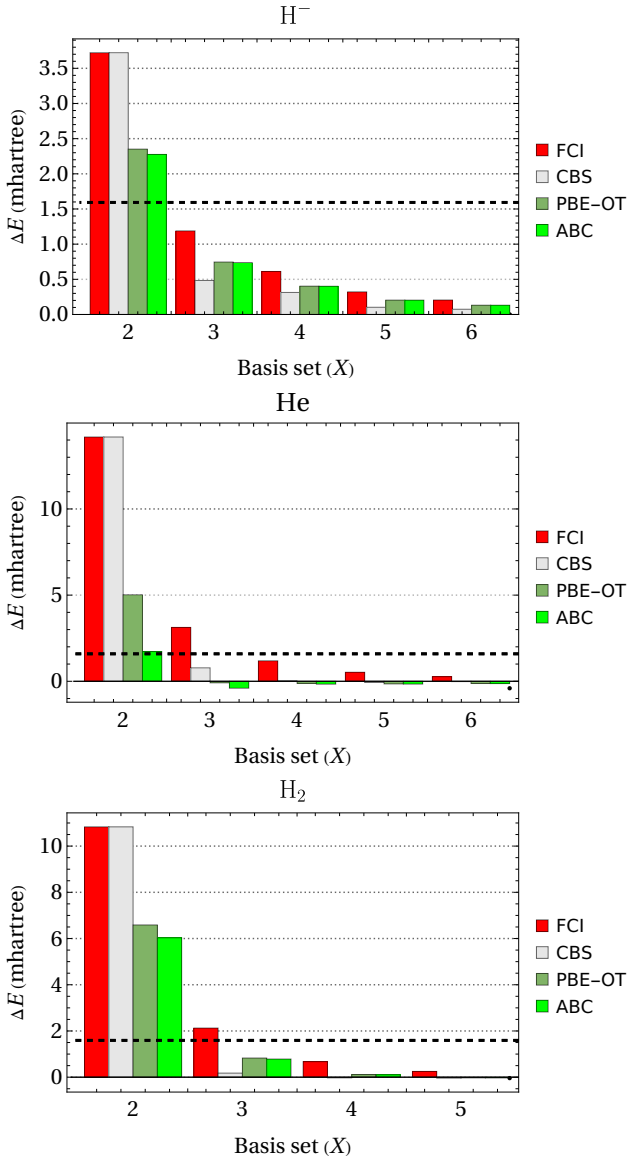
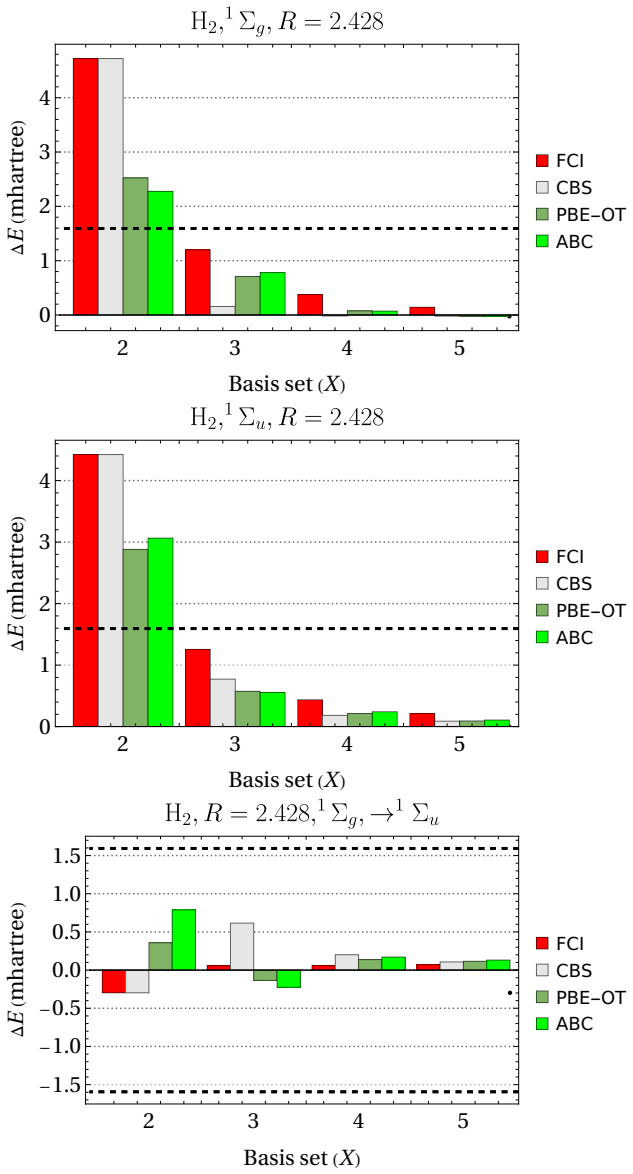
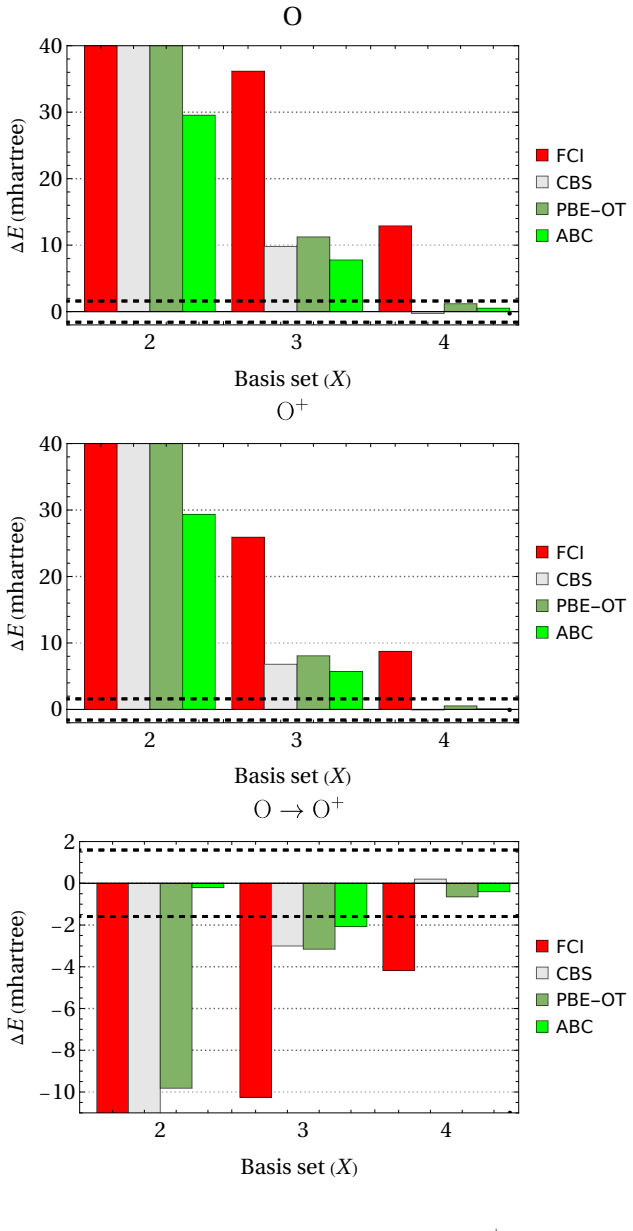
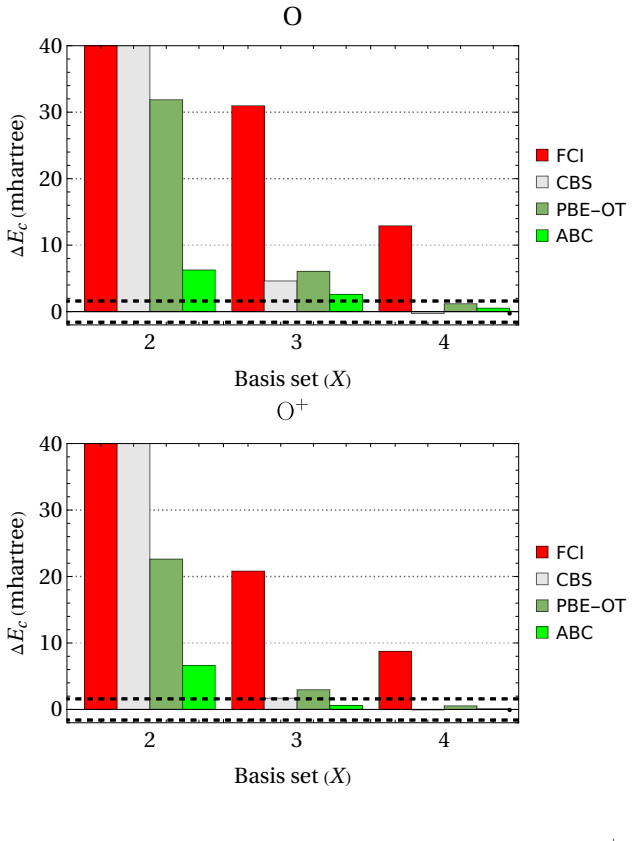
The paper establishes an equivalence between finite-basis physical Coulomb calculations and complete-basis error-function screened Coulomb calculations characterized by μ. From this and the adiabatic connection, a correction formula is obtained from the asymptotic expansion at large μ. The ABC correction depends only on the on-top pair density and a basis-derived local μ, and numerical tests confirm it delivers chemical accuracy with reduced basis set sizes for ground and excited states.
What carries the argument
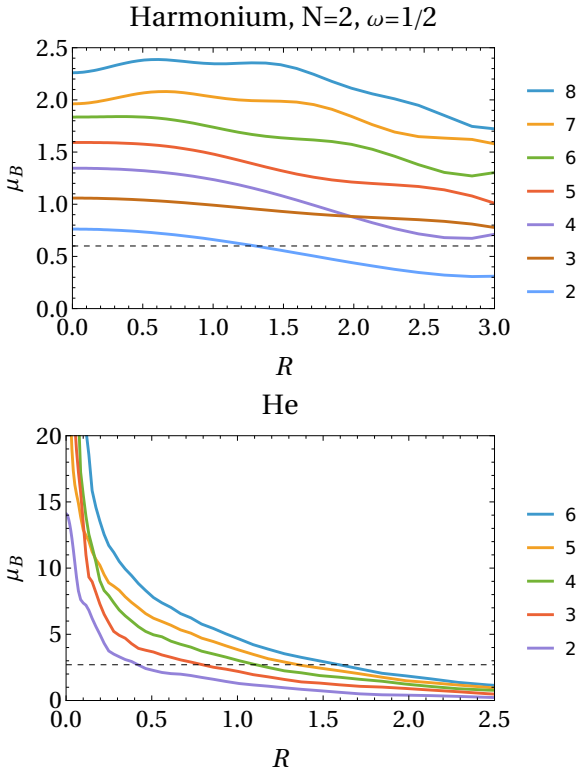
The mapping of finite-basis Coulomb calculations to complete-basis error-function screened calculations with range-separation parameter μ, combined with the adiabatic connection to extract the cusp correction from the on-top pair density.
If this is right
- Smaller basis sets suffice to reach chemical accuracy after applying the correction.
- The correction requires no empirical parameters and uses only the on-top pair density and local μ.
- The formula applies equally to ground and excited states.
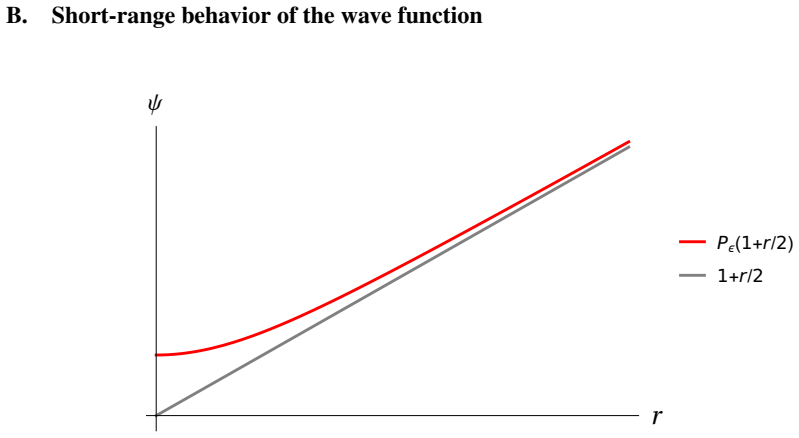
- The derivation relies on the short-distance asymptotic behavior of the wave function.
Where Pith is reading between the lines
- The local definition of μ from the basis set may allow straightforward implementation in various quantum chemistry programs.
- This suggests that the dominant basis set error is short-range and can be isolated from other correlation effects.
- Similar corrections could be explored for other observables computed from the wave function.
Load-bearing premise
The assumption that the basis set error with the physical interaction is equivalent to the difference introduced by using a screened interaction in a complete basis, with μ chosen to match the basis.
What would settle it
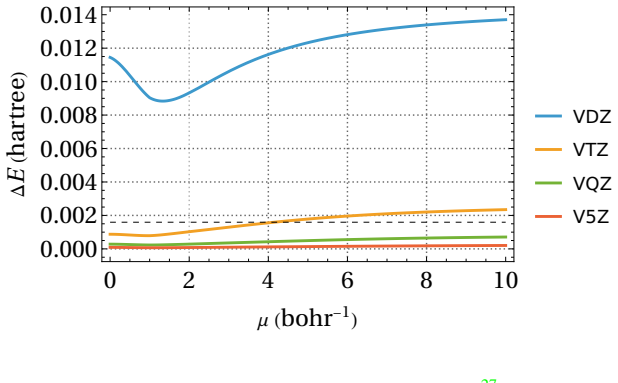
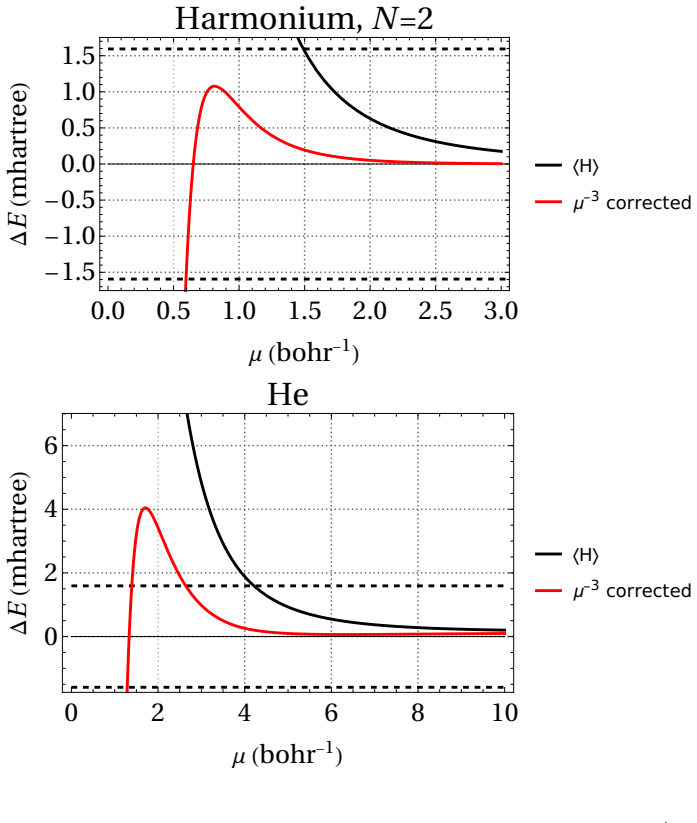
A direct comparison between ABC-corrected energies from small basis sets and reference values from much larger basis sets or explicitly correlated methods; persistent errors beyond chemical accuracy would disprove the correction's effectiveness.
Figures
read the original abstract
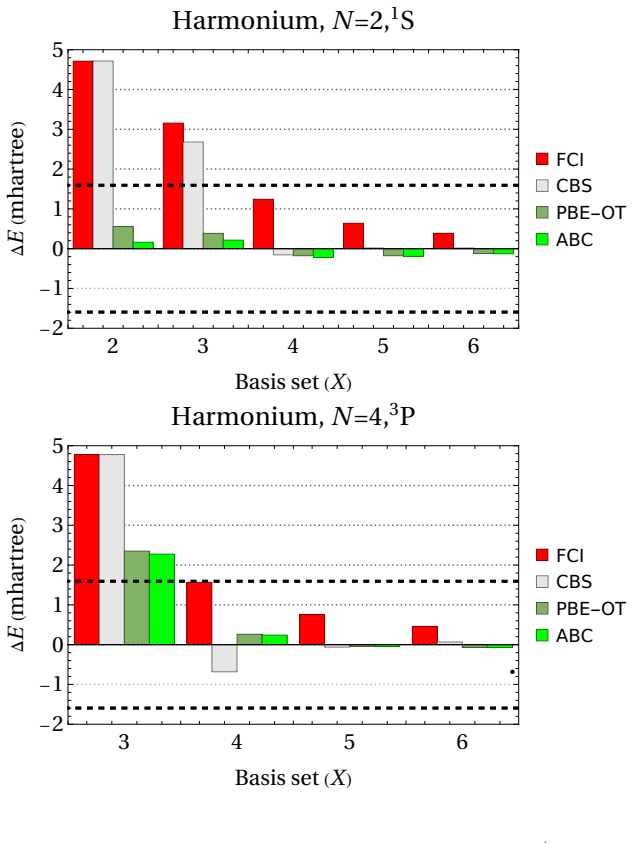
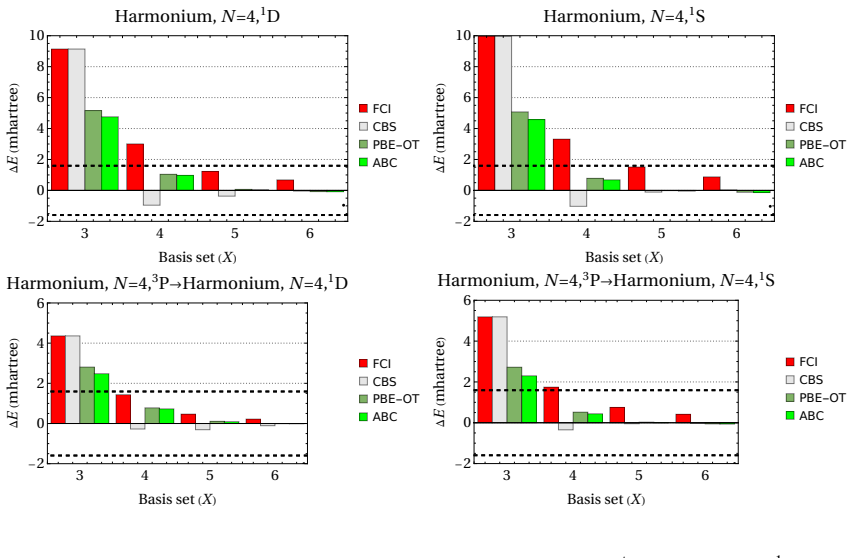
This article proposes an analytical method to address the slow convergence of electronic structure calculations caused by the inability of finite one-particle basis sets to describe the electron-electron cusp. An equivalence is made between a calculation using a finite basis set with the physical Coulomb interaction and a calculation using a complete basis set with a model interaction (specifically, the error-function screened Coulomb potential characterized by a range-separation parameter $\mu$). By leveraging the adiabatic connection formalism, a simple, parameter-free correction formula is derived. It depends only on the on-top pair density and a locally defined range-separation parameter ($\mu$) derived from the basis set itself. This `adiabatic connection based basis set error correction' (ABC) is derived from the asymptotic expansion of the wave function at large $\mu$ for small inter-electronic distances. Therefore it is applicable to both ground and excited states without the restriction imposed by the Hohenberg-Kohn theorem. Numerical tests illustrate that the method achieves chemical accuracy using smaller basis sets than typically required.
Editorial analysis
A structured set of objections, weighed in public.
Referee Report
Summary. The manuscript proposes an analytical correction for the basis-set incompleteness error arising from the electron-electron cusp. It posits an equivalence between a finite-basis calculation using the physical Coulomb interaction and a complete-basis calculation using the error-function screened interaction erf(μr)/r, where the range-separation parameter μ is locally defined from the basis set. Using the adiabatic-connection formalism and the large-μ asymptotic expansion of the wave function at small inter-electronic distances, a parameter-free correction is derived that depends only on the on-top pair density and this local μ. The method is stated to apply to both ground and excited states, and numerical tests are presented to show that chemical accuracy can be reached with smaller basis sets than usual.
Significance. If the posited equivalence and the subsequent derivation hold, the approach would supply a simple, parameter-free post-processing correction for cusp-related basis-set error that does not rely on the Hohenberg-Kohn theorem and is therefore usable for excited states. The explicit dependence on the on-top pair density and a basis-derived μ is attractive because it avoids additional fitted parameters. The numerical illustrations, if reproducible, would demonstrate practical utility for reducing basis-set requirements.
major comments (2)
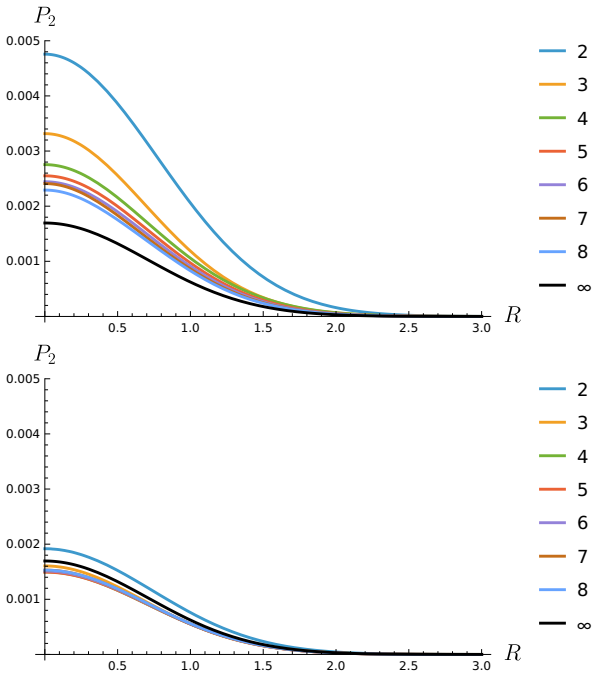
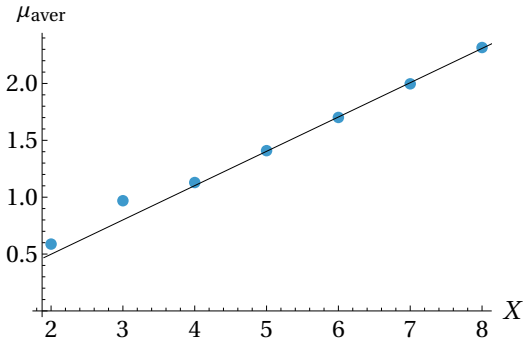
- [Abstract and equivalence section] Abstract (second paragraph) and the section introducing the equivalence: the central mapping between a finite-basis physical-Coulomb calculation and a complete-basis erf-screened calculation is asserted without derivation or error bound. No explicit rule is given for extracting the local μ from the basis (e.g., from Gaussian exponents, short-range fitting, or angular-momentum cutoff), so it is not shown that the screened interaction reproduces the missing high-angular-momentum components that cause the actual cusp error.
- [Derivation of the ABC correction] Section deriving the correction via adiabatic connection: the asymptotic expansion at large μ is invoked to obtain a formula depending only on the on-top pair density, but the intermediate steps that convert the adiabatic-connection integrand into this local expression are not supplied. Without those steps it cannot be verified that the correction exactly cancels the basis-set error under the posited equivalence rather than an approximate model Hamiltonian.
minor comments (2)
- [Numerical tests] The numerical tests section should tabulate the molecules, basis sets, reference values, and raw errors before/after correction so that the claimed chemical accuracy can be reproduced and the dependence on the choice of μ can be inspected.
- [Notation] Notation for the on-top pair density and the local μ should be introduced with a single consistent symbol and a brief definition when first used, rather than relying on the abstract alone.
Simulated Author's Rebuttal
We thank the referee for their careful reading of the manuscript and for the constructive comments. We respond to each major comment below.
read point-by-point responses
-
Referee: [Abstract and equivalence section] Abstract (second paragraph) and the section introducing the equivalence: the central mapping between a finite-basis physical-Coulomb calculation and a complete-basis erf-screened calculation is asserted without derivation or error bound. No explicit rule is given for extracting the local μ from the basis (e.g., from Gaussian exponents, short-range fitting, or angular-momentum cutoff), so it is not shown that the screened interaction reproduces the missing high-angular-momentum components that cause the actual cusp error.
Authors: The equivalence is introduced as a physically motivated working hypothesis linking the dominant short-range basis-set deficiency to the attenuation provided by the erf-screened interaction. While a formal derivation or rigorous error bound is not supplied in the present manuscript, the subsequent adiabatic-connection analysis and the numerical tests are predicated on this mapping. We will add an expanded paragraph detailing the concrete procedure used to obtain the local μ from the basis-set exponents and angular-momentum content, thereby making the construction of the screened interaction explicit. revision: partial
-
Referee: [Derivation of the ABC correction] Section deriving the correction via adiabatic connection: the asymptotic expansion at large μ is invoked to obtain a formula depending only on the on-top pair density, but the intermediate steps that convert the adiabatic-connection integrand into this local expression are not supplied. Without those steps it cannot be verified that the correction exactly cancels the basis-set error under the posited equivalence rather than an approximate model Hamiltonian.
Authors: The derivation relies on substituting the large-μ asymptotic form of the wave function into the adiabatic-connection integrand and integrating under the equivalence assumption. We agree that the intermediate algebraic manipulations are only sketched and should be written out in full. In the revised manuscript we will insert the explicit sequence of steps that converts the integrand into the final on-top-pair-density expression, thereby allowing direct verification that the correction is tied to the posited equivalence. revision: yes
Circularity Check
No significant circularity; derivation rests on external asymptotic analysis and posited equivalence rather than self-referential reduction.
full rationale
The paper posits an equivalence between finite-basis physical Coulomb calculations and complete-basis erf-screened interactions, then derives the ABC correction from the adiabatic connection's large-μ asymptotic expansion of the wave function at small interelectronic distances. This expansion yields a formula depending only on the on-top pair density and a locally defined μ taken from the basis set. No equation or step reduces the output correction to a fitted parameter or to the input data by construction; the derivation is presented as independent of the target observables and applicable to ground/excited states via wave-function properties. The equivalence itself is an assumption whose justification is external to the derivation chain, not a self-definition or self-citation load-bearing step. No renaming of known results or ansatz smuggling via prior self-work is indicated in the abstract or reader's summary.
Axiom & Free-Parameter Ledger
axioms (1)
- domain assumption Equivalence between a finite basis set calculation with physical Coulomb interaction and a complete basis set calculation with error-function screened Coulomb interaction
Reference graph
Works this paper leans on
-
[1]
Br. J. Chem. Phys. , volume =. 2022 , month = mar, issn =. 35291795 , doi =
2022
-
[2]
Hou, Lin and Irons, Tom J. P. and Wang, Yanyong and Furness, James W. and Wibowo-Teale, Andrew M. and Sun, Jianwei , title =. J. Chem. Phys. , volume =. 2024 , month = jan, issn =
2024
-
[3]
Aashamar and T
K. Aashamar and T. M. Luke and J.D. Talman , journal =. Optimized central potentials for atomic ground state wave functions , volume =
-
[4]
Abramowitz and I
M. Abramowitz and I. A. Stegun , title =
-
[5]
Adamo and V
C. Adamo and V. Barone , journal =
-
[6]
Adamson, Jeremy P
Ross D. Adamson, Jeremy P. Dombroski, Peter M. W. Gill , title =. J. Comput. Chem. , pages =. 1999 , volume =
1999
-
[7]
Adamo and M
C. Adamo and M. Ernzerhof and G. E. Scuseria , journal =
-
[8]
Aidas and A
K. Aidas and A. M. J. Chem. Phys. , volume =
-
[9]
Akinaga and S
Y. Akinaga and S. Ten-no , journal =
-
[10]
Mehboob Alam and Killian Deur and Stefan Knecht and Emmanuel Fromager , journal =
Md. Mehboob Alam and Killian Deur and Stefan Knecht and Emmanuel Fromager , journal =
-
[11]
Mehboob Alam and Stefan Knecht and Emmanuel Fromager , journal =
Md. Mehboob Alam and Stefan Knecht and Emmanuel Fromager , journal =
-
[12]
S. A. Alexander and R. L. Coldwell , journal =
-
[13]
Alijah and G
A. Alijah and G. Duxbury , journal =
-
[14]
Mojtaba Alipour , journal =
-
[15]
Allard and A
O. Allard and A. Pashov and H. Kn\"ockel and E. Tiemann , journal =
-
[16]
Almbladh and U
C.-O. Almbladh and U. von Barth , title =. Phys. Rev. B , volume =
-
[17]
Almbladh and A
C.-0. Almbladh and A. C. Pedroza , title =. Phys. Rev. A , volume =
-
[18]
A. G. Anderson and W. A. Goddard III. 2010 , journal =
2010
-
[19]
A. G. Anderson et W. A. Goddard III. 2010 , journal =
2010
-
[20]
J. B. Anderson , year =. J. Chem. Phys. , volume =
-
[21]
Andersson and D
Y. Andersson and D. C. Langreth and B. I. Lundqvist , title =. Phys. Rev. Lett. , pages =. 1996 , volume =
1996
-
[22]
J. M. Anglada and J. M. Bofill , journal =
-
[23]
J. G. \'Angy\'an and I. Gerber and A. Savin and J. Toulouse , title =. , year =
-
[24]
J. G. \'Angy\'an and I. C. Gerber and A. Savin and J. Toulouse , title =. Phys. Rev. A , volume =
-
[25]
J. G. \'Angy\'an , title =. J. Chem. Phys. , volume =
-
[26]
J. G. \'Angy\'an and R.-F. Liu and J. Toulouse and G. Jansen , title =. J. Chem. Theory Comput. , volume =
-
[27]
J. G. \'Angyan and R.-F. Liu and J. Toulouse and G. Jansen , note =
-
[28]
J. G. \'Angy\'an , journal =
-
[29]
2020 , note =
Ayoub Aouina and Matteo Gatti and Lucia Reining , journal =. 2020 , note =
2020
-
[30]
Aquilante and V
F. Aquilante and V. Barone and B. O. Roos , journal =
-
[31]
A. V. Arbuznikov and M. Kaupp , journal =
-
[32]
A. V. Arbuznikov and M. Kaupp and V. G. Malkin and R. Reviakine and O. L. Malkina , journal =
-
[33]
P. N. Argyres , title =. Phys. Rev. , volume =
-
[34]
Arias de Saavedra and I
F. Arias de Saavedra and I. Porras and E. Buend\'ia and F. J. G\'alvez , journal =
-
[35]
Armiento and A
R. Armiento and A. E. Mattsson , title =. 2002 , journal =
2002
-
[36]
Armiento and A
R. Armiento and A. E. Mattsson , title =. 2003 , journal =
2003
-
[37]
Artacho and L
E. Artacho and L. Mil\'ans del Bosch , title =. Phys. Rev. A , pages =. 1991 , volume =
1991
-
[38]
Aryasetiawan and O
F. Aryasetiawan and O. Gunnarsson and A. Rubio , journal =
-
[39]
and Miyake, T
Aryasetiawan, F. and Miyake, T. and Terakura, K. , title =. Phys. Rev. Lett. , year =
-
[40]
Thilo Aschebrock and Stefan K. J. Chem. Phys. , volume =
-
[41]
Aspuru-Guzik and O
A. Aspuru-Guzik and O. El Akramine and J. C. Grossman and W. A. Lester , journal =
-
[42]
Assaraf and M
R. Assaraf and M. Caffarel , journal =
-
[43]
Assaraf and M
R. Assaraf and M. Caffarel and A. Scemama , journal =
-
[44]
Atchity and Klaus Ruedenberg , collaboration =
Gregory J. Atchity and Klaus Ruedenberg , collaboration =. Strong shifts in diabatic nondynamic electron correlations cause conical intersection between low-lying closed-shell adiabatic singlets of like symmetry in ozone , publisher =. 1993 , journal =
1993
-
[45]
B. M. Austin and D. Yu. Zubarev and W. A. Lester , title = ". Chem. Rev. , volume =
-
[46]
F. W. Averill and G. S. Painter , journal =. 1981 , volume =
1981
-
[47]
F. W. Averill and G. S. Painter , journal =
-
[48]
P. Y. Ayala and G. E. Scuseria and A. Savin , title =. Chem. Phys. Letters , volume =
-
[49]
P. W. Ayers and M. Levy and A. Nagy , journal =
-
[50]
P. W. Ayers and M. Levy , journal =
-
[51]
R. A. Aziz and M. J. Slaman , title =. Chem. Phys. , volume =
-
[52]
Badinski and P
A. Badinski and P. D. Haynes and J. R. Trail and R. J. Needs , journal =
-
[53]
E. J. Baerends and O. V. Gritsenko , journal =
-
[54]
Roi Baer and Daniel Neuhauser , note =
-
[55]
2005 , journal =
Roi Baer and Daniel Neuhauser , title =. 2005 , journal =
2005
-
[56]
E. J. Baerends , journal =. 2001 , volume =
2001
-
[57]
Bajdich and L
M. Bajdich and L. Mitas and G. Drobn\'y and L. K. Wagner , journal =. 2006 , volume =
2006
-
[58]
Bajdich and L
M. Bajdich and L. Mitas and L. K. Wagner and K. E. Schmidt , journal =
-
[59]
Bajdich and M
M. Bajdich and M. L. Tiago and R. Q. Hood and P. R. C. Kent and F. A. Reboredo , title = ". Phys. Rev. Lett. , volume =
-
[60]
Baker , journal =
J. Baker , journal =
-
[61]
W. J. Balfour and A. E. Douglas , journal =
-
[62]
Banerjee and N
A. Banerjee and N. Adams and J. Simons and R. Shepard , journal =
-
[63]
Banerjee and J
A. Banerjee and J. Autschbach and A. Chakrabarti , journal =
-
[64]
Banerjee and A
A. Banerjee and A. Chakrabarti and T. K. Ghanty , journal =
-
[65]
Banerjee and F
A. Banerjee and F. Grein , journal =
-
[66]
Banerjee and M
A. Banerjee and M. K. Harbola , journal =
-
[67]
Barone and C
V. Barone and C. Adamo , journal =
-
[68]
von Barth and B
U. von Barth and B. Holm , title =. Phys. Rev. B , volume =
-
[69]
R. J. Bartlett , journal =
-
[70]
Bartolotti and Robert G
Libero J. Bartolotti and Robert G. Parr , title =. 1980 , journal =
1980
-
[71]
Bast and H
R. Bast and H. J. Aa. Jensen and T. Saue , journal =
-
[72]
Ronald Bass , title =. Phys. Rev. B , volume =
-
[73]
Bauernschmitt and R
R. Bauernschmitt and R. Ahlrichs , journal =
-
[74]
Baym and L
G. Baym and L. P. Kadanoff , title =. Phys. Rev. , volume =
-
[75]
Baym , title =
G. Baym , title =. Phys. Rev. , volume =
-
[76]
A. D. Becke , title = ". Int. J. Quantum Chem. , pages =. 1983 , volume =
1983
-
[77]
R. S. Becker and K. Inuzuka and J. King , journal =
-
[78]
A. D. Becke , journal =
-
[79]
A. D. Becke , title =. J. Chem. Phys. , pages =. 1986 , volume =
1986
-
[80]
Becke , title =
Axel D. Becke , title =. 1992 , journal =
1992
discussion (0)
Sign in with ORCID, Apple, or X to comment. Anyone can read and Pith papers without signing in.