Dependence Measures via Adapted Optimal Transport: Stability and Rates of Convergence
Pith reviewed 2026-06-27 20:27 UTC · model grok-4.3
The pith
An adapted optimal transport convergence mode restores continuity to dependence measures defined on conditional distributions.
A machine-rendered reading of the paper's core claim, the machinery that carries it, and where it could break.
Core claim
The paper establishes that an optimal transport-based mode of convergence, related to the adapted Wasserstein distance, captures weak convergence of conditional distributions. This restores continuity for dependence measures that characterize both independence and perfect functional dependence, allowing the derivation of O(N^{-1/3}) rates for their plug-in estimators based on the adapted empirical measure.
What carries the argument
The adapted empirical measure, which induces a convergence mode on conditional distributions via optimal transport that controls the continuity modulus of dependence measures.
If this is right
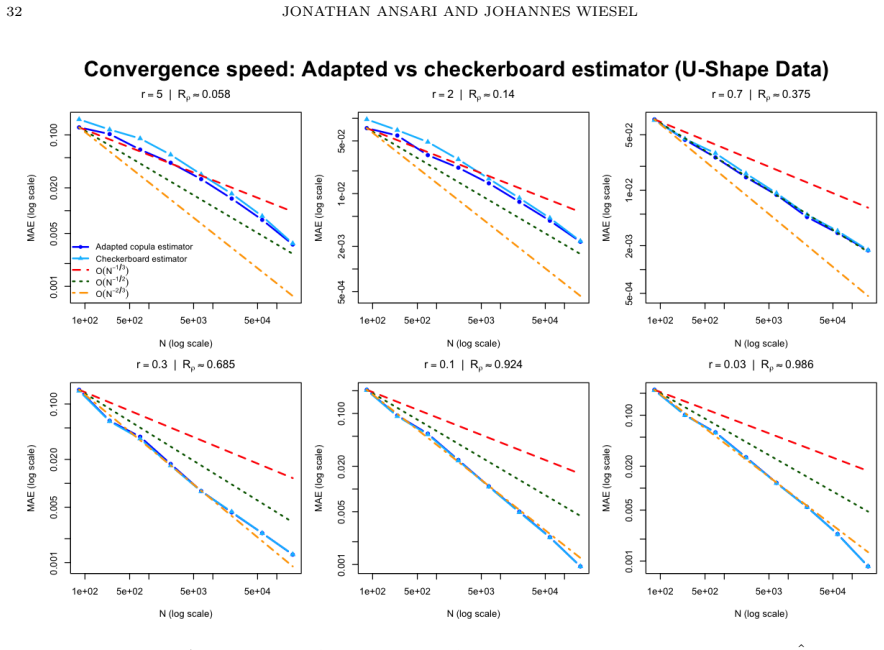
- Plug-in estimators of rank-based dependence measures achieve O(N^{-1/3}) rates under the new convergence.
- Rearranged dependence measures inherit the same convergence rates.
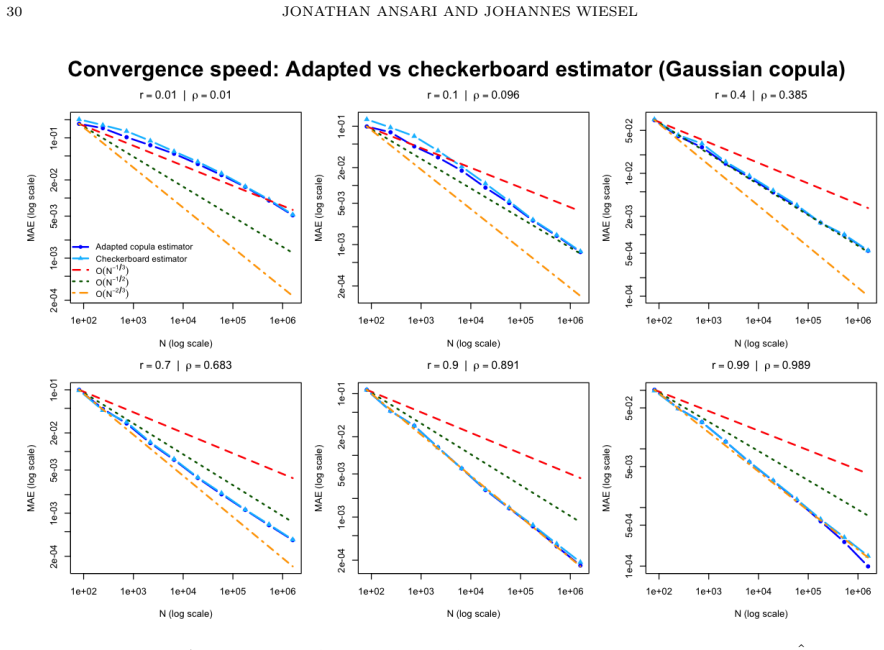
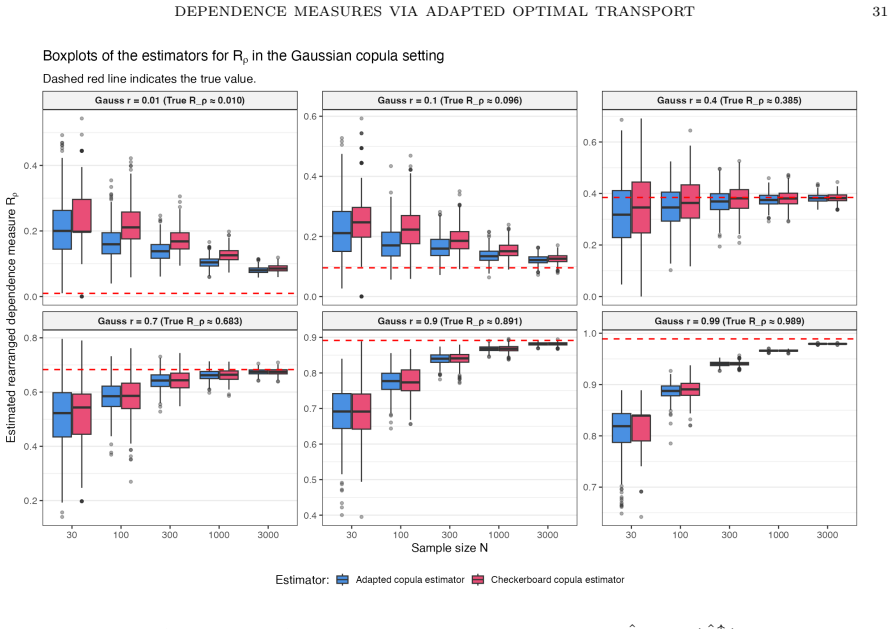
- The copula estimator based on the adapted empirical measure converges at O(N^{-1/3}) with respect to metrics capturing conditional weak continuity.
- The new convergence mode is related to the adapted Wasserstein distance, Knothe-Rosenblatt distance, and d1-metric on copulas.
Where Pith is reading between the lines
- This approach may allow consistent estimation in settings where conditional distributions vary, such as regression or time series.
- The framework could extend to other functionals of conditional distributions beyond dependence measures.
- Rates might improve under additional smoothness assumptions on the underlying distributions.
Load-bearing premise
The adapted empirical measure together with the chosen metrics on conditional distributions control the continuity modulus of the target dependence measures.
What would settle it
A counterexample showing a dependence measure that remains discontinuous even when conditional distributions converge weakly in the adapted optimal transport sense, or an empirical rate slower than N to the minus one third for the plug-in estimator.
Figures
read the original abstract
Recently studied dependence measures, such as Chatterjee's rank correlation, that characterize both independence and perfect functional dependence, provide a powerful framework for detecting nonlinear dependencies. However, these measures cannot be weakly continuous, which limits the applicability of classical plug-in estimators based on empirical distributions. This obstruction is natural, as such measures are defined via conditional distributions and not through their joint law alone. In this paper, we introduce an optimal transport-based mode of convergence that captures weak convergence of conditional distributions and restores continuity for a broad class of dependence measures. We relate this mode of convergence to the adapted Wasserstein distance, the Knothe-Rosenblatt distance and the d1-metric on copulas. Building on this perspective, we propose a copula estimator based on the adapted empirical measure and compare it with the classical rank-based checkerboard estimator. For both estimators, we derive O(N^{-1/3})-rates of convergence with respect to metrics that capture conditional weak continuity. As a consequence, we obtain the same rates for plug-in estimators of several classes of dependence measures, including rank-based and rearranged dependence measures.
Editorial analysis
A structured set of objections, weighed in public.
Referee Report
Summary. The paper introduces an optimal transport-based mode of convergence that metrizes weak convergence of conditional distributions, thereby restoring continuity for a broad class of dependence measures (including Chatterjee's rank correlation) that are defined via conditional laws rather than the joint distribution alone. It relates this mode to the adapted Wasserstein distance, the Knothe-Rosenblatt distance, and the d1-metric on copulas; proposes a copula estimator based on the adapted empirical measure and compares it to the classical rank-based checkerboard estimator; derives O(N^{-1/3}) rates of convergence for both estimators with respect to metrics capturing conditional weak continuity; and transfers these rates to plug-in estimators of rank-based and rearranged dependence measures.
Significance. If the central claims hold, the work provides a principled way to obtain explicit convergence rates for plug-in estimators of nonlinear dependence measures that previously lacked weak continuity, which is a meaningful advance for statistical inference on dependence. The explicit connections to adapted OT, Knothe-Rosenblatt, and copula metrics, together with the comparison of the adapted empirical estimator to the checkerboard estimator, strengthen the contribution. The use of standard empirical-process arguments adapted to the conditional setting to obtain the O(N^{-1/3}) rate is a positive technical feature.
minor comments (3)
- [§2.2] §2.2: the precise definition of the adapted empirical measure and the metric on conditional distributions should include an explicit statement of the constants or normalizations used, to make the O(N^{-1/3}) rate derivation fully transparent without reference to external results.
- [§4] The comparison between the adapted estimator and the checkerboard estimator in §4 would benefit from a short table summarizing the constants in the O(N^{-1/3}) bounds for each, to clarify whether one dominates the other uniformly.
- [Introduction / §3] Notation for the dependence measures (e.g., the functional form of Chatterjee's measure) is introduced in the abstract and introduction but should be restated once in the main technical section before the continuity argument is applied.
Simulated Author's Rebuttal
We thank the referee for the positive evaluation of our work and the recommendation of minor revision. No specific major comments were raised in the report, so we have no points to address point-by-point. We will incorporate any minor editorial suggestions in the revised version.
Circularity Check
No significant circularity
full rationale
The derivation begins from standard optimal transport objects (adapted Wasserstein, Knothe-Rosenblatt, copula metrics) and defines a new mode of convergence that metrizes weak convergence of conditional distributions. Continuity restoration for dependence measures and the O(N^{-1/3}) rates for plug-in estimators follow from the metric properties and standard empirical-process arguments applied to the adapted empirical measure; neither step reduces to a self-definition, a fitted parameter renamed as prediction, nor a load-bearing self-citation. The construction is externally grounded in existing OT theory and does not invoke uniqueness theorems or ansatzes from the authors' prior work to force the result.
Axiom & Free-Parameter Ledger
Reference graph
Works this paper leans on
-
[1]
Acciaio, B., Backhoff-Veraguas, J., and Carmona, R. (2019). Extended mean field control problems: stochastic maximum principle and transport perspective.SIAM journal on Control and Optimization, 57(6):3666–3693
2019
- [2]
-
[3]
Aldous, D. J. (1981). Weak Convergence and General Theory of Processes. Unpublished incomplete draft of monograph; Department of Statistics, University of California, Berkeley, CA 94720
1981
-
[4]
(2005).Gradient flows: in metric spaces and in the space of probability measures
Ambrosio, L., Gigli, N., and Savar´ e, G. (2005).Gradient flows: in metric spaces and in the space of probability measures. Springer
2005
-
[5]
Ansari, J. (2026). On a copula product linking Wasserstein correlations and rearranged dependence measures. Preprint, arXiv:2604.09950 [math.ST] (2026)
work page internal anchor Pith review Pith/arXiv arXiv 2026
-
[6]
and Fuchs, S
Ansari, J. and Fuchs, S. (2023+). A direct extension of Azadkia & Chatterjee’s rank correlation to multi-response vectors.Available atarXiv: 2212. 01621
2023
-
[7]
Ansari, J. and Fuchs, S. (2026). An ordering for the strength of functional dependence. Preprint, arXiv:2511.06498 [math.ST] (2026)
-
[8]
B., Fuchs, S., and Trutschnig, W
Ansari, J., Langthaler, P. B., Fuchs, S., and Trutschnig, W. (2026). Quantifying and estimating dependence via sensitivity of conditional distributions.Bernoulli, 32(1):179–204
2026
-
[9]
and R¨ uschendorf, L
Ansari, J. and R¨ uschendorf, L. (2021). Sklar’s theorem, copula products, and ordering results in factor models.Depend. Model., 9:267–306
2021
-
[10]
and Chatterjee, S
Azadkia, M. and Chatterjee, S. (2021). A simple measure of conditional dependence.Ann. Stat., 49(6):3070–3102
2021
-
[11]
and Roudaki, P
Azadkia, M. and Roudaki, P. (2025+). A new measure of dependence: IntegratedR 2.Available at https: // arxiv. org/ abs/ 2505. 18146
2025
-
[12]
Backhoff, J., Bartl, D., Beiglb¨ ock, M., and Wiesel, J. (2022). Estimating processes in adapted Wasserstein distance.Ann. Appl. Probab., 32(1):529–550
2022
-
[13]
Backhoff-Veraguas, J., Bartl, D., Beiglb¨ ock, M., and Eder, M. (2020). All adapted topologies are equal.Probability Theory and Related Fields, 178:1125–1172
2020
- [14]
- [15]
-
[16]
Bonnier, P., Liu, C., and Oberhauser, H. (2023). Adapted topologies and higher rank signatures. The Annals of Applied Probability, 33(3):2136–2175
2023
-
[17]
Borgonovo, E., Figalli, A., Ghosal, P., Plischke, E., and Savar´ e, G. (2025). Convexity and measures of statistical association.J. R. Stat. Soc. Ser. B Stat. Method., 87:1281–1304
2025
-
[18]
B¨ ucher, A. and Dette, H. (2024). On the lack of weak continuity of Chatterjee’s correlation coefficient. Preprint, arXiv:2410.11418 [math.ST] (2024)
-
[19]
Catalano, M. and Lavenant, H. (2025). Measures of dependence based on Wasserstein distances. Preprint, arXiv:2510.06034 [math.ST] (2025)
-
[20]
Chatterjee, S. (2020). A new coefficient of correlation.J. Amer. Statist. Ass., 116(536):2009–2022
2020
-
[21]
Chatterjee, S. (2024). A survey of some recent developments in measures of association. In Athreya, S., Bhatt, A. G., and Rao, B. V., editors,Probability and Stochastic Processes. Indian Statistical Institute Series.Springer, Singapore
2024
-
[22]
Chen, S. X. and Huang, T.-M. (2007). Nonparametric estimation of copula functions for dependence modelling.Can. J. Stat., 35(2):265–282. 34 JONATHAN ANSARI AND JOHANNES WIESEL
2007
-
[23]
F., Nguyen, B., and Olsen, T
Darsow, W. F., Nguyen, B., and Olsen, T. (1992). Copulas and Markov processes.Illinois J. Math., 36:600–642
1992
-
[24]
Deb, N., Ghosal, P., and Sen, B. (2020). Measuring association on topological spaces using kernels and geometric graphs.Available athttp: // 128. 84. 4. 18/ abs/ 2010. 01768
2020
-
[25]
and Kroll, M
Dette, H. and Kroll, M. (2025). A simple bootstrap for Chatterjee’s rank correlation.Biometrika, 112(1):15. Id/No asae045
2025
-
[26]
F., and Stoimenov, P
Dette, H., Siburg, K. F., and Stoimenov, P. A. (2013). A copula-based non-parametric measure of regression dependence.Scand. J. Statist., 40(1):21–41
2013
-
[27]
and Sempi, C
Durante, F. and Sempi, C. (2016).Principles of Copula Theory. CRC Press, Boca Raton FL
2016
-
[28]
Fermanian, J.-D., Radulovi´ c, D., and Wegkamp, M. (2004). Weak convergence of empirical copula processes.Bernoulli, 10(5):847–860
2004
-
[29]
Gamboa, F., Gremaud, P., Klein, T., and Lagnoux, A. (2022). Global sensitivity analysis: A novel generation of mighty estimators based on rank statistics.Bernoulli, 28(4):2345–2374
2022
-
[30]
G., and R´ emillard, B
Genest, C., Neˇ slehov´ a, J. G., and R´ emillard, B. (2017). Asymptotic behavior of the empirical multilinear copula process under broad conditions.J. Multivariate Anal., 159:82–110
2017
-
[31]
R., and Trutschnig, W
Griessenberger, F., Junker, R. R., and Trutschnig, W. (2022). On a multivariate copula-based dependence measure and its estimation.Electron. J. Stat., 16(1):2206–2251
2022
-
[32]
Han, F. (2021). On extensions of rank correlation coefficients to multivariate spaces.Bernoulli, 28(2):7–11
2021
-
[33]
Han, R., Rush, C., and Wiesel, J. (2026). Max-sliced Wasserstein concentration and uniform ratio bounds of empirical measures on RKHS.Bernoulli, 32(3):2123–2148
2026
-
[34]
Hellwig, M. F. (1996). Sequential decisions under uncertainty and the maximum theorem.Journal of Mathematical Economics, 25(4):443–464
1996
-
[35]
Hoover, D. N. and Keisler, H. J. (1984). Adapted probability distributions.Transactions of the American Mathematical Society, 286(1):159–201
1984
-
[36]
Huang, Z., Deb, N., and Sen, B. (2022). Kernel partial correlation coefficient—a measure of condi- tional dependence.J. Mach. Learn. Res., 23(216):1–58
2022
-
[37]
and Sampson, A
Kimeldorf, G. and Sampson, A. R. (1978). Monotone dependence.Ann. Stat., 6:895–903
1978
-
[38]
Lassalle, R. (2018). Causal transport plans and their Monge–Kantorovich problems.Stochastic Analysis and Applications, 36(3):452–484
2018
-
[39]
Li, X., Mikusi´ nski, P., and Taylor, M. D. (1998). Strong approximation of copulas.J. Math. Anal. Appl., 225(2):608–623
1998
-
[40]
and Han, F
Lin, Z. and Han, F. (2022). Limit theorems of Chatterjee’s rank correlation.Available athttps: // arxiv. org/ abs/ 2204. 08031v2
2022
-
[41]
and Han, F
Lin, Z. and Han, F. (2023). On boosting the power of Chatterjee’s rank correlation.Biometrika, 110(2):283–299
2023
-
[42]
Mikusinski, P., Sherwood, H., and Taylor, M. D. (1992). Shuffles of Min.Stochastica, 13(1):61–74
1992
-
[43]
and Taylor, M
Mikusi´ nski, P. and Taylor, M. D. (2009). Markov operators andn-copulas.Ann. Pol. Math., 96(1):75–95
2009
-
[44]
and Taylor, M
Mikusi´ nski, P. and Taylor, M. D. (2010). Some approximations ofn-copulas.Metrika, 72(3):385–414
2010
-
[45]
and Stoyan, D
M¨ uller, A. and Stoyan, D. (2002).Comparison Methods for Stochastic Models and Risks. Wiley, Chichester
2002
-
[46]
Nelsen, R. B. (2006).An Introduction to Copulas.Springer, New York, 2nd edition
2006
-
[47]
Omelka, M., Gijbels, I., and Veraverbeke, N. (2009). Improved kernel estimation of copulas: weak convergence and goodness-of-fit testing.Ann. Stat., 37(5B):3023–3058
2009
-
[48]
Rachev, S. T. and R¨ uschendorf, L. (1998).Mass Transportation Problems. Springer, New York. DEPENDENCE MEASURES VIA ADAPTED OPTIMAL TRANSPORT 35
1998
-
[49]
R¨ uschendorf, L. (1976). Asymptotic distributions of multivariate rank order statistics.Ann. Stat., 4:912–923
1976
-
[50]
R¨ uschendorf, L. (1985). The Wasserstein distance and approximation theorems.Probability Theory and Related Fields, 70(1):117–129
1985
-
[51]
(2013).Mathematical Risk Analysis.Springer, Berlin
R¨ uschendorf, L. (2013).Mathematical Risk Analysis.Springer, Berlin
2013
-
[52]
(2015).Optimal Transport for Applied Mathematicians
Santambrogio, F. (2015).Optimal Transport for Applied Mathematicians. Birkh¨ auser Cham
2015
-
[53]
and Wolff, E
Schweizer, B. and Wolff, E. F. (1981). On nonparametric measures of dependence for random variables.Ann. Stat., 9:879–885
1981
-
[54]
Shi, H., Drton, M., and Han, F. (2022). On the power of Chatterjee’s rank correlation.Biometrika, 109(2):317–333
2022
-
[55]
Shi, H., Drton, M., and Han, F. (2024). On Azadkia–Chatterjee’s conditional dependence coefficient. Bernoulli, 30(2):851–877
2024
-
[56]
Siburg, K. F. and Stoimenov, P. A. (2008). Gluing copulas.Commun. Stat., Theory Methods, 37(19):3124–3134
2008
-
[57]
Siburg, K. F. and Strothmann, C. (2021). Stochastic monotonicity and the Markov product for copulas.J. Math. Anal. Appl., 503(2):14
2021
-
[58]
and H¨ ormann, S
Strenger, D. and H¨ ormann, S. (2025). Azadkia–Chatterjee’s dependence coefficient for infinite di- mensional data.Bernoulli, page to appear
2025
-
[59]
Strothmann, C., Dette, H., and Siburg, K. (2024). Rearranged dependence measures.Bernoulli, 30(2):1055–1078
2024
-
[60]
Trutschnig, W. (2011). On a strong metric on the space of copulas and its induced dependence measure.J. Math. Anal. Appl., 384(2):690–705
2011
-
[61]
(2003).Topics in optimal transportation, volume 58 ofGrad
Villani, C. (2003).Topics in optimal transportation, volume 58 ofGrad. Stud. Math.Providence, RI: American Mathematical Society (AMS)
2003
-
[62]
(2009).Optimal Transport
Villani, C. (2009).Optimal Transport. Springer, Berlin
2009
-
[63]
Wiesel, J. (2022). Measuring association with Wasserstein distances.Bernoulli, 28:2816–2832. AppendixA.Auxiliary results Lemma A.1([27, Corollary 4.2.3]).Letπ n, π∈ P(R k ×R l)have cdfs denoted byH n, H. If(π n) converges weakly toπandHis continuous, then∥H n −H∥ ∞ →0. Furthermore, ifk=l= 1andH n are continuous cdfs, then also the induced copulas(C πn)con...
2022
discussion (0)
Sign in with ORCID, Apple, or X to comment. Anyone can read and Pith papers without signing in.