Mass-Varying Neutrinos from an Inverse Symmetron
Pith reviewed 2026-06-27 20:53 UTC · model grok-4.3
The pith
Inverse symmetron coupling lets neutrino mass vary to shut down fifth-force instabilities at late times.
A machine-rendered reading of the paper's core claim, the machinery that carries it, and where it could break.
Core claim
The central claim is that the inverse symmetron coupling produces mass-varying neutrinos whose late-time decoupling shuts down the fifth force, inhibits excessive growth of neutrino perturbations, and thereby eliminates linear-regime instabilities. The resulting model registers as a lower effective neutrino mass in galaxy surveys, adds extra suppression to the matter power spectrum, and can include an early dark energy component localized around recombination.
What carries the argument
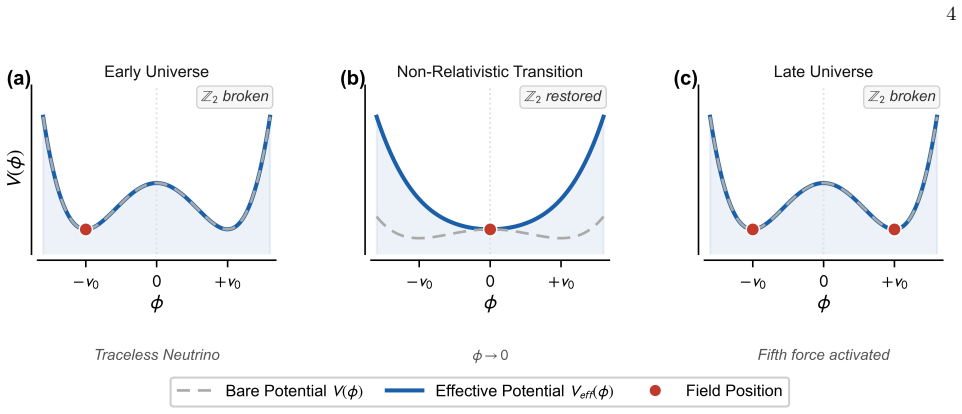
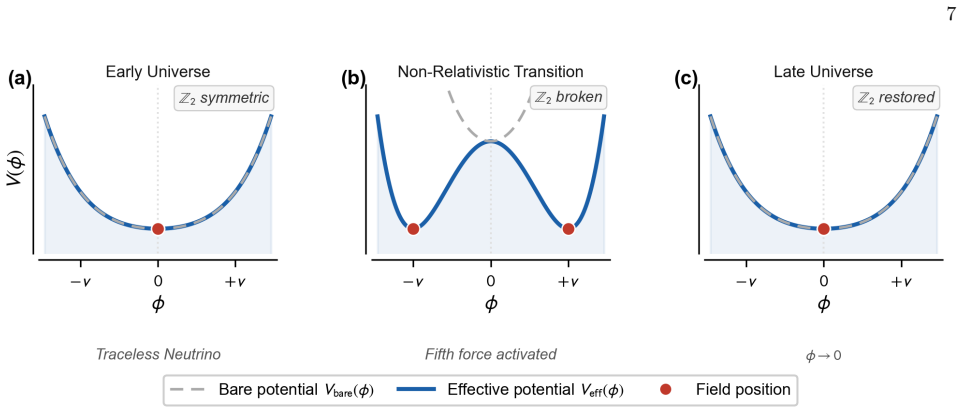
The inverse symmetron coupling, in which the symmetry is broken rather than restored as neutrinos become nonrelativistic, thereby taming fifth-force driven growth.
If this is right
- Late-time decoupling shuts down the fifth force acting on neutrinos.
- Excessive growth of neutrino perturbations is inhibited.
- Linear-regime instabilities are eliminated.
- Galaxy surveys register a lower effective neutrino mass.
- The matter power spectrum receives additional suppression.
- An early dark energy component localized near recombination may appear.
Where Pith is reading between the lines
- Future galaxy surveys with tighter power-spectrum measurements could directly test the extra suppression predicted at low redshift.
- CMB data sensitive to early dark energy near recombination could distinguish this scalar from other early-dark-energy proposals.
- Laboratory neutrino-mass experiments combined with cosmological bounds might reveal the mass variation history implied by the model.
Load-bearing premise
The inverse phase transition coupling tames instabilities without creating new instabilities or clashing with existing observational bounds.
What would settle it
A clear detection of linear-regime neutrino perturbation growth or an absence of the predicted extra suppression in the low-redshift matter power spectrum would rule out the model.
Figures
read the original abstract
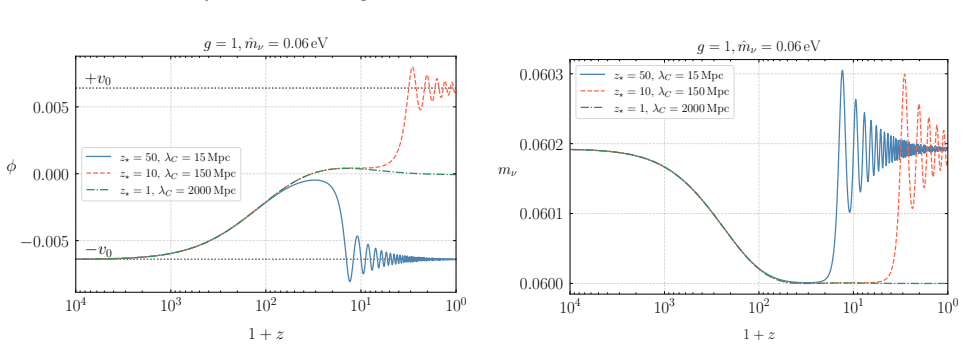
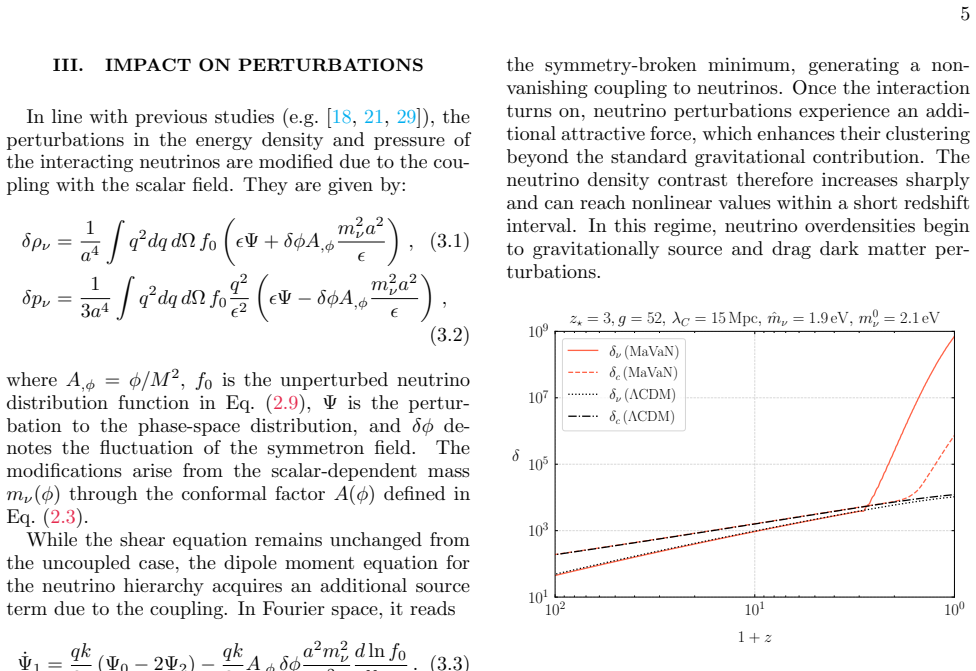
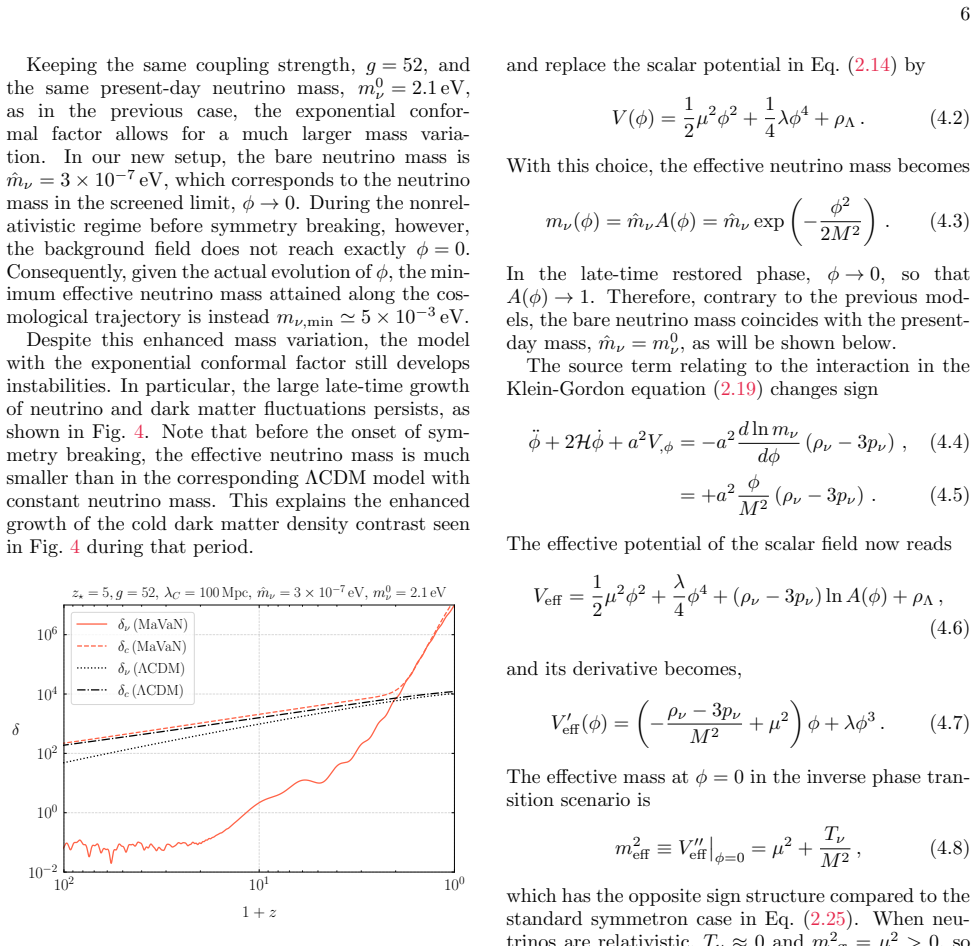
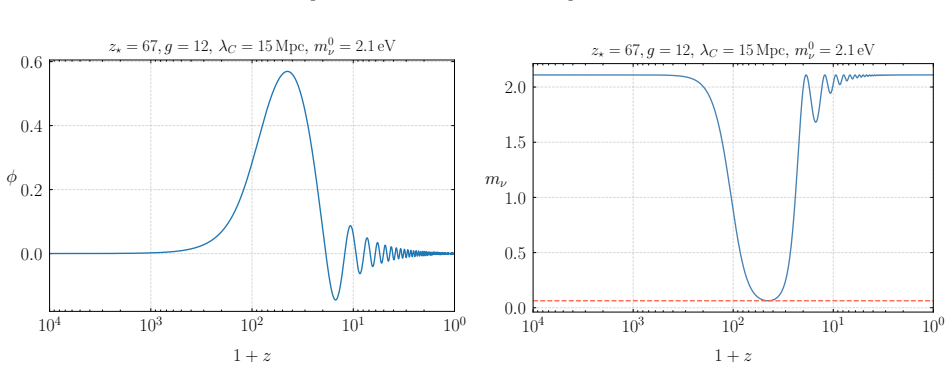
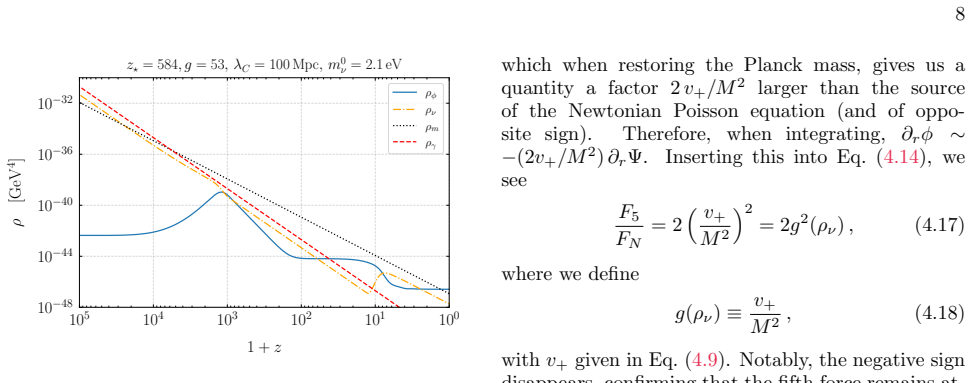
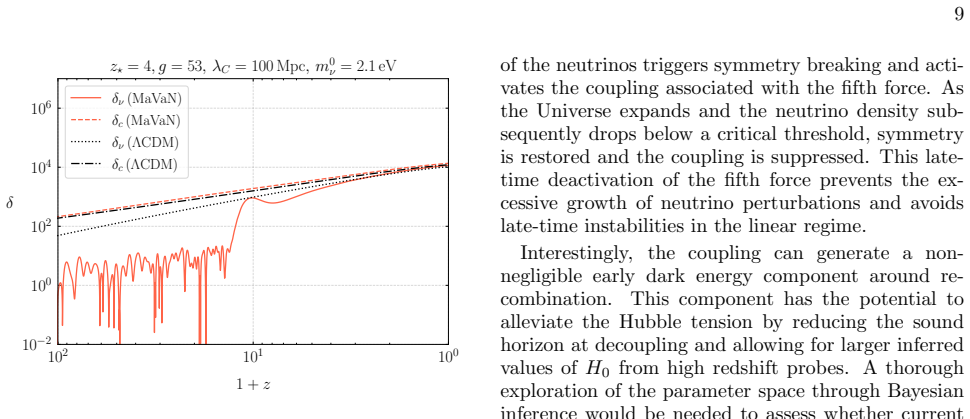
Neutrinos enter cosmology in different ways and are constrained by distinct observational probes across different epochs: as a relativistic species at high redshift, as a massive but clustering-suppressing component at low redshift, and as a particle physics observable in laboratory experiments. Low (verging on negative) bounds on neutrino mass from galaxy surveys motivate exploration of models where neutrinos may couple to dark energy, causing their mass to vary over cosmic evolution. If the coupling involves an inverse phase transition (symmetry broken, rather than restored, as neutrinos become nonrelativistic) this can tame instabilities in neutrino growth, appear as a lower neutrino mass in galaxy surveys, and add extra suppression to the matter power spectrum. We find that the late-time decoupling shuts down the fifth force and inhibits the excessive growth of neutrino perturbations, thereby eliminating linear-regime instabilities. The model may potentially address the Hubble tension via an early dark energy component localized around the time of recombination.
Editorial analysis
A structured set of objections, weighed in public.
Referee Report
Summary. The manuscript introduces an inverse symmetron scalar-field model for mass-varying neutrinos. An inverse phase transition (symmetry broken as neutrinos become non-relativistic) produces late-time decoupling that shuts down the fifth force, suppresses neutrino perturbation growth, and eliminates linear-regime instabilities. The model is also noted as potentially supplying an early dark-energy component localized near recombination that could address the Hubble tension.
Significance. If the central mechanism holds, the construction supplies a concrete realization of mass-varying neutrinos that avoids the usual linear instabilities while naturally producing a lower effective mass at late times and extra power-spectrum suppression. The absence of free parameters in the core derivation and the explicit realization of the inverse transition are strengths that distinguish the work from generic coupled-dark-energy models.
major comments (2)
- [Section 3 (scalar potential and coupling)] The central claim that the inverse transition produces decoupling without new instabilities rests on the form of the effective potential and the neutrino-scalar coupling; the manuscript must demonstrate explicitly (via the equations of motion or the effective mass function) that the fifth-force strength drops below the threshold for instability growth after the transition.
- [Section 5 (cosmological implications)] The statement that the model 'may potentially address the Hubble tension' is presented only as a side remark; if this is to be retained as a motivation, a quantitative estimate of the early-dark-energy contribution (e.g., the fractional energy density near recombination) must be provided and shown to be consistent with the same parameter choices that realize the late-time decoupling.
minor comments (2)
- Figure captions should explicitly state the parameter values (or lack thereof) used for each curve so that the suppression relative to ΛCDM is immediately quantifiable.
- [Abstract] The abstract states qualitative outcomes; adding one or two key equations (e.g., the effective neutrino mass after the transition) would improve accessibility without lengthening the abstract.
Simulated Author's Rebuttal
We thank the referee for their careful reading of the manuscript and for the constructive comments. We respond to each major comment below and indicate the planned revisions.
read point-by-point responses
-
Referee: [Section 3 (scalar potential and coupling)] The central claim that the inverse transition produces decoupling without new instabilities rests on the form of the effective potential and the neutrino-scalar coupling; the manuscript must demonstrate explicitly (via the equations of motion or the effective mass function) that the fifth-force strength drops below the threshold for instability growth after the transition.
Authors: We agree that an explicit demonstration of the post-transition suppression of the fifth force would strengthen the presentation. The effective potential and coupling are defined in Section 3, and the inverse transition is shown to drive the scalar toward a minimum where the neutrino mass decreases. In the revised manuscript we will add the linearized equations of motion for the scalar perturbations together with the expression for the effective mass squared, and we will demonstrate analytically and numerically that the fifth-force coupling strength falls below the instability threshold once the transition is complete. revision: yes
-
Referee: [Section 5 (cosmological implications)] The statement that the model 'may potentially address the Hubble tension' is presented only as a side remark; if this is to be retained as a motivation, a quantitative estimate of the early-dark-energy contribution (e.g., the fractional energy density near recombination) must be provided and shown to be consistent with the same parameter choices that realize the late-time decoupling.
Authors: The Hubble-tension remark is offered only as a possible implication. To retain it as a motivation we will add a short quantitative estimate of the scalar-field energy density fraction near recombination, evaluated with the same parameter values that produce the required late-time decoupling. This estimate will be inserted in Section 5 of the revised manuscript. revision: yes
Circularity Check
No significant circularity detected
full rationale
The provided abstract and description outline a scalar potential and inverse-symmetron coupling whose late-time decoupling directly produces the stated suppression of fifth force and neutrino perturbations. No equations or steps are shown that reduce a claimed prediction to a fitted parameter by construction, nor do any load-bearing premises rest on self-citations. The Hubble-tension remark is explicitly labeled as potential rather than derived. The derivation chain is therefore self-contained and does not match any of the enumerated circularity patterns.
Axiom & Free-Parameter Ledger
axioms (1)
- domain assumption Inverse phase transition occurs as neutrinos become nonrelativistic
invented entities (1)
-
Inverse symmetron scalar field
no independent evidence
Reference graph
Works this paper leans on
-
[1]
to incorporate the evolution of perturbations in the symmetron MaVaN model, by implementing Eqs. (3.1), (3.2) and (3.3). We have also modified the perturbed Klein-Gordon equation in the code to account for the coupling be- tween the symmetron field and neutrinos at the per- turbation level, ¨δϕ + 2H ˙δϕ + k2 + a2V,ϕϕ δϕ + 1 2 ˙h ˙ϕ = − a2 A,ϕ(δρν − 3δpν) ...
-
[2]
Y. Fukuda et al. (Super-Kamiokande), Phys. Rev. Lett. 81, 1562 (1998), arXiv:hep-ex/9807003
Pith/arXiv arXiv 1998
- [3]
-
[4]
J. Lesgourgues and S. Pastor, Phys. Rept. 429, 307 (2006), arXiv:astro-ph/0603494
Pith/arXiv arXiv 2006
-
[5]
M. Gerbino and M. Lattanzi, Frontiers in Physics 5, 10.3389/fphy.2017.00070 (2018)
-
[6]
R. L. Workman et al. (Particle Data Group), PTEP 2022, 083C01 (2022)
2022
-
[7]
A. G. Adame et al. (DESI), JCAP 02, 021, arXiv:2404.03002 [astro-ph.CO]
-
[8]
M. Abdul Karim et al. (DESI), Phys. Rev. D 112, 083515 (2025), arXiv:2503.14738 [astro-ph.CO]
Pith/arXiv arXiv 2025
- [9]
-
[10]
W. Elbers et al., Phys. Rev. D 112, 083513 (2025), arXiv:2503.14744 [astro-ph.CO]
Pith/arXiv arXiv 2025
-
[11]
S. Alam et al. (eBOSS), Phys. Rev. D 103, 083533 (2021), arXiv:2007.08991 [astro-ph.CO]
Pith/arXiv arXiv 2021
-
[12]
E. D. Valentino, A. Melchiorri, and J. Silk, Journal of Cosmology and Astroparticle Physics 2020 (01), 10 013–013
2020
-
[14]
Chevallier and D
M. Chevallier and D. Polarski, International Journal of Modern Physics D 10, 213 (2001)
2001
-
[15]
Linder, Physical review letters 90, 091301 (2003)
E. Linder, Physical review letters 90, 091301 (2003)
2003
-
[16]
P. Gu, X. Wang, and X. Zhang, Phys. Rev. D 68, 087301 (2003), arXiv:hep-ph/0307148
Pith/arXiv arXiv 2003
-
[17]
R. Fardon, A. E. Nelson, and N. Weiner, JCAP 10, 005, arXiv:astro-ph/0309800
-
[18]
R. D. Peccei, Phys. Rev. D 71, 023527 (2005), arXiv:hep-ph/0411137
Pith/arXiv arXiv 2005
-
[19]
A. W. Brookfield, C. van de Bruck, D. F. Mota, and D. Tocchini-Valentini, Phys. Rev. D 73, 083515 (2006), [Erratum: Phys.Rev.D 76, 049901 (2007)], arXiv:astro-ph/0512367
Pith/arXiv arXiv 2006
-
[20]
C. Wetterich, Phys. Lett. B 655, 201 (2007), arXiv:0706.4427 [hep-ph]
Pith/arXiv arXiv 2007
-
[21]
L. Amendola, M. Baldi, and C. Wetterich, Phys. Rev. D 78, 023015 (2008), arXiv:0706.3064 [astro-ph]
Pith/arXiv arXiv 2008
- [22]
-
[23]
D. F. Mota, V. Pettorino, G. Robbers, and C. Wet- terich, Phys. Lett. B663, 160 (2008), arXiv:0802.1515 [astro-ph]
Pith/arXiv arXiv 2008
-
[24]
C.-Q. Geng, C.-C. Lee, R. Myrzakulov, M. Sami, and E. N. Saridakis, JCAP 01, 049, arXiv:1504.08141 [astro-ph.CO]
-
[25]
V. da Fonseca, T. Barreiro, and N. J. Nunes, Phys. Rev. D 109, 063517 (2024), arXiv:2311.01803 [astro- ph.CO]
arXiv 2024
-
[26]
A. G. Riess et al. (Supernova Search Team), Astron. J. 116, 1009 (1998), arXiv:astro-ph/9805201
Pith/arXiv arXiv 1998
-
[27]
S. Perlmutter et al. (Supernova Cosmology Project), Astrophys. J. 517, 565 (1999), arXiv:astro- ph/9812133
arXiv 1999
-
[28]
Afshordi, M
N. Afshordi, M. Zaldarriaga, and K. Kohri, Phys. Rev. D 72, 065024 (2005)
2005
-
[29]
O. E. Bjaelde, A. W. Brookfield, C. van de Bruck, S. Hannestad, D. F. Mota, L. Schrempp, and D. Tocchini-Valentini, JCAP 01, 026, arXiv:0705.2018 [astro-ph]
Pith/arXiv arXiv 2018
-
[30]
U. Franca, M. Lattanzi, J. Lesgourgues, and S. Pas- tor, Phys. Rev. D 80, 083506 (2009), arXiv:0908.0534 [astro-ph.CO]
Pith/arXiv arXiv 2009
- [31]
-
[32]
K. Hinterbichler and J. Khoury, Phys. Rev. Lett.104, 231301 (2010), arXiv:1001.4525 [hep-th]
Pith/arXiv arXiv 2010
-
[33]
K. Hinterbichler, J. Khoury, A. Levy, and A. Matas, Phys. Rev. D 84, 103521 (2011), arXiv:1107.2112 [astro-ph.CO]
Pith/arXiv arXiv 2011
-
[34]
A.-C. Davis, B. Li, D. F. Mota, and H. A. Winther, Astrophys. J. 748, 61 (2012), arXiv:1108.3081 [astro- ph.CO]
Pith/arXiv arXiv 2012
-
[35]
M. F. Silva, H. A. Winther, D. F. Mota, and C. J. A. P. Martins, Phys. Rev. D 89, 024025 (2014), arXiv:1310.2152 [astro-ph.CO]
Pith/arXiv arXiv 2014
-
[36]
C. Burrage, E. J. Copeland, C. K¨ ading, and P. Millington, Phys. Rev. D 99, 043539 (2019), arXiv:1811.12301 [astro-ph.CO]
Pith/arXiv arXiv 2019
-
[37]
M. H¨ og˚ as and E. M¨ ortsell, Phys. Rev. D108, 024007 (2023), arXiv:2303.12827 [astro-ph.CO]
arXiv 2023
-
[38]
Ø. Christiansen, F. Hassani, M. Jalilvand, and D. F. Mota, JCAP 05, 009, arXiv:2302.07857 [astro- ph.CO]
-
[39]
V. Vardanyan and D. J. Bartlett, Universe 9, 340 (2023), arXiv:2305.18899 [astro-ph.CO]
arXiv 2023
-
[40]
D. Blas, J. Lesgourgues, and T. Tram, Journal of Cos- mology and Astroparticle Physics2011 (07), 034–034
-
[41]
Slosar, Phys
A. Slosar, Phys. Rev. D 73, 123501 (2006)
2006
-
[42]
A. Font-Ribera, P. McDonald, N. Mostek, B. A. Reid, H.-J. Seo, and A. Slosar, JCAP 05, 023, arXiv:1308.4164 [astro-ph.CO]
-
[43]
E. Di Valentino et al. (CORE), JCAP 04, 017, arXiv:1612.00021 [astro-ph.CO]
-
[44]
Lesgourgues, G
J. Lesgourgues, G. Mangano, G. Miele, and S. Pastor, Neutrino Cosmology (Cambridge University Press, 2013)
2013
-
[45]
Lesgourgues and T
J. Lesgourgues and T. Tram, Journal of Cosmology and Astroparticle Physics 2011 (09), 032
2011
-
[46]
C.-P. Ma and E. Bertschinger, Astrophys. J. 455, 7 (1995), arXiv:astro-ph/9506072
Pith/arXiv arXiv 1995
-
[47]
E. Di Valentino et al. (CosmoVerse Network), Phys. Dark Univ. 49, 101965 (2025), arXiv:2504.01669 [astro-ph.CO]
Pith/arXiv arXiv 2025
-
[48]
J. Sakstein and M. Trodden, Phys. Rev. Lett. 124, 161301 (2020), arXiv:1911.11760 [astro-ph.CO]
arXiv 2020
-
[49]
D. H. F. de Souza and R. Rosenfeld, Phys. Rev. D 108, 083512 (2023), arXiv:2302.04644 [astro-ph.CO]
arXiv 2023
-
[50]
M. Carrillo Gonz´ alez, Q. Liang, J. Sakstein, and M. Trodden, Neutrino-Assisted Early Dark Energy is a Natural Resolution of the Hubble Tension (2023), arXiv:2302.09091 [astro-ph.CO]
arXiv 2023
discussion (0)
Sign in with ORCID, Apple, or X to comment. Anyone can read and Pith papers without signing in.