Near-room-temperature magnetoelectric coupling engineered through inversion-breaking tilts in a bulk perovskite polytype
Pith reviewed 2026-06-27 21:22 UTC · model grok-4.3
The pith
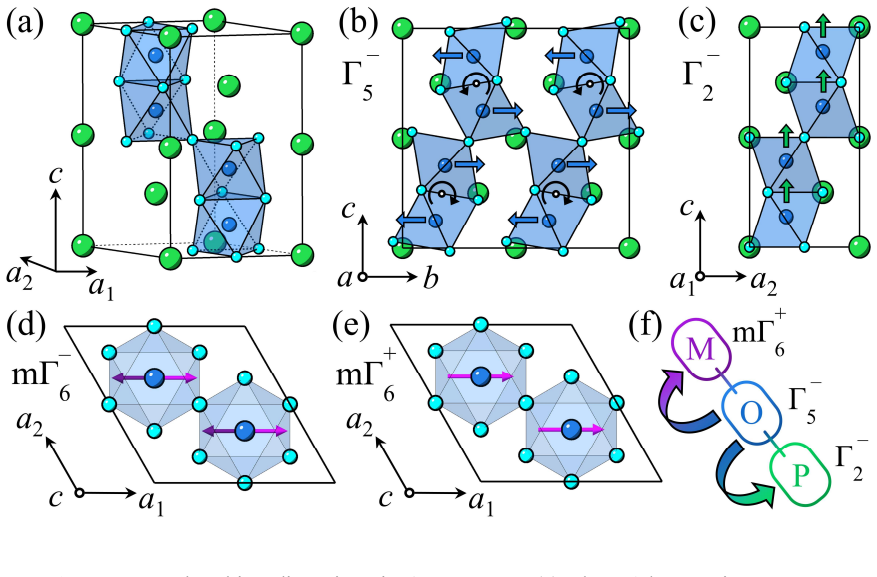
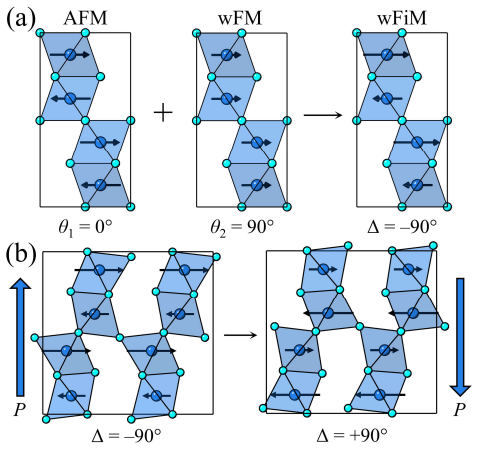
Co-operative tilts of Mn2O9 bioctahedral dimers in a hexagonal AMnO3 polytype generate both spontaneous polarization and a ferromagnetic moment.
A machine-rendered reading of the paper's core claim, the machinery that carries it, and where it could break.
Core claim
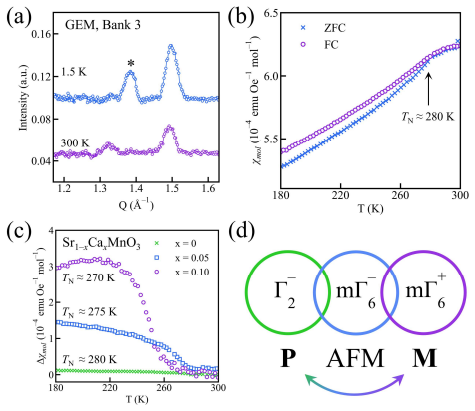
Symmetry analysis and first-principles calculations reveal that co-operative tilts of the Mn2O9 bioctahedral dimers generate both a spontaneous polarization and a ferromagnetic moment. High-resolution diffraction and magnetic susceptibility measurements show the structural and magnetic orders persist as high as 450 K and 280 K, respectively.
What carries the argument
The inversion-breaking rigid-unit mode of co-operative tilts of Mn2O9 bioctahedral dimers, which simultaneously breaks inversion symmetry to produce polarization and couples to the magnetic sublattice to produce a net ferromagnetic moment.
Load-bearing premise
The rigid-unit tilt mode alone is sufficient to produce both the polar and magnetic orders without additional mechanisms or competing phases.
What would settle it
A first-principles calculation in which the Mn2O9 tilt amplitude is constrained to zero while all other structural degrees of freedom are relaxed, showing that both the spontaneous polarization and the ferromagnetic moment disappear.
Figures
read the original abstract
Systematic strategies to design properties such as ferroelectricity or magnetoelectric coupling are well established in simple perovskite materials, but they remain scarce in more complex framework structures. Using a hexagonal polytype of the ternary manganite AMnO3 (A = Ba, Sr, Ca) as a model system, we introduce a symmetry-guided design principle in which an inversion-breaking rigid-unit mode (RUM) serves as a single structural instability generating both polar and ferromagnetic orders within a bulk material. Symmetry analysis and first-principles calculations reveal that co-operative tilts of the Mn2O9 bioctahedral dimers generate both a spontaneous polarization and a ferromagnetic moment. High-resolution diffraction and magnetic susceptibility measurements show the structural and magnetic orders persist as high as 450 K and 280 K, respectively, highlighting the untapped potential of framework structures which deviate from simple perovskite motifs to be designed to host useful ferroic properties. Our approach establishes a transferable symmetry-based framework to engineer ferroelectric and magnetoelectric states across chemically diverse framework architectures.
Editorial analysis
A structured set of objections, weighed in public.
Referee Report
Summary. The manuscript claims that in a hexagonal polytype of ternary manganites AMnO3 (A = Ba, Sr, Ca), cooperative tilts of Mn2O9 bioctahedral dimers constitute an inversion-breaking rigid-unit mode (RUM) that simultaneously generates spontaneous polarization (via improper ferroelectricity) and a net ferromagnetic moment. This is supported by symmetry analysis, first-principles calculations, high-resolution diffraction confirming structural order to 450 K, and magnetic susceptibility measurements showing magnetic order to 280 K, establishing a transferable symmetry-based design principle for magnetoelectric coupling in complex framework structures.
Significance. If the central claim is substantiated, the work provides a concrete symmetry-guided route to engineer both polar and magnetic orders from a single structural instability in non-simple-perovskite frameworks, which could enable near-room-temperature magnetoelectric materials in chemically diverse bulk systems where conventional perovskite design rules do not apply.
major comments (1)
- [Symmetry analysis and first-principles calculations] The central claim requires that the RUM tilt is both necessary and sufficient for the ferromagnetic moment (via symmetry-allowed DM canting or modified superexchange). The symmetry analysis establishes inversion breaking and permits a polar mode, but the manuscript does not report explicit calculations on the untilted reference structure to demonstrate that no independent antiferromagnetic or canted state exists without the tilt amplitude; if such a state is present or if magnetic energy scales are set by Mn-O-Mn angles independent of RUM amplitude, the single-instability premise fails.
Simulated Author's Rebuttal
We thank the referee for their careful reading and constructive feedback on our manuscript. We address the single major comment below and agree that additional calculations will strengthen the central claim.
read point-by-point responses
-
Referee: The central claim requires that the RUM tilt is both necessary and sufficient for the ferromagnetic moment (via symmetry-allowed DM canting or modified superexchange). The symmetry analysis establishes inversion breaking and permits a polar mode, but the manuscript does not report explicit calculations on the untilted reference structure to demonstrate that no independent antiferromagnetic or canted state exists without the tilt amplitude; if such a state is present or if magnetic energy scales are set by Mn-O-Mn angles independent of RUM amplitude, the single-instability premise fails.
Authors: We agree that the manuscript does not report explicit calculations on the untilted reference structure, and that such a comparison would more rigorously establish necessity of the RUM for the ferromagnetic moment. Our symmetry analysis shows that the cooperative bioctahedral tilts break inversion symmetry and thereby allow a symmetry-permitted Dzyaloshinskii-Moriya canting that produces net magnetization; without the tilt the parent structure retains inversion, forbidding this canting in the collinear antiferromagnetic state. The first-principles results were obtained on the fully relaxed tilted structure. To directly address the concern, the revised manuscript will include new calculations on a constrained untilted reference structure (with tilt amplitude fixed to zero while preserving the antiferromagnetic order) to confirm the absence of a canted moment and to show that the relevant magnetic energy scales track the RUM amplitude. This addition will be presented as a new figure or supplementary section. revision: yes
Circularity Check
No circularity: symmetry analysis and DFT are independent of fitted inputs or self-citations
full rationale
The derivation relies on symmetry analysis showing that the inversion-breaking RUM permits both polar and ferromagnetic orders, followed by first-principles calculations confirming the coupling. No equations or sections reduce a claimed prediction to a fitted parameter by construction, nor does any load-bearing premise rest on a self-citation chain. The abstract and described approach treat the tilt mode as an input instability whose consequences are computed externally, with experimental confirmation providing an independent check. This is the standard non-circular case for symmetry-plus-DFT papers.
Axiom & Free-Parameter Ledger
Reference graph
Works this paper leans on
-
[1]
https://doi.org/10.1038/ncomms5927. (64) Clarke, G.; Daisenberger, D.; Luo, X.; Cheong, S. W.; Bristowe, N. C.; Senn, M. S. Pressure- Dependent Phase Transitions in Hybrid Improper Ferroelectric Ruddlesden-Popper Oxides. Phys. Rev. B 2024, 109 (9), 094107. https://doi.org/10.1103/PhysRevB.109.094107. (65) Lawes, G.; Harris, A. B.; Kimura, T.; Rogado, N.; ...
-
[2]
Daoud-Aladine, A. et al. Structural phase transition and magnetism in hexagonal SrMnO3 by magnetization measurements and by electron, x-ray, and neutron diffraction studies. Phys. Rev. B 75, 104417 (2007)
2007
-
[3]
Simpson, S. et al. Goldstone-Mediated Polar Instability in Hexagonal Barium Titanate. Phys. Rev. Lett. 136, 116101 (2026)
2026
-
[4]
& Senn, M
Simpson, S. & Senn, M. S. Octahedral Tilting in Perovskite Polytypes. Chem. Mater. 37, 4524–4533 (2025)
2025
-
[5]
Kimura, T. et al. Magnetic control of ferroelectric polarization. Nature 426, 55–58 (2003)
2003
-
[6]
& Hanfland, M
Søndenå, R., Ravindran, P., Stølen, S., Grande, T. & Hanfland, M. Electronic structure and magnetic properties of cubic and hexagonal SrMnO3. Phys. Rev. B 74, 144102 (2006)
2006
-
[7]
J., Stokes, H
Campbell, B. J., Stokes, H. T., Averett, T. B., Machlus, S. & Yost, C. J. The ISOTILT software for discovering cooperative rigid-unit rotations in networks of interconnected rigid units. J. Appl. Cryst. 54, 1847–1856 (2021)
2021
-
[8]
H., Lawson, A
Kwei, G. H., Lawson, A. C., Billinge, S. J. L. & Cheong, S. W. Structures of the ferroelectric phases of barium titanate. J. Phys. Chem. 97, 2368–2377 (1993)
1993
-
[9]
T., Hatch, D
Stokes, H. T., Hatch, D. M. & Campbell, B. J. ISODISTORT, ISOTROPY Software Suite. iso.byu.edu
-
[10]
J., Stokes, H
Campbell, B. J., Stokes, H. T., Tanner, D. E. & Hatch, D. M. ISODISPLACE: A web-based tool for exploring structural distortions. J. Appl. Cryst. 39, 607–614 (2006)
2006
-
[11]
Qin, S. et al. High-Pressure Synthesis and Magnetism of the 4H-BaMnO3 Single Crystal and Its 6H-Type Polymorph. Inorg. Chem. 60, 16308–16315 (2021)
2021
-
[12]
Adkin, J. J. & Hayward, M. A. Structure and magnetism of 4H-BaMnO3−x (0⩽x⩽0.35) and 4H- Ba0.5Sr0.5MnO3–x (0⩽x⩽0.21). J. Solid State Chem. 179, 70–76 (2006)
2006
-
[13]
& Menyuk, N
Dwight, K. & Menyuk, N. Magnetic Properties of Mn3O4 and the Canted Spin Problem. Phys. Rev. 119, 1470–1479 (1960). 62
1960
-
[14]
Aich, P. et al. Fluorinated hexagonal 4H SrMnO3: a locally disordered manganite. J. Mater . Chem. C 7, 3560–3568 (2019)
2019
-
[15]
L., Sleight, A
Chamberland, B. L., Sleight, A. W. & Weiher, J. F. Preparation and Characterization of BaMnO3 and SrMnO3 Polytypes. J. Solid State Chem. 1, 506–511 (1970)
1970
-
[16]
D., Gibb, T
Battle, P. D., Gibb, T. C. & Jones, C. W. The structural and magnetic properties of SrMnO3: A reinvestigation. J. Solid State Chem. 74, 60–66 (1988)
1988
-
[17]
& Roth, R
Negas, T. & Roth, R. S. The system SrMnO3−x. J. Solid State Chem. 1, 409–418 (1970)
1970
-
[18]
T., Spaldin, N
Artyukhin, S., Delaney, K. T., Spaldin, N. A. & Mostovoy, M. Landau theory of topological defects in multiferroic hexagonal manganites. Nat. Mater. 13, 42–49 (2014)
2014
discussion (0)
Sign in with ORCID, Apple, or X to comment. Anyone can read and Pith papers without signing in.