REVIEW 1 major objections 1 cited by
Bubbles vs. Baselines: Token Valuation and Institutional Capital in PoS Networks under EIP-1559
T0 review · 1 major / 0 minor · reviewed 2026-06-27 · grok-4.3
Pith's one-line read In the utility-consumption model for PoS networks, token price reaches a steady state that scales with adoption and eliminates institutional yield premiums.
desk verdict Model claims explicit steady-state ETH price that anchors to adoption and dissolves yield premium once retail consumers trade for utility, but the result rests on imposed behavioral rules. read the letter →
The pith
A machine-rendered reading of the paper's core claim, the machinery that carries it, and where it could break.
The reading
What carries the argument
The Utility-Consumption Model, in which retail consumers buy and sell tokens to match crypto wealth to real-world fiat consumption needs, generating the steady-state price equilibrium.
What would settle it
Empirical observation that ETH price in steady state does not scale proportionally with network adoption metrics or continues to exhibit an institutional yield premium.
Extended reading notes
Core claim
Within the Utility-Consumption Model, consumers dynamically purchase and sell tokens to keep their crypto wealth aligned with fiat consumption requirements. This produces a closed-form steady-state equilibrium price for ETH that increases directly with measures of network adoption. The price formation removes the yield premium available to institutions in an accumulation setting. Portfolio rebalancing by institutions transmits TradFi shocks into token-price volatility, yet inflation stays constant and consumer counter-cyclical sales prevent any single institution from dominating network security.
Load-bearing premise
Consumers will dynamically buy and sell tokens to keep their crypto holdings in balance with their real-world fiat consumption needs.
Editorial extensions
If this is right
- Token valuation scales directly with network adoption.
- Institutional yield premium is eliminated in steady state.
- Token price volatility from external shocks does not destabilize network inflation.
- Consumer behavior protects network security against institutional concentration.
- Institutional excess returns derive from extraction of retail transactional demand.
Reading between the lines
- The framework could be applied to other fee-burn mechanisms to test whether utility balancing stabilizes prices across different consensus protocols.
- Empirical studies might examine whether adoption metrics predict token prices better in networks with high retail utility use.
- Extensions could model varying levels of institutional leverage to quantify the size of the extracted premium.
- Policy interventions that encourage consumer-like holding patterns might reduce bubble formation in emerging token economies.
Signed reviews
Editorial analysis
A structured set of objections, weighed in public.
Referee Report
Summary. The paper presents an open-economy macroeconomic equilibrium model for Proof-of-Stake networks with EIP-1559 fee-burn mechanics. It contrasts two behavioral regimes: the Unbounded Accumulation Model, in which retail consumers purely accumulate tokens and generate an expanding speculative bubble with compounding excess returns for Kelly-optimizing institutions, and the Utility-Consumption Model, in which consumers dynamically buy and sell tokens to balance crypto wealth against fiat consumption. Within the latter regime the authors derive an explicit steady-state equilibrium price for ETH that anchors to a fundamental baseline scaling directly with network adoption and completely dissolves the institutional yield premium. Numerical simulations are reported to show that TradFi shocks propagate into high token-price volatility while network inflation remains stable, and a proof is claimed that counter-cyclical consumer behavior insulates network security from institutional monopoly. The central conclusion is that institutional excess returns arise from leveraged extraction of retail transactional demand rather than from the staking protocol itself.
Significance. If the steady-state derivation is internally consistent and non-circular, the work supplies a formal framework that distinguishes bubble dynamics from adoption-anchored baselines in PoS token valuation. The explicit equilibrium, the insulation result for security, and the attribution of excess returns to consumer utility rather than protocol mechanics would constitute a substantive contribution to mathematical finance applied to cryptocurrencies, with potential implications for fee-market design and institutional participation.
major comments (1)
- [Utility-Consumption Model and steady-state derivation] Utility-Consumption Model and steady-state derivation: the claimed explicit equilibrium price that anchors to adoption and completely dissolves the institutional yield premium rests on the premise that consumers dynamically buy and sell tokens to balance crypto wealth against real-world fiat consumption. This behavioral assumption appears to define the anchoring outcome by construction, raising a circularity risk that the result reduces to the regime specification rather than emerging from equilibrium conditions independent of those assumptions. The abstract provides no equations, utility specification, or proof steps with which to verify whether the price is parameter-free or merely restates the consumer's balancing rule.
Simulated Author's Rebuttal
We thank the referee for their careful reading and constructive comments. We address the concern regarding potential circularity in the Utility-Consumption Model below. The derivation is not tautological but follows from explicit optimization and market-clearing conditions.
read point-by-point responses
-
Referee: Utility-Consumption Model and steady-state derivation: the claimed explicit equilibrium price that anchors to adoption and completely dissolves the institutional yield premium rests on the premise that consumers dynamically buy and sell tokens to balance crypto wealth against real-world fiat consumption. This behavioral assumption appears to define the anchoring outcome by construction, raising a circularity risk that the result reduces to the regime specification rather than emerging from equilibrium conditions independent of those assumptions. The abstract provides no equations, utility specification, or proof steps with which to verify whether the price is parameter-free or merely restates the consumer's balancing rule.
Authors: The Utility-Consumption Model specifies an explicit utility function for the retail consumer that trades off marginal utility from token holdings (for transactional services, scaled by an adoption parameter representing network usage) against fiat consumption. Token demand is obtained by solving the consumer's constrained optimization problem, producing a closed-form demand schedule that is a function of price, adoption, and other parameters. The steady-state equilibrium price is the unique solution to the market-clearing equation in which this demand equals net supply (institutional Kelly portfolio holdings plus staking issuance minus EIP-1559 burns). This price is not imposed by the regime; it is the fixed point of the resulting system and depends non-trivially on the adoption parameter. The institutional yield premium vanishes at this price because expected returns are equalized once consumer balancing is incorporated. The full manuscript contains the utility specification, first-order conditions, demand derivation, market-clearing condition, and the explicit steady-state solution. We acknowledge the abstract is equation-free and are prepared to revise it to include a concise statement of the equilibrium derivation if the editor requests. revision: partial
Circularity Check
No significant circularity detected
full rationale
The abstract describes deriving an explicit steady-state equilibrium price for ETH within the Utility-Consumption Model, where valuation anchors to network adoption and dissolves the yield premium. No full manuscript equations, derivation steps, or self-citations are supplied in the query to allow inspection of any reduction to inputs by construction. The model premises (consumer balancing crypto wealth against fiat consumption) are stated as behavioral regime assumptions, but the claimed derivation is presented as an explicit result rather than a tautological fit or renamed input. No load-bearing self-citation chains, ansatzes smuggled via citation, or fitted parameters called predictions are evident. This is the default honest finding when the derivation chain cannot be walked with quoted paper text.
Assumptions & free parameters
free parameters (1)
- behavioral regime parameters
assumptions (1)
- domain assumption Institutional investors optimize via Kelly criterion and consumers balance crypto against fiat utility
Cite this review
Pith. "Pith review of Bubbles vs. Baselines: Token Valuation and Institutional Capital in PoS Networks under EIP-1559." pith.science (2026). https://pith.science/paper/772CXV6W
@misc{pith2026260607445,
  author       = {Pith},
  title        = {Pith review of: Bubbles vs. Baselines: Token Valuation and Institutional Capital in PoS Networks under EIP-1559},
  year         = {2026},
  howpublished = {\url{https://pith.science/paper/772CXV6W}},
  note         = {Machine review of arXiv:2606.07445}
}
read the original abstract
This paper presents an open-economy macroeconomic equilibrium model for Proof-of-Stake (PoS) networks with fee-burn mechanics (EIP-1559) that formalizes the strategic interplay between a Kelly-optimizing rational institutional investor and a utility-driven retail consumer. We analyze network dynamics across two behavioral regimes. In The Unbounded Accumulation Model, the consumer purely accumulates tokens, creating an exclusive buy-side pressure that interacts with institutional portfolio rebalancing to fuel an ever-expanding speculative bubble and generate compounding excess returns for investors. Conversely, in The Utility-Consumption Model, the consumer dynamically buys and sells tokens to balance crypto wealth against real-world fiat consumption. Within this framework, we derive an explicit steady-state equilibrium price for ETH, demonstrating how token valuation anchors to a stable fundamental baseline that scales directly with network adoption while completely dissolving the institutional yield premium. Our numerical simulations show that while exogenous traditional finance (TradFi) shocks propagate through portfolio rebalancing to drive high token price volatility, network inflation remains highly stable. Furthermore, we prove that network security is insulated from institutional monopoly by counter-cyclical consumer behavior. Our findings reveal that institutional excess wealth creation in PoS ecosystems is not native to the staking protocol itself, but is strictly driven by the leveraged extraction of the retail consumer's continuous demand for transactional utility.
Figures

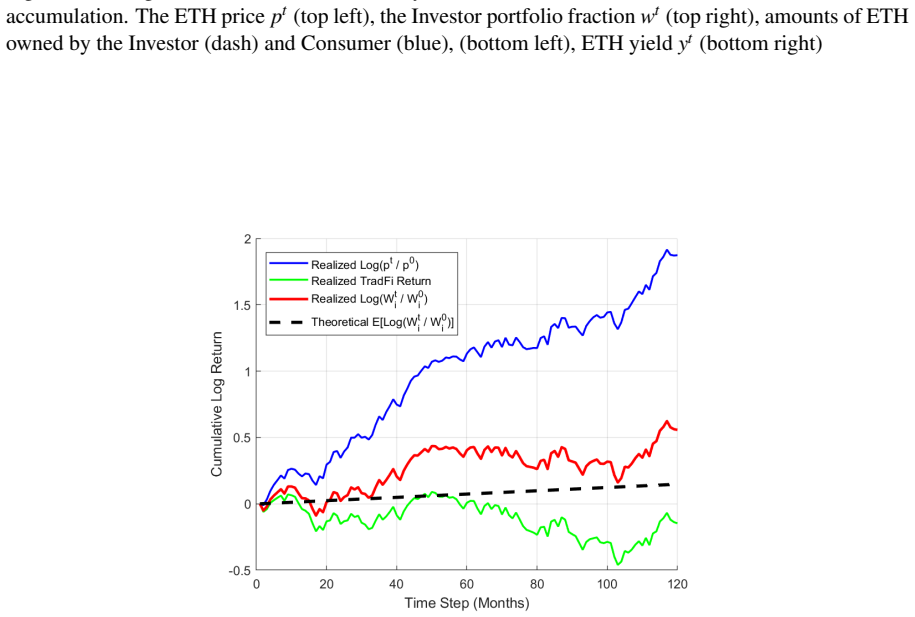

Figures from the paper (4 more)


Forward citations
Cited by 1 Pith paper
-
Proof-of-Stake Dynamics: The Elusive Price Anchor and Endogenous Volatility Harvesting
In a calibrated proof-of-stake model, equilibrium price is only a very-long-run anchor (≈46-year half-life), passive staking raises price and centralizes ownership, and symmetric speculative cycles transfer tokens fro...
Reference graph
Works this paper leans on
-
[1]
Jermann, Urban , title =
-
[2]
Journal of Monetary Economics , volume =
Jermann, Urban and Xiang, Haotian , title =. Journal of Monetary Economics , volume =. 2025 , doi =
2025
-
[3]
The Review of Financial Studies , volume =
Saleh, Fahad , title =. The Review of Financial Studies , volume =
-
[4]
Evolution of Shares in a Proof-of-Stake Cryptocurrency , journal =
Ro. Evolution of Shares in a Proof-of-Stake Cryptocurrency , journal =. 2021 , doi =
2021
-
[5]
Fanti, Giulia and Kogan, Leonid and Viswanath, Pramod , title =
-
[6]
The Review of Financial Studies , volume =
Cong, Lin William and Li, Ye and Wang, Neng , title =. The Review of Financial Studies , volume =. 2021 , doi =
2021
-
[7]
and Saleh, Fahad , title =
John, Kose and Rivera, Thomas J. and Saleh, Fahad , title =. 2021 , url =
2021
-
[8]
The Merge - A Deep Dive With Nansen , year =
Show all 13 references
-
[9]
GOOSE-2025 & EGGs-2025 Final Report , year =
2025
-
[10]
Proceedings of the 22nd ACM Conference on Economics and Computation , year =
Roughgarden, Tim , title =. Proceedings of the 22nd ACM Conference on Economics and Computation , year =
-
[11]
Proceedings of the 5th Distributed Ledger Technology Workshop (DLT 2023) , series =
Studying the Compounding Effect: The Role of Proof-of-Stake Parameters on Wealth Distribution , author =. Proceedings of the 5th Distributed Ledger Technology Workshop (DLT 2023) , series =. 2023 , url =
2023
-
[12]
The Financialization of Proof-of-Stake: Asymptotic Centralization under Exogenous Risk Premiums , journal=
Mikhail Perepelitsa , year=. The Financialization of Proof-of-Stake: Asymptotic Centralization under Exogenous Risk Premiums , journal=. 2604.26076 , archivePrefix=
-
[13]
arXiv preprint arXiv:2001.00919 , year =
Chitra, Tarun , title =. arXiv preprint arXiv:2001.00919 , year =. 2001.00919 , archivePrefix =
2001
Reviewed June 27, 2026 · model on record in the stance chip above.
Discussion (0). Continue with ORCID to comment.